Discover why time management is important for productivity and wellbeing. Learn actionable strategies and how Fluidwave helps you reclaim your focus.
September 28, 2026 (5d ago)
Why Time Management Is Important for Success
Discover why time management is important for productivity and wellbeing. Learn actionable strategies and how Fluidwave helps you reclaim your focus.
← Back to blog
Most time-management advice starts with the wrong question: How can you fit more into the day? That framing turns a full calendar into a personal failure and pushes already tired professionals toward tighter schedules, longer workdays, and another productivity system they won't maintain.
A better question is: What deserves your limited attention, and what friction can you remove? Time management matters because it protects judgment, energy, focus, and the parts of life that work is supposed to support. It isn't a contest to see how many tasks you can complete before exhaustion wins.
Redefining Time Management Beyond Productivity
Time management isn't the art of squeezing every available minute until nothing remains. It's the practice of deciding where your attention goes, creating enough structure to act on those decisions, and leaving room for recovery. The outcome isn't a busier day. It's a day with fewer avoidable decisions and a clearer connection between effort and meaningful results.
That distinction matters for people who look productive on paper but feel permanently behind. A professional can answer messages all day, attend every meeting, and keep a task list moving while neglecting strategic work, health, relationships, or rest. A system that increases activity without protecting capacity only makes burnout more efficient.
A 2025 Frontiers review found that planning, goal-setting, prioritization, and task organization were the most beneficial strategies for improving productivity, wellbeing, and overall performance (the review's findings). That combination is revealing. It doesn't isolate output from wellbeing. The same behaviors that help people make progress also help them experience greater control over their workload.
The real objective is lower cognitive load
Every unresolved commitment occupies mental space. You remember the email you haven't answered, the report that needs checking, the appointment you still need to schedule, and the task someone mentioned casually in a meeting. Even when you're not working on those items, your brain keeps monitoring them.
Good planning moves those commitments out of working memory and into a trusted system. Prioritization then prevents every request from presenting itself as equally urgent. Goal-setting supplies a reason to reject work that doesn't support the outcomes you're responsible for.
Practical rule: A useful schedule should tell you what to ignore, not just what to do.
This is why time management is important for success in a broader sense. It helps you preserve the mental energy required for complex decisions, creative work, and patient collaboration. It also gives you a defensible basis for saying no, renegotiating a deadline, or asking for help before a manageable workload becomes a crisis.
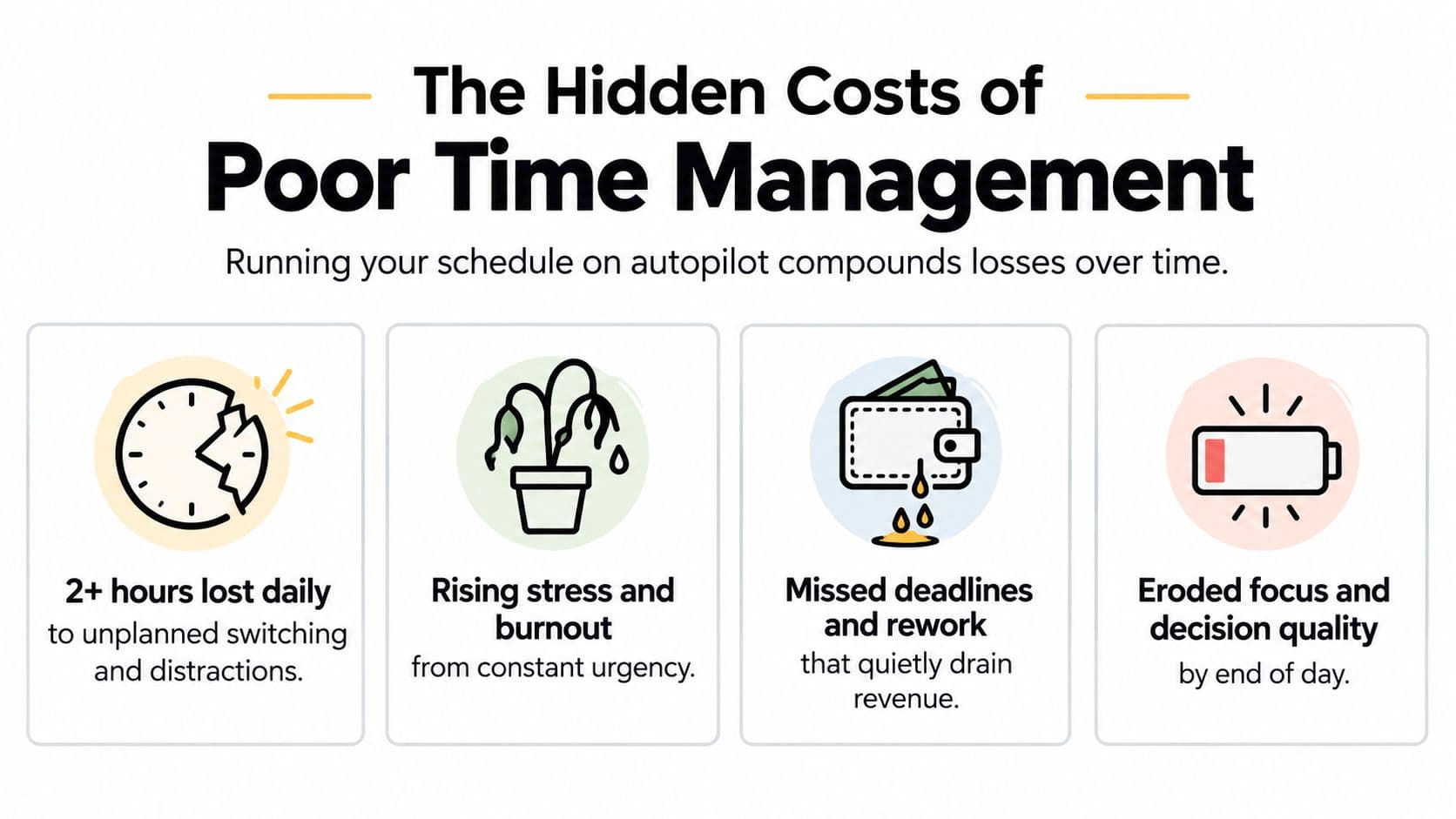
The Hidden Costs of Poor Time Management
Poor time management rarely looks dramatic at first. It looks like checking email before starting the important task, accepting a meeting without asking what decision it requires, or reopening the same document several times because the next action isn't clear. Each choice feels small. Together, they create a workday dominated by switching, recovery, and administrative cleanup.
One published summary reports that 51% of workdays are attributed to low-value tasks, while spending 12 minutes planning a day can eliminate up to 2 hours of wasted time (Hubstaff's time-management statistics summary). Those figures shouldn't be treated as a promise that every person will recover the same amount of time. They do show why a short planning ritual can have an outsized practical value when it prevents reactive work from taking over.
Where the losses usually appear
The visible cost is missed work. Deadlines slip, colleagues wait for inputs, and rushed delivery produces rework. The less visible cost is relational. When people repeatedly need to remind you, they stop trusting your commitments and begin adding buffers, duplicate checks, or unnecessary status meetings.
There's also a personal cost. Poorly controlled work expands into evenings, interrupts time with family, and makes rest feel undeserved. Over time, professionals may abandon important goals because their calendars leave no protected space for learning, health, or deliberate career decisions.
Audit your own week by looking for these signals:
- Unplanned switching: Count how often you leave an important task for a message, notification, or minor request.
- Unclear ownership: Mark work that stays with you because nobody has a defined responsibility or handoff.
- Repeated rework: Identify tasks returned for missing context, avoidable errors, or late reviews.
- Open loops: List commitments that exist only in your memory, inbox, or scattered notes.
Money management offers a useful parallel. Just as timing bills and income can help with overdraft prevention, planning work reduces the chance that small timing errors create a larger emergency. The point isn't perfect control. It's making constraints visible early enough to respond intelligently.
Willpower can't solve a structural problem. If every request enters through the same channel and every task competes for immediate attention, discipline is forced to fight the system all day. Better time management changes the system first.
How Time Control Reduces Psychological Stress
Stress doesn't come only from having many responsibilities. It also comes from uncertainty about whether you can meet them, what should happen first, and when the pressure will end. A clear plan can't remove every demand, but it can reduce the ambiguity surrounding those demands.
A Japanese study on time management and psychological stress response found that stronger time-control perception was associated with a lower stress response (the study on time control and psychological stress). The useful insight isn't that a calendar magically makes work harmless. It's that feeling some agency over time may change how the body and mind respond to workload.
Agency matters more than a perfect schedule
A rigid schedule often fails because real work contains interruptions, dependencies, and changing priorities. A practical system gives you a stable default and a clear way to revise it. You know the next meaningful action, the work that can wait, and the boundary that protects recovery.
That might mean reserving a morning block for analysis, grouping routine communication into a defined window, or ending the workday with a short review. These choices reduce the number of moments in which you must ask, “What should I do now?” They also make it easier to notice when the workload exceeds available capacity.
A 2024/2025 survey summary reported that 94% of respondents said better time management increases productivity, 91% said it reduces stress at work, and 90% said it improves focus on tasks (TimeWatch's survey summary). Survey responses don't establish a universal causal effect, but they do reflect how closely workers connect time control with both performance and wellbeing.
Boundaries are operational controls
A boundary isn't a motivational statement. It's a rule that changes access to your attention. Examples include declining meetings without a decision purpose, setting response expectations for non-urgent messages, and protecting a defined shutdown point.
Professionals recovering from overload often need fewer promises and stronger defaults. A weekly review can expose commitments that should be delegated or renegotiated. A daily plan can identify the one outcome that must move forward, rather than presenting a long list that creates guilt before work begins.
For a broader set of practical safeguards, burnout prevention strategies can help connect workload design with sustainable working habits. The central principle is simple: control is not the same as certainty. You can't predict every interruption, but you can create a reliable response to it.
Time Management for Neurodivergent Brains
Traditional time-management advice often assumes that people know how long tasks will take, can begin on command, and will remember the plan once they write it down. Those assumptions fail many adults with ADHD and other executive-function challenges. The problem may not be laziness or a lack of ambition. It may be difficulty sensing duration, initiating an unclear task, sustaining attention, or holding several steps in working memory.
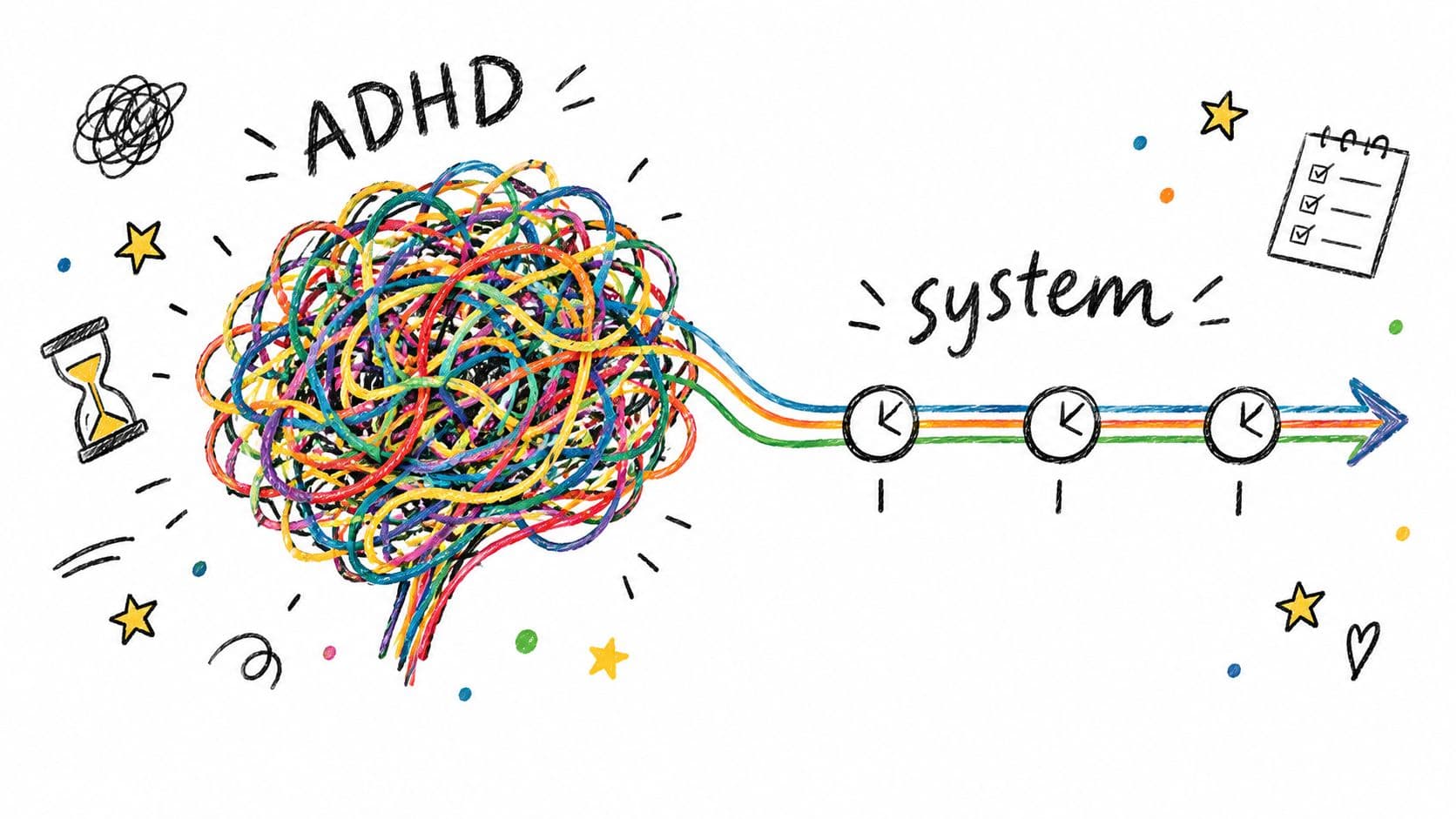
Recent research on adults with ADHD describes persistent difficulties with organization, planning, sustaining attention, and time management, including misjudging duration and struggling with follow-through (research on task management and ADHD). That explains why adding another calendar reminder often disappoints. A reminder can announce a task without making the task easier to start.
Externalize the work
The most useful adjustment is to move executive work outside the brain. Replace “prepare presentation” with a visible sequence such as gather source material, choose the argument, draft the opening, create the slide outline, and request review. Each step should be small enough to identify a clear starting action.
Visual systems can help because they make time and progress concrete. A Kanban board can show what is waiting, active, blocked, or complete. A calendar can show whether the plan fits. A task list can hold the details that would otherwise compete for working memory.
Rigid schedules can also backfire. If one delayed task causes the entire day to collapse, the system creates shame instead of resilience. Use flexible anchors instead. Define the next action, add a realistic time window, and create a recovery path when the day goes off course.
For people designing work around attention differences, neurodivergent productivity practices offer useful principles for reducing friction without demanding a different personality. The goal isn't to imitate someone else's routine. It's to build enough external structure that your ability becomes easier to access.
Reclaiming Focus with Intelligent Delegation
Personal organization only goes so far. If you keep every low-priority task, approval, lookup, and follow-up, a cleaner task list won't create more capacity. Effective time management asks a harder question: Which work requires your judgment, and which work merely requires completion?
Begin with an inventory. Capture recurring administrative tasks, then classify each by consequence and skill requirement. Some work should stay with you because it involves confidential judgment or a core decision. Some work should be automated. Other work can go to a capable assistant with a clear brief.

A delegation workflow that survives busy weeks
- Define the outcome. State what finished looks like, not just the activity. “Compile qualified vendor options in a comparison sheet” is clearer than “research vendors.”
- Add constraints. Include the deadline, budget, preferred format, relevant files, and decisions the assistant shouldn't make.
- Break down ambiguity. Turn a large assignment into reviewable stages so you can correct direction early.
- Choose the right owner. Delegate based on capability and risk, not just on how annoying the task is.
- Review the handoff. A short quality check is cheaper than quietly redoing unclear work.
Fluidwave combines AI task organization with human virtual-assistant delegation. It can create, organize, and auto-prioritize tasks across table, list, calendar, Kanban, and card views, while delegated work is assigned to assistants on a pay-per-task basis. That makes it one option for externalizing planning and moving routine work away from the person responsible for the highest-value decisions.
The same principle applies whether you use Fluidwave, a project-management platform, or a shared spreadsheet. A delegation system needs clear ownership, visible status, and an easy way to surface blockers. For leadership context, these Kushan Business Solutions leadership insights provide a useful perspective on delegation as an operating discipline rather than an abdication of responsibility.
Use a distraction-free workflow for deep work, then batch approvals and reviews. If you protect focus but keep checking the delegation queue every few minutes, you haven't removed the interruption. Set review points that match the risk of the work.
For a practical guide to assigning work without creating confusion, see how to delegate effectively. Delegation works when the handoff is designed as carefully as the task itself.
Building Your Sustainable Time Strategy
A sustainable time strategy begins with an honest audit, not a new app. Review the last several working days and identify where attention went, which commitments moved forward, and which tasks created repeated friction. Don't judge the record. Use it to find patterns.
Then build a small operating rhythm:
- Plan the day around outcomes: Choose the work that would make the day worthwhile even if interruptions occur.
- Protect cognitive peaks: Put demanding work where your attention is strongest, and reserve routine processing for lower-energy periods.
- Create a delegation lane: Keep a running list of tasks that can be automated, handed off, or removed.
- Close the loops: End with a short review that updates status, captures follow-ups, and sets the next action.
The strategy must include limits. Leave space for unexpected work, protect meals and recovery, and stop treating every open hour as available capacity. A calendar with no margin is not disciplined. It's fragile.
Professionals often look for a perfect framework, but consistency comes from reducing the number of decisions required to use the system. Keep task names concrete, make priorities visible, and review the plan when circumstances change. Students can apply the same principles to competing deadlines and personal commitments through resources on practical student time management.
Why time management is important becomes clearest when you stop measuring success by busyness. The true measure is whether your schedule helps you do consequential work, maintain dependable relationships, preserve your health, and recover when the plan changes. That requires planning, but it also requires delegation, boundaries, and a system that respects how different brains work.
Fluidwave combines AI-assisted task organization, multiple planning views, and human virtual-assistant delegation so you can separate high-value decisions from routine execution. Visit Fluidwave to create a clearer workflow, protect focused time, and start moving low-leverage work out of your calendar.
Focus on What Matters.
Experience lightning-fast task management with AI-powered workflows. Our automation helps busy professionals save 4+ hours weekly.