Delegation isn’t about losing control; it’s about gaining leverage. Assign the right tasks to the right people with a clear brief and you’ll free time for high-impact work that moves the needle.
January 11, 2026 (8mo ago) — last updated April 8, 2026 (5mo ago)
How to Delegate Effectively
Learn practical delegation frameworks, clear task briefs, and tracking methods to reclaim time and scale your impact.
← Back to blog
How to Delegate Effectively to Reclaim Time & Scale Impact
Summary: Learn practical delegation frameworks, clear task briefs, and tracking methods to reclaim time, reduce burnout, and scale your impact.
Introduction
Delegation isn’t about losing control; it’s about gaining leverage. When you assign the right tasks to the right people with a clear brief, you free time for high-impact work that moves the needle. This guide offers practical frameworks, examples, and proven strategies to help you delegate more effectively and scale your impact.
The True Cost of Doing Everything Yourself
We’ve all heard it: “If you want something done right, do it yourself.” That mindset feels true in the moment, but over time it creates a bottleneck that chokes growth and pushes you toward burnout.
Learning how to delegate effectively is one of the most important leadership skills you can develop—it’s not a sign of weakness. It’s the only way to scale your impact and unlock new levels of productivity for you and your team. When you refuse to let go, you become the single point of failure: your day gets eaten by tasks someone else could handle while strategic opportunities pass by.
A large survey for DDI’s Global Leadership Forecast 2025 found that 71% of leaders report significantly higher stress since stepping into their current role, and only 19% of leaders demonstrate strong delegation skills1.
The real cost of doing everything yourself isn’t just the time you lose; it’s the future opportunities you sacrifice. Every hour spent on a low-impact task is an hour you didn’t spend on strategy, innovation, or building key relationships.
Shifting from Doer to Director
For leaders focused on growth, shifting from “doer” to “director” is essential. It means you stop executing every detail and instead guide and empower your team to deliver.
This shift takes trust and a new perspective on what drives results. Your value isn’t measured by how many items you personally check off a list; it’s measured by the collective output you make possible.
For business owners, that can mean offloading entire functions so you can focus on scaling. Resources such as The Business Owner’s Guide to HR Outsourcing show how delegating a whole department, not just tasks, creates leverage. When you get this right, you stop managing tasks and start leading growth.
Deciding What to Delegate Without Losing Control
The first real hurdle isn’t finding someone to do the work; it’s figuring out what you should let go of. Protect the top 20% of activities that drive 80% of your results and delegate the rest.
If everything on your to-do list feels important, use a simple decision flow: if a task isn’t tied to core strategy or long-term growth, it’s likely a delegation candidate.
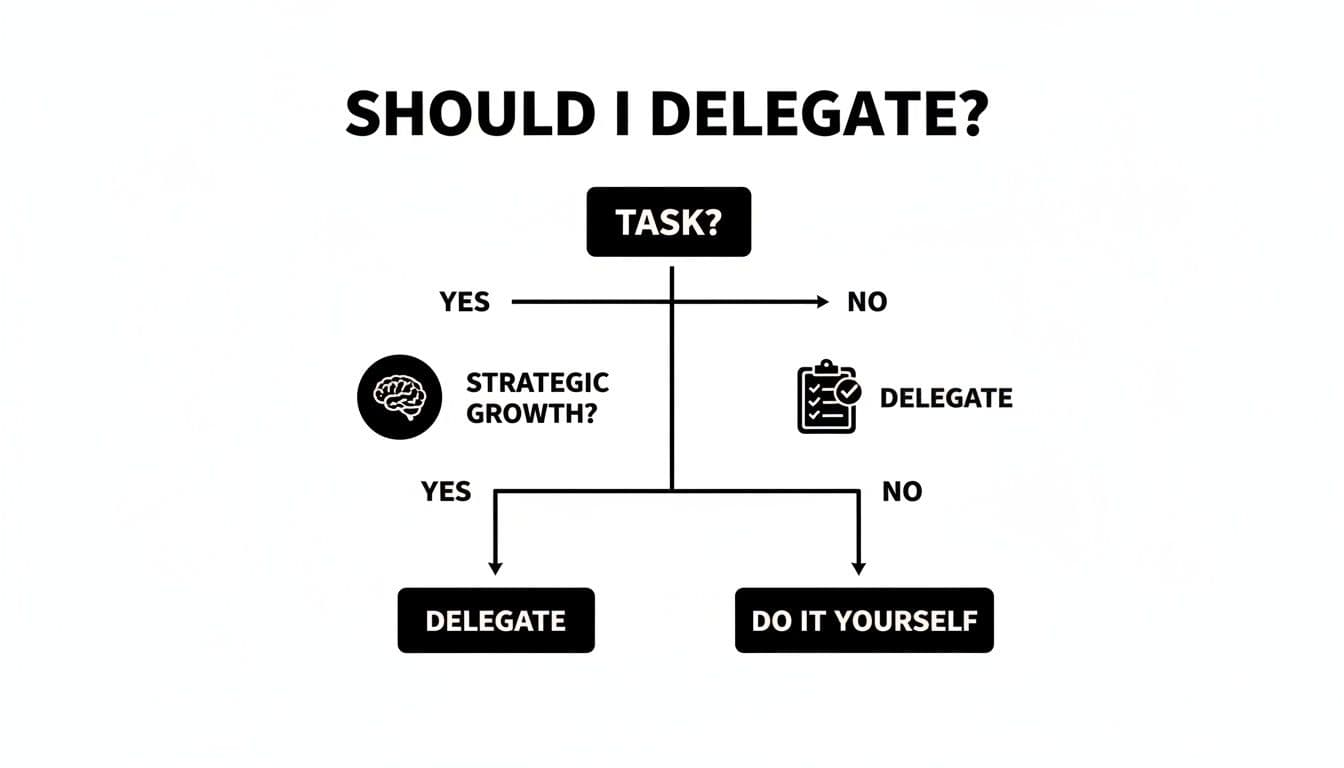
The Low-Hanging Fruit: Where to Start Delegating
Start with tasks that are repeatable, time-consuming, or require specialized skills you don’t need to own personally. These are perfect to offload immediately.
Look for tasks in these buckets:
- Administrative work: scheduling, inbox management, travel, file organization.
- Data entry and research: compiling lists, transcribing meetings, initial research.
- Content and social media: scheduling posts, simple graphics, formatting articles.
- Repetitive processes: any predictable workflow—document it and hand it over.
Breaking your workload down this way is fundamental. For more on organizing priorities, see our guide on prioritization techniques.
The goal isn’t just to clear your plate. It’s to intentionally carve out time for the work that only you can do—closing major deals, setting strategy, or mentoring your team.
From Cost Center to Profit Lever
Delegation isn’t just a soft skill. Offloading the right work is an investment in growth. Research indicates that leaders who delegate well drive higher business performance, including stronger revenue outcomes2.
To make delegation concrete, use a simple matrix to classify tasks by impact and required involvement. It shows what to keep, delegate, or automate.
Delegation Decision Matrix
| Task Category | Description | Action |
|---|---|---|
| High impact, your expertise required | Strategic planning, key client relationships, core product innovation | Keep & do |
| High impact, not your expertise | Specialized tasks like design, financial modeling, SEO | Delegate |
| Low impact, your expertise required | Tasks you’re good at but don’t move the needle | Automate or delegate |
| Low impact, not your expertise | Repetitive admin, data entry, scheduling | Delegate immediately |
Sorting tasks this way builds a system that lets you focus on high-value work while empowering your team. That’s how you stop being a bottleneck and become a multiplier.
Crafting a Task Brief That Guarantees Results
Once you decide what to hand off, the most critical step is explaining it clearly. Vague, one-line instructions lead to follow-up questions, rework, and the urge to just do it yourself.
A great brief is a recipe: the better your instructions, the better the outcome. A solid brief gives context so the person you assign can make smart decisions independently.

The Anatomy of a Perfect Task Brief
At a minimum, your brief must answer four questions:
- The Why (Objective): Why does this task matter? Context guides decisions. For example: “We need this report to see which social channels drove sales last month so we can adjust Q3 ad spend.”
- The What (Deliverables): What exactly do you expect? Be specific. “A one-page PDF report with charts for engagement, reach, and click-through rates for Facebook, Instagram, and LinkedIn.”
- The How (Resources & Guidelines): Provide templates, brand guidelines, and links. “Use the attached template and pull data from our analytics account.”
- The When (Deadline): Give a final due date and, for bigger projects, milestone deadlines. “Final PDF due Friday at 5 PM. Draft for review by Thursday EOD.”
Documented procedures make this faster. For recurring tasks, see our guide on creating standard operating procedures.
Vague vs. Clear Delegation in Action
Vague brief (what not to do):
“Hey, can you pull together the social media stats for last month? Need it ASAP.”
Clear brief (the goal):
Objective: We need to understand May social performance for the June content strategy meeting.
Deliverables: A single PDF summarizing key metrics for Facebook and Instagram including:
- Total follower growth for each platform.
- Top 3 posts by engagement rate.
- A chart showing website clicks from each platform.
Resources: Use the “Monthly Social Report” template in our shared drive. Export data from our analytics platform.
Deadline: Final report due Friday, June 7 at 3 PM.
The clear brief eliminates guesswork and sets your teammate up for success.
Choosing the Right Person and Tracking Progress
Delegation is as much about people as it is about process. After a crystal-clear brief, match the task to the right person. Skills, availability, and work style should align with the task. Don’t default to whoever has the most free time.

Matching the Task to the Talent
Consider both the task’s needs and the person’s growth potential.
- Existing skills: If speed and quality matter now, pick someone who already has the chops.
- Potential for growth: Use stretch assignments to develop talent, with the right support.
- Current workload: Be realistic about capacity to avoid burnout.
- Interest and motivation: People who care deliver better work.
The real challenge isn’t just handing off the work; it’s staying in the loop without micromanaging. Build systems of trust and accountability, not control.
Establishing a Monitoring Rhythm
After assignment, shift from doer to supporter. Agree on a predictable check-in rhythm so updates don’t become disruptive.
A simple framework:
- Set clear check-in points before work begins. For a week-long task, a midpoint check-in is often enough.
- Use shared task boards so you can see status in real time.
- Focus on outcomes, not activities. Ask, “Are we on track to hit the deadline?” rather than “What are you doing right now?”
Effective monitoring builds autonomy and lets you catch problems early. For more on maintaining visibility, see our article on tracking project progress.
Common Delegation Mistakes and How to Fix Them
Even with good intent, delegation can go wrong. Knowing common traps helps you design a process that empowers people and frees your time.
Mistake #1: Delegating Responsibility Without Authority
Handing over responsibility without the authority to decide creates bottlenecks and frustration. Instead of micromanaging every decision, shift from requiring permission to seeking alignment.
- Instead of: “Handle the social calendar but run every post by me.”
- Try: “You’re in charge of the social calendar and can schedule posts that align with our brand. Let’s sync weekly to review performance.”
Mistake #2: Providing Vague, Unclear Instructions
Ineffective communication is a leading cause of project failure3. Be specific in your requests.
- Instead of: “Can you look into competitors?”
- Try: “Research Companies A, B, and C and provide a one-page summary of their social ads and recent blog content by Thursday.”
Clarity eliminates guesswork and speeds delivery.
Mistake #3: Offloading Only the Grunt Work
If you only delegate tedious tasks, you’ll demotivate your best people. Mix in meaningful, visible projects that let employees stretch their skills and demonstrate trust.
Frequently Asked Questions About Delegation
How do I start delegating if I’ve never done it before?
Start small with a low-risk, well-defined task—scheduling next week’s meetings or building a folder structure. The goal is practicing the delegation process and building trust.
What if the delegated task isn’t done to my standards?
Before reacting, review your brief. Quality issues often stem from unclear instructions. If the brief was clear, give constructive feedback with specific changes and use it as a coaching moment.
How do I trust someone else with important tasks?
Trust is built incrementally. Assign small pieces of a bigger project with clear checkpoints. As the person succeeds, increase responsibility and autonomy.
Ready to stop being the bottleneck and start scaling your impact? Fluidwave combines smart task management with on-demand virtual assistants to make delegation seamless. Create your tasks, set your terms, and let skilled assistants handle the rest—you only pay for completed work. Start delegating the smart way with Fluidwave.
Quick Q&A: Common Delegation Pain Points
Q: What should I delegate first when time is tight?
A: Start with repeatable, low-risk tasks that consume time—administrative work, routine reporting, or scheduling. Those free up hours fast.
Q: How do I ensure quality without micromanaging?
A: Provide a clear brief, set milestones, and focus on outcomes. Use a midpoint check-in and a shared task board to maintain visibility.
Q: How can delegation help my team grow?
A: Mix routine tasks with stretch assignments. Delegation gives people new skills and visibility while building trust and capacity.
1.
DDI, “Global Leadership Forecast 2025.” https://www.ddiworld.com/global-leadership-forecast-2025
2.
Gallup, research on leadership and performance. https://www.gallup.com
3.
Kapable, “Workplace leadership statistics” (survey summary on project communication). https://kapable.club/blog/statistics/workplace-leadership-statistics/
Focus on What Matters.
Experience lightning-fast task management with AI-powered workflows. Our automation helps busy professionals save 4+ hours weekly.