Discover practical strategies for neurodivergent productivity. Our guide offers effective systems tailored to your unique needs in 2026.
August 16, 2026 (1mo ago)
Neurodivergent Productivity: Systems That Work
Discover practical strategies for neurodivergent productivity. Our guide offers effective systems tailored to your unique needs in 2026.
← Back to blog
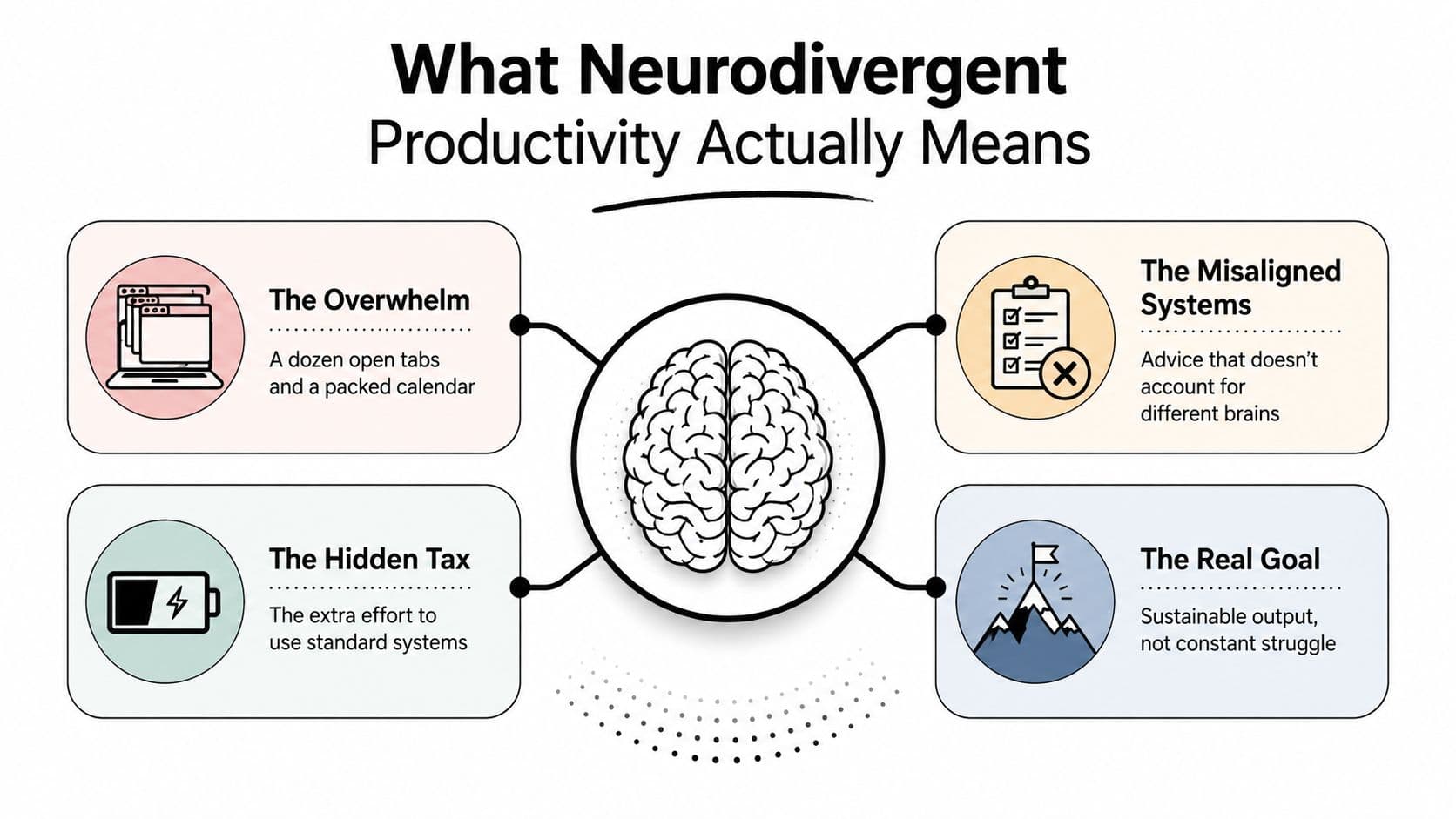
You've got twelve browser tabs open, a calendar packed with meetings, and a deadline that somehow arrived before you felt ready for it. You know what needs doing, but choosing the first task feels harder than the task itself. Then a message arrives, your attention shifts, and the afternoon disappears into small decisions, unfinished drafts, and the uneasy feeling that you've missed something important.
That pattern isn't proof that you're lazy or incapable. Neurodivergent productivity improves when the environment carries more of the remembering, prioritizing, and switching work. The practical question isn't, “How do I force myself to work like everyone else?” It's, “What system lets my attention and abilities produce useful work without paying an unnecessary cognitive tax?”
What Neurodivergent Productivity Actually Means
Neurodivergent productivity describes the ways people with neurological differences organize attention, energy, information, communication, and action at work. The term commonly includes ADHD, autism spectrum conditions, dyslexia, dyscalculia, dyspraxia, and other variations in cognition. It doesn't describe one universal work style. It describes a need to design work around how a particular brain processes demands.
A conventional productivity system often assumes that you can hold priorities in mind, estimate time accurately, switch tasks without much disruption, and begin work on command. Those assumptions fail for many people. A task list can make priorities visible, but it can't necessarily supply enough urgency to start. A calendar can show an appointment, but it may not show the preparation, transition, recovery, or follow-up that the appointment creates.
That's why I treat productivity as a fit between cognition and environment, not a test of personal discipline. If your workspace is noisy, your instructions are implied, and every project depends on remembering the next step, the system is asking your brain to perform invisible administrative work before it can perform the visible job.
The scale of the problem
This isn't a niche concern. A major 10-country World Health Organization-linked study found that adults with ADHD missed an average of 8.4 additional workdays per year, experienced 21.7 additional days of reduced work quantity, and 13.6 additional days of reduced work quality. Together, that represented 22.1 excess days of lost role performance annually for each affected worker in the study, as reported in the WHO-linked study on ADHD and lost work performance.
Across the civilian labor forces examined, the study estimated 143.8 million lost productivity days each year associated with ADHD. The average ADHD prevalence among surveyed workers was 3.5%, with estimates of 4.5% among U.S. workers and 6.3% in France, showing that the issue reaches across major labor markets rather than belonging to one workplace or one person.
The implication is straightforward: sustainable output comes from engineering the workflow, reducing friction, and making hidden work visible. If you want a plain-language explanation of the mental skills involved, this guide to executive function provides useful context.
How Different Neurodivergent Profiles Actually Struggle
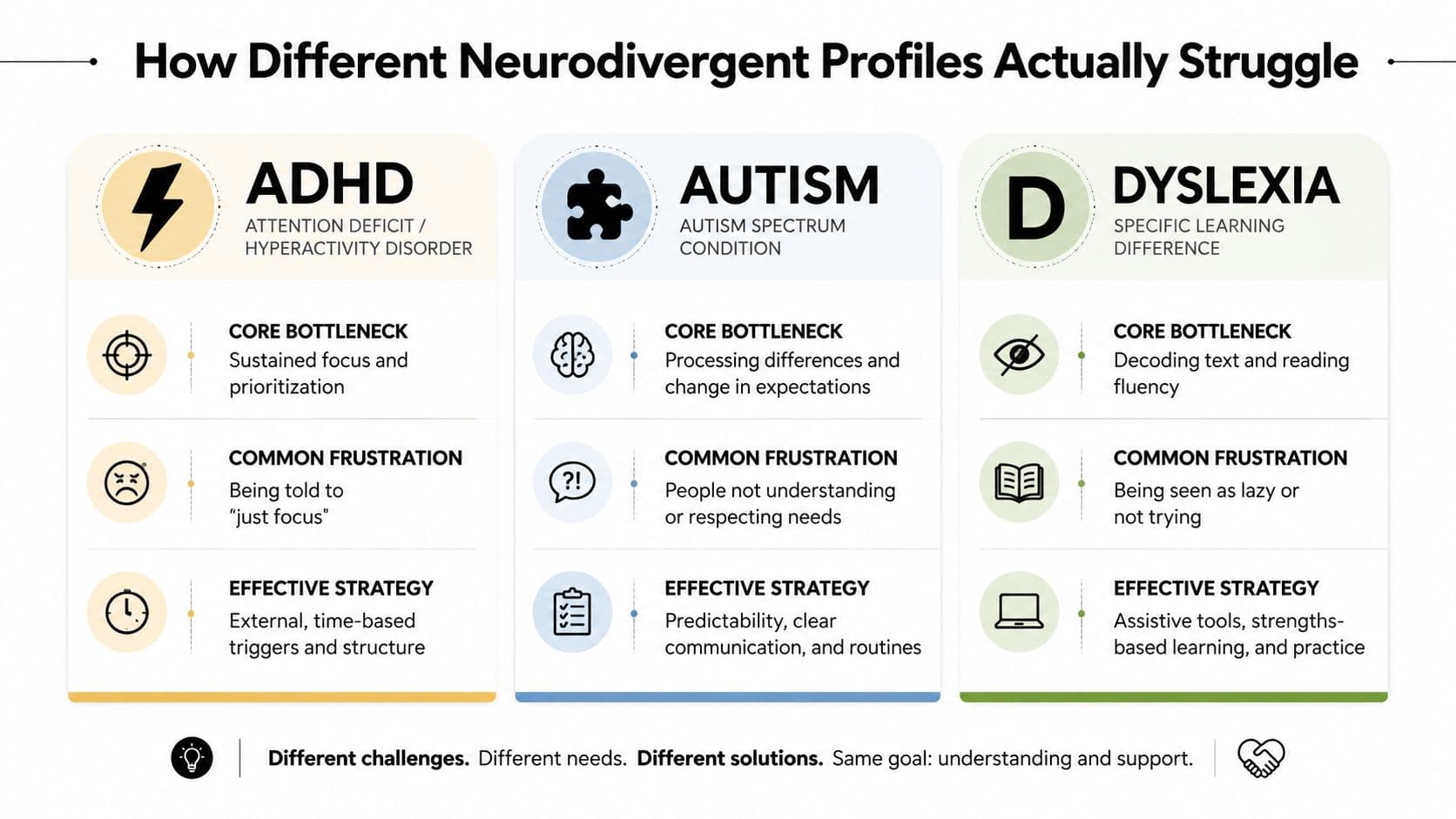
“Neurodivergent” is a useful umbrella term, but it's a poor productivity diagnosis. Two people can both identify as neurodivergent and need opposite interventions. One may need stronger external prompts to begin; another may need fewer interruptions after beginning. One may work best with a spoken explanation; another may need written detail and time to process it.
ADHD
For many adults with ADHD, the recurring bottlenecks are prioritization, time estimation, and task switching. A survey of 49 participants found that workers actively wanted better support around these areas, while task-switching research linked inattentive traits with switching performance. The practical consequence is that frequent context changes can consume control capacity even when the person has the skills to complete each individual task. The findings are discussed in the research on ADHD productivity tools and task switching.
A typical workday might look like this: you open a report, notice an unanswered message, check the message, remember a meeting, search for the meeting notes, find a new request, and then return to the report without remembering which paragraph you were editing. The problem isn't a lack of ideas. It's the cost of repeatedly rebuilding context.
Autism spectrum conditions
Autistic workers can have very different executive-function profiles from people with ADHD, and support should reflect that difference. In a 2009 study comparing adults with ADHD and autistic spectrum disorder, the ADHD group showed difficulty withholding responses, while initiation and planning were relatively preserved. That finding doesn't define every person, but it demonstrates why a single “neurodivergent productivity” template is inadequate. The workplace accommodation discussion that summarizes these profiles appears in this guide to ADHD-friendly workplace accommodations.
For an autistic employee, unclear ownership, implied expectations, unpredictable meetings, sensory overload, or abrupt changes may create the greatest friction. A written agenda and explicit definition of done can be more useful than another reminder notification.
Dyslexia and related profiles
Dyslexia can add a reading, spelling, sequencing, and information-processing layer to work that depends heavily on dense documents. Dyscalculia may make numerical information and estimation more effortful. Dyspraxia can affect coordination, sequencing, and the practical mechanics of moving from intention to action.
These differences overlap, but they aren't interchangeable. A study of 181 secondary-school students found that students with ADHD outperformed neurotypical peers on verbal creativity originality while researchers assessed executive functions including flexibility, working memory, and inhibition with a VR-based battery, as described in the PubMed study on creativity and executive functions. That contrast matters at work: generating original ideas may be a strength, while executing and sequencing those ideas may require stronger scaffolding.
The Four Principles Behind Every Effective System
A productivity tool earns its place only if it solves a specific bottleneck. I use four tests before keeping any system: Does it reduce memory load? Does it make priority visible? Does it protect attention? Does it accommodate variable energy?
Reduce working-memory load
Store commitments, decisions, links, and next actions outside your head. A task called “client project” is still a memory burden. “Draft the opening section, attach the approved outline, and send it for review” gives your future self an entry point.
The creativity research described above supports this division of labor. If idea generation is relatively strong but execution needs support, don't spend all your effort trying to make ideation more orderly. Capture ideas quickly, then create a separate execution path.
Externalize prioritization
A long list isn't a priority system. Your workflow should answer one question without interpretation: What should I do next? Use a visible “Today” view, a short active list, or a manager-confirmed sequence. A PLOS ONE paper on ADHD-related performance found only small effects for plan recall, self-initiation, and execution, a useful reason to target the exact bottleneck rather than assume a general planning failure. The finding is summarized in this overview of workplace accommodations for neurodivergent employees.
Signal task switching
Don't rely on willpower to remember when to stop, start, or resume. Use calendar blocks, alarms, written handoff notes, and a visible “resume here” line in every unfinished document. Longer uninterrupted blocks are especially valuable when switching itself consumes control capacity.
Practical rule: Every interruption should leave a restart instruction, not just an open tab.
Protect entry points to flow
Starting rituals reduce the number of decisions between sitting down and beginning. Open the same document, put the phone away, set a short timer, and begin with a deliberately small action. For support with initiation, prioritization, and other executive-function challenges, executive function coaching for ADHD adults can help identify which part of the process needs intervention.
Designing Your Environment and Workflow
Start with the room, not the app. If your environment repeatedly interrupts attention, a more complex task manager won't solve the underlying problem.
Remove obvious sensory friction first. Try a quieter workspace, noise-canceling headphones, softer lighting, or a screen arrangement that keeps unrelated windows out of sight. Workplace accommodation guidance commonly recommends these adjustments alongside written instructions and advance agendas, because reducing sensory input and ambiguity lowers the amount of information your brain must filter. The workplace accommodation guidance from Inkludx describes these environmental and communication supports in practical terms.
Make transitions visible
Most workflows contain more transitions than people acknowledge. “Prepare for the meeting” may include finding the agenda, reviewing the previous decision, creating questions, opening the right files, and deciding what to bring. Write those transitions as tasks or checklist items.
Do the same with handoffs. Instead of ending a work block with a vague note such as “continue report,” write, “Next, compare the two revenue tables and draft the second paragraph.” That sentence closes a loop and saves your future self from reconstructing the entire context.
Use externally signaled focus blocks
A simple focus block needs only four parts:
- Choose one outcome: Define what will exist when the block ends.
- Remove competing inputs: Silence notifications and close unrelated tabs.
- Set a visible boundary: Put the block on your calendar or use a timer.
- Leave a restart note: Record the next action before you stop.
A block can be short or long. The point isn't to copy a standard duration. The point is to make the start and finish externally visible, then protect the middle from casual switching. This is the operating logic behind time blocking for ADHD, especially when a calendar needs to represent preparation and recovery rather than meetings alone.
For meetings, ask for an agenda in advance and write down decisions, owners, and dates during the call. If the team doesn't provide a recap, send one yourself. Written clarity is not bureaucratic overhead. It prevents a later memory search.
Assistive Tools, AI, and Where They Actually Help
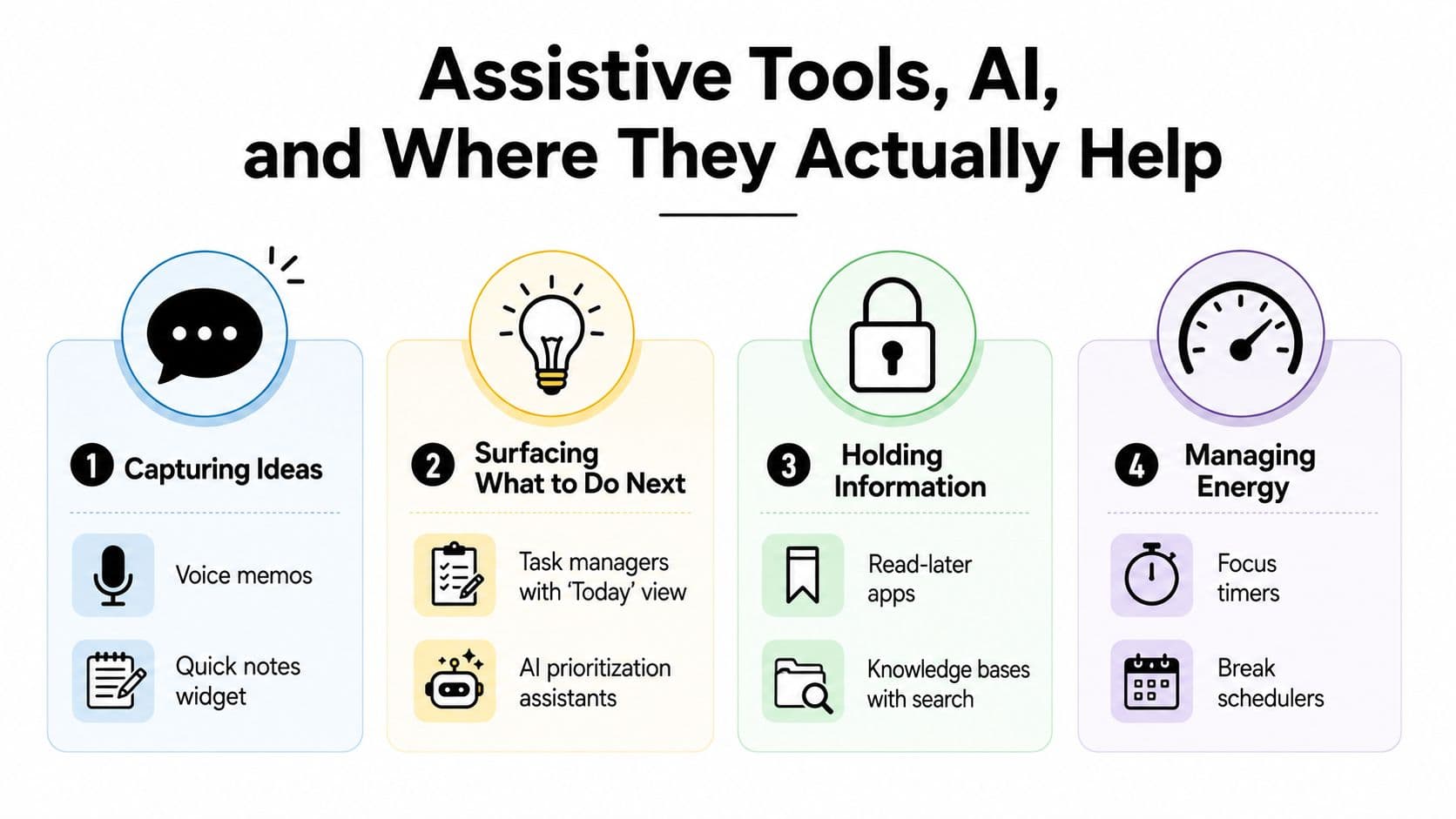
A tool can reduce one bottleneck while creating another. Voice capture removes the demand to hold an idea in working memory, while an AI prioritization assistant may reduce decision load. Neither can compensate for constant notifications or a workflow that requires too many handoffs.
Capture ideas before they disappear
Use Apple Voice Memos, Google Keep, a quick-notes widget, or one inbox in your task manager. Capture the thought before sorting it. Requiring a label, project, or priority during the moment of inspiration adds a second task and can turn a useful idea into an unfinished filing process.
Surface the next action
A task manager with a dependable “Today” view limits the number of decisions required at the start of work. A calendar helps when a task has a genuine time constraint. AI assistants can convert a long project description into possible next actions, but review each suggestion. If the system invents assumptions, it shifts the work from planning to correcting.
A practical comparison framework appears in the Pretty Progress executive function guide. Compare capture, planning, focus, and review supports by the function they serve. Adding applications without identifying the missing function usually adds maintenance rather than capacity.
Hold attention and review the system
Distraction blockers, ambient sound, focus timers, and read-later tools can protect execution. A searchable knowledge base keeps reference material available without interrupting a writing session to find a document. Review the setup regularly. Keep supports that reduce friction and remove those that have become another task to maintain.
AI helps when it addresses a specific bottleneck. A 2025 workplace study reported that moderate AI use increased task completion for employees with ADHD from 61% to 88% over six months, while neurotypical peers improved by 3%, as reported in the workplace AI and ADHD research paper. Treat this as a reason to test targeted uses, not as a promise that every AI feature will work for every person.
Use AI to summarize meetings, extract action items, draft a first-pass checklist, or identify missing dependencies. Keep human review for judgment, confidential decisions, and accountability. The guide to using AI for productivity explains how to place AI inside a workflow rather than treating it as a replacement for one.
Delegation as an Executive-Function Tool
Delegation isn't only a leadership skill. For neurodivergent workers, it can function as an accessibility support. Offloading repetitive research, scheduling, data cleanup, formatting, or follow-up can preserve attention for work that depends on creativity, judgment, relationships, or specialist knowledge.
Start with a task brief. Write five things:
- Outcome: What should be different when the work is complete?
- Deadline: When must the result arrive?
- Budget: What resource limit applies?
- Definition of done: What quality or format is acceptable?
- Reference material: Which files, examples, or constraints should guide the work?
“Clean up my inbox” is ambiguous. “Identify messages requiring a reply, move newsletters to the reading folder, draft responses for the three client threads, and return the draft set by Friday afternoon” gives another person or system a workable boundary.
Choose the right executor
Use a human assistant when context, judgment, or communication matters. Use software for repeatable rules, reminders, filtering, and status changes. Use AI for summarization, classification, drafting, and converting unstructured notes into a checklist. In many cases, a hybrid works best: AI prepares the material, a person checks it, and you approve the final result.
Fluidwave is one example of a task and delegation platform that combines task organization with human virtual assistants on a pay-per-task basis. Its task views and prioritization features can keep delegated work visible while the assistant handles an agreed deliverable. That structure fits neurodivergent workflows because the request, budget, deadline, and status live outside working memory.
Keep feedback loops small. Ask for an initial confirmation of the brief, a progress update when a dependency appears, and a final handoff that includes links and unresolved questions. Delegation should reduce decisions, not create a new stream of vague coordination.
If worry keeps you from handing work off, separate legitimate risk from repetitive mental checking. Resources on overthinking and anxiety can help you recognize when review has stopped improving the result and started consuming capacity.
What Managers and Teams Should Change
Individual systems can't compensate for a workplace that communicates through implication, rewards constant availability, and treats interruptions as commitment. Managers control many of the conditions that determine whether neurodivergent employees can use their skills consistently.
EY's 2025 global study of 2,111 professionals across 22 countries found that only 25% of neurodivergent professionals felt included at work. Those who did feel included reported a 10% lift in skill proficiency, including a 17% increase in resilience and agility, according to the EY inclusion study. A 2026 UK study of 605 participants also found poorer wellbeing, psychological safety, and work-life balance among neurodivergent workers than in the wider workforce, as summarized in the same source.
Manager-side changes with practical impact
- Write first: Put decisions, owners, deadlines, and changes in writing instead of relying on memory after a meeting.
- Make meetings predictable: Share an agenda, explain the purpose, allow processing time, and publish the recap.
- Measure outcomes: Evaluate completed work and quality rather than treating visible busyness or instant replies as performance.
- Discuss accommodations directly: Ask what conditions help the employee perform, then agree on specific adjustments and review them.
Team members can advocate for these norms without disclosing a diagnosis. “Could we document the decision and owner?” is a reasonable request for any employee. A written-first culture also helps people who work across time zones, manage caring responsibilities, or need time to process complex information.
Inclusion isn't separate from productivity. It determines whether a person's skills reach the work at all.
Measuring What Actually Changed
Track the system, not your self-worth. Choose four signals: tasks completed on time, protected deep-work blocks, days lost to context-switching fog, and energy at the end of the week.
Record them in a simple weekly note. Count completed commitments, mark the focus blocks you protected, describe any day when switching prevented meaningful progress, and rate your ending energy in plain language such as low, steady, or sustainable. Don't turn the review into another elaborate project.
Run the experiment for six weeks, matching the timeframe used in the workplace AI study cited earlier. Change one major condition at a time, such as written agendas, a “Today” view, or delegated administrative work. Look for patterns across weeks rather than treating one unusually good or bad day as proof.
Productivity is a system you tune. It isn't a personality trait you either possess or lack.
If the results don't improve, inspect the bottleneck again. You may need less noise, clearer ownership, fewer switches, better task briefs, or a different form of support. The right system makes useful work easier to begin, easier to resume, and less expensive to complete.
Fluidwave combines task organization, intelligent prioritization, focus-oriented workflows, and pay-per-task delegation through virtual assistants. Visit Fluidwave to create a clearly defined task, set its deadline and budget, and test whether moving one recurring cognitive burden outside your head gives you more room for focused work.
Focus on What Matters.
Experience lightning-fast task management with AI-powered workflows. Our automation helps busy professionals save 4+ hours weekly.