Tired of chaos? Learn how time blocking for ADHD can transform your focus and productivity. Our guide provides practical steps to master your schedule.
March 23, 2026 (6mo ago)
A Guide to Time Blocking for ADHD That Actually Works
Tired of chaos? Learn how time blocking for ADHD can transform your focus and productivity. Our guide provides practical steps to master your schedule.
← Back to blog
If you have ADHD, you’ve probably felt that time is this slippery, abstract thing that just refuses to be managed. It’s a super frustrating, common experience, but it’s not a personal failure. It's a neurological reality often called time blindness, and it's the main reason most traditional time management systems feel like they were designed for someone else entirely.
For a neurotypical brain, a long to-do list might feel organized and motivating. But for the ADHD brain, it’s a one-way ticket to Overwhelm City.

Why To-Do Lists Don't Cut It
A simple list of tasks just doesn't give our brains the context we need to get started. It leaves a long trail of unanswered questions:
- When am I supposed to do this?
- How long will it actually take me?
- What’s the most important thing to tackle first?
Without clear answers, you’re stuck in decision paralysis. Every task shouts for your attention with the same urgency, which either leads to frantic task-switching or complete avoidance because you just don't know where to begin. This happens because the ADHD brain works differently, especially when it comes to the mental skills that help you plan, prioritize, and see tasks through—your what is executive function.
Traditional To-Do Lists vs ADHD-Friendly Time Blocking
A standard to-do list is a list of what to do, but it offers no help with the when or how. For an ADHD brain that struggles with time perception and prioritization, this is a setup for failure. Time blocking, on the other hand, provides the missing structure.
Let's break down the difference.
| Feature | Traditional To-Do List | Time Blocking for ADHD |
|---|---|---|
| Structure | Unstructured list of tasks. | Tasks are assigned to specific, visual time slots on a calendar. |
| Time Perception | Assumes you can accurately gauge how long tasks will take. | Makes time tangible and finite, removing the guesswork. |
| Prioritization | All tasks can feel equally urgent, causing overwhelm. | Forces you to prioritize by fitting tasks into a limited schedule. |
| Focus | Encourages multitasking and jumping between items. | Creates a clear "single-tasking" window. Your only job is what's in the block. |
| Outcome | Often leads to decision paralysis, procrastination, and unfinished tasks. | Reduces mental load, clarifies focus, and increases completion rates. |
The table makes it pretty clear: a to-do list gives you a destination with no map, while time blocking provides turn-by-turn directions.
Making Time Visible and Tangible
This struggle with "slippery time" isn't just a feeling; it’s backed by solid research. A massive 2023 meta-analysis confirmed a significant impairment in time perception for people with ADHD across their lifespan. The research found that for folks under 18, poor working memory made the problem worse, while in adults, the inattentive subtype was hit hardest by this time distortion.
Time blocking works because it stops asking your brain to "feel" time. Instead, it makes time visible and concrete. It becomes an external scaffold for your executive functions.
By assigning every task to a specific block on your calendar, you create a visual roadmap for your day. You're no longer staring at a vague, intimidating list of things to do. You just look at your calendar and see that from 10:00 AM to 10:45 AM, your only job is to work on that project proposal.
This approach drastically cuts down on the mental energy wasted on deciding what to do next. It turns abstract goals into clear, actionable steps, giving your brain the structure it needs to finally get things done.
Preparing Your Tools and Mindset for Success
Before you even think about dragging a block onto your calendar, let's talk about prep work. Diving headfirst into time blocking without getting your head and your tools in order is a recipe for frustration, especially with an ADHD brain. To make this system actually stick, we need to lay some groundwork first. It’s all about a crucial mindset shift and picking the right gear for the job.
The first thing I always have people do is a brain dump. This isn’t just another task to check off; it's a pressure release valve. If your mind is anything like mine, it’s a constant storm of to-dos, brilliant-but-fleeting ideas, random worries, and appointments you almost forgot. A brain dump gets all of that out of your head and onto paper (or a screen).
Just grab a notebook or open a doc and for 10-15 minutes, let it all out. Don’t filter or organize. Just write.
- Every single work task you can remember.
- That nagging feeling you need to do laundry.
- The "genius" side project idea you had in the shower.
- Personal calls you need to make.
- Anxieties about an upcoming deadline or meeting.
The point is to externalize the chaos. By creating a master list of everything vying for your attention, you immediately lower your mental load and free up some much-needed brainpower.
Categorizing Your Tasks
With your brain dump complete, you can start to make sense of it all. This isn't about rigid prioritization just yet. It's simply about understanding what you're working with. Group all those items into a few simple buckets.
- Deep Work: These are the high-focus, mentally draining tasks that move the needle. Think writing a report, coding a new feature, or mapping out a strategy.
- Shallow Tasks: This is the low-effort admin work. It's stuff like answering routine emails, booking appointments, or simple data entry.
- Personal Time: This is non-negotiable. It’s anything that recharges you, like hitting the gym, spending time with family, or diving into a hobby.
- Life Admin: All the essential chores and errands that keep your life running—grocery shopping, paying bills, tidying up.
Sorting your list this way gives you a clear, honest look at where your energy needs to go, which is the foundation for building a realistic schedule. Time blocking itself is a powerful behavioral strategy. For anyone exploring a holistic approach to ADHD management, it's also helpful to be aware of all available support systems, including ADHD treatment options that don't involve medication, to create a well-rounded plan.
Choosing Your Single Source of Truth
Now for the crucial part: choosing your command center. The best tool is simply the one you'll actually use day in and day out. This becomes your single source of truth—the one and only place where all your tasks and appointments live.
The most effective tool is not the one with the most features, but the one that reduces friction and feels intuitive to you. If it’s a chore to use, you won’t use it.
So, what are your options?
- Digital Calendars: Tools like Google Calendar or Outlook are fantastic because they're everywhere you are and make for easy visual blocking.
- Physical Planners: For many people, the tactile act of writing things down is what makes it stick. If that's you, embrace it!
- Dedicated Apps: Purpose-built tools can be a game-changer. For a detailed comparison, our guide on the best ADHD productivity apps is a great resource. An integrated platform like Fluidwave, for example, combines the calendar with task management, creating a seamless system where nothing falls through the cracks.
Once you’ve cleared your head, sorted your tasks, and picked your tool, you've built a solid foundation. You're no longer just reacting to chaos—you're ready to start telling your time where to go.
Putting It All Together: Your First ADHD-Friendly Schedule
Okay, let's get down to the fun part—actually building your schedule. You’ve done the hard work of emptying your brain and choosing your tool. Now, the single most important rule is to forget about perfection. A perfectly packed, back-to-back schedule is a trap. For an ADHD brain, that kind of rigidity feels less like a plan and more like a prison. We’re not building a prison; we're creating a flexible guide for your day.
The first step is to anchor your schedule with the absolute non-negotiables. These are the fixed appointments and commitments that form the scaffolding of your day.
- Appointments and Meetings: Any calls, meetings, or appointments that are already set in stone.
- Meals: Yes, block them out. Skipping meals is a recipe for low energy and poor focus.
- Sleep: Be disciplined about protecting your sleep. Block out your wind-down time and your wake-up time.
- Commute: If you travel to an office or appointments, that time is part of your day. Account for it.
Once you put these on your calendar, you’ll immediately see the real, finite amount of time you have to work with. It's almost always less than you imagine. This reality check is the foundation of a successful plan.
This is the process in a nutshell, starting from the very beginning.
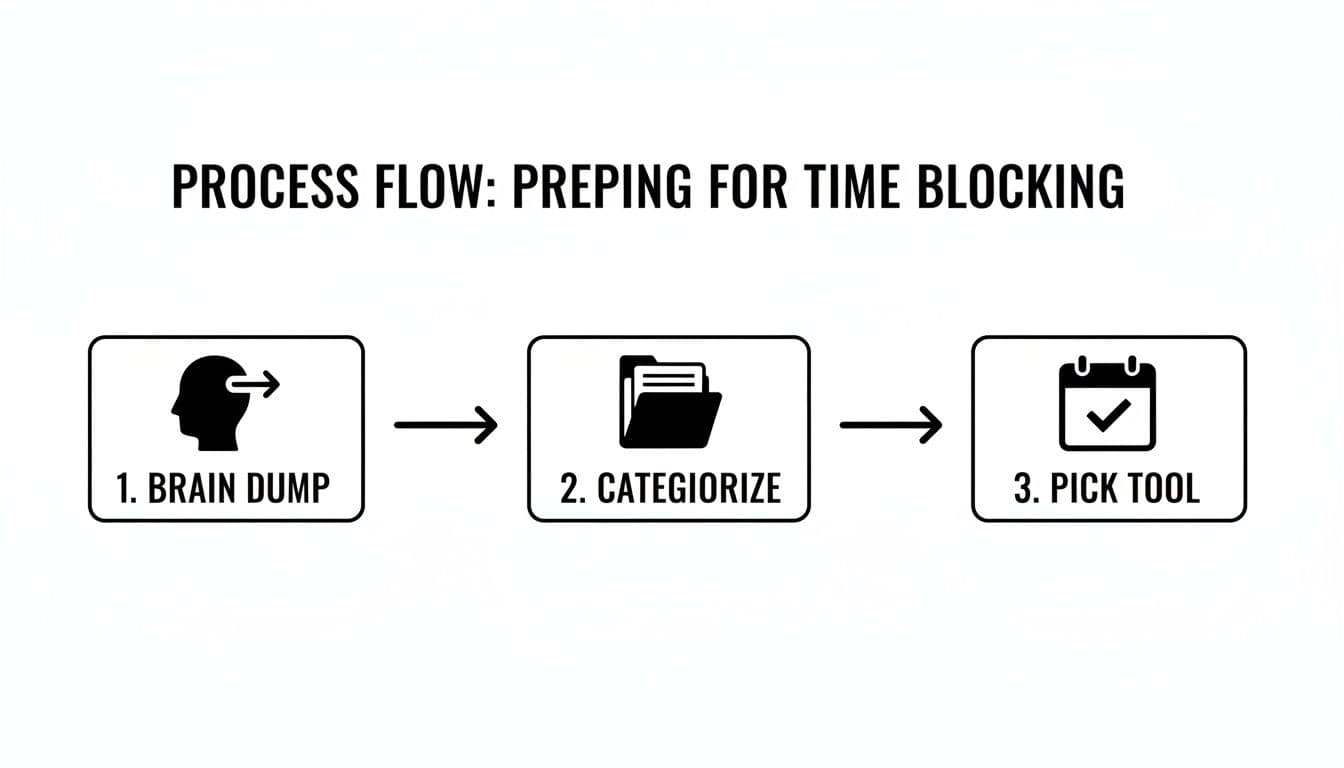
As you can see, getting the thoughts out of your head before you even open your calendar is what makes this system work.
Batch Your Chores and Dedicate Time to Focus
With your anchors in place, it’s time to start plugging in the tasks you brainstormed earlier. This is where task batching becomes your best friend. Instead of jumping between wildly different activities, you group similar, low-effort tasks into a single, dedicated block. This massively reduces the mental "cost" of switching gears.
For instance, you could create a single "Admin Power Hour." During that block, you do nothing but answer emails, return voicemails, and pay a few bills. You stay in that same administrative headspace, which saves your precious executive function for the work that truly matters.
Next, find the big rocks. Pick one or two of your most important tasks for the day and give them their own "focus work" blocks. When you're just starting out, be brutally honest about how long things take. Our brains are notoriously optimistic with time estimates. This isn't a personal failing; it's a documented neurological trait, as explored in this insightful study on time perception in ADHD. Start with shorter blocks (maybe 45-60 minutes), and you can always adjust as you learn your own rhythm.
The Secret Sauce: Buffers and Planned Procrastination
This is where a time-blocking system designed for ADHD really shines. A traditional schedule leaves no room for error, but our brains need wiggle room.
A schedule without buffer time is a schedule destined to fail. For the ADHD brain, transition time isn't a luxury; it's a necessity.
Seriously, build buffer blocks of 10-15 minutes directly into your schedule between your main tasks. This is your permission slip to grab a drink, stretch, switch your laundry, or just stare out the window for a minute. These little gaps are what prevent one task running over from completely torpedoing your entire day.
Finally, you need to get real and schedule the "unproductive" things you know you're going to do anyway.
- Planned Procrastination: Want to scroll TikTok or fall down a YouTube rabbit hole? Great. Schedule a 20-minute block for it. By giving your brain a designated time for these distractions, it’s much easier to tell yourself "not now" during a focus block.
- Catch-All Block: I always recommend a 30-45 minute "overflow" block toward the end of the day. This is your safety net—a flexible slot to finish something that took longer than expected, handle a surprise task, or simply wrap things up for the day.
Automating Your Schedule with Fluidwave
Manually recreating your time blocks every single day is exhausting. For an ADHD brain already battling decision fatigue, it can feel like a full-time job in itself. This is often where even the best time-blocking intentions fall apart.
Once you get the hang of the basic principles, the real magic happens when you let technology take over the heavy lifting. This is how you shift your schedule from a fragile, manual to-do list into a reliable system that works for you.
A great place to start is by setting up recurring blocks for all those non-negotiable routines. Think about the things you do every week, or even every day: checking email, daily stand-ups, client follow-ups, or your end-of-day shutdown routine.
In a tool like Fluidwave, you can create these blocks once and set them to repeat automatically. This single move eliminates hundreds of future decisions and frees up precious mental energy.
Sync and Centralize Your Schedule
One of the biggest frustrations for an ADHD brain is having tasks, appointments, and reminders scattered across half a dozen different apps. It’s a recipe for chaos and missed deadlines. A dedicated platform solves this by becoming your "single source of truth."
For example, you can sync your Google Calendar directly with your task list. Our guide on how to sync your schedule with Google Calendar walks you through the exact process. This integration means any meeting or appointment booked in your calendar instantly shows up in your master schedule, preventing double-bookings and that nagging feeling you’ve forgotten something.
This side-by-side view is incredibly powerful. It directly connects your time (the calendar) with your tasks (the list), giving you the concrete, visual clarity needed to stay on track.
The Power of Delegation
Now, here’s where things get really transformative: delegation. You have to be honest with yourself—many of the tasks filling your day don't actually require your unique skills. This is especially true for the smaller sub-tasks hiding within a larger time block.
Let's say you have a 2-hour block for "Weekly Project Reporting." That block probably includes several distinct steps:
- Gathering sales data from three different sources.
- Formatting the data into a spreadsheet.
- Writing the high-level summary and analysis.
- Creating presentation slides.
The real game-changer is realizing you only need to handle the high-level analysis. The rest is perfect for delegation.
Using a platform like Fluidwave, you can assign those data-gathering and formatting sub-tasks to a virtual assistant on a pay-per-task basis. You aren't hiring a full-time employee; you're just paying for specific, completed work.
Suddenly, your 2-hour administrative slog becomes a 30-minute block of pure, high-impact analysis. This is how you reclaim your focus and energy for the strategic work that only you can do.
Navigating Common Roadblocks and Staying Consistent
You’ve mapped out your perfect week, your tools are synced, and you feel ready to conquer your to-do list. And then, Monday morning hits. An unexpected call derails your first block, you slip into a hyperfocus rabbit hole on a minor task, or you just wake up with your brain in a fog where focus feels miles away.
This isn’t a sign of failure. It’s just the reality of having an ADHD brain. The goal was never to build a schedule so rigid it can't be broken, but one that’s resilient enough to bend without snapping when life inevitably happens.

Think of your time-blocked schedule as a friendly GPS, not a drill sergeant. Its purpose is to guide you, and the most valuable skill you can develop is learning how to gently reroute yourself without the guilt trip when you take a wrong turn.
Handling Distractions and Hyperfocus Mishaps
One of the biggest hurdles I see people face is getting completely sidetracked. This can look like the classic social media scroll, but just as often, it’s hyperfocusing on the wrong thing. You might spend two hours perfecting the color palette on a presentation slide while the actual report you were supposed to write sits untouched.
When this happens, the key is to avoid the shame spiral. Don't beat yourself up; just notice it and pivot.
- Acknowledge what happened. A simple mental note is all you need: "Okay, I just spent an hour in my email inbox instead of working on Project X." No judgment.
- Assess the situation. Is the distraction over? Can you jump back into your planned block, or does the rest of the day need a reshuffle?
- Redirect your focus. Gently guide your attention back to what your schedule says you should be doing now. Your calendar is your anchor.
The moment you notice you're off track is a success in itself. It's an opportunity to practice self-awareness and get back on course, not a reason to abandon the whole day.
This isn't just feel-good advice; it's backed by solid research. A 2018 study showed that kids with ADHD who combined time-management training with digital tools like timers got significantly better at perceiving time and managing their day. The same principle applies directly to professionals using a tool like Fluidwave. The visual calendar and clear task lists provide the external structure that our brains need to fight time blindness. You can explore more of the science behind improving time perception in ADHD on the NCBI website.
The Crucial Weekly Review
Your schedule can't be a "set it and forget it" document. It has to be a living plan that adapts as you learn more about your own work patterns. That’s why the weekly review is absolutely non-negotiable if you want this system to stick.
Block out 30 minutes every Friday afternoon or Sunday evening for this. It's a quick but powerful ritual. During that time, ask yourself:
- What actually worked this week? Which blocks did I consistently hit?
- What was a total miss? Where did I constantly run over time or skip a block entirely?
- Do I need to make some blocks longer and others shorter? (e.g., "Deep Work" might need 90 minutes, not 60).
- What are the 1-3 most important things I need to accomplish next week?
This review is your chance to get brutally honest with yourself in a constructive way. If you notice you’re always drained by 3 PM on Tuesdays, stop trying to force a heavy focus block there. Adjust your schedule to align with your real energy levels, not your ideal ones.
Feed the Dopamine-Seeking Brain
Finally, consistency comes from making the process feel good. The ADHD brain is wired to seek dopamine, and you can absolutely use that to your advantage. The trick is to build small, immediate rewards directly into your schedule.
Finished a grueling focus block? Great. Take a 10-minute break for a walk outside or to listen to a favorite song. Cleared your inbox? Go make that fancy coffee you love.
By tying the completion of a task to a little hit of pleasure, you create a positive feedback loop. It gamifies the process and makes your brain want to stick to the plan. Suddenly, time blocking isn't a chore you have to endure; it's a game you can win, one block at a time.
Common Questions and Roadblocks
Even with a great plan, starting a new system always brings up a few "what if" scenarios. Let's walk through some of the most common hurdles people with ADHD face when they start time blocking and how to navigate them.
What If I Can’t Stick to My Time Blocks Perfectly?
Let's get one thing straight: you won't. Nobody does, and that's not the point. The goal of time blocking for ADHD isn't perfection; it's about having a compass to guide you back when you get lost.
Think of your schedule as a GPS. When you miss a turn because you got distracted by something shiny on the side of the road, you don't just give up and throw your phone out the window. The GPS simply recalculates and shows you the new path forward.
When you notice you've drifted, just gently guide yourself back to what you planned. No judgment needed. This is exactly why we build in buffer time and those "catch-all" blocks. They're designed to absorb the chaos of a real day. The win isn't in flawless execution, but in the simple act of coming back to the plan.
How Long Should My Time Blocks Even Be?
There’s no magic number here. The right length for a time block is all about the task itself and your own brain's energy at that moment. Trying to force a 90-minute block for a task you absolutely dread is just setting yourself up for failure.
Here’s a more realistic approach to experiment with:
- High-Friction Tasks: For anything you know you'll resist—boring paperwork, difficult reports—start small. Really small. Try a 15-25 minute block. The low commitment makes it so much easier to just get started.
- Flow-State Work: For the things you actually enjoy or get lost in, you can afford to go longer. A 45-90 minute block is often the sweet spot.
- Crucial Breaks: This is non-negotiable. Always, always schedule a 5-10 minute break between blocks. It gives your brain the reset it needs to switch gears without feeling overwhelmed.
How Do I Handle Unexpected Tasks or Interruptions?
Life happens. A coworker drops by, an "urgent" email lands in your inbox, your kid needs help finding their shoes. The key isn't to prevent all interruptions but to have a system for them so they don't completely derail your day.
First, be proactive. During a focus block, turn off your notifications. Close the extra browser tabs. Put your phone on silent and out of sight.
For everything else that breaks through, try this:
- The Two-Minute Rule: If it's a genuine fire and it will take less than two minutes, just do it. Get it done and out of your head so it stops nagging you.
- The Capture Habit: If it’s going to take longer, don't switch gears. Quickly jot it down in a designated "inbox" (a tool like Fluidwave is perfect for this) and immediately return to your planned block.
- Process Later: Deal with all the items in your inbox during a dedicated admin block you've already scheduled for later.
If a major interruption is truly unavoidable, consciously pause your block. Handle the emergency. Then, make a decision: can you jump back into the original task, or do you need to shuffle the rest of your day?
Isn’t Time Blocking Too Rigid for a Creative ADHD Brain?
This is probably the biggest myth about time blocking, and I get why it feels true. But in my experience, the opposite is what actually happens. Real creativity doesn't come from total chaos; it comes from having protected space.
Without any structure, the urgent-but-unimportant stuff—the constant pings, the minor admin tasks, the "quick questions"—will always expand to fill every waking moment. It leaves zero room for the deep, innovative thinking your brain is actually wired for.
Time blocking creates freedom through structure. By scheduling and containing the "have-to-dos," you are literally building a fortress around the time for your "want-to-dos." You’re guaranteeing that your creative work, your big ideas, and your hobbies get the sacred, uninterrupted space they deserve.
Ready to stop fighting your calendar and start making it work for you? Fluidwave combines visual time blocking with smart task management and delegation, creating a system that finally works with your ADHD brain, not against it. Start building your first flexible schedule today.
Focus on What Matters.
Experience lightning-fast task management with AI-powered workflows. Our automation helps busy professionals save 4+ hours weekly.