Ditch project confusion. Our guide provides a free RACI matrix template and step-by-step instructions to define clear roles and responsibilities for any team.
July 3, 2026 (3mo ago)
RACI Matrix Template: A Guide to Clear Project Roles
Ditch project confusion. Our guide provides a free RACI matrix template and step-by-step instructions to define clear roles and responsibilities for any team.
← Back to blog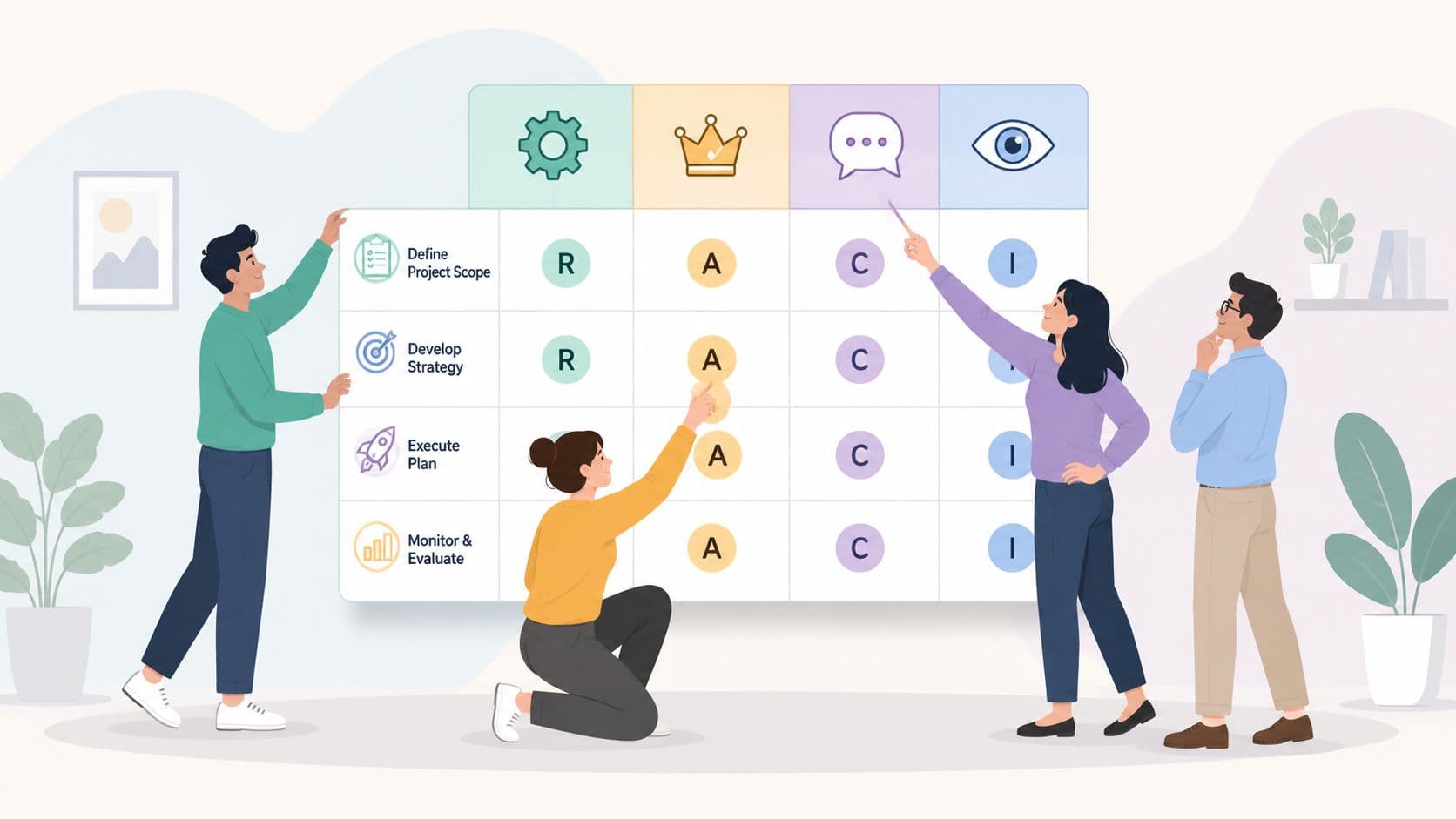
A task slips. The deadline passes. Three smart people each thought someone else owned the handoff, and by the time anyone notices, the project has already picked up delay, friction, and blame.
That's usually when teams start looking for a RACI matrix template.
The appeal is obvious. You want a simple way to answer four questions fast. Who's doing the work, who owns the outcome, who needs input, and who just needs an update. A good RACI chart does exactly that. A bad one turns into a spreadsheet nobody trusts after week one.
The difference usually isn't the template itself. It's how clearly the roles are defined, how realistically the work is mapped, and whether the chart lives anywhere near the team's actual workflow.
What a RACI Matrix Is and Why Your Team Needs One
The RACI matrix, also called a Responsibility Assignment Matrix, is a project management tool used at the start of a project to clarify roles for tasks, milestones, and decisions, especially in large or cross-functional work with many stakeholders, as outlined by Project Management's guide to the Responsibility Assignment Matrix.
When teams skip this step, the same problems show up every time. Work gets duplicated. Approvals stall. People join meetings because they're unsure whether they need to weigh in. Then someone asks who owns the decision, and the room goes quiet.
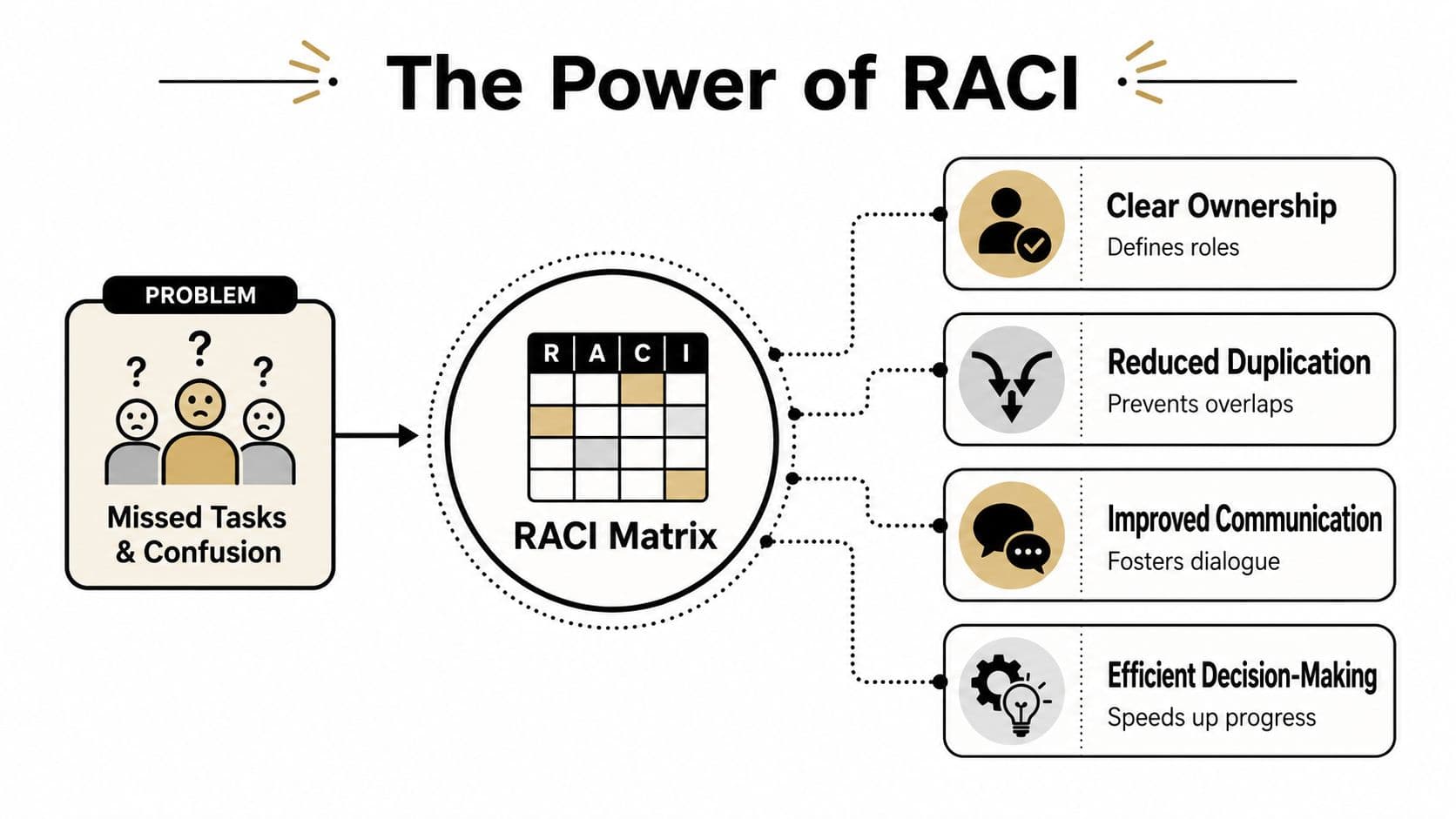
What the four letters actually mean
A RACI chart works because it forces precision. These roles sound simple, but teams mix them up all the time.
Responsible means the person doing the work.
Accountable means the one person who owns the outcome.
Consulted means the people who give input before a decision or deliverable is finalized.
Informed means the people who need updates but aren't part of the decision itself.
That distinction matters most between Responsible and Accountable. A developer can build the feature, a designer can produce the assets, and a specialist can draft the copy. But one person still needs to own whether the task is complete and acceptable.
Where teams usually feel the pain
RACI becomes useful when work crosses functions. Product needs engineering. Engineering needs legal. Marketing needs design. Operations needs sign-off from finance. Once several teams touch the same deliverable, casual assumptions stop working.
A practical RACI matrix template gives you:
- Clear ownership: Every meaningful task has a visible owner.
- Cleaner approvals: Teams know who can decide and who can advise.
- Less meeting drag: People stop inviting half the company “just in case.”
- Better onboarding: New team members can scan the chart and understand the project quickly.
If your team is already struggling with unclear ownership, role design usually needs attention before process design does. That's why role clarity and handoffs matter so much in day-to-day execution, not just in formal planning. A useful companion read is this breakdown of team roles and responsibilities.
A RACI chart doesn't create accountability by itself. It makes accountability visible, which is often the part teams were missing.
How to Build Your First RACI Matrix Template
Teams often overcomplicate the first version. They either map every tiny action until the chart becomes unreadable, or they stay so high level that the chart can't guide real work. A usable RACI matrix template sits in the middle. It covers the tasks, decisions, milestones, and deliverables that matter.
A straightforward layout works best. Put tasks in the first column. Put roles across the top row. That structure is common in Google Sheets, Excel, and Miro because it's easy to scan and update.

Start with the work, not the people
The cleanest way to build the chart is to list the project work first. According to Meegle's guide to RACI matrix templates for Google Sheets, the template should include tasks, milestones, decisions, and deliverables as rows, and those rows can be grouped by phase such as planning, execution, review, and launch. For reusable templates, job titles are recommended over employee names.
That last point matters more than people think. If you build the chart around names, the template dies as soon as staffing changes. If you build around roles like Product Manager, Engineering Lead, Designer, and Legal Reviewer, you can reuse it across projects.
A solid starting list often includes:
- Planning items: Scope approval, timeline sign-off, stakeholder alignment
- Execution items: Build feature, write copy, run QA, prepare launch assets
- Decision points: Final approval, compliance review, go-live decision
- Closeout items: Post-launch review, retrospective, handoff to support
Fill the grid with the team in the room
Don't assign the letters alone and email the result afterward. That's how you get passive resistance and role disputes later.
Instead, get the core stakeholders together and fill the grid collaboratively. You want the conversation. That's where hidden assumptions surface. One lead may think legal only needs to be informed. Legal may think it must be consulted before release. Better to find that out in a workshop than three days before launch.
Practical rule: If a row doesn't contain a real decision, deliverable, or handoff, it probably doesn't belong in the matrix.
You'll also need to think clearly about delegation. If someone is responsible for delivery but has no authority to move the task forward, the chart may look neat while the work still stalls. This guide on what it means to delegate is useful because delegation and accountability often get confused in exactly the same way Responsible and Accountable do.
A quick visual walkthrough can help if you're building your first chart:
Keep the template readable
Once the assignments are in place, scan the chart for clutter. If nearly every row has multiple Consulted and Informed entries, the template is too noisy to help.
A readable RACI matrix template usually has these qualities:
| Check | What good looks like |
|---|---|
| Task rows | Specific enough to assign clearly, not so detailed that the chart becomes fragile |
| Role columns | Based on roles or titles for reusable templates |
| Assignments | Clear spread of R, A, C, and I without crowding |
| Review habit | Shared early and updated when scope or ownership changes |
The final chart should be shared early, while people can still challenge it. If your team waits until execution starts, the chart becomes documentation of confusion instead of a fix for it.
RACI Matrix Examples for Different Teams
A RACI matrix template only becomes useful when you can picture it in a real project. The format stays the same, but the way you apply it changes with the team, the pace of work, and the number of cross-functional dependencies.
Software feature launch
A small product team is shipping a new in-app onboarding feature. The project moves fast, but the work still cuts across product, design, engineering, and QA. Without a RACI chart, teams usually assume the product manager owns everything and the engineers will sort out the rest. That's where launch gaps creep in.
In this setup, the team keeps the matrix tight. They don't create a row for every subtask. They focus on decisions and handoffs that commonly stall.
| Task | Product Manager | Engineering Lead | Designer | Developer | QA |
|---|---|---|---|---|---|
| Define feature requirements | A | C | C | I | I |
| Create onboarding designs | C | I | A/R | I | I |
| Build feature | I | A | I | R | I |
| Test release candidate | I | C | I | C | A/R |
| Approve launch | A | C | I | I | C |
A few things stand out here. The Product Manager doesn't own every execution task. The Engineering Lead is accountable for the build, while QA owns testing. That separation prevents the common trap where one person becomes the default owner of everything important.
If your software team is agile, don't use RACI to micromanage sprint tasks. Use it to clarify ownership for major deliverables, approvals, and cross-team dependencies.
Marketing campaign rollout
Now take a larger internal marketing campaign. The team is launching a multi-channel push for a new service line. Content, design, paid media, sales enablement, and leadership all need visibility. In this scenario, a RACI matrix can save a lot of meeting time.
The challenge isn't only ownership. It's making sure stakeholders who want input don't all become decision-makers.
| Task | Marketing Manager | Content Lead | Designer | Paid Media Lead | Sales Lead | Executive Sponsor |
|---|---|---|---|---|---|---|
| Approve campaign brief | A | C | I | I | C | I |
| Draft campaign messaging | C | A/R | I | I | C | I |
| Produce campaign visuals | I | C | A/R | I | I | I |
| Launch paid campaign | I | I | I | A/R | C | I |
| Share launch status and results | A | I | I | C | I | I |
This version works because each row has a visible decision owner. The Executive Sponsor stays informed instead of becoming a bottleneck. The Sales Lead is consulted where message fit matters, but not on every creative or channel decision.
What changes between teams
The letters don't change, but the pattern does.
For software teams, the matrix usually centers on build, test, approve, and release. For marketing teams, it often centers on brief, message, asset production, launch, and reporting. In both cases, the template works when the rows reflect actual operational risk, not just a generic project checklist.
If the chart feels too abstract, the problem usually isn't RACI. It's that the project hasn't been broken into meaningful ownership points yet.
Common RACI Pitfalls and How to Avoid Them
A RACI matrix usually breaks in ordinary ways. Someone wants shared approval. Someone else gets copied into every decision to avoid conflict. Then the spreadsheet sits untouched while the project changes and the team keeps working from memory.
I see the same pattern in delayed launches and messy handoffs. The chart exists, but nobody trusts it.
Multiple Accountables and no real owner
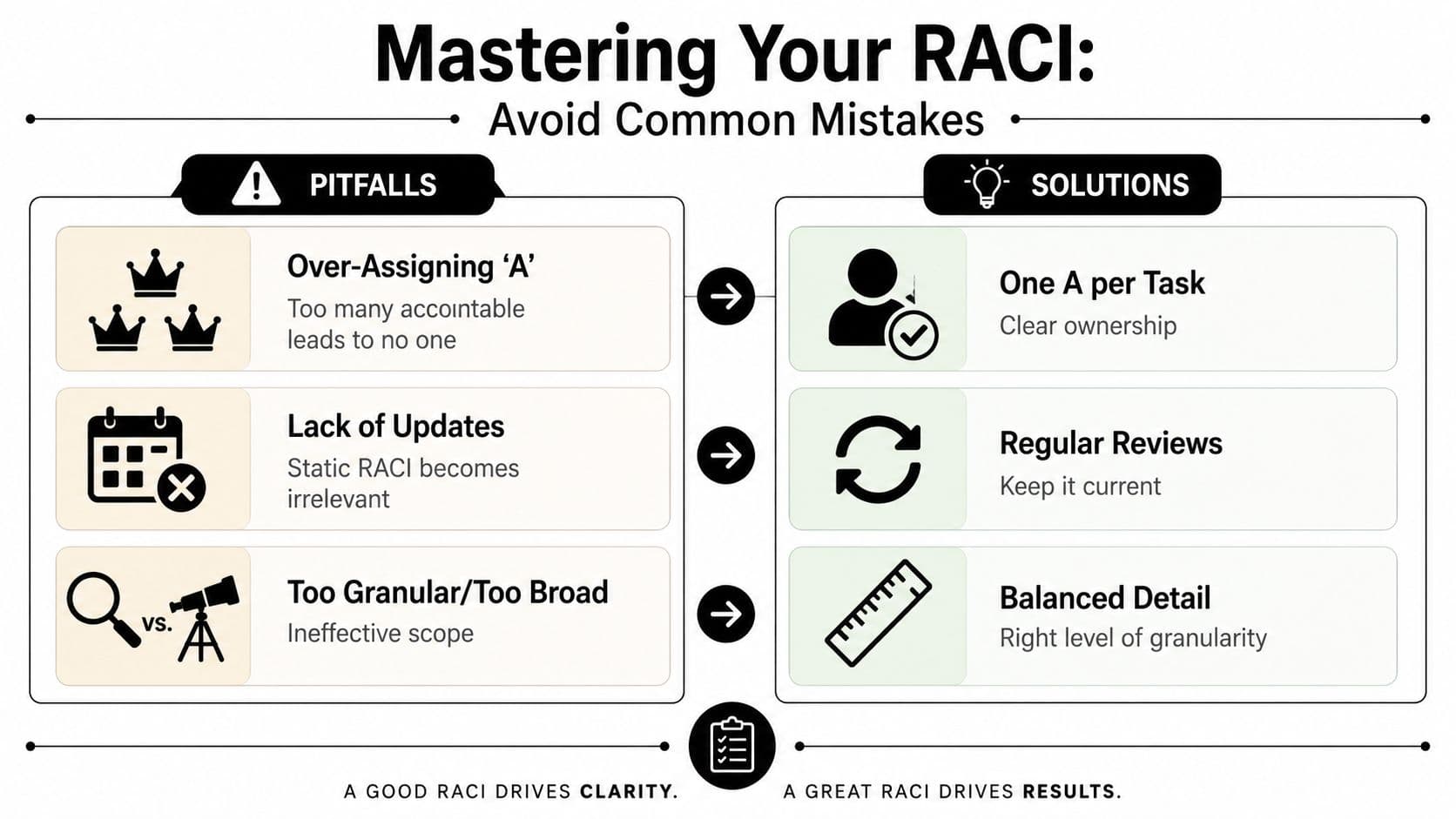
The fastest way to weaken a RACI is to assign two people as A on the same row. Teams usually do this to keep peace between managers. In practice, it slows approvals, creates side conversations, and leaves contributors guessing whose call counts.
CIO's guidance on designing a successful RACI project plan points to the same issue. One accountable person per task speeds decisions. It also warns against overloading the people marked Responsible, because too many delivery assignments on one person creates missed deadlines and avoidable stress.
Use a stricter rule set:
- One Accountable per row: If two leaders need separate sign-off, break the work into two rows with two distinct decisions.
- At least one Responsible: A task without a doer is only an approval checkpoint.
- Check workload before kickoff: If one person carries too many Rs, the matrix is warning you about capacity, not solving it.
This sounds rigid. It saves time later.
Too many Consulted voices
Consulted roles are where good charts turn into slow ones. Legal wants visibility. Sales wants input. Product wants a review. Soon a simple task has six Cs, nobody knows whose feedback matters most, and every deadline picks up another review round.
A better rule is to consult representatives, not everyone with an opinion. One person can bring the team view back to the group. That keeps feedback useful without turning each row into a committee.
If a RACI row reads like a meeting invite, it will behave like one.
This is also where static templates start showing their age. In a spreadsheet, people often keep adding Cs because it feels safer than revisiting the workflow itself. In a live system, it is easier to define who comments, who approves, and who only needs status updates. If you are setting up your own workflow from scratch, this guide on how to make a template for recurring team processes helps turn role clarity into something the team can use day to day.
Static charts that age badly
A RACI made at kickoff is only useful if it stays current. That is the failure point with spreadsheet templates. A reviewer changes, a workstream expands, or a handoff moves to another team, but the file still reflects last month's structure.
That gap creates quiet errors. People ask the wrong approver. Work waits in the wrong queue. Status updates go to people who no longer matter, while the actual owner is left out.
Here is a practical way to catch drift before it turns into confusion:
| Pitfall | What it looks like | Better move |
|---|---|---|
| Too many As | Shared ownership, unclear approvals | Assign one owner or split the task |
| R overload | One person owns too much delivery | Redistribute execution work |
| Too many Cs | Long review cycles, crowded meetings | Use one consulted representative per team |
| No updates | Chart no longer matches reality | Review ownership whenever scope changes |
Teams do not need a prettier spreadsheet. They need the RACI logic tied to the place where tasks, approvals, and updates already happen. That is the difference between a template people fill out once and a working model people follow.
Go Beyond Static Templates with Fluidwave
Static RACI templates work fine when the project is stable and the team sits close enough to resolve confusion quickly. That's not how many teams work now. Roles shift, dependencies move, and people operate across time zones, departments, and communication channels.
That's where spreadsheets start to fail.
According to AIHR's analysis of RACI templates, 78% of project managers report that role confusion increases in remote and hybrid teams due to communication silos. The same source notes a 65% rise in remote collaboration failures linked to outdated responsibility maps. That's the core weakness of a traditional RACI matrix template. It captures a moment, but many projects need something that adjusts as the work changes.
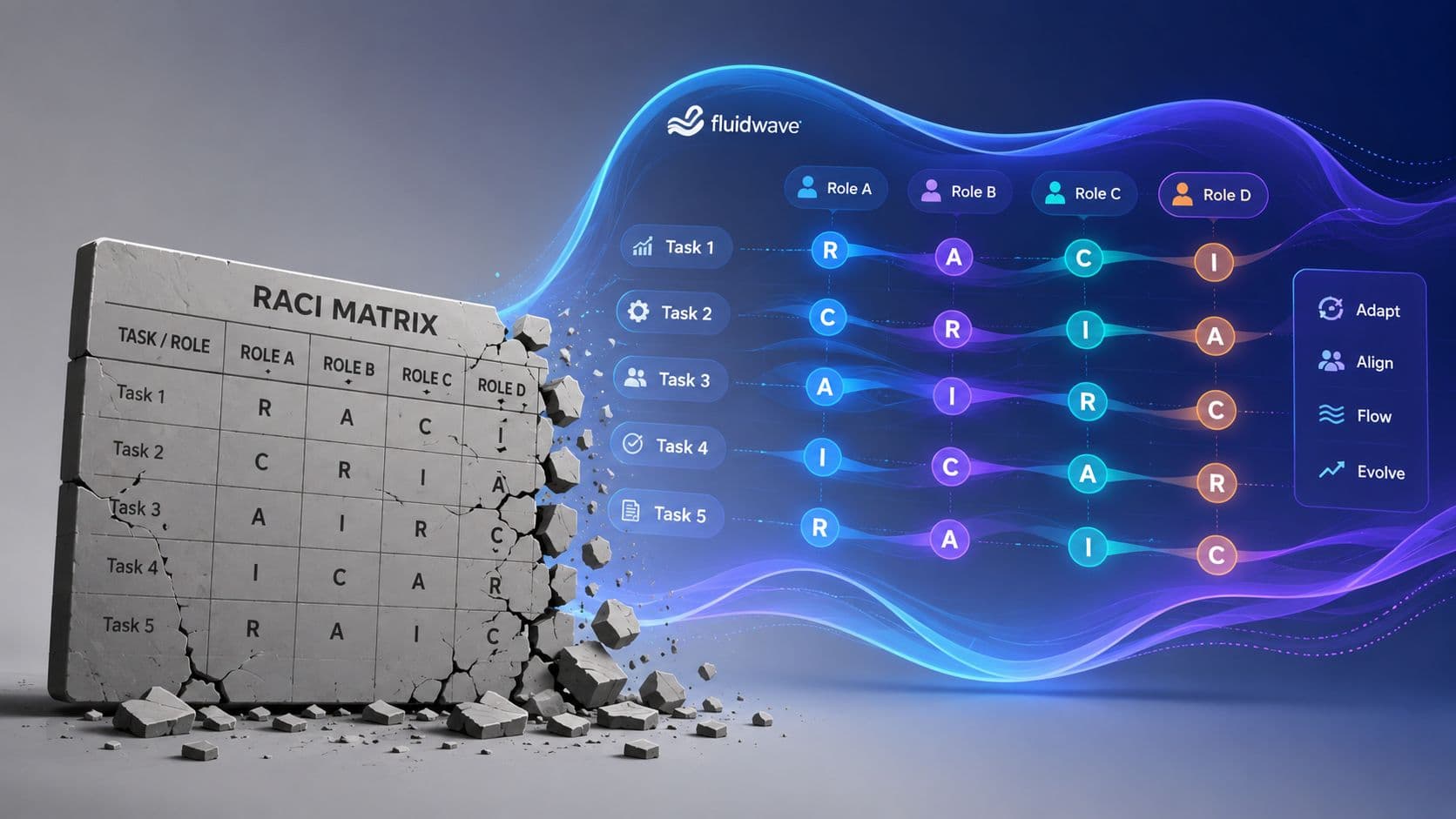
Translate RACI into live workflow behavior
The practical move is to stop thinking of RACI as a separate chart you maintain on the side. Instead, map the logic into the system where the team already manages tasks and communication.
In a dynamic workspace, the roles can be represented like this:
- Accountable: The task owner or final approver
- Responsible: The assignee or execution lead
- Consulted: People added for comments, review, or approval input
- Informed: Followers, watchers, or stakeholders receiving status updates
That doesn't mean the matrix disappears. It means the matrix becomes operational. Ownership isn't trapped in a spreadsheet tab. It's attached to the actual task, decision, or handoff.
What modern teams need from the template
The old version of a RACI matrix template answers, “Who owns this?” A modern version also needs to answer, “How will everyone know when that changes?”
That requires a few things spreadsheet templates rarely handle well:
- Version visibility: People can see when ownership changed and why.
- Automated notifications: Informed stakeholders don't need manual chasing.
- Multiple views: Teams can review ownership in list, table, calendar, or Kanban format depending on the project.
- Reusable structures: Templates can be duplicated without rebuilding role logic every time.
If your team wants a repeatable setup, it helps to think in terms of reusable workflow structures, not only reusable sheets. This guide on how to make a template is useful for that mindset shift.
A RACI chart becomes far more useful when ownership is tied to living tasks, not a document someone remembers to open before the weekly status call.
What actually improves when the system is live
When responsibility is embedded in day-to-day work, the familiar RACI problems shrink. People don't ask who owns a deliverable because the owner is attached to the task. Consulted stakeholders can weigh in where needed without getting copied on everything. Informed leaders can follow progress without becoming blockers.
That's a significant upgrade. The framework stays the same. The maintenance burden drops because the chart isn't separate from execution anymore.
Beyond the Matrix to a Culture of Clarity
A project rarely slips because the team lacks a template. It slips because ownership gets fuzzy the moment priorities change, another stakeholder joins, or a task moves without the roles being updated.
That is why the actual goal is not a polished RACI matrix sitting in a shared drive. The goal is a team that can answer ownership questions in seconds because responsibility is already visible in the work.
Clarity is a working habit
Teams that handle responsibility well do a few things consistently. They assign one clear owner to the outcome, keep consultation tight, and separate visibility from decision-making. Those sound simple, but they break down fast in static spreadsheets. I have seen solid RACI charts become useless within two weeks because the project changed and nobody updated the file.
The better habit is to check role clarity at the same time work is assigned and reviewed.
- Who owns the result: Name the person accountable for the outcome.
- Who completes the work: Make execution visible so handoffs do not get missed.
- Who gives input: Ask for input from the people who can improve the decision.
- Who needs updates: Keep stakeholders informed without pulling them into every approval.
One practical rule helps here. Keep consulted roles narrow. Once too many people are marked C, decisions slow down, comments conflict, and the accountable owner starts waiting for consensus that was never required.
The matrix is only the starting point
A RACI chart gives teams a shared way to talk about roles. The ultimate test is whether that logic holds up after kickoff.
If the chart lives in a spreadsheet and the work lives somewhere else, teams drift. Task owners change. New reviewers get added informally. Status updates happen in chat instead of in the system the team is supposed to trust. At that point, the matrix stops guiding execution and becomes a document people reference only when something goes wrong.
A dynamic setup fixes that problem. In Fluidwave, ownership, collaboration, and updates can sit inside the workflow itself. When a task changes hands, the system reflects it. When someone only needs visibility, they can follow progress without turning into an accidental approver. That is the shift from documenting responsibility to operationalizing it.
The payoff looks like this:
| Team behavior | What changes |
|---|---|
| Ownership is reviewed in the workflow | Fewer dropped tasks and less duplicate work |
| Consultation stays limited | Decisions move faster and meetings stay smaller |
| Visibility is built into updates | Stakeholders stay informed without slowing delivery |
| Roles change with the project | The RACI logic stays useful after kickoff |
A good RACI matrix template gives teams a starting structure. A healthy operating culture keeps that structure current, visible, and tied to real work. That is usually the difference between a chart people admire and a system people consistently use.
If your team is tired of static spreadsheets that go stale the moment roles shift, Fluidwave is worth a look. It gives you a practical way to turn ownership, delegation, collaboration, and updates into part of the workflow itself, so responsibility stays clear while the work keeps moving.
Focus on What Matters.
Experience lightning-fast task management with AI-powered workflows. Our automation helps busy professionals save 4+ hours weekly.