What does it mean to delegate effectively? Go beyond tasks. Learn frameworks, benefits, and tools to boost productivity and empower your team.
June 30, 2026 (3mo ago)
What Does IT Mean to Delegate: Delegate Effectively
What does it mean to delegate effectively? Go beyond tasks. Learn frameworks, benefits, and tools to boost productivity and empower your team.
← Back to blog
Your task list is full. Your calendar is worse. You're approving small decisions you shouldn't be touching, fixing work that should've been right the first time, and telling yourself you'll delegate once things calm down.
They usually don't.
Most managers hit this point. Founders do too. So do team leads who got promoted because they were excellent individual contributors. The trap is thinking delegation means pushing work away. It doesn't. If that's how you use it, people get confused, standards slip, and the task lands right back on your desk.
What does it mean to delegate? It means transferring a piece of work in a way that also transfers enough authority to complete it, while you still remain accountable for the outcome. That's a management skill, not a clerical move. Done well, it reduces your operational load, develops judgment in other people, and gives your team room to grow. Done badly, it creates rework with extra steps.
What Delegation Really Is and What It Is Not
A familiar scene: a manager says, “Can you handle this?” The employee says yes. Two days later, the manager is answering the same questions, rewriting the draft, and stepping into every decision anyway.
That wasn't delegation. That was task dumping.
The term 'delegation' possesses a more precise meaning than is often recognized. In management, it's the intentional transfer of tasks from one person to another to reduce a manager's workload by assigning responsibility to capable subordinates. It also requires a system: clear resources, time limits, authority to act, and a shared understanding of what success looks like. Research summarized in the Expert Journals paper on delegation describes it as more than a one-way command. It's a two-way process built on trust, competence, and communication, with the manager still ultimately accountable for the result (management research on delegation).
What people confuse with delegation
A lot of bad delegation comes from mixing up four very different moves:
- Assigning a task: You tell someone to do a thing.
- Requesting help: You ask for temporary support, but keep control.
- Abdicating: You walk away and hope.
- Delegating: You transfer defined work, authority, and responsibility, then stay accountable.
That distinction matters because the employee experiences each one differently. If you assign a task but keep every decision, they become an errand runner. If you abdicate, they inherit risk without support. If you delegate, they get room to think and act.
Delegation is not about getting rid of work you don't like. It's about placing work where it can be done well, while building someone else's capacity in the process.
The part managers resist
Managers often avoid delegation for reasons that feel rational. It's faster to do it yourself. You know your quality bar. You don't want to burden the team. You're worried mistakes will reflect on you.
Some of that is true. In the short term, delegation can feel slower.
But if you never hand over meaningful work, you train your team to wait for instructions and you train yourself to stay buried in execution. Over time, that becomes a leadership problem. The point isn't to offload. The point is to multiply capability.
The Three Pillars of Successful Delegation
The cleanest way to understand delegation is to separate authority, responsibility, and accountability.
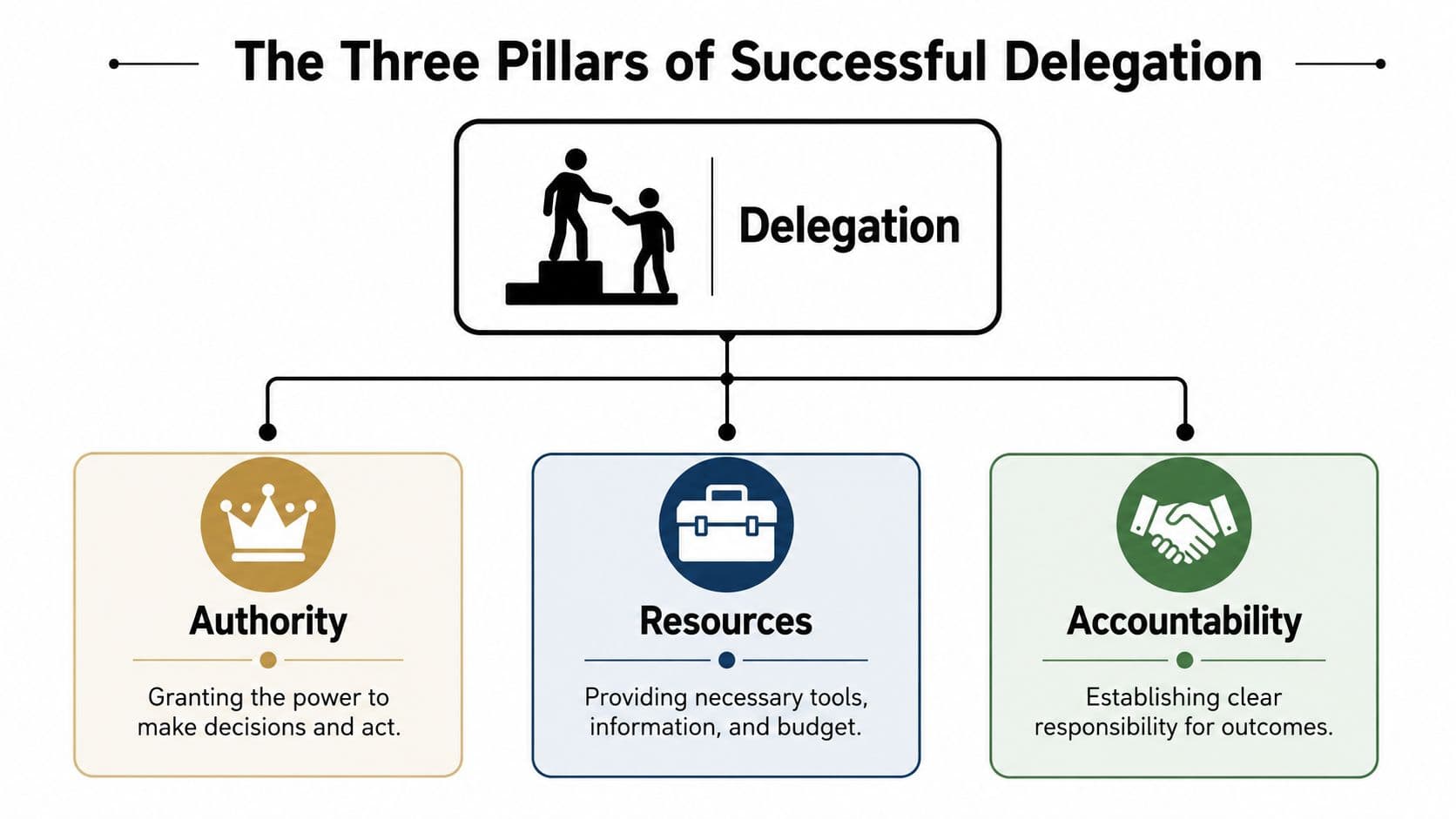
A useful analogy is a film director and a cinematographer. The director owns the film. That doesn't change. But the cinematographer needs real authority over lighting, framing, and camera choices to deliver the scene. If the director says, “You're responsible for this shot,” but then withholds every decision, the cinematographer can't do the work properly.
That's what happens in teams all the time.
According to Leadership IQ's explanation of delegation, in organizational management, “to delegate” means the structured transfer of authority and task responsibility while retaining ultimate accountability. It also describes four phases: allocation of duties, delegation of authority, assignment of responsibilities, and creation of accountability.
Authority
Authority is the permission to decide and act.
Without it, delegation stalls. Someone may technically own the task but still need approval for every move. That creates bottlenecks, hesitation, and constant escalation. If you want someone to manage a vendor, they need the authority to schedule meetings, request files, and make agreed decisions inside clear boundaries.
A practical test is simple: can the person complete the work without repeatedly coming back for ordinary decisions? If not, you probably assigned responsibility without authority.
Responsibility
Responsibility is the obligation to do the work.
Expectations need to become concrete. What result is due? By when? With what resources? What constraints matter? Responsibility should be specific enough that the person can tell whether they're on track or off course without guessing.
The strongest managers don't just say, “Take care of this.” They define the result and the guardrails.
Accountability
Accountability stays with the delegator.
That's the part many leaders either forget or resent. If a client deliverable fails, “I delegated it” won't save you. Accountability doesn't move down the org chart just because a task did.
Practical rule: Delegate the work. Share the ownership of execution. Keep ownership of the outcome.
The pillar people forget
The image in this section names resources for a reason. In real work, authority without resources is a setup. If people don't have the information, time, access, budget, or tools to finish the job, they aren't equipped. They're exposed.
That's why good delegation feels structured, not casual. You're not just handing over effort. You're creating the conditions for somebody else to succeed.
The Strategic Payoffs and Hidden Risks
Delegation pays off when it moves beyond random task assignment and becomes a deliberate operating habit. Leaders who delegate enough real operational authority create more room for strategic work, and teams get more chances to practice judgment.
The benchmark data is hard to ignore. In high-performance teams, leaders who delegate 60 to 70% of operational decision-making authority see a 25% increase in productivity and reclaim 4 hours per week of their own workload, according to corporate efficiency data summarized by GeeksforGeeks.
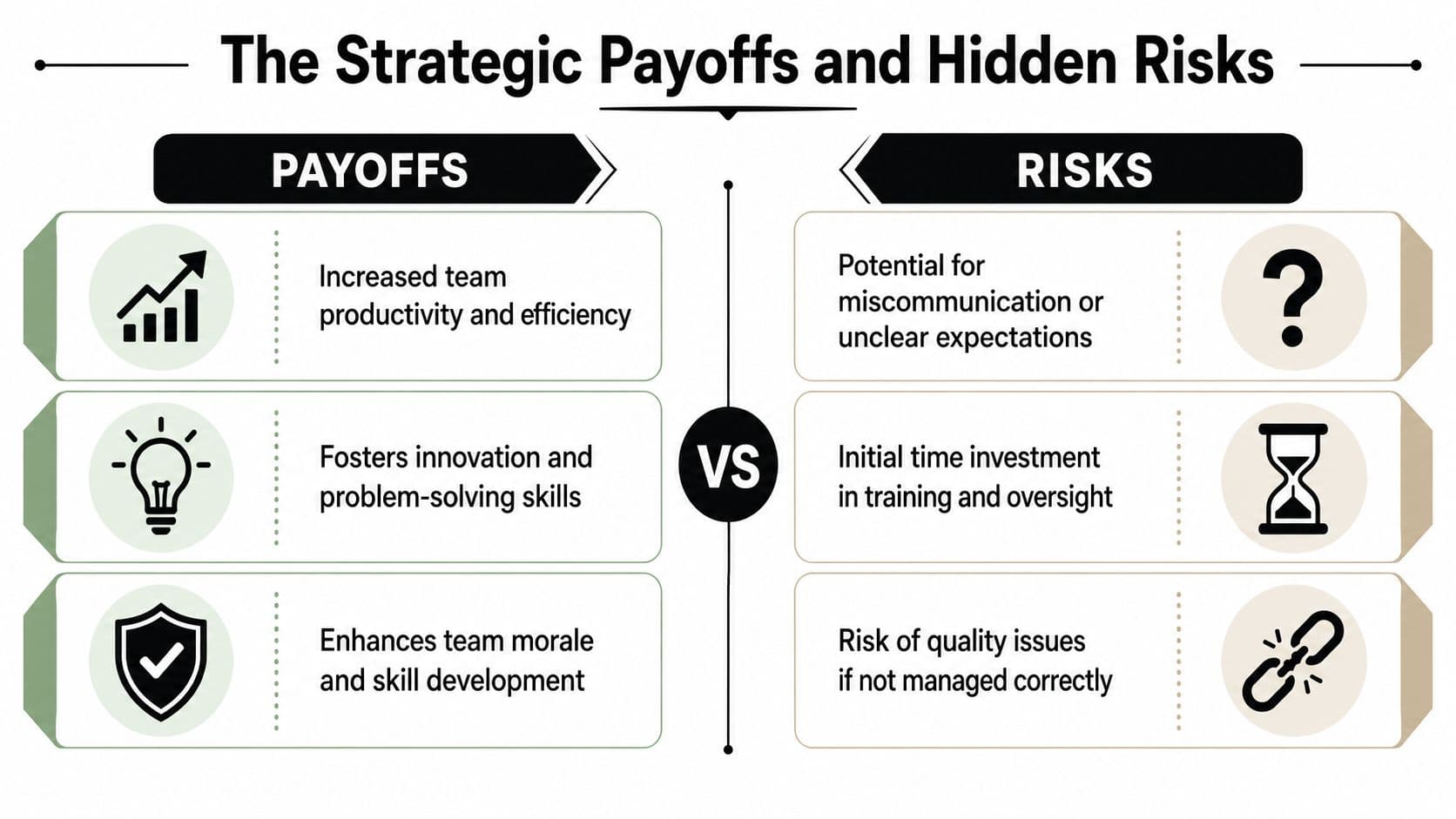
That's the payoff on paper. In practice, the gains usually show up in three places.
Where the upside shows up fast
- Manager focus improves: You stop spending prime attention on recurring operational decisions.
- Team capability grows: People learn how to think through trade-offs instead of waiting for answers.
- Work moves faster: Fewer approvals means less drag between decision and action.
If you're trying to make a business case for changing how your team works, it helps to compare the actual cost of holding everything centrally. A useful frame is the broader trade-off between time, output, and impact, which is similar to the thinking in Fluidwave's piece on costs vs. benefits of delegation and support models.
Where delegation fails
The risks are real, and pretending otherwise makes bad advice.
The first risk is unclear expectations. People don't know what done looks like, so they produce something reasonable but wrong.
The second is authority gaps. They're responsible, but they still need you for every small move.
The third is reverse delegation. The task comes back upward in the form of endless questions, draft rewrites, and “just checking” messages.
If someone needs your approval for every meaningful step, you haven't scaled yourself. You've just added supervision overhead.
The trade-off managers need to accept
There's usually an upfront cost. You'll spend time clarifying the result, choosing the right person, and checking progress. That can feel inefficient, especially if you're under pressure.
But the alternative is worse. You remain the default owner of every non-strategic task, and the team never gets enough space to improve. Delegation is one of those decisions that often costs more today so tomorrow doesn't stay overloaded.
The hidden risk isn't that delegation might fail once. It's that avoiding it becomes your team's permanent operating model.
What to Delegate and What You Must Own
Most leaders don't need more encouragement to delegate. They need better judgment about what to hand off and what to keep.
The strongest filter is this: delegate work that amplifies effort, repeatability, or another person's capability. Keep work that defines direction, carries sensitive judgment, or requires your direct credibility.
Intentional delegation matters commercially too. Research from The Alternative Board says leaders who match tasks to people based on skills and appetite for responsibility can boost revenue by 33% (The Alternative Board on delegation benefits).
Delegation Decision Matrix
| Delegate These (Tasks that Empower) | Keep These (Tasks You Must Own) |
|---|---|
| Recurring administrative work with clear rules | Final accountability for strategy and priorities |
| Research, preparation, and first drafts | Performance conversations that require your judgment |
| Process-driven follow-ups and coordination | High-stakes crisis decisions |
| Reporting, scheduling, data cleanup, and documentation | Culture-setting decisions and values-based calls |
| Project components that help someone stretch a skill | Final approval on sensitive hiring or firing choices |
| Operational decisions with defined guardrails | Stakeholder issues where your direct trust is the asset |
Good delegation candidates
Some tasks are almost made for delegation:
- Repeatable work: If the task follows a pattern, someone else can usually own it with a documented process.
- Preparation work: Briefs, research packs, draft decks, status gathering, and coordination are often ideal.
- Development opportunities: If a team member is ready for a bigger scope, give them a contained piece of it.
- Work that doesn't require your title: A surprising amount of executive busyness exists only because leaders never questioned this point.
If you're running a commercial team, this matters in areas like lead qualification, CRM cleanup, follow-up workflows, and coordination around outreach. For founders thinking about scaling B2B sales smart, that distinction between core ownership and delegated execution becomes especially important.
Work you should be careful not to hand off
Some responsibilities can involve support from others but still need your direct ownership:
- Strategic direction: You can gather input. You can't outsource judgment on where the business is going.
- Final people calls: You can delegate parts of hiring and coaching, but not the leadership accountability behind them.
- Crisis response: During ambiguity, people look for a clear owner.
- Relationship repair: If trust has been damaged with a client or employee, your presence often matters more than process.
A useful companion to this decision is role clarity. Teams struggle when delegated work sits in a grey zone. In such cases, a simple role map helps, especially if responsibilities are already fuzzy across functions. Fluidwave's article on team roles and responsibilities is a practical reference for that problem.
A 5-Step Framework for Flawless Delegation
Managers often treat delegation like a soft skill. In reality, it works better as a checklist.
Healthcare uses a rigorous model called the Five Rights of Delegation: right task, right circumstance, right person, right supervision, and right direction. It exists because mistakes in delegation can create real harm. A 2024 StatPearls review at NCBI notes that 78% of delegation errors stem from misidentifying the right person or the right circumstance. Business isn't clinical care, but the discipline transfers well.
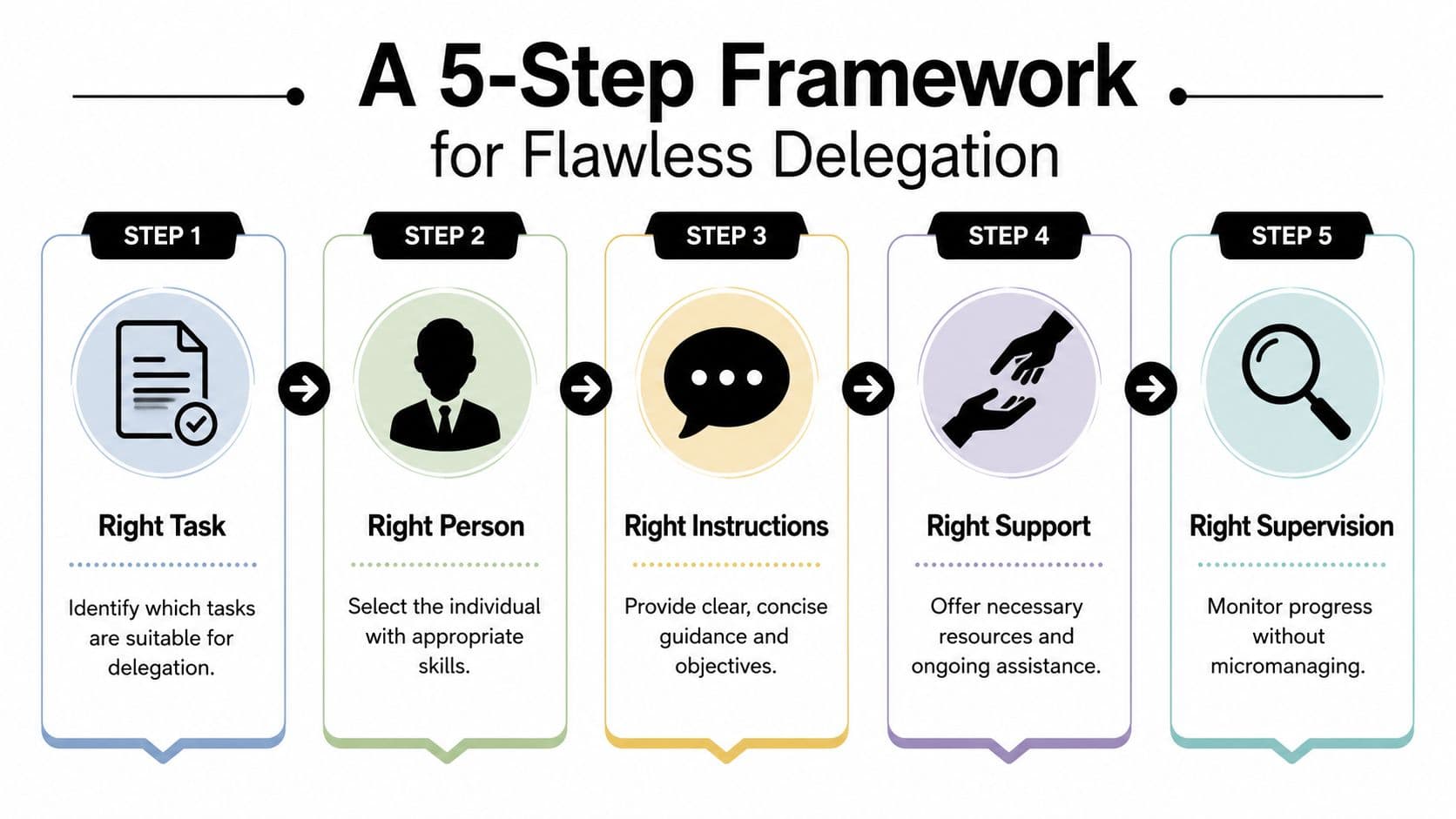
1. Right task
Start by asking whether the work is suitable to delegate at all.
Not every task should move. Good candidates are clear, bounded, and teachable. If the work depends on your confidential judgment, your formal authority, or a sensitive relationship, keep it. If the task is operational, recurring, or a strong development opportunity, it's a better fit.
A simple four-part filter helps here. Know what needs to be delegated, understand the employee's skill level, know the goal, and know what resources are on hand, as outlined in Study.com's lesson on delegation in management.
2. Right person
Many leaders misstep. They delegate to whoever is available, not whoever is suited.
Capacity matters, but so do skill, judgment, and appetite for ownership. A task that stretches someone slightly can be healthy. A task that demands judgment they don't yet have will create anxiety and rework.
The right person isn't always the person with the emptiest calendar. It's the person who can handle the decision load involved.
3. Right direction
Vague delegation creates predictable confusion. “Can you take this on?” is not direction.
Use a clear handoff instead. This template works:
Task: [What needs to be done]
Outcome: [What success looks like]
Deadline: [When it's due]
Guardrails: [Budget, tone, approvals, limits]
Resources: [Files, tools, people, context]
Check-in point: [When we'll review progress]
Escalate if: [What should come back to me]
That level of clarity prevents most avoidable back-and-forth.
A quick visual walkthrough can help if you want another perspective on how to think through the handoff:
4. Right supervision
Supervision doesn't mean hovering.
Set checkpoints based on risk and complexity. A simple task may need one midpoint review. A complex one may need milestone check-ins. The key is to review progress early enough to correct course without taking the work back.
Open communication matters here. The delegation process is often described in four phases, from preparation through closure, and that model emphasizes communication channels and feedback loops rather than one-time instructions (Wikipedia's overview of delegation phases).
5. Right circumstance
Timing, context, and operating conditions matter more than people admit.
A strong employee can still fail if the task arrives during a deadline pileup, without the necessary access, or in the middle of shifting priorities. Right circumstance means checking whether the environment supports success.
When managers skip this step, they often blame the person. The problem was the setup.
How Tools Like Fluidwave Streamline the Process
Delegation breaks down in the gaps between intention and execution. The work sounds clear in your head, but the task description is fuzzy. The assignee is capable, but they don't have the files. The deadline exists, but nobody can see progress without asking for updates.
That's where tools help. Not because software can replace judgment, but because a good system makes judgment easier to apply consistently.

What modern tools actually solve
Delegation works better when the tool forces clarity on a few basics:
- Task definition: The work has a clear scope, deadline, and expected result.
- Assignment: The task goes to a specific person or assistant, not a vague shared inbox.
- Tracking: Progress is visible without constant status meetings.
- Limits: Budget, approvals, and due dates are attached to the task itself.
The broader principle is established in guidance on business growth and delegation. Effective delegation helps teams achieve more within a stipulated time frame, and it works best when leaders distinguish between broad authority and clearly defined tasks with limits (LinkedIn's overview of delegation for business growth).
Applying that to AI and human support
In practice, hybrid models become particularly interesting. Some work is ideal for automation. Some still needs a human assistant with context and judgment. The job of the manager is to route the task well.
If you're exploring that blend, tools such as Donely's AI agent deployment show how teams are starting to assign certain operational work to AI agents, while keeping more nuanced tasks with people. The key question isn't whether a task is “delegable” in the abstract. It's whether it should go to software, a human, or a combination of both.
One example in this space is Fluidwave's task automation workflow approach. It combines task organization with delegation to human virtual assistants on a pay-per-task basis, which is useful when you need structured handoffs, visible deadlines, and progress tracking in one place. That doesn't remove the leadership skill. It just removes some of the administrative friction around it.
Tools don't fix weak delegation logic. They make strong delegation easier to repeat.
Your First Step to Better Leadership
Delegation is one of the clearest signs that someone has moved from doing the work to leading the work. That shift feels uncomfortable at first because it exposes every weakness in your management habits. If you're vague, people get vague outcomes. If you hold authority too tightly, they stall. If you disappear, standards drift.
That's why delegation is a skill, not a switch.
The practical meaning of delegation is straightforward. You choose work that should move, match it to the right person, define the outcome, provide enough authority and support, and stay accountable for the result. The deeper meaning is leadership development. Every well-delegated task gives someone else a chance to build judgment, confidence, and ownership.
Start small. Pick one low-risk task from your list today. Not the hardest one. Not the most political one. Choose something clear, useful, and slightly time-consuming. Then hand it off using the Five Rights. Be specific about the result. Set one check-in. Resist the urge to grab it back at the first wobble.
That's how managers stop being bottlenecks. It's also how teams become stronger than the person leading them.
If you want a practical system for turning loose to-dos into structured delegation, Fluidwave is worth a look. It gives you a way to define tasks, assign them clearly, track progress, and delegate selected work to human assistants without turning your workflow into another management project.
Focus on What Matters.
Experience lightning-fast task management with AI-powered workflows. Our automation helps busy professionals save 4+ hours weekly.