Stop confusion and boost productivity. Learn to define clear team roles and responsibilities with proven frameworks like RACI for unstoppable team performance.
March 24, 2026 (6mo ago)
Defining Team Roles and Responsibilities for High Performance
Stop confusion and boost productivity. Learn to define clear team roles and responsibilities with proven frameworks like RACI for unstoppable team performance.
← Back to blog
Defining team roles and responsibilities is all about making it crystal clear who owns what, who makes the final call, and who just needs to be kept in the loop. It’s the playbook that makes sure everyone knows their part, preventing confusion and creating real accountability.
The High Cost of Unclear Team Roles

Does your team ever feel like it’s just spinning its wheels? You see talented people working hard, but key projects stall, deadlines get missed, and a sense of frustration starts to creep in. This isn't just a minor annoyance; it's a classic symptom of a much deeper problem: poorly defined roles and responsibilities.
When nobody knows who truly owns a task or a decision, chaos isn't far behind. This ambiguity is a direct threat to your bottom line. It shows up as duplicated work, critical tasks falling through the cracks, and a slow, steady drain on team morale.
The Real-World Consequences of Role Ambiguity
Think about it. Have you ever seen two marketing specialists accidentally spend days building the exact same social media campaign? Or a critical bug report that sits untouched for a week because every developer assumed someone else was on it? These aren't just hypotheticals; they happen every single day on teams without a clear operational playbook.
This lack of clarity absolutely cripples productivity and breeds resentment. Team members start hesitating to take initiative, afraid they might step on someone's toes. At the same time, others might overreach, sparking turf wars that pull focus away from the actual work.
A team without defined roles is like an orchestra without a conductor. The musicians might be brilliant, but without clear direction, all you get is noise, not music.
The financial and cultural fallout is massive. Research shows that companies with highly engaged teams—where roles are clear—are 23% more profitable than their competitors. Yet, an astonishing 86% of employees and executives point to a lack of collaboration as the cause of workplace failures. And 97% agree that a lack of alignment directly torpedoes project outcomes, as detailed in recent workplace collaboration statistics.
To see if your team is suffering from role ambiguity, here’s a quick health check.
Role Clarity Health Check
This table shows the common pain points that arise from ambiguity versus the positive outcomes you get from having well-defined roles.
| Symptom of Unclear Roles | Outcome of Clear Roles |
|---|---|
| Tasks are missed or duplicated. | Everyone has clear ownership, ensuring full coverage. |
| Decisions get stuck in committee. | There's a designated decision-maker for faster progress. |
| Team members feel frustrated or disengaged. | People feel empowered and valued for their contribution. |
| Conflict arises over "who does what." | Collaboration is smooth because boundaries are known. |
| Blame is common when things go wrong. | Accountability is a natural part of the culture. |
If the left column looks a little too familiar, don't worry—it's a fixable problem.
From Frustration to Focus
The good news is that you can absolutely turn this around. Establishing clear roles and responsibilities is the most powerful first step any team can take to trade chaos for clarity. It’s about building a system where everyone understands their unique contribution and how it plugs into the team's wider success.
This goes way beyond just handing out job titles. It’s a collaborative effort to define:
- Who is accountable for the final success or failure of a project.
- Who is responsible for doing the hands-on work.
- Who needs to be consulted for their specific expertise.
- Who simply needs to be informed about progress.
Once that structure is in place, the entire dynamic shifts. Duplicated effort vanishes, tasks get done right the first time, and accountability becomes second nature. People feel empowered because they know exactly what’s expected of them and who to go to for what. This solid foundation is non-negotiable for any modern team aiming for peak performance.
Why Traditional Hierarchies Are No Longer Enough
Think about the classic org chart. It’s simple, clean, and has those neat, top-down lines of command that once felt so reassuring. For decades, it was the gold standard for how a business should run. But let’s be honest—in today’s world, that rigid structure often creates more problems than it solves. It’s a relic from an era of factory lines, not flexible, modern work.
The teams we rely on today are anything but static. They’re dynamic, often spread out across the globe, and filled with specialists who collaborate across departments. A rigid hierarchy just can’t keep up with the speed and complexity of how things actually get done now.
The Rise of Dynamic and Matrixed Teams
Work has fundamentally changed. Teams are no longer defined by who sits next to whom in an office. They are fluid groups, assembled to tackle specific projects and often pulling experts from entirely different parts of the company. This has given rise to matrixed organizations, where a person might report to a functional manager for career growth but also to a project lead for their day-to-day tasks.
In this kind of setup, a job title tells you very little. A software engineer isn’t just an engineer anymore. On Monday, they might be the technical lead for a new feature launch, and by Wednesday, they could be consulting on a marketing analytics project. Project-based accountability is the new reality.
This fluidity, however, brings its own challenges. When one person answers to multiple leaders or floats between projects, the old command-and-control model completely breaks down. Without a better way of defining who does what, you end up with confusion, bottlenecks, and a whole lot of finger-pointing.
Moving from Fixed Titles to Fluid Accountability
The most forward-thinking organizations are learning to treat roles less like fixed positions and more like flexible assignments. The question is shifting from, "What's your job title?" to, "What are you responsible for on this project?" This approach builds agility, allowing teams to pivot quickly without being boxed in by an org chart.
A hierarchy is designed for control and stability. A modern team needs a system designed for speed and adaptability. The goal is no longer to just manage people, but to orchestrate contributions effectively.
This model also requires a different kind of leadership. Instead of commanding from the top, leaders must empower their teams by providing clear context and delegating real authority. If you’re curious about what this looks like in practice, take a look at our guide on the delegative leadership style, which is perfectly suited for these modern team structures.
This new way of working demands a clear, accessible system for mapping out who is accountable for what. It’s not about getting rid of structure entirely—it’s about swapping a rigid, outdated one for a flexible framework that reflects how work actually happens today. This is where defining team roles and responsibilities becomes a critical, ongoing practice, not just a one-time HR task.
Proven Frameworks for Mapping Team Responsibilities
We all know that fuzzy roles and responsibilities lead to chaos. But the solution isn't to wrap your team in bureaucratic red tape. So, how do you map out who does what in a way that’s simple, effective, and doesn't feel like you’re building a corporate machine?
That’s where a good responsibility framework comes in. Think of these not as rigid rules, but as simple tools designed to bring order to your projects. They help you assign team roles and responsibilities with real clarity, making sure every task has an owner and every decision has a clear path forward.
A great first step is to take a hard look at your current team structure. Are you set up for the speed of modern work, or are you held back by an older, more rigid hierarchy?
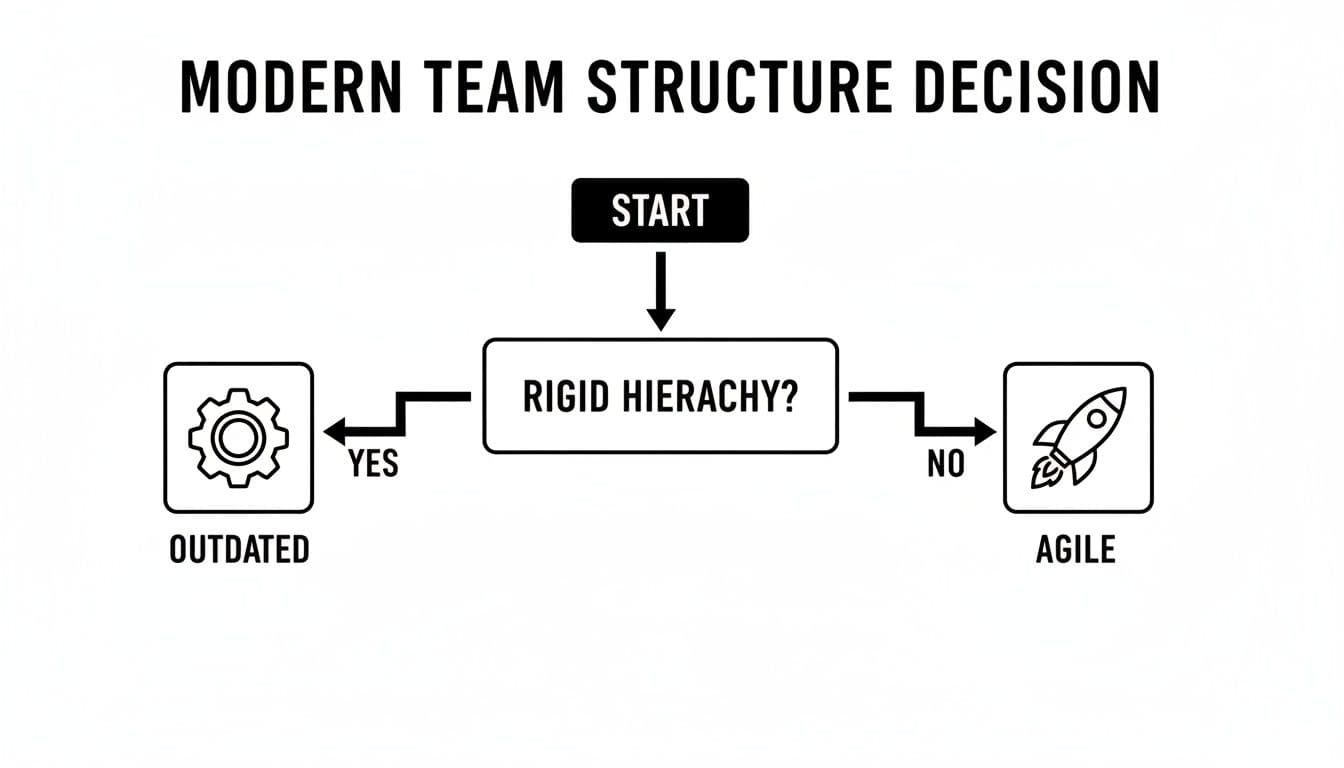
This fork in the road is critical. Teams that operate with agility and trust need lightweight systems to stay aligned, not heavy-handed processes. Let’s look at a few frameworks that are purpose-built to give agile teams the structure they need without slowing them down.
The Classic RACI Chart for Clear Execution
If you've heard of any responsibility framework, it's probably RACI. It’s a classic for a reason: it’s incredibly straightforward and works wonders for clarifying roles on most projects. The acronym defines the four key hats a person can wear for any task.
- Responsible: This is the doer. They are the ones actually performing the work—the person with their hands on the keyboard. You can have more than one.
- Accountable: This is the owner. They are the single person who ultimately answers for the task's success or failure. This role is the buck-stops-here final authority, and there should only ever be one "A."
- Consulted: These are your subject matter experts. You need to get their input before moving forward. This is a two-way conversation to gather feedback and insights.
- Informed: These are the people who just need a heads-up. It's a one-way broadcast to keep them in the loop after a decision is made or work is done. They don’t provide input, they just need to know.
A RACI chart is your go-to when clear execution is the name of the game. It’s the perfect antidote to the "too many cooks" problem and ensures nothing falls through the cracks.
The DACI Framework for Complex Decisions
But what if your project is less about getting a task done and more about making a big, complex decision with lots of stakeholders? That’s where the DACI framework really shines. It's specifically designed to cut through the noise and prevent "analysis paralysis."
The genius of DACI is that it separates the act of doing from the authority to decide. This is a game-changer when you have a room full of people with strong opinions.
Here’s how DACI assigns the roles:
- Driver: The project manager who steers the ship. They corral stakeholders, gather the necessary information, and keep the process moving forward.
- Approver: The single person who makes the final call. They have the ultimate say and veto power.
- Contributors: The experts who provide the input and recommendations. They have a voice, but not a vote.
- Informed: Anyone who needs to be notified once the decision is made.
If you’ve ever sat in a meeting where a decision gets debated in circles, you can immediately see the power of having one designated Approver.
Choosing Your Responsibility Framework
So, which framework should you use? The answer depends entirely on your situation. There's no single "best" model—the right choice is simply the one that brings the most clarity to your team and your specific project.
| Framework | Best For | Key Roles | Primary Benefit |
|---|---|---|---|
| RACI | Straightforward project execution and task management. | Responsible, Accountable, Consulted, Informed | Clarifies who does the work versus who owns the outcome. |
| DACI | Complex, multi-stakeholder decision-making. | Driver, Approver, Contributors, Informed | Prevents gridlock by assigning a single decision-maker. |
| RAPID | High-stakes corporate decisions requiring consensus. | Recommend, Agree, Perform, Input, Decide | Ensures buy-in before a decision is finalized. |
By picking the right framework, you stop talking about team roles and responsibilities in the abstract and start building a concrete system for getting things done.
How to Define and Document Roles That Actually Work
Picking a framework like RACI or DACI is a great start, but it’s just a blueprint. The real test is turning that structure into clear, practical documentation your team will actually use. If you skip this step, even the most brilliant framework becomes just another good idea that never leaves the whiteboard.
This is your chance to build the team’s go-to guide for accountability. The goal isn't to create a rigid set of rules, but to foster a shared understanding that finally puts an end to those dreaded, "Wait, I thought you were doing that," moments.
Running a Collaborative Role-Definition Session
Let’s be honest: defining roles from the top down is the fastest way to get zero buy-in. Real ownership comes from building the roles together as a team. So, get everyone involved in the project into the same room (whether it’s virtual or in-person) for a workshop.
Kick things off by aligning on the team’s core objectives. Before you can hand out responsibilities, everyone has to agree on what you’re all trying to achieve. From there, brainstorm a master list of all the key tasks and decisions required to hit those goals. Now you have a complete inventory of responsibilities that need owners.
Next, introduce your chosen framework (like RACI) and start working through that task list. For each item, open up the floor for discussion:
- Who is the best person to actually do this work (Responsible)?
- Who has the final say and owns the result (Accountable)?
- Whose expertise should we draw on along the way (Consulted)?
- Who simply needs to be kept up to date (Informed)?
This process is incredibly powerful because it forces assumptions and disagreements to the surface right away. It gives everyone a voice, which naturally makes them more invested in the outcome. As you outline what’s expected, these conversations also help with setting clear workplace boundaries by defining each person's scope of work.
From Vague Ideas to Concrete Actions
With your assignments mapped out, it's time to document them with absolute clarity. Vague descriptions are the arch-nemesis of accountability. A responsibility isn't "handle social media"—it's "draft, schedule, and publish three Instagram posts per week, including image creation and caption writing."
To make sure your documentation hits the mark, apply these principles to every single responsibility:
- Be Specific: State the exact deliverable or action. Cut out the jargon and ambiguous language.
- Be Measurable: Attach numbers, deadlines, or clear indicators of success. How will you know the task is done, and done well?
- Be Action-Oriented: Kick off every description with a strong verb like "Create," "Approve," "Analyze," or "Publish."
Think of your responsibility matrix not as a static document, but as a living playbook. It should be the first place anyone looks when they have a question about who owns what. Make it visible and easily accessible to everyone on the team.
This level of detail is what creates genuine clarity. If you're looking for an even more structured way to document entire workflows, check out our guide on how to create Standard Operating Procedures. SOPs are the perfect companion to a well-defined responsibility chart.
Dodging Common Documentation Pitfalls
Even with great intentions, documentation can easily miss the mark. Keep an eye out for these common traps:
-
Making Roles Too Rigid: Your role definitions are there to provide structure, not a straitjacket. The goal is clarity, not suffocating bureaucracy. Make it clear that roles are flexible and people are encouraged to pitch in where needed.
-
Forgetting to Update: A responsibility matrix isn't a "set it and forget it" task. Projects evolve, people move into new roles, and priorities shift. Schedule regular check-ins—maybe quarterly or at the start of a new project—to review and refresh the document.
-
Hiding the Document: The most perfectly crafted role chart is completely useless if nobody can find it. Make sure it lives in a central, shared spot like a team wiki, project management tool, or a shared drive that everyone has instant access to.
Putting Accountability into Practice with Modern Tools
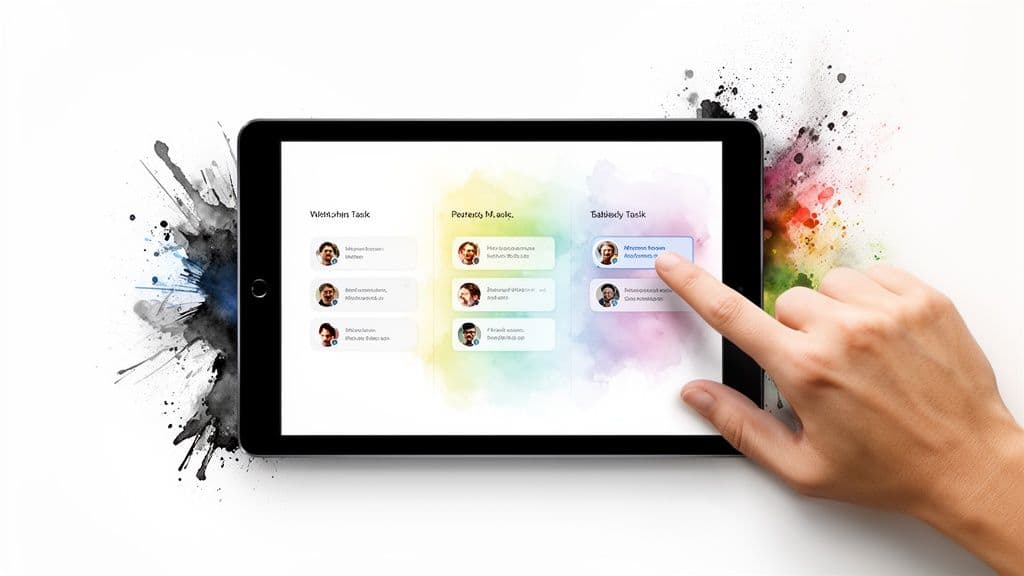
Defining roles on a whiteboard is one thing. Making them stick during the daily grind of deadlines and shifting priorities is another entirely. That responsibility matrix you spent all week creating? It’s practically useless if it's just sitting in a shared drive, collecting digital dust.
This is where the right tools can make all the difference. They take your carefully defined team roles and responsibilities off the page and embed them directly into your team's day-to-day workflow. When a platform like Fluidwave becomes the engine for your work, accountability isn't an afterthought—it's built right in.
Automate Role Assignments with Task Templates
Let’s say you’ve just mapped out your RACI chart for an upcoming product launch. Instead of manually assigning every single task every time you run this playbook, you can build a task template that does the heavy lifting for you.
The moment you kick off that "Product Launch" project, the system knows exactly what to do. The graphic designer automatically gets a task to "Create ad visuals." The copywriter is assigned to "Draft the press release." The project manager is prompted to "Approve the final budget." No more manual delegation, no more "Who was supposed to do that again?"
This kind of automation isn't just about saving time; it's about building consistency and removing the mental load of remembering who does what. For specialized businesses that depend on repeatable processes, this is non-negotiable. For instance, well-designed software for tutoring centers ensures that administrative, teaching, and client-facing responsibilities are handled the same way, every single time.
Unlock Focus with Intelligent Delegation
Let's be real: not every task is a top-priority, strategic initiative. Routine duties like compiling weekly reports or scheduling follow-up meetings can slowly chip away at your team's focus, pulling them from the work that truly drives results.
Intelligent delegation is the answer. With a platform like Fluidwave, you can offload these recurring tasks to skilled virtual assistants on a per-task basis. This smart move keeps your core team locked in on their primary responsibilities while ensuring all the supporting work still gets done. You’re not just assigning tasks; you're strategically protecting your team's most valuable asset: their attention.
When you operationalize your team roles and responsibilities, you stop managing people and start orchestrating outcomes. The system handles the logistics so your team can focus on the work that truly matters.
Gain Clarity Through Integrated Project Views
One of the biggest roadblocks to accountability is a lack of visibility. When work is scattered across disconnected emails, spreadsheets, and personal to-do lists, it’s nearly impossible to get a clear picture of who’s doing what or where a project really stands.
This is a problem modern task management tools were born to solve. By providing a single source of truth—whether it’s a Kanban board, a shared calendar, or a central task list—everyone on the team can see progress in real time.
This transparency makes accountability feel effortless. It’s immediately obvious who owns each task, when it’s due, and what its current status is. The endless "Just checking in..." meetings become a thing of the past because the information is always there for everyone to see. In fact, learning how to use shared to-do lists effectively is a powerful first step toward this kind of clarity. This radical visibility reinforces ownership and helps build a culture where everyone is aligned and accountable for their piece of the puzzle.
Common Pitfalls in Defining Roles and How to Fix Them
Getting your team roles and responsibilities down on paper is a massive win, but don’t expect the process to be perfect right out of the gate. Even with the best frameworks and intentions, most teams hit a few predictable speed bumps along the way. The trick is knowing what they are so you can steer around them.
Think of it this way: you’ve drawn up the blueprint for a new road, but you're still going to find some soft spots and unexpected rocks when you start paving. Let’s walk through the most common issues that can derail your efforts and, more importantly, how to get things back on track.
Pitfall 1: Responsibility Creep
This one is sneaky. Responsibility creep happens when those crystal-clear roles you defined start to get a little fuzzy over time. It might be an enthusiastic team member jumping in to "help" on tasks that aren't theirs, or new responsibilities that pop up without anyone officially owning them. Before you know it, you're back to square one, with everyone wondering who's actually in charge of what.
The Fix: Make role review a regular, lightweight habit. This isn't about adding more meetings to the calendar. It’s just a quick check-in—maybe once a quarter or at the end of a project—to make sure your responsibility matrix still matches reality. Just ask, "Does this chart still look like how we're actually working?"
Pitfall 2: Authority Without Power
This is a classic and deeply frustrating situation. It’s what happens when someone is marked as Responsible for a task but has zero authority to make decisions or get the resources they need. They’re on the hook for an outcome they can't control, which is a fast track to burnout and missed deadlines.
Giving someone responsibility without authority is like asking them to drive a car but refusing to hand over the keys. It’s an exercise in frustration that grinds progress to a halt and erodes trust.
The Fix: Always connect responsibility directly to authority. When you define roles, make it a non-negotiable rule: the person who owns the outcome must also have the power to approve decisions, assign resources, and guide the people doing the work. Build this check right into your process.
Pitfall 3: Disagreements and Role Conflicts
When you first start mapping out roles, I can almost guarantee you’ll hit a point where two people feel they should be the single "Accountable" owner for the same task. Don't panic—this is actually a good sign! It means you're uncovering hidden assumptions that would have caused major friction down the line.
The Fix: Frame this moment as a chance to solve a problem together, not as a turf war.
- Focus on the Goal: Step back and look at the main objective of the task. Which person's role is most directly tied to making sure that goal is met?
- Explain "Accountable" vs. "Consulted": Often, the person who doesn’t get the "A" just wants their expertise valued. Reassuring them that they will be a critical "C" (Consulted) is often all it takes to resolve the conflict.
- Have a Tie-Breaker Ready: If the team is truly stuck, a manager or team lead needs to make the final call. The key is to explain the "why" behind the decision so everyone is on the same page.
By tackling these pitfalls head-on, your responsibility framework stops being a document that collects dust. It becomes a living, breathing tool that helps your team adapt and grow stronger together.
Frequently Asked Questions About Team Roles
As you start defining roles, a few common questions always seem to pop up. Let's tackle them head-on, because getting these details right makes all the difference.
How Often Should We Review Team Roles?
Don't treat your role definitions as a one-and-done task you can file away. Think of them as a living part of your team's operating system. A great rhythm is to review them every quarter or, at a minimum, at the kickoff of any major new project.
This regular check-in ensures the responsibilities on paper still reflect what's happening on the ground. It’s your best defense against "responsibility creep"—that slow, silent process where duties get blurry and people aren't sure who owns what anymore.
What's The Difference Between a Role and a Responsibility?
This one trips people up, but it's pretty straightforward when you break it down.
- A role is the "hat" someone wears on the team. It’s their official title within the context of a project, like Content Strategist or Technical Lead.
- A responsibility is a specific task or outcome they own within that role. It’s the action, like “Approve the final blog post” or “Write the API documentation.”
Think of it this way: a Chef is a role; "prepares the main course" is one of their core responsibilities.
Can One Person Have Multiple Roles in a RACI Chart?
Absolutely. On smaller, leaner teams, this is not just common—it's necessary. You'll often see the same person being both Responsible for doing the work and Accountable for the final outcome.
The one golden rule to remember, though, is that you can only have one "A" (Accountable) person assigned to any given task. This is non-negotiable. Having a single point of accountability eliminates confusion and ensures someone has the final say.
What if Someone Disagrees with Their Assigned Role?
First off, don't panic. This is actually a good thing! It means your team is engaged enough to care, and you’re uncovering a misalignment before it can cause problems down the line.
Disagreements over roles aren't a roadblock; they're a diagnostic tool. They reveal hidden assumptions about ownership that, once resolved, make the entire team stronger and more aligned.
Treat this as an opportunity for conversation, not conflict. The first step is to bring the discussion back to the project's main goals. Then, work together to figure out which role is truly best positioned to drive that outcome. Often, a team member who wants to be Accountable simply wants their expertise to be heard. Making them a key Consulted party can be the perfect solution, giving them a voice while keeping decision-making clear and streamlined.
Ready to stop confusion and start automating your team's workflows? Fluidwave helps you embed roles and responsibilities directly into your tasks, so accountability is built-in, not bolted-on. Get started for free at https://fluidwave.com.
Focus on What Matters.
Experience lightning-fast task management with AI-powered workflows. Our automation helps busy professionals save 4+ hours weekly.