Analyze the costs vs benefits of task delegation. Our guide provides ROI frameworks, calculations, and a checklist to see if automation is right for you.
June 25, 2026 (3mo ago)
Costs vs Benefits: A Guide to Task Delegation ROI
Analyze the costs vs benefits of task delegation. Our guide provides ROI frameworks, calculations, and a checklist to see if automation is right for you.
← Back to blog
You clear your inbox, update the project board, answer three “quick” Slack questions, reschedule a meeting, fix a formatting issue in a deck, and chase one missing document. By lunch, you've been busy the entire morning and moved nothing important forward.
That's the trap. Most professionals don't have a time management problem. They have a valuation problem. They treat every task like it costs the same to keep, and they judge delegation by sticker price instead of total impact.
A proper costs vs benefits analysis changes that. It forces you to count the labor you don't see, the focus you keep breaking, and the strategic work you keep postponing. For founders, managers, freelancers, and especially neurodivergent professionals, that hidden cost can matter more than the direct fee attached to outside help.
The useful question isn't “Can I afford to delegate this?”
It's “What is it costing me to keep doing it myself?”
Is Your To-Do List Costing You More Than You Think
Most overloaded professionals make the same accounting mistake. They compare the price of help with their hourly wage and stop there. That shortcut misses the underlying economics of work.
If you hire or assign work internally, labor doesn't equal salary alone. In March 2026, U.S. Bureau of Labor Statistics data showed that benefit costs for private industry workers averaged $14.01 per hour and represented 30.1% of total compensation, which means labor costs are materially higher than wages alone (BLS compensation cost data). That matters any time you compare doing work in-house versus delegating it.
Early in any costs vs benefits review, it helps to separate three questions:
| Decision lens | What people usually ask | What they should ask |
|---|---|---|
| Direct spend | What does delegation cost? | What is the full cost of doing this internally? |
| Time | How long will it take to hand off? | How much higher-value time does this free up? |
| Attention | Can I just do it faster myself? | What does context switching do to my judgment and output? |
| Risk | What if the work comes back imperfect? | What is the cost of delay, distraction, and repeated low-value work? |
Why busy isn't the same as valuable
Small tasks create a false sense of progress because they close quickly. Strategic work rarely does. Writing a hiring brief, preparing for a client pitch, designing a product decision, or planning a quarter usually requires uninterrupted thought. Administrative clutter keeps stealing that time in fragments.
Practical rule: If a task is repeatable, low-risk, and doesn't require your unique judgment, it belongs in a delegation review.
Where the financial logic starts
A to-do list has a cost structure, whether you model it or not. Every task consumes one or more scarce assets:
- Time: Hours you can't use elsewhere.
- Attention: Cognitive energy that drops with each switch.
- Timing: Delays on work with outsized downstream value.
- Capacity: The ability to take on new opportunities.
That's why costs vs benefits analysis works better than instinct. It gives you a way to price the hidden losses, not just the visible fees.
Defining the Real Costs and True Benefits
A sound delegation decision starts with a complete inventory. Individuals often count the invoice and ignore the rest. That's how they understate cost on one side and understate value on the other.
What belongs on the cost side
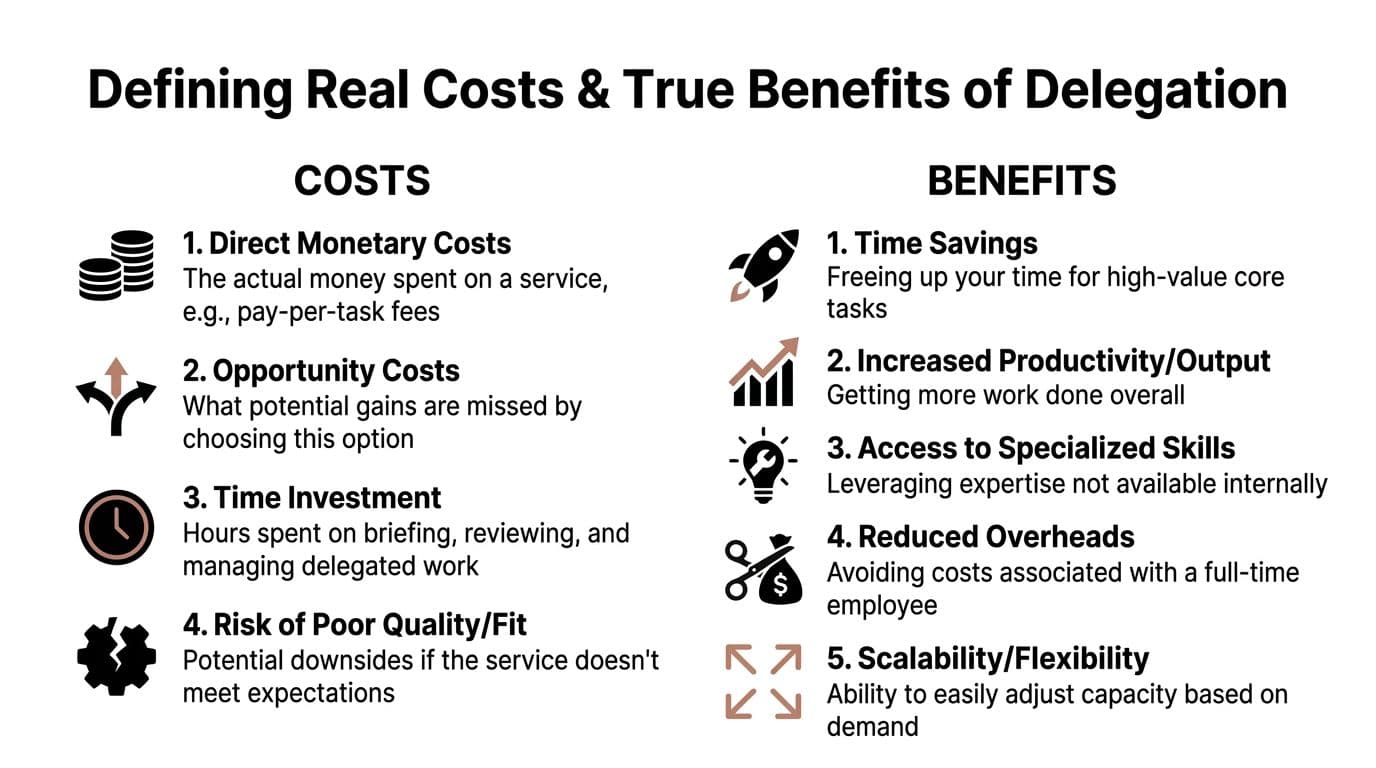
The first cost is obvious. It's the direct fee you pay for a task, project, retainer, or assistant.
The less obvious costs are usually more important:
- Coordination time: Writing instructions, sharing files, clarifying scope.
- Review time: Checking deliverables, approving revisions, giving feedback.
- Transition friction: The short-term slowdown that happens while someone learns your preferences.
- Quality risk: Rework if the task isn't done to the needed standard.
- Opportunity cost: What you give up while doing or managing low-value work.
A useful benchmark comes from benefits administration. The key metric is the Administrative Cost Ratio, which measures the cost of managing a program versus the total spend. That framework is valuable because it highlights a common problem: organizations often underestimate the cost of managing work, not just paying for it. Selerix's overview of employee benefit cost analysis and administrative cost ratio is a good reference point for that concept.
What belongs on the benefit side
Benefits are broader than “hours saved.”
Some are direct and easy to observe:
- Recovered work time: Hours you can redirect to client work, leadership, or planning.
- Greater output: More tasks completed without expanding headcount.
- Flexible capacity: The ability to scale support up or down with demand.
- Reduced overheads: Avoiding the fixed burden tied to full employment.
Some benefits are harder to price, but they're still real:
- Better focus
- Lower mental switching
- Improved consistency on recurring tasks
- More energy for work that requires your judgment
- Less stress from unfinished administrative loops
The biggest mistake in costs vs benefits analysis is treating attention as free.
Why hourly comparisons fail
A simple wage comparison ignores burdened labor cost and ignores the value difference between task types. If your hour is spent on filing, scheduling, inbox cleanup, and formatting, the issue isn't just labor cost. It's task misallocation.
That's why the BLS compensation data matters. Labor has a hidden layer. The direct wage is only part of the picture. When a professional compares delegation to hiring or internal handling, the true baseline isn't wage alone. It includes benefits, management time, and the work displaced by keeping routine tasks on the wrong desk.
A Practical Framework for Calculating Your ROI
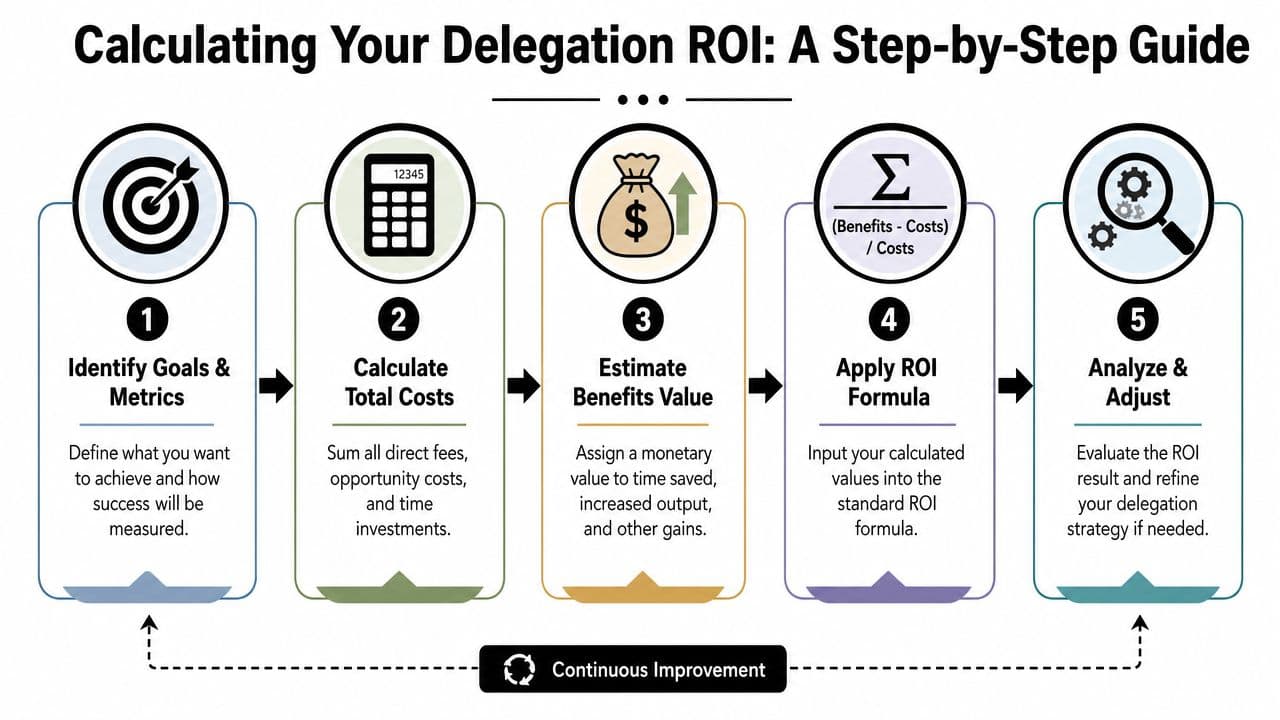
A good delegation decision doesn't need a complicated finance model. It needs a disciplined one. Start with a small set of variables, value them accurately, then test whether the benefits still hold if your assumptions get worse.
Start with your actual hour value
Your hour has at least two values.
The first is replacement value. What would it cost to have someone else handle the work? The second is strategic value. What is that hour worth when you use it for revenue, decision-making, planning, selling, or creative work only you can do?
If you're a freelancer, this can map to billable versus non-billable time. If you're a founder or executive, it maps to the work that shapes growth rather than supports it.
A simple worksheet looks like this:
- List candidate tasks you repeat each week.
- Estimate the time each one consumes.
- Separate execution time from management time.
- Assign a conservative value to the hours you'd recover.
- Subtract the full cost of delegation from the value of time reclaimed.
Use the core formulas
The standard ROI formula is:
ROI = (Benefits - Costs) / Costs
That works well for short-term decisions. For anything recurring, use NPV.
According to the U.S. Department of Health and Human Services discussion of health IT cost-benefit methods, Net Present Value is the Present Value of Future Benefits minus the Present Value of Future Costs, and a positive NPV indicates the project is financially viable (HHS cost-benefit analysis framework).
That sounds technical, but the business meaning is simple. If the present value of what delegation gives back exceeds the present value of what it costs, the decision works financially.
A practical way to test a delegation pilot
Use a three-line model:
-
Benefits
- Value of time recovered
- Value of errors avoided
- Value of faster turnaround or added capacity
-
Costs
- Direct task fees
- Your briefing and review time
- Any rework or correction cost
-
Decision
- Positive ROI for a short pilot
- Positive NPV for a recurring process
Decision shortcut: If the task is frequent, drains focus, and doesn't need your best thinking, test delegation before you optimize your own workflow around it.
If you want a structured worksheet, a delegation ROI calculator can help turn time saved and management effort into a cleaner financial estimate.
Why break-even matters more than enthusiasm
In benchmark analyses of EHR implementations, projected benefits exceeded investment costs, but break-even timing varied widely, from 3 years to 13 years, largely because hidden operating friction changed the result. That lesson matters outside healthcare. A delegation system can look attractive on paper and still disappoint if review, correction, and handoff friction stay too high.
That's also why sensitivity analysis matters. Run the model again with harsher assumptions. Lower the value of time saved. Increase the coordination burden. Assume some rework. If the case still holds, you've got a durable decision instead of wishful math.
The Hidden Opportunity Cost of Not Delegating
The most expensive workflow choice is often the one that feels safest. You keep the task because you know how to do it, you can do it quickly, and you don't want to explain it. That logic works in a single afternoon. It breaks over months.
The clearest evidence comes from executive work allocation. A 2025 McKinsey study found that 40% of executive time is lost to non-strategic activities, creating a $1.2 trillion global opportunity cost annually. That number matters because it reframes delegation. The cost of doing small work yourself isn't only labor. It's the strategic work that never gets done.
The tax on attention
Opportunity cost isn't abstract for knowledge workers. It shows up as interrupted thought.
A founder who spends the morning on scheduling and status chasing may still complete those tasks well. But the pitch memo, hiring decision, or partnership idea that needed uninterrupted reasoning gets pushed to late evening, when judgment is worse and patience is thinner.
For neurodivergent professionals, this gets sharper. Task switching doesn't just take time. It can collapse momentum. The actual loss is often the gap between being “available” and being able to think thoroughly enough to solve the right problem.
Protecting focus isn't a wellness perk. It's an economic decision.
Why inaction looks cheap and isn't
Not delegating avoids a visible expense. It doesn't avoid cost. It only hides cost inside delay, fatigue, fragmented attention, and stalled high-value work.
That's why practical remote support guidance matters. If you're evaluating how to structure handoffs, communication norms, and repeatable support processes, YayRemote's VA remote success guide offers a useful operational lens. The value isn't just hiring advice. It's learning how to reduce the friction that makes leaders keep too much work by default.
A good costs vs benefits analysis should always include one final question: if you keep this task, what important work gets displaced?
That answer is usually more expensive than the fee you were trying to avoid.
Costs vs Benefits in Three Real-World Scenarios
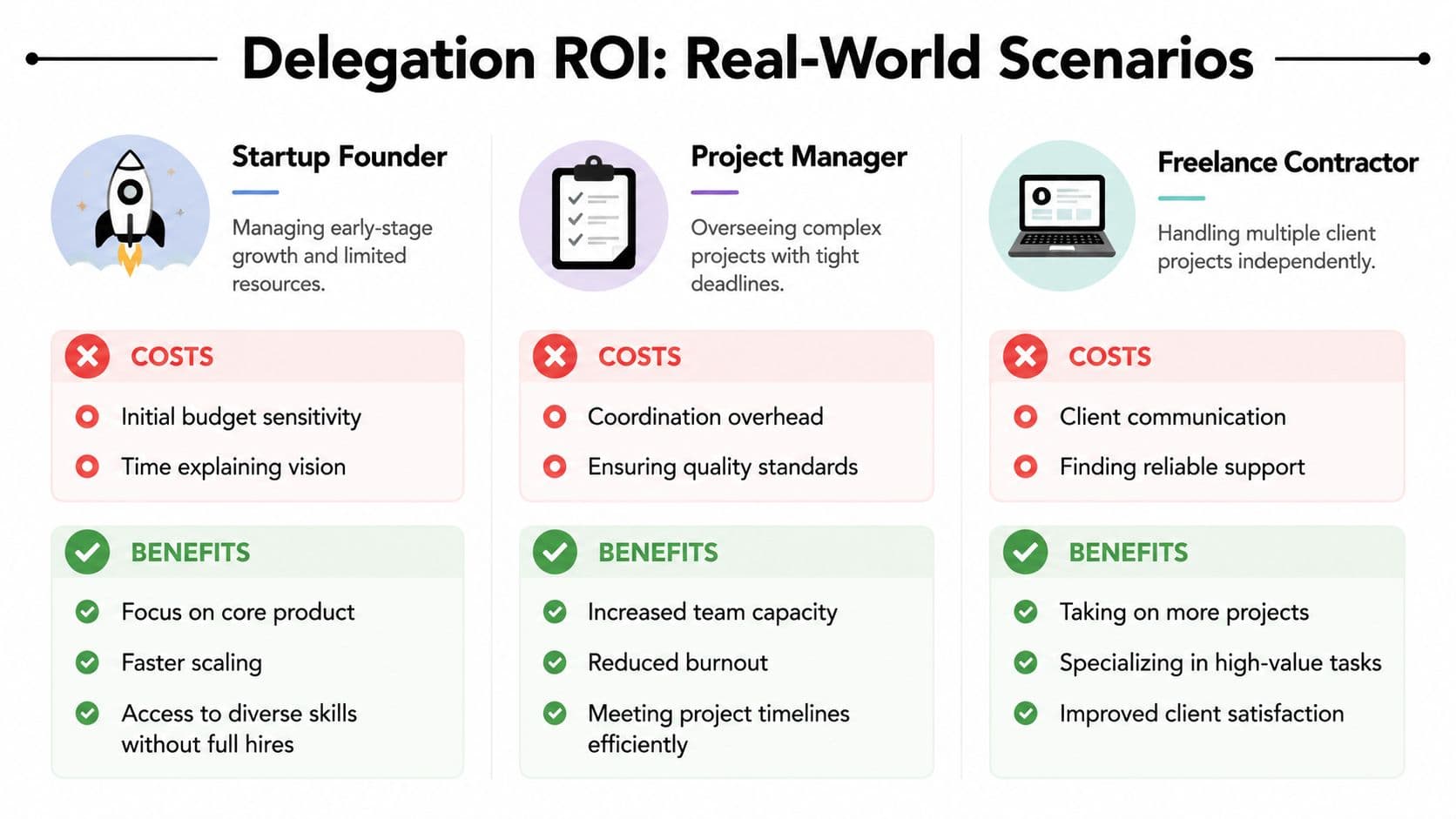
Abstract frameworks are useful. Decisions get clearer when you attach them to actual working lives.
Startup founder
A founder usually hesitates for one reason. Cash feels scarce. So every outside spend gets scrutiny.
That caution is healthy. But founders often apply it unevenly. They inspect the fee for support and ignore the cost of spending prime working hours on inbox triage, calendar wrangling, travel coordination, CRM cleanup, and document formatting.
The better question is whether those tasks block fundraising, product decisions, recruiting, or customer conversations. If they do, the founder isn't saving money by keeping them. They're reallocating expensive founder attention into work with low strategic return.
A helpful benchmark comes from capital budgeting. In one manufacturing case study, a $500,000 investment produced an NPV of $104,925 and a Benefit-Cost Ratio of 1.18, which means benefits exceeded costs by 18%. The point isn't that a founder should expect the same numbers. The point is that a good investment often looks modest at first glance and still clears the test because value compounds after the initial spend.
Project manager
Project managers face a different problem. They're not only managing their own time. They're protecting team bandwidth.
When recurring work like scheduling, status reporting, follow-up reminders, documentation cleanup, and meeting coordination stays manual, the manager often becomes the hub for every small interruption. The team then pays twice. First in the manager's time. Then in the context switching imposed on everyone else.
A manager's costs vs benefits review should focus on questions like these:
- Which tasks repeatedly interrupt delivery work
- Where does low-complexity coordination create delay
- What reporting work could be standardized or delegated
- How much manager attention is spent chasing rather than unblocking
The benefit isn't just reclaimed hours. It's a cleaner operating rhythm for the whole team.
Freelance contractor
Freelancers usually see the math fastest because the trade-off is brutally clear. An hour spent on proposals, invoicing, scheduling, file organization, or admin is an hour not spent on client work.
Still, many freelancers keep everything because control feels efficient. It often isn't. The problem is that non-billable work expands unnoticed and absorbs the best parts of the day.
A freelancer doesn't need to delegate everything. They need to stop doing work that crowds out paid work.
For freelancers, the right test is simple. If an admin task repeatedly steals time from paid delivery, marketing, or client relationships, it belongs on the delegation shortlist.
These three roles look different on paper. The logic is the same in all of them. You're not evaluating whether support has a price. Everything does. You're deciding where your highest-value judgment should go.
How Pay-Per-Task Changes the Equation
The structure of the help you buy matters as much as the amount. Fixed support models create a planning problem before they solve a workflow problem. You commit to hours, retainers, or headcount first, then try to fill the capacity.
Pay-per-task flips that order. You identify the work first, then attach cost directly to completed output.

Why variable cost is easier to justify
Traditional hiring brings fixed commitments, management overhead, and idle-capacity risk. Retainers can create the same issue in smaller form. You pay for availability whether the task flow is heavy or light.
A pay-per-task model is different because it matches spend to actual workload. That reduces one of the biggest obstacles in costs vs benefits decisions: uncertainty. You don't have to predict a full future support need before testing whether delegation works.
The hidden win is operational drag
The smarter comparison isn't “assistant versus no assistant.” It's “administrative burden with this model versus administrative burden with that model.”
The concept of Administrative Cost Ratio, defined as the cost of managing a program versus total spend, is useful here because it exposes the often-ignored cost of coordination. Lower management burden improves the economics even when direct task prices look similar. For readers comparing support models, this explanation of virtual assistant rates is helpful because pricing only makes sense when you pair it with the management load behind it.
One option in this category is Fluidwave, which combines task management, automation, and human delegation on a pay-per-task basis. The financial logic is straightforward. When workflow tools reduce the effort required to assign, track, and complete delegated work, they lower the hidden cost side of the equation as well as the visible one.
Your Delegation Decision Checklist and Next Steps
Don't start with your hardest task. Start with the one you repeat, resent, and can describe clearly.
Use this checklist before you delegate
- Spot repeatable work: Identify a short list of tasks that happen often and follow a pattern.
- Value your time: Use your strategic hour value, not just your wage or salary logic.
- Count management effort: Include briefing, review, and correction time in your estimate.
- Pick a low-risk pilot: Choose work where quality standards are clear and the downside of error is limited.
- Define success in advance: Decide whether success means time recovered, faster turnaround, lower stress, or better consistency.
- Review after one cycle: Keep, refine, or stop based on evidence rather than instinct.
A smart first move
A pilot works best when it's narrow. Delegate one administrative process, one recurring coordination task, or one reporting activity. Track what you spent, how much attention it saved, and whether the handoff reduced or increased friction.
If you need help deciding which tasks belong in that first test, this guide on delegation in management is a practical place to start.
The key is to avoid turning delegation into a philosophical question. It's an operating decision. Run a small experiment, use a real costs vs benefits lens, and let the numbers tell you whether this work still belongs to you.
If your calendar is full but your best work keeps slipping, start with one delegated task and measure the result. Fluidwave gives you a way to organize tasks, automate routine workflow, and assign work to human assistants on a pay-per-task basis, so you can test delegation without building your whole operation around a fixed commitment.
Focus on What Matters.
Experience lightning-fast task management with AI-powered workflows. Our automation helps busy professionals save 4+ hours weekly.