Build a quarterly planning template that turns goals into 90-day results. Steps, metrics, timelines and review tips for busy teams.
September 17, 2026 (2d ago)
Quarterly Planning Template How to Build One That Works
Build a quarterly planning template that turns goals into 90-day results. Steps, metrics, timelines and review tips for busy teams.
← Back to blog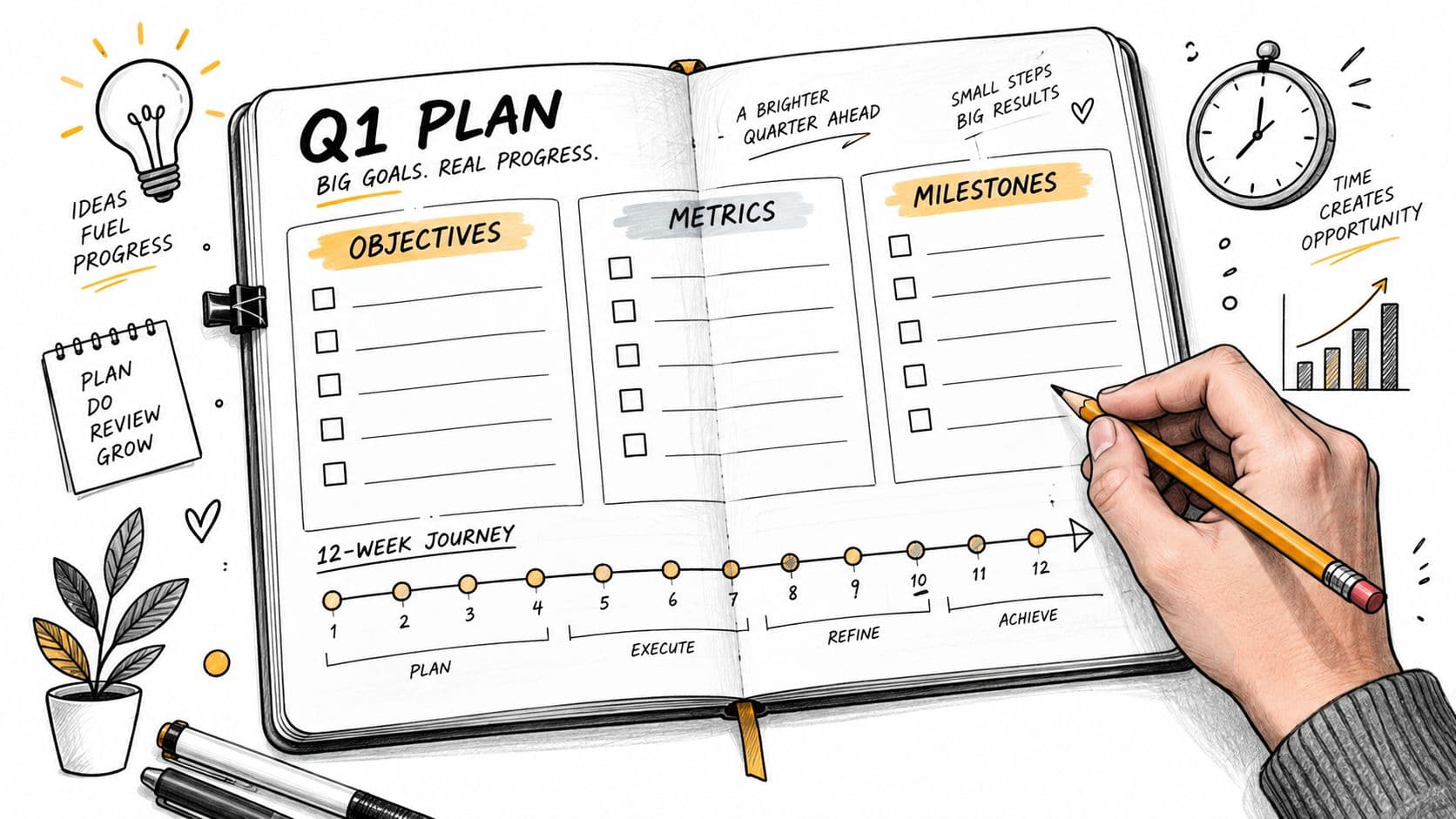
You've got an annual strategy, a list of initiatives, and a calendar filling up faster than the team can work. By the middle of the quarter, priorities compete with urgent requests, dependencies remain unclear, and nobody can say which deliverable matters most. The plan looked ambitious in the kickoff meeting, but it never became an executable operating rhythm.
A practical quarterly planning template solves that problem by forcing strategy into a limited execution window. It gives every priority an owner, makes dependencies visible, and creates enough review points to change direction before the quarter is lost. The key isn't producing a polished document. It's designing a plan the team can realistically absorb.
Why Quarterly Planning Beats Annual Goals Alone
Annual goals provide direction, but they're too distant to manage daily trade-offs. A team may commit to improving retention, launching a product capability, expanding a market, and tightening operations, yet still lack a clear answer to what must happen this month or this week.
Quarterly planning creates the missing layer between strategic intent and weekly work. It commonly uses a 90-day execution cycle, with a 1–2 week process at the quarter boundary for reviewing prior-quarter OKR results, analyzing variance, setting the next quarter's OKRs, and establishing monthly check-ins during execution. Startups.com's definition of quarterly planning describes this cadence as a middle ground between annual continuity and monthly agility.
A distributed product team might start the year with a broad goal to improve customer onboarding. That goal becomes useful only after the team narrows it into a small set of quarterly outcomes, assigns owners, and identifies what evidence will show progress. Without that translation, every department interprets the annual goal differently, and the plan becomes a collection of reasonable tasks rather than a coordinated commitment.
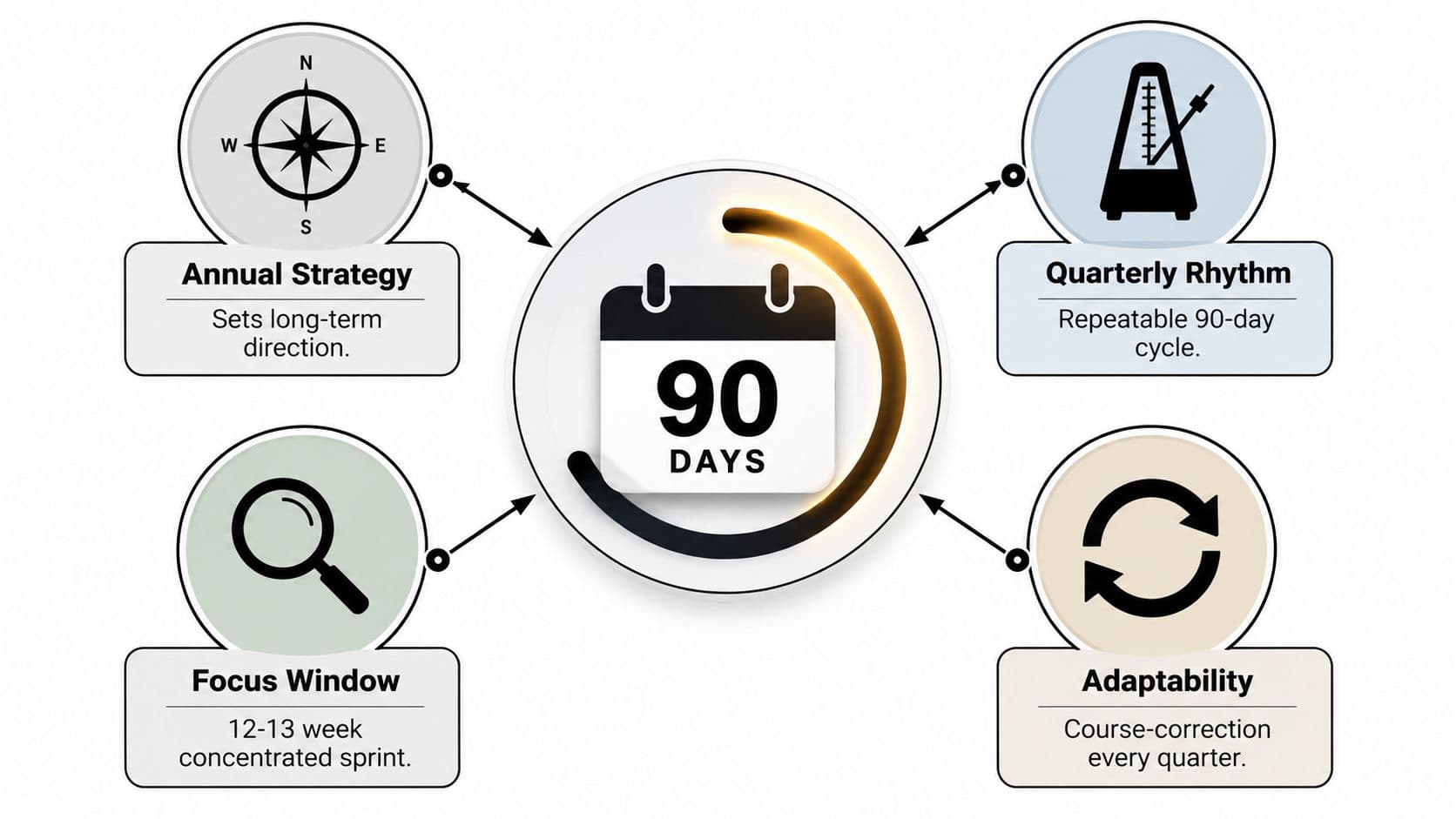
The quarter is a focus window
The quarter itself is usually treated as a 12–13 week operating window. Week 1 launches the work, the middle weeks provide monitoring and adjustment, and the final stage supports reflection and reset. That rhythm is more useful than a vague three-month label because it gives the team a shared expectation for when decisions happen.
Annual planning offers strategic continuity. Monthly planning supports tactical responsiveness. Quarterly planning connects the two without forcing people to re-plan every time a new request appears.
Practical rule: If a priority can't be explained as a measurable result with a named owner and a review date, it isn't ready for the quarterly plan.
Who benefits most
Busy professionals gain a clear limit on competing commitments. Cross-functional teams gain a common set of outcomes instead of separate departmental wish lists. Distributed teams benefit particularly because written owners, dependencies, and decision deadlines reduce the need to reconstruct context across time zones.
Quarterly planning works best when leaders treat capacity as part of strategy. A plan that contains more priorities than the team can execute isn't ambitious. It's inaccurate.
Essential Sections Every Quarterly Planning Template Needs
A quarterly template should let a teammate understand the plan without opening several project boards or searching meeting notes. Put the outcome first, then include the fields needed to test feasibility, assign responsibility, and act on the plan.
Start with quarterly objectives. Keep the list small, generally three to five objectives per team. Each added objective creates another stream of decisions, coordination, and reporting, so a longer list can hide capacity problems. Write objectives as meaningful outcomes rather than activities. “Improve onboarding” gives direction. “Make onboarding faster” needs a defined measure before the team can judge success.
Under each objective, add three to four measurable key results, following the OKR-oriented structure described in Miro's quarterly goals template. Each key result should show how progress will be measured, state a target, and have one accountable owner. If a result depends on another team, record that dependency instead of assigning shared accountability to everyone.
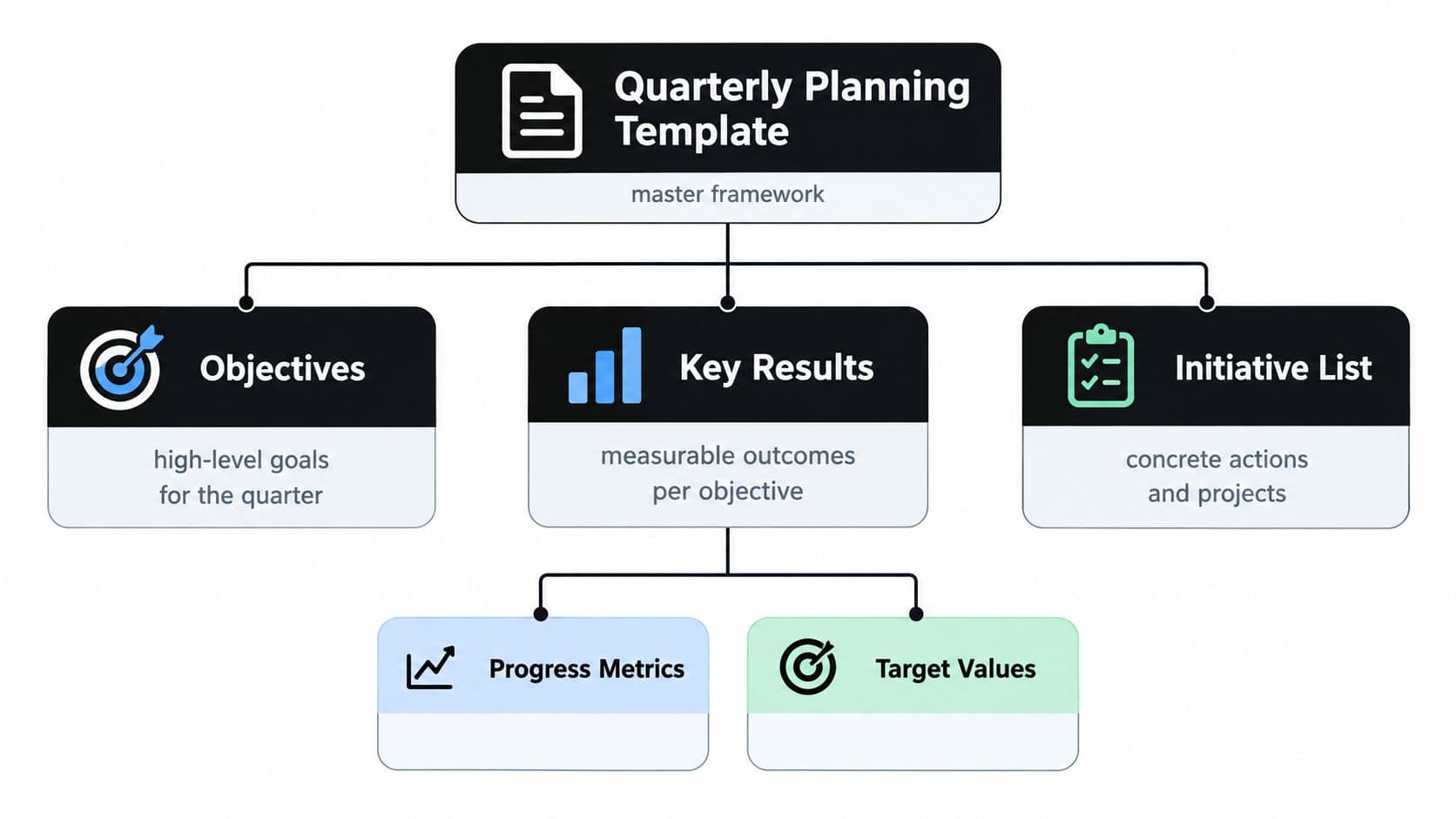
The fields that prevent drift
Separate what the team wants to achieve from what the team will do. Initiatives are workstreams intended to influence key results. Finishing an initiative does not prove that the objective succeeded.
Include these fields:
- Objective: The outcome the team is pursuing.
- Key results: Measurable evidence of progress.
- Success metric: The main measure used to judge the result.
- Initiatives: Concrete workstreams linked to the result.
- Owner: One person accountable for progress.
- Milestones: Intermediate proof points that show whether work remains on track.
- Dependencies: People, decisions, systems, or approvals required.
- Risks and assumptions: Conditions that could weaken or invalidate the plan.
- Review dates: Scheduled points for checking progress and changing the response.
- Buffer date: Reserved time for slippage, approvals, or unexpected operational work.
- Warning signal: A condition that triggers escalation or replanning before the result is missed.
Success metrics, milestones, risk tracking, and calendarized checkpoints give the team visibility before quarter-end. Buffer dates and warning signals add the capacity check that many templates omit. Together, these fields help distinguish a blocked result from a slow result and expose a plan that has too much work for its available owners.
Keep the document scannable
Use a table for the main plan, with longer context stored in linked project pages. A practical row might look like this:
| Objective | Key result | Owner | Milestone | Dependency | Review |
|---|---|---|---|---|---|
| Improve onboarding | Defined measurable target | Product lead | First validation checkpoint | Analytics access | Weekly |
| Improve onboarding | Defined measurable target | Customer lead | Customer feedback review | Support participation | Mid-quarter |
The exact fields can vary, but a reviewer should see the result, accountable person, next proof point, dependency, and warning signal at a glance. Teams building a repeatable operating rhythm can also review guidance on how to build a repeatable business plan. For teams comparing OKRs with outcome-based goals or other methods, these goal-setting frameworks can help match the structure to the team's operating context.
How to Build and Customize Your Template Before the Quarter Starts
A quarterly plan built in one rushed meeting usually reflects enthusiasm more than capacity. Build the document through a 3–4 week preparation cycle: review the previous quarter, draft priorities, confirm stakeholder commitments, then publish the plan and configure tracking. IdeaPlan's quarterly planning guidance describes this sequence as a way to test commitments against evidence and constraints before work begins.
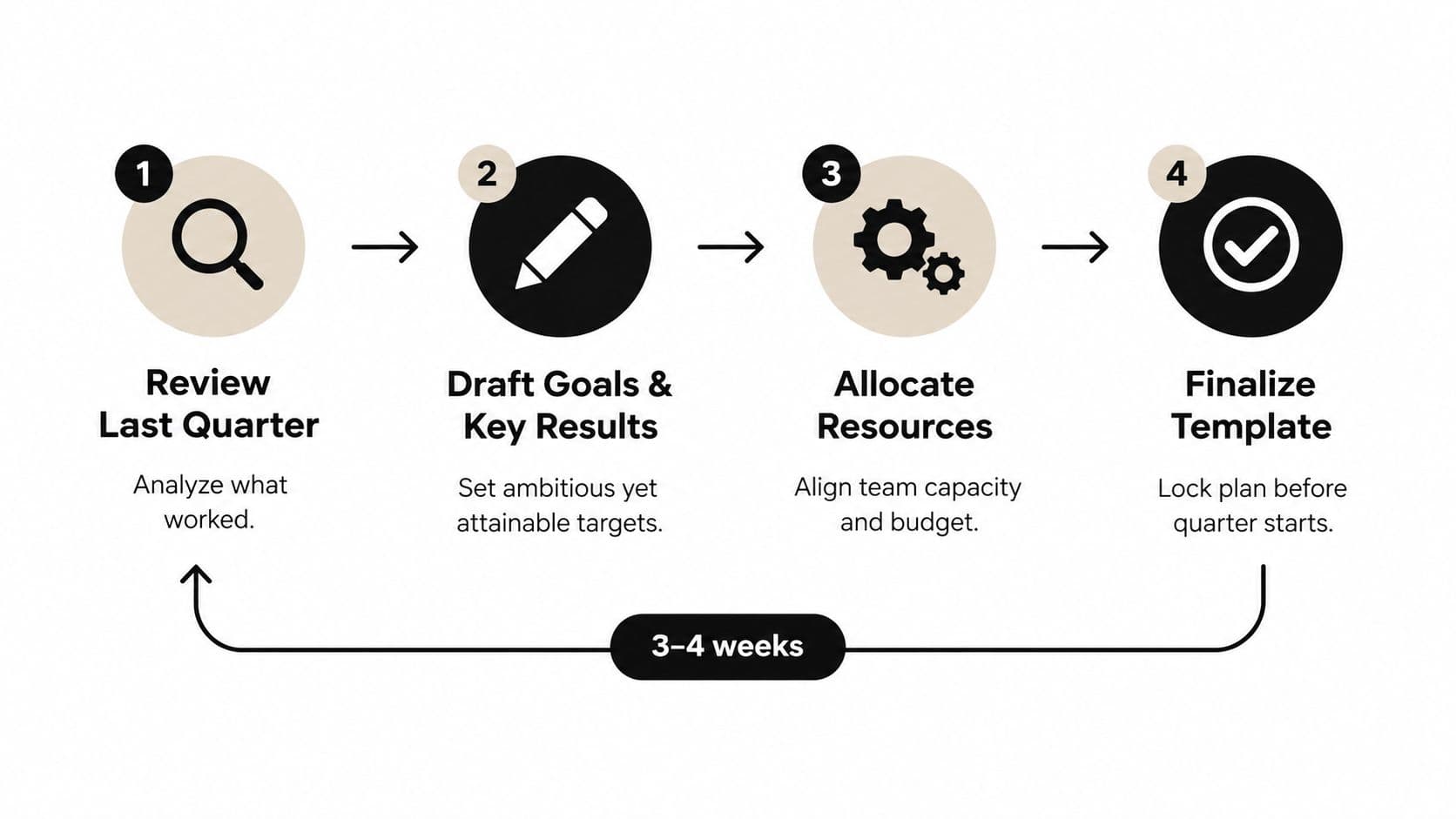
Week 1 reviews reality
Begin with the previous quarter's commitments. Mark each result as complete, progressing, blocked, changed, or abandoned, then record the reason. Keep the discussion operational rather than turning it into a performance ceremony. Ask:
- Which commitments used more capacity than expected?
- Which dependencies delayed delivery?
- Which decisions arrived too late?
- Which assumptions proved fragile?
- What work should stop, continue, or change?
Distributed teams should complete this review asynchronously before the live meeting. Written responses give quieter contributors time to identify recurring blockers, unclear ownership, and hidden operational work that may vanish during a fast video call.
Week 2 drafts the next commitments
Use the annual strategy as direction, not as quarterly wording. Convert broad priorities into outcomes that can produce evidence during the quarter. Start with more candidates than the plan can hold, then remove any objective without a clear owner, measurable result, or credible path through its dependencies.
Silent prioritization helps keep the discussion balanced. Have participants rank proposed objectives independently before the group meeting, then compare the results and discuss disagreements. Structured planning guidance also includes a 2.5-hour planning workshop and a 45-minute retrospective, with silent prioritization used to reduce bias. Miro's quarterly goals template provides that supporting framework.
Use this video as a visual reference when the team needs a shared workshop format.
Weeks 3 and 4 test the plan
Week 3 is for stakeholder alignment. Ask each dependent team what must be available, who makes the decision, and which date creates risk. If an objective crosses several teams and no one has confirmed the handoff, mark it as unready instead of treating it as committed work.
Week 4 turns the draft into an operating document. Publish one source of truth, connect each initiative to an objective or key result, and schedule review meetings before launch. Add a named owner, dependency status, buffer date, and warning signal to each major commitment. A buffer date exposes slippage early, while a warning signal tells the team when to escalate or replan.
Customization depends on the team's working conditions. A solo professional may need a personal capacity view and a short deliverables list. A fast-moving startup may revisit assumptions more often. A regulated organization may require longer approval paths and clearer evidence gates. The cadence can change, but the discipline remains: review, select, align, communicate, and track.
Turning Goals Into an Executable 12 Week Timeline
A quarterly plan becomes credible when the team can explain what happens each week. Treat the quarter as a 12-week execution cycle, not a loose three-month container. One practical model uses a 45-minute kickoff, twelve 15-minute weekly check-ins, and a 60-minute quarterly reflection, with one to three goals and milestones placed around Weeks 4, 8, and 11. Goals and Progress outlines this 12-week rhythm.
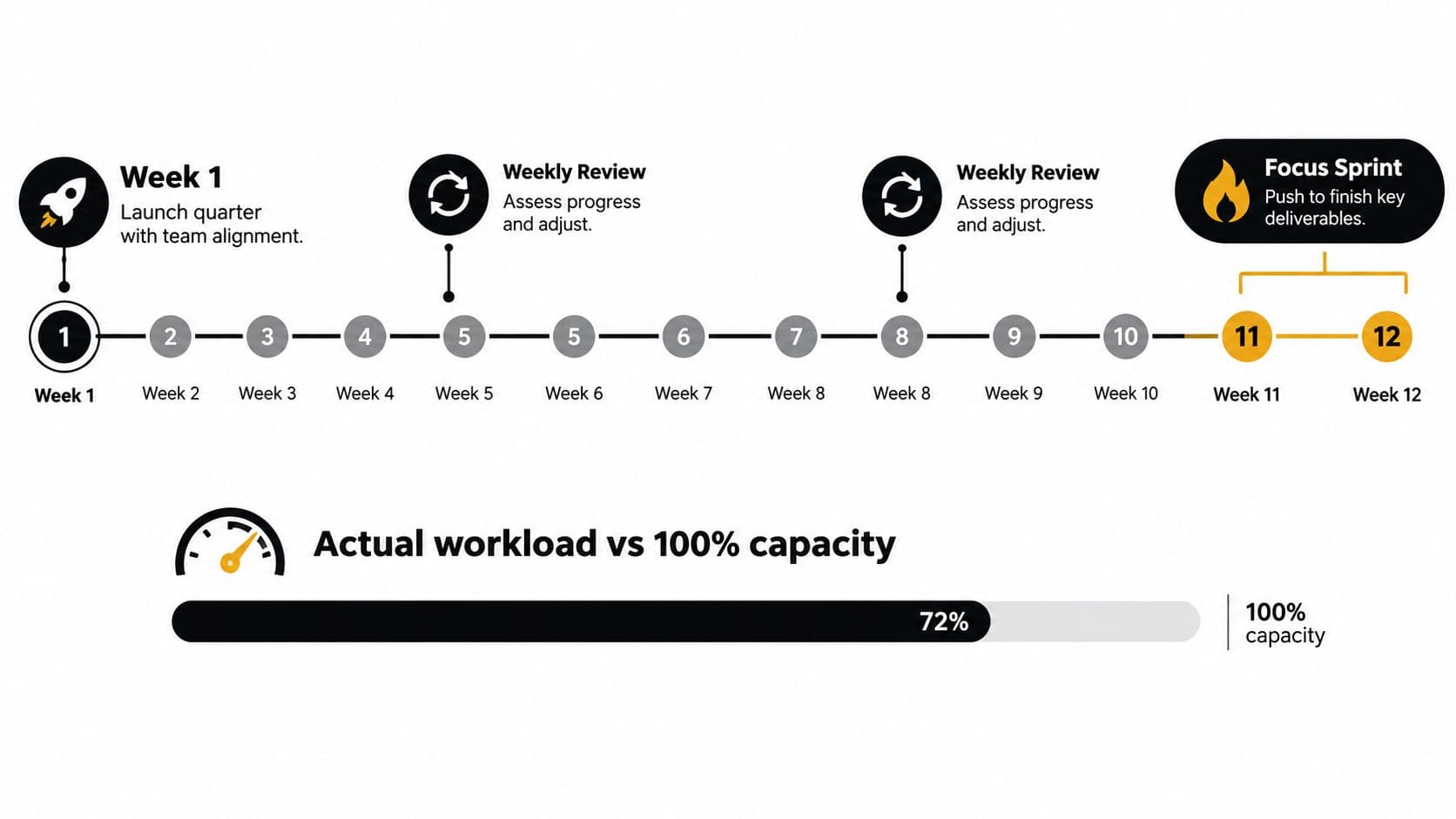
The kickoff should confirm three things: what the team will achieve, who owns each result, and what work starts first. Weekly check-ins should focus on movement rather than status theatre. Each owner should be able to state the current position, the next milestone, and the blocker requiring attention.
Plan around actual capacity
The most important planning question isn't “What would be valuable?” It's “What can this team absorb while handling its existing obligations?”
Before accepting an objective, examine:
- Available capacity: Which recurring work, support obligations, and operational duties will continue?
- Accountability: Who makes decisions and who is merely contributing?
- Dependencies: Which teams, vendors, approvals, or technical systems can delay progress?
- Buffer dates: Where can the plan absorb a dependency slip without destroying the final delivery?
- Trade-offs: What work will pause if this priority enters the quarter?
A team that assigns an owner but ignores the owner's existing workload hasn't completed capacity planning. The same applies to dependencies. Listing “engineering support” as a dependency isn't enough. Name the decision, handoff, or deliverable required and place it on the calendar.
Use milestones as evidence, not decoration
Week 4 should answer whether the team has started the right work. Week 8 should show whether the chosen approach is producing useful evidence. Week 11 should expose what remains for the final focus push. These milestones don't need to be large launches. They can be prototypes, validated requirements, reviewed drafts, or resolved technical decisions.
Keep weekly tasks small enough to assign and review. Repetitive breakdown work, reminders, data gathering, and administrative follow-up can be handled through automated workflows or delegated to a virtual assistant instead of consuming the owner's attention. Tools such as Fluidwave's Gantt chart guide can help teams turn dependencies and milestones into a visible timeline.
The point of automation and delegation isn't to hide capacity limits. It's to reserve specialist attention for decisions that require judgment while routine work still moves forward.
Tracking Progress and Running a Quarterly Review That Improves the Next Cycle
A quarterly planning template should stay active after the kickoff. Teams commonly use weekly or biweekly execution meetings, a mid-quarter review near day 45, and a full end-of-quarter review around day 90, as described in The Alternative Board's 90-day planning guidance.
Weekly tracking should answer three questions: What changed, what's blocked, and what will happen next? A useful check-in records the current score for each key result, the specific blocker when progress trails the expected path, and the action that will close the gap this week. OKRsTool's guidance on stretch goals frames about 70–80% attainment of key results as genuine progress for stretch-oriented goals, while emphasizing that a score without a corrective action isn't useful management information.
Watch leading signals
Lagging metrics tell you what happened. Leading signals tell you whether the current work is likely to produce the intended outcome. For example, a final adoption result may move slowly, while completed user interviews, validated workflow changes, or approved implementation milestones reveal whether the team is building momentum.
Track both types in the template. The owner should record the current state, expected trajectory, evidence, and next action. A task-tracking system such as Fluidwave's project tracking metrics guide can help teams decide which measures belong on the working dashboard rather than in a retrospective archive.
Treat the retrospective as a decision meeting
The end-of-quarter review shouldn't congratulate completed tasks. It should change the next plan. Capture lessons learned, unresolved dependencies, fragile assumptions, warning signals, and wildcard bets that may deserve exploration.
Revise the plan when evidence changes the underlying decision. A priority may need to be narrowed, paused, reassigned, or replaced if its dependency remains unavailable, its assumption fails, or its leading indicators consistently deteriorate. Continuing unchanged can feel disciplined, but it often protects the original plan at the expense of the actual outcome.
The template becomes a living operating system when every review produces a concrete decision, and every decision is visible to the people who depend on it.
Practical Tips to Keep Your Quarterly Plan Focused and Achievable
A focused quarterly planning template should make overcommitment uncomfortable. Recent guidance increasingly emphasizes 3–4 weeks of preparation, 3–5 objectives, 2–3 key results per objective, and buffer dates for dependency risk, pointing toward capacity-aware design rather than generic goal setting. Atlassian's quarterly planning guidance supports that direction.
Use these guardrails before week one:
- Cut priorities aggressively: If everything is important, the team has no usable order of operations.
- Name one accountable owner: Contributors can be listed separately, but one person must drive each result.
- Schedule the evidence: Put weekly, mid-quarter, and end-of-quarter reviews on calendars before launch.
- Expose dependencies: Record the required handoff, responsible party, and decision date.
- Add recovery space: Buffer dates protect the plan from approvals, blocked systems, and competing operational work.
- Separate outcomes from tasks: Completing activity isn't the same as producing the intended result.
- Delegate repetitive execution: Move routine coordination, research preparation, and task breakdown away from owners when appropriate.
- Keep assumptions visible: A fragile assumption should have an early warning signal and a decision path.
- End with a stop rule: Decide in advance what evidence would cause the team to narrow, pause, or replace a priority.
Before committing, ask whether each objective has a measurable result, a realistic owner, a first milestone, a known dependency path, and enough room for unplanned work. If the answer is no, reduce the scope rather than hoping the team will find extra capacity later.
Start the preparation cycle now, beginning with a candid review of the last quarter. A focused quarter that finishes its most important work will serve your strategy better than an ambitious plan that leaves every major initiative incomplete.
Fluidwave combines task organization, automated workflows, calendar and Kanban views, and pay-per-task delegation to help teams connect quarterly objectives with weekly execution. Create the plan, assign owners and timelines, delegate routine work where it fits, and visit Fluidwave to set up a more realistic next quarter.
Focus on What Matters.
Experience lightning-fast task management with AI-powered workflows. Our automation helps busy professionals save 4+ hours weekly.