Compare SMART, OKR, GROW, BHAG, WOOP, and CLEAR goal setting frameworks with practical examples and step-by-step guidance for implementing them in Fluidwave.
August 3, 2026 (1mo ago)
Goal Setting Frameworks: SMART, OKR, GROW & More Compared
Compare SMART, OKR, GROW, BHAG, WOOP, and CLEAR goal setting frameworks with practical examples and step-by-step guidance for implementing them in Fluidwave.
← Back to blog
91% of companies use some form of goal-setting process, but only 7% believe theirs works. That gap usually isn't about ambition, it's about weak implementation, and the rest of this article is the practical fix.
Teams often don't need another framework list. They need to know which system fits the work in front of them, how to run it inside a real task manager, and what to do when the quarter gets messy, the inbox fills up, and the original plan starts slipping. A strong starting point is to set business goals that drive growth, but the true test is turning those goals into daily execution.
Why Goal Setting Frameworks Still Matter
A founder can spend half a day choosing between SMART, OKRs, and GROW, then still end up with a spreadsheet nobody opens after week two. I've seen that happen because the team treated the framework like the work, when it's really just the container for the work.
The reason goal setting frameworks still matter is simple, they reduce ambiguity. Specific, challenging goals have long outperformed vague ones in the foundational research base associated with Locke and Latham, with later summaries reporting performance gains of about 80% and one cited framing saying such goals improve performance 90% of the time across 10,000 participants. That's why frameworks like SMART and OKRs keep showing up in serious operating systems, they turn “try harder” into something measurable.
Practical rule: if a goal can't be reviewed on a recurring cadence, it usually isn't a goal, it's a wish.
The failure mode in most organizations is not the framework itself. It's the lack of a system around it, no owners, no review rhythm, no task breakdown, and no visible link between the goal and the actual work. If you need a plain-language refresher on the operational side, this guide on measuring anything is useful because it keeps the focus on indicators instead of vague intent.
The shift over the last decade is that teams don't just want goals that sound good in a meeting. They want goals that survive a busy week, get delegated cleanly, and can be checked without starting from scratch every Monday. That's where structured execution starts to separate from motivational language.
The Science Behind Goal Setting Frameworks
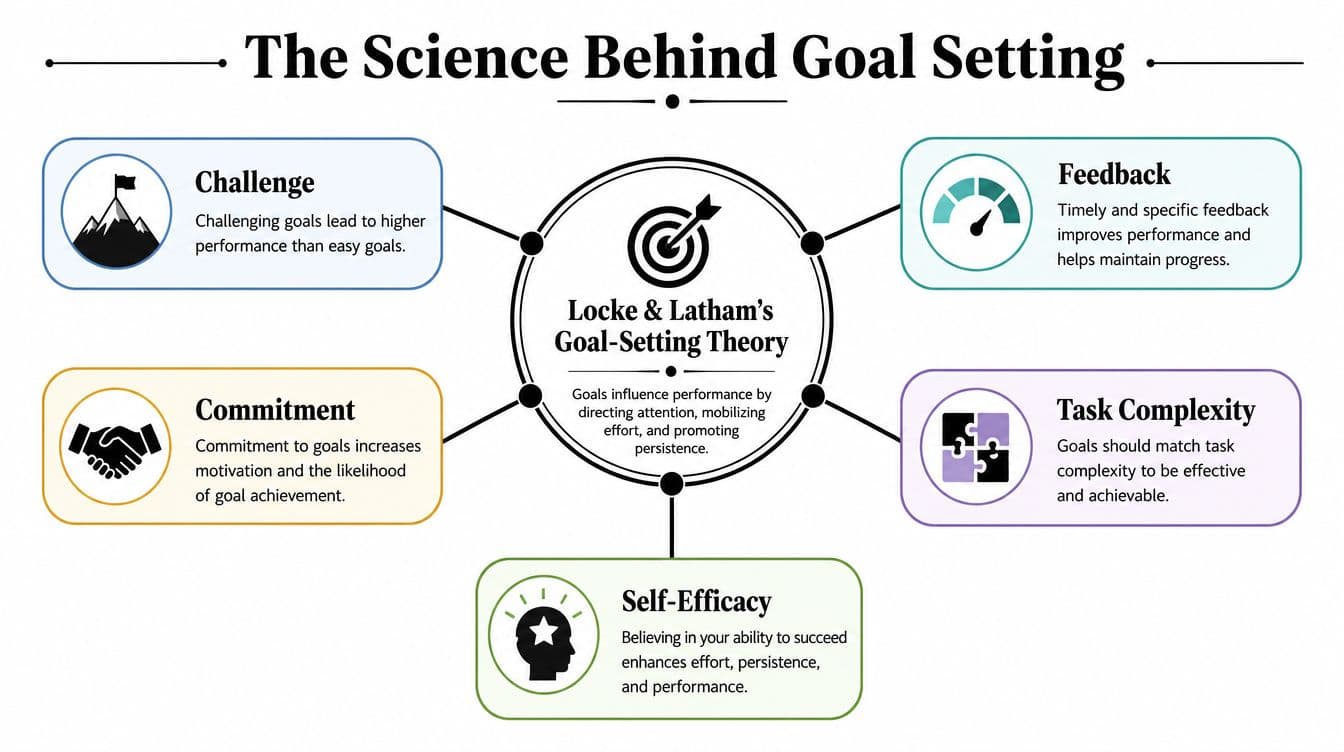
Every modern goal-setting framework is basically a different way of operationalizing the same idea, make the target clear, make progress visible, and keep feedback in the loop. That's the reason the old theory still matters in a software-heavy workplace.
Why specificity beats vagueness
Locke and Latham's goal-setting theory is the historical base. The research foundation says specific, challenging goals outperform vague goals, and combining goals with feedback improves performance by 30% compared with goals or feedback alone. That is the reason recurring check-ins became standard practice, not because managers enjoy meetings, but because goals work better when progress is visible and corrected in time.
This also explains the shape of modern systems. SMART turns ambiguity into a measurable control system. OKRs split an ambition into a visible objective and measurable key results. Even coaching-style models borrow the same logic, they just package it differently.
Why the cadence changed
The old model was annual, top-down, and static. That made sense when work changed slowly. It falls apart when priorities move every week, dependencies cross teams, and execution needs adjustment before a quarter is over.
The practical shift from annual documents to weekly or quarterly review cycles comes straight out of that research logic. Feedback changes behavior faster than a distant review, and teams that can inspect progress regularly are less likely to drift. In business terms, the framework matters, but the cadence matters just as much.
Good goal systems don't just define what matters, they define when the work gets reviewed.
The consequence is straightforward. Goal-setting isn't a morale exercise, it's an operating discipline. That's why the most effective teams stop asking, “Which framework sounds smartest?” and start asking, “Which one fits the pace, complexity, and accountability of the work?”
SMART vs OKR vs GROW vs BHAG vs WOOP vs CLEAR
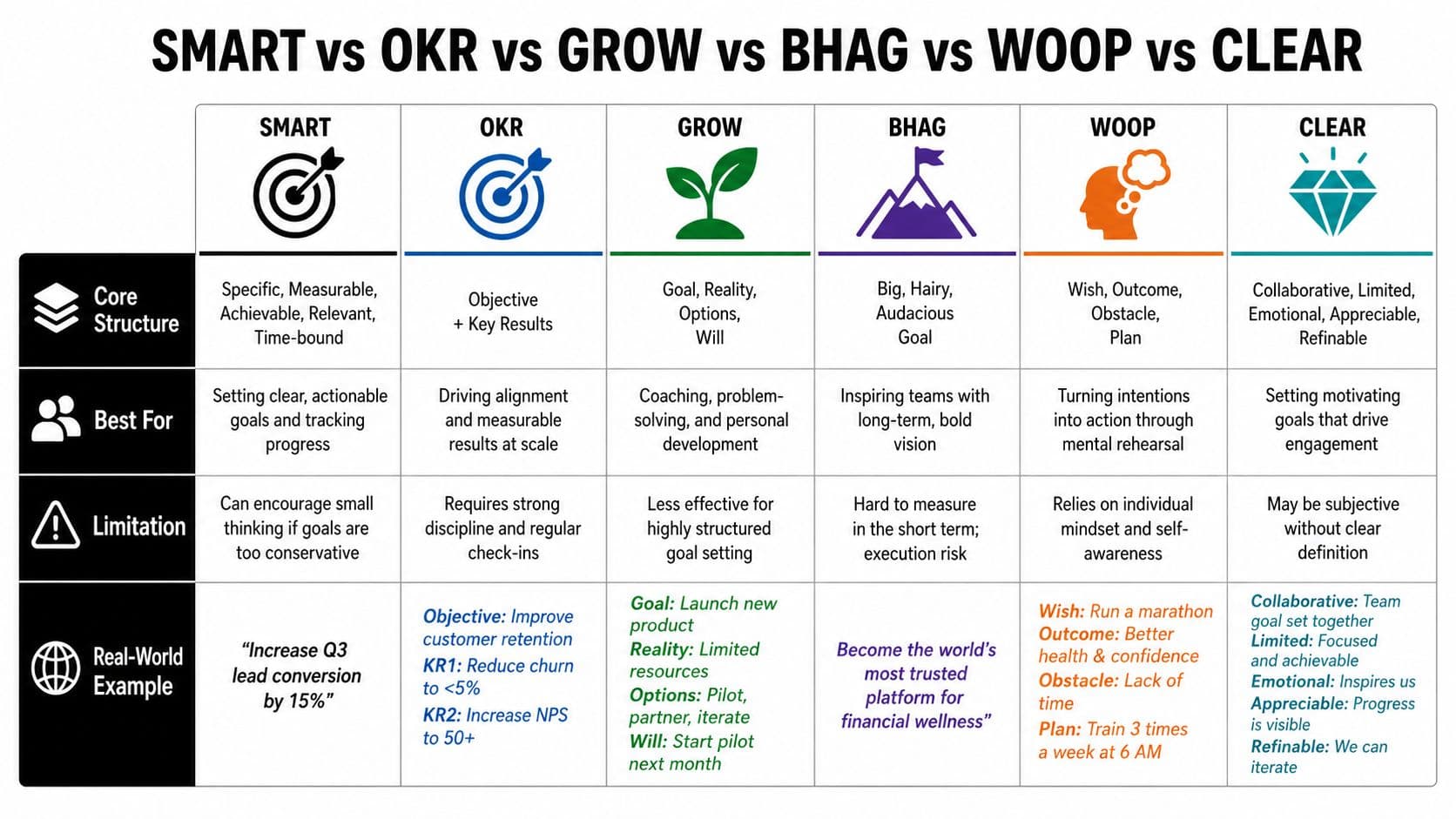
SMART
SMART means Specific, Measurable, Achievable, Relevant, and Time-bound, which makes it the cleanest choice when you need a goal to behave like a checklist with a deadline. It works well for short-term execution, compliance-heavy work, and projects where ambiguity is expensive.
Its weakness is rigidity. A SMART goal can be perfectly written and still go stale if the environment changes midstream. A common example is a quarterly sales target, where the target stays fixed even as the channel mix shifts.
OKR
OKRs separate the inspirational objective from 2 to 4 key results and optional initiatives. That makes them better for higher-variance work, where the team needs clarity on the destination but some freedom in how to get there.
The downside is overload. Too many objectives or too many key results dilute focus fast. A typical OKR example is a product team setting one objective for customer adoption and tying it to a small set of measurable outcomes.
GROW
GROW is a coaching framework built around Goal, Reality, Options, Will. It works best in one-on-one conversations, manager development sessions, or any setting where the issue isn't just the goal itself, but the person's path toward it.
It's weaker when the team needs hard operational accountability. GROW helps someone think clearly, but it doesn't automatically create execution structure.
BHAG
BHAG stands for Big Hairy Audacious Goal. It's a north-star framework, useful when leadership wants to stretch the organization toward a long-term leap instead of a modest increment.
The trade-off is obvious. BHAGs inspire, but they can also float above daily work if they aren't connected to milestones and ownership. They're strongest as a directional anchor, not as a weekly management tool.
WOOP and CLEAR
WOOP uses Wish, Outcome, Obstacle, Plan, which makes it especially useful when motivation, habit change, or personal development matters. It's valuable because it doesn't ignore the obstacle, it names it early.
CLEAR works better in collaborative, agile settings, where goals are emerging rather than fixed. It is better suited to team-based discovery than to rigid performance tracking.
If you're choosing by context, the rule is pretty simple. Use SMART for precision, OKRs for alignment, GROW for coaching, BHAG for aspiration, WOOP for motivation and obstacle planning, and CLEAR for collaborative work that changes as you go.
Implementing SMART Goals in Fluidwave
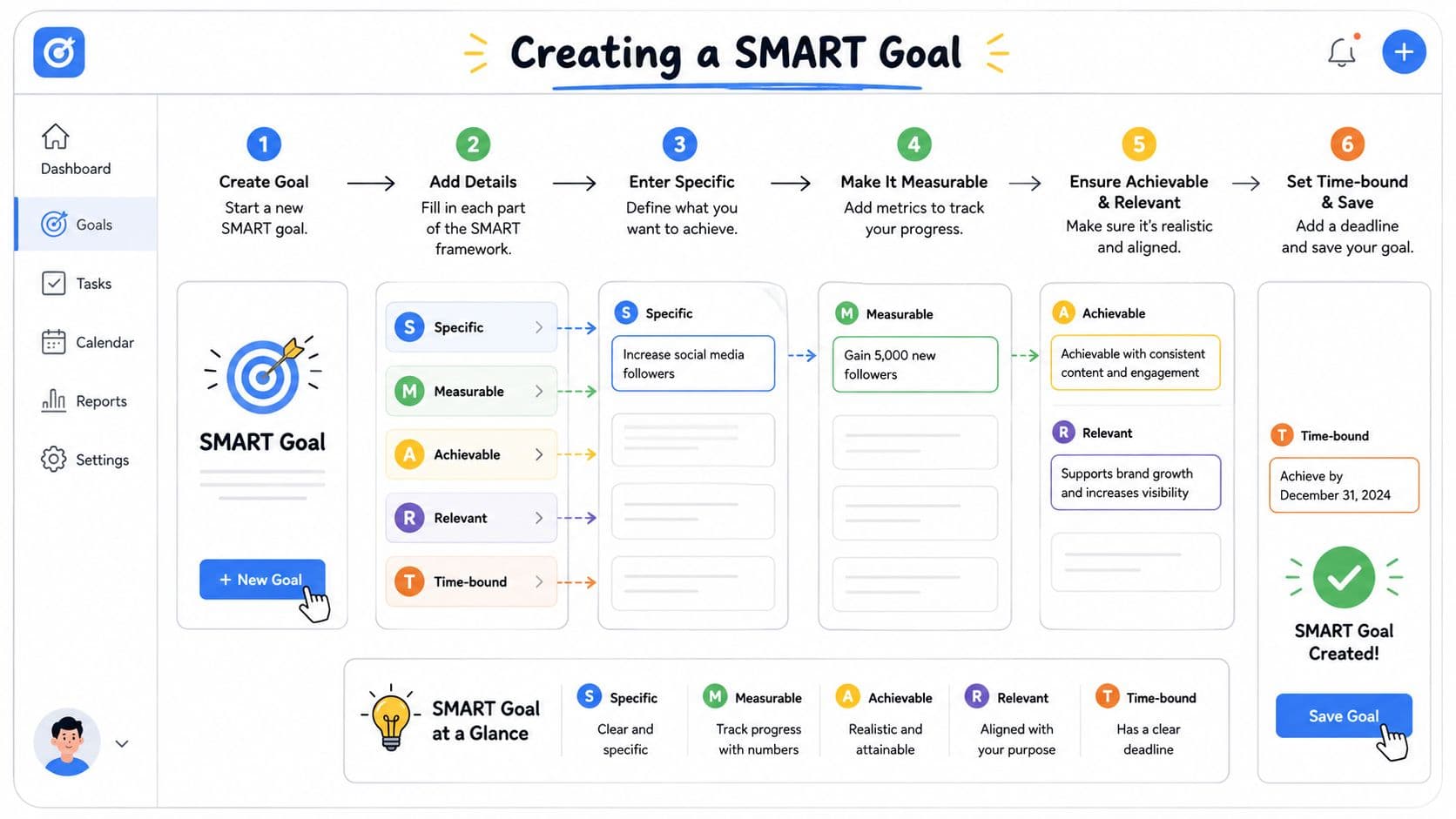
A SMART goal only works when the task structure forces it to stay measurable. In Fluidwave, the cleanest way to do that is to build the goal as a parent task, then break it into milestones that can be delegated and checked separately.
Build the goal as a measurable task chain
Start with a single task title that names the outcome, not the activity. Instead of “Launch campaign,” write something like “Complete Q3 product launch readiness checklist.” Then add subtasks for specific deliverables, such as assets, approvals, QA, and launch coordination.
That structure matters because SMART depends on clarity. The more the goal looks like a project with visible steps, the easier it is to review whether the goal is still achievable and whether the timeline still makes sense. If you need a practical sample of how these kinds of goals translate into work plans, these developmental goal examples are useful for seeing the difference between vague intent and structured execution.
Assign ownership and automate the review rhythm
Delegation stops being administrative and starts being operational when you assign each milestone a clear owner. Use Fluidwave's task delegation to hand off pieces that don't need executive attention. For example, a launch goal might leave final approval with the founder, while a virtual assistant handles asset follow-up and deadline reminders.
A good SMART setup also needs recurring review. SAMHSA's SMART-goals fact sheet emphasizes measurable objectives and ongoing monitoring, and that maps neatly onto weekly check-in templates in a task system. FranklinCovey's guidance also recommends weekly check-ins as a required execution rhythm, which is exactly the kind of cadence SMART goals need to stay alive.
If a SMART goal has no review template, it usually becomes a sticky note with better grammar.
For a real team example, think about a product launch that needs copy, design, landing page QA, and partner updates. Each item becomes a tracked milestone, each milestone gets an owner, and each check-in asks one question, did the metric move or did the deadline slip? That's the point where SMART becomes useful in practice, not just readable in a planning doc.
Running OKRs and Agile Frameworks in Fluidwave
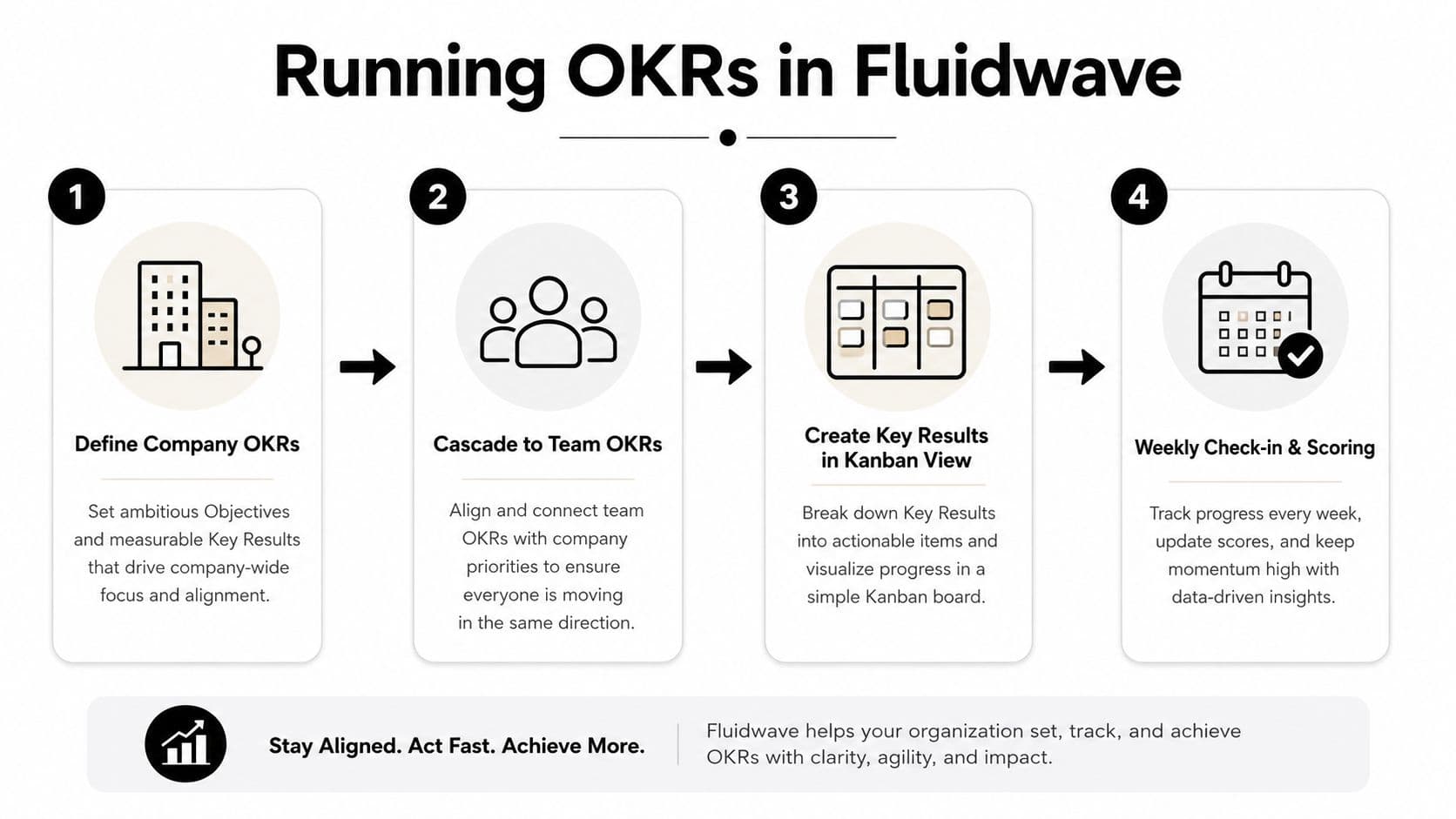
OKRs work best when the team needs alignment across multiple moving parts, not just a clean to-do list. In Fluidwave, keep the objective visible in a table view, then move the key results into Kanban so the team can track progress without flattening the goal into a checklist.
Structure the objective and key results separately
Write the objective as a directional statement, then create separate tasks for each key result. Microsoft's Viva guidance treats key results as measurable outcomes and initiatives as the activity layer, and that split works well in a task tool. The objective stays motivating, while the tasks underneath stay specific enough to act on.
If you're working with a quarterly planning cycle, Stoa's quarterly OKR template shows how to keep planning simple without drifting into vagueness. The point is to keep the outcome set small and clear, not to catalog every idea the team has.
Use delegation to protect accountability
Each key result should have one owner. That does not mean the owner does every task. It means the owner stays accountable for the outcome while supporting work can move across the team or to a virtual assistant. In Fluidwave, that separation keeps responsibility visible even when execution is distributed.
For team leaders who want a tighter read on whether the system is working, measuring team performance should sit alongside the OKR review itself. A weekly look at progress, blocked work, and reassigned tasks tells you whether the framework is driving action or just producing tidy planning notes.
For agile teams, the execution pattern usually looks like this:
- Company objective: capture the strategic goal in one visible place.
- Team objective: translate it into a smaller outcome the team can influence.
- Key result tasks: move each measurable outcome into Kanban for weekly progress tracking.
- Weekly scoring: review what moved, what stalled, and what needs reassignment.
That same structure also works for GROW, WOOP, and CLEAR when the work is more personal or collaborative. GROW sessions can live as coaching task notes, WOOP can be turned into an obstacle and action template, and CLEAR can sit in a shared planning board where emerging goals are refined as the team learns.
The system has to stay light. OKRs only survive if the process is easy enough to use every week and strict enough to show when something is off.
How to Choose the Right Framework for Your Situation
The wrong framework usually fails for one of three reasons, the goal is too complex for the structure, the review cadence doesn't match the pace of work, or the goal isn't tied closely enough to execution. That's why generic advice doesn't help much in real teams.
Match the framework to the shape of the work
For short-term personal goals, SMART or WOOP usually fits best. SMART gives you a clean target and deadline, while WOOP helps when motivation or follow-through is the bigger issue. If the work is emotionally difficult or habit-based, WOOP gives you a more realistic plan.
For cross-functional quarterly business goals, OKRs are usually the better fit. They separate the target state from the work required, which helps different teams coordinate without collapsing every initiative into one giant task list. That also matches the fact that many companies have a goal-setting process but very few run it effectively, so the framework needs a strong execution layer.
For ambiguous creative or exploratory work, CLEAR or GROW often works better than SMART. Those frameworks leave space for conversation, discovery, and adjustment, which is useful when the outcome isn't fully known at the start.
For high-stakes leadership targets, BHAG belongs at the top of the stack, not as the only system. It's useful when you need a bold north star, but it should be paired with a more operational framework underneath so the team knows what to do next Monday.
Use cadence as a deciding factor
If the goal needs weekly review, choose a framework that can tolerate frequent inspection, usually SMART or OKRs. If the goal evolves through conversation, choose GROW or CLEAR. If the goal is long horizon and directional, BHAG works as a strategic anchor.
The last question is practical, not theoretical. Ask whether the framework can be represented in tasks, delegated cleanly, and reviewed without a separate planning ceremony every time. If the answer is no, the team will stop using it.
Taking Action With Your Chosen Framework
Pick the framework that matches the work, not the one that looks smartest in a slide deck. SMART is for measurable control, OKRs are for aligned outcomes, GROW is for coaching, BHAG is for aspiration, WOOP is for motivation under pressure, and CLEAR is for collaborative work that keeps evolving.
The differentiator is execution rhythm. Weekly check-ins, visible ownership, and task-level accountability are what keep a framework alive after the first planning session ends. That's also where a tool like Fluidwave fits, because it lets you turn goals into delegated tasks, review them in the views you already use, and keep progress visible without adding more process.
If you're ready to move from theory to practice, build one goal in Fluidwave this week, assign one owner per key result, and set a recurring review before the quarter gets noisy. The framework won't do the work for you, but the right system makes the work much easier to keep moving.
If you want a goal system that lives inside the work instead of sitting beside it, start with Fluidwave. It's built for task templates, delegation, and automation, which makes it a practical place to run SMART goals, OKRs, and the weekly check-ins that keep them real.
Focus on What Matters.
Experience lightning-fast task management with AI-powered workflows. Our automation helps busy professionals save 4+ hours weekly.