Discover how project management with ai can boost efficiency, forecast risks, and streamline workflows. Learn practical steps to implement AI-driven project success.
Do less, be more with Fluidwave
Fluidwave combines smart task prioritization with an assistant marketplace — AI and human help, all in one productivity app.
December 2, 2025 (1d ago)
Project Management with AI: Boost Your Team's Efficiency Today
Discover how project management with ai can boost efficiency, forecast risks, and streamline workflows. Learn practical steps to implement AI-driven project success.
← Back to blog
At its core, project management with AI is really just using smart systems to help plan, execute, and keep an eye on projects. Think of it like a smart assistant for project managers—one that handles the boring, administrative stuff so you can focus on making big decisions and actually leading your team. It’s a shift from being reactive to proactive, letting data, not guesswork, steer you toward success.
The End of Project Management Overload

Does your day-to-day feel like you're constantly fighting off missed deadlines, scope creep, and a team stretched to its breaking point? You're not the only one. For way too many project managers, the job has become less about strategic leadership and more like a frantic game of whack-a-mole—just trying to keep all the pieces from flying apart.
This constant firefighting isn't just exhausting; it kills efficiency. It pulls you away from the work that actually matters, like mentoring your team, keeping stakeholders happy, and delivering real value. The problem is almost always the sheer amount of manual, admin tasks that eat up your day—updating spreadsheets, chasing down status reports, and endlessly tweaking timelines.
A Smarter Way to Manage Projects
This is exactly where AI in project management comes in, not as some futuristic idea, but as a practical copilot for your daily grind. Imagine having an assistant that can instantly analyze your team’s workload to suggest the perfect person for a new task. Or one that predicts a potential budget overrun weeks before it happens and automatically rejigs the entire project schedule when a single deadline slips.
AI in this context is all about augmentation, not replacement.** It’s a tool built to handle the repetitive, data-heavy work that bogs us down, freeing up our mental bandwidth for critical thinking and creative problem-solving.
This shift is a total game-changer. Instead of relying on gut feelings and reports that are a month old, you get to make decisions based on what’s happening right now, backed by predictive insights. You stop just reacting to problems and start getting ahead of them. For a deeper look at how this works, our guide on AI-powered workflow automation breaks down how these intelligent systems can completely reshape daily operations.
What This Means for Your Team
Bringing this approach into your workflow has an immediate, positive impact on your team's effectiveness and morale. When the administrative burden disappears, your team can finally focus on what they were hired to do: innovate, create, and get things done.
Here are some of the benefits you'll see right away:
- Reduced Administrative Overload: AI takes over tedious tasks like progress tracking and reporting, giving everyone back precious time for high-value work.
- Data-Informed Decision-Making: With AI providing predictive analytics, your choices are backed by solid data, not just a hunch.
- Improved Focus and Productivity: By automating distractions, tools like Fluidwave help teams get into a state of deep work and deliver much better results.
- Proactive Risk Management: AI systems can flag potential risks and bottlenecks early, letting you address them long before they become full-blown crises.
Ultimately, this is about evolving your role from a taskmaster into a true strategic leader.
How AI Changes the Game for Everyday Project Tasks
So, what does project management with AI actually look like on a Tuesday morning? It’s not about sci-fi robots taking over. It's about smart, practical help that takes the grind out of your daily work. Think of it less as a replacement for your expertise and more as a massive upgrade, shifting your decision-making from gut feelings to data-backed confidence.
The whole point is to get the repetitive, administrative junk off your plate. Instead of spending half your day tweaking a Gantt chart or chasing people for updates, you’re free to focus on what really matters: mentoring your team, managing stakeholder expectations, and solving the complex problems that no algorithm can touch. AI becomes your behind-the-scenes partner, making the entire project engine run a whole lot smoother.
This shift moves you from being a reactive firefighter to a proactive strategist. Let's dig into the specific ways this happens, looking at some simple "before and after" scenarios to see the immediate impact.
Intelligent Automation for Smarter Workflows
Before AI, assigning a new task was often a juggling act. You’d have to mentally run through who has the skills, who has the bandwidth, and who is already drowning in work. It was a slow, manual process that could easily create bottlenecks or burn out your best people.
Intelligent automation completely flips the script. It’s like having a hyper-efficient resource manager who has a perfect, real-time understanding of your team's skills, workload, and even their past performance on similar tasks. When a new task comes in, the system instantly recommends the best person for the job, making sure work is distributed evenly and effectively.
- Before: You're digging through spreadsheets and pinging team members on Slack to see who can take on an urgent task.
- After: The AI analyzes everyone's real-time capacity and suggests the ideal person, then automatically assigns the task and lets them know.
This kind of automation goes way beyond just assigning work. It can send automated follow-up reminders, update project statuses when tasks are completed, and even archive deliverables, all without you lifting a finger. It’s the same idea other industries use to get rid of manual drudgery; for instance, many finance teams rely on automated compliance software to manage regulatory work that once took hundreds of human hours.
Predictive Analytics for Spot-On Forecasting
Let's be honest: forecasting timelines and budgets has always been more of an art than a science. A project manager would lean on their experience—and maybe a few old project plans—to make an educated guess. But one unexpected delay could throw the whole schedule into chaos.
Predictive analytics is like having a crystal ball powered by data. By analyzing thousands of data points from past and current projects, it can forecast timelines, budget needs, and resource allocation with surprising accuracy.
If a key deliverable starts to slip, the AI doesn't just flash a red warning. It instantly recalculates the ripple effect on every single dependent task and proposes the most efficient new path forward. A potential crisis becomes a simple, manageable course correction.
This is a massive leap forward. It means you can see potential budget overruns or schedule delays weeks ahead of time, giving you plenty of room to pivot instead of scrambling to react. If you're curious about which platforms are good at this, it's worth exploring some of the top AI-powered project management tools on the market.
Natural Language Processing for Clearer Communication
Project knowledge is usually scattered all over the place—in emails, chat threads, meeting minutes, and random documents. Finding that one key decision from a meeting three weeks ago can feel like an archaeological dig.
This is where Natural Language Processing (NLP) comes in. It’s the tech that lets an AI understand human language. In a project context, this means your system can "read" all of your team's communications. It can summarize a chaotic 200-message chat thread, pull out key decisions from a meeting recording, and even analyze team sentiment to give you a heads-up on potential morale issues.
- Before: You spend an hour after every big meeting typing up notes, trying to read your own handwriting, and manually assigning action items.
- After: The AI transcribes the meeting, figures out who agreed to do what, and automatically creates and assigns those tasks in your project tool, complete with context and deadlines.
This tech is a game-changer for keeping everyone on the same page. It ensures that crucial information never falls through the cracks and creates a single source of truth for the entire team, with no constant manual updates needed.
The Real Business Case for AI in Project Management
While the tech itself is pretty cool, what really matters is the impact on your bottom line. Bringing AI into your project management workflow isn't just about chasing the latest trend; it's a strategic move that delivers real, measurable returns. Let's get past the buzzwords and look at the financial and operational gains you can actually expect.
At its core, the main advantage is a huge boost in team productivity and a sharp drop in wasted resources. By automating the thankless administrative work, your team is freed up to focus on high-value, creative tasks—the very work that fuels business growth. You get more out of your people without having to hire more people.
From Reactive Firefighting to Proactive Strategy
Think about how project management usually works. A problem pops up—a delay, a budget overrun—and the team scrambles to put out the fire. This reactive cycle is expensive and draining. AI completely flips this dynamic by giving you the power to see what's coming.
Imagine your AI tool flags a 75% probability that a critical deliverable will be late in two months, all because it spotted a potential supply chain issue in external data. Instead of getting blindsided a few days before the deadline, you now have weeks to react. You can order materials early, shift resources around, or just give the client a heads-up. This is the difference between a minor course correction and a full-blown crisis.
AI-driven risk mitigation transforms project management from a practice of damage control into one of strategic foresight. It spots potential trainwrecks months in advance, giving you the time and data to steer clear.
This proactive approach doesn’t just save projects; it saves a ton of money. Preventing even one major delay or scope creep incident can pay for the AI software many times over. The positive effects ripple out, leading to stronger stakeholder trust, happier teams, and more predictable revenue.
This simple map shows how AI's key abilities—automation, analytics, and language processing—all work together to drive better business results.
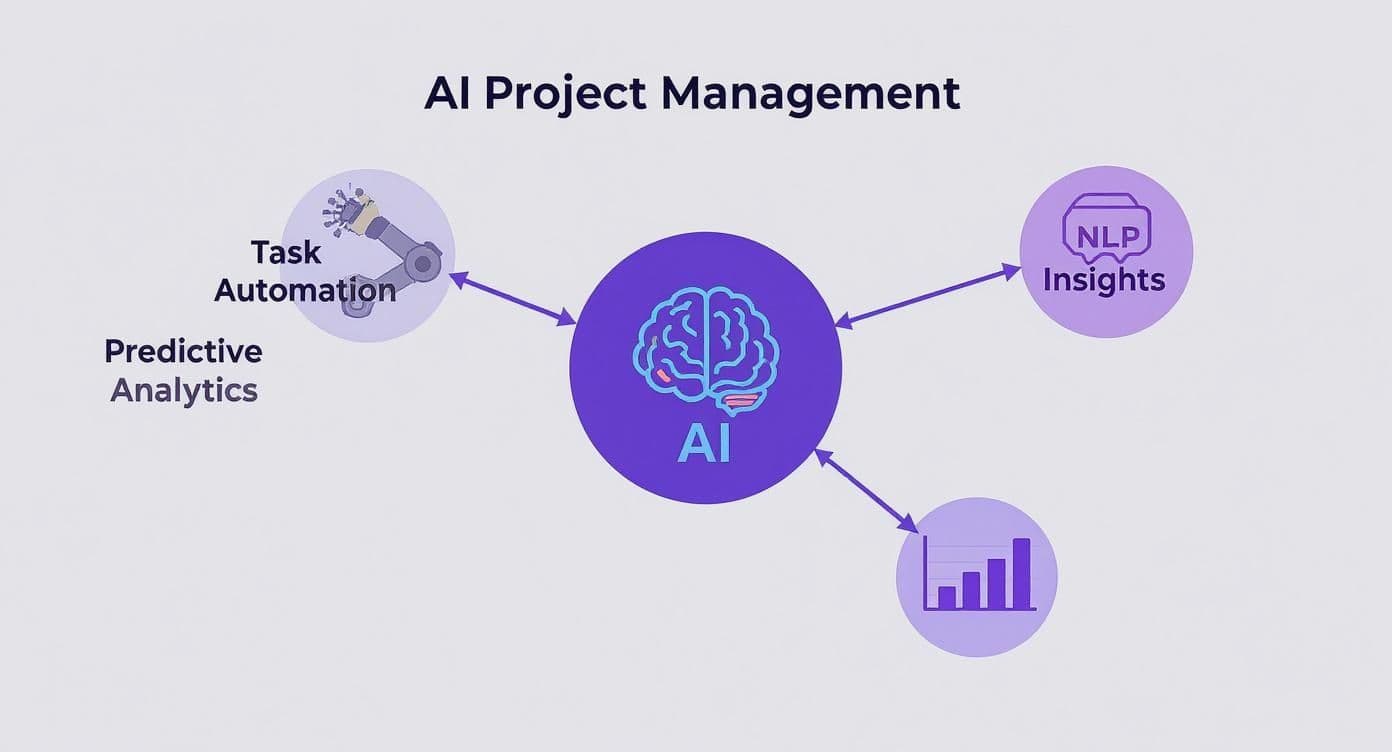
As you can see, these aren't just separate features. They're interconnected parts of an intelligent system that strengthens every phase of a project's lifecycle.
Enhancing Productivity and Operational Efficiency
One of the first things you'll notice with AI in project management is how much more productive your team becomes. Repetitive work is a huge time-suck. AI steps in to handle things like:
- Automated Reporting: Instantly generating daily or weekly progress reports without you having to do a thing.
- Intelligent Scheduling: Finding the best possible timeline based on team availability and task dependencies.
- Resource Allocation: Recommending the right person for a task based on their skills and current workload.
This kind of automation gives your team back hours every single week. That reclaimed time can be put toward innovation, building client relationships, and big-picture planning. When you get more done with the same resources, you're directly improving your operational efficiency. To dig deeper into this idea, check out our guide on what is operational efficiency and how to get there.
Platforms like Fluidwave are built from the ground up to eliminate these administrative bottlenecks, letting your team focus on what they do best.
A Competitive Necessity in a Growing Market
Let's be clear: adopting AI is quickly moving from a "nice-to-have" to a competitive must. The market for these tools is exploding as more businesses see the benefits firsthand. The global AI in project management market was recently valued at over USD 3 billion and is on a steep upward climb.
In fact, market projections show the industry is on track to hit USD 14.14 billion by 2030, which is a compound annual growth rate of nearly 22%. This intense growth is fueled by the demand for automation, real-time analytics, and smarter ways to manage resources. You can read more about this trend in this market outlook report from GlobeNewswire.
Companies that drag their feet on this will risk being outmaneuvered by more agile, data-savvy competitors who can deliver projects faster, on budget, and with way more predictability.
Seeing AI Project Management in the Real World

It’s one thing to talk about the benefits of AI in theory. But where it really gets interesting is in how this technology solves tangible, everyday problems for teams out in the field. This isn't science fiction; companies are putting these tools to work right now to get a real competitive edge.
The beauty of AI in project management is how flexible it is. The same basic principles—automation, smart forecasting, data analysis—can be adapted to fit the unique challenges of pretty much any industry. Whether you're on a construction site or in a creative agency, teams are finding ways to work smarter, not just harder.
Construction: Managing Safety and Materials
Think about a massive construction project. The logistics are a dizzying puzzle of thousands of moving parts, strict safety rules, and razor-thin margins. A project manager's day is often a frantic race against the clock to prevent delays and costly mistakes.
This is where AI becomes an extra set of eyes on the site. Drones fly over the area daily, capturing thousands of high-res images. An AI system sifts through this visual data to:
- Spot Safety Hazards: It can automatically flag where workers are missing proper safety gear, identify poorly stored equipment, or even detect potential structural issues long before a human inspector might catch them.
- Optimize Material Orders: By comparing the day's images to the project blueprint, the AI calculates precisely how much material was used. It then predicts when new shipments of steel, concrete, or drywall are needed and can even automate the purchase orders so work doesn't grind to a halt.
Suddenly, a chaotic, high-risk environment becomes more predictable and safer. The project manager is no longer just reacting to problems—they're preventing them.
Software Development: Streamlining Sprints
For a software development team, the daily grind is often a battle against an endless stream of bugs, feature requests, and tight sprint deadlines. Prioritizing what to tackle next can feel like guesswork, and planning is often based on gut feelings.
An AI-powered system can plug right into this workflow. By analyzing historical performance data, it brings a dose of reality to the chaos. The tool looks at which developers are fastest with certain types of bugs, how long similar features took in the past, and who on the team has bandwidth.
The AI doesn't just manage a backlog; it optimizes it. By prioritizing bugs based on their real-world impact and assigning them to the developer most likely to solve them quickly, the system ensures that the most critical issues are always addressed first.
This leads to much more accurate sprint planning. The team gets a realistic forecast of what they can actually get done, which cuts down on the burnout that comes from over-committing. It turns the stressful guessing game of planning into a data-informed strategy.
Marketing: Allocating Creative Resources
Now, picture a busy marketing agency juggling multiple campaigns for different clients. Profitability hinges on assigning the right creative talent—designers, writers, strategists—to the right projects without burning anyone out.
AI can step in as an intelligent resource manager. A new project brief comes in, and the AI analyzes its scope, keywords, and goals. It then cross-references this information with a database of the team's skills, past project successes, and current workloads.
- It suggests the ideal project team, matching creative strengths to the campaign's specific needs.
- It generates a realistic project timeline by looking at how long similar campaigns have taken.
- It flags potential bottlenecks weeks in advance, alerting managers if a key designer's schedule is getting overloaded.
This intelligent allocation helps ensure projects are staffed for success right from the get-go. To get a feel for how this works in practice, it’s worth exploring some of the top AI-powered project management tools that make these scenarios a reality.
These examples are just scratching the surface. The adoption of AI is becoming more widespread every day, touching sectors from banking and healthcare to manufacturing and IT. In fact, over 82% of companies worldwide are either using or exploring AI, with 92% of Fortune 500 companies already bringing it into their operations. This isn't just a trend; it's the new standard for efficient work. You can find more details in this in-depth industry analysis from GM Insights.
A Practical Roadmap to Implementing AI

Alright, you can see the potential. You get how AI could seriously improve your workflows. So, what’s next? The thought of a massive, company-wide AI rollout is enough to make anyone nervous, but getting started is actually much more doable than it sounds.
A successful switch doesn’t happen overnight; it’s a series of small, deliberate steps. The key is to build momentum without blowing up your current operations. By starting small and proving the value early, you can get your team excited about the change instead of resistant to it. Think of this as a journey, not a light switch.
Here’s a straightforward, four-step roadmap to guide you.
Step 1 Start with Your Biggest Headaches
Before you even look at a single tool, take a step back and look at how your team actually works. Where’s the friction? What are the repetitive, soul-crushing tasks that drain everyone’s time and energy?
Your first job is to find the pain. Pinpointing these specific bottlenecks gives you a clear target for where project management with AI can make the biggest and most immediate impact.
Common pain points often include:
- Manual Status Reporting: How many hours are burned each week just compiling and sending updates?
- Inaccurate Timelines: Are projects constantly slipping because initial estimates were a total guess?
- Resource Conflicts: Is it a constant battle to figure out who has time for new tasks?
By focusing on a real problem, you ensure your first AI initiative solves something your team genuinely cares about. That’s how you build instant goodwill.
Step 2 Launch a Small Pilot Project
Once you’ve identified a key pain point, resist the urge to overhaul everything at once. Instead, launch a small, contained pilot project. The goal here is simple: show that it works on a small scale.
Choose one team or a single, straightforward project to test out a new AI-powered approach. This controlled experiment lets you learn, adapt, and work out the kinks without putting a high-stakes client deliverable on the line.
A successful pilot project acts as your internal case study. It provides hard data and a success story you can use to get buy-in from the rest of the team and senior leadership.
This approach minimizes risk and makes the whole change feel much less intimidating. It’s all about evolution, not revolution.
Step 3 Choose the Right Tools for Your Team
With a clear use case in mind, you can now find the right tool for the job. The market is blowing up, especially in North America, which has become the dominant region for AI in project management. In fact, the United States alone accounted for USD 1.35 billion of the market, driven by a huge demand for automation and agile solutions. You can dig into more data on this leadership trend from Fortune Business Insights.
When you’re evaluating your options, here’s what really matters:
- Ease of Integration: The tool has to play nicely with the systems you already use, like Slack, Google Calendar, or Jira. A clunky integration will kill adoption before it even starts.
- User Experience: Is the interface intuitive? Your team won't touch a tool that’s confusing or a pain to navigate, no matter how powerful it is. Platforms like Fluidwave focus on a clean, distraction-free design to help people stay in their flow.
- Scalability: Pick a solution that can grow with you. It needs to work for your small pilot project but also have the muscle to support your entire organization down the road.
Step 4 Prepare Your Data and Train Your Team
Finally, a smooth transition requires a bit of prep work. AI systems run on data, so the better your historical project info is, the smarter the AI’s insights will be. Start by getting past project timelines, budgets, and communication logs organized.
Just as important is preparing your people. Introduce the new tool and explain the "why" behind it—how it’s going to make their jobs easier, not replace them. Offer hands-on training sessions and create a space where your team can ask questions and share feedback. This human-centric approach is the secret to turning a powerful technology into a real-world success story.
So, What's Next? Putting AI to Work for You
Let's cut through the noise. Project management with AI isn't about replacing good managers with algorithms. It’s about giving them a serious upgrade—a way to achieve a level of efficiency, foresight, and strategic focus that just wasn't possible before.
This technology fundamentally reshapes the job. It pulls you out of the administrative quicksand and puts your attention back where it belongs: on the uniquely human parts of leadership. Mentoring your team, navigating tricky stakeholder dynamics, and creatively solving problems—that's where you truly make a difference. Think of it as a partnership: AI crunches the numbers so you can lead the people.
Take One Small, Meaningful Step
You don't need a massive, company-wide overhaul to get started. The best way to begin is by taking one small, practical step that demonstrates the value to you and your team.
The most effective first move? Pinpoint one repetitive, low-value task in your workflow that’s begging to be automated. This could be anything from compiling those weekly status reports to manually assigning the same old tasks or endlessly chasing people for updates.
Once you’ve identified that task, imagine what you could do with that time back. Could you finally spend an hour coaching a junior team member? Or maybe you could dedicate that time to the deep strategic thinking that always gets shoved to the back burner.
This isn’t just a mental exercise; it’s the start of a real shift. Platforms like Fluidwave are built to make this first step incredibly simple. They help you offload those time-sinks, freeing you up to guide your team toward a future that's more productive and far less chaotic.
By starting small, you create momentum. You build confidence. And you begin paving the way for a smarter, more impactful way to deliver projects.
Your Questions About AI in Project Management, Answered
Jumping into AI-powered project management naturally brings up a lot of questions. It’s a big shift in how we work, so it's totally normal to have concerns about the cost, the learning curve, and even what this means for your job.
Let's clear the air and tackle some of the most common questions head-on. My goal here is to give you straightforward, no-nonsense answers so you can make practical decisions for your team.
Will AI Replace Project Managers?
Let's be very clear: absolutely not. The real purpose of AI in this context is to act as a powerful co-pilot for project managers, not to take over the controls. Think of it as the ultimate assistant, handling the tedious, data-heavy work that eats up your day.
Imagine an assistant that drafts initial schedules, scans thousands of data points to flag a potential risk, or compiles routine status reports without you lifting a finger. That's what AI does.
This frees you up to focus on the uniquely human skills where you create the most value:
- Strategic Leadership: Guiding your team, making tough judgment calls, and seeing the big picture.
- Stakeholder Negotiation: Building relationships, navigating tricky political landscapes, and managing expectations.
- Creative Problem-Solving: Thinking on your feet when a project goes off the rails.
AI gives you the data-driven insights; you provide the wisdom and leadership to use them effectively.
Is Implementing AI in Project Management Difficult?
It's a lot more approachable than you might think. The old days of needing a dedicated team of data scientists and a server room to even think about AI are long gone. Most modern AI-powered project management platforms are cloud-based, so there’s no massive upfront hardware investment.
The key is to avoid a "big bang" implementation. The smartest approach is to start small with a single team or a low-risk pilot project. This lets you prove the ROI and build team momentum before rolling it out more widely.
These tools are built to be user-friendly and often plug right into the software you already use. When you factor in the long-term savings from better efficiency and catching costly errors early, the initial investment almost always pays for itself many times over.
What Kind of Data Do I Need for AI?
Great insights come from great data, but you don't need a perfect, massive dataset to get started. You can begin with the information you already have from your past projects.
Valuable data sources include things like:
- Past project timelines and how they compare to actual completion dates.
- Original budgets versus final project costs.
- Task duration estimates and actual team performance.
- Communication logs from platforms like Slack or Microsoft Teams.
The more clean, organized data the system has, the sharper its predictions will become. But don't let that stop you. Many modern AI tools, like Fluidwave, are designed to deliver value right away. They learn and get smarter as they analyze your ongoing projects, so you don't need a flawless historical record from day one.
Ready to stop reacting and start leading? Fluidwave provides the intelligent automation you need to eliminate administrative overload and focus on what truly matters. See how you can deliver projects with more clarity and less chaos.
Do less, be more with Fluidwave
Fluidwave combines smart task prioritization with an assistant marketplace — AI and human help, all in one productivity app.