Run your next project kickoff meeting with confidence. Get 10 proven project kickoff meeting agenda templates, checklists, and tips for any project type.
May 31, 2026 (4mo ago)
10-Point Project Kickoff Meeting Agenda for 2026
Run your next project kickoff meeting with confidence. Get 10 proven project kickoff meeting agenda templates, checklists, and tips for any project type.
← Back to blog
A bad kickoff feels familiar. People join late, half the room hasn't read the brief, someone asks what success looks like, and the answer turns into a debate. By the end, everyone says the meeting was “helpful,” but nobody is fully sure what they own, what's in scope, or what happens next.
That's how projects drift before they even start. Scope starts stretching. Handoffs get missed. The team spends the first few weeks fixing alignment problems that should've been settled in the first hour. A strong project kickoff meeting agenda prevents that. It gives the team a shared picture of the work, names the decisions that matter, and turns discussion into assigned action.
The structure itself isn't a mystery. Most established project management guides use the same backbone: project purpose, goals and success criteria, scope and deliverables, roles and responsibilities, timeline and milestones, communication plan, and risks or dependencies. They also recommend confirming meeting logistics before the session starts and ending with explicit next steps, owners, and due dates, as outlined in this overview of kickoff meeting agenda structure.
What changes the outcome isn't having more slides. It's making the agenda concrete enough that people can act on it immediately. That's where a good task system helps. If you're using Fluidwave, the kickoff shouldn't end in a notes document that gets ignored. It should end with tasks created, owners assigned, delegated work briefed, and follow-up already moving.
1. Project Overview & Objectives
If the room can't answer “Why are we doing this?” in one clean sentence, stop there first.
A kickoff goes sideways when people confuse activity with purpose. “Launch the site redesign” isn't a purpose. “Reduce support confusion by simplifying the customer onboarding path” is closer. The overview needs to connect the project to an actual business need, then translate that need into a small set of outcomes the team can work toward.
Start with the business reason
Keep this part tight. Participants don't need a history lesson. They need enough context to make better decisions when trade-offs show up later.
A few examples:
- A software team may be trying to close feature gaps before a competitive launch.
- A marketing team may need campaign assets aligned around one audience and one offer.
- An operations team may be replacing a messy manual process with a cleaner workflow.
Those are different projects, but the rule is the same. State the problem, the intended result, and the boundaries.
Practical rule: If the project sponsor and the delivery team describe success differently, the kickoff isn't done.
Turn goals into trackable work
Tools are vital. In Fluidwave, create one primary task for the project outcome, then break it into subtasks tied to concrete deliverables or milestones. That keeps the objective visible after the meeting instead of burying it in a deck.
What works:
- Writing objectives in plain language
- Naming the end-state deliverables
- Making the objective visible in a shared workspace
- Assigning a direct owner to each major goal
What doesn't work:
- Vague phrases like “improve experience”
- Listing too many goals
- Letting every stakeholder add their own definition of success
- Treating goals as discussion points instead of execution anchors
A kickoff is usually the first formal alignment point after project authorization, often after the charter is approved. That's exactly why this section matters so much. It sets one common understanding before execution begins.

2. Stakeholder Roles & Responsibilities Matrix (RACI)
Nothing creates project confusion faster than shared ownership.
When everyone is “involved,” nobody is clearly accountable. You see it in approval delays, duplicate work, and quiet resentment when tasks fall through. A simple RACI matrix fixes a lot of that early.
One owner beats a committee
For each major workstream, name:
- Responsible: the person doing the work
- Accountable: the single person who owns the outcome
- Consulted: people whose input is required
- Informed: people who need updates
That “single person” part matters. Accountability by committee sounds collaborative, but in practice it slows decisions and weakens follow-through.
For distributed teams, this gets even more important. If you're working with contractors or virtual assistants, include them in the matrix from day one. Don't treat delegated contributors like invisible labor sitting outside the project system. If they produce work that affects the timeline, they belong in the role map.
Make the matrix usable, not theoretical
The best RACI is boring and easy to scan. A table in your project hub is enough. In Fluidwave, I'd keep it in a shared table view and tie role ownership directly to the related tasks so the matrix isn't separate from the work.
If your team needs a cleaner way to frame ownership before the kickoff, this guide on team roles and responsibilities is a useful reference.
A real scenario:
- Marketing writes the launch copy
- Design creates the visuals
- Legal reviews claims
- The product manager is accountable for the final launch package
- Sales leadership is informed, not pulled into every draft round
That split is healthy. People know when to act and when to stay out of the way.
Clear ownership doesn't make a project rigid. It makes collaboration faster because people know whose decision ends the debate.

3. Timeline, Milestones & Critical Path
Optimistic timelines are easy to approve and hard to deliver.
Most kickoff timelines look fine until dependencies start moving. One delayed approval, one missed handoff, one vendor issue, and the whole sequence shifts. That's why I care less about listing dates and more about exposing the order of work.
A good timeline shows where pressure lives.
Milestones are decision points, not decoration
Use milestones to mark moments that change the project state. A design review. A client sign-off. A content freeze. A testing handoff. A release readiness check.
Those points help the team understand what has to be true before the next phase can start. In Fluidwave, the calendar view is useful here because people can see deadlines in sequence instead of as isolated tasks.
If you need a planning frame for dependency-heavy work, a PERT chart overview can help teams map the order more clearly before they lock the schedule.
A software launch example makes this obvious:
- Product finalizes requirements
- Design completes handoff
- Engineering builds
- QA tests
- Marketing prepares launch assets
- Release goes live
If design slips, engineering slips. If engineering slips, QA compresses or launch moves. That's the critical path. Talk about it plainly in the kickoff.
Here's a useful visual if you need to explain the concept live:
Timebox the meeting, not just the schedule
Kickoff agendas themselves should be timeboxed. That discipline usually reflects the quality of the planning behind them. If the team can't explain the major milestones cleanly in the meeting, the timeline probably isn't ready.
What works:
- High-level milestones
- Named dependencies
- Visible deadlines tied to owners
- Immediate updates when the critical path changes
What fails:
- Pretending every task is equally urgent
- Building a timeline no one maintains
- Hiding assumptions inside the schedule
4. Budget, Resources & Constraints
Teams often avoid this topic because it feels political. That's a mistake.
If the budget is tight, say it. If the team is stretched, say it. If a key specialist is only available part time, say it in the kickoff instead of acting surprised later. Projects don't get stronger when constraints stay vague.
Name the limits early
Every project runs inside some combination of constraints:
- Budget
- Capacity
- Time
- Technical limitations
- Approval bottlenecks
- Vendor or platform restrictions
A marketing campaign might have enough budget for paid distribution but not enough for custom video production. An IT rollout might have the technical tools it needs but not enough internal implementation support. Those are planning facts, not inconveniences.
When you're delegating through Fluidwave, this section gets practical fast. You can decide which work should stay with the internal team and which tasks can be delegated to virtual assistants on a pay-per-task basis. That helps protect specialist time for work only they can do.
Resource planning should reflect reality
I like splitting resources into four buckets:
- People: who is staffed
- Tools: software or systems required
- External services: freelancers, agencies, virtual assistants
- Contingency: room for the unknown
That doesn't need a polished finance presentation. It needs honesty. If one designer is supporting three active initiatives, the kickoff should reflect that. If approvals always bottleneck with one executive, call that a constraint too.
A budget line rarely kills a project by itself. Hidden capacity limits do it much more often.
What works:
- Direct conversation about trade-offs
- Clear task budgets for delegated work
- Early escalation of staffing conflicts
- Monthly budget and allocation review
What doesn't:
- Treating resources as unlimited
- Assuming people will “make time”
- Keeping constraints out of the kickoff to avoid discomfort
5. Communication Plan & Meeting Cadence
Often, teams don't have a work problem. They have an information flow problem.
People miss decisions because updates live in too many places. Stakeholders feel blindsided because nobody defined how often they'd hear from the team. Delivery slows because blockers sit in chat threads instead of getting escalated.
Decide the rhythm before work starts
A practical communication plan answers a few simple questions:
- Where do project updates live?
- How often does the core team meet?
- How do stakeholders get status updates?
- What triggers an escalation?
- Where are decisions documented?
The agenda and pre-read materials should be sent in advance, ideally 2 to 3 days before the kickoff, with 24 hours as a minimum fallback. That early send matters because the kickoff is supposed to accelerate alignment, not waste time introducing basic context.
For the working rhythm, I usually prefer something like this:
- Short standups for active delivery teams
- A weekly status review
- A less frequent steering or sponsor check-in for higher-level decisions
- Async updates for routine progress
Keep updates tied to tasks
Fluidwave helps if you use it as the actual source of truth rather than a side system. Task updates, progress tracking, and shared views reduce the need to restate the same status in five different places.
If you need a template for the basic structure, this communication plan template is a solid starting point.
For remote teams and teams using virtual assistants, be explicit:
- Which messages belong in chat
- Which decisions need to be logged
- How feedback is delivered
- What qualifies as urgent
A common failure pattern is using meetings to discover work instead of review it. A good cadence prevents that. People arrive already informed, then spend live time resolving issues and confirming decisions.
6. Risk Assessment & Mitigation Strategy
Every project has risks. The question is whether the team is willing to name them while there's still time to respond.
Weak kickoffs treat risk as a compliance exercise. Strong kickoffs use it to surface what could derail delivery, who is watching it, and what happens if the risk becomes real.
Keep the register simple
You don't need a dramatic enterprise artifact. A short risk register is enough if it includes:
- The risk
- Why it matters
- The owner
- The mitigation
- The contingency if mitigation fails
I've seen teams waste time listing dozens of low-value risks while ignoring the two that threaten delivery. Focus on the risks with real impact. Vendor dependency. Approval delays. Key-person reliance. Regulatory uncertainty. Integration gaps. Competing internal priorities.
A practical example: A product team depends on a third-party API. The risk isn't just “integration issue.” The risk is that API documentation changes or support is slow, which could delay build and testing. Mitigation might mean early technical validation. Contingency might mean reducing scope for the first release.
Put risk work into the task system
This is where many teams miss the point. Risks don't get managed by naming them once in a slide. They get managed by assigning follow-up work.
In Fluidwave, high-priority risks should become tasks with owners and review dates. If a virtual assistant can help with supporting work, like documentation prep, stakeholder follow-up, scheduling, or gathering materials for mitigation, delegate it right away so your core team stays focused on the hard decisions.
Use the kickoff to ask one direct question: “What are we assuming will go smoothly that probably won't?”
Teams closest to the work usually see the sharpest risks first. Give them room to say it out loud.
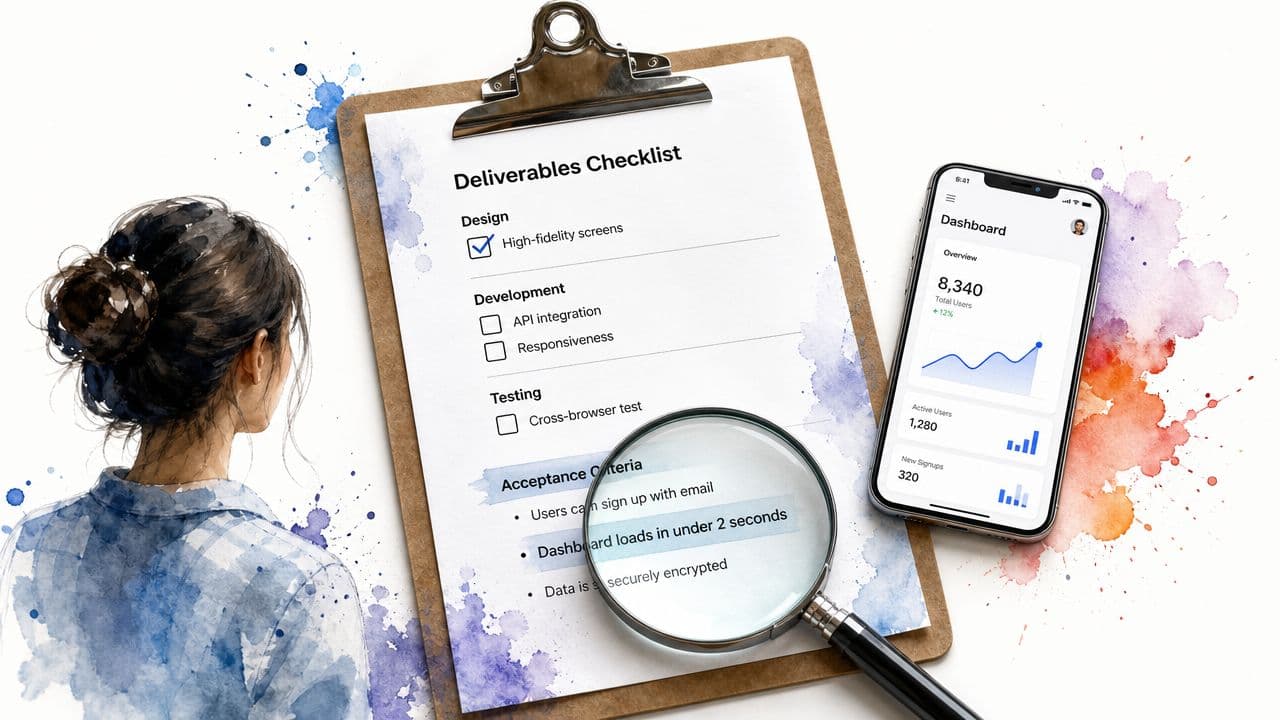
7. Deliverables, Acceptance Criteria & Quality Standards
A lot of project conflict is really a deliverables problem.
One team thinks the work is done when a draft is submitted. Another thinks it's done after revisions, approval, formatting, and upload. Nobody is wrong in bad faith. They're just using different finish lines.
Define done in concrete terms
Every major deliverable needs a clear description and acceptance criteria. Not “homepage copy.” More like:
- Homepage hero copy
- Supporting section copy
- Meta description
- Two revision rounds included
- Final approved version uploaded to the CMS
That level of detail matters even more when work is delegated. If you hand a task to a virtual assistant without the acceptance criteria in the task description, you're inviting rework.
A few examples:
- Software: accepted when the feature works as specified, passes agreed testing, and is approved for release
- Marketing: accepted when assets match the approved message, format, and brand requirements
- Training: accepted when materials are complete, reviewed, and ready for delivery
Quality should be visible before review starts
Quality standards shouldn't appear only at the end when someone says, “This isn't what I expected.” Build them into the work from the kickoff onward.
In Fluidwave, I'd use a deliverables checklist inside each task and include the acceptance notes directly in the brief. That's especially useful when an assistant is handling production support, research cleanup, document formatting, or scheduling coordination tied to a larger deliverable.
A project kickoff meeting agenda should remove subjective ambiguity wherever possible. The team shouldn't have to guess what “good enough” means.
8. Dependencies, Integration Points & Handoffs
Projects rarely fail in the middle of individual tasks. They fail between tasks.
One team finishes its part and assumes the next team has everything it needs. The next team opens the file, finds missing context, and the delay starts. Handoffs are where hidden project friction shows up.
Map the waiting points
A dependency can be internal or external:
- Waiting for legal review
- Needing product approval before design starts
- Depending on a vendor deliverable
- Requiring access from IT
- Waiting on a client response
Write those out clearly. For each one, name the owner and the escalation path. If nobody owns the dependency, it will sit until it becomes urgent.
A common example: Marketing can't launch until product confirms the final feature set. Product can't confirm the feature set until QA clears release readiness. QA can't complete readiness until engineering resolves a blocker. That's not just a schedule issue. It's a chain of handoffs that needs active management.
Handoffs need instructions, not assumptions
For each handoff, define:
- What is being passed
- In what format
- To whom
- By when
- What acceptance looks like on the receiving side
That sounds basic, but often, teams skip it because everyone assumes they're aligned. They usually aren't.
If you're using Fluidwave, link related tasks so people can see upstream and downstream work. That matters even more when virtual assistants are supporting part of the flow. If an assistant is preparing research, cleaning CRM data, formatting assets, or coordinating materials for a next-step owner, they need to know exactly what downstream task depends on their output.
9. Team Structure, Onboarding & Collaboration Framework
A kickoff isn't only about the project plan. It's also about how the people doing the work will function together.
That becomes more important when the team is cross-functional, remote, or partly delegated. If a new contributor joins midstream and there's no onboarding path, the existing team pays the price in repeated explanations and sloppy handoffs.
Show people how the team operates
A simple visual org chart helps. So does one short working agreement that answers:
- Who leads the project day to day
- Who approves major decisions
- Where key documents live
- How feedback should be given
- What response times are expected
- Which hours overlap for collaboration
For distributed teams, keep the structure flatter than you think. Too many communication layers slow everything down.
If your team is remote or hybrid, this practical playbook for remote teams gives a useful outside perspective on collaboration habits that prove effective in practice.
Onboarding should be built into the workflow
I like having a lightweight onboarding checklist for every new contributor:
- Read the brief
- Review current milestones
- Understand role ownership
- Get access to tools
- Review decisions already made
- Confirm first deliverable
In Fluidwave, that can live as a reusable template. When you bring in a virtual assistant, the kickoff becomes more than a meeting. It becomes the source for their task briefs, quality notes, owners, and deadlines.
The trade-off here is speed versus clarity. If you rush people into execution without context, you start faster and lose time later. If you over-onboard everyone, you create drag. The right balance is enough structure that a new person can contribute without requiring constant rescue.
10. Success Metrics, Measurement & Retrospective Plan
Projects feel “busy” by default. That's not the same as being successful.
A kickoff should settle how the team will know whether the project worked, what signals they'll watch during delivery, and when they'll pause to learn from the process. If you skip that conversation, teams usually track whatever is easiest instead of what matters.
Separate activity from outcome
Activity metrics tell you work is moving. Outcome metrics tell you whether the work delivered value.
Examples:
- Activity: tasks completed, assets produced, tickets closed
- Outcome: stakeholder adoption, quality of the release, campaign response, operational improvement
Both matter. But if the team leaves the kickoff only measuring activity, you get a clean execution story without a business result story.
I prefer a short list of metrics tied directly to the project objective. Then I add one retrospective checkpoint at a major milestone and another at project close. That keeps the team from waiting until the end to admit something isn't working.
Decide how lessons will be captured
Retrospectives work best when they're practical. Keep two lists:
- What worked and should be repeated
- What created friction and should change
That split matters. Not every imperfect step is a failure. Sometimes a process was useful but too slow. Sometimes a delegated task worked well but needed a better brief. Sometimes the meeting cadence was right for the core team but too heavy for stakeholders.
For teams using Fluidwave, this section is also where you decide what to watch around delegation. Which tasks were good candidates for assistants? Where did the handoff quality hold up? Where did internal ownership still need to stay close?
A project kickoff meeting agenda should point forward to delivery and backward to learning. That's how teams get better instead of just getting finished.
Project Kickoff Agenda: 10-Point Comparison
| Agenda Item | 🔄 Implementation Complexity | ⚡ Resource Requirements | 📊 Expected Outcomes | 💡 Ideal Use Cases | ⭐ Key Advantages |
|---|---|---|---|---|---|
| Project Overview & Objectives | Low–Medium; prep-heavy, requires executive clarity | Minimal; stakeholder time and shared documentation | Aligned goals, clear success criteria, reduced scope creep | Kickoffs, strategic initiatives, product launches | Clarifies scope and accountability; unifies team purpose |
| Stakeholder Roles & Responsibilities Matrix (RACI) | Medium; mapping roles across components and updates | Stakeholder time, periodic maintenance | Clear ownership, fewer duplicate efforts, defined escalation | Cross-functional programs, delegated/VA workflows | Eliminates role ambiguity; clarifies decision authority |
| Timeline, Milestones & Critical Path | Medium–High; dependency analysis and maintenance | Scheduling tools, PM time, timeline data | Realistic completion estimates, prioritized critical tasks | Releases, construction, phased rollouts | Identifies schedule risks; enables focused prioritization |
| Budget, Resources & Constraints | Medium; budgeting, capacity and contingency planning | Financial data, resource managers, monitoring tools | Controlled costs, realistic scope, early gap identification | Fixed-budget campaigns, infrastructure, expansions | Prevents over-commitment; supports informed trade-offs |
| Communication Plan & Meeting Cadence | Low–Medium; define cadence, channels, and reporting | Meeting time, communication platforms, templates | Predictable information flow, fewer surprises, better visibility | Distributed teams, leadership reporting, fast-moving projects | Reduces info silos; enables early problem detection |
| Risk Assessment & Mitigation Strategy | Medium; identification, scoring, and ownership | Risk owners, expert input, monitoring processes | Fewer surprises, contingency readiness, prioritized risks | High-uncertainty initiatives, vendor-dependent projects | Proactive prevention; focuses resources on high-impact risks |
| Deliverables, Acceptance Criteria & Quality Standards | Medium; define measurable acceptance and tests | QA resources, reviewers, test tools | Objective “done” definitions, reduced rework, consistent quality | Product releases, marketing assets, training programs | Prevents ambiguity; enables objective approvals and handoffs |
| Dependencies, Integration Points & Handoffs | High; map integrations, interfaces, and contingencies | Cross-team coordination, technical specs, testing | Smoother integrations, fewer late surprises, clear handoffs | Integration projects, regulatory-dependent launches | Improves coordination; exposes external risks early |
| Team Structure, Onboarding & Collaboration Framework | Low–Medium; org chart, onboarding flows, norms | Onboarding materials, collaboration tools, training time | Faster ramp-up, clearer reporting, stronger cohesion | Distributed teams, projects using virtual assistants | Accelerates onboarding; reduces coordination overhead |
| Success Metrics, Measurement & Retrospective Plan | Medium; define KPIs, data flows, and retrospective cadence | Data collection tools, analyst time, reporting processes | Measured outcomes, data-driven decisions, lessons captured | Outcome-driven initiatives, process improvements | Demonstrates impact; supports continuous improvement and learning |
From Agenda to Action: Prep, Follow-Up, and Delegation
The agenda is only the visible part of the kickoff. The actual impact comes from what happens before the meeting, immediately after it, and during the first few days of execution. That's where projects either gain traction or drift back into ambiguity.
Before the kickoff, get the mechanics right. Confirm the meeting date, time, location, and duration in advance. Then send the agenda and any pre-read materials early enough that people can show up prepared. Teams commonly share them a few days ahead, and many templates accept sending them no later than a day before as a minimum fallback. That timing matters because the kickoff is supposed to speed up alignment on scope, milestones, and responsibilities before work starts, not force people to process everything live.
The prep itself should stay lean. Finalize the attendee list. Make sure the project purpose, goals, scope boundaries, timeline, roles, and known risks are in shape. If a sponsor hasn't approved the basic direction yet, don't use the kickoff to discover that. Resolve it first. Kickoffs work best as alignment meetings after authorization, not as disguised planning sessions.
During the meeting, keep the conversation disciplined. Timebox the major agenda items. Capture decisions in real time. Don't leave action items floating in the discussion. Every next step should end with an owner and a due date before the meeting closes. That one habit changes the tone of the whole project because it signals that the kickoff isn't just informational. It's operational.
After the meeting, speed matters. Many project guides recommend sending minutes or follow-up notes within 24 hours, and that's a good standard to hold. The notes should include decisions, action items, owners, deadlines, and any open issues that need escalation. If the notes arrive days later, people fill the gap with memory, and memory is unreliable under pressure.
A modern workflow provides critical support. Instead of letting the notes sit in a document, convert them into tracked work immediately. In Fluidwave, that can mean creating the project hub, assigning owners, linking dependencies, and turning risks or handoffs into visible tasks. If part of the project can be delegated, create those task briefs while the discussion is still fresh. Virtual assistants can often take on supporting work such as documentation cleanup, scheduling, follow-up coordination, research preparation, formatting, and administrative execution. That frees the core team to stay on decisions, delivery, and stakeholder management.
A simple post-kickoff flow works well:
- Confirm decisions and distribute notes quickly
- Create or update tasks the same day
- Assign owners and due dates
- Flag risks and dependencies as tracked items
- Delegate support work that doesn't require specialist judgment
- Schedule the first status review before momentum fades
That last point matters more than teams think. A kickoff creates clarity, but only a follow-up rhythm preserves it. If there's no immediate review point, questions pile up and people improvise. By the time the project manager sees the drift, the team has already built work on different assumptions.
The best project kickoff meeting agenda doesn't end when the meeting ends. It becomes the structure the team operates from. If you want the kickoff to impact execution, treat it like a launch sequence. Prepare people early, document decisions fast, and push work into the system right away. Fluidwave is one option that fits that style of execution because it combines task management with delegation in the same flow, which makes it easier to move from discussion to owned action without losing context.
If you want your kickoff to produce real follow-through instead of a polished recap, try Fluidwave as the place where agenda items turn into assigned tasks, delegated support work, and visible next steps.
Focus on What Matters.
Experience lightning-fast task management with AI-powered workflows. Our automation helps busy professionals save 4+ hours weekly.