Discover pricing transparency benefits & best practices for your business. See real examples to build trust and drive conversions.
July 10, 2026 (3mo ago)
Pricing Transparency: Your 2026 Guide to Trust & Conversions
Discover pricing transparency benefits & best practices for your business. See real examples to build trust and drive conversions.
← Back to blog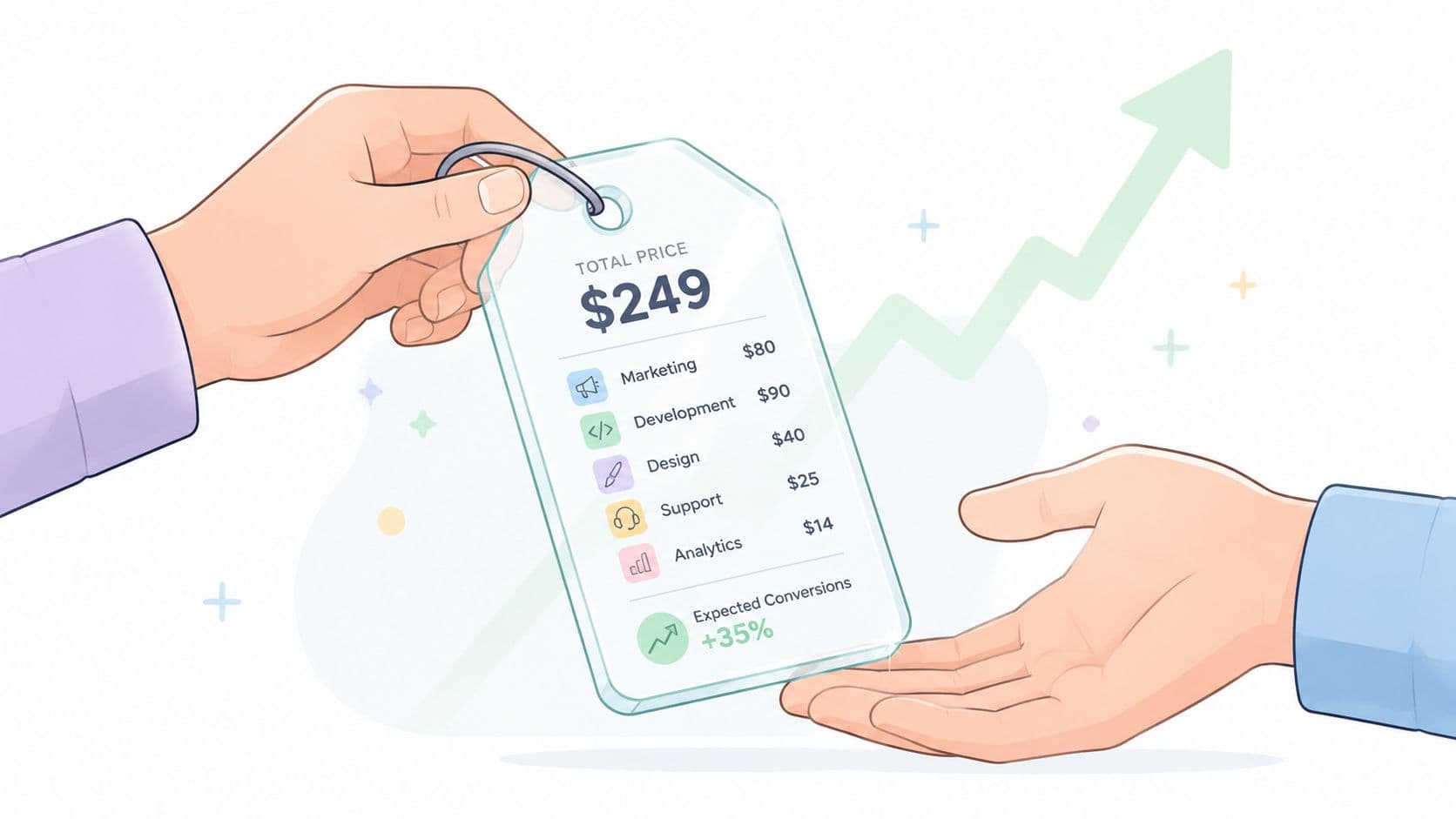
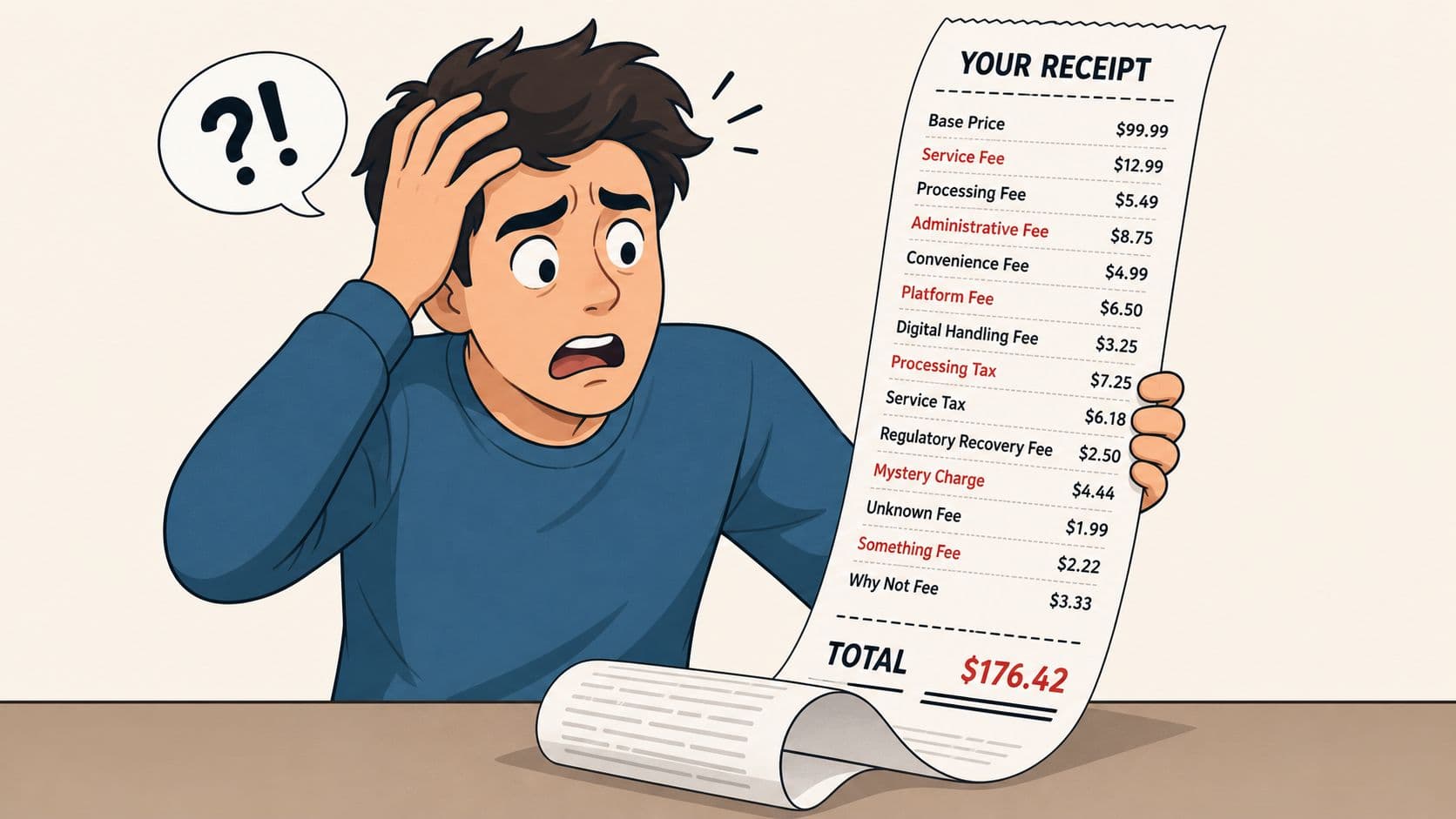
You've seen this movie before. A customer clicks “buy,” feels good about the listed price, and then the final screen adds setup fees, platform fees, service charges, or a vague “custom implementation cost” that somehow appears out of nowhere.
That moment does more damage than most companies admit. The customer doesn't just question the bill. They question your intent.
If your pricing forces people to guess, chase a sales rep, or brace for surprises, you're not just creating friction. You're training buyers to distrust you before the relationship even starts. In a market where buyers already assume they'll be nudged, upsold, and boxed into terms they didn't fully understand, pricing transparency is no longer a nice brand value. It's a commercial advantage.
The deeper shift is psychological. Transparent companies stop treating price as a trapdoor and start treating it as part of the product experience. Customers stop asking, “What are they hiding?” and start asking, “Is this worth it for me?” That's a far better conversation.
What Is Pricing Transparency Really
A common understanding of pricing transparency is that it means posting a number on a website. That's too shallow.
Pricing transparency means a business explains, in plain language, what the customer will pay, why that amount makes sense, what's included, what isn't, and what could change the final cost. It's not a pricing page feature. It's a decision-making philosophy.
It's about clarity, not cheapness
A transparent company doesn't have to be the lowest-priced option. In many cases, it shouldn't be. Buyers will pay more when they understand what they're getting and believe the pricing logic is fair.
That's the point many teams miss. Hidden pricing isn't an advanced strategy. It usually signals one of three things:
- You're unsure of your value
- Your offer is too messy to explain cleanly
- You believe confusion helps conversion
That third belief is the most dangerous. It may help you squeeze a few deals through the pipeline, but it weakens trust at the exact moment trust matters most.
Customers rarely get angry about paying. They get angry about being surprised.
The internal mindset shift
Transparent pricing changes how the business behaves, too. It forces leadership to answer hard questions. What exactly are we charging for? Which parts of our offer create real value? Which charges exist because we've always billed that way?
That pressure is healthy. It strips out lazy packaging and exposes costs that should have been simplified long ago.
A clear pricing model tells customers, “We respect your time, your budget, and your ability to make a decision.” That message lands before a sales call, before onboarding, and before the first invoice. It's one of the fastest ways to prove you operate like an adult business.
The Business Case for Open Pricing
Open pricing isn't charity. It's operational discipline with revenue upside.
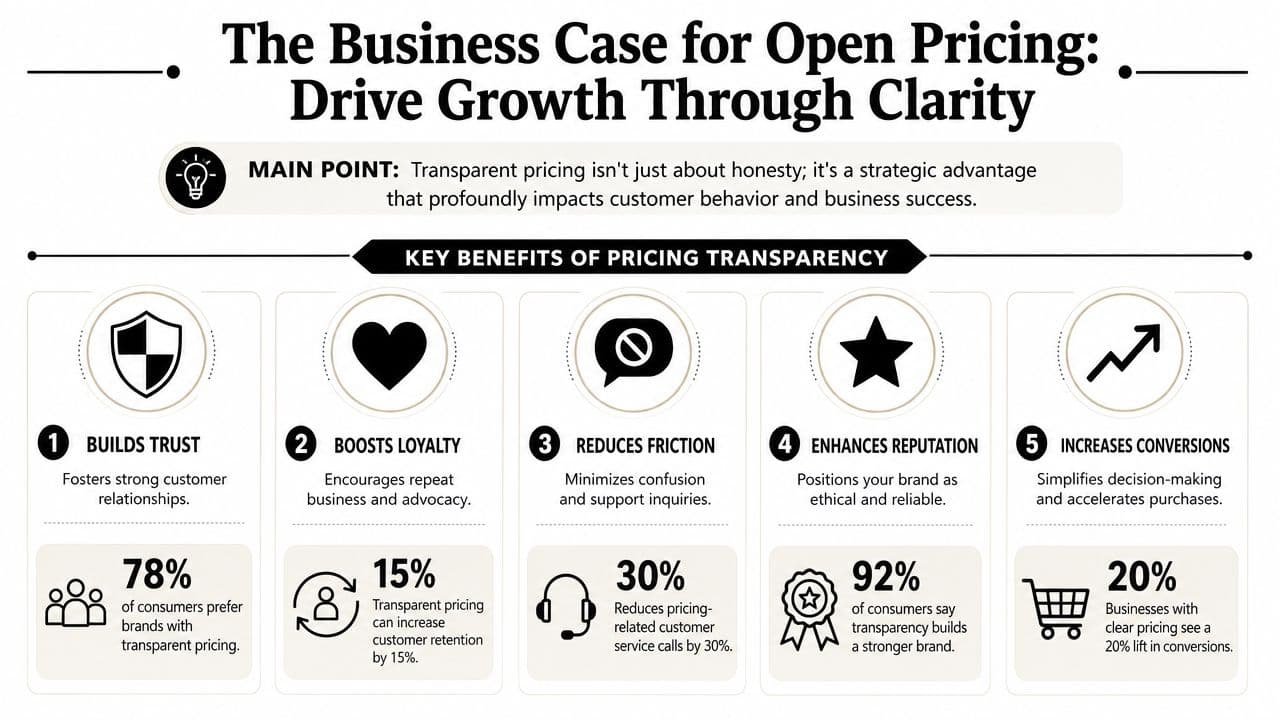
When buyers can understand cost quickly, they make cleaner decisions. Some will disqualify themselves early, and that's a good thing. You stop wasting sales time on people who were never a fit. The prospects who stay move forward with less suspicion and fewer defensive questions.
Better buyers come in the front door
Opaque pricing fills pipelines with curiosity clicks. Transparent pricing tends to attract intent.
If someone sees your pricing structure, understands the range, and still books a call, they're usually further along mentally. They've already accepted the basic economics of the relationship. That changes the tone of the conversation from “convince me this won't be a ripoff” to “help me choose the right option.”
That shift matters because sales friction often has nothing to do with the product. It comes from uncertainty. Buyers delay when they can't estimate total cost, can't compare options, or suspect they'll be cornered later.
Transparency turns price shoppers into value advocates.
Trust reduces drag
Teams often obsess over persuasion and ignore comprehension. But confusion is expensive. It creates more calls, more objections, more abandoned checkouts, and more awkward renegotiations after the proposal lands.
Transparent pricing reduces that drag because it lowers the mental effort required to evaluate your offer. Buyers don't need to decode jargon, infer hidden rules, or wonder whether another fee will appear after they say yes.
If you want a simple framing tool, compare the short-term appeal of flexible pricing with the long-term value of understandable pricing. This breakdown of costs vs benefits is a useful way to think about where hidden complexity undermines buyer confidence.
Retention is where transparency pays off
The strongest argument for open pricing isn't at the top of the funnel. It's what happens after the sale.
A 2025 Forrester study found that companies rated highly for pricing transparency see 56% higher customer retention rates and a 34% increase in average customer lifetime value compared to less transparent competitors, according to Forrester's report on the ROI of pricing transparency.
That result makes sense. Customers stay when their expectations match reality. They leave when the commercial relationship feels slippery.
What open pricing does inside the business
Transparent pricing also improves internal behavior:
- Sales gets cleaner conversations because reps spend less time defending surprise charges.
- Marketing attracts better-fit leads because the offer is easier to self-qualify.
- Finance deals with fewer disputes because invoices match expectations more closely.
- Customer success starts from trust instead of trying to repair a shaky first impression.
The companies that win with pricing transparency don't just publish numbers. They remove ambiguity from the buying experience. That's why the commercial impact compounds. Trust lowers friction, lower friction improves conversion quality, and better-fit customers stay longer.
How to Implement Transparent Pricing Models
Most companies don't need a dramatic pricing overhaul. They need a honesty overhaul.
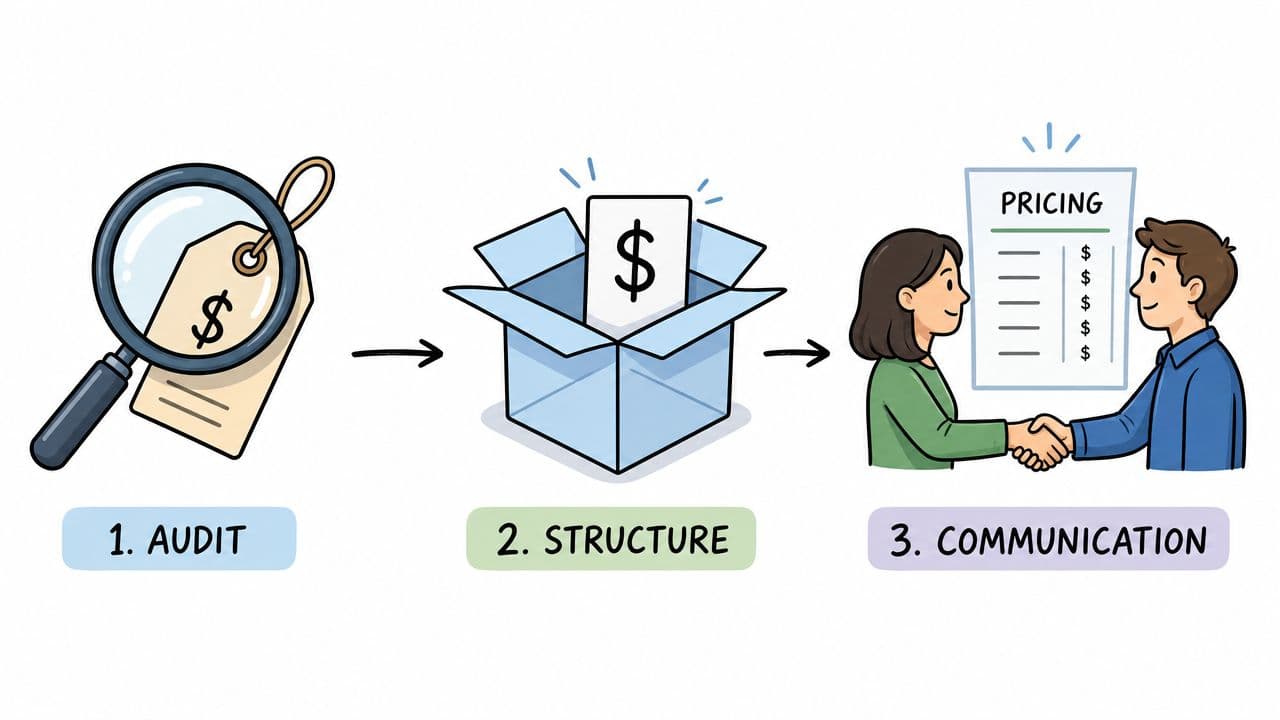
Start by assuming your current pricing is more confusing than you think. If customers regularly ask what's included, whether there are extra fees, or why the invoice doesn't match the original expectation, the model isn't clear enough.
Audit what buyers actually experience
Don't begin with your internal spreadsheet. Begin with the customer journey.
Walk through every point where a buyer encounters price: website, proposal, demo call, contract, invoice, renewal notice. Look for language that hides the true cost or delays clarity. Phrases like “starting at,” “custom,” or “contact sales” aren't automatically bad, but they become a problem when they're used to avoid specificity.
Use this short audit:
- Check the first visible number. Does it reflect what a typical buyer will pay?
- Review add-ons and exclusions. Are they explicit, or buried in a footnote?
- Listen to sales calls. Where do prospects sound surprised or defensive?
- Compare proposal to invoice. If those two documents feel like distant cousins, fix that first.
Structure around value people can understand
Good pricing models use a unit buyers can grasp quickly. Seats, projects, locations, transactions, usage bands, retained hours, or task volume can all work if they map cleanly to delivered value.
Bad pricing models mix too many variables. That's when customers lose the thread and assume you've made the system complicated on purpose.
Here's the rule I give clients: if a competent buyer needs a live call just to understand how charges are calculated, your model is still too opaque.
A useful example comes from service businesses that bill for discrete outcomes instead of vague effort. In education operations, for instance, teams often need systems that clearly connect activity to billing. A tool like tutoring billing software is helpful because it reflects a practical truth. Transparent charging works better when the billing unit is visible, trackable, and easy to reconcile.
Explain what is not included
Many pricing pages frequently fail. They show the attractive headline and hide the boundaries.
You'll build more trust by saying, clearly, “This plan does not include X,” than by letting customers discover it after signup. That applies to onboarding, support levels, overages, revisions, rush work, integrations, cancellation terms, and any service that tends to trigger uncomfortable follow-up charges.
Practical rule: If a customer could reasonably assume something is included, state the answer plainly.
That one habit prevents a lot of resentment.
Replace jargon with commercial plain English
“Enterprise-grade support framework” is not pricing language. “Email support during business hours” is.
“Variable implementation architecture” is not pricing language. “Setup cost depends on system complexity and data migration needs” is.
Transparency isn't just about the amount. It's about readability. Buyers shouldn't need a translator to understand your commercial terms.
Show the logic behind the number
A smart customer doesn't only want the price. They want the rationale.
If your service costs more because it includes faster turnaround, deeper expertise, stronger QA, or dedicated support, say so directly. If your lower tier is limited because it's designed for lighter usage, say that too.
Many teams become timid. They post numbers but avoid explaining why the price is fair. That's a mistake. The “why” is what turns a price into a value judgment instead of a cost trigger.
A related consideration is rate design. If you're comparing hourly, project, retainer, and unit-based models, this guide to virtual assistant rates is a practical reference for thinking through how pricing structure affects buyer expectations.
Use models that align payment with delivered work
One clean way to increase pricing transparency is to charge for completed work rather than abstract access. That's why pay-per-unit models often feel more credible than subscriptions with fuzzy usage rules or hourly billing that leaves customers guessing.
Fluidwave is one example of that approach. It combines task management with access to virtual assistants on a pay-per-task basis, so users pay for completed work rather than committing to a subscription for delegation. That model removes a common source of buyer hesitation because the pricing unit is concrete.
Here's a quick walkthrough of the broader principle in action:
Publish ranges when exact pricing isn't possible
Some businesses can't post a single fixed number. Fine. Then publish a range, the variables that affect it, and sample scenarios.
That's still transparent. “Most implementations fall into these categories, and these factors move the price” is infinitely better than “Book a demo to find out if you can afford us.”
For custom deals, give buyers enough information to self-assess before they talk to sales. If your team protects pricing until the call, buyers assume the worst.
Examples of Companies Winning with Transparency
Companies don't all practice transparency the same way. That's the point. The principle is flexible. The commitment is what matters.
Buffer made openness part of the brand
Buffer became widely known for publishing information many firms keep hidden, including details related to salaries and revenue philosophy. That broader culture of openness shaped how people interpreted the company's commercial behavior. Customers tend to give transparent companies more benefit of the doubt because the business has already signaled, repeatedly, that it doesn't rely on concealment.
That's the first lesson. Pricing transparency works better when it matches the rest of the company's posture. If your pricing is open but your terms are slippery, buyers notice the mismatch immediately.
Everlane explained cost, not just price
Everlane took a different route. Rather than limiting transparency to the shelf price, it showed customers how product cost was assembled through materials, labor, and other production components. That approach changed the buyer's internal question.
Instead of asking, “Why is this so expensive?” customers were prompted to ask, “Does this markup feel reasonable?”
That is a major psychological shift. Transparent businesses help customers evaluate fairness, not just affordability.
Buyers are more comfortable with a higher price than with a mysterious price.
Transparency can be procedural too
Not every company needs a dramatic public breakdown. Sometimes the winning move is procedural clarity. That means plain-language quotes, all-in tiers, visible renewal terms, and clear exceptions before purchase.
If you want a practical framework for pressure-testing your own process, PEO Metrics' transparency guide is a useful checklist. It's valuable because it pushes teams to examine where ambiguity still slips in, even when they believe their pricing is already straightforward.
Pricing Approach Comparison
| Metric | Opaque Pricing Approach | Transparent Pricing Approach |
|---|---|---|
| Initial visibility | “Contact us for pricing” with no context | Public price, range, or qualification criteria |
| Fees | Charges appear later in checkout or contract | Fees are disclosed early and explained clearly |
| Plan design | Confusing bundles with unclear limits | Tiers tied to visible usage or outcomes |
| Buyer reaction | Suspicion, delay, defensive questions | Faster self-qualification and clearer expectations |
| Sales conversation | Starts with cost anxiety | Starts with fit, scope, and value |
| Renewal experience | Surprise increases or buried terms | Clear terms, timing, and change conditions |
The strongest examples all share one trait. They don't weaponize uncertainty. They make the customer's decision easier, even when the answer is no.
Addressing Common Fears and Legal Questions
Leaders usually resist pricing transparency for one reason. They're afraid competitors will use the information against them.
That fear is overstated.
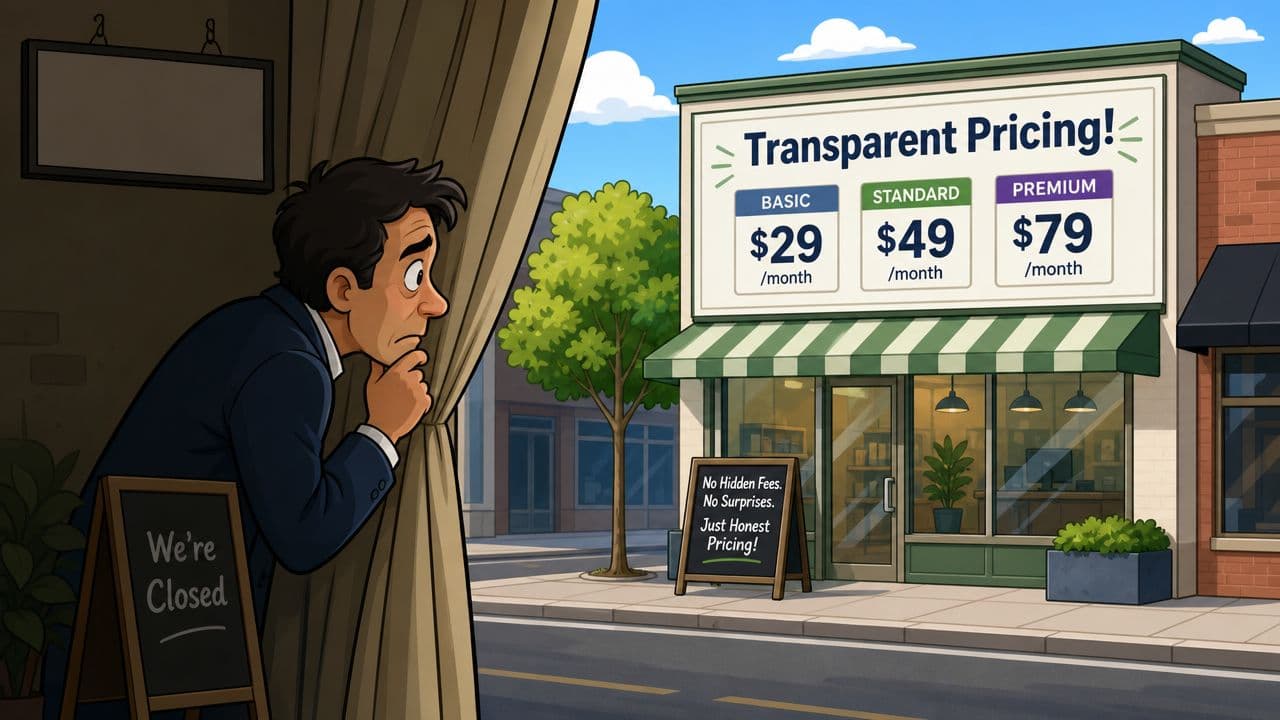
Competitors already know more than you think
Your competitors can often estimate your pricing from customers, prospects, job postings, lost deals, procurement processes, and market conversations. What they usually can't copy easily is the trust created by being clear first.
When you publish understandable pricing, you force less transparent competitors into an awkward position. Either they stay vague and look evasive, or they follow your lead and validate the standard you set.
That first-mover effect is real in practice, even if many companies are too cautious to claim it openly.
The bigger risk is buyer distrust
Executives tend to obsess over competitive exposure and ignore buyer psychology. But customers don't leave because a rival saw your pricing page. They leave because they felt misled, cornered, or surprised.
If your sales model depends on hiding the actual cost until late in the process, you don't have a pricing strategy. You have a trust deficit.
For any business that formalizes payment terms, it also helps to tighten the contract language around scope, timing, and obligations. This overview of an agreement to pay contract is a useful reference for making sure commercial clarity carries through after the quote.
Legal direction is moving toward more disclosure
I'm not giving legal advice here, but the direction of travel is obvious. Regulators are paying closer attention to hidden fees, drip pricing, and misleading price presentation. Businesses that rely on partial disclosure are betting against the way consumer protection is moving.
That's not just a retail issue. It shows up in services, subscriptions, healthcare, education, and care-related benefits. In complex areas, the lesson is the same: people need upfront visibility into what may or may not be covered. For example, someone navigating maternal care benefits might use a resource like Medicaid doula coverage by state because clarity on coverage rules directly affects real purchasing decisions.
Clear pricing isn't only good sales practice. It's increasingly the safer compliance posture.
If you're worried about legal exposure, simplify before you lawyer everything to death. Start by removing surprise charges, vague qualifiers, and buried exclusions. The cleaner the pricing, the less strain you place on the contract to rescue a confusing deal.
Your Pricing Transparency Questions Answered
How can we be transparent if our deals are custom
You can still be transparent without posting one flat fee.
Publish a pricing range, the main variables that affect cost, the minimum engagement level if one exists, and a few sample deal shapes. Tell buyers what drives complexity. Team size, integration depth, turnaround speed, support level, volume, and compliance requirements are all fair variables if you explain them plainly.
The mistake is hiding behind “custom” as if that ends the conversation. It doesn't. Buyers still need orientation. Give them enough detail to know whether they're in the ballpark before they speak to sales.
What's the first step if our current pricing is a mess
Don't start by redesigning the page. Start by collecting the moments where people get confused.
Pull customer emails, sales call notes, proposal objections, invoice disputes, refund requests, and support tickets related to price. You'll find patterns fast. Those patterns tell you where the pricing model is unclear, where language is weak, and where internal teams are improvising around a broken structure.
Then make one pass through these priorities:
- Remove surprise fees that create the strongest emotional backlash.
- Standardize naming so the same charge isn't described three different ways.
- Clarify inclusions and exclusions in customer-facing language.
- Create a visible pricing logic that a non-expert can explain in one minute.
That sequence works because it solves trust first, then comprehension.
Will showing our prices attract low-ball customers
It may attract some price-sensitive buyers. Good. Let them self-select early.
The bigger benefit is that it repels mismatched prospects who would have wasted your team's time anyway. Transparent pricing tends to filter in serious buyers and filter out people who were never going to accept your economics.
There's another point founders often miss. Low-ball customers don't appear because you showed the price. They appear because your value story is weak, your offer is poorly packaged, or your market positioning is fuzzy. Hiding the number doesn't fix any of that.
What if our sales team hates open pricing
That usually means the team has learned to use ambiguity as a negotiation tool.
You'll need to reset incentives. The goal isn't to preserve mystery. The goal is to shorten the path to a qualified yes or a clean no. Good salespeople can still sell with open pricing. In many cases, they sell better because they're talking to informed prospects instead of spending half the call managing suspicion.
How often should we update public pricing
Update it whenever the actual buying experience changes in a meaningful way. If your posted price no longer reflects how you sell, the page becomes a liability.
Set a simple review cadence with sales, finance, and operations. Check whether the public pricing, proposal language, contract terms, and invoice structure still match. If they drift apart, trust erodes.
The standard is simple. Buyers should feel that the price they saw, the price they discussed, and the price they paid all belong to the same company.
If your pricing still depends on mystery, you're making customers work too hard to trust you. Fluidwave is worth a look if you want a model that pairs task management with pay-per-task delegation, so the pricing unit stays visible and tied to completed work.
Focus on What Matters.
Experience lightning-fast task management with AI-powered workflows. Our automation helps busy professionals save 4+ hours weekly.