Learn how to draft, enforce, and manage a legally sound agreement to pay contract. Our guide covers key clauses, common pitfalls, and modern workflow tips.
June 24, 2026 (3mo ago)
Agreement to Pay Contract: A Practical Guide for 2026
Learn how to draft, enforce, and manage a legally sound agreement to pay contract. Our guide covers key clauses, common pitfalls, and modern workflow tips.
← Back to blog
You probably know the moment. A client says, “Just send the work over and I'll pay Friday.” A contractor says, “I'll catch up on the missed amount next month.” A team lead approves a rush task in Slack, everyone moves fast, and then the invoice gets questioned because nobody wrote down the schedule, the amount, or what counted as complete.
That's where an agreement to pay contract stops being legal paperwork and starts being an operating tool. It gives both sides one clear answer to the questions that usually trigger disputes: who owes what, why they owe it, when it's due, how it gets paid, and what happens if something goes sideways.
I've seen businesses treat payment terms like an afterthought and then spend far more time arguing over wording than they would have spent drafting a clean document in the first place. The contract doesn't need to be dramatic. It needs to be precise.
Why a Handshake Is Not a Contract
A verbal promise often feels fine right up until cash is late.
A founder hires a freelance designer after a quick phone call. The freelancer starts immediately because the deadline is tight. The founder believes payment will happen after final approval. The freelancer believes half is due upfront and the rest on delivery. Both sides think they had a clear conversation. Neither side wrote it down.
That gap is where relationships get damaged. It's also where recoverability gets weak. If you're dealing with disputed dates, disputed scope, or disputed conditions for payment, you're no longer discussing goodwill. You're discussing proof.
A useful primer on understanding oral agreements shows why spoken deals can create real obligations while still being difficult to enforce cleanly when memories diverge.
Why this problem is so common
The bigger issue isn't that people never sign documents. It's that they sign them constantly and still miss the parts that matter. Goldberg Law Group found that 84% of people sign legal agreements multiple times a year, while only 1 in 6, about 16%, say they read every word (Goldberg Law Group data). That's a dangerous mix in any payment arrangement.
When I review messy disputes, the same pattern shows up:
- The amount was discussed casually: One side remembers the gross amount, the other remembers the net after offsets or revisions.
- The timing stayed vague: “Next week” or “end of month” sounds clear until a month has five Fridays, a bank holiday lands, or someone expects payment on receipt.
- Completion wasn't defined: One party thinks submission triggers payment. The other thinks acceptance does.
Practical rule: If payment matters, memory isn't a control system.
What a written contract fixes
A written agreement to pay contract does three things that a handshake usually doesn't:
| Problem | What happens without a contract | What the contract should do |
|---|---|---|
| Identity | People use nicknames, trade names, or incomplete business details | State the exact legal parties |
| Timing | Due dates drift into “whenever accounting gets to it” | Lock in dates or a precise schedule |
| Consequences | Missed payments trigger arguments instead of action | Define default, fees, and remedies |
A handshake may start the work. It rarely finishes the payment conversation well.
What an Agreement to Pay Contract Actually Is
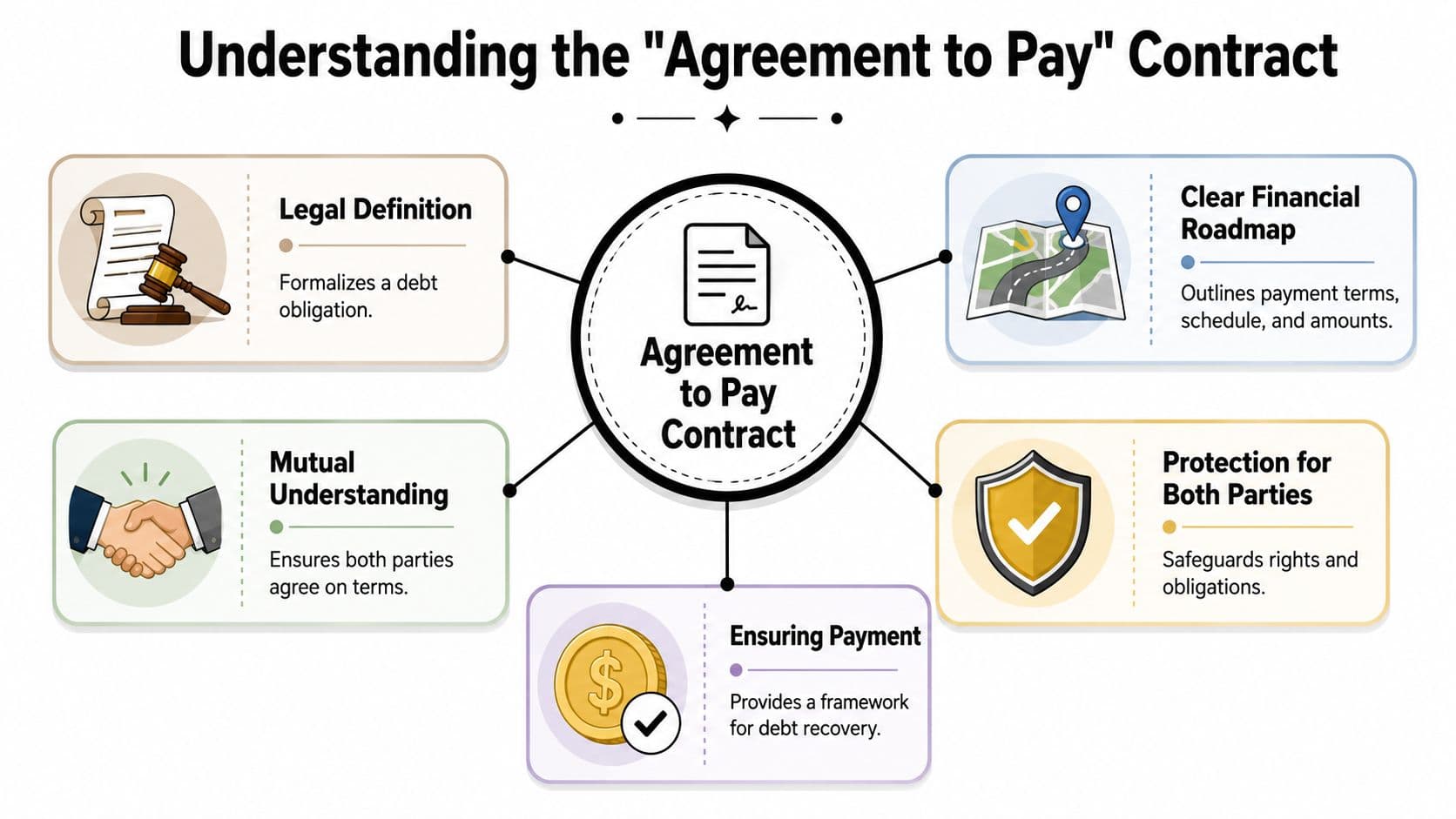
An agreement to pay contract is a written promise that turns a financial obligation into a usable roadmap. It's more than an invoice, and it's different from a casual acknowledgment that money is owed.
An invoice says, “Here's what I'm billing.” An agreement to pay says, “Here's the debt or obligation, here's the schedule, here are the rules, and both sides accept them.”
Think of it as a payment roadmap
Good payment agreements remove guesswork. They tell each side what lane they're in and what happens at each checkpoint.
At minimum, the modern structure is familiar because it grew out of the old promissory note. Historically evolving from informal promises, the modern payment agreement now typically includes identified parties, the total debt, a precise payment schedule, and defined interest or late fees (Sirion overview of payment agreement contract terms).
That historical shift matters. Older business cultures tolerated more informal promises because trade was slower, smaller, and easier to track by relationship. Modern work is faster and often fragmented across contractors, platforms, and short projects. That means the written record has to carry more weight.
What it is not
People often confuse a payment agreement with nearby documents. They overlap, but they don't do the same job.
- An invoice requests payment.
- A statement of work defines the work itself.
- A promissory note usually focuses tightly on a debt promise.
- An agreement to pay contract ties the obligation, schedule, enforcement terms, and party commitments together.
That distinction matters in practice. If a customer says, “I never agreed to those installment terms,” sending the invoice again won't solve much if the invoice never established those terms in the first place.
The best payment agreements read like operational instructions, not courtroom theater.
The plain English version
If you strip away the legal language, the contract should answer five business questions:
- Who is involved
- Why the money is owed
- How much is owed
- When each payment is due
- What happens if payment is late, disputed, or missed
If one of those answers is fuzzy, the contract is carrying risk you'll eventually feel in cash flow, collections, or relationship strain.
The Legal Pillars of an Enforceable Agreement
A payment document becomes enforceable because it behaves like a real contract, not because it looks formal.
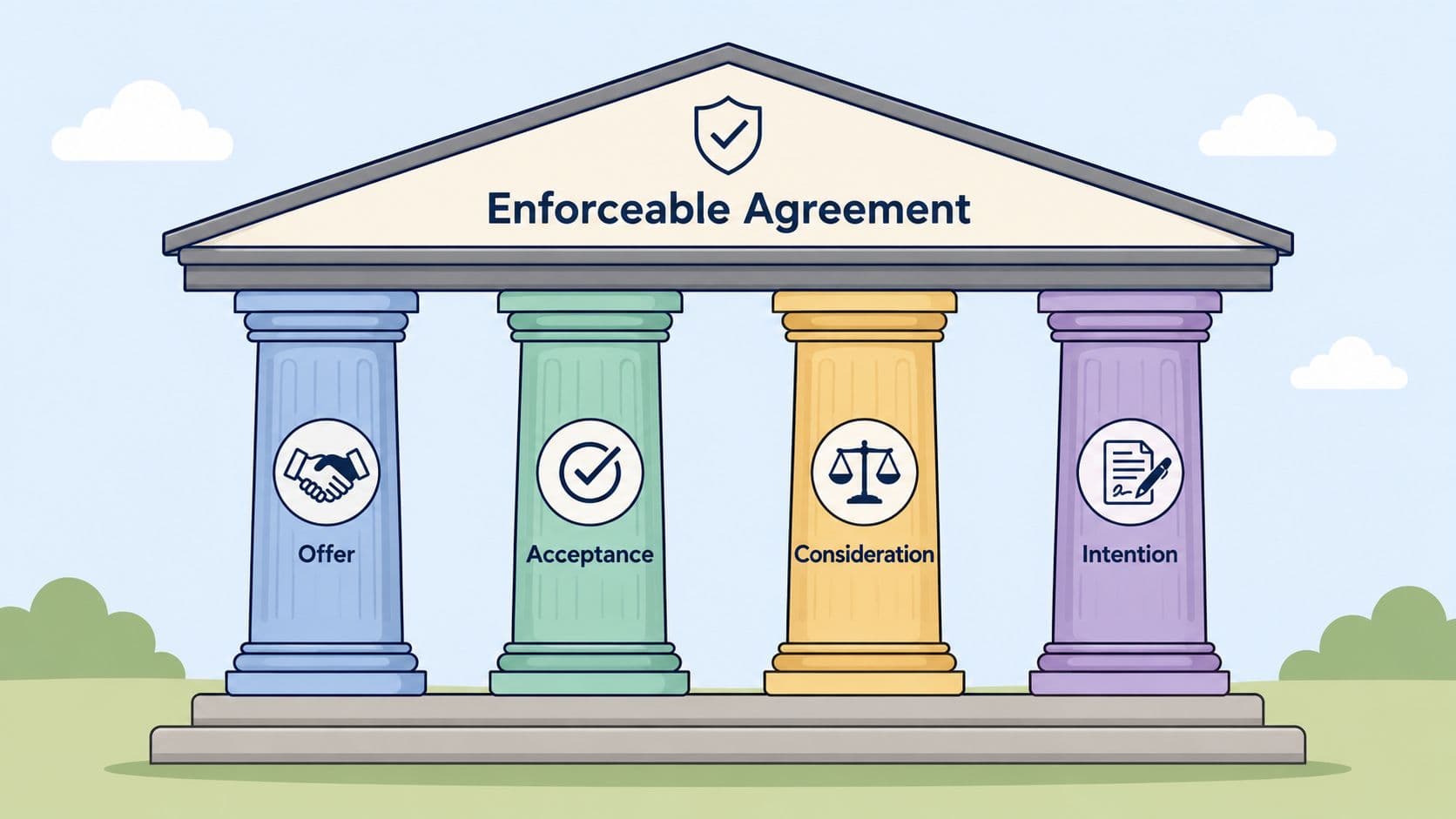
The classic pillars are offer, acceptance, consideration, and intent to create legal relations. If one is missing, the document gets harder to defend.
Offer and acceptance
Offer is the concrete proposal. Acceptance is the clear yes.
In a payment context, that might look like this: a consultant agrees to complete a project, the client agrees to pay in installments on stated dates, and both sign the same terms. Trouble starts when people leave one piece implied. A message saying “sounds good” may confirm the relationship, but it may not capture the exact repayment structure you need if a dispute begins later.
Electronic signing is usually practical and efficient, but the process still needs to be handled correctly. If your team is moving to digital execution, this guide from Homebase on electronic signature compliance is a useful check on what valid execution should look like.
Consideration is what gives the promise weight
This is the piece many non-lawyers skip. Consideration means each side is giving something of value. In plain English, one side isn't just making a one-way promise for no reason. There's an exchange.
For a payment agreement, the exchange may be:
- Goods already delivered
- Services performed
- A debt restructure instead of immediate collection
- Additional time to repay on agreed terms
If that exchange isn't described clearly, the contract weakens fast. Legal practitioners note that consideration is essential for enforceability, and 40% of payment disputes stem from ambiguous schedule definitions. The takeaway is simple: the agreement must clearly state what is being exchanged and exactly when payment is due.
Intent and clarity
Business people don't usually say, “We intend to create legal relations.” They show it by writing terms that look serious, specific, and final.
A workable agreement should identify the creditor and debtor with full legal names and addresses, describe the originating debt, and define the repayment schedule with exact due dates. If the schedule says “monthly” but never says which day, you've left room for conflict. If it says “payment after completion” but never defines completion, you've done the same thing.
Here's a short explainer that captures the basics before you draft or sign:
What holds up better in the real world
A strong contract usually has these traits:
| Pillar | Weak version | Strong version |
|---|---|---|
| Offer | “We'll work something out” | Exact amount and structure |
| Acceptance | Verbal or scattered messages | Signed single document |
| Consideration | Debt mentioned vaguely | Clear reason value was exchanged |
| Intent | Informal language and assumptions | Formal terms with deadlines and remedies |
If I had to pick the clause people underestimate most, it's the schedule. That's where payment disputes usually stop being abstract and become expensive.
Drafting Your Contract With Essential Clauses
Most bad payment agreements aren't bad because someone used the wrong legal phrase. They're bad because key facts are missing.
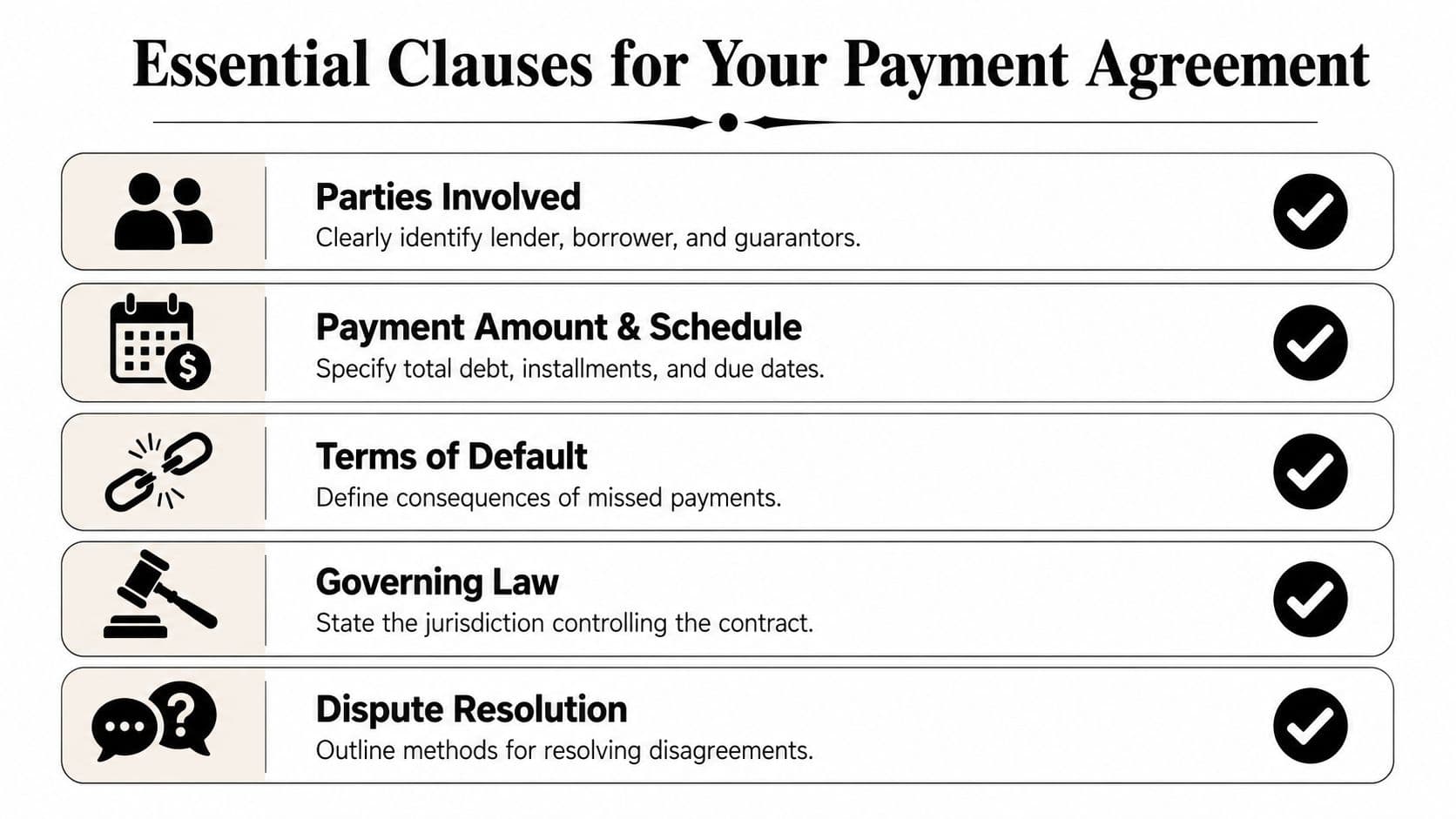
A practical agreement to pay contract should read like a checklist a finance lead could follow without calling the drafter for interpretation.
Start with the parties and the debt
First, identify the legal parties properly. Use full legal names and mailing addresses. If one party is a company, use the registered business name, not the brand nickname everyone uses in email.
Then define the original debt mechanically, not casually. State:
- The date the debt originated
- The circumstances that created it
- The original amount, if it differs from the current amount owed
That detail matters because it anchors the agreement to a real obligation. “Outstanding balance from prior services” is weak. “Balance arising from design services delivered under the May project, incurred on the stated date” is much stronger.
Build a schedule that no one can misread
Many agreements falter because of vague terms. Expert analysis shows that contracts with vague repayment terms suffer a 25% increase in late payment penalties. Precision reduces confusion and gives you a cleaner enforcement record.
Don't write “monthly payments until paid.” Write the frequency, each payment amount, the exact due date, and the final payment date. If there are installment numbers, list them. If there's a balloon payment, say so directly.
A schedule should survive a handoff from sales to finance to legal without anyone needing a phone call to decode it.
A clean schedule often includes:
| Clause point | Weak wording | Better wording |
|---|---|---|
| Amount | “Pay balance over time” | State current total amount owed |
| Frequency | “Monthly” | State the exact day of each month |
| Finality | “Until resolved” | State total number of payments and final due date |
| Method | “Bank transfer” | Specify approved method such as ACH, wire, or check |
Spell out late fees, default, and changes
If payment is late, the contract should say what happens next. That may include a late fee, interest if applicable, acceleration, suspension of future work, or a notice-and-cure period. What matters most is consistency and clarity.
Change control belongs here too. If the amount, timing, or scope can change, write down how that change becomes valid. An email approval from an authorized person may be enough, but say so. If you leave amendments informal, the original schedule becomes harder to rely on the moment the project shifts.
Scope discipline also matters. If payment ties to deliverables, your contract should line up with your work definition. A clear explanation of what scope of work means is worth reviewing if your payment terms depend on milestones, revisions, or acceptance criteria.
Include the operational clauses people forget
The clauses below often decide whether collections are smooth or messy:
- Payment method: State acceptable methods and, if relevant, the payment currency.
- Invoice submission rules: If invoices must include a purchase order number or go to a specific email, write it down.
- Receipt confirmation: Note whether the payee issues a receipt or confirmation of funds received.
- Dispute resolution: State whether disputes go to negotiation, mediation, arbitration, or court.
- Governing law: Name the jurisdiction controlling the contract.
Sample phrasing doesn't need to sound ornate. “Payments are due on the first business day of each month by ACH to the account designated by Creditor” is better than a paragraph of foggy legalese.
Common Use Cases in Business and Finance
An agreement to pay contract shows up in very different settings, but the good ones all do the same job. They reduce assumptions before money changes hands or after a balance already exists.
Vendor and freelancer work
This is the version most small businesses run into first.
A company hires a copywriter, developer, or operations consultant. The project has milestones, revisions, and approval stages. The contract should link payment to those real checkpoints rather than rely on “project completed,” which means different things to different people.
For independent workers comparing tools, rates, and operating habits, this roundup of best apps for independent contractors fits the same theme. Administration matters just as much as delivery.
A practical freelance payment agreement usually works better when it separates:
- Deposit or initial payment
- Milestone payments
- Final payment after acceptance
- What happens if the client pauses or expands the work
Personal and business loans
Loan-related agreements are less forgiving because the debt itself is the core of the document.
In that setting, the contract often needs to define the amount advanced, whether interest applies, the schedule, payment method, default terms, and whether any collateral or guaranty exists. If family members or founders are involved, the emotional pressure can make people draft less, not more. That's usually backwards. Informal relationships need cleaner documentation because people often avoid hard conversations until the problem is already expensive.
If a loan would strain the relationship when repayment slips, document it before the money moves.
Settlement agreements
Payment agreements also resolve disputes after something has already gone wrong.
A vendor may have overbilled. A customer may owe for old invoices but can't pay in one lump sum. A former contractor may accept staged repayment to avoid immediate litigation. In those situations, the agreement isn't just about future payments. It's about closing factual arguments over the older obligation and replacing them with a new, defined schedule.
The strongest settlement payment terms usually identify the prior dispute, state the agreed amount to resolve it, and explain what happens if an installment is missed. That way, nobody has to re-litigate the background every time a payment date arrives.
Managing Agreements in the Modern Workflow
The old model assumed fewer contracts, larger amounts, and longer billing cycles. That's not how a lot of work happens now.
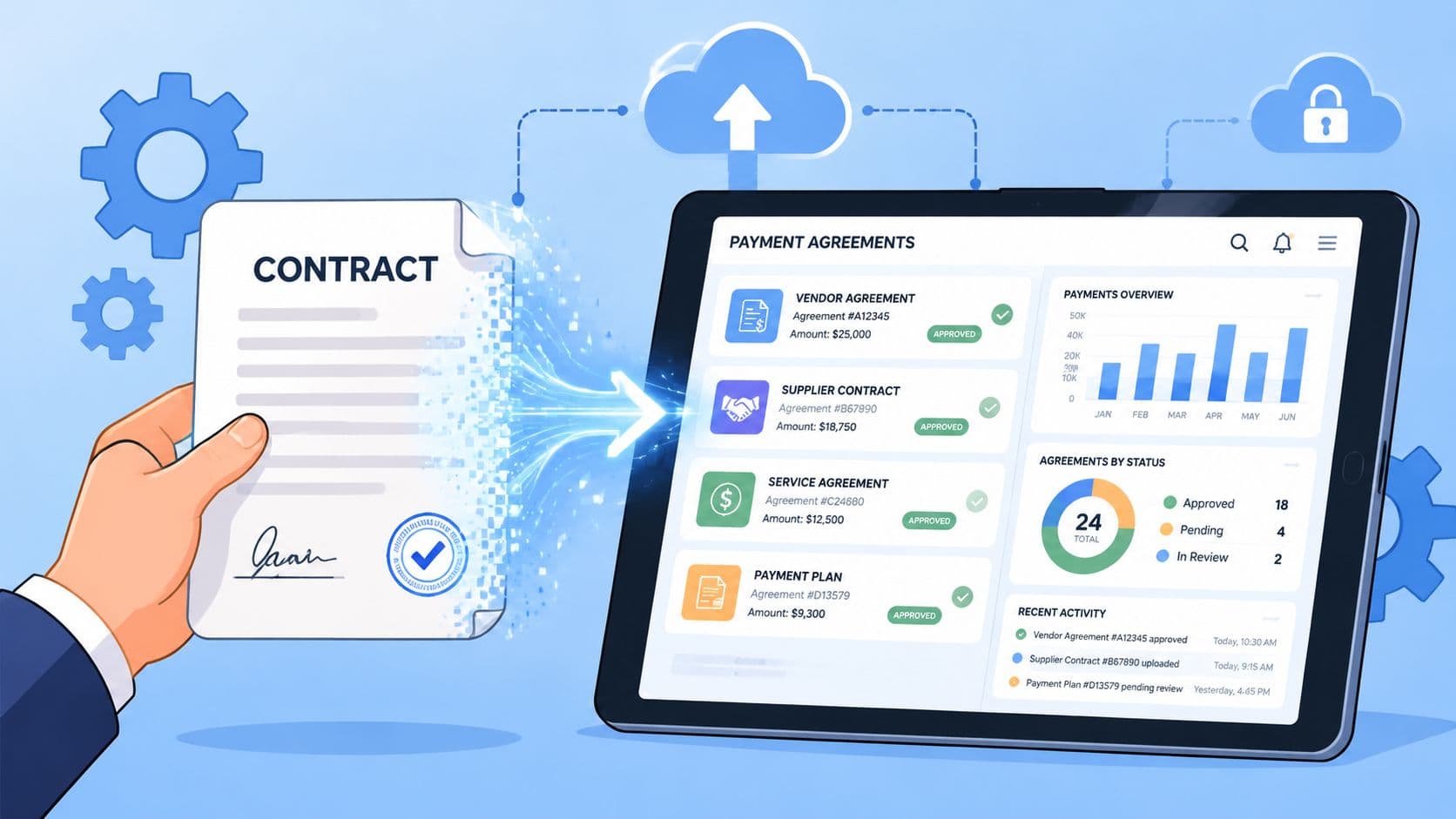
Today, teams authorize short tasks, limited-scope deliverables, and one-off assignments all day long. Data shows that 68% of new gig work involves tasks under one hour, while 92% of online content about payment agreements still assumes long-term retainers. That mismatch leaves a real gap for anyone using delegated micro-tasks and fast-turn workflows.
Why micro-contracts need different thinking
A monthly retainer contract can tolerate some generality because the relationship is stable and repeated. A micro-task arrangement can't.
If the task is small and fast, the agreement needs to answer narrower questions with more precision:
| Workflow issue | Traditional contract habit | Better approach for micro-tasks |
|---|---|---|
| Completion | Broad milestone language | Define the exact deliverable |
| Timing | Net terms or monthly billing | Tie payment to task verification |
| Failure | Generic default clause | State what happens if work is incomplete |
| Updates | Formal amendment process only | Allow controlled task-level modifications |
That's especially relevant in AI-assisted operations, where people assign tasks quickly and expect systems to track status, handoffs, and evidence. The legal logic is still traditional. The operational speed is not.
Where businesses get exposed
The weak spots usually aren't dramatic. They're procedural.
- The task was assigned before payment conditions were written down
- The acceptance standard wasn't defined
- The payer assumed “submitted” meant “done”
- The worker assumed “started” guaranteed payment
For leaders handling many small assignments, bookkeeping discipline matters as much as contract language. Tools and workflows built for contractor-heavy operations can reduce confusion around proof, timing, and reconciliation. A review of independent contractor bookkeeping software is useful if your contract process keeps breaking down at the payment tracking stage.
What works better than a generic template
A static template usually underperforms in fast task environments. You need a modular structure that can adapt to short, specific work without losing legal basics.
That often means using a short core agreement plus task-level terms that define:
- The exact task
- The payment amount or formula
- The verification standard
- The due-on-acceptance or due-on-submission rule
- The fallback if work is incomplete or disputed
The goal isn't to turn every small task into a negotiation. It's to make the system predictable. Once the trigger points are standardized, you can move quickly without relying on memory, chat fragments, or goodwill to sort out who gets paid and when.
From Handshake to Signed Document
Most payment disputes don't start with bad intent. They start with loose language, rushed approvals, and assumptions that seem harmless until money is late.
A strong agreement to pay contract fixes that. It turns a vague promise into a documented obligation with named parties, a defined debt, a real schedule, and workable remedies. It also protects both sides. The payer knows what they're committing to. The payee knows what they can enforce.
That matters even more in modern work, where assignments are shorter, teams are distributed, and payment terms need to keep pace with real operations. The old advice still holds. Write it down. Be specific. Keep the schedule clean. Match the payment terms to the actual work.
If you're reviewing one before signing, slow down enough to read the operative clauses, not just the headline amount. If you're drafting one, assume a third party with no background will need to interpret it later. That mindset usually produces better contracts.
A handshake may start trust. A signed document protects it.
If you're handling repeat tasks, contractor payments, or delegated work at speed, Fluidwave gives you a cleaner way to organize assignments, define budgets and timelines, and keep payment-related task details from getting lost in chat threads or scattered spreadsheets. It's a practical setup for teams that want less ambiguity and better follow-through.
Focus on What Matters.
Experience lightning-fast task management with AI-powered workflows. Our automation helps busy professionals save 4+ hours weekly.