Learn how to write a plan of action with goals, milestones, owners, timelines and risks, plus a template you can copy and use today.
November 8, 2026 (Today)
Plan of Action Template: How to Build One That Gets Done
Learn how to write a plan of action with goals, milestones, owners, timelines and risks, plus a template you can copy and use today.
← Back to blog
You've agreed on the goal, shared the document, and asked everyone to get moving. Then a client approval stalls, someone assumes legal is handling the consent form, and Friday's update lists completed tasks without showing whether the client experience improved.
A useful plan of action makes those gaps visible before they become missed deadlines. It connects the outcome to named owners, dated handoffs, evidence of progress, and decisions about what to change when the original approach stops working.
A Plan of Action Template You Can Copy Today
Copy this template onto one page. For a hypothetical 30-person marketing agency, the challenge is to shorten client onboarding without skipping approvals or pushing unfinished work onto account managers.
Plan of action template fields with examples
| Field | What to write | Example |
|---|---|---|
| Goal | One measurable outcome with a deadline | Cut client onboarding from 14 to 7 days by 30 June |
| Scope | What is in and what is out | Includes contract and kickoff; excludes billing setup |
| Milestones | Three to six checkpoints in order | Template approved; first pilot client onboarded; full rollout |
| Owners | One named person per task | Priya owns the template; Marcus owns the pilot |
| Timelines | Start and due date for each task | Pilot starts 2 June and is due 13 June |
| Risks | Top threats with a planned response | Pilot client delays sign-off; agree a backup client |
| Monitoring | Review date and the metric to check | Friday review of onboarding days per client |
Fill the fields in that order. Start with the result, then draw the boundary around the work before choosing checkpoints. Otherwise, you'll schedule tasks that don't belong in the project.
Use the owners and timelines fields to expose resource conflicts. If Priya is also delivering client work, her availability needs to be agreed, not assumed. Put the required capacity alongside the relevant task in the supporting schedule.
The Open Government Partnership's implementation guidance connects activities with resources, deadlines, expected outputs, responsible parties, and risks with mitigation measures. That's why this template includes a planned response to risk, rather than stopping at a list of things to do.
Keep the working document short
For a broader view of how this page connects to resource allocation and recurring operations, use TheContentMap operational planning guide. Keep detailed procedures, supporting calculations, and the full risk register outside the one-page summary.
Usability test: Give the page to someone unfamiliar with the project. They should be able to name the first action, its owner, and its due date within thirty seconds.
If they can't, clarify the page before adding more detail.
How to Set a Measurable Goal and Clear Scope
“Improve onboarding” leaves too much room for interpretation. The account manager might hear faster kickoff, while finance hears fewer contract errors.
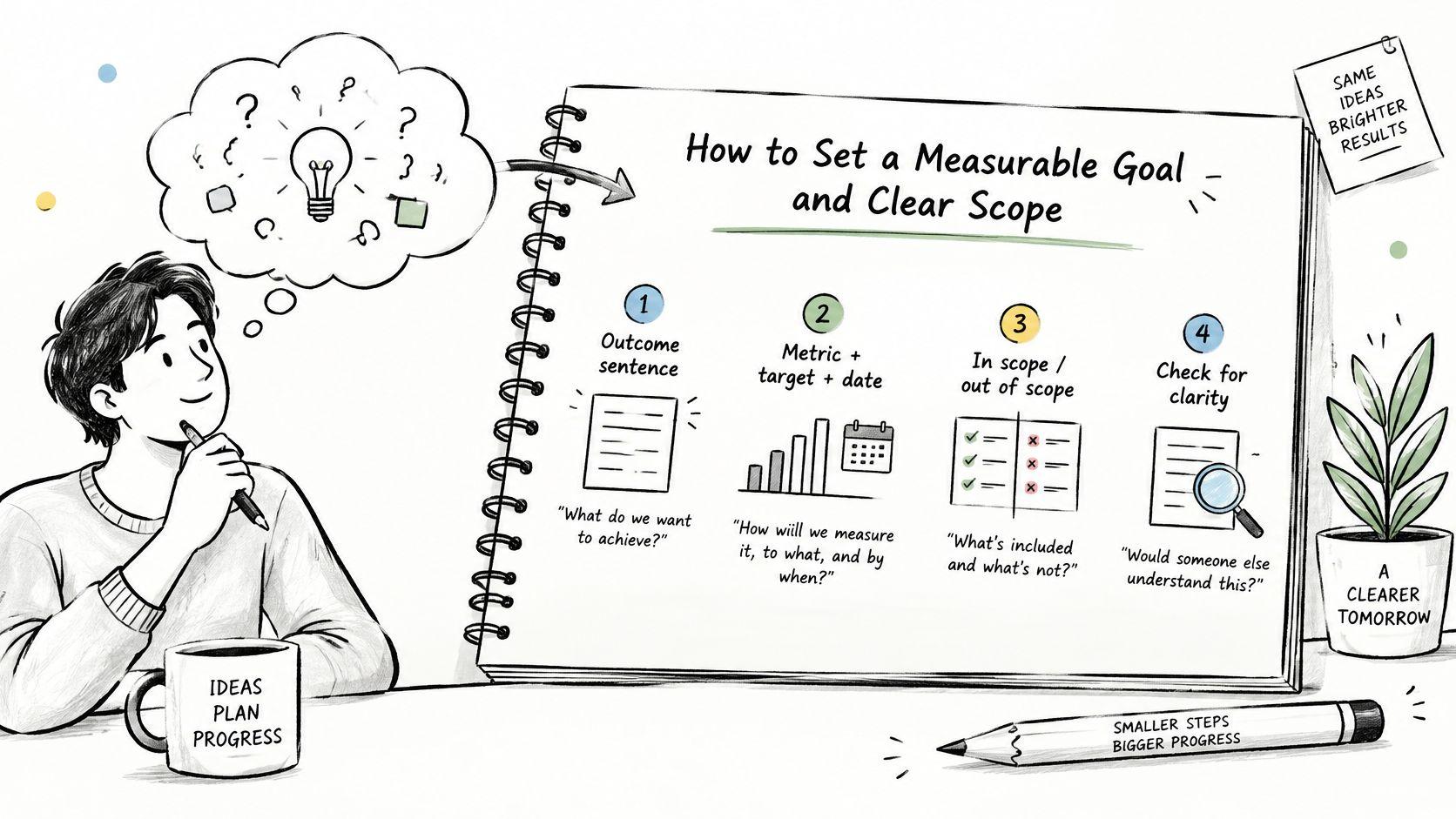
Use this sequence to turn that wish into an outcome everyone can check.
-
Describe what changes. Write the client-facing result in one sentence, not the work you intend to perform. Before choosing a target, calculate average onboarding time across the last twelve clients in this example, using consistent start and finish events.
-
Add the measure, target, and date. If that calculation establishes the example's fourteen-day baseline, the goal becomes: cut average onboarding from fourteen to seven days by 30 June. UK government monitoring and evaluation guidance calls for objectively observable, measurable objectives and a defined approach to post-implementation review.
-
Check available capacity. Count the hours people can contribute over the next eight weeks in this scenario, after client commitments and leave. If the work won't fit, lower the target or extend the date, and record which trade-off the sponsor accepted.
-
Write separate in-scope and out-of-scope lists. Include tempting additions, such as rebuilding the client portal, so nobody treats them as implied commitments.
-
Get sponsor approval before creating tasks. The budget holder should approve both the intended result and the boundaries. Agreement after work starts is harder because people have already committed effort.
Separate outcomes from activities
Holding three workshops is an activity in this example, not evidence that onboarding improved. Workshops belong under the work required; the goal should describe the change they're meant to produce.
For alternative ways to structure the objective, compare these goal-setting frameworks, then choose one consistent approach rather than combining several.
Use the video as a prompt for discussing the goal with the people responsible for delivery.
How to Build Milestones, Owners and Timelines
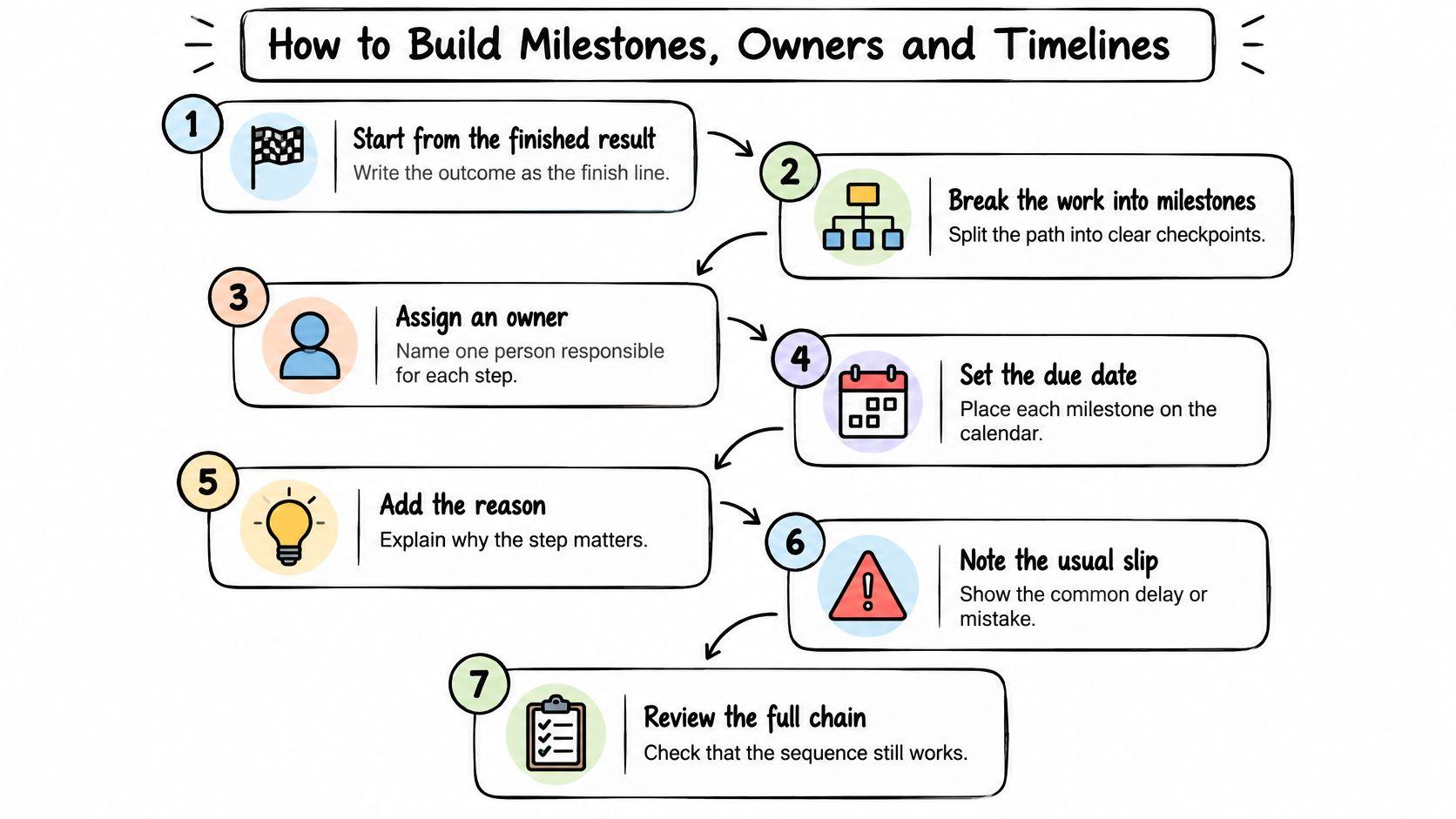
Build the schedule from the work, not from a date someone announced in a meeting. OECD implementation guidance recommends starting with the final output, identifying the actions required, estimating their duration, and recording responsibilities and costs; it also allows deadlines to be phased by quarter or month for closer monitoring.
Build the delivery chain
-
Start from the finished result. Write “the client signs off on the new onboarding pack” at the top of the page. The usual slip is choosing an internal finish line, such as sending the pack, when acceptance is still outstanding.
-
List every required action before ordering it. Include legal review, client communications, access permissions, and corrections after testing. Jumping straight into a polished schedule makes small but necessary jobs easier to miss.
-
Estimate effort in working days and identify who'll do it. Separate hands-on effort from elapsed waiting time. A short review can still delay delivery if the reviewer has no available slot.
-
Choose three to six meaningful milestones for this example. Group actions under checkpoints such as template approval or completed pilot onboarding. Don't label every task a milestone, or the important decisions disappear among routine work.
-
Assign one accountable owner to each task. Other people can contribute, but one person must secure the inputs and confirm completion. Naming a department instead of a person leaves the follow-through unresolved.
-
Work backward to set start and due dates. Allow time for review and corrections before each milestone. Scheduling only the first draft creates a deadline that assumes nothing will need changing.
-
Record every dependency explicitly. For example, the pilot can't begin until legal approves the consent form. Check the full chain, because a task can be on time individually while still arriving too late for its successor.
The same backward-planning technique applies outside work. Makon AI's guide to plan your SAT practice sessions offers a useful comparison for fitting preparation around a fixed endpoint.
Put the pilot on the calendar
For the agency scenario, the pilot milestone is client onboarded and completion evidence accepted. Its supporting tasks are approving the pack, running the onboarding sequence, and checking the client's sign-off before release to the wider team.
Pilot milestone timeline
| Task | Owner | Start | Due |
|---|---|---|---|
| Template approved | Priya | 26 May | 1 Jun |
| Pilot client onboarded | Marcus | 2 Jun | 13 Jun |
| Full rollout | Priya | 16 Jun | 30 Jun |
These are illustrative commitments, not estimates to copy without checking availability. Use these examples of milestones in project management to distinguish a completed checkpoint from the tasks beneath it.
Risks and Dependencies to Map Before Work Starts
Execution deserves more attention than another round of document polishing. In IBM's Making Change Work study, approximately 41% of projects met their time, budget, and quality objectives, while 59% missed at least one objective or failed entirely.
That finding isn't a prediction for your team. It's a reason to agree on warning signs and responses while you still have choices.
Common plan risks, early warning signs and responses
The thresholds below are proposed operating rules for the agency scenario, not universal benchmarks.
| Risk | Early warning sign | Response |
|---|---|---|
| Unclear owner | Task untouched for three working days | Name one owner within 24 hours |
| Hidden dependency | Work waits on another team's input | Add the dependency as a dated task |
| Capacity shift | Logged hours run 20% over estimate | Re-scope or move the milestone in writing |
| Failed assumption | Early results contradict the plan | Pause and review the goal before spending more |
| Scope creep | New requests added with no new deadline | Log the change and show its effect on the due date |
Agree on responses before the pressure arrives
An untouched task needs an ownership decision, not another reminder. Waiting on another team requires a visible commitment from that team. An effort overrun calls for a capacity discussion, while contradictory pilot results require checking whether the approach is still valid.
Unapproved additions need a different response: make their consequences explicit. Every new request should carry a short note on time, cost, capacity, and the committed deadline before the sponsor approves it.
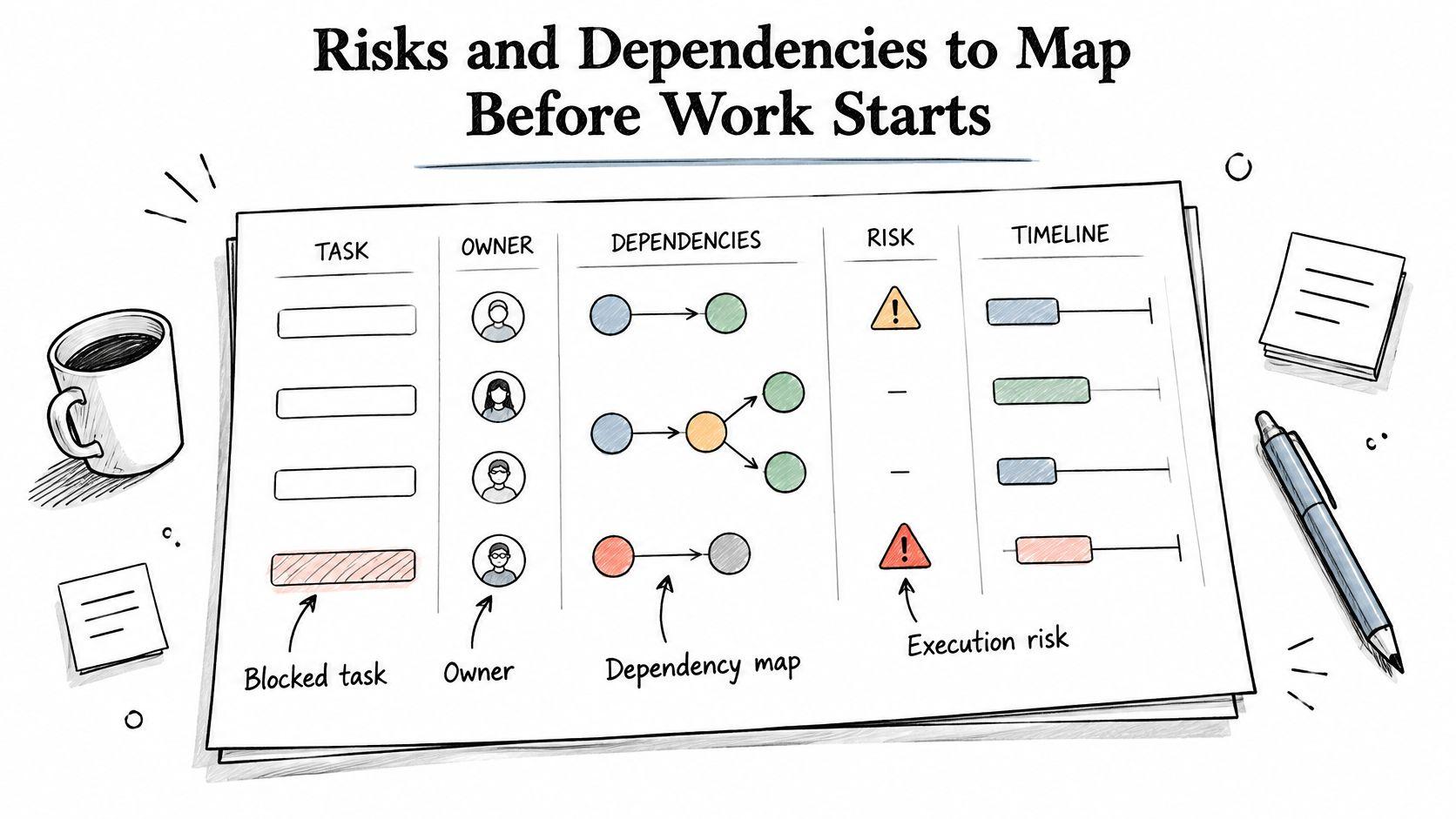
In a working session, rank the relevant risks by likelihood and impact, then name a person responsible for watching each one. Pay particular attention to approvals and other teams' capacity: both need dated tasks with confirmed owners, not footnotes saying support is required.
Re-scope trigger: For this pilot, reopen the scope when two warning signs affect the same milestone, or when evidence disproves an assumption behind the goal.
Re-scoping means making an explicit decision about deliverables, resources, or timing. It doesn't mean moving dates until the dashboard looks healthy.
Delegating Tasks Without Losing Control of the Plan
Give each owner a brief that answers four questions: What outcome do you own? What proves it's done? When is it due? What can you decide without asking? Missing any of those answers creates a handoff problem before the work even starts.
For the onboarding checklist, the outcome might be a client-ready pack covering the agreed contract and kickoff steps. The acceptance test should name the required contents, approved consent wording, and the person who accepts the finished pack. The due date belongs beside that test, along with the owner's authority to change layout but not contractual language.
Make autonomy explicit
- Confirm ownership in writing. Name the person responsible for the result, even when several colleagues contribute.
- Share the reason. Explain which client delay the task should remove so the owner can make sensible small decisions.
- Choose one update channel. In this scenario, use a Monday message in the project thread rather than scattered chats and ad hoc chasing.
- Set a blocker rule. Ask owners to raise a blocker within one day of noticing it, not when the deadline arrives.
- Review the milestone. Ask what is accepted, what remains uncertain, and what decision is needed. Don't substitute hours logged for delivery evidence.
Checking in means helping the owner reach the agreed checkpoint. Checking up means repeatedly requesting reassurance without resolving anything. A useful update can be brief if it contains evidence and a clear request.
Catch the missing handoff
Suppose a designer takes ownership of the onboarding checklist but doesn't realize legal review must happen before client use. The design is finished, yet the milestone slips a week while everyone waits for approval.
A decision rule could have caught the problem on day two of this hypothetical assignment: any change involving consent language must go to legal before design approval. The designer would know both the boundary of their authority and the next person to involve.
A delegated task without an acceptance test is still the planner's problem.
You haven't transferred responsibility effectively if the owner must guess what you'll accept at the end.
Tracking Progress Without Drowning in Status Updates
Start with the measured onboarding baseline and keep the measurement method consistent. Changing the start event from contract signature to kickoff preparation midway through the pilot would make the comparison unreliable.
The Australian government's monitoring and evaluation guidance recommends establishing a baseline before setting realistic outputs and targets, then collecting and analyzing evidence against them. The practical point is simple: choose what you'll measure before anyone starts reporting success.
Review cadence and the decision each review makes
These are proposed review rules for the agency example.
| Review | What to check | Decision |
|---|---|---|
| Daily | Blockers and next action for each owner | Unblock or reassign within 24 hours |
| Weekly | Milestones due and the metric trend | Keep, adjust or escalate the plan |
| Monthly | Progress against the baseline | Re-scope if the metric drifts more than 15% |
| Closing review | Outcome against the original goal | Close the plan or set the next one |
Report change, not busyness
In a hypothetical weekly update, “twelve workshops held” describes effort. “Average onboarding down to nine days” describes a change in the outcome. Put the latter in the headline; mention workshops only if they explain the result or a decision.
Check these signals each week:
- Milestone reliability. Which checkpoints were accepted on time?
- Metric direction. Is onboarding time moving toward the target?
- Aging blockers. Which unresolved blockers are older than three days under this example's escalation rule?
- Dependency exposure. Which upcoming handoffs are now at risk?

Keep the review focused on decisions. Use this guide to tracking project progress to structure the supporting record, and include logged hours only when they explain a missed milestone or capacity problem.
For this scenario, agree on expected metric values at monthly checkpoints. If actual onboarding time drifts more than 15% from that planned path, without a clear external cause, reopen the goal and scope. Record what changed and why, then notify the sponsor in writing rather than burying the decision in a status update.
Start Your First Plan This Week
Pick one goal and complete its one-page plan before Friday. Choose something with a clear finish line and a sponsor who can resolve trade-offs, not a broad ambition that depends on everyone changing everything.
Use the scope, milestones, owners, and risks you've identified to make the first commitment manageable.
Make the first commitment
- Set the metric, target, and date. Make sure the baseline is recorded and the sponsor accepts the result you're aiming for.
- Create the first task. Assign one owner and take its due date from the first milestone, rather than choosing an isolated deadline.
- Book the Friday review. Send the invitation before closing the page, with the decision you'll need to make.
Fluidwave fits at this handoff. Enter tasks in plain words, assign each to one team member, and group the list by assignee so everyone can see their queue. Our auto-prioritization uses tunable criteria such as due dates, quick wins, importance, and dependencies; we can also break big tasks into small, doable steps.
Keep those smaller steps under the same accountable owner unless you deliberately transfer responsibility. The tool doesn't choose the goal, settle ownership disputes, or decide whether to re-scope. Those decisions stay with you.
Finish your page with a concrete commitment from the example: Priya will submit the onboarding template for approval by 1 June.
Fluidwave helps you turn an agreed plan of action into assigned tasks, manageable steps, and a prioritized queue. Visit Fluidwave to enter your first milestone's tasks, assign their owners, and prepare the work you'll review on Friday.
Focus on What Matters.
Experience lightning-fast task management with AI-powered workflows. Our automation helps busy professionals save 4+ hours weekly.