Learn how outcome based pricing works, how it compares to time-and-materials and value pricing, and how to implement it with the right metrics and contracts.
August 1, 2026 (1mo ago)
Outcome Based Pricing: How It Works in Real Life
Learn how outcome based pricing works, how it compares to time-and-materials and value pricing, and how to implement it with the right metrics and contracts.
← Back to blog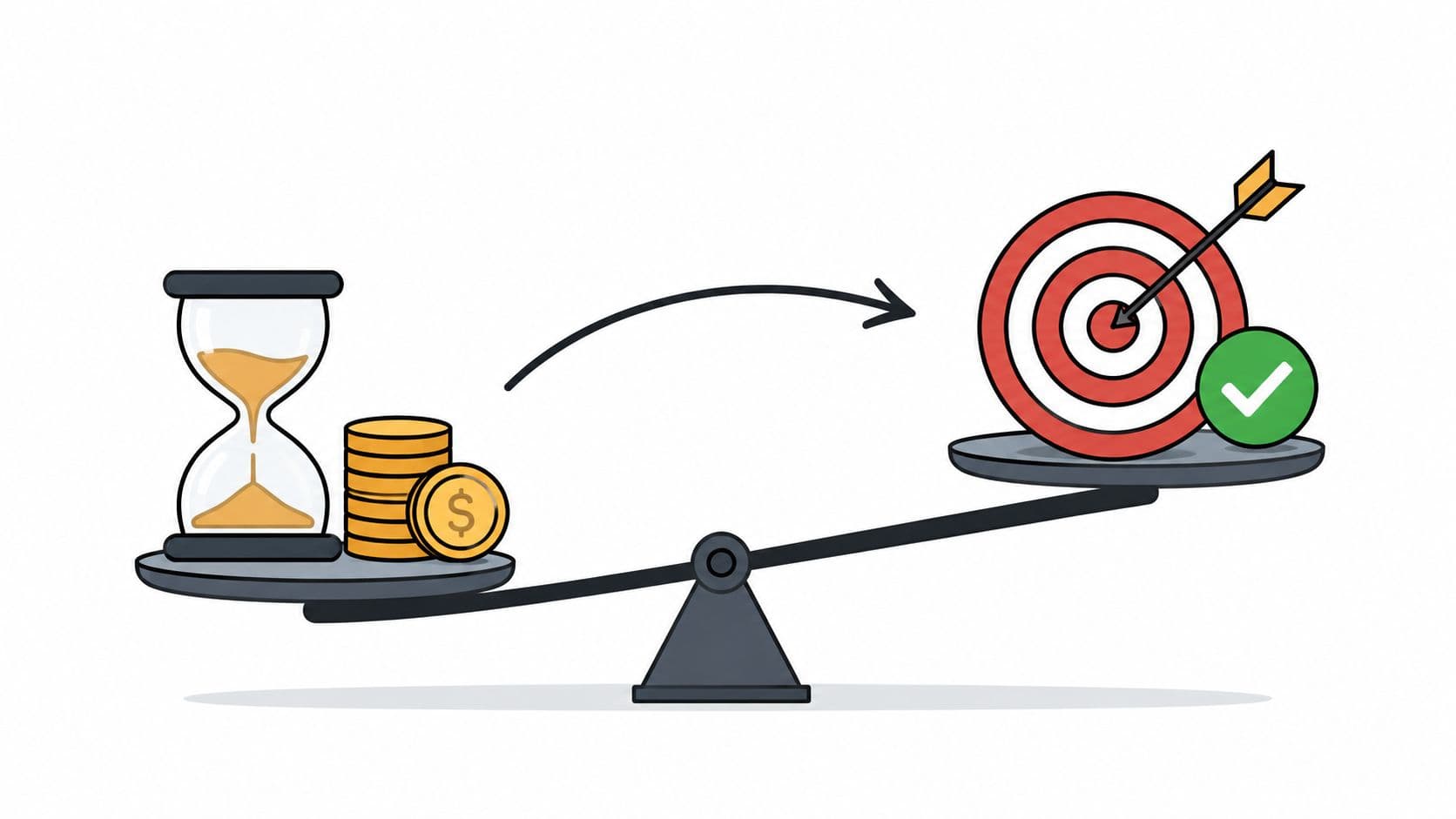
You're paying for something right now that may not match what you want. Maybe it's a consultant billing by the hour while the core problem sits unchanged, a software subscription no one uses fully, or a service contract that looks neat on paper but still leaves you guessing whether the spend created any genuine value.
That friction is exactly why outcome based pricing keeps showing up in more industries. It changes the question from, “What did we buy?” to, “What did we get?” and that shift sounds simple until you try to write the contract, measure the result, and decide who carries the risk when the outcome is messy.
Paying for Effort Versus Paying for Results
A founder hires an agency to improve lead generation. The invoice arrives every month, the team logs hours, the reports look busy, and the pipeline barely moves. Everyone has done work, but the buyer still doesn't know if the spend was smart or just expensive.
That same frustration shows up in healthcare, software, and internal operations. A clinic can reimburse a treatment whether or not a patient improves, and a company can keep renewing tools that nobody fully adopts. Effort-based pricing makes it easy to bill, but it also makes it easy to drift away from value.
Outcome based pricing emerged as a structural answer to that mismatch. The logic is blunt, the seller gets paid when a defined result shows up, not just when work is performed. In regulated markets, that idea has been formalized for years, including healthcare outcome models where performance-related incentives depend on outcomes for at least 10% of the payment, with narrow models showing positive quality effects in 5 of 9 cases and all 3 broad models improving quality of care and reducing healthcare cost growth, according to the review in the verified data set (Dutch review of outcome-based payment models).
Practical rule: if the buyer can't tell whether the vendor delivered value, effort-based billing will eventually feel like a tax on ambiguity.
The appeal is obvious. The buyer wants less waste, the seller wants a clearer link between work and value, and both sides want fewer arguments about whether a task was worth the bill. The hard part is that the promise only works when the result can be defined and verified. If not, the model just renames the old problem instead of solving it.
What Outcome Based Pricing Actually Means
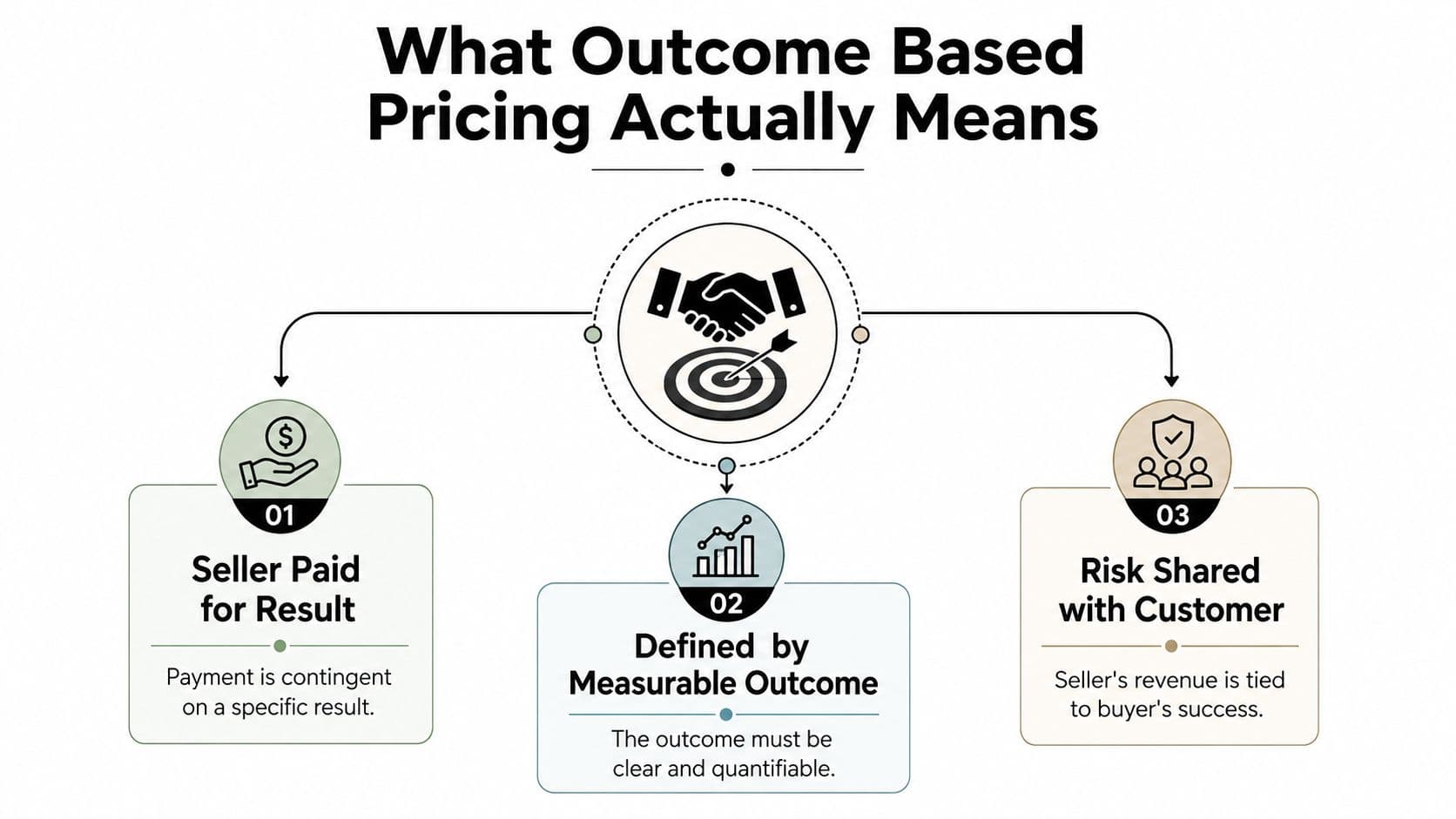
At its simplest, outcome based pricing means the seller gets paid, in whole or in part, when a defined result is achieved. The unit you pay for is not time, seats, or raw activity. It's the result that both sides agreed mattered.
A good way to make that sticky is to think about pharmacy billing. Paying per pill is fee-for-service. Paying for a full course of treatment is closer to usage. Paying only if the patient's condition improves moves into outcome-based territory because the bill follows the result, not the input.
The three things that change
First, a measurable unit of value replaces time or volume. Second, risk is shared, because the seller is now exposed to whether the result shows up. Third, measurement becomes central, because the contract only works if the outcome can be observed without guesswork.
That last point is where a lot of people get confused. Value pricing and outcome pricing can look similar from far away, but they're not the same thing. Value pricing usually reflects perceived benefit or willingness to pay, while outcome pricing anchors the invoice to a specific result that can be checked after the fact.
Plain version: if you can't point to the result on a screen, in a log, or in a record, you probably don't have outcome based pricing yet.
The phrase sounds modern, but the logic is old. The important part isn't the label. It's whether the contract moves payment from “we did work” to “we achieved the agreed result.”
The Anatomy of an Outcome Based Contract
A contract can sound outcome-based on paper and still behave like ordinary billing if the measurement logic is loose. The trouble usually starts in the plumbing. If the result, the timing, and the proof are not written clearly enough, both sides end up arguing about the invoice instead of the work.
The pieces that have to be written down
A strong contract starts with a clear outcome definition. It also needs a measurement window, a baseline or counterfactual, attribution rules, and guardrails such as floors, caps, and deadbands. Oxford's guidance on outcomes-based contracts emphasizes comparing realized outcomes against what would otherwise be expected, which is why baseline design matters so much in practice (Oxford guidance on outcomes-based contracts).
A baseline is where many negotiations stall. If a team claims savings during a quarter that was already improving on its own, the buyer can end up paying for change that would have happened anyway. If outside conditions move against the seller, the seller can be charged for factors it did not control. Well-built contracts usually set audit rights, agree on the measurement window, and include a neutral dispute process for cases where outside forces distort the result.
The structure helps to separate the commercial promise from the measurement system. A practitioner can agree that a vendor should be paid for a result, but without a reliable event trail, the contract has no stable footing. That is why an agreement to pay contract structure has to define what gets counted, who checks it, and what happens when the numbers are contested.
Here's the checklist I've seen hold up better than most:
- Outcome definition: spell out the exact result that triggers payment.
- Measurement window: name when the result is judged, not just what counts.
- Baseline: set the comparison point so you are pricing incremental value, not raw activity.
- Attribution: define what counts as caused by the seller's work.
- Guardrails: use caps, floors, or deadbands to keep volatility manageable.
A useful real-world example comes from the Repatha agreement between Amgen and Harvard Pilgrim. If a patient later suffered a heart attack or stroke, the drug cost was refunded to both the patient and the insurer, which shows how outcome-linked repayment works when the parties can agree on the trigger and the proof (Repatha outcome-based contract example).
The cleanest way to picture the contract is as a machine-readable scorecard. If the scorecard is vague, the billing turns into a dispute. If the scorecard is crisp, the model becomes auditable instead of argumentative, and the parties can spend less time debating the math and more time trusting the result.
How It Compares to Time-and-Materials and Value Pricing
A lot of confusion clears up once you stop asking which model is “better” and start asking which risk you want to carry. Time-and-materials, value pricing, and outcome based pricing each put the burden somewhere different.
A useful way to compare them is through the lens of delivery risk, measurement burden, and contract clarity. If you're trying to price an HR advisory engagement, for example, a public cost reference like the HR advisory cost overview can help frame the market conversation, but it still won't tell you whether the work created the result you wanted.
| Dimension | Time-and-Materials | Value Pricing | Outcome Based Pricing |
|---|---|---|---|
| Who carries delivery risk | Buyer pays for effort regardless of result | Shared loosely through perceived value | Seller shares direct risk tied to the result |
| How easy it is to measure | Easy to count hours or units | Harder, because value is subjective | Hardest upfront, easiest after the metric is defined |
| Where it works best | Work with unclear scope or heavy customization | Work with strong expertise and visible business value | Work with discrete, verifiable outcomes |
| Where it breaks | Buyers resent paying for inefficiency | Buyers argue over perceived value | Buyers and sellers fight over attribution and baselines |
| Commercial feel | Safe for seller, risky for buyer | Flexible, but negotiable | Most disciplined, but also most demanding |
A simple decision lens
Time-and-materials works when the task is open-ended and the buyer mainly wants labor. Value pricing works when expertise is the product and both sides can agree on the strategic worth of that expertise. Outcome based pricing works when the result is specific enough to measure and important enough to share risk around.
That's why outcome pricing can feel attractive in theory but awkward in practice. It asks for more discipline from the seller, more clarity from the buyer, and more agreement from both sides than the other models do. When that discipline is there, the model can be cleaner than hourly billing. When it isn't, the contract becomes a fight over definitions instead of a relationship around value.
Implementing Outcome Based Pricing Step by Step
The first mistake is trying to price everything this way. Start with one outcome, one workflow, and one measurement method that both sides can inspect without a meeting becoming a courtroom.
The operational sequence
Begin by defining a single measurable result. Then instrument the workflow so the result is captured in logs, events, or another verifiable record. Stripe's implementation pattern is useful here, capture the event, evaluate it against the outcome definition, record the confirmed result in a ledger, then trigger billing only after verification (Stripe on outcome-based pricing).
Next, agree on the baseline and the reporting source. That sounds boring, but it's the difference between a contract that holds up and one that gets renegotiated every time the environment changes. Once the baseline is set, write the formula in plain language, including what counts, what doesn't, and what happens when the data is incomplete.
A few details matter more than many teams expect:
- Define exclusions early: if human intervention, seasonal swings, or third-party tools can affect the result, say so.
- Write the review cadence: decide when the outcome is checked and when invoices move.
- Add audit rights: both sides should be able to inspect the data trail.
- Specify disputes: if the result is contested, the process shouldn't be improvised mid-bill.
Operator's advice: the contract should read like a measurement plan, not a marketing promise.
The internal system matters too. Fluid task and delegation platforms that work from budgets, timelines, and completed work naturally mirror this logic, because they already think in terms of defined tasks and verified completion. If the work is chunkable, visible, and logged, outcome billing becomes much easier to run without custom infrastructure. For a deeper framework on measurement discipline, see how to measure anything.
A good first clause is often boring on purpose. Boring is good. Boring means the seller knows when payment triggers, the buyer knows what proof to expect, and neither side needs a translation layer to understand the bill.
Outcome Based Pricing in Healthcare, Pharma, AI Agents, and Delegation
A hospital, a drug maker, and an AI vendor can all call their contracts outcome based pricing, yet the measurement setup underneath each one looks very different. The label sounds simple. The hard part is deciding what gets counted, who can verify it, and whether the result can be separated from everything else happening around it.
Healthcare shows the model in its most visible form. Hospital payment systems have long tied a portion of reimbursement to measured performance, which is why U.S. hospital value-based purchasing history matters here. Once a payer decides that a measure is worth paying for, the contract stops being a vague promise and starts acting like a ledger entry tied to tracked events. A hospital operations stack that can capture admissions, discharge timing, documentation status, and follow-up actions, such as an integrated hospital operations system, makes that logic easier to run because the workflow is visible instead of hidden in scattered systems.
Pharma made the logic concrete
Pharma turned the idea into something many procurement teams could recognize immediately. The Repatha example is useful because payment was tied to a named clinical event, and the older Merck Zocor arrangement used a similar structure by refunding treatment costs if simvastatin plus diet did not lower LDL cholesterol enough (pharma outcome-based contracts). That is the same basic pattern you see in a warranty, only the “defect” is a clinical outcome instead of a broken part.
The lesson is practical. These contracts work best when the parties can define the event in writing, observe it without too much argument, and agree on what happens if the result misses the target.
AI agents are pushing the model into software
AI pricing is now testing the same idea in a much faster-moving setting. One industry analysis reported that a minority of native AI solutions used outcome-based pricing, while a larger share still relied on usage-based pricing, and it also reported strong margins among the companies already using outcome-linked models (AI pricing statistics). Another pricing example shows the newer hybrid pattern clearly, with vendors charging per resolved conversation or per lead recommendation instead of charging only for raw model use (AI agent pricing examples).
That shift matters because AI buyers rarely care about token counts on their own. They care about whether the agent solved the chat, finished the task, or passed a qualified lead to the next step. Once again, the contract only works if the event is measurable enough to audit.
Delegation platforms apply the same logic to human work
Delegation makes the same principle easy to see because the buyer is paying for completed work, not for time spent sitting online. A task is easier to price on results when the handoff is clear, the output is visible, and someone can check it without debating what “effort” meant. That is why outcome pricing shows up naturally in task queues, reviewed work, and workflows where completion can be logged.
The pattern is consistent across all of these settings. Outcome based pricing works best when the work leaves a trace, the trace is trusted, and the result can be separated from unrelated noise. It is less about the industry name and more about whether the measurement architecture can hold up when someone asks, “What exactly were we paying for?”
Why Pure Outcome Pricing Often Fails and Hybrids Win
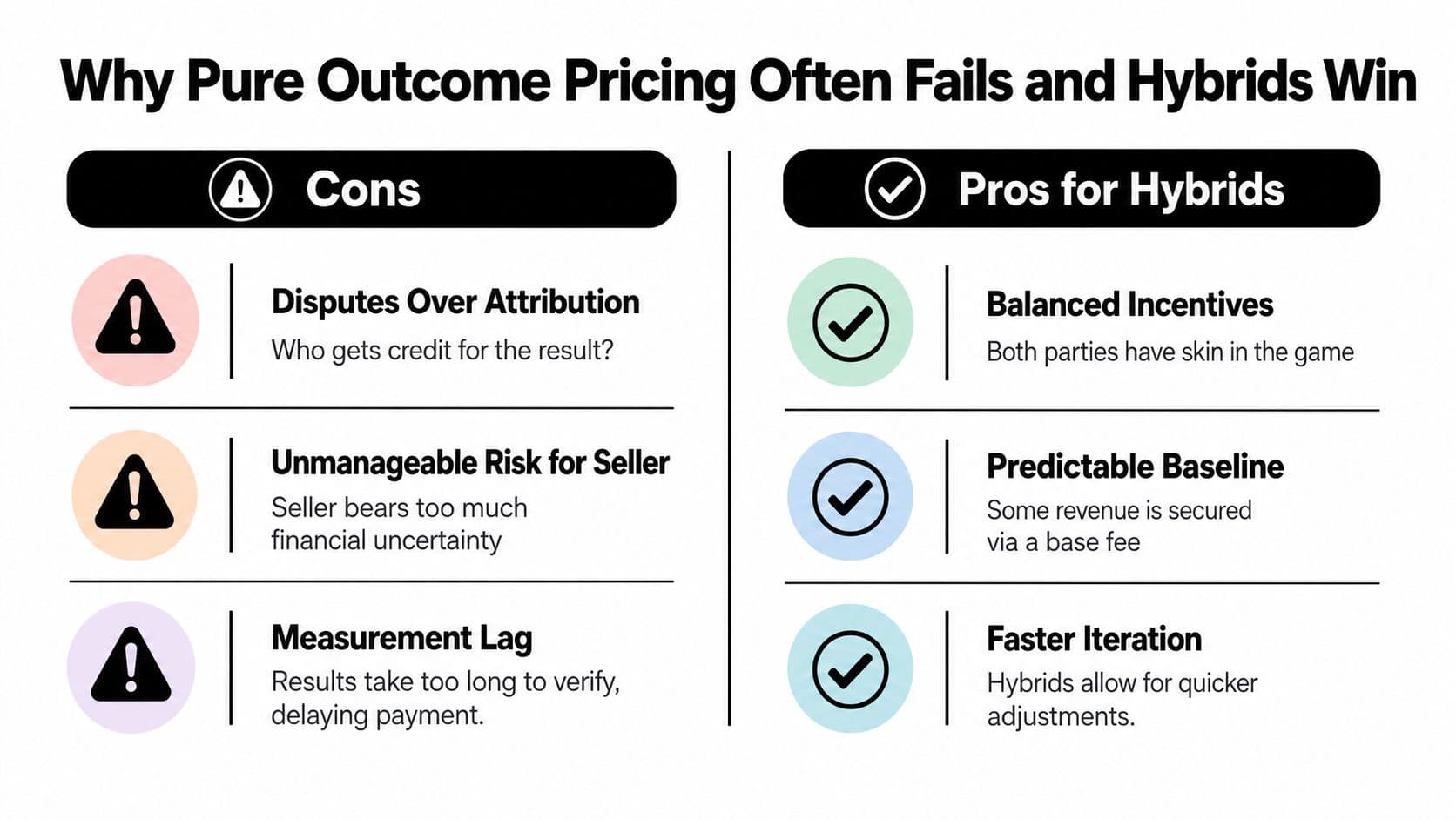
Pure outcome pricing looks elegant in a pitch deck. In a real contract, it can become too volatile, too disputed, or too slow to verify. That's where many teams move toward hybrids instead of insisting on a pure model.
The three failure points
The first problem is attribution. Multiple systems, teams, or vendors may contribute to the same result, and that makes the invoice hard to defend. The second problem is volatility, because revenue becomes harder for the seller to forecast and harder for the buyer to budget. The third problem is measurement lag, since some outcomes take too long to verify, which delays payment and creates tension on both sides.
This is why many pricing teams end up mixing a base fee with outcome-linked charges. A 2026 analysis described Salesforce's Breeze Customer Agent moving to $0.50 per resolved conversation from $1 per handled conversation, while Breeze Prospecting Agent shifted to $1 per lead recommended; the same source also noted Agentforce launching in late 2024 at a flat $2 per conversation (outcome pricing in practice). The pattern matters more than the exact labels. Vendors are not throwing out usage or flat fees. They're using outcome language where the result is discrete and measurable.
Practical takeaway: hybrids usually win when the outcome is valuable but not stable enough to carry the whole contract.
A pure model can still work when the workflow is clean and the proof is simple. But most commercial environments aren't that tidy. The skill is choosing the right blend, not worshipping one pricing label.
A Practical Decision Framework and What Comes Next
Use outcome based pricing when the result can be defined, measured, and attributed without constant argument. If any of those three are missing, the contract will spend more time in dispute than in billing.
A simple test helps. Can both sides agree on the unit of value, the baseline, the measurement window, and the proof source before the work starts? If yes, you probably have a candidate for outcome pricing. If not, keep the structure simpler and avoid pretending the metric is cleaner than it is.
A useful contract template starts with one sentence: payment triggers when a defined outcome is independently verified within an agreed measurement window, against an agreed baseline, under agreed attribution rules. That sentence does a lot of heavy lifting because it forces clarity before anyone starts arguing about the invoice. For a broader process lens on how teams make decisions before they commit, the 6 steps of the decision making process are a useful companion.
The direction of travel is clear. AI agents are pushing more software toward completed results, and task platforms are normalizing pay-per-task structures in day-to-day work. That doesn't mean every contract should be rewritten tomorrow. It does mean more buyers will expect measurement, not just promises, and more sellers will need pricing that reflects what they can prove.
If you're thinking about how to turn this logic into a working system, Fluidwave gives teams a practical way to define tasks, set budgets and timelines, and pay only for completed work. Visit Fluidwave to see how task-based delegation can support clearer measurement, cleaner handoffs, and more accountable execution.
Focus on What Matters.
Experience lightning-fast task management with AI-powered workflows. Our automation helps busy professionals save 4+ hours weekly.