Master the 6 steps of the decision making process. Learn to define problems, evaluate options, and implement choices effectively with our practical 2026 guide.
July 29, 2026 (1mo ago)
The 6 Steps of the Decision Making Process: A 2026 Guide
Master the 6 steps of the decision making process. Learn to define problems, evaluate options, and implement choices effectively with our practical 2026 guide.
← Back to blog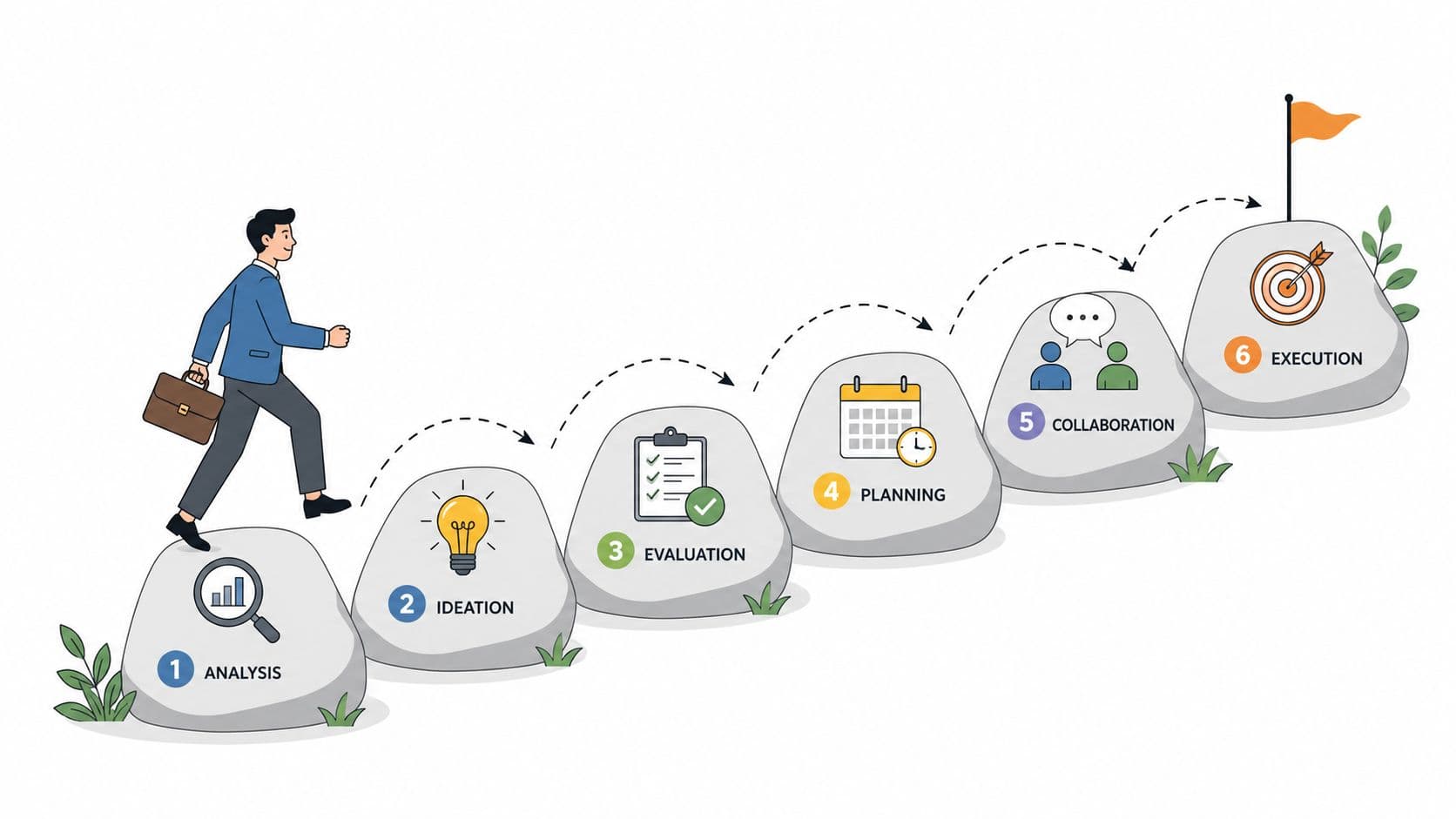
Beyond the coin flip, the challenge is making a call when two options both look reasonable and the clock keeps moving. One team wants speed, another wants more data, and you're stuck trying to avoid a bad decision without turning the whole process into a week of debate. The 6 steps of the decision making process give you a repeatable way to move from uncertainty to action, and they're grounded in a long-standing management framework that shows up in university guidance, decision theory traditions, and structured models like DECIDE and GOFER. The point isn't perfection. It's making a defensible choice, executing it cleanly, and learning fast when reality changes.
1. Step 1 Define the Problem or Opportunity

Most bad decisions start with a sloppy problem statement. A founder thinks they need more features, but the core issue is task prioritization. A project manager blames performance, when the actual bottleneck is unclear ownership. The first step is to name the gap between where you are and where you need to be, because every option you evaluate after that depends on how well you framed the problem in the first place.
5 Whys earns its keep. Keep asking why until you stop describing symptoms and hit the root cause. If a team keeps missing deadlines, the answer may not be “we need more people.” It may be that no one owns the handoff, which is a very different decision.
Write the problem down before you debate solutions
A written problem statement exposes fuzzy thinking fast. Vague language sounds acceptable in a meeting, but it falls apart on paper. In practice, this means documenting the decision, naming the gap, and setting a time boundary so analysis doesn't sprawl forever.
Practical rule: if you can't explain the problem in one or two clear sentences, you're not ready to compare solutions yet.
Tools like Fluidwave can help here by making workflow bottlenecks visible across views like list, Kanban, and calendar. That matters when the core problem is hidden inside overloaded task queues or repeated handoffs. For teams, involving the right stakeholders early also prevents the classic mistake of solving for the wrong thing.
2. Step 2 Gather Information and Research
Good decisions need relevant information, not endless information. Once the problem is defined, the job is to collect what reduces uncertainty, including constraints, stakeholder needs, and hard operational realities. A project lead might gather delivery estimates from each contributor. An executive might compare vendor inputs before choosing a delegation platform. In both cases, the quality of the choice depends on the quality of the input.
The trap is over-researching. Busy teams often confuse more information with better information, but the better move is to separate must-have data from nice-to-have detail. That's where structured triage helps. TechTarget recommends defining the hypothesis, setting KPIs, building a decision matrix, and checking worst-case scenarios before making a recommendation, which is a stronger approach than hoarding notes and hoping clarity appears later. TechTarget's data-driven decision framework is especially useful here.
Centralize what matters and delegate the collection work
Information gathering breaks down when it lives in inboxes and scattered chat threads. A task platform like Fluidwave can keep research in one searchable place, assign who gathers what, and set deadlines so the process doesn't stall. That also makes it easier to hand off research tasks to a virtual assistant, especially when the work is repetitive but still needs to be accurate.
- Set a deadline early: Perfect information doesn't exist, so the search has to stop somewhere.
- Separate signal from noise: Focus on data that changes the decision, not background material that only feels reassuring.
- Capture assumptions explicitly: If you're filling gaps with judgment, say so in writing.
- Use real-world input: Talk to people who've made similar calls, because experience often surfaces risks that reports miss.
Gathering information should narrow the field, not create a false sense of control. If the research phase keeps expanding, the decision wasn't defined tightly enough.
3. Step 3 Generate and Evaluate Alternatives
Once the facts are on the table, the next mistake is jumping to the most familiar answer. Strong decision-makers force at least a few real alternatives into the room, because single-option thinking is just approval in disguise. The six-step format works because it makes you compare paths before you commit, not after.
The best practical test here is simple. If you're looking at a hiring decision, don't just compare “hire now” versus “wait.” Compare full-time hiring, freelancers, and virtual assistants. Each option carries different trade-offs in control, speed, and overhead. If you're choosing a workflow system, compare no system, spreadsheets, basic tools, and an AI-driven platform like Fluidwave. That gives you a real decision, not a polite agreement.
Use criteria before you score options
Establishing evaluation criteria after you already like one option is how bias sneaks in. Set the criteria first, then compare alternatives against them. A decision matrix helps because it forces the same standards across every option, which is exactly what you want when the group is split.
For a deeper look at the tension between options, the relationship between decisions and trade-offs is worth understanding, especially when one choice improves speed but reduces flexibility. Read the internal guide on decisions and trade-offs if your team keeps pretending every choice can preserve everything.
The point isn't to find a perfect option. The point is to make the trade-offs visible enough that nobody feels surprised later.
A useful habit here is assigning a devil's advocate. That person should challenge the favorite option, not to be difficult, but to expose weak assumptions before the team locks in.
4. Step 4 Make the Decision
At some point, analysis has to stop. This is the moment where many professionals freeze, usually because they've gathered enough information to feel responsible but not enough to feel safe. Major business decisions rarely come with a clean right answer. They come with defensible choices and known trade-offs.
That's why decisiveness matters. A leader who waits for perfect clarity often creates more damage than one who commits on time with a clear rationale. The DECIDE model, published in 2008, reflects this same logic by moving from defining the problem to implementing and then evaluating the outcome. The framework's structure reinforces a simple truth, decisions are not just choices, they're commitments to action and review. The DECIDE model overview captures that broader shift toward evidence-based management.
Ownership has to be clear before the call is made
Ambiguous ownership slows everything down. Someone has to make the final call, document why it was made, and communicate it to the people affected. If you're managing a team, that means deciding by the deadline you already set, then explaining the trade-offs without softening them into meaningless consensus.
The fastest way to avoid decision paralysis is to treat delay as a decision with its own cost. If the team keeps circling, use a clear decision owner and move. The internal guide on decision-making paralysis is a useful companion when indecision has started to consume more energy than the problem itself.
Practical rule: once the deadline hits, choose the best available option and record the reason. That documentation matters when outcomes diverge from expectations.
Fluidwave fits neatly here because the moment the decision is made, implementation tasks can be assigned immediately. That turns commitment into a concrete workstream instead of a vague promise to “follow up later.”
5. Step 5 Implement the Decision
A decision isn't valuable until people do the work. That sounds obvious, but implementation is where many teams fall apart. They spend weeks debating, then assign the rollout to “the team,” which usually means nobody owns the next step. Good execution needs task-level clarity, real deadlines, and follow-through that doesn't depend on memory.
A platform like Fluidwave becomes practical, not theoretical. If you need to roll out a new delegation process, assign training to team leads, set milestones, and track progress in one place. If you're handing off operational work to virtual assistants, break the rollout into specific tasks so nobody has to guess what “done” means. The right tool won't fix a bad decision, but it will keep a good one from dying in execution.
Turn the decision into visible work
Implementation should never feel like one giant project. Break it into small enough actions that progress is visible daily or weekly. That makes it easier to spot friction before it becomes a crisis. It also helps when the work is being distributed across a team, a freelancer, and a virtual assistant at the same time.
A useful execution pattern looks like this:
- Name the task owner: Every action needs one accountable person.
- Set go or no-go points: Some milestones should pause the work before the team spends more time or money.
- Add regular check-ins: Weekly or bi-weekly reviews catch blockers early.
- Document contingencies: Most rollout problems are predictable if you've seen enough projects.
- Keep communication broad: Stakeholders should hear progress updates, not just the implementation group.
The internal guide on how to create an action plan pairs well with this stage because implementation works better when the sequence is obvious. A team that can see the work can manage the work. A team that can't, drifts.
Rigid plans also fail when reality changes. Give people room to adjust tactics without changing the strategic direction every hour.
6. Step 6 Monitor, Review, and Adjust
The final step is where strong teams separate themselves from busy ones. They don't just act, they check whether the action solved the original problem. That review needs to be formal enough to matter, but not so rigid that it becomes a ritual. The point is to compare actual outcomes with expected outcomes, then decide whether to adjust the tactic or revisit the decision itself.
This is especially important in task systems, because a decision can look fine on paper while the operational result is weak. Domo's guidance on data-driven decision-making emphasizes monitoring and iteration as the last step, and Atlassian's approach to decision loops points in the same direction. If you're using a platform like Fluidwave, real-time task tracking becomes useful here, because you can watch completion, turnaround, and delegation outcomes without waiting for a quarterly postmortem. Domo's decision-making guidance supports that loop.
Review the outcome, not just the activity
A team can finish every assigned task and still miss the goal. That's why the success metric has to be defined before implementation starts. If you wait until after the fact to define success, you'll probably redefine it to protect the decision instead of judging it fairly.
A practical review process should include both numbers and human feedback. Quantitative data tells you whether something changed. Qualitative feedback tells you why it changed, or why it didn't. That's useful when a delegation workflow is technically live, but the team still avoids using it because the onboarding was unclear or the task structure felt clumsy.
The review should also distinguish tactical failure from strategic failure. Sometimes the decision was right, but the rollout was weak. Sometimes the rollout was fine, but the decision itself was off. That difference matters, because it tells you whether to fix the execution or reconsider the path altogether.
Close the loop publicly. Teams learn faster when leaders explain what changed and why.
If the decision worked, document the approach for future use. If it didn't, treat the result as information, not embarrassment. That's how mature teams improve.
6-Step Decision-Making Comparison
| Step | 🔄 Implementation Complexity | ⚡ Resource & Time Requirements | 📊 Expected Outcomes (Impact) | 💡 Ideal Use Cases | ⭐ Key Advantages |
|---|---|---|---|---|---|
| Step 1: Define the Problem or Opportunity | Moderate, needs stakeholder alignment and root-cause analysis | Low–Moderate: facilitation time, documentation | Clear problem statement, scope, baseline metrics | Project scoping, process improvement, hiring workflow issues | Prevents solving wrong problem; aligns teams ⭐⭐⭐ |
| Step 2: Gather Information and Research | Moderate–High, breadth and depth of data collection | Moderate–High: data sources, interviews, analysis time | Reduced uncertainty; documented assumptions and constraints | Market research, vendor selection, risk assessment | Improves decision quality; reveals blind spots ⭐⭐ |
| Step 3: Generate and Evaluate Alternatives | High, creative ideation plus systematic evaluation | Moderate: facilitation, evaluation matrices, team input | Multiple realistic options with trade-off analysis | Strategic choices, product direction, process design | Prevents tunnel vision; uncovers hybrid solutions ⭐⭐⭐ |
| Step 4: Make the Decision | Low–Moderate, commitment, communication, accountability | Low: decision authority, rationale documentation, stakeholder briefings | Explicit choice, ownership, enables resource allocation | Final approvals, go/no-go moments, leadership decisions | Ends deliberation; creates accountability ⭐⭐ |
| Step 5: Implement the Decision | High, execution coordination, change management | High: people, budget, project-management tools | Tangible outcomes, operational change, tracked progress | Rollouts, process changes, multi-team execution | Converts decisions into results; builds execution capability ⭐⭐⭐ |
| Step 6: Monitor, Review, and Adjust | Moderate, ongoing measurement and course correction | Moderate: monitoring tools, analytics, scheduled reviews | Continuous improvement, validated outcomes, informed pivots | Post-implementation reviews, KPI tracking, iterative products | Enables evidence-based adjustments; reduces sunk-cost risk ⭐⭐⭐ |
Turn Your Decisions into Actionable Results
The 6 steps of the decision making process give you a practical structure for turning uncertainty into action. Define the problem, gather the right information, compare alternatives, commit to a decision, implement it with ownership, and review the outcome with discipline. That sequence works because it balances speed with rigor, and it keeps teams from confusing motion with progress.
The value shows up when the framework becomes part of everyday work. A manager can use it to delegate more clearly. A founder can use it to avoid analysis paralysis. A team lead can use it to reduce noise and make accountability visible. The model is mature because it reflects how strong organizations operate, they decide, act, and learn in a loop instead of treating choices like one-time events.
Tools matter here too. A platform like Fluidwave gives you one place to define tasks, assign ownership, prioritize work, and track results across table, list, calendar, Kanban, and cards. That makes the decision process easier to run in the world, especially when virtual assistants, cross-functional teams, and shifting priorities are all involved.
If you want faster decisions with fewer dropped handoffs, start by using a system that supports the process from first question to final review. Visit Fluidwave to see how AI-driven task management and human delegation can help your team turn better decisions into completed work.
Focus on What Matters.
Experience lightning-fast task management with AI-powered workflows. Our automation helps busy professionals save 4+ hours weekly.