Stuck overthinking? Discover causes of decision making paralysis, including ADHD's role. Get practical strategies to regain control & boost productivity.
June 17, 2026 (2mo ago)
Beat Decision Making Paralysis: Practical Strategies
Stuck overthinking? Discover causes of decision making paralysis, including ADHD's role. Get practical strategies to regain control & boost productivity.
← Back to blog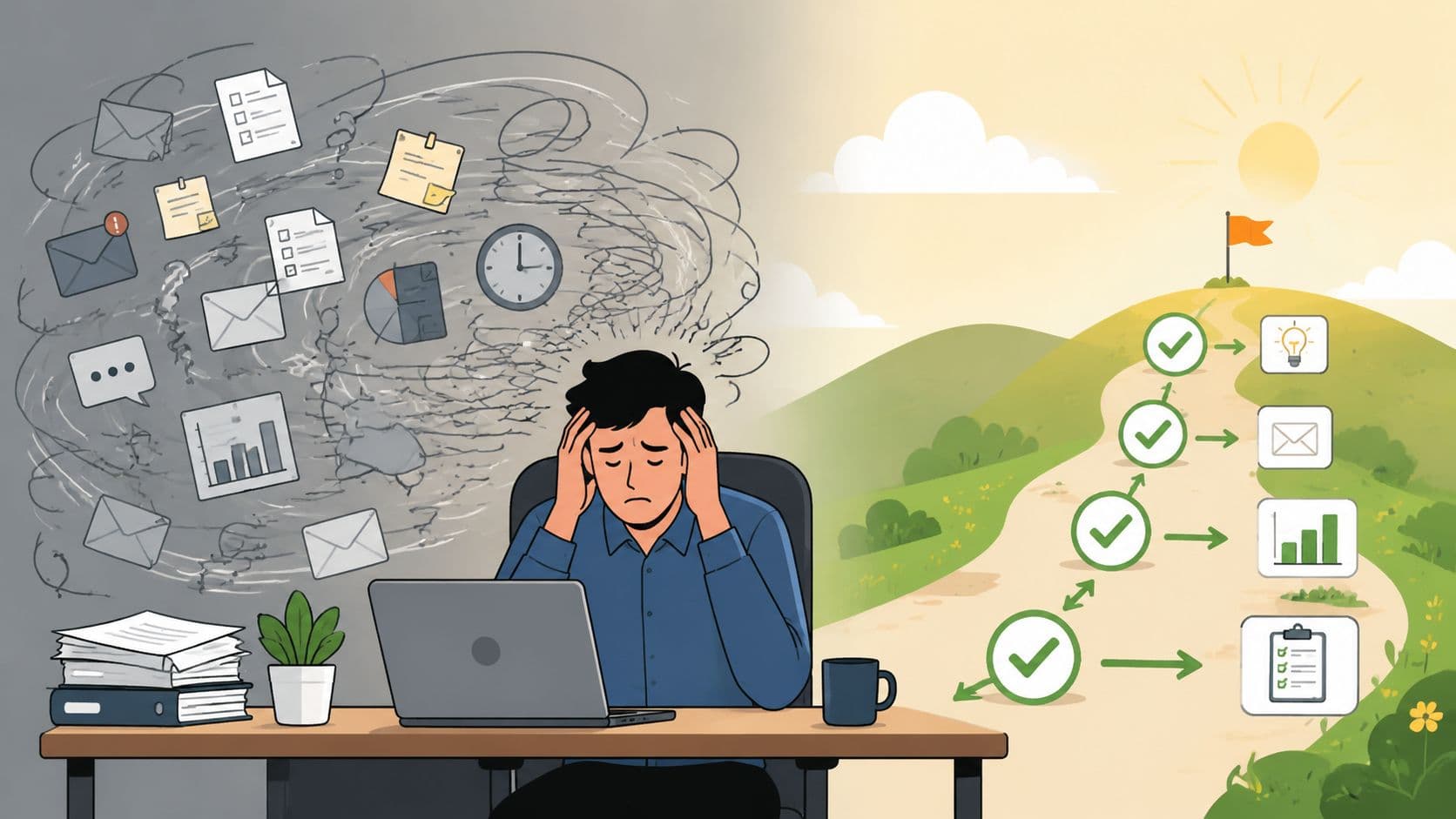
You open your laptop to make one simple call. Which proposal gets approved. Which task gets your next hour. Whether to reply now, wait, ask for more context, or rewrite the message again.
Twenty minutes later, you're still staring at the screen.
The tabs are open. Slack is blinking. Your notes app has three different priority lists. You've compared options, reread the same email, and somehow made no real progress. That stuck, heavy feeling can look lazy from the outside. It usually isn't. It's often a sign that your brain is trying to manage too many choices, too many signals, or too much perceived risk at once.
For a lot of professionals, this happens in small ways all day long. You delay a hiring decision. You keep researching software instead of choosing one. You rewrite a calendar plan because the “best” version still feels unclear. By the afternoon, even low-stakes choices feel oddly hard.
That experience has a name. Decision making paralysis is what happens when thinking stops helping and starts blocking action.
That Feeling of Being Frozen by Choice
A manager sits down on Monday with a reasonable plan. Finish a budget review, respond to a client, and decide who should own a delayed project. None of that is unusual. Then the day starts moving.
A teammate asks for feedback in Slack. Another sends a spreadsheet with new variables. An email comes in with three possible timelines. The project board has a dozen tasks marked urgent. By noon, the manager has touched everything and decided almost nothing.
That's what decision making paralysis often looks like in real life. Not dramatic collapse. Not obvious panic. Just a person who's capable, responsible, and overloaded enough that even simple choices start to feel sticky.
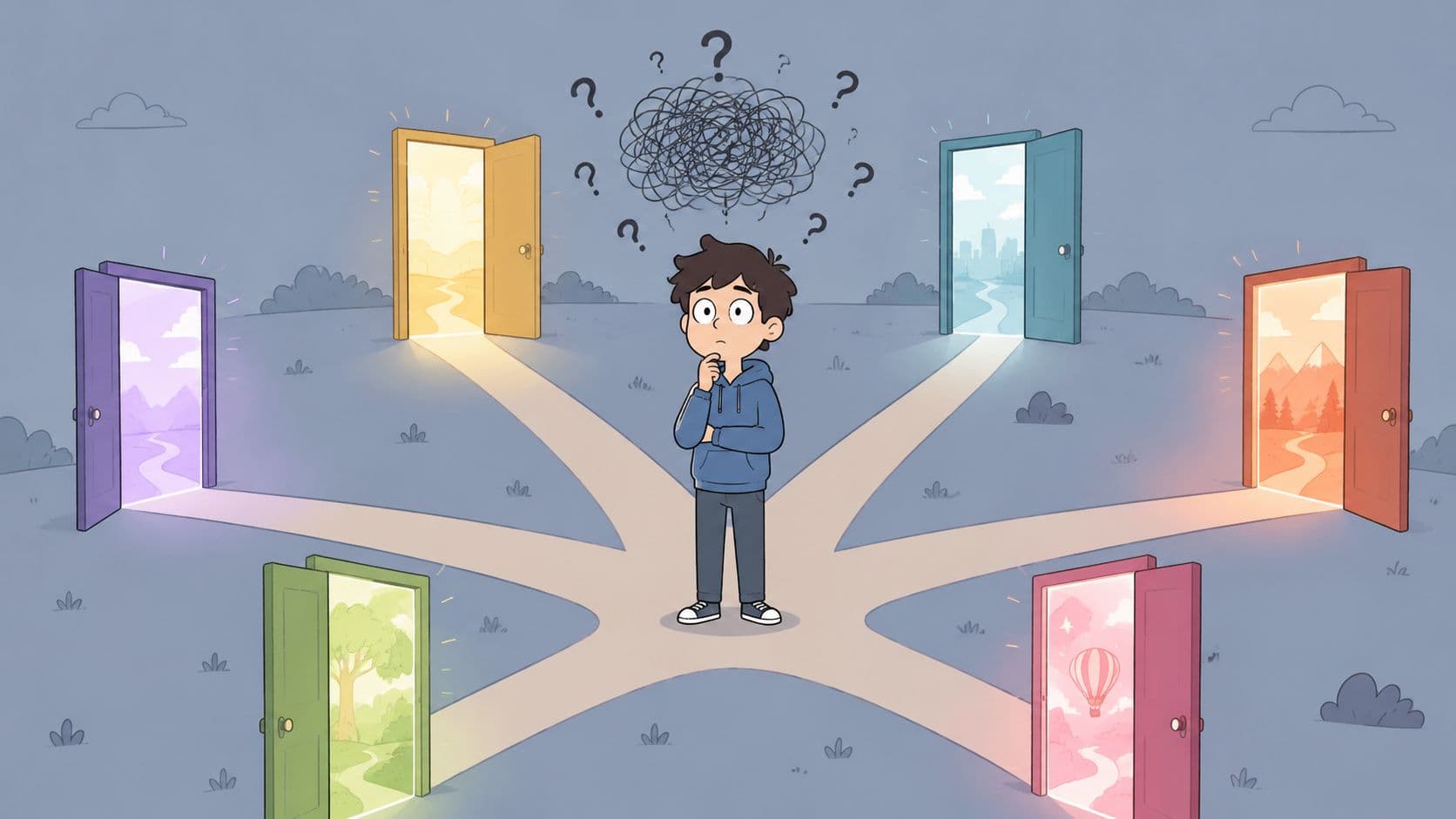
Sometimes the freeze shows up as procrastination. Sometimes it looks like endless research. Sometimes it turns into “I'll decide after one more meeting,” even when another meeting won't solve the actual problem.
You can be informed, intelligent, and highly motivated, and still get stuck when the number of choices outruns your working capacity.
That matters because many people assume indecision means lack of discipline. More often, the issue is mismatch. The demands of the moment exceed the brain's ability to compare, prioritize, and tolerate uncertainty.
A few common versions show up again and again:
- Task paralysis: You know what needs doing, but can't choose where to begin.
- Research paralysis: You keep gathering information because choosing feels riskier than searching.
- Communication paralysis: A message matters enough that you over-edit it and avoid sending it.
- Priority paralysis: Everything feels important, so nothing becomes clear enough to act on.
If any of that sounds familiar, the fix isn't to shame yourself into being decisive. It's to understand what kind of overload you're dealing with and then reduce it on purpose.
What Is Decision Paralysis Really
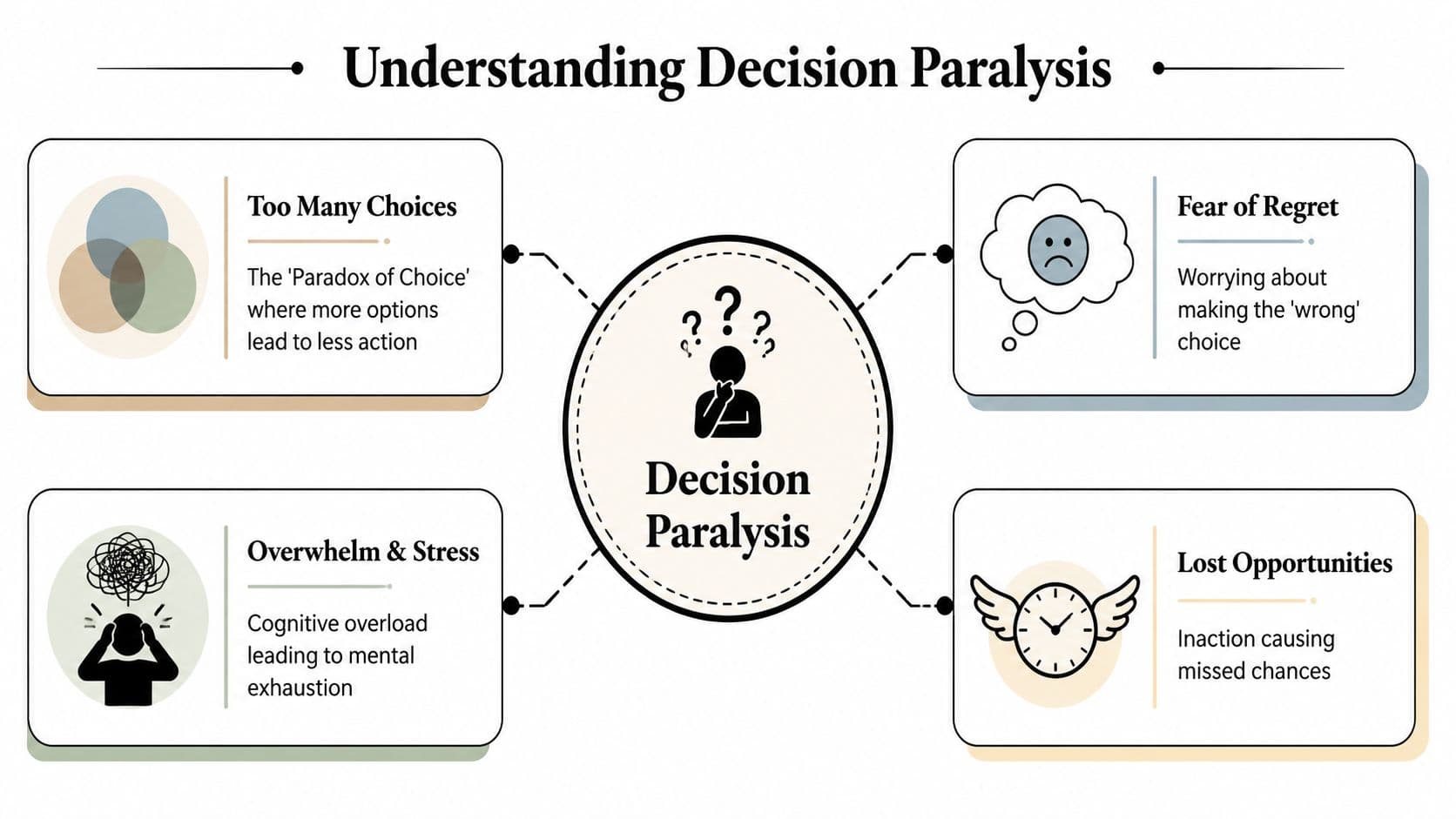
Decision paralysis is the point where the process of evaluating choices becomes so mentally demanding that action stalls. You're not failing to think. You're thinking past the point where thinking is useful.
A good analogy is a laptop with too many apps open. Each app might matter. None seems huge on its own. But together they eat memory, slow everything down, and make even basic actions lag. Your brain can do something similar when it's juggling options, consequences, tradeoffs, and the fear of getting it wrong.
The paradox of choice in plain language
More options feel like freedom. Up to a point, they are. After that point, they can become friction.
That's the core idea behind choice overload, often called the paradox of choice. When people face too many alternatives, comparing them gets harder, regret becomes more likely, and avoiding the decision starts to feel strangely appealing.
A practical example appears in retirement behavior. The Decision Lab's overview of choice overload bias notes that in 2006, more than half of U.S. workers had access to a contribution plan, yet 21% of those people chose not to participate. More choice didn't automatically create more action.
What makes a choice feel paralyzing
The same decision can feel easy one day and impossible the next. That usually depends on load, not character.
A choice becomes more likely to freeze you when it has several of these features:
- Too many viable options: Not bad options. Good-enough options that all require comparison.
- Unclear criteria: You haven't decided what matters most, so every factor competes.
- Fear of regret: The mind keeps simulating future disappointment.
- No stopping rule: You don't know when you've learned enough to choose.
Practical rule: If you can't explain your decision criteria in one sentence, your brain will keep reopening the case.
The important thing to notice is this. Decision paralysis isn't always about big life choices. It can also come from repeated, low-level mental friction. Pick a task. Sort the inbox. Compare vendors. Choose the draft. Approve the meeting time. Those small decisions stack up fast.
When people say they're overthinking, this is often what they mean. Not deep reflection. Cognitive traffic.
Why You Get Stuck in a Loop of Indecision
Modern work isn't just busy. It's built around constant choice architecture. Every tool asks you to sort, label, compare, reply, defer, snooze, prioritize, or re-prioritize. Even before the important decision arrives, your attention is already taxed by dozens of smaller ones.
That environment changes how indecision feels. It stops being a rare event and becomes a repeating loop. You don't just face one hard choice. You face many unfinished ones, all competing for mental bandwidth.
Digital overload creates too many inputs
For many knowledge workers, the problem isn't lack of information. It's surplus.
In a Fortune report on Oracle's 2023 survey, 86% of respondents said the volume of data is making decisions in their personal and professional lives more complicated, not less. That matters because it describes a familiar workday: dashboards, chat threads, analytics, meeting notes, customer feedback, and conflicting recommendations all arriving before anyone acts.
When you're exposed to that much input, your brain starts asking harder questions than the task requires. What if I'm missing a key variable. What if another data point changes the answer. What if waiting a bit longer leads to a better choice.
Those questions can sound responsible. They often become avoidance dressed as diligence.
Perfectionism changes the stakes
Not every stuck decision comes from too much data. Sometimes it comes from the feeling that a wrong choice will be hard to recover from.
Perfectionism turns ordinary tradeoffs into moral tests. A small decision starts carrying extra weight. The vendor must be the ideal vendor. The reply must be perfectly phrased. The plan must survive every possible objection before anyone sees it.
A few signs that perfectionism is fueling the loop:
- You keep reopening settled questions because a better option might exist.
- You delay visible work because choosing means being judged.
- You treat reversible decisions like permanent ones and raise the emotional cost of action.
The loop feeds itself
Indecision is exhausting. That exhaustion makes later decisions worse.
By the time you've spent an hour debating where to start, your focus drops. Then the next choice feels harder than it should. Then you trust yourself less, so you gather more information. Then the information creates more complexity. Around and around it goes.
A lot of paralysis isn't caused by one impossible decision. It's caused by too many unfinished decisions sitting open at the same time.
That's why generic advice often falls flat. “Just decide” ignores the design of the environment. If your tools and habits produce endless micro-decisions, willpower alone won't solve the problem.
The Unique Link Between ADHD and Decision Paralysis
For some people, decision making paralysis isn't mainly about too many options. It's about executive dysfunction.
That distinction matters. If you have ADHD, the act of choosing can carry a kind of mental weight that other people don't see. The task may be clear. The consequences may be minor. But initiating the decision, holding the variables in mind, and tolerating uncertainty can still feel disproportionately hard.
Why generic advice often misses the mark
A person with ADHD may hear “just pick one” and feel worse, not better. That advice assumes the block is reluctance. Often the block is cognitive strain.
The National Institute of Mental Health is cited in the verified data here as reporting that 68% of adults with ADHD identify decision paralysis as a primary barrier to task completion, and that this can contribute to a 30% reduction in weekly productive output. The underlying issue is often executive dysfunction, where the effort of deciding feels heavier than the eventual benefit.
That can create a pattern many people with ADHD know well:
- A decision appears.
- The brain senses effort, ambiguity, or possible error.
- Instead of choosing, the person gathers more inputs.
- More inputs make the decision harder.
- The task remains open and starts generating shame.
This isn't laziness. It's often a nervous system response to friction.
How paralysis can show up with ADHD
The presentation varies. One person might freeze at the start of a task. Another might spend an hour comparing calendar apps. Another may bounce between priorities because none feels certain enough to commit to.
Common patterns include:
- Information spirals: You research to reduce uncertainty, but the extra information increases load.
- Initiation delays: You know the next step, but can't get over the threshold to begin.
- Fear-based avoidance: Choosing feels risky, so your brain tries to postpone the feeling.
- Micro-decision fatigue: Repeated tiny choices drain energy needed for the important one.
What helps is external support, not self-criticism
People with ADHD often do better when decisions become more visible, smaller, and more structured.
That can mean using a written shortlist instead of comparing everything in your head. It can mean asking someone else to help narrow options before you choose. It can mean assigning a tiny first action, like “pick the top two” instead of “decide the whole thing.”
If your brain stalls at the point of choice, the answer usually isn't more pressure. It's less internal load.
That's also why accommodations matter. External reminders, shared decisions, pre-set rules, and delegated admin choices aren't crutches. They're functional tools.
Practical Frameworks to Make Decisions Easier
Frameworks help because they replace vague thinking with a repeatable process. You don't need a perfect system. You need one that lowers friction enough for action to happen.
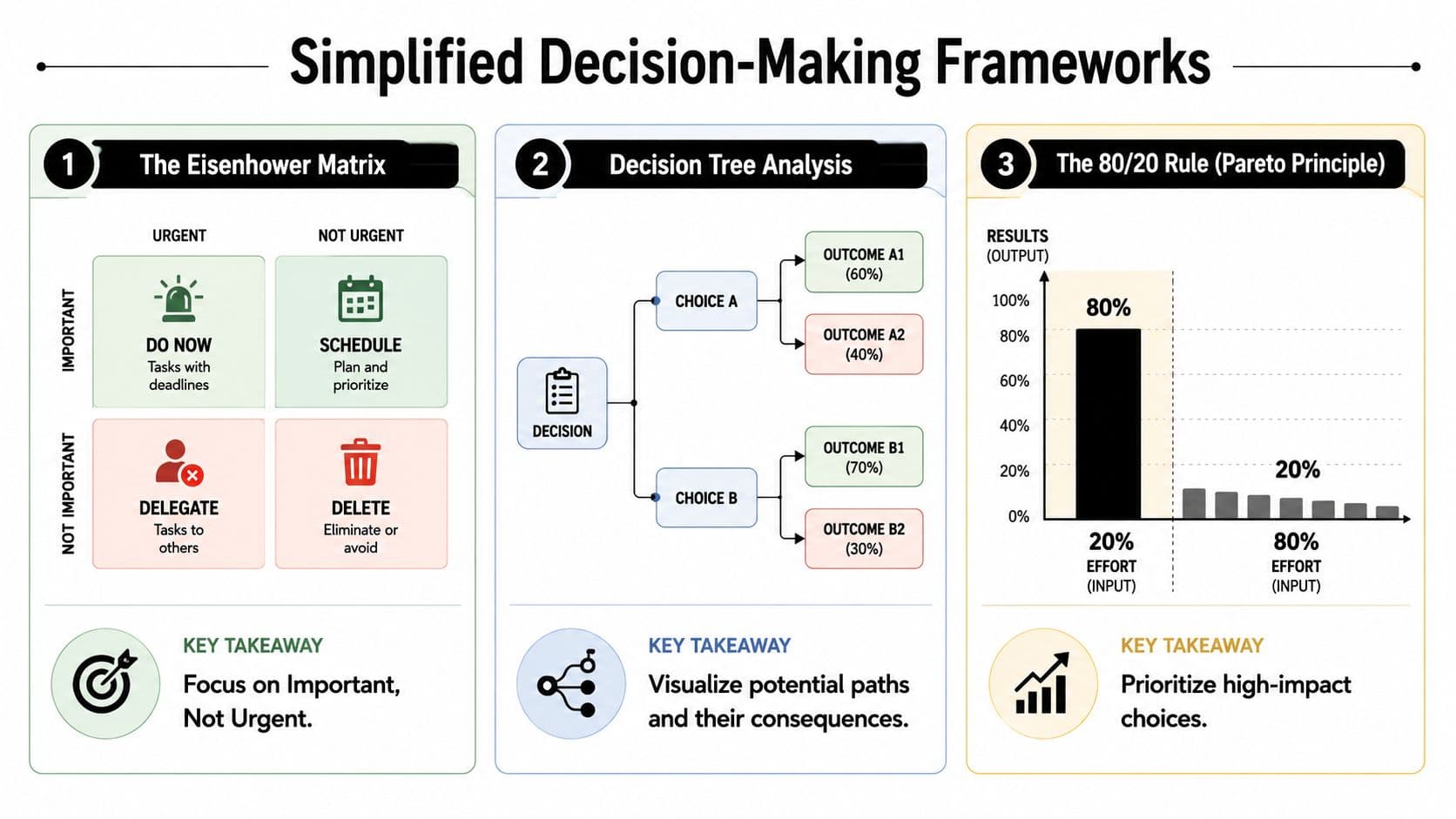
One useful starting point is this. The more options you compare, the more likely you are to stall. The verified data for this article states that when people face more than 10 options, the probability of making no decision rises by about 40%, and that a practical response is constraint optimization, meaning you narrow the initial set to 3 to 5 candidates before deeper evaluation. Because the provided source is Harvard Business Review, the key practical lesson is simple: don't evaluate everything.
Use the two-way and one-way door test
Some decisions are reversible. Others are costly to undo.
If a choice is a two-way door, you can try it, learn, and change course. Think about testing a new meeting format, trying a task app for a week, or sending a draft with a note that says “early version.” These decisions don't need courtroom-level evidence.
If a choice is a one-way door, slow down. Hiring, legal commitments, major pricing changes, and public promises deserve more care because reversing them is harder.
A fast filter helps:
| Decision type | Ask yourself | Response |
|---|---|---|
| Two-way door | Can I reverse this without major cost? | Decide quickly and review later |
| One-way door | Would reversal be expensive or disruptive? | Gather input, then commit |
Use the Eisenhower Matrix when everything feels urgent
This framework is useful when the actual problem isn't one choice, but too many competing tasks.
Sort work into four buckets:
- Important and urgent: Do these first.
- Important and not urgent: Schedule them.
- Urgent and not important: Delegate if possible.
- Neither urgent nor important: Remove or defer.
That simple sort reduces false urgency. It also protects your best attention from low-value noise.
A short explainer can help if you want to see these tools in action:
Use the 40 to 70 rule when you're waiting for certainty
Some people stall because they think confidence must come first. It usually doesn't.
The verified data for this article notes that ISACA's guidance includes a useful heuristic: act when 40% to 70% of the needed information is available, instead of waiting for perfect certainty. That's especially helpful for fast-moving work, where delay creates its own cost.
Try this in plain language:
- Below the lower end: You probably need basic facts.
- Within the range: Choose and move.
- Above the upper end: You may be collecting information to avoid discomfort, not to improve the decision.
None of these frameworks makes uncertainty disappear. They just stop uncertainty from running the whole process.
Build Systems to Reduce Decision Fatigue
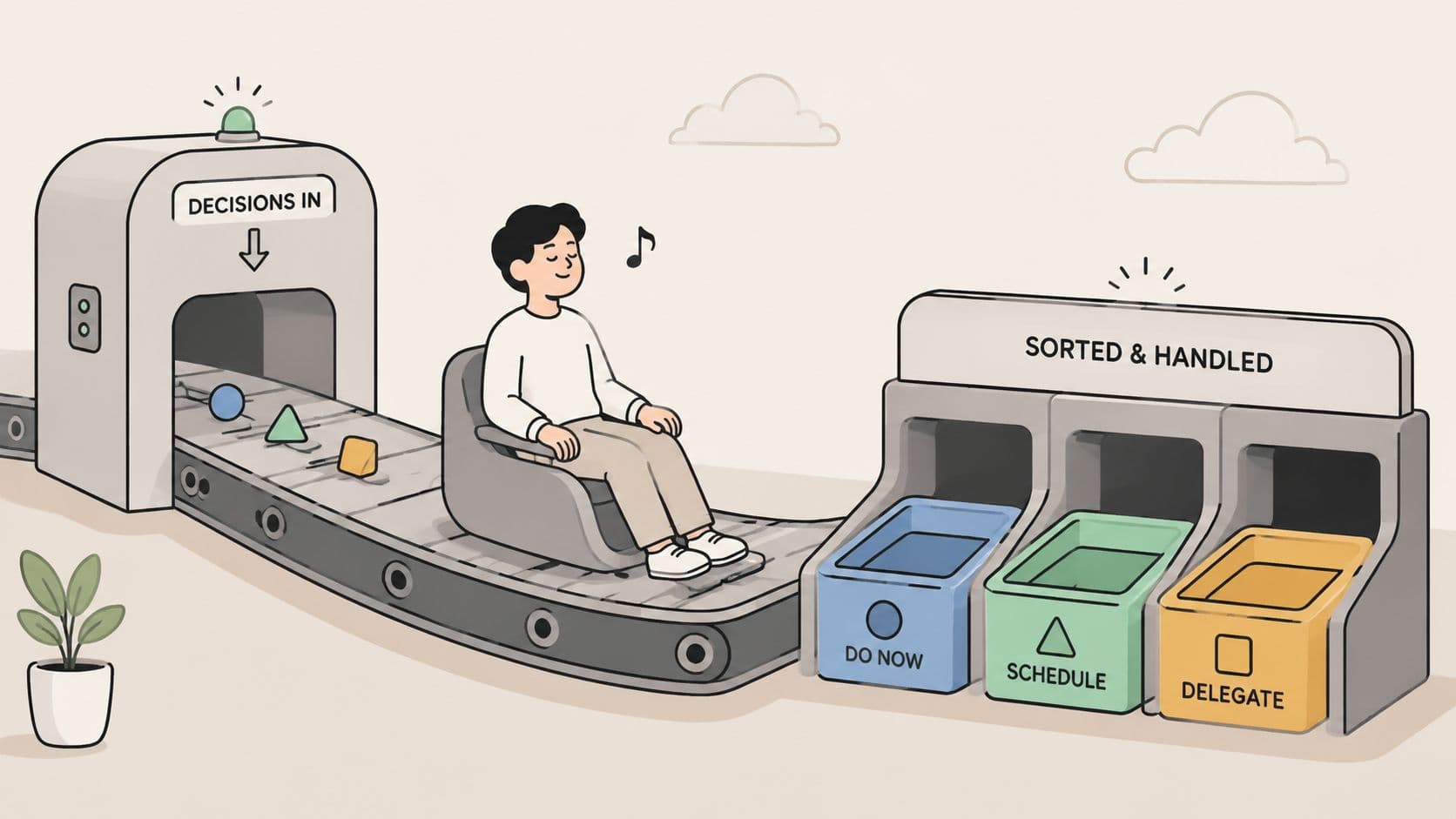
The strongest long-term fix for decision making paralysis is not becoming better at making endless choices. It's needing to make fewer of them.
That sounds obvious, but people often keep treating every repeated decision like a fresh event. They recreate priorities every morning, rewrite the same kinds of emails, manually sort similar tasks, and personally hold questions that could be routinized. That keeps the brain in constant evaluation mode.
Externalize repeat decisions
You want fewer choices living only in your head.
Guidance summarized by Cleveland Clinic emphasizes that when paralysis affects work and quality of life, especially with executive function challenges, it often helps to externalize choices through structured processes, shared decision making, and delegation. In practice, that means building visible rules and supports outside your brain.
A few examples work well:
- Templates for recurring work: Client replies, meeting agendas, onboarding steps, and weekly reviews shouldn't start from scratch.
- Default rules: Decide in advance how you'll handle common situations. For example, “If a meeting doesn't need discussion, send a written update.”
- Shortlists instead of open fields: Don't ask yourself to pick from everything. Create a small approved set.
Decide what should never require fresh thought
Here, productivity systems become protective, not rigid.
Ask of any recurring decision, “Do I need to think about this again?” If the answer is no, turn it into a checklist, a trigger, or an assignment rule.
Try a simple audit:
| Recurring friction | Better system |
|---|---|
| Daily task triage | Fixed planning time and priority labels |
| Repetitive messages | Reusable drafts and response templates |
| Admin bottlenecks | Delegation with clear ownership |
| Tool comparison loops | Pre-set evaluation criteria before researching |
Small systems beat heroic effort. If a task repeats, your process should carry more of the load than your memory.
Delegate the parts that drain you most
Delegation helps when the block isn't the final choice, but the buildup around it.
You can hand off research gathering, scheduling, formatting, follow-ups, first-pass organization, and status tracking. That doesn't remove your authority. It removes low-value decision clutter that crowds out better thinking.
One factual example in this category is Fluidwave, which combines task management, automation, and human virtual assistants so users can organize work, auto-prioritize tasks, and delegate specific items on a pay-per-task basis. For someone who gets stuck at the volume-of-decisions layer, that kind of setup can move routine sorting and follow-through out of your head and into a shared workflow.
The key is to delegate with enough structure that the other person doesn't inherit your confusion. Give criteria, deadlines, and a definition of done. “Handle this” creates more ambiguity. “Compare these three vendors against these four criteria and return a recommendation” reduces it.
Your First Step to Breaking the Cycle
If you remember one thing, make it this. Decision making paralysis is usually a systems problem before it's a character problem.
Your brain gets stuck for reasons. Too many options. Too much input. No clear criteria. Perfectionism. Executive dysfunction. Repeated micro-decisions that drain the attention you needed for the important call. Once you see that, the goal changes. You stop trying to become infinitely decisive and start building conditions that make deciding easier.
Start very small.
Pick one recurring decision that annoys you or slows you down every week. Maybe it's planning your day, answering certain emails, assigning tasks, or deciding what to work on first. Don't optimize the whole month. Just create one rule, one template, or one shortlist for that one decision.
If you do that today, you've already interrupted the cycle. Not by forcing faster thinking, but by removing a little unnecessary choice from tomorrow.
If decision overload is coming from the way work is organized, Fluidwave is one practical option to explore. It gives you a place to structure tasks, auto-prioritize work, and delegate specific items to human assistants instead of holding every small decision in your own head. For busy professionals, founders, teams, and neurodivergent users, that kind of external support can make the next step easier to see and easier to take.
Focus on What Matters.
Experience lightning-fast task management with AI-powered workflows. Our automation helps busy professionals save 4+ hours weekly.