Onboard new team members with a practical Fluidwave workflow for first-week tasks, delegation, handoffs, automated checklists, and feedback.
October 21, 2026 (1d ago)
How to Onboard New Team Members with Fluidwave
Onboard new team members with a practical Fluidwave workflow for first-week tasks, delegation, handoffs, automated checklists, and feedback.
← Back to blog
Your new hire has a welcome message, a calendar full of introductions, and a folder of documents. By midmorning, they're asking which request matters most, who can approve their work, and whether anyone has checked their access. Their manager is already in meetings. Everyone means well, but the new person has become the coordinator of their own onboarding.
A better approach treats onboarding as a workflow-resilience system: clear ownership, useful context, manageable work, and a fallback when the usual decision-maker isn't available.
Why New Team Member Onboarding Often Stalls
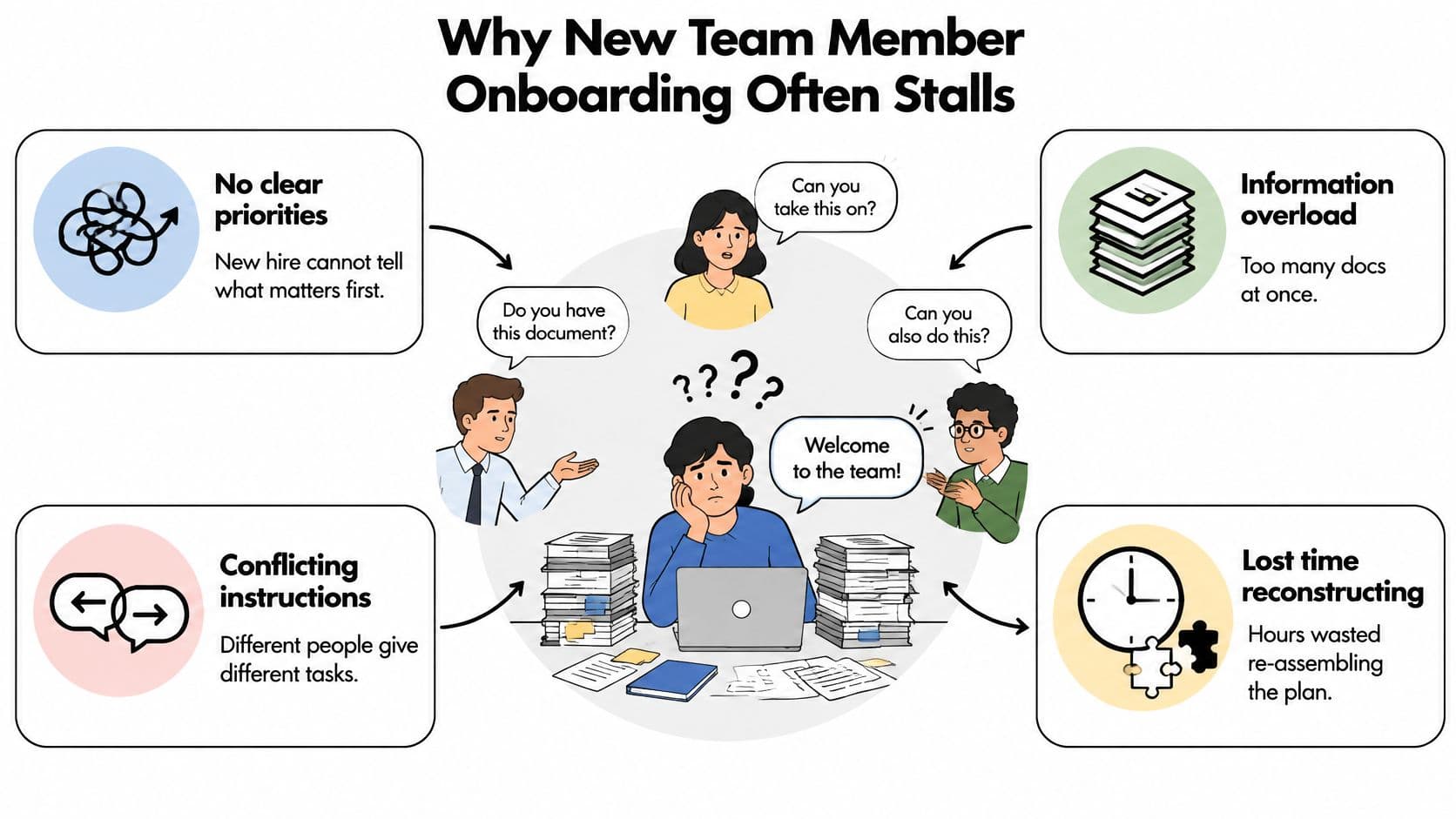
Consider a project manager joining a distributed team. A colleague asks them to update the backlog, another wants a status report, and their manager suggests reviewing project history. None of those requests is unreasonable. The problem is that nobody has explained the order, the expected output, or which request can wait.
The new hire starts reconstructing a plan that should already exist. They may look busy while making little progress toward meaningful responsibility.
These are coordination failures, not a shortage of welcome messages.
Separate activity from readiness
Gallup reports that only 12% of employees strongly agree their organization does a great job onboarding them, a finding that should make managers question whether completing orientation means someone is ready to contribute (Gallup's onboarding research).
A coordinated workflow makes readiness observable:
- Access: The person can use the systems required for their actual work, not merely receive login invitations.
- Clarity: They can explain their immediate priority and what acceptable work looks like.
- Connection: They know who can answer operational, technical, and role-specific questions.
- Momentum: They can complete useful work without repeatedly waiting for someone to interpret instructions.
Role-specific resources belong inside that workflow. For a sales development hire preparing for customer conversations, the SDR first call playbook from hireSDR.com can be a discussion resource alongside the team's own call expectations and review process.
Practical rule: Don't ask whether the new person has received everything. Ask whether they can take the next useful action.
That distinction changes the manager's job. Instead of sending more material whenever someone gets stuck, the manager identifies the missing decision, permission, example, or owner. Effective onboarding gives new team members a reliable route through uncertainty, rather than expecting confidence to appear after orientation.
Prepare a Clear Onboarding Workflow
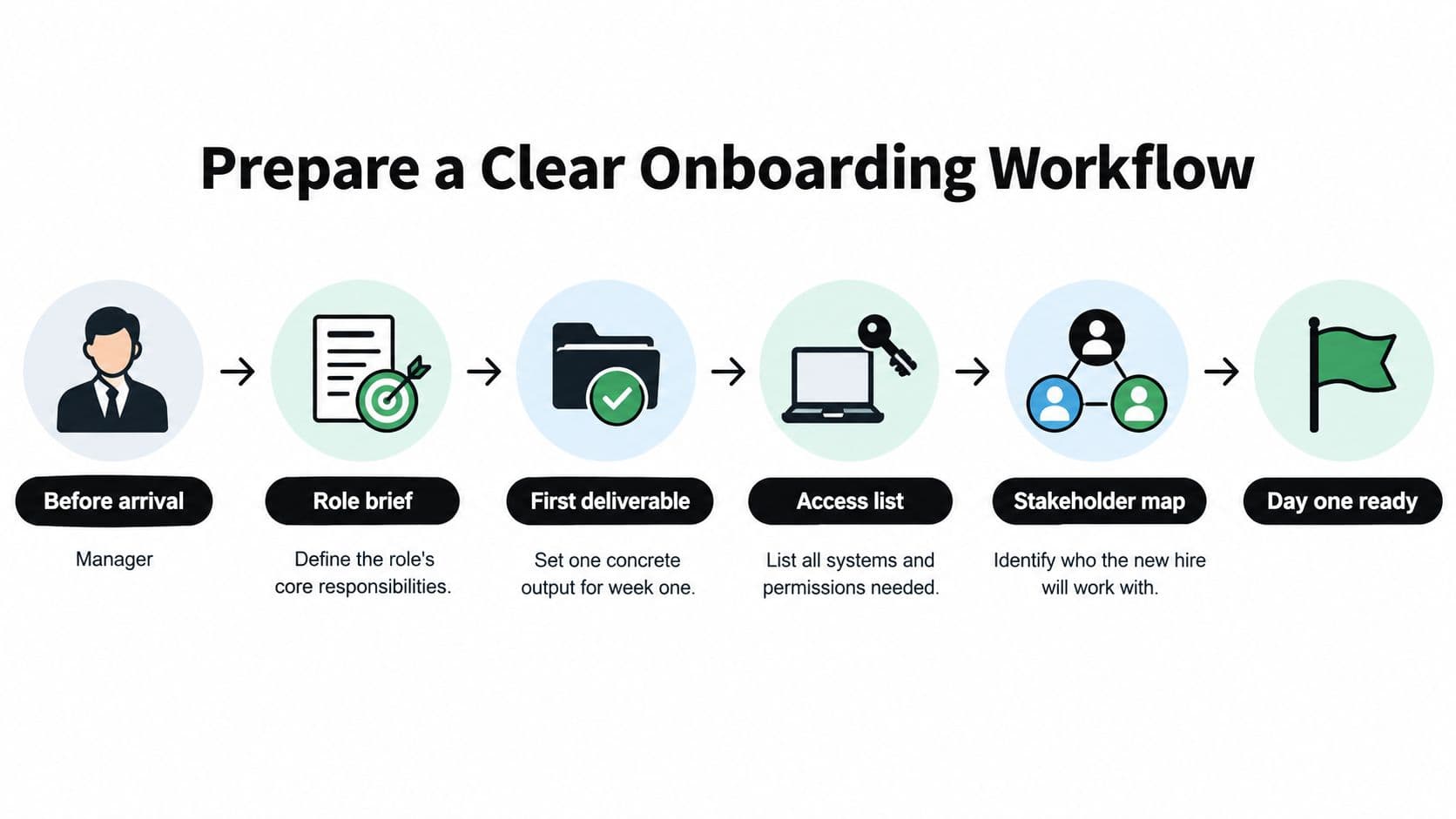
Start before arrival by defining the work, not by copying last year's welcome checklist. Write a role brief covering responsibilities, boundaries, expected outcomes, and decisions that require approval. Then choose a first deliverable small enough to review closely but useful enough to matter.
Use this preparation sequence to check the essentials.
Turn preparation into owned tasks
Build a reusable onboarding template with separate tasks for preparation, verification, and review. Each task needs an owner, due date, priority, relevant context, and acceptance criteria.
- Manager preparation: Approve the role brief and first deliverable. Include a representative example of acceptable work.
- Access preparation: Ask the system owner to confirm the required permissions. Don't store passwords in shared task descriptions.
- Team preparation: Identify stakeholders, communication channels, working-hour overlaps, and recurring check-ins.
- Readiness verification: Assign someone to test whether the planned workflow is usable, including document permissions and backup ownership.
For a project manager joining a distributed team, the first deliverable might be a draft status update for an existing project. Preparation would include access to the project record, an approved reporting example, definitions of status categories, and a named reviewer.
For a customer-facing role, substitute a supervised response to a routine inquiry. For an operations hire, use a low-risk request processed against a documented procedure. The structure stays consistent; the work and permissions change.
A process documentation example can help turn informal knowledge into usable instructions. For UK teams assembling their preparation materials, the practical onboarding guide for UK employers is another resource to consider alongside internal policies.
Plan beyond arrival
SHRM Foundation guidance recommends a written plan with milestones at 30, 60, 90, and 120 days, extending check-ins through the first year when appropriate (SHRM Foundation's onboarding guidance). Use those review points to schedule responsibility, not just training attendance.
A video can supplement the written plan, but it shouldn't replace task-level instructions.
Keep a reusable master template, then adapt a working copy for each hire. Automate routine task creation where your tools support it, but require owners to verify the details. An automatically assigned access task is still unfinished until someone confirms that access works.
Run a Focused First Week
The first week needs a controlled sequence, not a fully booked calendar. Microsoft's 2025 Work Trend Index found that employees using Microsoft 365 were interrupted by a meeting, email, or notification about every two minutes during core work hours (Microsoft's analysis of the infinite workday). Don't add scattered onboarding requests to that environment.
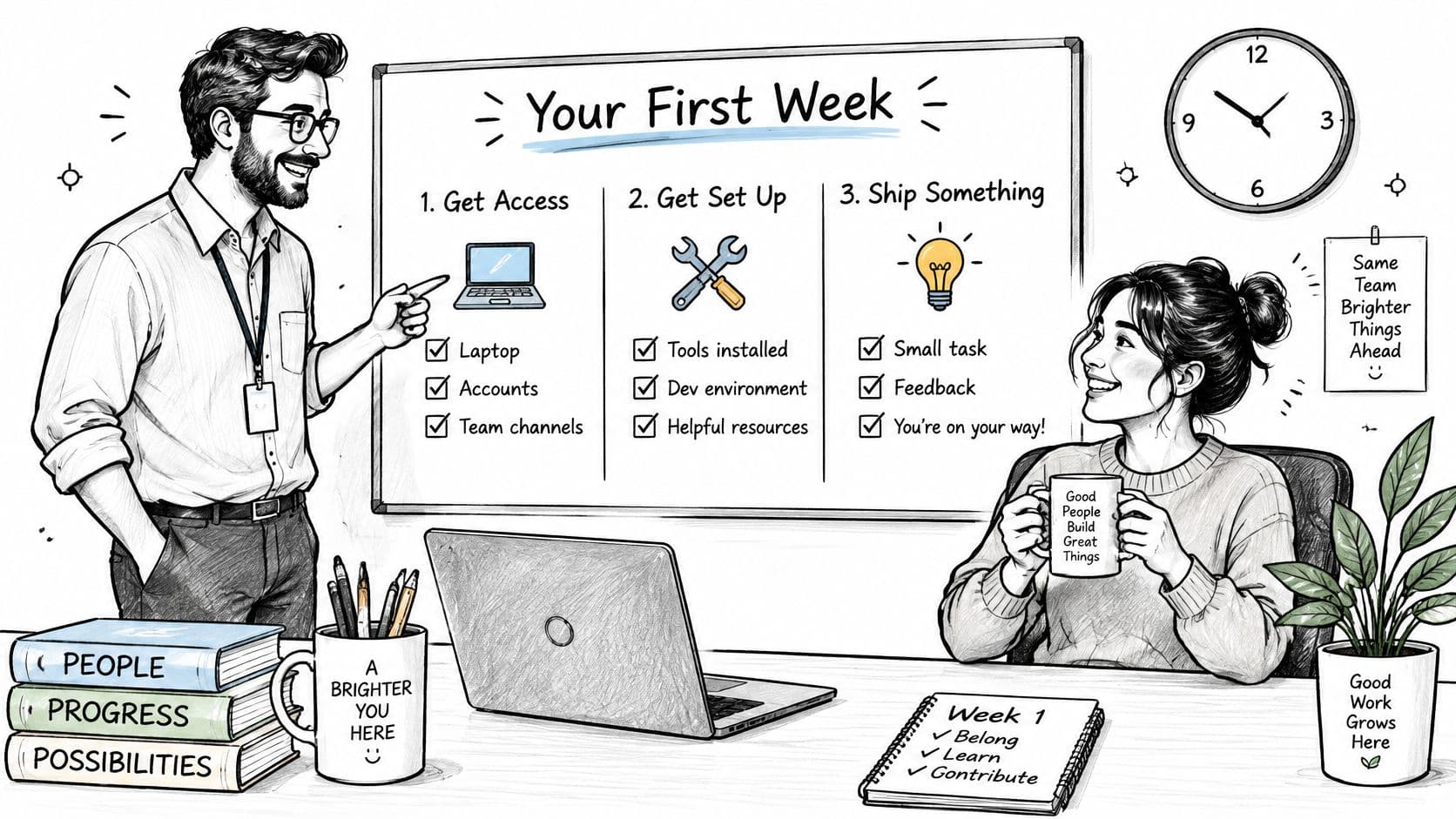
Organize the onboarding board around outcomes such as “Ready to work,” “Understand the project,” and “Deliver reviewed work.” Administrative tasks still belong there, but they shouldn't obscure the work the person joined to do.
A working example for a project manager
Before the project walkthrough, ask the new hire to open the relevant systems, review a short project summary, and note unclear terms. The walkthrough then becomes a conversation about the project rather than a live reading of its documentation.
| Point in the week | Useful work | Human support required |
|---|---|---|
| Arrival | Verify access and review immediate priorities | Manager confirms scope and decision rights |
| Early work | Read the project summary and annotate questions | Peer explains team-specific terminology |
| Guided delivery | Draft the project status update | Project lead checks interpretation and omissions |
| Week-end review | Revise the update and discuss blockers | Manager agrees the next level of responsibility |
Postpone broad system tours and introductions without an immediate working purpose. A meeting earns its place when the new hire needs that person's context to proceed.
Make the task usable
A practical task template contains:
- Outcome: Draft a status update that the project lead can review.
- Inputs: Link the project record, reporting example, and current decisions.
- Boundaries: Don't change commitments or send the update externally.
- Completion: Explain progress, risks, dependencies, and unresolved questions accurately.
- Review: Name the reviewer and specify how to request feedback.
Use a list view for the new hire's immediate priorities, a board for shared progress, and a calendar for time-sensitive commitments. Different views should display the same work, not create competing task lists.
A first deliverable should reveal understanding, not reward the ability to copy a previous document.
At the end of the week, ask what required unnecessary searching, which instructions conflicted, and where the person waited for help. Grant more independence when they can explain their choices and recognize an escalation boundary, not merely when they've submitted a draft.
Delegate Work Without Losing Context
An overloaded manager shouldn't retain every onboarding task. They also shouldn't delegate the judgments that only they can make. Keep role expectations, sensitive feedback, and performance decisions with the accountable manager; distribute specialist instruction and bounded support work elsewhere.
The useful question is who can complete this work safely while preserving the new hire's learning? Urgency alone isn't a good reason to hand something off.
Choosing How to Handle an Onboarding Task
| Work Situation | Best Owner | Why | Required Handoff Detail |
|---|---|---|---|
| Conflicting priorities or unclear authority | Manager | Requires accountable judgment | Competing requests, consequences, decision needed |
| Explaining a specialist workflow | Peer or team lead | Requires local knowledge | Procedure, worked example, practice task |
| Formatting meeting notes or compiling approved report inputs | Virtual assistant | Bounded output can be reviewed | Inputs, format, deadline, budget, exclusions |
| Creating standard reminders or recurring task shells | Automation | Repeatable work follows stable rules | Trigger, destination, exception owner |
| Practicing the role's core responsibility | New team member | Builds capability through application | Scope, support, acceptance criteria |
Make handoffs visible
For a recurring report, an assistant might compile approved inputs while the new hire interprets the exceptions. For client research, the assistant can organize permitted background material, but the account owner should validate anything used in a customer conversation.
A good handoff names the desired output, explains its purpose, supplies approved inputs, and sets constraints. Add the deadline and budget where relevant, plus the review step that determines completion. This guide to delegation of responsibility provides a useful starting point for separating execution from accountability.
- Protect information: Share only what the task requires and follow organizational access rules.
- Reserve approval: Require review before external communication, publishing, spending, or changing customer records.
- Preserve learning: Save the inputs, method, corrections, and accepted output where the new hire can inspect them.
Avoid invisible assistance. If someone fixes every report behind the scenes, the new employee may never learn which judgments were wrong. Ask the reviewer to distinguish formatting corrections from reasoning corrections.
Pay-per-completed-task support can suit bounded work without turning each request into a staffing decision. It still requires a responsible internal reviewer. Delegation should remove avoidable preparation work, not conceal a missing training plan.
Build Autonomy With a 90-Day Plan
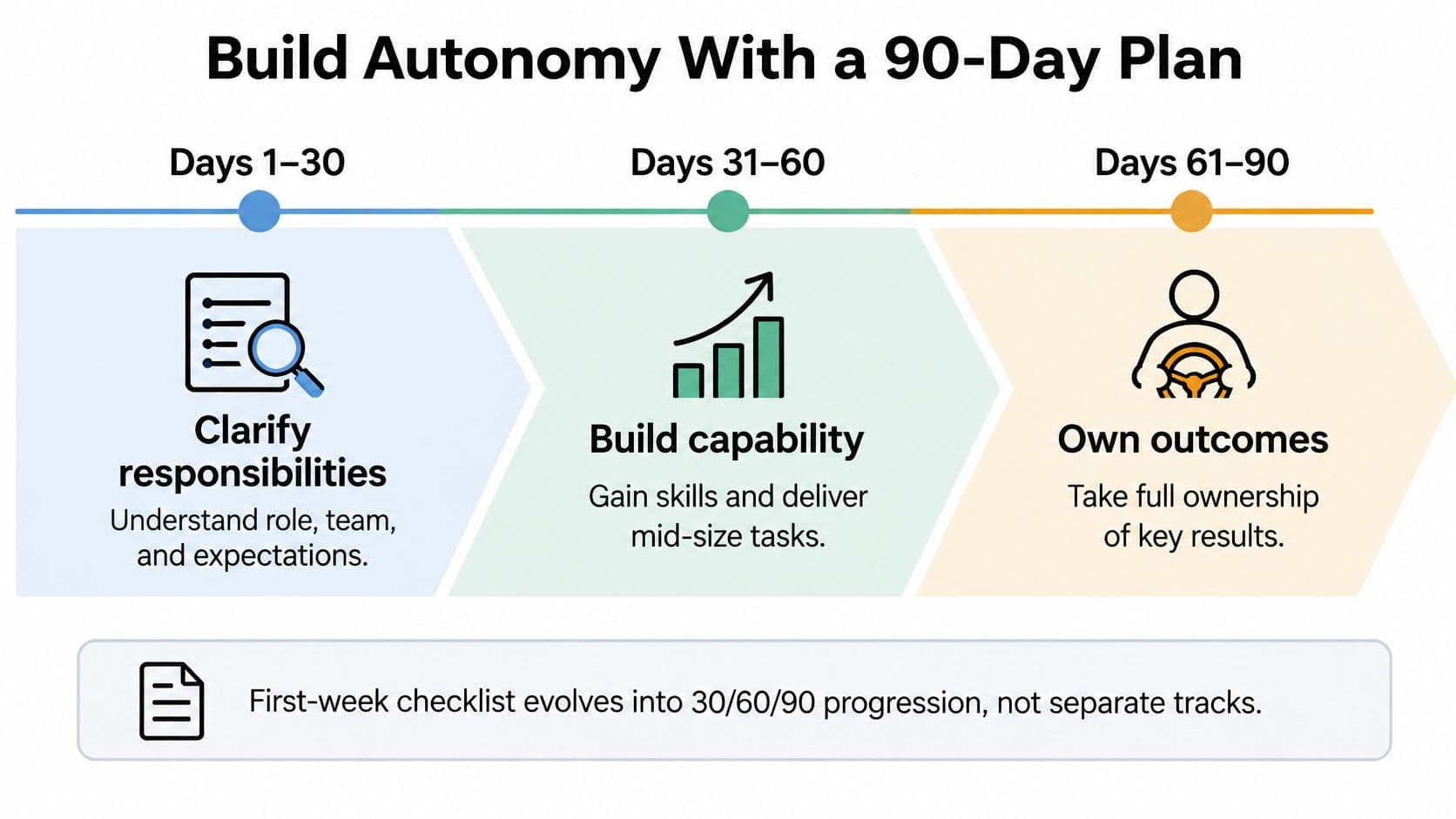
A project coordinator shouldn't move from observation to full ownership just because orientation has ended. Increase responsibility when their work demonstrates readiness, using a 30/60/90-day progression as a planning framework rather than a guaranteed timetable.
The important change is the level of judgment expected. Preparing meeting materials, coordinating follow-ups, and owning a low-risk workflow require progressively broader decisions.
Increase responsibility against evidence
During the first month, the coordinator might prepare meeting materials from approved sources. Review whether they understand the project's purpose, distinguish decisions from discussion, and identify missing information. Training completion matters, but the work should show whether they can apply it.
During the next phase, assign follow-up coordination. The coordinator drafts action records, checks ownership, and flags dependencies. Manager review should focus on judgment: did they notice an unresolved commitment, or merely transcribe the conversation?
By the final phase, give them a low-risk workflow to own, such as maintaining an internal project review cycle. They should arrange inputs, manage routine exceptions, and escalate decisions outside their authority.
| Evidence to inspect | What it helps establish |
|---|---|
| First meaningful contribution | Whether useful work has begun |
| Applied role-specific training | Whether instruction transfers into practice |
| Reviewer assessment of proficiency | Whether quality meets the role's standard |
| Collaborative deliverables | Whether the person can work across dependencies |
| Retention by onboarding cohort | Whether early departures warrant investigation |
Keep an evidence trail
Connect milestone tasks to completed work, review comments, and unresolved exceptions. A quarterly planning template can help align the ramp-up with actual team commitments rather than a parallel set of training exercises.
For distributed teams working across locations, consider the guide to nearshore team onboarding when reviewing local handoffs and working arrangements.
Don't advance someone solely because a date has arrived, and don't hold them back solely because a checklist remains unfinished. Explain which capabilities are established, which need practice, and what evidence will justify the next increase in ownership.
Protect Focus and Build Belonging
A new hire can understand their tasks and still feel unable to ask a question. They may not know whether a terse message signals urgency, whether disagreeing in a meeting is acceptable, or whether declining an optional social event will be judged negatively.
Make those unwritten rules explicit. Offer written context before meetings, explain how decisions are recorded, and provide ways to contribute without speaking spontaneously. For remote, hybrid, introverted, neurodivergent, or ADHD team members, ask about useful working conditions rather than assuming a diagnosis or personality predicts preferences.
Offer participation without performance
Assign a peer contact with defined responsibilities: explain terminology, interpret routine team practices, and direct questions to the right owner. Don't make that person an unofficial substitute manager.
- Protect concentration: Agree on focus periods and distinguish urgent requests from items that can wait.
- Allow preparation: Share agendas and questions early enough for considered responses.
- Offer formats: Accept written questions and asynchronous updates where the work allows.
- Check the experience: Use lightweight pulse checks around days 7, 30, and 90 as suggested review points, then adjust support based on answers.
Ask concrete questions: Can you get help when blocked? Which communication format is hardest to use? What still feels risky to ask? A report of overload should lead to reprioritization, not another meeting about resilience.
Design around manager availability
A 2025 HR survey reported that 83% of managers had no formal people-management training, while only 36% of organizations had a structured process for onboarding first-time managers (HR Cloud's first-time manager onboarding guide). Don't assume managers will improvise dependable support under pressure.
Create a fallback decision path with named backup contacts, agreed response windows, and explicit escalation boundaries. Ask blocked employees to record the decision needed, available options, consequences of waiting, and their recommendation.
Fallback test: If the manager disappeared from chat, would the new hire know what they could safely continue?
Separate urgent blockers from normal uncertainty. Customer risk, security concerns, and irreversible commitments need prompt escalation; reversible internal drafts may continue within agreed limits. Record the eventual decision so the next person doesn't have to ask again.
Verify and Improve the Onboarding System
Review the workflow after each milestone using actual work, not completion percentages alone. Select a representative deliverable and trace its path from assignment to acceptance. Look for missing context, avoidable waits, unclear review ownership, and corrections that nobody explained.
Gallup reports that managers account for 70% of the variance in team engagement, while only 29% of new hires feel fully prepared and supported to excel in their role (Gallup's exceptional onboarding journey report). Managers remain accountable for the experience even when others handle parts of the workflow.
Inspect readiness and support
Use a compact verification checklist:
- Access: Can the person complete the required workflow with their current permissions?
- Role clarity: Can they explain their responsibilities and approval boundaries?
- Meaningful contribution: Has a reviewer accepted useful work against explicit criteria?
- Manager contact: Are check-ins resolving questions and producing decisions?
- Stakeholder interaction: Has the person completed work with relevant collaborators?
- Delegation quality: Are handoffs understandable, reviewable, and visible?
- Belonging: Can the person ask for help through a format they can use comfortably?
- Remaining skill gaps: Does each gap have a practice opportunity, owner, and review point?
Convert friction into a revision
Repeated questions across handoffs suggest missing shared context. Overdue access requires intervention from the system owner. Scattered requests need prioritization by someone with authority, while stalled acceptance criteria may mean the reviewer hasn't defined acceptable work clearly enough.
Persistent manager dependency deserves closer diagnosis. The person may need more practice, but they may also lack permission to make routine decisions. Fix the cause rather than telling them to be more proactive.
Update the reusable template with the correction, assign ownership, and check it before the next arrival. Keep exceptions separate from standard requirements so a workaround for one hire doesn't become everyone's burden.
Finish each review by agreeing what the new team member can now own and what support remains available. A dependable onboarding system makes both clearer over time.
Fluidwave combines task management, intelligent automation, and human virtual assistants to help teams organize onboarding work and delegate bounded tasks. Visit Fluidwave to build a reusable onboarding workflow with clear priorities and visible progress, then use pay-per-completed-task delegation, with no delegation subscription required, for preparation work that keeps managers and new team members focused.
Focus on What Matters.
Experience lightning-fast task management with AI-powered workflows. Our automation helps busy professionals save 4+ hours weekly.