Master the delegation of responsibility with practical frameworks, workload triage methods, and platform strategies to scale your output without losing control.
October 12, 2026 (7d ago)
Delegation of Responsibility: A Practical Framework
Master the delegation of responsibility with practical frameworks, workload triage methods, and platform strategies to scale your output without losing control.
← Back to blog
Most delegation advice starts with trust. It tells managers to let go, stop micromanaging, and give people room to work. That advice isn't wrong, but it misses the operational failure that causes many delegated tasks to return unfinished: the work moved, but the authority, resources, acceptance criteria, and accountability didn't move with it.
Delegation of responsibility isn't a productivity trick for clearing a crowded inbox. It's a control system for distributing execution without creating confusion about decisions or ownership. Done well, it gives capable people enough room to act while keeping consequential outcomes visible to the person answerable for them.
Redefining the Delegation of Responsibility
A task assignment says, “Please do this.” A real delegation decision answers more difficult questions: What may this person decide? What result are they accountable for? Which constraints apply? When must they escalate? What evidence will show the work is complete?
The distinction matters because responsibility without authority creates a queue of unnecessary approvals. An employee may own a deliverable but still need permission to contact a supplier, change a process, spend within an agreed budget, or resolve a routine exception. The manager then becomes the execution bottleneck while believing the task has been delegated.
The reverse failure is just as damaging. Authority without explicit accountability leaves several people believing someone else owns the outcome. Effective delegation therefore transfers authority, accountability, and task ownership as a coordinated system, rather than treating them as isolated assignments. The delegator should define decision rights, intended outcomes, constraints, and escalation conditions, as described in this organizational-behavior synthesis on delegation.
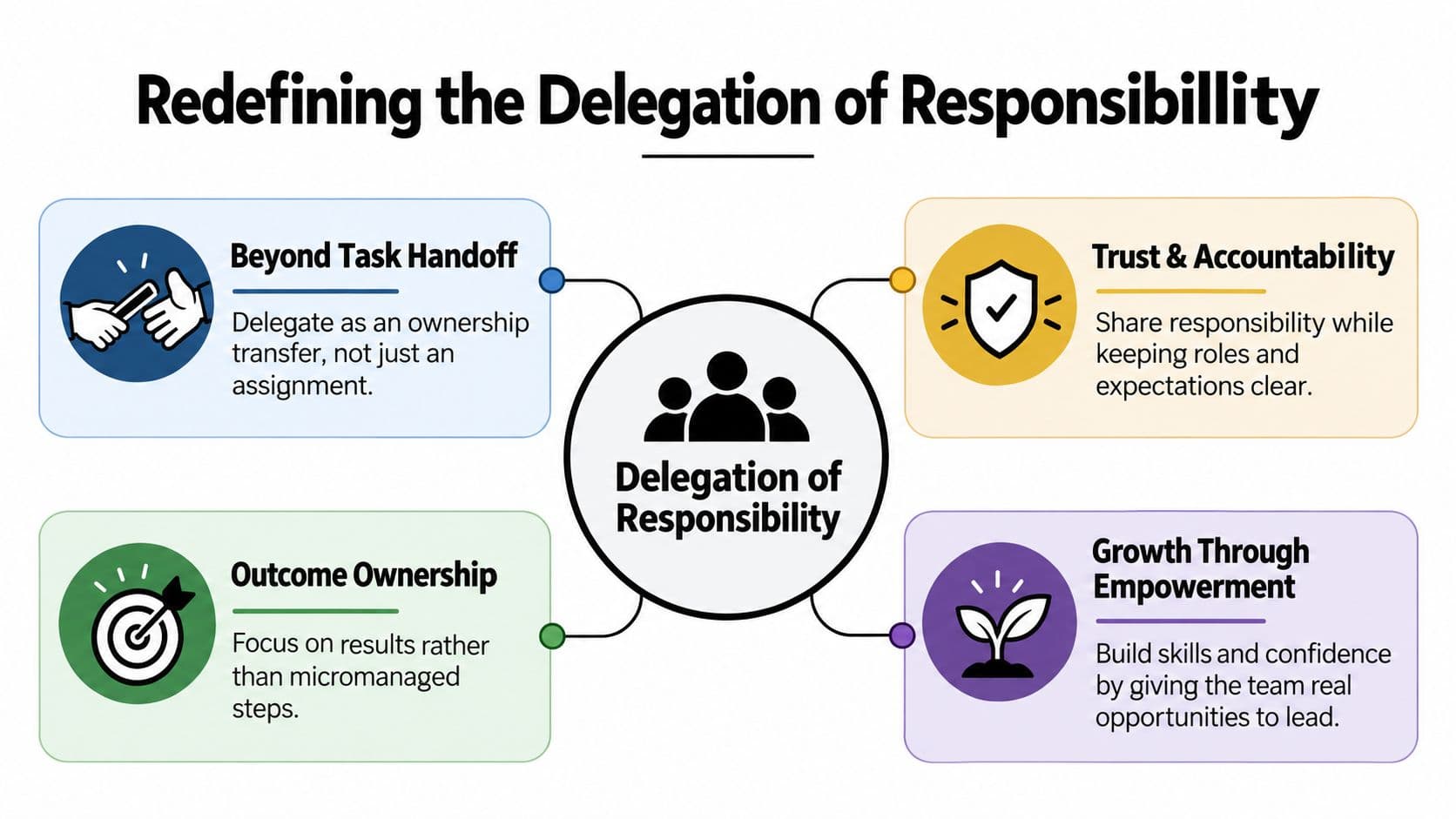
The handoff needs an operating boundary
A useful delegation brief identifies one accountable owner and gives that person sufficient control over the inputs and decisions needed to deliver. The owner might coordinate several contributors, but the final result shouldn't sit in a group chat where nobody has the authority to close the work.
That doesn't mean the manager disappears. Supervisory review belongs at predefined milestones, not in every routine decision. A low-risk recurring task may need an outcome checkpoint, while a sensitive customer, legal, safety, or financial decision may require interim validation and a documented approval.
For a practical explanation of how ownership differs from simple task assignment, delegating with Approved Experiences Traveler offers useful context. Teams building this discipline into their workflows can also compare their approach with what delegation means in practice.
Practical rule: If the assignee is accountable for the result but can't make routine decisions within a defined scope, the task hasn't been fully delegated.
The Accountability Paradox in Modern Teams
Delegation creates a paradox. The person doing the work may become responsible for execution, but the person who chose to delegate often remains answerable for the overall decision and outcome. Treating delegation as a transfer of blame is how governance breaks down.
This becomes obvious in high-stakes environments. Imperial College London's safety-management guidance states that, under UK law, line-management accountability for health and safety cannot be delegated. Managers may assign day-to-day activities, but they must ensure the appointed person has sufficient time, resources, competence, and support to perform the duties effectively. A manager can't hand over a safety responsibility to an unprepared employee and then claim the risk belongs elsewhere. The Imperial College guidance on safety-management roles makes that retained accountability explicit.
Healthcare uses a similar logic. The delegator remains accountable for deciding whether delegation is safe, providing adequate instructions, and protecting the wider relationship with the patient where applicable. The colleague who accepts the task becomes accountable for how the work is performed and must prioritize safety. The two responsibilities are different, and both matter. The General Medical Council's guidance on delegation and referral distinguishes safe delegation from merely shifting blame.
Build a responsibility cascade
The practical answer is a responsibility cascade. Instead of recording only who clicked “delegate,” map responsibility across the points where control is exercised:
- Initiation: Who decided the work was necessary and defined its purpose?
- Delegation: Who selected the assignee and confirmed that the person had the competence, time, access, and authority to act?
- Checkpoint: Who reviews progress, exceptions, or high-risk decisions before completion?
- Execution: Who performs the work and owns the decisions made within the approved scope?
- Outcome: Who approves the final result and remains answerable for its consequences?
This model is especially important when contractors, assistants, and AI systems contribute to one deliverable. A system can produce an output, but it doesn't remove the need for a human to review consequential decisions. Efficiency isn't proof that accountability is clear. If nobody can explain who approved the result, who checked the inputs, or what triggered escalation, the organization has created ambiguity rather than a strategic advantage.
Triage Methods for Choosing What to Delegate
The hardest delegation decision often isn't “Do I trust this person?” It's “Which part of this overloaded workload can leave my queue without creating a new risk?” That question is structural, especially for founders, executives, and people managing ADHD or other working-memory constraints. A vague instruction to let go doesn't reduce decision fatigue. A sorting method does.
A 2025 global leadership dataset assessed more than 70,000 manager candidates and reported that only 19% demonstrated strong delegation ability. A separate survey found that small-business leaders spent 28% of working time on duties outside their core roles. Those figures point to a design problem, not a character flaw. The delegation statistics and leadership data support a practical conclusion: managers need a repeatable way to sort work before they assign it.
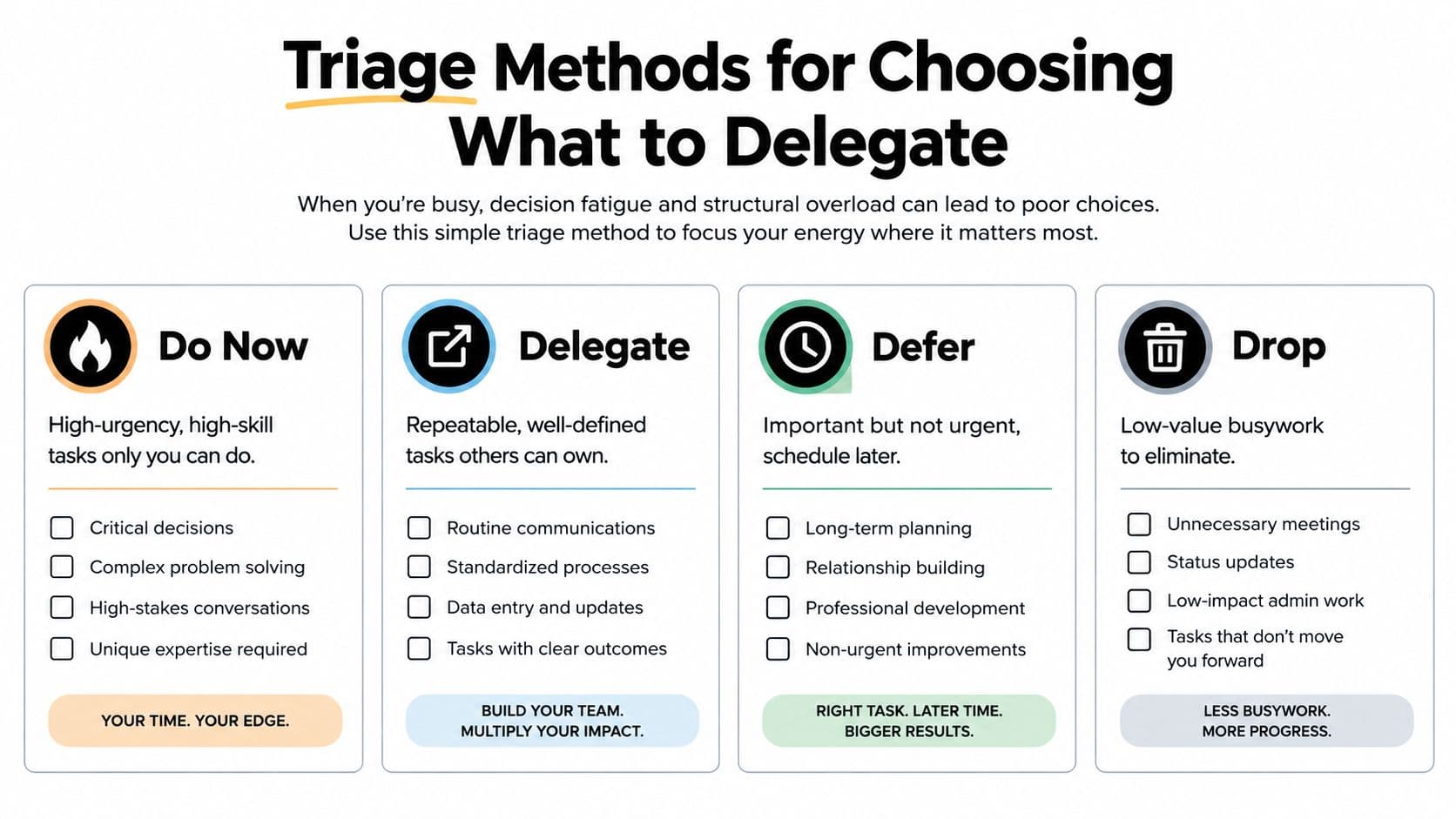
Sort by consequence and reversibility
Start by rating each task against four questions:
- What happens if this goes wrong? Identify customer, financial, legal, safety, or reputational consequences.
- How repeatable is the work? Repeated work is easier to document, train, and quality-check.
- How much context does the task require? A task that depends on years of tacit knowledge may need staged delegation rather than an immediate handoff.
- How reversible is the decision? A draft email is easy to revise. A public commitment, access change, or irreversible transaction may need approval.
Then place each item into one of four working groups:
- Do now: High-consequence or highly contextual work that only you can currently perform, with explicit checkpoints if another person contributes.
- Delegate: Repeatable, well-defined work where another person can control the necessary inputs and produce observable evidence of completion.
- Defer: Important work that isn't urgent and needs a scheduled decision rather than an anxious handoff.
- Drop: Activity with no meaningful outcome, no clear customer, or no reason to continue.
The “delegate” category should receive the next level of detail. Break the work into a defined outcome, a responsible owner, a deadline, and a quality threshold. If you're assessing administrative support, a resource such as medical virtual assistant tasks and costs can help distinguish repeatable support work from duties requiring professional judgment.
The trade-off is straightforward. Delegating too little preserves control but keeps the manager overloaded. Delegating too much without checkpoints may create hidden failure costs. Before assigning a task, compare its consequence and reversibility with the assignee's competence and available authority. A costs-versus-benefits framework can help make that decision explicit instead of leaving it to mood or urgency.
Designing a Bulletproof Delegation Brief
Most rework begins before the assignee touches the task. The manager describes an activity, the employee imagines an outcome, and both discover the mismatch at the deadline. A delegation brief prevents that gap by turning an informal request into an operating agreement.
A useful brief can be short, but it needs the right fields:
- Outcome: State the result, not just the activity. “Prepare a customer-ready comparison” is clearer than “research competitors.”
- Owner: Name one person accountable for completion. Contributors can be listed separately.
- Deadline: Include the delivery point and any intermediate milestone that matters.
- Authority: Specify which decisions the owner can make without approval.
- Resources: Provide access, source material, tools, budget, and relevant contacts.
- Constraints: Record legal, brand, technical, customer, or process boundaries.
- Quality threshold: Define what makes the output acceptable, such as factual accuracy, formatting, customer acceptance, or a required review.
- Escalation trigger: State the conditions that require attention, such as a missed dependency, a budget exception, a quality risk, or an unclear decision.
- Evidence of closure: Identify the file, link, confirmation, metric, or acceptance message that proves the task is complete.
Separate visibility from approval
A common mistake is treating status visibility and approval authority as the same thing. They aren't. The assignee should be able to execute within the agreed scope, while the delegator receives progress signals and intervenes only when a boundary is crossed.
That structure creates a control loop. The owner acts, the platform or workflow records progress, the delegator receives exception signals, and the final result is evaluated against an agreed standard. Routine work can use outcome-based checkpoints. High-impact work needs interim validation, especially when the person doing the work is still developing competence.
A study of 211 government employees found a positive, statistically significant effect of accountability on performance, while authority and responsibility alone didn't show significant effects. The implication is practical, not academic: completion must be observable and evaluable. The study on delegation, accountability, and performance supports using evidence such as accuracy, cycle time, defect count, customer acceptance, or completed subtasks.
A delegation brief should answer one question before work starts: What can the owner decide alone, and what evidence will convince us that the result is done?
If the answer requires the manager to inspect every step, the scope is either too broad, the owner lacks authority, or the quality standard hasn't been defined clearly enough.
Applying Governance Frameworks to Daily Work
Triage decides what should move. Governance decides who owns it, who performs it, who advises, and who needs visibility. Without that second layer, cross-functional work often produces a familiar pattern: several people contribute, several people approve, and nobody knows who can make the final call.
The RACI matrix remains useful because it separates four roles:
| Role | Function | Limit per Task |
|---|---|---|
| Responsible | Performs or coordinates the work | May be assigned to more than one contributor when execution genuinely requires it |
| Accountable | Owns the result and approves completion | One person only |
| Consulted | Provides expertise before or during the work | Include only people whose input can change the decision |
| Informed | Receives updates or the final result | Keep visibility purposeful, not automatic |
The Government of British Columbia defines the Accountable person as ultimately answerable for correct and complete delivery, including delegating the work and approving the Responsible party's output. Its RACI guidance enforces the one-owner rule. Work can be distributed across contributors, but final authority must remain unambiguous.
RACI versus lighter operating models
A full RACI matrix works well for a complex project, a regulated process, or a recurring handoff with many dependencies. It becomes wasteful when teams create a large matrix for every minor task and then stop updating it.
For fast-moving work, use the lightest structure that preserves ownership. A task can record one accountable owner, one or more responsible contributors, a short consultation list, and an informed audience. A decision log can replace a large project matrix when the main risk is unclear approval rather than complicated execution.
The key is to make governance visible where work happens. Store the owner, decision rights, deadline, and acceptance criteria with the task rather than in a separate document nobody checks. Teams that need a practical starting point can use this RACI matrix template, then remove roles that don't affect the decision.
Don't confuse collaboration with shared accountability. Several people can work together, but “the team” isn't an accountable owner. If a deliverable fails, the operating system should identify one person who must explain what happened, approve the correction, or escalate the issue.
Streamlining Workflows with Fluidwave
A delegation framework only works if people can use it without turning every handoff into a meeting. The practical test is simple: can a busy manager create a task with a clear owner, budget, deadline, and acceptance standard, then see progress without interrupting the person doing the work?
Fluidwave is one example of a task-management platform that combines automated task organization with access to human virtual assistants. A manager can create a task, assign it to a team member, or mark it for delegation to an assistant, then record the budget and deadline in the handoff. The workflow supports multiple views, including table, list, calendar, Kanban, and cards, so the same work can be inspected by due date, status, or assignee.

A handoff without the usual friction
Suppose an executive needs a recurring research task completed. The manager doesn't need to write a long message in one channel, follow up in another, and reconstruct the status later. The task can identify the expected output, the permitted budget, the delivery date, the quality threshold, and the escalation condition in one place.
The owner then executes within that boundary. The manager can group tasks by assignee, monitor the queue, and receive progress signals without taking over routine decisions. If a dependency slips or the output falls below the agreed standard, the issue becomes visible as an exception rather than appearing for the first time at the deadline.
That distinction lowers cognitive load. People who struggle with task initiation or working memory benefit from an externalized next action, a single owner, and a visible definition of done. Managers benefit because they can review outcomes instead of repeatedly reconstructing context.
Where the tool helps, and where it doesn't
Automation can prioritize tasks, organize views, and preserve the record of a handoff. A human assistant can perform work that requires judgment, research, communication, or careful completion. Neither feature replaces governance.
The delegator still has to choose an appropriate task, confirm that the assignee has the required competence and access, define the quality threshold, and retain approval for consequential outputs. A platform makes responsibility easier to observe. It doesn't make an ambiguous responsibility structure safe.
The strongest workflow is therefore hybrid. The system handles visibility and routine coordination, the assistant or teammate handles execution, and the accountable manager reviews evidence at the agreed control points.
Building a Sustainable Delegation Culture
Delegation fails when leaders treat it as a one-time act of courage. A manager assigns work, waits for the result, and concludes either that delegation works or that nobody can do the job properly. Sustainable teams use a different loop: triage, brief, execute, review, calibrate.
Start by auditing the current queue. Look for work that repeatedly returns to the same manager, tasks with unclear owners, approvals that add no meaningful control, and deliverables that lack a definition of done. Those are workflow defects, not just personal habits.
Then set a regular calibration rhythm. Review whether the assignee had enough authority, whether the brief contained too much or too little detail, whether the checkpoint arrived at the right time, and whether the quality threshold measured the outcome that actually mattered. If a task repeatedly escalates, either expand the owner's decision rights, improve training, narrow the scope, or retain the decision centrally.
Grow capability without creating dependency
Good delegation develops people, but development requires graduated control. A new owner may need closer checkpoints and examples. A capable owner may need only the outcome, boundaries, and escalation rules. An experienced project lead can coordinate contributors and make decisions within a broader scope, while the executive reviews strategic risks rather than daily activity.
The manager's job is to reduce support as competence grows. Permanent over-involvement turns an assistant or employee into an approval seeker. Permanent under-involvement leaves the person exposed to decisions they weren't equipped or authorized to make.
Team rituals can reinforce the same principles. For leaders planning an off-site or collaborative activity, these team building event planning tips are useful because the event itself also needs a clear owner, budget, decision rights, and acceptance standard. Culture improves when people experience delegation as a clear operating agreement, not as abandonment.
A practical rollout can begin with one recurring task. Assign one accountable owner, write the brief, record the escalation trigger, and review the result against evidence. After that, expand the pattern to other work. The aim isn't to remove managers from execution completely. It's to reserve their attention for decisions that genuinely require their judgment while giving others the authority to deliver.
Fluidwave combines task organization, automated prioritization, transparent progress tracking, and access to human virtual assistants for structured delegation. Visit Fluidwave to create a task with an owner, budget, timeline, and acceptance criteria, then turn delegation into a workflow your team can measure and improve.
Focus on What Matters.
Experience lightning-fast task management with AI-powered workflows. Our automation helps busy professionals save 4+ hours weekly.