Your 2026 guide to mental health at work: causes, prevention, manager training, neurodivergent support, & measuring real progress.
July 27, 2026 (2mo ago)
Mental Health at Work: Your 2026 Essential Guide
Your 2026 guide to mental health at work: causes, prevention, manager training, neurodivergent support, & measuring real progress.
← Back to blog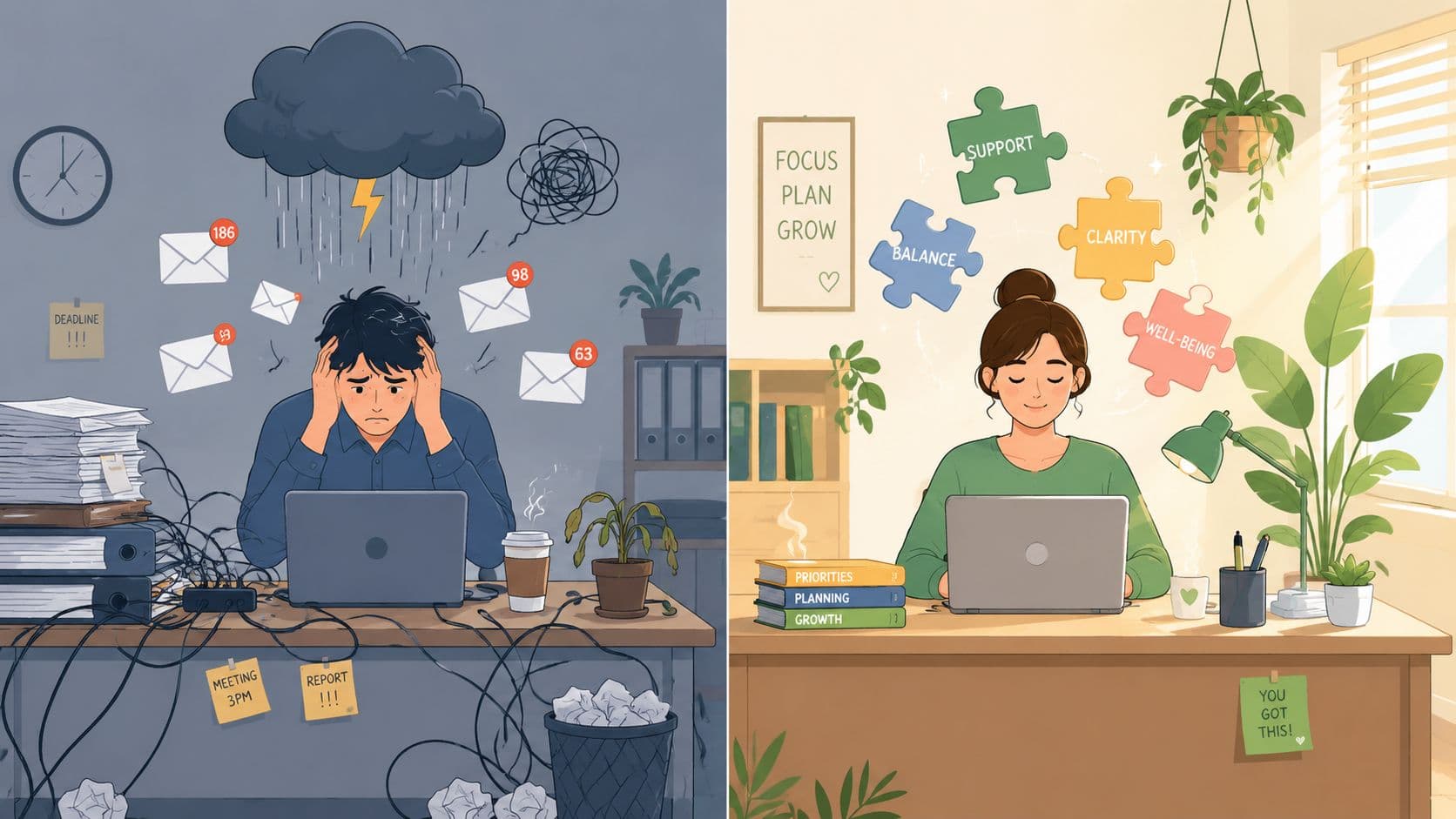
On a Monday morning, the signs are usually there before anyone says the word burnout. The inbox is full, the calendar is packed, one teammate is already three messages behind, and a manager is asking for a status update that should've been a ten-minute check-in but somehow turned into a thirty-minute scramble. That's what mental health at work looks like in real life, not as a slogan, but as the way work feels, the way it's paced, and the amount of strain people carry between meetings.
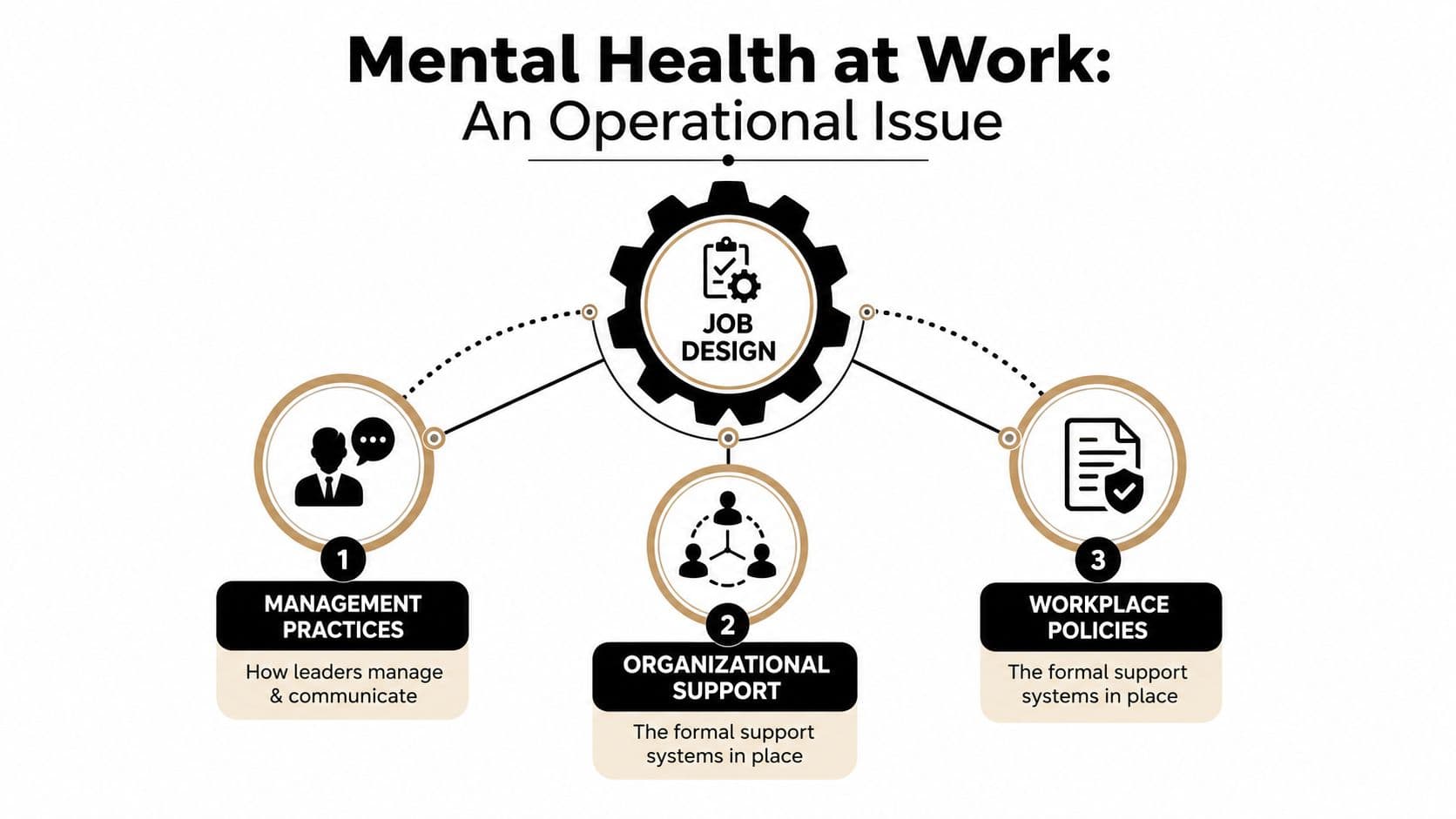
The useful way to think about it is operational. Mental health at work is shaped by job design, management behavior, workplace policies, and access to support, not just by whether someone is naturally resilient. If the system keeps producing overload, confusion, or constant urgency, the problem isn't a weak employee personality. It's a work system that keeps generating risk.
What Mental Health at Work Really Means
A lot of workplace talk turns mental health into a vague culture issue. That misses the point. In practical terms, mental health at work is the day-to-day experience of cognitive load, control, fairness, recovery, and support inside the workday, plus the structures around work that either reduce or increase strain.
Start with the work, not the personality
A senior contributor staring at an overflowing inbox on Monday isn't failing a mindset test. They may be dealing with too many shifting priorities, unclear ownership, or a manager who treats every request as urgent. That's why the World Health Organization says employers should assess psychosocial risks and then mitigate, modify, or remove workplace stressors, rather than relying on resilience training alone, and it specifically recommends manager training, worker mental-health literacy training, and integration with occupational safety and health systems (WHO mental health at work guidance).
That framing matters because it moves the conversation upstream. Psychosocial risks include things like high job demands, low control, poor communication, harassment, and weak support. Those aren't abstract HR terms. They're the everyday conditions that determine whether someone can think clearly at 2 p.m. or spend the afternoon in triage mode.
Practical rule: if the fix only helps after someone is already distressed, it's probably too late to be your main strategy.
A useful resource for support pathways
When people ask where to send an employee who needs a confidential place to start, it helps to point them toward services that are easy to understand and not wrapped in jargon. A simple example is XO mental health services, which can be part of a broader support ecosystem when an organization wants to make help easier to find without turning the workplace into a clinic.
The core distinction is this. Individual coping is what a person does to get through a hard day. Organizational responsibility is what the company changes so fewer hard days turn into chronic strain. Once you see the difference, the rest of the conversation gets clearer. You stop asking, “How do we toughen people up?” and start asking, “Which parts of this job are creating avoidable harm?”
Common Causes and Early Warning Signs
The most common causes are often hiding in plain sight. Heavy workload is one, but so is low control over priorities, poor communication, unclear expectations, and manager behavior that makes every task feel politically risky. A workplace does not have to be openly toxic to drain people. It only has to be consistently unpredictable.
The cause is often the system, not the event
When a team is overloaded, the first sign is not always absenteeism. It is often presenteeism, where people show up but their concentration, pace, or reliability slips. That is the quiet middle zone between “fine” and “out.” The UK evidence in the provided review links poor mental health with lost productivity through both absenteeism and presenteeism, which is why managers should watch for changes in functioning, not just sick days (systematic review on productivity loss).
The early warning signs are usually behavioral. A colleague misses small deadlines they would normally hit, becomes shorter in meetings, stops contributing ideas, or starts asking for the same information twice. None of those prove a mental health condition. They do suggest strain that deserves attention.
A simple mental checklist helps:
- Workload shifts: Is the person carrying more than their peers, or more than their role can reasonably absorb?
- Control issues: Can they prioritize, or are they reacting to a constant stream of other people's urgency?
- Communication problems: Are instructions changing after work has already started?
- Safety signals: Do people feel comfortable saying they are behind before they are buried?
Stress becomes a loop when performance slips
Mental distress reduces concentration, pace, and reliability. Then work takes longer, mistakes increase, and the person feels more pressure. That creates a second layer of strain. You can see why this becomes self-reinforcing. Reduced performance raises stress, and stress further reduces performance. The issue is less about willpower and more about capacity under pressure.
For leaders, the important question is whether the system around someone makes recovery hard. A person who dreads Sunday night, avoids Slack after hours, or starts withdrawing from team conversation may be telling you that the work design has become too expensive for their energy budget. Those are not character flaws. They are operational clues.
The Business Case and Human Cost
Mental health at work has a hard-number problem, but the number doesn't show up where leaders first expect it. Globally, mental health conditions and related productivity loss affect about 1 in 6 people, or 14.7%, and are associated with about 12 billion lost working days each year, which is roughly 50 million years of work lost annually. The broader economic burden is about $1 trillion every year (global workplace mental health statistics).
Where the money actually goes
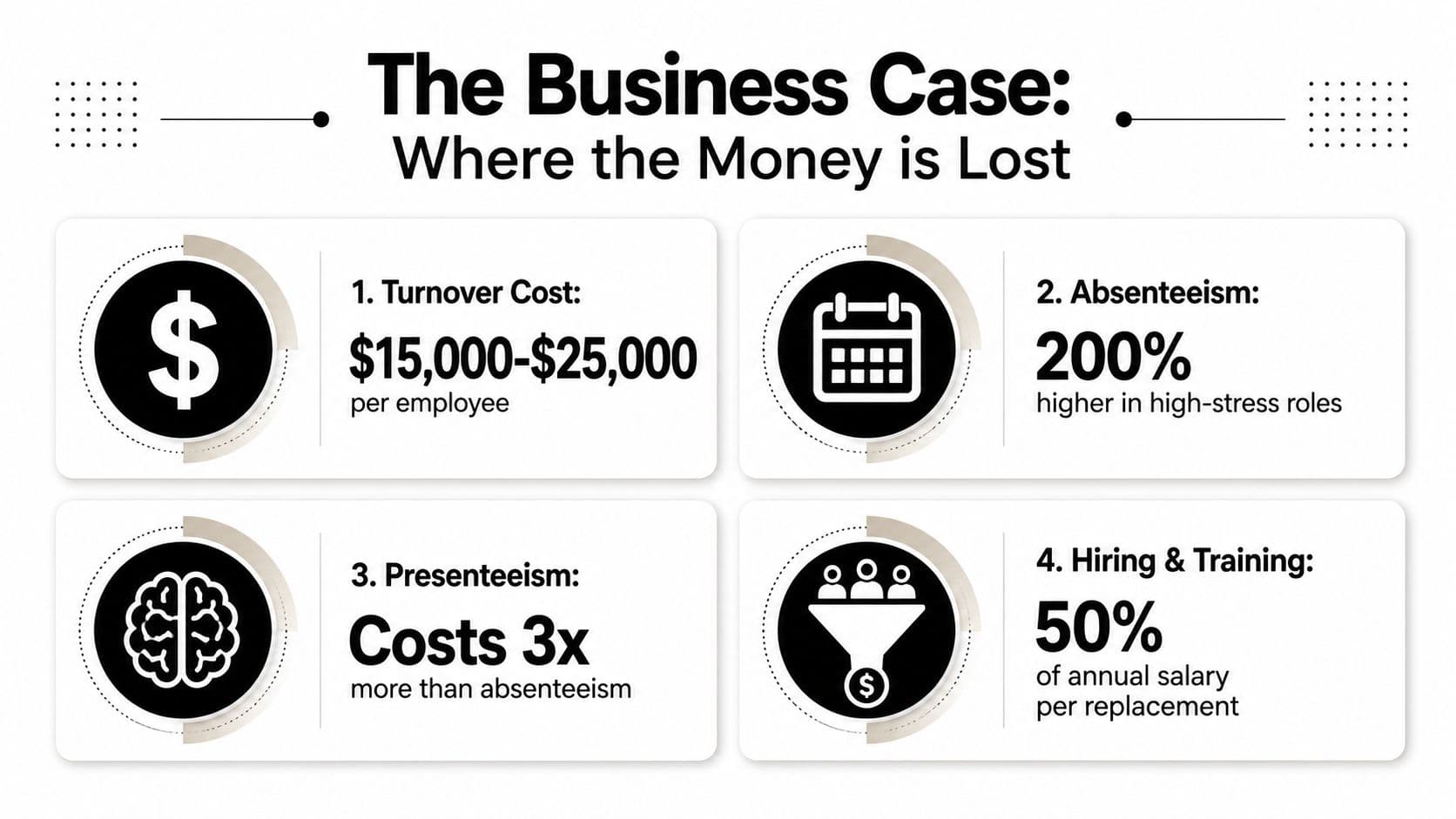
Absenteeism is visible. Presenteeism is harder to spot, and usually more expensive in practice because people are physically present while functioning below capacity. That's why finance teams often miss the early damage. The work still gets logged, meetings still happen, and the loss gets spread across rework, delay, and poor decisions.
The UK data in the provided review makes that hidden cost concrete. In 2022/23, work-related stress, depression, or anxiety affected an estimated 875,000 workers and caused 17.1 million working days lost, while poor mental wellbeing was estimated to cost employers £42 billion to £45 billion annually through presenteeism, sickness absence, and turnover (UK review in PubMed Central). The same review notes an average return of about £5 for every £1 invested in workplace mental-health interventions, which is one reason smart employers treat this as a cost-management issue, not just a benefits line item.
Key takeaway: the first business loss is often not a resignation, it's slower, less reliable work that quietly expands across the team.
The human cost shows up in judgment
The human side matters because a productivity story without people becomes empty. Chronic stress changes how people decide, how creative they feel, and how willing they are to take smart risks. Career trajectories narrow when people spend all their energy staying afloat.
That's why leaders should resist the temptation to talk only in cost language. Cost matters, but so does dignity, trust, and the ability to do solid work without dreading every request. When mental health support is weak, people don't just suffer privately. They lose momentum, confidence, and often the willingness to stay.
Prevention Strategies That Work
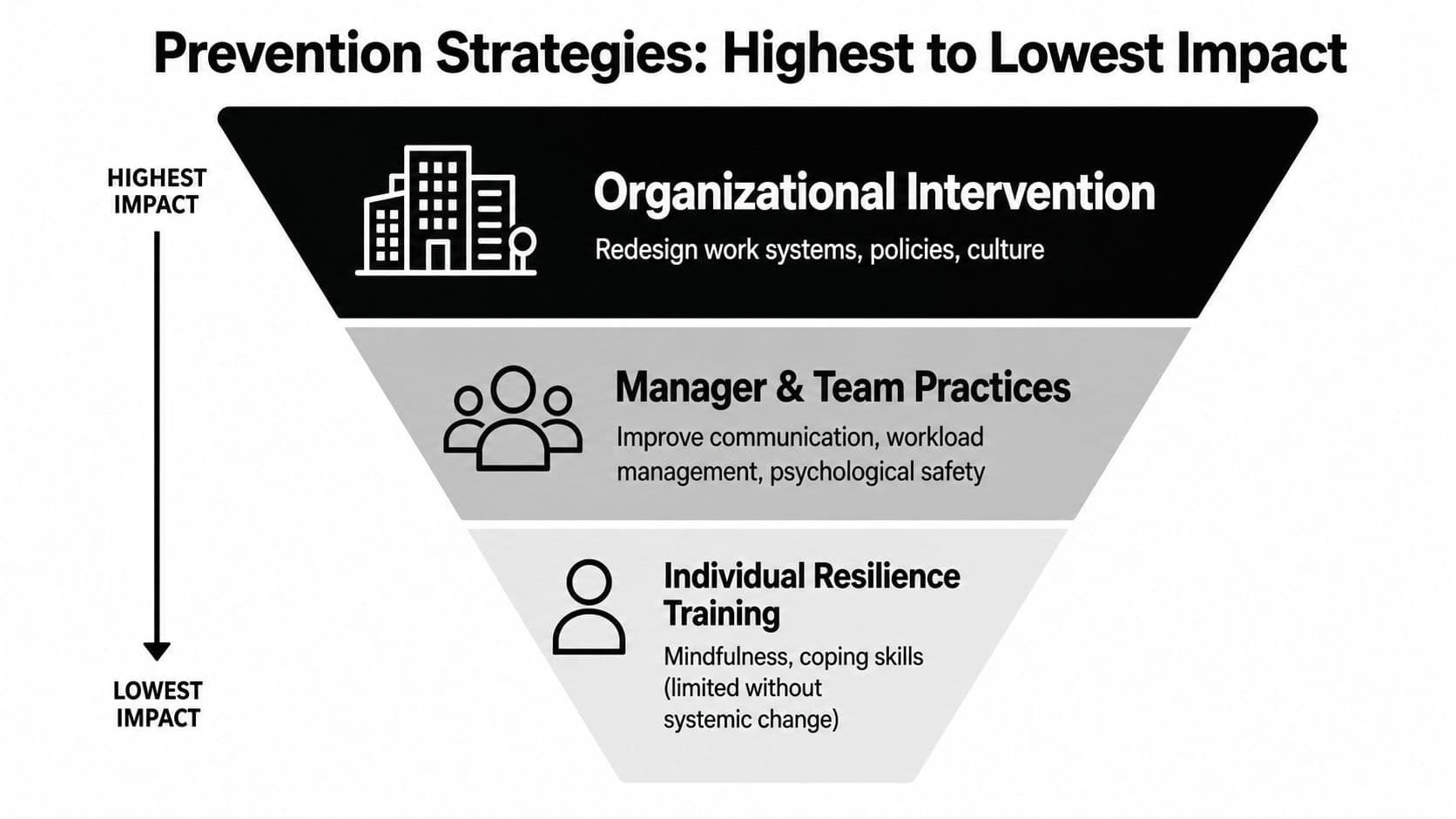
A well-run prevention plan starts with the work itself. The WHO's guidance points employers toward organizational intervention, which means assessing psychosocial risks and then reducing, changing, or removing the stressors that create them, while also paying attention to manager training, mental-health literacy, worker participation, and occupational safety systems (WHO mental health at work guidance). That matters because it changes exposure at the source, instead of asking people to cope harder with the same pressure.
Use the five essentials as an operating model
The APA's 2023 five essentials help break a broad topic into parts leaders can manage: protection from harm, connection and community, work-life harmony, mattering at work, and opportunity for growth (APA Work in America 2023). In practice, each one points to a different part of the system.
- Protection from harm: managers deal with harassment, bullying, and chronic overload early, before they become part of the normal routine.
- Connection and community: teams use predictable check-ins and clear support, instead of relying on performative “we're a family” language.
- Work-life harmony: schedules allow real recovery, and people have some control over how their work gets done.
- Mattering at work: workers understand why their role matters and how it connects to the outcome.
- Opportunity for growth: jobs stretch people without constantly pushing them past what they can sustain.
These are not slogans for a wall. They show up in meeting cadence, onboarding, feedback loops, and the way promotion decisions are made. A company can say it values wellbeing, but the schedule, the workload, and the manager's behavior reveal whether that claim is real.
Don't turn support into surveillance
A common mistake is to treat early detection as the main solution. A peer-reviewed review in PubMed Central says the WHO does not recommend routine screening for mental illness in the workplace because the evidence on benefits or harms is not sufficient (review on workplace screening and support). That is a useful boundary. It keeps employers from drifting into a model where support feels like monitoring.
The better move is to build universal supports that reduce stigma and make help easier to reach. Open conversations with managers or designated mental health champions can help, as can confidential check-ins for people who are at higher risk, flexible adjustments where appropriate, and worker participation in how programs are designed. If you want a practical starting point on the stressors that deserve redesign, employee burnout causes is a useful place to examine what is driving strain in the first place. For a closer look at how employers can structure prevention without relying on app-based fixes, see burnout prevention strategies.
Awareness helps people name the problem. System changes reduce the risk. If the work stays chaotic, no morale campaign will carry that load.
Workflow and Task Design Adjustments
Most strain shows up in the task list before it shows up in an HR dashboard. People don't burn out because of one bad afternoon. They burn out because their workday keeps forcing context switching, unclear priorities, and constant interruption. That's why workflow design is part of mental health at work, not a separate productivity topic.
Reduce cognitive load where the work actually happens
Start by changing how work enters the system. If everything arrives as urgent, nothing is prioritized. Use chunking to break large tasks into smaller actions, batching to group similar work, and async communication for updates that don't need live discussion. That lowers mental switching costs and gives people a better chance of finishing what they start.
A practical rule for managers is to protect focus blocks and discourage meeting creep. If someone has three deep-work windows on their calendar, don't treat them like empty slots waiting to be filled. The goal is not to make the day slower. It's to make the day less fragmented.
If every request arrives by a different channel, the work system is already leaking attention.
Delegate to protect energy, not just to move tasks
Delegation often fails because leaders offload without clarifying scope. A junior employee ends up holding too many loose ends, then spends half the week asking for context. Better delegation is specific. Name the outcome, the deadline, the dependencies, and where the person can make decisions without asking permission for every step.
Task tools can help if they surface priority instead of hiding it. A platform like Fluidwave's task management approach fits that principle when it helps people see what matters next across list, calendar, and Kanban views, rather than forcing them to triage from scratch every morning. The important design test is whether the tool reduces confusion or just creates another place to store it.
Meeting design matters too. Keep agendas short, send pre-reads in advance, and end with explicit owners. The best mental health move is often the least glamorous one, a cleaner workflow with fewer open loops. That's what lets people leave work without dragging the whole day home.
Accommodations for Neurodivergent and ADHD Workers
Neurodivergent and ADHD workers often aren't lacking effort. They're working inside environments designed for a narrower cognitive style. The smartest accommodations are usually the ones that look like good management for everyone, which is why they're so often underused.
Make the work more predictable
Predictability helps more than people think. Written instructions beat verbal instructions when a task has multiple steps. Clear deadlines beat “as soon as you can.” Async options help people respond when they're ready to think, not when a meeting invite appears.
For many workers, the biggest relief comes from reducing context switching. Keep recurring tasks in the same place, use visual progress signals, and break large projects into the smallest meaningful first step. If a task feels too large to start, the core problem may be that the first action wasn't made visible enough.
Accommodations should feel normal, not exceptional
The worst failure mode is making accommodations feel like special treatment. The second worst is burying them in paperwork and hoping the employee will keep pushing. Managers can avoid both by treating adjustments as part of role design, not as a favor.
Examples of low-friction changes include:
- Predictable routines: regular check-ins at the same time each week.
- Written follow-up: short summaries after important conversations.
- Reduced distraction: quiet space, headphones, or fewer open-office interruptions when possible.
- Flexible timing: letting people work at their best times when the role allows it.
The internal guide on time blindness strategies is a useful complement here because time perception is often a hidden part of missed deadlines and last-minute stress. The larger point is that support should lower friction. When the work becomes easier to manage, talent stops leaking through the cracks.
Measuring Success Without Creating Surveillance
Mental health metrics can either help or harm. If you measure the wrong thing, people start performing wellness instead of receiving support. The goal is to track risk reduction, not to build a mood-monitoring machine.
Track exposure, not private feelings
A good measurement system combines lagging indicators and leading indicators. Lagging indicators tell you what already happened. Leading indicators tell you where the risk is building. The mistake is overrelying on HR outcomes after the damage is already visible.
| Metric Type | Examples | What It Tells You | Risk of Misuse |
|---|---|---|---|
| Lagging indicators | absenteeism, turnover, leave patterns | whether strain has already affected staffing and retention | can make leaders reactive if used alone |
| Leading indicators | workload distribution, after-hours message volume, psychological-safety scores, manager-behavior ratings | where risk is building before people drop out | can feel invasive if tied to individual punishment |
The review on workplace productivity loss is useful here because it shows why self-reported functioning matters alongside absence data, especially when presenteeism can outpace sick leave as a cost driver (review on absenteeism and presenteeism). That means a fair measurement system should ask whether people can do their work well, not just whether they're still logged in.
Keep the survey short and anonymous
Pulse surveys work best when people trust the process. Keep them short, explain what will be done with the results, and report back on changes. If employees never see action, response quality drops fast. Don't track individual mood scores or screen time. Those are surveillance signals, not workplace health signals.
For a practical measurement framework, the internal guide on how to measure employee productivity is a good reminder that productivity needs context. In mental health work, context is everything. A balanced scorecard is more defensible than any single number because it shows whether the organization is reducing strain without making people feel watched.
Practical Next Steps for Individuals, Teams, and Leaders
The best next move depends on your role, but it doesn't need to be complicated. One person can start by changing their calendar. A team lead can change the way check-ins work. A leader can change the policies that keep the same stressors coming back.
Small changes that are worth making this week
For individuals, start with focus blocks, a quick audit of stress triggers, and clearer boundaries around after-hours communication. If your day is constantly breaking apart, don't assume you need more motivation. You may need fewer interruptions and a more honest view of what's draining you.
For team leads, set a steady one-on-one rhythm, review workload distribution, and normalize plain-language mental health conversations. Don't wait for a crisis to ask how the work is landing. The middle of a project is usually where strain first shows up.
For leaders, begin with a psychosocial risk review, manager training, and confidential access pathways that employees can use. Then track a small set of leading indicators quarterly. Don't add another app just because it feels active. Reduce predictable stressors first.
Sustainable work habits are a management decision before they're a personal virtue.
The key test is simple. If you made one change on Monday, would Tuesday feel any different? If the answer is yes, you're working on the right level of the problem.
Fluidwave helps busy professionals turn overloaded task lists into clear, prioritized work, which matters when stress is being driven by confusion and constant switching. If you want a more organized way to protect focus, delegate cleanly, and keep work from turning into triage, visit Fluidwave and see how it can support a calmer, more workable week.
Focus on What Matters.
Experience lightning-fast task management with AI-powered workflows. Our automation helps busy professionals save 4+ hours weekly.