Learn how to measure employee productivity with a modern framework that values outcomes over hours, driving performance, engagement, and sustainable growth.
December 20, 2025 (9mo ago)
How to Measure Employee Productivity Without Micromanaging
Learn how to measure employee productivity with a modern framework that values outcomes over hours, driving performance, engagement, and sustainable growth.
← Back to blog
How to Measure Employee Productivity Without Micromanaging
Learn how to measure employee productivity with a modern framework that values outcomes over hours, driving performance, engagement, and sustainable growth.
Learn how to measure employee productivity with a modern framework that values outcomes over hours, driving performance, engagement, and sustainable growth.
Figuring out if your employees are productive means you have to stop counting the hours and start measuring the results. The best way to do it is straightforward: define what success looks like, pick metrics that actually show that success—like the quality of work or hitting project milestones—and then track progress against those benchmarks. It’s about shifting the conversation from “busyness” to “business impact.”
Why Old Productivity Measures No Longer Work
Let’s be honest: the old way of thinking about productivity is broken. For decades, the model was simple—presence equaled performance. That might have worked on a factory floor where output tied directly to time, but it’s an outdated model for today’s knowledge work.
The gap between being “busy” and being genuinely productive is a massive blind spot for many companies. We’ve all seen the coworker who’s constantly online, firing off emails at all hours, yet their actual contribution to the team’s goals is unclear. That’s the classic trap of mistaking activity for achievement.
The Problem with Counting Hours
The explosion of remote and hybrid work finally shattered the illusion that clocked hours mean anything. When your team isn’t physically in front of you, you have to judge work on what it delivers, not how long people appear to be working. It’s a shift from presence to performance that was long overdue.
Studies consistently find that the average office worker is truly productive for only about 2 hours and 53 minutes to 4 hours and 12 minutes per day1. The difference in those numbers often comes down to how it’s measured—passive computer tracking versus self-reporting—but the conclusion is the same: assuming a full day of pay equals a full day of output is misleading.
“The biggest mistake in traditional productivity measurement is confusing inputs (time spent) with outputs (value created). An engineer who solves a complex bug in one focused hour is far more productive than one who spends a week on it and gets nowhere.”
Shifting Focus to What Really Matters
This isn’t just a remote-work issue; it’s about the nature of modern work. For roles like software development, marketing, or design, value isn’t created linearly. One brilliant burst of creativity can produce more value than 40 hours of distracted, shallow work. To measure productivity today, you first have to understand what creates value for each role.
Acknowledging that “time-on-task” is a flawed metric is the first step. From there, build a system that measures what actually moves the needle for your business. That creates a fairer, more accurate way to understand contributions and build a culture that values real achievement.
Time-Based vs. Outcome-Based Productivity Metrics
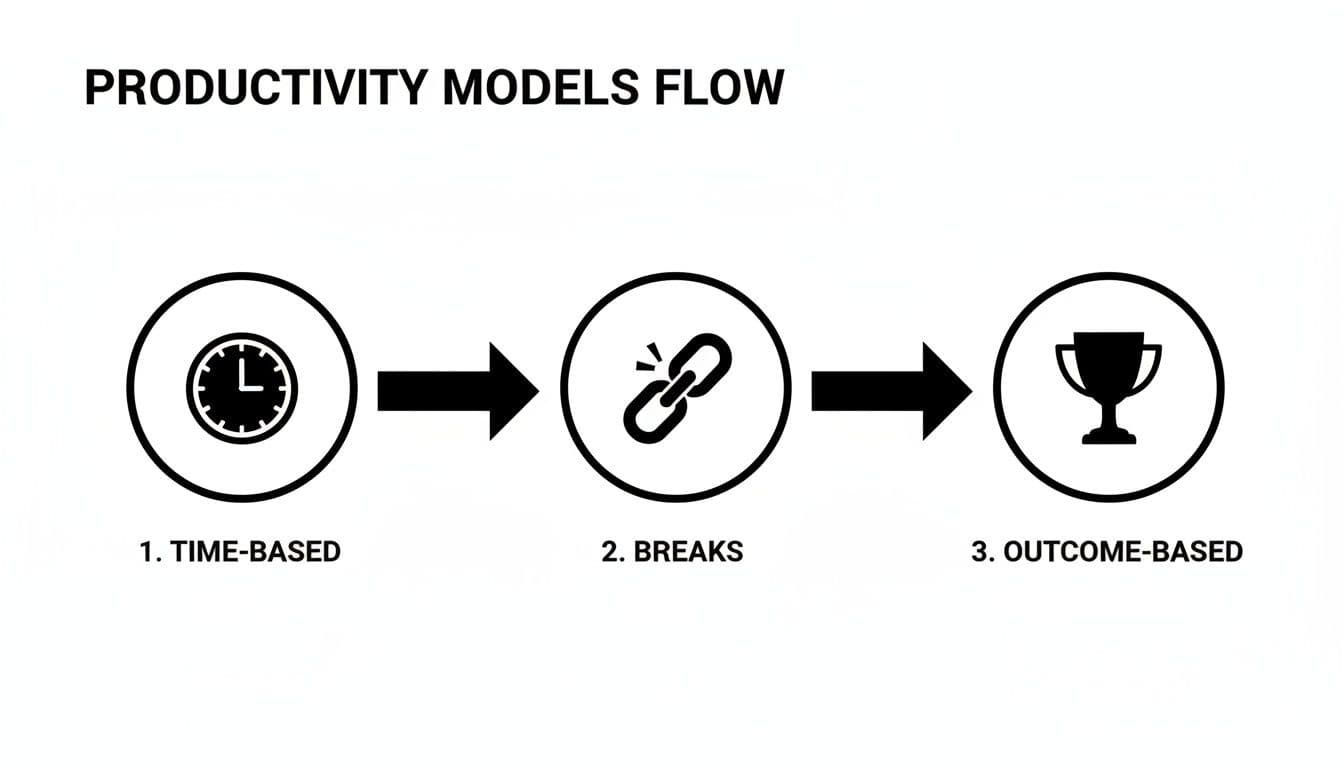
To make this shift real, it helps to see the two approaches side-by-side. Traditional metrics ask “how long,” while modern, effective metrics ask “how well.”
| Metric Type | Example | What It Measures | Potential Pitfall |
|---|---|---|---|
| Time-Based | Hours worked per week | Presence and availability | Rewards inefficient work; doesn’t correlate with value. |
| Time-Based | Time to first response (support) | Speed of initial engagement | Can incentivize quick, low-quality replies. |
| Outcome-Based | Customer satisfaction score (CSAT) | Quality and effectiveness of a solution | Can be influenced by factors outside the employee’s control. |
| Outcome-Based | Features shipped per quarter (dev) | Tangible delivery of value to users | Can encourage rushing and technical debt without quality checks. |
| Outcome-Based | Sales revenue generated | Direct contribution to business goals | May ignore collaborative or enabling roles. |
Choosing the right metric isn’t about ditching one approach entirely. It’s about creating a balanced view. While an outcome metric like CSAT is the ultimate goal, a time-based metric like average resolution time can still offer useful signals. The key is ensuring main success measures tie to real results, not just the clock.
Building a Modern Productivity Measurement Framework
Moving past old-school tracking requires a thoughtful plan. Building a modern framework isn’t about tossing a few metrics onto a dashboard. It’s about being crystal clear on what success looks like for each role and finding the right data to tell that story.
Start with a simple but powerful question: What does “productive” actually mean for us? The answer for a salesperson closing deals is different from a developer squashing bugs. A sales rep’s productivity may be revenue or sales cycle length. For a developer, it’s more about deployment frequency, bug resolution, or cycle time.
Define Productivity for Each Role
Before you measure anything, define the outcome you want. This means sitting down with team leads—and the employees themselves—to map out what a productive day, week, or quarter looks like. That conversation is the bedrock of your system.
Without clarity, you’ll measure activity, not achievement. For example, tracking the number of emails a marketing manager sends is a vanity metric; it tells you nothing about impact. A better measure is the number of qualified leads generated or the conversion rate of a landing page they built.
“The goal is to shift the conversation from, ‘What did you do?’ to ‘What impact did your work have?’” Your framework must be built on that idea.
Select a Balanced Mix of Metrics
Once you’ve defined productivity for each role, pick metrics that paint a full picture. Relying on a single data point is risky because it can be gamed. Instead, use a balanced scorecard approach across three metric types:
- Output Metrics: Direct quantity measures—articles written, tickets closed, features delivered.
- Outcome Metrics: Quality and impact—CSAT, revenue growth, churn reduction.
- Efficiency Metrics: Resources used—cost per acquisition, time to resolution, revenue per employee.
For broader insights, connecting these measures to HR analytics can reveal organizational trends and signal where to invest in training or process change.
Establish Baselines and Set Realistic Goals
You can’t know if you’re improving without a baseline. Let teams work for a few weeks or a month to establish starting points for each metric.
Initial data gives you a realistic launchpad. For example, if your support team’s average first response time is 45 minutes, set an achievable goal—like 35 minutes—rather than an arbitrary target.
Look at macro benchmarks too. The OECD reported average labor productivity across member countries near USD 70 per hour in 2023, which can serve as a high-level anchor when translating broad goals into role-level targets2.
This data-first approach keeps your system fair, informed, and aligned with business needs.
Choosing the Right Metrics for Different Teams
The biggest mistake is applying the same yardstick to every person. A one-size-fits-all approach produces skewed data and frustrated employees. The metrics that define success for sales are different from those for engineering or support.
To get this right, tailor measures to each department’s contribution.
| Department | Quantitative Metric | Qualitative Metric | Efficiency Metric |
|---|---|---|---|
| Sales | Revenue per rep | Customer lifetime value (CLV) | Sales cycle length |
| Customer Support | First-contact resolution (FCR) | Customer satisfaction (CSAT) | Average resolution time |
| Engineering | Deployment frequency | Change failure rate | Cycle time |
| Marketing | MQLs generated | Brand sentiment | Cost per lead (CPL) |
| HR | Time to fill | Employee Net Promoter Score (eNPS) | Cost per hire |
Metrics for Sales Teams
Sales productivity often ties directly to the bottom line, but closed deals alone can hide pipeline issues. Track a mix of KPIs:
- Revenue per sales rep
- Sales cycle length
- Lead conversion rate
- Customer lifetime value (CLV)
These reveal who’s delivering results and who might need coaching.
Metrics for Customer Support Teams
Support must balance speed with quality. Track both quantitative and qualitative measures:
- First response time (FRT)
- Average resolution time
- Customer satisfaction score (CSAT)
- First-contact resolution (FCR)
The best teams don’t just close tickets; they create satisfied customers.
Metrics for Engineering and Development Teams
Measuring engineering productivity is tricky. Metrics like lines of code are misleading. Focus on delivery, quality, and reliability:
- Cycle time: work start to production
- Deployment frequency: how often the team ships
- Change failure rate: percentage of deployments causing failures
- Mean time to recovery (MTTR): how quickly incidents are fixed
These are the DORA metrics, which help measure team performance based on outcomes and system health rather than feelings of busyness4.
The Human Side of Measuring Productivity
Dashboards and data only tell part of the story. If you focus only on numbers, you risk creating a surveillance culture where people feel like cogs. The best frameworks put people first.
Data should never be a weapon for micromanagement. Its real power is starting meaningful conversations. When a metric dips, the first question shouldn’t be about blame. It should be, “What’s going on, and how can I help?”
That shift turns productivity data into a diagnostic tool for coaching and support.
Empowering Your Team with Data
How you share productivity data matters. Public leaderboards often breed resentment. A smarter approach is personalized, private dashboards where individuals can track their progress against goals.
When people see their own data, they can spot patterns, make adjustments, and take ownership. Transparency should empower, not punish.
“When employees see data as a tool for growth rather than a stick to be beaten with, they become active partners in boosting productivity.”
The Link Between Engagement and Output
You can’t separate productivity from engagement. Disengaged employees can follow processes yet deliver minimal value. Engaged employees look for smarter ways to reach goals.
Disengagement has a real economic cost. Only about 21% of employees worldwide are actively engaged at work, and engaged teams can show roughly 14% higher productivity and much lower absenteeism3.
Adding an engagement metric, like eNPS, gives you the “why” behind your quantitative data.
Navigating the Ethical Considerations
Measurement tools come with responsibility. If your team suspects secret monitoring, you’ll lose trust.
- Be open about the why: explain the goal is to improve processes and support people, not to catch them out.
- Involve your team: get input on chosen metrics to ensure fairness and relevance.
- Focus on trends, not moments: review performance over weeks or months to avoid knee‑jerk reactions.
Trust is non-negotiable for any productivity initiative to work.
Weaving Your Tools Together for Effortless Tracking
You’ve designed your framework and picked your metrics. Now collect the data without creating manual work. A measurement system that adds overhead will fail.
Integrate the tools your team already uses—project management, CRM, communication apps—into a central dashboard. Automate data flows so measurement runs quietly in the background and respects people’s time.
Finding the Right Tech Stack
Choose software that integrates easily, respects privacy, and fits your framework.
- Plays well with others: strong APIs or native integrations with Asana, Jira, Salesforce, Slack, and your CRM.
- Keeps things private and transparent: prioritize business outputs, not invasive surveillance.
- Fits your framework: customizable dashboards for role-specific KPIs.
This connected view lets managers see project health at a glance without interrupting the team.

Putting Data Collection on Autopilot
Automation is where the real value appears. Integrate your VoIP with your CRM to avoid manual call logging. Pull deployment data from your pipeline rather than asking developers to self-report.
Blending data from different sources gives you richer insights—for example, linking CRM and support platforms to see the full customer journey. Modern platforms with AI can spot bottlenecks and suggest improvements, freeing managers to coach and remove blockers.
“The ultimate goal of a tech-enabled productivity system is to make measurement invisible. It should run quietly in the background, providing insights without disrupting work.”
Connecting the Dots in Daily Workflow
Introduce tools that fit existing habits to reduce friction. For example, a task manager that integrates with Slack lets team members update statuses without leaving the app they use daily.
A marketing workflow might look like this:
- A campaign is built in a project tool with tasks and owners.
- The team shares assets and progress in their messaging app.
- The project tool tracks task completion and cycle times automatically.
- The marketing platform feeds lead and conversion data into a central dashboard.
- The manager sees both project progress and campaign results on one screen.
A connected ecosystem delivers low-effort insights to guide the team.
Common Questions About Measuring Productivity
Getting ahead of common concerns shows you’ve considered the human element.
How do you measure productivity for creative or knowledge-based roles?
Shift from counting completed tasks to measuring impact. For designers, track conversion lift from a new page or feedback from user testing. For developers, use cycle time and change failure rate to measure delivery and quality. For strategists, measure adoption rate of a new process or on-time project launches.
The trick is linking work to tangible business outcomes.
Won’t employees feel like they’re being spied on?
Transparency and purpose matter. Position measurement as insight, not oversight. Be upfront about what you measure and why, and involve teams in choosing metrics. When people see data as a tool to help them win, fear fades.
What if an employee’s numbers are low?
Treat dips as signals, not judgments. Use data to start a supportive conversation: are they struggling with tools, overloaded, or burned out? This approach turns a negative moment into an opportunity for coaching and support.
Ready to move from theory to action without micromanagement? Fluidwave provides tools to track progress, delegate tasks seamlessly, and give your team the clarity they need to perform at their best. Start managing your team’s productivity the smart way.
Quick Q&A — Practical Takeaways
Q: What’s the single most important change to measure productivity fairly?
A: Move from time-based inputs to outcome-based measures that reflect impact for each role.
Q: How do I avoid creating a surveillance culture?
A: Be transparent, involve your team in metric selection, and use data for coaching—not punishment.
Q: What should I automate first?
A: Start with integrations that remove manual reporting—CRM, deployment pipelines, and project tools feeding a central dashboard.
1.
RescueTime: “The State of Focus” and related productivity reports; see https://www.rescuetime.com for research on average focused work time.
2.
OECD: labour productivity statistics and analysis (2023); see https://www.oecd.org for national and industry comparisons.
3.
Gallup: State of the Global Workplace and employee engagement research; see https://www.gallup.com for engagement and productivity correlations.
4.
DORA metrics overview and research on software delivery performance; see Google Cloud’s DevOps/Accelerate resources at https://cloud.google.com/devops.
Focus on What Matters.
Experience lightning-fast task management with AI-powered workflows. Our automation helps busy professionals save 4+ hours weekly.