Learn practical strategies for managing continuous improvement programs, from frameworks and KPIs to culture and automation that actually sticks.
August 13, 2026 (1mo ago)
Managing Continuous Improvement a Practical Playbook
Learn practical strategies for managing continuous improvement programs, from frameworks and KPIs to culture and automation that actually sticks.
← Back to blog
The first sign usually isn't a crash. It's a meeting that used to feel sharp and now feels ceremonial, a spreadsheet full of ideas nobody owns, and a leadership team asking whether the improvement program is still doing anything. The work is happening, but the system around the work is fading. That's the point where managing continuous improvement stops being about enthusiasm and starts being about operating mechanics.
Most CI programs don't die in a dramatic way. They drift. A team launches with energy, captures a long list of opportunities, and then the same few people keep showing up to report status while the actual changes stall in inboxes, shared drives, and half-finished action items. If that sounds familiar, a good companion read is Your Success Shift guide to getting unstuck, because the pattern is the same in process work and in business performance, motion without traction.
The right lens is simple. Treat CI as an operating system with inputs, decisions, throughput, and standardization, not as a toolbox of events and templates. If the system can't route ideas, assign owners, prove impact, and lock in the change, the program looks busy while the business stays flat. A strong starting point is to work from a root-cause method rather than a vague “let's improve things” conversation, and this root cause analysis template is a practical place to begin.
When Continuous Improvement Quietly Stalls
The easiest trap in managing continuous improvement is confusing activity with progress. A team runs a strong kickoff, gets a wall of ideas, and for a few weeks everyone feels momentum. Then the ideas start piling up faster than decisions, the same problems keep resurfacing, and monthly reviews turn into polite narration.
The failure mode looks productive
The team still holds meetings. People still update slides. Someone still says the program is “in flight.” But the work has shifted from solving problems to describing them. That's usually when the bottleneck shows up, because CI isn't short on ideas, it's short on execution discipline.
I've seen this happen when leaders treat CI like a campaign instead of a management system. Campaigns need launch energy. Systems need ownership, cadence, and standards. If the intake channel is wide open but the follow-through is weak, the program becomes a suggestion box with nicer branding.
That's why the question isn't whether people care. They do. The question is whether the organization has built a path from idea to standard work. If not, the loudest signal in the room becomes false confidence.
The test that exposes the problem
A healthy CI program leaves artifacts that move. An idea gets captured, reviewed, assigned, tested, adopted, and measured. A stalled program leaves artifacts that accumulate.
Watch for three signs. First, ideas sit in spreadsheets with no owner. Second, the same status updates repeat with different dates. Third, leaders can't answer whether the program is improving flow, quality, cost, or customer experience. When those signals show up together, the issue isn't motivation. It's the operating model.
The deeper point is that CI should behave like a supply chain for improvement. Inputs come in, work gets triaged, changes are made, and results are standardized. If any link breaks, the whole chain weakens. That's why the program needs a tighter design than many organizations provide.
Practical rule: if an improvement can't move from idea to decision to standard work without someone chasing it manually, the system is too fragile.
The rest of the work is about fixing that fragility. Start by choosing a framework that fits the cadence of the team, not the one that looks best in a slide deck. Then build governance that can make decisions. After that, measure what predicts progress, not just what makes the dashboard look active. The point is to make improvement repeatable, not inspirational.
Choosing the Right Framework and Scope
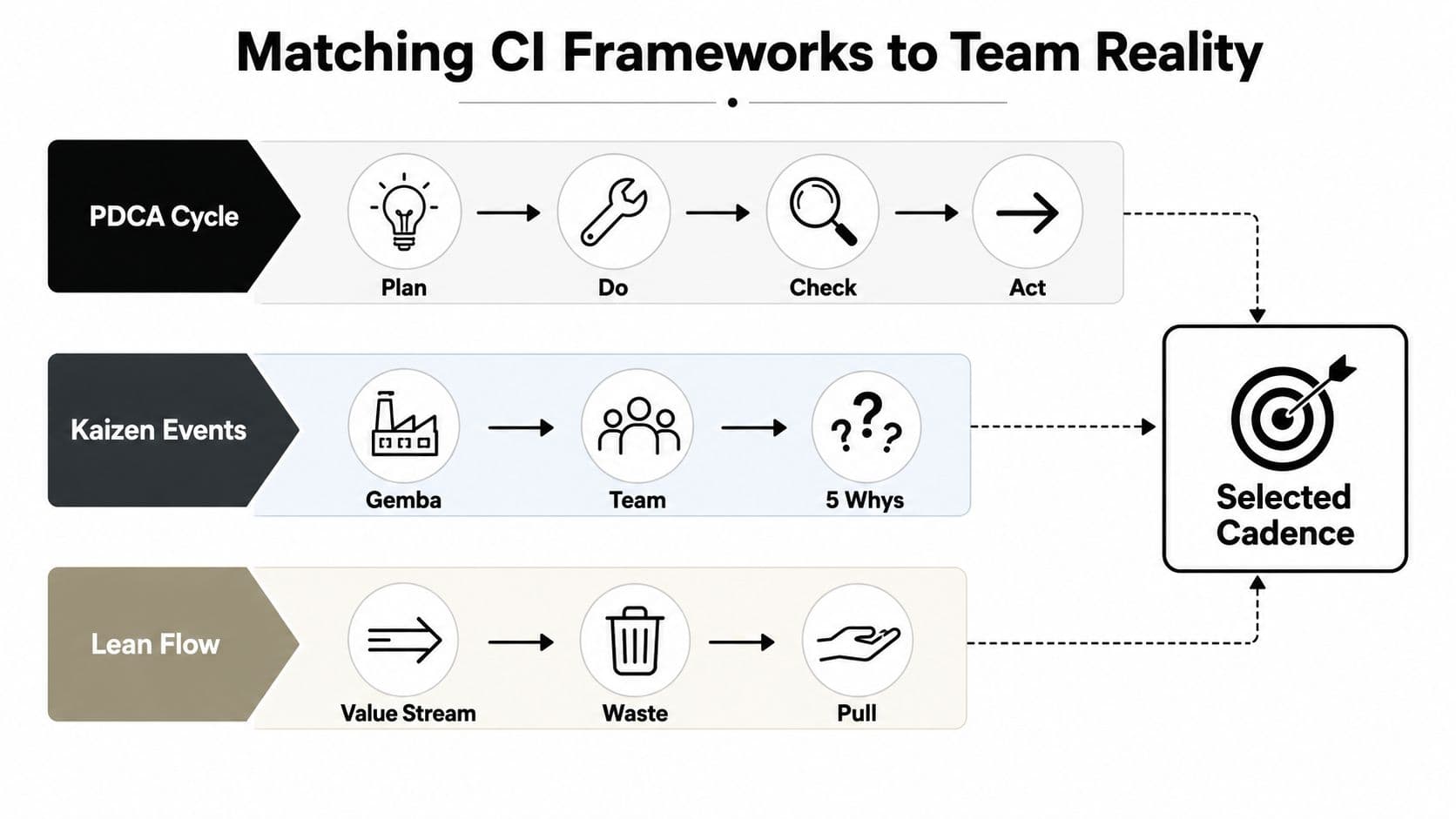
A team can pick a respected CI method and still stall if the method does not fit the way work moves through the week. PDCA, Kaizen, and Lean all work, but each one fits a different kind of problem, a different cadence, and a different level of process complexity.
Match the method to the work
Use PDCA when one process needs short learning loops. It fits a single workflow with a clear metric, a small team, and a review cycle that can stay tight without dragging everyone into the room. That makes it useful when the problem is contained and you need a disciplined way to test a change before anyone treats it as standard work.
Use Kaizen when the team needs a focused improvement burst. It works best for a visible problem that justifies clearing calendars, bringing in the right people, and making decisions while the details are still fresh. That is where a short, intense event pays off, because the team can remove friction in one pass instead of letting the issue linger for weeks.
Use Lean when the problem is flow across the value stream. If work keeps bouncing between functions, sitting in queues, or coming back for rework, Lean gives you a better starting lens because it puts handoffs, waste, and customer value in the same frame. If the process is messy, start by making the flow visible before anyone tries to fine-tune it.
Start smaller than your instinct wants
The common scope mistake is trying to improve the whole company at once. Pick one process where the team already has data and can name the customer. That gives you a baseline, a clear owner, and a place to learn what the organization can handle without turning every change into a special project.
A practical way to choose scope is to ask three questions.
- Where is the pain visible? Start with a process people already complain about, because hidden pain takes longer to prove and harder to rally around.
- Where is the data usable? If the team cannot measure the process without heroic effort, the first project is probably instrumentation, not improvement.
- Who can decide? A narrow scope with clear decision rights beats a broad scope with shared confusion.
The goal-setting frameworks guide is useful here, because it keeps the target metric and review cadence from drifting into vague talk. It helps a team set a goal that the operating rhythm can support, rather than one that sounds good and then gets ignored.
A CI framework should make decisions easier, not add another layer of ceremony.
Scope matters at the execution layer, where most programs fail. A useful test is whether the team can move from a problem statement to a trial change to a standard update without waiting for a manager to chase status. If that path is blocked, the framework is too heavy for the team's current operating model. If the team can handle the workflow, keep the first use case narrow and real. For example, a warehouse team might start with dock-to-stock time in one shift, while a service team might start with one recurring handoff between support and operations. That is enough to see whether the method survives contact with daily work.
Use the team growth exercise for Ducks In A only if the group needs a quick reset before the work starts. It can help surface how people coordinate, but it should not replace a real improvement scope or a measurable process target.
Governance, Roles, and Weekly Cadences
A CI program without governance is just a collection of well-intentioned meetings. The work needs a place to land when someone has to make a call, approve a change, remove a blocker, or decide that a project should die.
Keep the org design minimal
The minimum viable structure is straightforward. An executive sponsor clears roadblocks and signals that the work matters. A CI lead runs the cadence, keeps the pipeline honest, and coaches the teams. Process owners agree to changes in their area. Team members generate ideas, test them, and report what happened.
That's enough. Adding layers before the program proves value usually creates slower decisions and cleaner excuses. The sponsor shouldn't sit in every working session, but the sponsor does need to show up where commitment is visible. HumanPerf's guidance is blunt on this point, senior management must be involved for improvement efforts to work, and in practice that involvement has to be real, not ceremonial, or the program loses credibility quickly. (HumanPerf guidance on continuous improvement management)
A simple way to organize accountability is to use a RACI-style map, especially when multiple teams touch the same process. This RACI matrix template is useful when you need to make ownership explicit before the first review meeting happens.
Use cadence to force decisions
Weekly reviews should be short and specific. The point is to decide, not to narrate. Each active improvement should answer four questions, what changed since last week, what evidence supports the change, what's blocked, and what decision is needed now.
Monthly reviews serve a different purpose. They clean out stalled work, retire ideas that no longer deserve attention, and reallocate effort to the items that still have a path. Quarterly steering reviews sit above that and check whether the portfolio still matches strategy, budget, and leadership priorities.
If a recurring meeting doesn't produce a decision, a handoff, or a standard, it's not governance. It's theater.
A strong weekly rhythm usually has three outcomes. First, the team knows what's active. Second, blocked items get an owner. Third, completed work moves into standard practice so the improvement doesn't evaporate after the excitement passes. That last part matters more than people think, because CI dies fastest when every win stays local and undocumented.
Measuring KPIs That Actually Predict Progress
The wrong dashboard will make a weak CI program look healthy for months. That's dangerous, because leadership keeps funding something that feels active while the underlying process doesn't move. Good measurement has to show whether the pipeline is healthy, whether the work is being absorbed, and whether the business is better.
Use three layers, not one number
The most useful scorecards separate activity metrics, throughput metrics, and outcome metrics. Activity tells you whether people are submitting ideas and holding reviews. Throughput shows whether ideas are moving through the system. Outcome tells you whether the process or business changed in a meaningful way.
| Layer | Example Metric | Audience | Review Cadence |
|---|---|---|---|
| Activity | Ideas submitted, review meetings held | CI lead, team leads | Weekly |
| Throughput | Ideas implemented, cycle time to standard work | Process owner, sponsor | Weekly or monthly |
| Outcome | Defect rate, lead time, cost per transaction, employee engagement | Executives, finance | Monthly or quarterly |
The table matters because different audiences need different signals. Executives usually need a small set of business KPIs. Working teams need the broader pipeline data that shows whether the improvement system is alive. If you give finance a wall of activity metrics, they'll miss the point. If you give frontline teams only outcome numbers, they won't know what to fix next.
Measure the hard stuff carefully
PA Consulting calls out the measurement challenge around the immeasurable, including collaboration, knowledge sharing, and decision quality, and that's the right problem to face. Those cultural signals matter, but they're easy to oversimplify if the organization starts pretending that every soft benefit can be reduced to a single neat percentage. (PA Consulting on continuous improvement culture measurement)
The practical move is to pair business KPIs with a few judgment-based indicators that leaders review consistently. For example, ask whether teams are sharing lessons across functions, whether decisions are getting made faster because the data is better, and whether the same issue keeps reappearing. That's a more honest way to track learning than trying to force a fake precision number onto culture.
Useful standard: if a metric won't change a decision, don't put it on the executive dashboard.
A team dashboard can be more detailed because it supports action. An executive dashboard should be tighter, with enough context to see whether the system is producing durable change. The measurement layer is where many CI programs fail, because they either count activity only or they overreach into vague cultural claims without enough discipline to make the numbers useful.
Workflow Automation and Smart Delegation
The execution layer is where most CI programs fail. Ideas get captured, then they sit in inboxes, chat threads, or shared drives because nobody owns the follow-through. The fix isn't “more effort.” It's designing the workflow so the next action is obvious and hard to lose.
Build the pipeline like a process, not a pile of tasks
Start with intake. Every idea needs a single entry point, a category, a priority, and an owner for triage. From there, the system should route work to the right process owner based on what kind of change it is and how urgent it is. That keeps the CI lead from becoming the human router for every small decision.
Then design assignment and standardization together. If a change is approved, the owner should know who will document it, who will validate it, and who will update the standard. Without that sequence, the idea is technically “done” but operationally unfinished.
Automation helps. A workflow tool can move ideas into the right view, keep active items visible, and push status updates into the weekly review without manual chasing. In practice, platforms such as Fluidwave can combine task routing with delegated work, so team members can hand off micro-tasks like data gathering, document drafting, or scheduling while keeping the main process moving.
Use delegation for the friction you don't need to own
A lot of CI work gets slowed down by tasks that are necessary but not strategic. Someone needs to compile the baseline data. Someone needs to clean up the action list. Someone needs to draft the standard work update. Those jobs are real, but they don't need to consume the same people who are making the process decisions.
That's where smart delegation changes the economics of CI. A team can set budget and timeline controls, watch tasks across table, Kanban, or calendar views, and keep the review cadence fed with live status instead of chasing updates by hand. The point isn't to automate judgment. It's to remove the repetitive work that gets in the way of judgment.
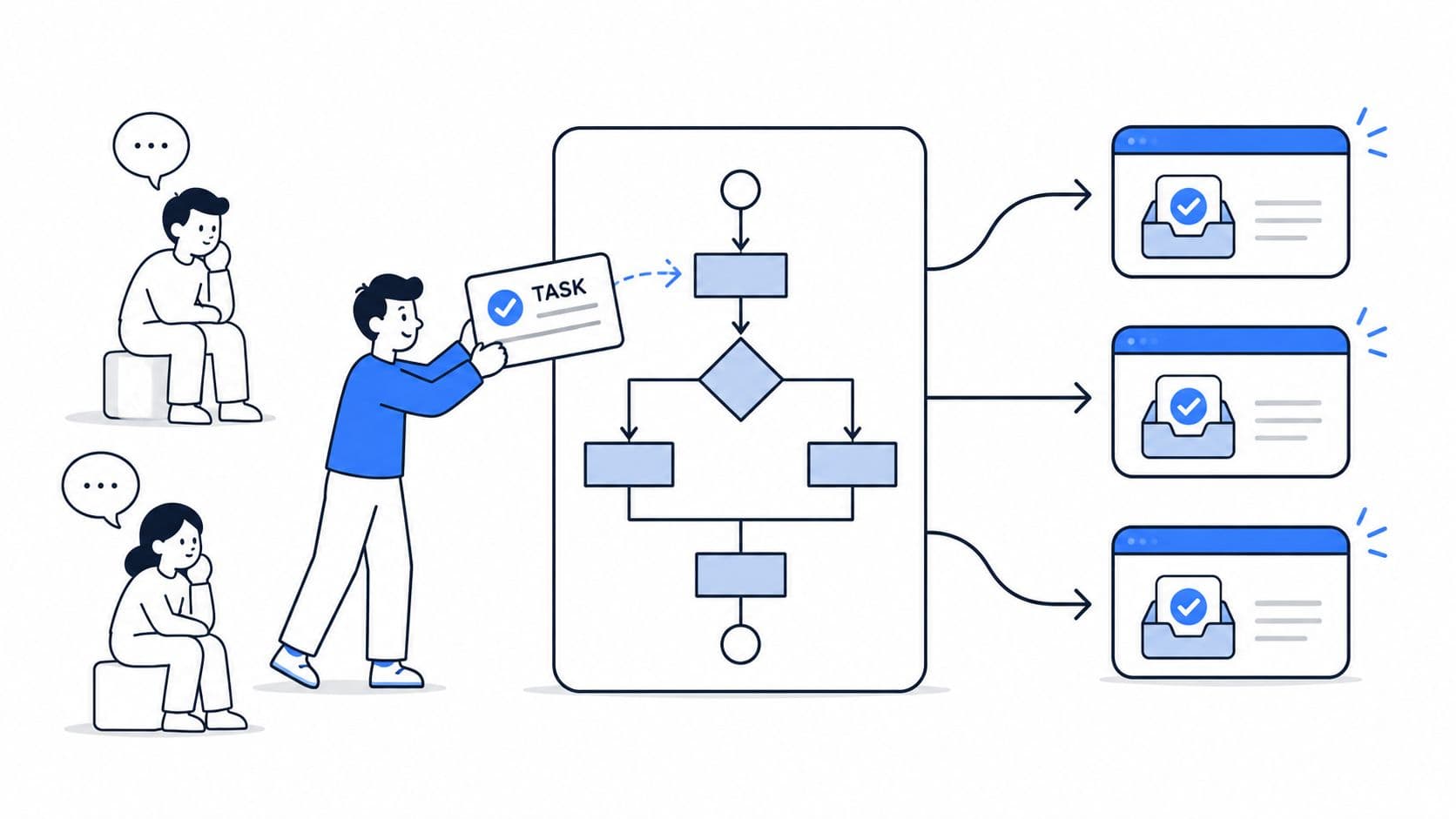
If the handoff is manual, expect drift. If the handoff is automated, expect fewer dropped balls.
The biggest win is visibility. When status updates are tied to the workflow itself, the weekly review becomes a decision forum instead of a scavenger hunt. That's how automation and delegation support CI without turning it into software theater.
A 90-Day Rollout That Actually Works
A good rollout respects the fact that teams already have full calendars. The goal isn't to launch a perfect program. It's to build enough structure in 90 days that the system can survive contact with real work.
Days 1 to 30
Pick one process. Name the sponsor. Assign the CI lead. Set the baseline metric. Open one intake channel and make it the only place where ideas enter the program.
By the end of this phase, you should have a single problem statement, one target metric, and one visible owner for each active item. If those artifacts don't exist, the program is already too vague. The common failure here is trying to define the whole portfolio before any one workflow has been proven.
Days 31 to 60
Run the first three PDCA cycles. Hold weekly reviews. Standardize anything that works. Retire anything that clearly doesn't have traction.
This phase is where the program becomes real. People stop discussing whether improvement matters and start seeing whether the work is moving. Keep the communication tight so leadership gets progress without getting buried in extra meetings.
Days 61 to 90
Expand to a second process only after the first one has a stable cadence. Present a portfolio review to leadership. Separate the ideas worth pursuing from the ones that should be closed.
A simple communication plan helps here. Send a short weekly update with three items, what shipped, what's blocked, and what needs decision. Then use the 90-day mark to decide whether the next process has enough support to join the pipeline. The point of the rollout is not speed for its own sake, it's proving the program can carry load without losing control.
Building the Culture That Survives Year Two
Tools and workflows matter, but year two is where culture decides the outcome. The strongest CI programs I've seen had visible leadership participation, clear handling of failure, and enough psychological safety that people could admit when a change didn't work. The weakest ones had polished templates and a quiet workforce that learned not to bother.
Make leadership participation visible
Senior leaders can't just approve the program. They need to show up in the review rhythm, ask hard questions, and reward the people who surface issues early. That doesn't mean overruling every decision. It means making it clear that improvement work is part of normal management, not an extracurricular activity.
Recognition matters too, but it has to reinforce the right behavior. Praise the team that killed a bad idea quickly. Praise the manager who standardized a better method across shifts. Praise the contributor who brought evidence instead of opinion. Those are the behaviors that make CI durable.
Handle resistance without getting sentimental
Not every skeptical manager is a blocker. Some are protecting the team from another half-built program. The difference is usually visible in behavior. Healthy skepticism asks for evidence, clearer scope, and better timing. Quiet resistance delays decisions, reopens already-settled questions, or keeps promising to “circle back” without ever doing it.
The response shouldn't be confrontation for its own sake. It should be discipline. Bring the data, make the ownership clear, and keep the cadence consistent. If the process owner won't commit, the sponsor needs to step in, because ambiguity spreads fast when the organization watches a manager stall without consequence.
Research on CI implementation keeps pointing to the same failure patterns, weak leadership commitment, poor training, and weak project selection. The exact mix varies, but the lesson doesn't. If the program can't choose good work, teach people how to execute it, and back it with leadership, the culture eventually learns that CI is optional. Research also shows that success rates are often below 60%, which is a good reminder that the default outcome is not automatic success, it's drift unless the system is designed well. (structured CI model research in Heliyon, CI maturity framework research)
Use a quarterly pressure test
Ask these questions every quarter.
- Are leaders still reviewing real work? If they've drifted into ceremonial attendance, the program is weakening.
- Are blocked items getting resolved? If not, ownership is missing.
- Are standards changing after improvements land? If not, the gains won't stick.
- Are middle managers helping or buffering the old way? The answer says a lot about year-two durability.
A practical charter helps keep the program honest. Use one page to define the purpose, sponsor, scope, cadence, decision rights, and key metrics. Pair that with a weekly review agenda, an intake form for ideas, and a maturity self-assessment that helps the team see whether the work is still structured, strategic, proactive, or fully embedded. A simple starter set of KPIs should include activity, throughput, and outcome measures so the team can see both pipeline health and business impact.
The test of managing continuous improvement is whether the system keeps working after the novelty wears off. That means fewer slogans, more ownership, and enough automation and delegation that the load doesn't collapse onto one exhausted manager. If you want a CI program that survives year two, build the operating system first and let the toolkit support it.
If you want a CI system that doesn't depend on heroic follow-up, Fluidwave gives teams a way to route tasks, delegate the small stuff, and keep improvement work visible across table, Kanban, and calendar views. Visit Fluidwave to see how a workflow-first approach can help your CI pipeline stay moving without adding more manual chasing.
Focus on What Matters.
Experience lightning-fast task management with AI-powered workflows. Our automation helps busy professionals save 4+ hours weekly.