Download our free root cause analysis template (5 Whys, Fishbone, Formal Report) to turn findings into trackable actions & solve problems for good.
May 20, 2026 (5mo ago)
Root Cause Analysis Template: Solve Problems for Good
Download our free root cause analysis template (5 Whys, Fishbone, Formal Report) to turn findings into trackable actions & solve problems for good.
← Back to blog
The issue is back again.
Maybe it's the same shipping delay every month, the same QA escape after every release, or the same machine stoppage that gets “fixed” until it fails again next week. Often, teams don't have a problem-solving problem. They have a follow-through problem. They patch the symptom, close the ticket, and move on before anyone has figured out what broke.
That's where a good root cause analysis template earns its keep. Not as paperwork. Not as a blame document. As a way to force a team to slow down, look at evidence, and turn one ugly incident into a correction that sticks.
Beyond the Blame Game Why Your Team Needs a Root Cause Analysis Template
When teams hear “RCA,” they often expect a stiff form and an uncomfortable meeting. That's usually because they've seen bad RCAs. The kind that ask who made the mistake, fill a few boxes, and disappear into a shared drive.
A useful root cause analysis template does the opposite. It keeps people focused on the chain of events, the failed controls, and the decisions that allowed the problem to happen. It shifts the conversation from fault to prevention.
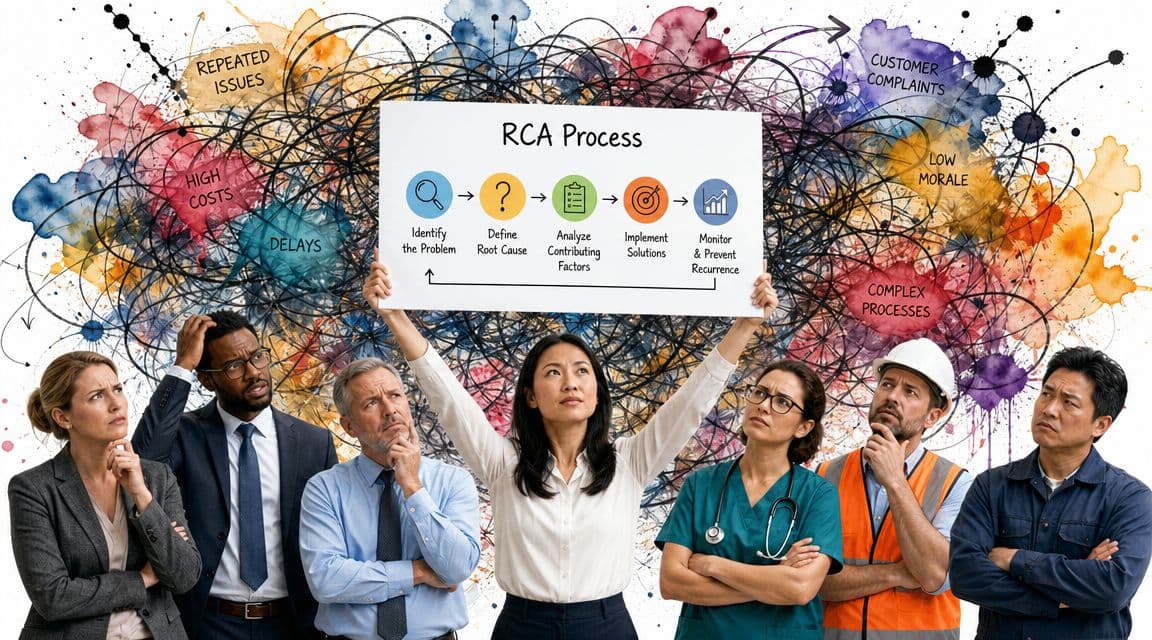
What a real RCA template actually does
Public guidance from Indiana's Family and Social Services Administration describes root causes as causes for which effective recommendations can be generated to prevent recurrence, and it states that the final RCA should feed directly into a thorough Quality Improvement Plan, creating an auditable chain from problem identification to proof of resolution in the Indiana RCA template guidance.
That matters because a template isn't just a worksheet. It's a decision tool.
A solid template usually forces the team to capture:
- The incident itself: What happened, when it happened, who or what was affected.
- The sequence: A basic timeline, because cause and effect get muddy fast when people work from memory.
- The evidence: Photos, witness notes, logs, equipment data, screenshots, or supporting records.
- Immediate containment: What the team did right away to stop further damage.
- Corrective and preventive actions: What will change, who owns it, when it's due, and how the team will verify it worked.
Practical rule: If your RCA template ends with “root cause” and nothing after it, it's incomplete.
The teams that get value from RCA treat it like an operating tool. The teams that hate it usually treat it like compliance homework.
What works and what usually fails
Good RCA work is specific. “Operator error” isn't specific. “The handoff checklist didn't include a verification step for revised part numbers” is specific. One leads nowhere. The other tells you what to fix.
That's also why teams that need to identify root causes of downtime usually rely on a structured process instead of a freeform discussion. Complex failures produce too many assumptions if nobody is writing down the sequence and testing the logic.
If you're building your own version, it helps to start with a consistent framework instead of a blank page. This guide on how to make a template is useful for setting up a format people will use under pressure.
A template should reduce confusion in the moment. If it creates more of it, the design is wrong.
Choosing the Right RCA Method for Your Problem
Not every incident needs the same level of analysis. That's where teams waste time. They use a heavy process on a simple issue, or they try to force a complex failure into a quick conversation.
The method should match the shape of the problem.
Tableau notes that the 5 Whys is the most widely recognized RCA method, and while five “whys” is a common benchmark, a simple issue may take only 2 questions and a complex one may take up to 50 in its root cause analysis overview. That's a good reminder that simplicity is useful, but only up to a point.
Which RCA Template Should You Use?
| Method | Best For | Complexity | Time Investment |
|---|---|---|---|
| 5 Whys | A single issue with a fairly direct cause chain | Low to moderate | Low |
| Fishbone Diagram | Problems with several possible contributors across teams or systems | Moderate to high | Moderate |
| Formal RCA Report | High-risk incidents, regulated environments, or events needing documented follow-through | High | High |
A practical way to choose
Use 5 Whys when the event is narrow and recent. A missed handoff. A failed approval. A recurring data entry error. It works best when the team can trace one causal path without a lot of branching.
Use a Fishbone diagram when too many things might be true at once. If the issue spans process, tooling, staffing, materials, or environment, a linear chain won't hold up. You need a map of possibilities before you decide what to test.
Use a formal RCA report when the incident has legal, safety, customer, or audit implications. In those cases, the analysis isn't done when the meeting ends. It's done when the actions are assigned, completed, and verified.
The trade-off most teams miss
Fast methods feel efficient, but they can hide complexity.
I've seen teams run 5 Whys on issues that clearly had multiple contributors. They walked out with one neat explanation and three unresolved risks. The write-up looked clean. The operation didn't improve.
On the other hand, I've also watched people overcomplicate minor issues by dragging half the company into a workshop when a short 5 Whys would've exposed the process gap in half an hour.
A simple filter helps:
- Choose 5 Whys if one team owns the process and the failure path looks mostly linear.
- Choose Fishbone if the event crosses functions or has several plausible causes.
- Choose a formal report if someone will need to review the evidence, actions, and verification later.
If your team already maps handoffs and bottlenecks, this primer on business process analysis is a useful companion. RCA gets easier when the underlying workflow is already visible.
Running a 5 Whys Session That Gets Real Answers
A 5 Whys session goes wrong in predictable ways. People start with a vague problem statement. Someone jumps to a familiar complaint. The room settles on a cause that sounds reasonable, then skips straight to a solution.
That's how you end up fixing symptoms.
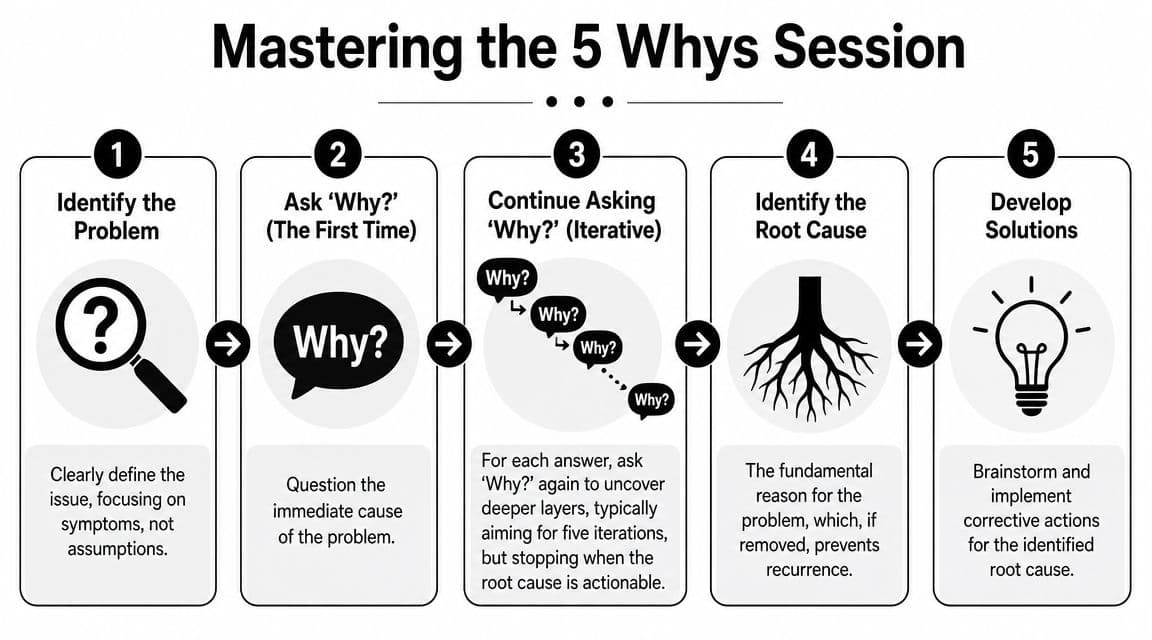
Start with a problem statement you can test
The strongest sessions begin with a plain statement of the issue. Not a theory. Not a grievance. Just the event.
Bad version: “The warehouse team keeps messing up orders.”
Better version: “Two customer orders shipped with the wrong SKU during the second shift on Tuesday.”
That gives the group something concrete to investigate. It also strips out blame before the discussion starts.
Xtensio's guidance on RCA warns that a common pitfall is treating symptoms as causes, and it recommends a strict sequence of defining the problem, gathering evidence, identifying causal factors, and explicitly testing whether a proposed cause explains the event in its guide on how to do root cause analysis.
How to facilitate without letting the room drift
Run the session with a whiteboard, digital board, or even a plain document projected on screen. The point is to make the chain visible. If people can't see the logic, they'll talk past each other.
Use this rhythm:
- State the problem clearly. Keep it factual and narrow.
- Ask the first why. Capture the answer in one sentence.
- Ask why that answer is true. Keep going until the answer becomes actionable.
- Challenge weak answers. If someone says “human error,” ask what condition made that error possible.
- Test the endpoint. Ask whether removing that cause would reasonably prevent recurrence.
Here's a simple example:
- Problem: A customer invoice went out with the wrong pricing.
- Why? The rep used an outdated quote sheet.
- Why? The current pricing file wasn't in the shared folder.
- Why? The pricing update process depended on one manager replacing the file manually.
- Why? There was no controlled update workflow or version check.
- Root cause: The pricing change process lacked a controlled publishing and verification step.
That result gives you something to fix. “Rep used wrong file” does not.
Before moving deeper, it often helps to reset the room with a short visual explainer.
Signs you've stopped too early
A 5 Whys session is usually unfinished if the answer ends on one of these:
- A person's name or role: That points to who was involved, not why the system allowed failure.
- A broad label: “Miscommunication,” “oversight,” and “lack of training” need another layer.
- A condition you can't act on: If nobody can change it, it's not a useful endpoint.
Don't stop when the answer sounds familiar. Stop when the answer tells you what control, process, or design needs to change.
The best 5 Whys sessions stay disciplined. They don't hunt for a dramatic explanation. They keep pulling until the team reaches a cause that is specific, credible, and fixable.
Mapping Complex Problems with a Fishbone Diagram
Some problems don't have one clean causal chain. They have several weak spots that line up at the same time. A 5 Whys session can miss that because it pushes the team down one path. A Fishbone diagram is better when the problem is messy, cross-functional, or politically charged.
It gives the room a structure for broad thinking without turning the meeting into a free-for-all.
When Fishbone beats a linear approach
If your issue touches staffing, process design, tools, inputs, and operating conditions, you need categories. That's what the “bones” are for. They let people sort possible causes before they argue over which ones matter most.
Common categories include:
- People: Training gaps, unclear responsibilities, bad handoffs
- Method: Missing steps, inconsistent procedures, weak controls
- Machine: Equipment, systems, software, or tooling problems
- Material: Inputs, data quality, components, documents
- Measurement: Missing checks, poor visibility, delayed detection
- Environment: Noise, timing pressure, layout, temperature, outside constraints
A Fishbone diagram doesn't prove root cause by itself. It helps the team surface possibilities in an organized way.
A real-world example
Take a problem like Q4 sales target missed.
The team might fill the diagram like this:
| Category | Possible contributing factors |
|---|---|
| People | New reps ramping slowly, weak manager coaching |
| Method | Follow-up cadence inconsistent, qualification rules unclear |
| Machine | CRM fields incomplete, reporting lagging |
| Material | Outdated pitch deck, weak proposal templates |
| Measurement | Pipeline review too shallow, forecast quality poor |
| Environment | Budget freezes, longer procurement cycles |
Once the diagram is populated, the next move is not to vote on the favorite theory. The next move is to test, rank, and narrow.
The Joint Commission's RCA framework stresses that strong analysis for complex incidents should capture multiple contributing factors, rank them, and map corrective actions to each, while avoiding the mistake of stopping at one obvious cause in its framework for conducting a root cause analysis and action plan.
How to keep Fishbone useful
The Fishbone session falls apart when people confuse brainstorming with conclusions.
Use a tight process:
- Brainstorm first: Capture possibilities by category without debating each one.
- Mark evidence gaps: Flag which ideas are supported, which are assumptions, and which need checking.
- Rank contributors: Identify which factors were central, secondary, or background conditions.
- Assign actions by factor: If there are three meaningful contributors, there should usually be more than one corrective action.
The Fishbone diagram is a map, not a verdict. The team still has to test what belongs at the center of the story.
If your team struggles to visualize handoffs or causal branches, these examples of flowcharts and process mapping can help. A lot of RCA confusion clears up once the workflow is visible enough for everyone to point at the same failure points.
From Analysis to Action Integrating RCA into Your Workflow
Most RCA failures happen after the meeting.
The root cause gets documented. The notes get saved. Everyone agrees on a few actions. Then daily work takes over, ownership gets fuzzy, and the same issue returns with a slightly different face. That isn't an analysis problem. It's an execution problem.
A root cause analysis template only becomes valuable when it creates visible, trackable follow-through.
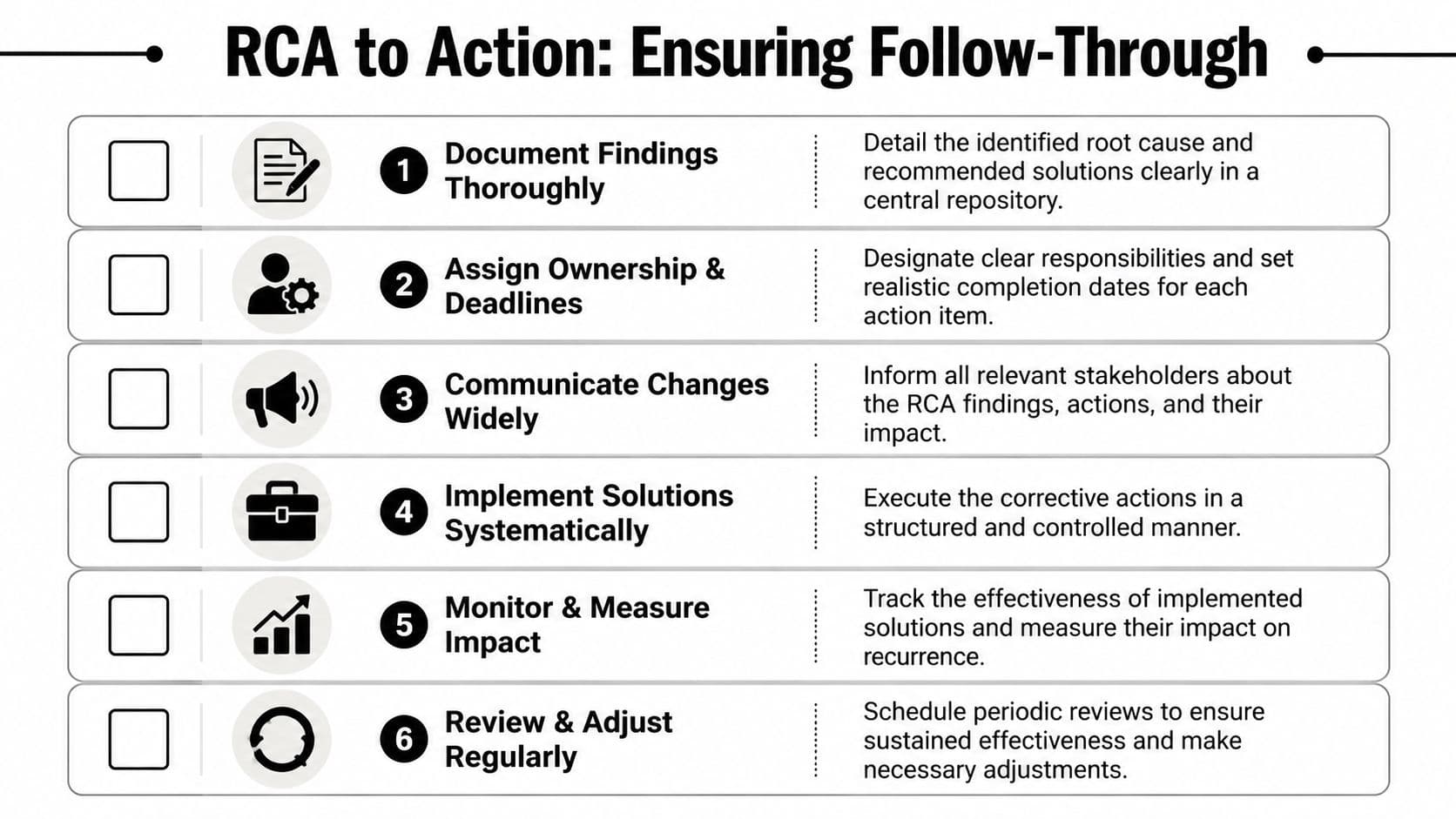
What a corrective action plan needs
SafetyCulture points out a gap many teams feel in practice. Modern RCA work requires action tracking, ownership, deadlines, and verification, yet many guides don't explain how to build those controls into day-to-day systems, which is why RCA can slide into “documentation theater” in its discussion of root cause analysis templates.
That phrase is accurate. Plenty of teams complete the document and skip the discipline.
A workable corrective action plan should include:
- One clear owner per action: Shared ownership often means nobody moves first.
- A due date: Without one, the task will lose to urgent work.
- A defined deliverable: “Improve process” is too vague. “Publish revised intake checklist and train intake staff” is usable.
- Verification criteria: What evidence will show the action worked.
- A review point: Someone needs to check whether the change held after implementation.
What good follow-through looks like in practice
Here's where teams usually tighten the process:
Convert findings into tasks immediately
Don't leave action items buried in meeting notes. Create them as tasks while the discussion is still live. If a control needs redesign, make that a task. If documentation needs revision, create it on the spot. If a manager has to confirm implementation, assign that too.
Separate containment from prevention
Many teams log the short-term fix and call it done. That's a mistake.
Containment is what stopped the immediate pain. Prevention is what changes the conditions that allowed it. You usually need both, and they should be tracked separately so the temporary fix doesn't masquerade as the final one.
Require proof, not status updates
“Done” should mean there's something to inspect. A revised SOP. A completed training record. A screenshot of a system control. A signed check. A manager review. If the action can't be verified, it's not complete.
Field note: The most reliable RCA process isn't the one with the best form. It's the one where unfinished actions stay visible until someone closes the loop with evidence.
A simple operating model
Use a lightweight structure your team can repeat:
- Capture the incident and analysis.
- Break corrective actions into task-level work.
- Assign one owner per task.
- Add due dates and dependencies.
- Define what verification will look like.
- Review open actions until each one is evidenced and signed off.
- Share the lesson so another team doesn't repeat the same failure.
This is the part most guides gloss over, and it's the part that prevents recurrence. The analysis tells you what happened. The workflow determines whether anything changes.
Frequently Asked Questions About Root Cause Analysis
Teams usually don't struggle with the idea of RCA. They struggle with the practical friction once the meeting starts. These are the questions that come up most often in real operations work.
Who should be in the room
Keep the group small enough to think and broad enough to see the full process.
A good RCA session usually includes the person closest to the work, the process owner, someone who can validate evidence, and the person who will own corrective action. If the issue crossed teams, include one representative from each affected function. Don't invite spectators. Large groups generate noise, side arguments, and safer but weaker conclusions.
What if the team disagrees on the root cause
That's normal. In fact, some disagreement is healthy because it forces the group to separate assumptions from evidence.
When people disagree, don't settle it by seniority or volume. List the competing explanations, ask what evidence supports each one, and note what still needs checking. If the team can't validate a claim, treat it as a hypothesis, not a conclusion. Strong facilitation matters here. The facilitator's job is to keep the group honest, not to be the smartest person in the room.
Can RCA be used for successes, not just failures
Yes, and more teams should do it.
If a project ran unusually well, a launch stayed stable under pressure, or a team recovered from a disruption cleanly, the same discipline can uncover what made that possible. The structure changes slightly because you're tracing enabling conditions rather than failure points, but the value is similar. You're still asking what happened, what factors mattered, and what should be repeated.
How do you know the RCA was good
A good RCA produces action that changes behavior, controls, or workflow.
A weak RCA gives you a tidy explanation. A strong one gives you a prevention plan, named owners, verifiable completion, and lessons that can be reused. If the same issue returns and nothing meaningful had changed in the system, the analysis wasn't finished, no matter how polished the document looked.
How formal should the template be
Match the formality to the risk.
For a simple internal issue, a concise 5 Whys record with actions may be enough. For safety, compliance, customer-impacting, or repeated incidents, use a more detailed root cause analysis template that captures evidence, contributing factors, assigned actions, and verification. The point isn't to create paperwork. The point is to create enough structure that the next person can see what happened, what changed, and whether it worked.
If your team is tired of RCAs that end in a document instead of a fix, Fluidwave is worth a look. It gives you a practical way to turn findings into assigned tasks, track deadlines, keep action owners visible, and verify completion without losing the thread in scattered notes and follow-up messages.
Focus on What Matters.
Experience lightning-fast task management with AI-powered workflows. Our automation helps busy professionals save 4+ hours weekly.