Learn how to stop micromanaging with clear expectations, planned review points and habits that build trust while keeping results on track.
November 15, 2026 (2d ago)
How to Stop Micromanaging: A Practical Guide for Managers
Learn how to stop micromanaging with clear expectations, planned review points and habits that build trust while keeping results on track.
← Back to blog
You know the pattern. It's 9:40 on a Tuesday, the stand-up is at ten, and you've already opened the project board three times. You sent a message asking how the vendor email is coming along, and you already know how it's coming along, because you read the draft last night and rewrote two sentences in it before bed.
From the inside, that reads as diligence. You're accountable for the result, so you stay close to the work. What doesn't show up anywhere is the cost: people stop making decisions, and the ones they do make arrive at your desk for a signature first.
This guide treats micromanaging as a visibility problem you can redesign, not a character flaw to overcome. You don't fix it by caring less. You fix it by agreeing on what "done" means, naming who decides what, and swapping constant checking for review points and exception alerts, so a hybrid or remote team stays accountable without you reading over anyone's shoulder.
Spot the Habits That Signal Micromanaging
A "quick check before I send this" arrives about a routine client reply. The person already knows the account, the tone, and the facts. The message is there because an approval loop trained them that sending without you is the risky move. I read that request as a visibility design problem, not a timid personality. The loop keeps running until what counts as enough information changes.
The pattern is wider than one team. In 2024, 34% of 2,027 employed U.S. adults agreed they were micromanaged, defined as being supervised, instructed, or monitored too closely, according to this summary of micromanagement statistics. Manager behavior also carries unusual weight. Gallup's analysis of 11,781 work teams found managers accounted for at least 70% of the variance in team-level employee-engagement scores. A small change in how you check work moves a large outcome.
From the manager's desk, these habits show up before you name them. They feel like diligence. On a hybrid or remote team they usually mean you cannot see the work unless someone performs it a second time, for you.

A useful ratio: count how often people ask permission in a week against how often they tell you about a decision they already made. That ratio is your baseline, and it is more honest than your memory of the week.
Five Habits and What Sits Underneath Them
| Habit | What It Signals | First Move |
|---|---|---|
| Approving every step | Decision rights are unclear | Name the decisions the owner makes alone |
| Rewriting finished work | The definition of done was never agreed | Write the done criteria before work starts |
| Daily status requests | Visibility is being confused with control | Replace requests with a shared tracker |
| Overriding the owner's method | The outcome was never agreed | Judge the result, not the process |
| Taking credit for ideas | Ownership was never written down | Name the idea's owner in the team channel |
Run a one-week tally before you change anything. Every time you ask to approve something, write it down, and next to it note whether your review changed the outcome. Not whether you preferred your version. Whether the result would have been different. Managers who finish that tally usually hold a long list of approvals and a short list of real changes. That gap shows how much oversight is insurance against nothing. The useful redesign is a planned review point, plus an alert when something is off, so accountability stays visible without a shoulder check on every draft.
Build the Trust That Makes Letting Go Safe
Hovering usually starts with one bad week. A deadline slipped once, or a client spotted an error before you did, and from then on you check everything. The team reads that as a verdict on them, and it stops offering ideas.
The cost is measurable. A study of 400 full-time employees across five major sectors in Metro Cebu, Philippines found the control-oriented pattern was negatively associated with trust in leadership (r = -0.49, p < .001), while taking employees' ideas without credit was negatively associated with innovation behavior (r = -0.42, p < .001), per this study of micromanagement patterns and workplace outcomes. Rewriting decisions and claiming ideas both cost you the two things delegation runs on.
Psychological safety is the second ingredient, and it holds up under scrutiny. A study of 802 employees in Malaysia found psychological safety had a significant positive relationship with well-being (B = 0.15, 95% CI 0.07 to 0.23) and buffered the damage psychosocial risk did to well-being, according to this Asia Pacific Journal of Human Resources study.
Four habits build it faster than any speech:
- Invite the correction. Once a week, ask the team what you're missing on a live project, and thank the first person who answers.
- Audit the process, not the person. When something breaks, the first question is what the brief allowed, not who dropped it.
- Keep coaching separate from verdicts. Feedback on the work goes in the work channel; anything about how someone is developing happens in private.
- Attribute ideas out loud. When a team member's suggestion ships, say whose it was, in the room where it lands.
When Delegation Feels Unsafe
Sometimes the fear is justified. Research summarized across five studies and eight samples links excessive, sustained or unnecessary control with lower trust, turnover intentions, emotional exhaustion, job-search behavior and physical symptoms, as this review of micromanagement evidence sets out. That cuts both ways: reducing control without fixing capability or context creates failures, and failures make you hover harder next time.
Diagnose the missing piece before you hand anything over. Is it capability (they haven't done this before), clarity (nobody wrote down what good looks like) or confidence (they're overloaded and hiding it)? A short worked example fixes capability, a rewritten brief fixes clarity, and a smaller scope fixes confidence. If you want the fuller picture of how a delegative style sits alongside directive and supportive ones, this breakdown of the delegative leadership style is worth twenty minutes.
How to Set Outcomes and Decision Rights Before You Delegate
Trust makes delegation possible; clear outcomes and decision rights make it workable. When people know what success looks like and which decisions they own, they can act without waiting for approval at every turn. A 2018 meta-analysis of 72 studies and 32,870 participants found that autonomy-supportive leadership was positively associated with motivation, engagement, well-being and desirable work behaviors, and negatively associated with distress and undesirable behaviors.
A meta-analysis of 105 samples on empowering leadership also found positive associations with individual and team performance, creativity and organizational citizenship. Trust and a sense of ownership acted as mediators. The practical point is straightforward: autonomy works best when people have room to act and understand the boundaries.
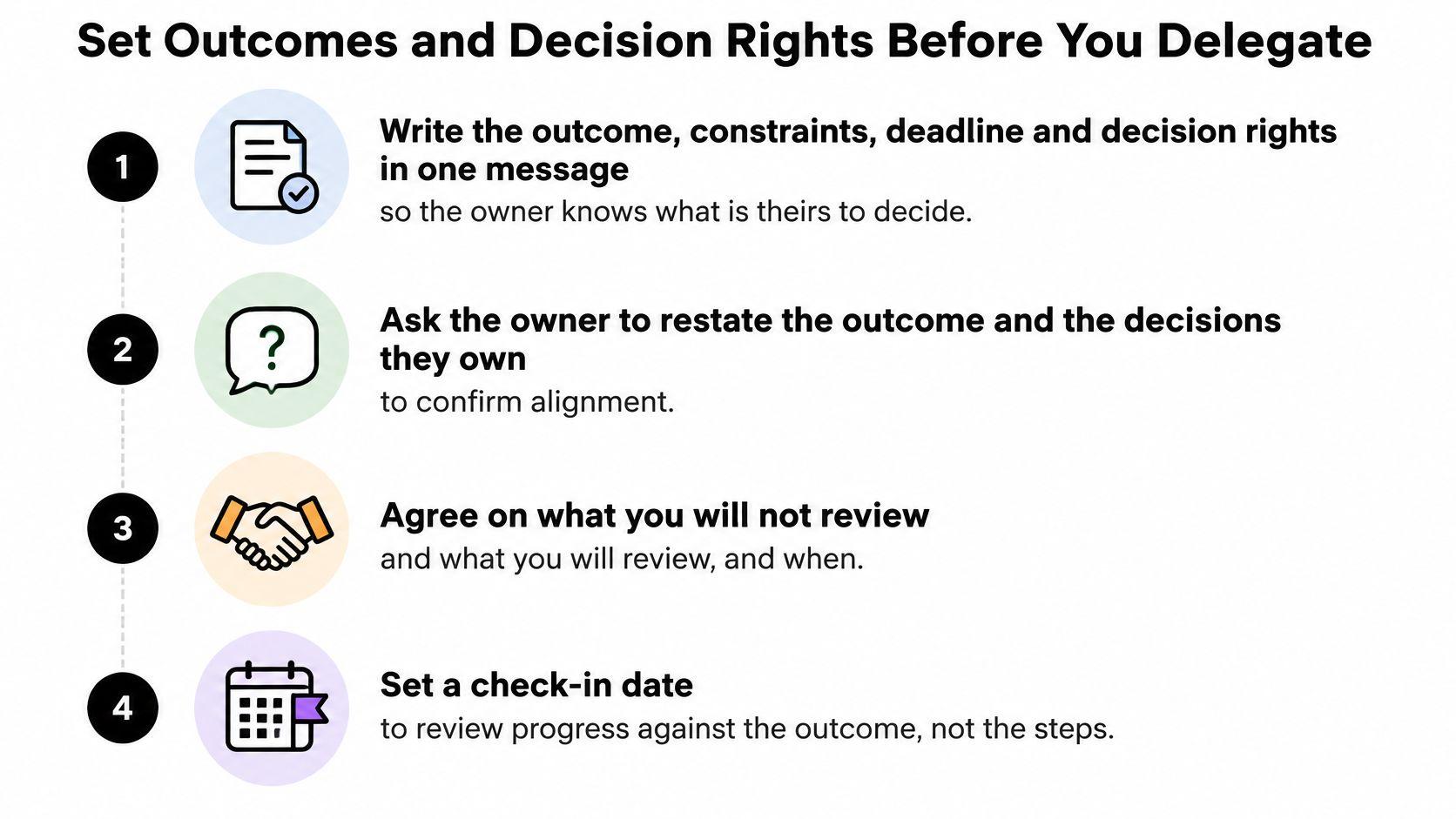
The Five-Step Handoff
- Write the outcome, constraints, deadline and decision rights in one message. Name what the owner can decide, what needs your approval and what would trigger an escalation. A RACI matrix template can help record who is responsible, accountable, consulted and informed.
- Ask the owner to propose the execution plan and how they would divide the work. Their plan shows whether the brief is clear and gives them ownership of the sequence.
- Set two or three review points tied to risk. Give each one a date and a question to answer. That gives you visibility without turning the handoff into a stream of status requests.
- At each review, compare evidence with the agreed outcome. If the result is on track, leave the method alone. If it is not, address the gap against the brief rather than prescribing every next move.
- Hold a short retrospective after delivery. Identify whether the brief, decision boundary or execution created friction, then adjust the next handoff.
For a launch page, the owner might control the copy structure, section order, and layout. You might retain authority over the price claim and legal wording because those carry commitments the owner cannot verify alone. Set those boundaries clearly. If the work also needs hands-on support, you can hire a virtual assistant for repetitive tasks while keeping decisions that require your authority with you.
Three Pitfalls That Undo the Handoff
Delegating without authority leaves the owner accountable but unable to act. “Own the page” means little if they cannot book the designer or decline a request that threatens the deadline. Changing success criteria midstream creates a moving finish line. If you add a mobile requirement at a later review, explain the change and agree on its impact rather than treating it as part of the original brief. Confusing visibility with control turns access into surveillance. Give people the information and review structure needed to report progress without watching every edit.
Before you close the brief, watch someone who does this well:
Use one final check: can the owner explain what done looks like and what would make them escalate, without opening the brief? If not, clarify the handoff before the work starts.
Replace Daily Check-Ins With Planned Review Points
Say a new hire is reconciling invoices for the first time. Give her 20 invoices rather than the full month, one review before the deadline, and an escalation trigger: any discrepancy above the threshold you agree. She picks the order she works in and whether she builds a spreadsheet or filters the export. Risk stays visible and you never prescribed the method.
The research backs the caution and the boundary in one place. A 2025 review of research on micromanagement found that excessive control generally reduces employee autonomy and job satisfaction while increasing stress and turnover, and also identified where close supervision helps: less-experienced employees and high-risk, process-driven work, where structure strengthens self-efficacy. As competence grows, oversight should shift toward clearer outcomes, support and periodic check-ins.
Daily contact isn't the problem on its own. A study of 86 Norwegian Navy cadets on a 30-day transatlantic voyage, with 2,022 daily observations and a 97% response rate, found daily leader support for autonomy was positively associated with engagement through satisfaction of autonomy, competence and relatedness needs, with the autonomy pathway significant at β = .050, p < .001, according to this European Journal of Work and Organizational Psychology study. Talk to people daily. Just stop reviewing their keystrokes daily.
Check-In Cadence by Task Risk and Experience
| Situation | Review Points | Escalation Trigger | Who Decides |
|---|---|---|---|
| Experienced owner, low-risk task | One review at the deadline | Missed milestone | Owner |
| Experienced owner, high-impact task | Two reviews tied to named risks | Quality problem or scope change | Owner, with manager sign-off |
| New or inexperienced owner | Three reviews, with a smaller first outcome | Blocked for more than one working day | Owner and manager together |
| Regulated or safety-critical work | Fixed milestone reviews plus a compliance check | Any gap in the control process | Manager and compliance |
Written updates carry most of this weight. Good asynchronous communication means the evidence is already waiting when the review point arrives, so the conversation is a decision rather than a download.
The risk-versus-anxiety test: a real risk has a named dependency, a missed milestone or a scope change attached to it. Anxiety is a feeling with no trigger. Ask yourself which specific event would make you step in, then write that trigger down before the work starts. If you can't name one, you're not reviewing anything, you're reassuring yourself.
Stay Informed and Start One Change
Status requests aren't a personality tic. They're what a manager does when the system shows nothing until asked. Fix the system and the requests mostly dry up.
Make the Work Observable
A shared tracker clears the bar when it shows four things per item: a single named owner, a deadline, the current state, and any open blocker. That's the whole requirement. Teams that add activity logging, keystroke monitoring or per-person output counters rebuild the same control with better instruments. Recent management research on balancing control and autonomy in hybrid and remote work treats observability, not surveillance, as the way to hold that balance, and it raises the question most guides dodge: which information should a manager see, how often, and who decides when intervention is justified?
Ask each owner for a milestone update in three lines: what's done, what's blocked, what comes next. Then set exception alerts, so they tell you only when a deadline moves, a dependency stalls or the scope changes. Permission is the other half of the problem. In a 2025 survey of 1,500 workers reported by HR Dive, 77% said they felt trusted at work but only 49% said they felt able to take action without waiting for permission. That gap is a decision-rights failure, not a confidence failure.
Decide Who Sees What, Then Say It Out Loud
Keep your view at team-level progress and exceptions. Be explicit about what you watch and why, and ask which updates help and which feel like an audit. People tolerate visibility they understand and resent visibility they discover.
The test for any monitoring tool: would you be comfortable posting its full list of tracked fields in the team channel? If not, it isn't oversight, it's a search for evidence.
One Change This Week
Pick a single recurring task you currently check repeatedly. Send the owner one message containing the outcome, the decision rights and one review point, and name the exact event that would make you step in. Then delete one routine status request tied to that task and replace it with the three-line milestone update. That's the whole experiment, and it takes fifteen minutes.
Fluidwave is built as a personal task system that sits beside your team's existing tracker, and each person's Active list shows only the tasks they can work on now, ordered by auto-prioritization, with anything waiting on a teammate hidden. Ownership becomes visible without a request landing in anyone's inbox.
Measure Whether Your Oversight Is Working
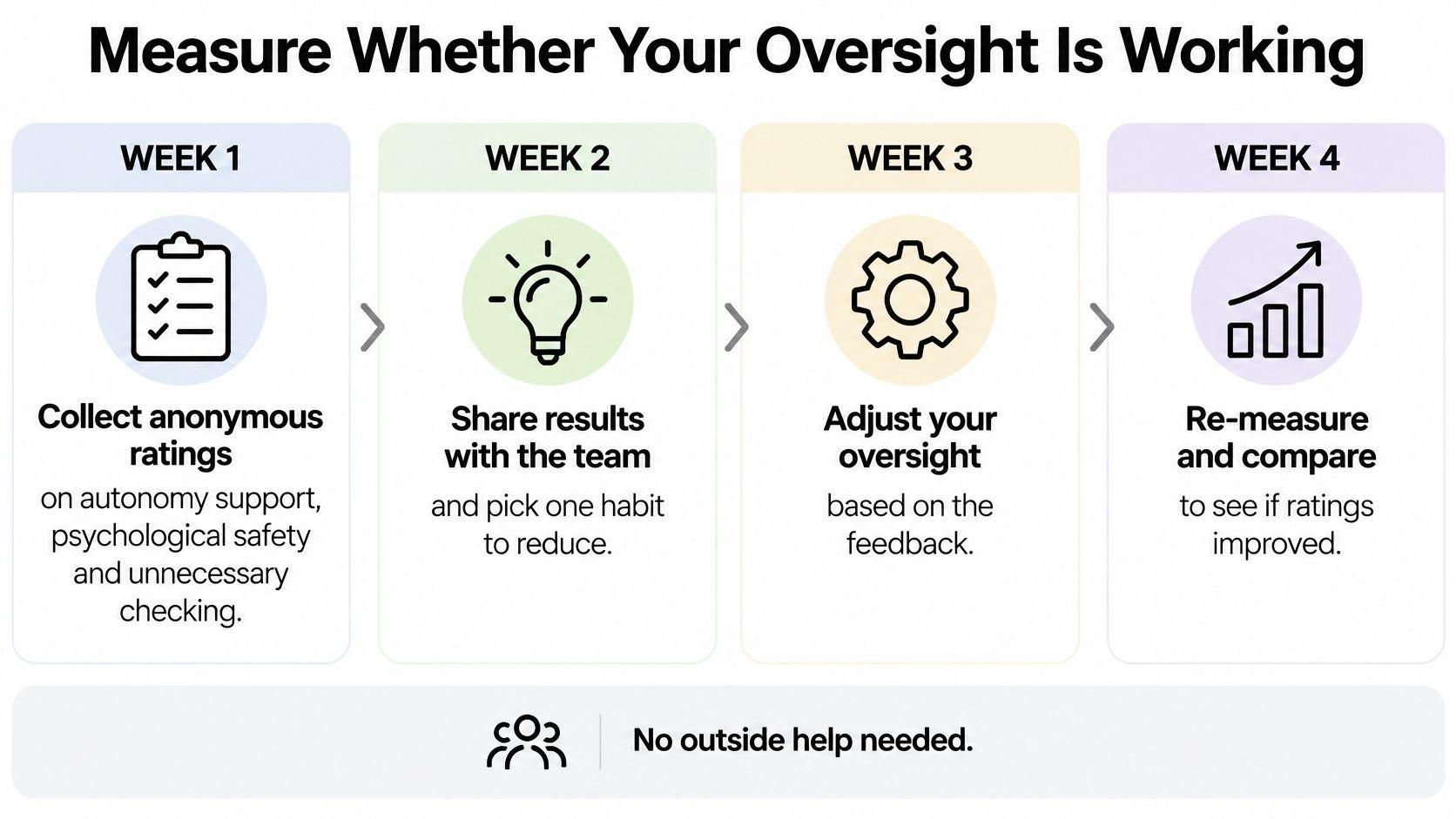
You stopped the daily check-in. A week later the pings are back, because quiet is not the same as working oversight. Run four weeks with a baseline and an outcome. Treat the result as a visibility problem you can redesign, not a personality flaw you have to outgrow.
Week 1 is measurement only. Collect anonymous ratings from your team on autonomy support, psychological safety and unnecessary checking. Weeks 2 and 3 are practice: ask a diagnostic question before offering a solution, give bounded choices instead of open-ended instructions ("pick one of these two angles" rather than "make it pop"), and schedule feedback instead of interrupting with it. Week 4 is comparison: set the ratings beside delivery quality, rework, cycle time and how often people seek feedback on their own.
A quasi-experimental workplace training study involving seven managers and 39 employees found a statistically significant increase in perceived autonomy support after training, with a large reported effect size (η² = 0.14; t(35) = 3.323; p < .001), alongside improvements in autonomous motivation, need satisfaction, engagement and burnout outcomes. Treat it as an encouraging benchmark rather than a forecast. The teams were not randomly assigned and the sample was small. That research also finds workplace coaching effective overall, without promising the same shift on your team.
The Three Numbers to Watch
Add one weekly pulse item on a 1 to 5 scale: "My manager gives me enough autonomy to complete my work." Then log every intervention you make and label it as a milestone review, a risk response or an unnecessary override. A milestone review is a planned look at an outcome. A risk response is an exception alert you named in advance, such as a slipped date or a blocked dependency. An override is you stepping in because the silence felt like negligence.
Show three things at the end of the month: the pulse score trend, the share of interventions that were overrides, and rework before and after.
The failure modes are predictable. Coaching people on autonomy while still holding approval rights fools nobody. Vague delegation ("own this") without a definition of done produces the anxiety you were trying to prevent. Measuring only short-term speed rewards the manager who hands over too much, too fast.
The keep-or-revert rule: if overrides fall and quality holds, keep the new rhythm. If quality drops, you handed over autonomy without clear outcomes, so return to the handoff and rewrite the outcome, the constraints and the decision rights before you touch the review cadence.
Book the first review now, two weeks out, and bring the intervention log with you. The log is what turns a good intention into a habit you can defend with evidence.
Fluidwave lets you create tasks, assign them to teammates, and see what needs doing next in one view, and you can hand a task to a skilled human assistant and pay only for completed work, so start with one task and a review date this week at Fluidwave.
Focus on What Matters.
Experience lightning-fast task management with AI-powered workflows. Our automation helps busy professionals save 4+ hours weekly.