Master asynchronous communication to boost deep work and reduce meetings. Learn when to use async vs sync, with templates and workflows.
August 18, 2026 (2mo ago)
Asynchronous Communication: Guide for Distributed Teams
Master asynchronous communication to boost deep work and reduce meetings. Learn when to use async vs sync, with templates and workflows.
← Back to blog
Most advice about asynchronous communication starts with the wrong question. It asks whether your team uses Slack, email, or a project-management tool, then assumes async work is already in place. In practice, many teams have only replaced meetings with long chat threads, constant notifications, and undocumented decisions. That isn't async-first work. It's a live conversation stretched across the day.
A useful operating model treats communication as part of workflow design. The team decides what information belongs in a durable record, what requires a response, and what benefits from people being present at the same time. The result isn't slower collaboration. It's less waiting, fewer interruptions, and clearer ownership, with live discussion reserved for work that needs rapid clarification or human nuance.
Redefining Asynchronous Communication for Modern Work
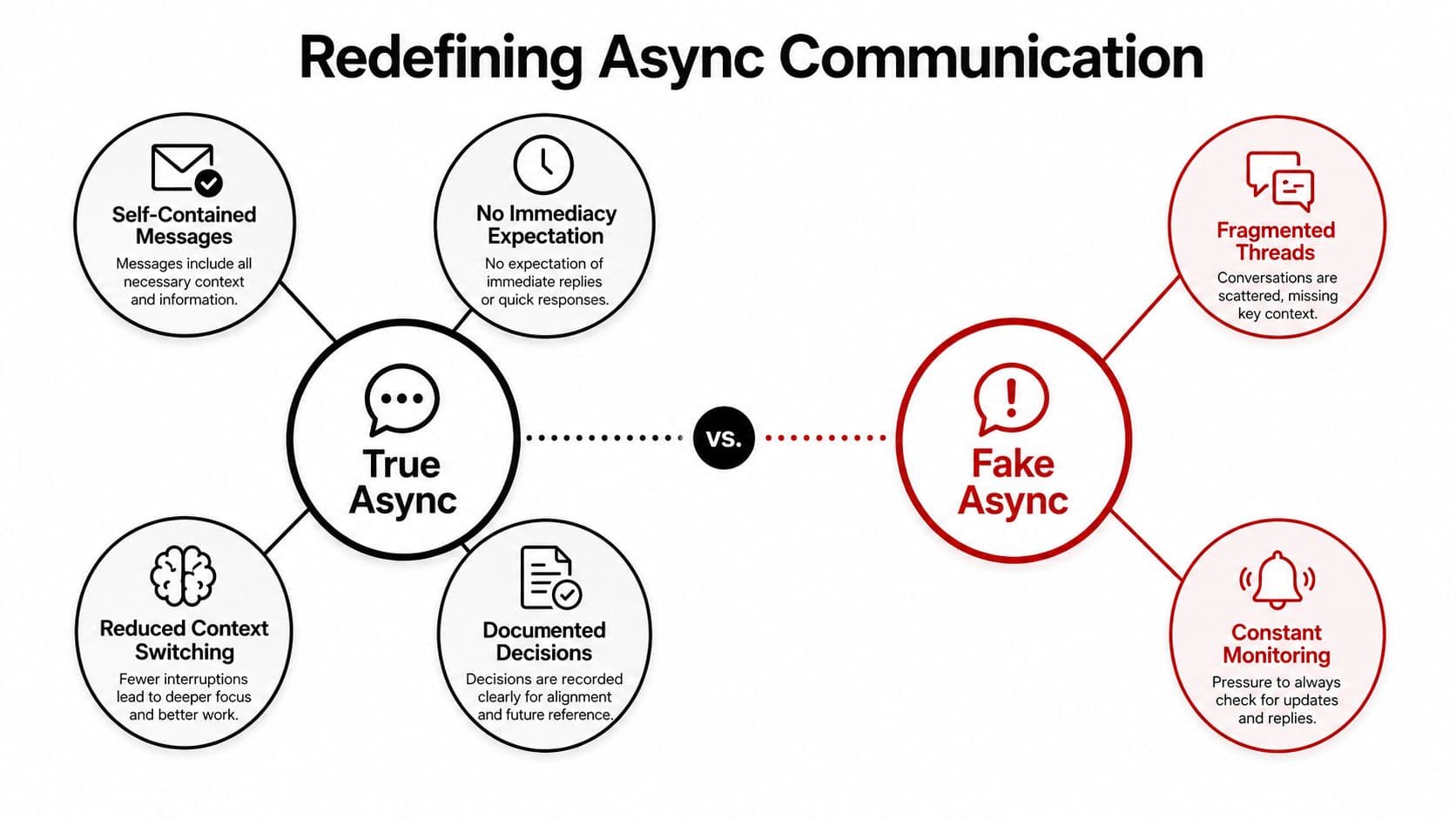
Asynchronous communication means people can send, receive, interpret, and act on information at different times, without an expectation of immediate participation. That definition sounds simple, but it excludes a surprising amount of workplace chat. A Slack message that demands an instant answer, a task buried beneath dozens of replies, or a direct message followed by repeated “just checking” prompts may be delayed communication, but it doesn't create a reliable async workflow.
True async communication packages information so another person can use it later. The message contains enough context to stand on its own, identifies the decision or action required, and gives the recipient a reasonable way to respond. The work moves through a queue rather than through a chain of interruptions.
Fake async creates a hidden coordination bill
Long chat threads create three costs that teams often miss:
- Context reconstruction: A colleague must read backward through fragmented replies to understand the original question, the latest version, and the decision.
- Availability pressure: People keep monitoring channels because the team hasn't separated urgent requests from routine work.
- Weak retrieval: Even when a decision exists somewhere in the thread, future teammates may not know which conversation contains it.
This is why a project-management task, decision log, shared document, or recorded walkthrough often works better than a busy channel. The tool matters less than whether the information has a stable home and an owner.
A practical test is simple: could a teammate who starts work several hours later understand the request, complete the next step, and find the relevant decision without waking the sender? If not, the workflow is probably fake async.
Practical rule: Delay is not the same as decoupling. A message becomes genuinely asynchronous when the recipient can act without reconstructing the sender's train of thought.
Teams that want to make this shift should define where different information lives. Chat can handle lightweight coordination and alerts. A task record should hold ownership, status, deadlines, files, and the current ask. A decision log should preserve the conclusion and its rationale. A practical guide to asynchronous collaboration tools can help teams compare these layers without treating every channel as interchangeable.
The Measurable Impact on Task Completion and Deep Work
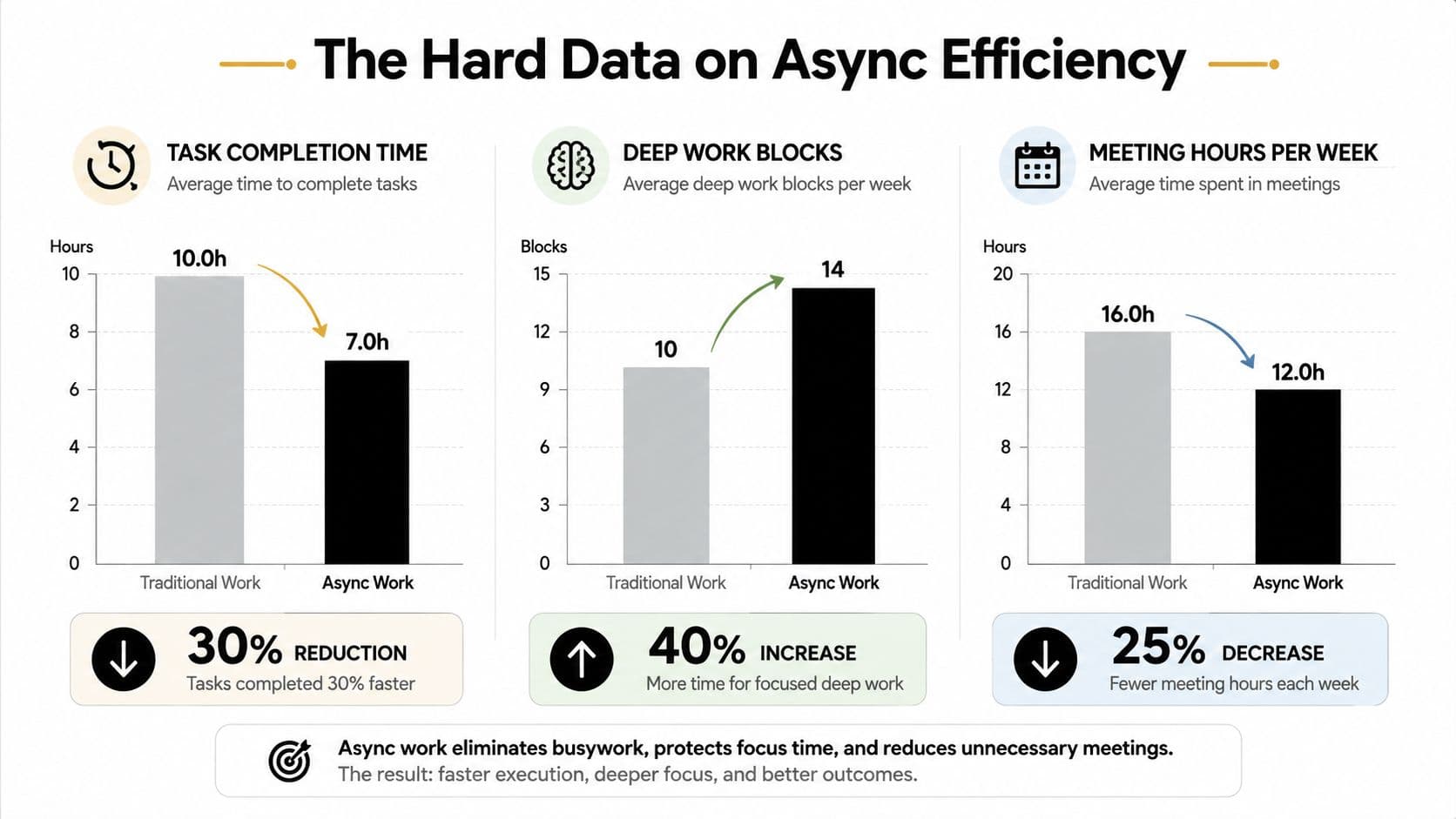
Async work often feels slower because the response doesn't arrive immediately. That perception confuses local speed with system throughput. A live exchange may resolve one question quickly, but the meeting, interruption, scheduling delay, and recovery time can make the complete task slower than a well-formed written handoff.
A 2020 peer-reviewed study found that asynchronous communication reduced average task completion time by 20.1 minutes, producing a mean 58.8% time reduction compared with traditional synchronous methods, with the result reported as statistically significant at p<0.01. The findings are available in the PubMed Central study on asynchronous and synchronous communication.
Why coordination overhead changes throughput
The underlying task doesn't need to change for completion time to improve. The communication mode can alter how often a person waits for clarification, approval, or a colleague's availability. Moving routine coordination into a task record lets someone prepare the work once, answer when ready, and leave a usable trail for the next person.
That matters most when a team handles recurring requests. A small delay repeated across many approvals or handoffs becomes a meaningful capacity problem. Async doesn't eliminate waiting, but it makes waiting visible and decouples it from constant attention.
The same logic applies to deep work. A person who checks a message, attends a short call, and returns to a complex task hasn't lost only the meeting's duration. They also need to recover the task context. Batching non-urgent communication gives people a better chance to protect uninterrupted work blocks.
A report from an independent source describes teams with strong asynchronous norms as having 22% fewer unnecessary meetings, 18% higher deep-work hours per week, and 15% higher self-reported productivity than sync-heavy remote teams. Those figures appear in the report on remote-work asynchronous communication.
The productivity paradox is therefore predictable. Async can feel slower during the first exchange because the team isn't forcing an instant answer. It can still produce faster delivery because fewer tasks sit on the critical path of calendars, interruptions, and repeated clarification.
For readers who want a concise treatment of protecting focused work, this deep work summary offers a useful companion perspective.
Choosing Between Async and Sync Based on Task Ambiguity
Time zones are a reason to use async, but they shouldn't be the decision rule. The better question is whether the work can be described precisely enough for someone else to continue without immediate clarification.
A task with low ambiguity and a clear output usually belongs in an async channel. A task with high ambiguity may need a live conversation, even if everyone works in the same office. Urgency adds a second dimension. A well-defined urgent task can use a short, direct message or alert. An ambiguous, high-stakes issue often needs a call because the cost of misunderstanding exceeds the cost of interruption.
Async vs Sync Decision Matrix
| Task Characteristic | Best Mode | Example Scenario |
|---|---|---|
| Low ambiguity, flexible timing | Async | Approving a documented expense or reviewing a complete draft |
| Low ambiguity, urgent response | Async with an explicit escalation path | Confirming whether a known operational issue has been resolved |
| High ambiguity, flexible timing | Async first, then sync if questions remain | Sharing a written proposal before discussing competing options |
| High ambiguity, urgent | Sync | Resolving a live incident where facts are changing quickly |
| Sensitive or emotionally complex | Sync, followed by async documentation | Giving difficult feedback and recording agreed next steps |
| Repetitive, rule-based work | Async | Assigning a research request with a defined format and deadline |
The sync tax appears when a team schedules a meeting before reducing ambiguity. Participants spend live time discovering the background, defining the problem, and identifying missing information. A short pre-read can move that setup work into async space, leaving the meeting for judgment, trade-offs, and decisions.
That doesn't mean every meeting needs a document. If the issue is unclear, a conversation can be the fastest way to expose assumptions. The discipline is to make the call do work that writing can't do efficiently, rather than using a call to compensate for an incomplete request.
A useful routing sequence is:
- Can the recipient act from a complete written brief? If yes, use async.
- Does the task require rapid back-and-forth or shared interpretation? If yes, consider sync.
- Will the decision affect future work? Use a durable async record before or after the live discussion.
- Is the request urgent? State the deadline and escalation route instead of relying on implied immediacy.
The best teams don't eliminate live communication. They make it intentional.
Writing Self-Contained Messages That Prevent Bottlenecks
Async communication fails when the first message contains only a question. “Can you look at this?” forces the recipient to ask what to review, why it matters, what decision is needed, and when the work is due. Each missing detail creates another turn in the thread.
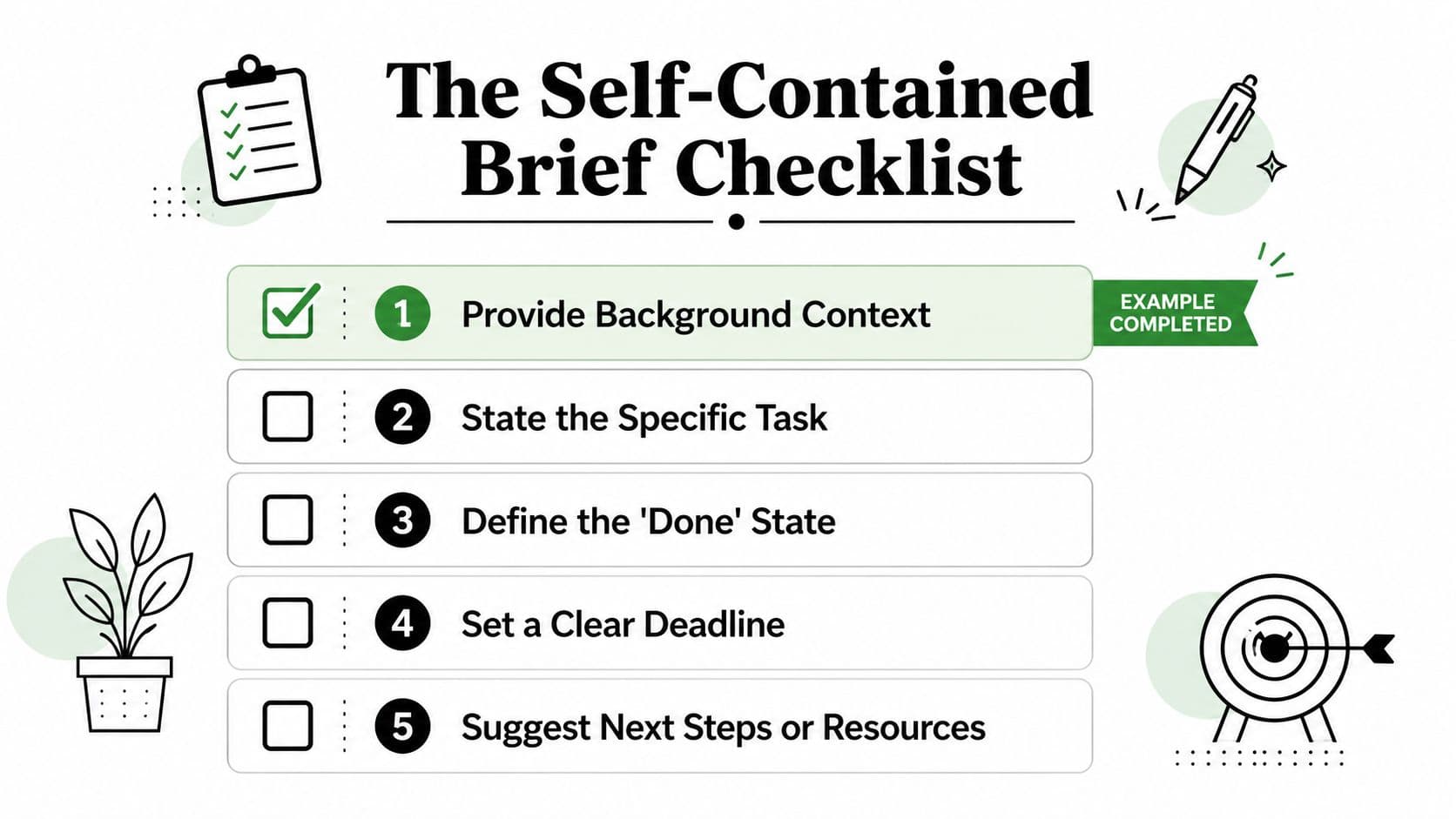
A self-contained brief gives the next person enough information to make progress without the sender's presence. It doesn't need to be long. It needs to be complete.
The five parts of a usable async brief
Background context explains why the task exists and what has already happened. Link to the relevant document, customer request, decision, or prior task instead of making the recipient search.
The specific task states one clear action. “Review the pricing page and list factual errors in the shared document” is easier to execute than “take a look at pricing.”
The done state defines the expected output. Specify whether completion means a recommendation, a marked-up file, a short summary, or a decision request.
The deadline and response expectation separate the due date from the moment the recipient reads the message. If the work isn't urgent, say so. If it is urgent, state what happens when the deadline can't be met.
Resources and next steps remove predictable blockers. Include templates, examples, owners, access details, and the person who should receive the finished work.
Templates that reduce back-and-forth
For a status update, use: Current state, completed work, open risk, next action, owner, deadline. This format lets a manager scan progress without requesting a meeting.
For delegation, use: Purpose, task, constraints, output format, definition of done, deadline, escalation route. Constraints might include approved sources, a spending limit, a required audience, or a file type.
For feedback, separate observations from requests. Identify the exact section, describe the issue, explain the impact, and propose the change or ask a focused question. The recipient should know whether they need to revise, decide, or just acknowledge.
A strong async message doesn't make the recipient guess what “done” means.
Store the brief with the work, not only in chat. That choice turns a one-time request into reusable organizational context and helps someone else take over when priorities change.
Building Team Norms That Protect Focus and Cohesion
Individual writing habits won't fix a team that rewards instant replies. People follow the loudest signal. If managers send routine requests through direct messages and praise whoever answers first, employees will monitor every channel regardless of the stated async policy.
A Team Communication Charter gives the group a shared operating system. It should name the purpose of each channel, the expected response window, the escalation path, and the situations that warrant a live conversation. Keep it short enough to use during a busy day.
A practical charter structure
- Chat: Use for lightweight coordination, alerts, and questions that don't need a permanent record.
- Tasks and documents: Use for ownership, requirements, decisions, progress, files, and review comments.
- Email: Use for external communication, formal notices, and recipients who aren't inside the team's task system.
- Live meetings: Use for incidents, sensitive conversations, ambiguous decisions, relationship-building, and work that benefits from rapid exchange.
- Escalation: Use a clearly named urgent route, with an explicit statement that routine messages don't belong there.
Response windows reduce anxiety because they replace guesswork with a shared expectation. The exact window should match the team's work rather than become an arbitrary promise. A request can be acknowledged without being completed, and a status can say when the owner will return with an answer.
Async also needs a social layer. Teams can maintain cohesion through deliberate one-to-ones, onboarding conversations, retrospectives, informal written updates, and occasional live gatherings. The risk isn't fewer meetings. The risk is removing the interactions that help colleagues build trust while leaving no replacement.
Research on hybrid IT teams emphasizes that a balanced use of synchronous and asynchronous communication supports cohesion, while excessive reliance on async can weaken shared context. It also links task type to channel choice, with async better suited to precision and documentation, and live clarification better suited to complex or ambiguous work. See the hybrid-work research on communication balance and cohesion.
The same principle applies outside internal delivery. Teams that coordinate interviews can use documented ownership and clear handoffs to reduce candidate scheduling delays, while reserving live conversations for the human moments that need nuance.
Implementing Async Workflows with AI and Task Management
A structured async workflow lets a leader delegate an outcome instead of supervising every exchange. Consider an executive who needs a competitor research brief for an upcoming planning session. The request can be entered as one task with the business question, approved sources, budget, deadline, audience, and required output format.
The task system then becomes the coordination point. A human assistant can gather and organize information, while an AI assistant can help classify material, summarize findings, or identify gaps for review. The executive doesn't need to schedule a kickoff call if the task contains enough context to begin.
What the handoff should contain
The task should define:
- The outcome: A decision-ready research brief, not “research competitors.”
- The boundaries: Which competitors, markets, sources, and assumptions belong in scope.
- The deliverable: A document, table, presentation outline, or recommendation.
- The controls: Budget, deadline, reviewer, and escalation rule.
- The acceptance test: What makes the work complete and usable.
The assistant posts progress in the task record, flags uncertainty, and attaches source material there. The executive reviews the result when convenient, requests a targeted revision if needed, and leaves the final decision in the same workspace. That sequence preserves context and makes the handoff visible without creating a live coordination chain.
AI changes the design problem because a system must decide not only what to communicate, but when a message is useful and whether the information remains fresh. Recent work on hybrid organizations and LLM agents treats timing, message freshness, and novelty as measurable parts of communication design, including research on asynchronous information exchange among hybrid workers. The research on hybrid work and LLM agents provides background for this shift.
Platforms such as Fluidwave combine task organization, automated prioritization, and delegation to human or AI assistants, giving teams a place to manage the outcome and its supporting updates. Its AI task management approach is relevant when the main problem is not a lack of messages, but too much manual coordination around routine work.
A Rollout Plan for Leaders and Distributed Teams
Async adoption works better as an operating experiment than as a company-wide slogan. Start by observing where work stalls. Review recurring meetings, repeated status requests, unclear ownership, and decisions that people can't locate later.
A four-week rollout
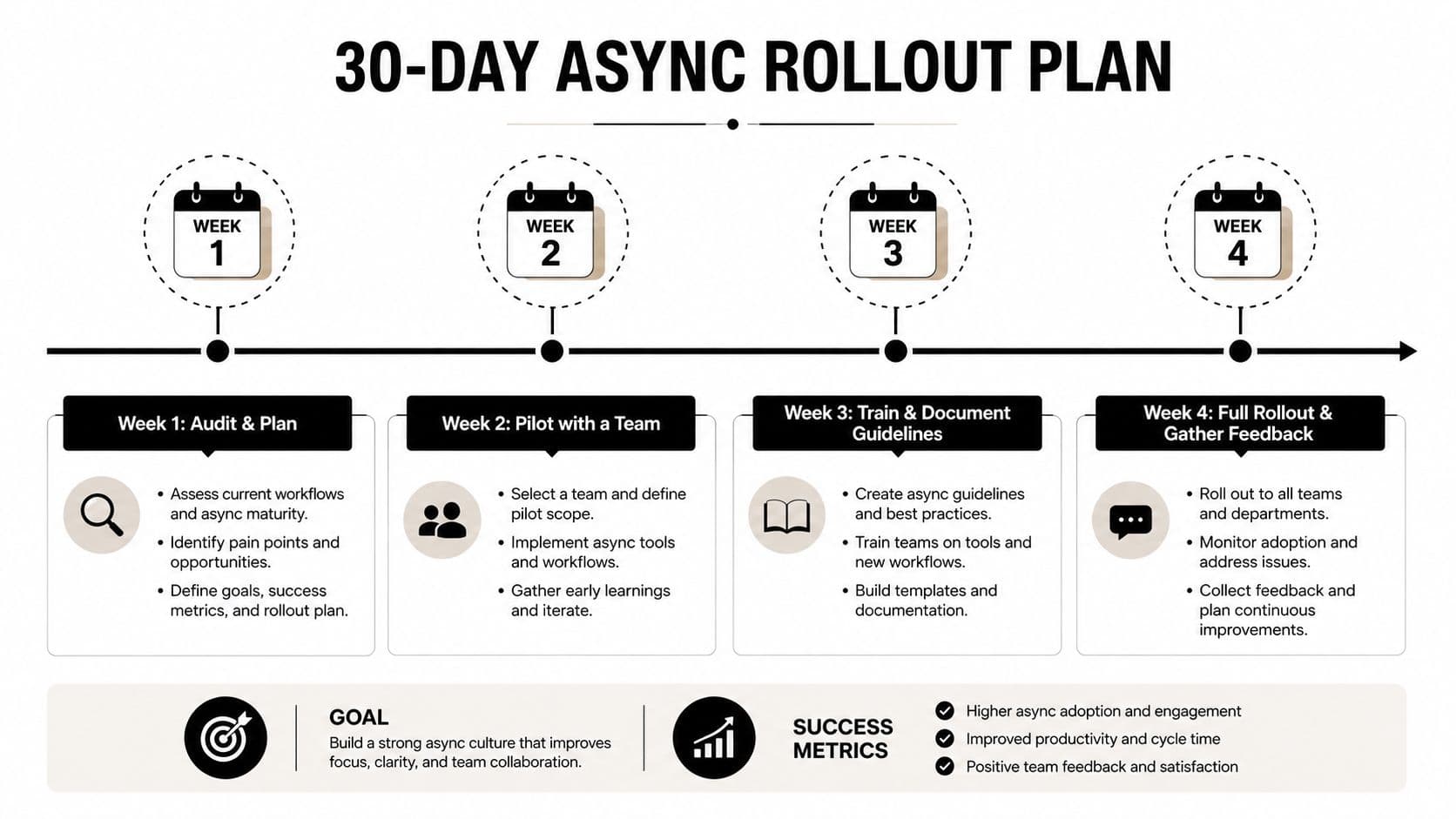
Week 1, audit and plan: List the team's meetings and classify each as necessary, replaceable, or poorly designed. Identify the most common handoff failures, choose a primary home for tasks and decisions, and draft the communication charter.
Week 2, pilot with one team: Move routine updates, reviews, and delegations into the chosen async workflow. Add a no-meeting day if the work allows it, but keep an escalation route for urgent or ambiguous issues.
Week 3, train and document: Teach people how to write self-contained briefs, record decisions, set response expectations, and close tasks. Managers should model the behavior by stopping routine “quick questions” that lack context.
Week 4, roll out and gather feedback: Expand the norms, review what created friction, and adjust the channel rules. Ask where information was hard to find, which requests remained ambiguous, and where a live discussion saved time.
Metrics and failure signals
Track task cycle time, interruptions, meeting load, overdue handoffs, and the time people spend in focused work. The goal isn't to maximize async activity. It's to improve flow while retaining alignment and cohesion.
Watch for async hoarding, where people document everything but fail to notify the people who need to act. Also watch for silent delays, duplicated work, buried decisions, and isolation. A task isn't successful because it exists. It succeeds when the right person can find it, understand it, and move it forward.
A 2022 to 2023 remote-work survey cited in an industry summary reported that 65% of remote team communication happened asynchronously, while only 39% of respondents said their organizations had explicit norms for deciding between synchronous and asynchronous work. Those figures are reported in the summary of asynchronous-work statistics. The operational lesson is clear: teams may already be working async by habit, but leaders still need to design the rules.
An async rollout should leave you with fewer accidental interruptions, stronger records, and a clear answer to one question: does this work need a person now, or does it need a well-designed handoff?
Fluidwave gives busy teams a central place to create, prioritize, delegate, and track tasks with documented updates instead of scattered conversations. If you want to turn asynchronous communication into a dependable operating workflow, visit Fluidwave and start by moving one recurring coordination process into a structured task.
Focus on What Matters.
Experience lightning-fast task management with AI-powered workflows. Our automation helps busy professionals save 4+ hours weekly.