Explore 10 goals for project managers, with SMART examples, KPIs, templates, and practical ways to track progress with Fluidwave.
September 29, 2026 (4d ago)
10 Goals for Project Managers That Drive Results
Explore 10 goals for project managers, with SMART examples, KPIs, templates, and practical ways to track progress with Fluidwave.
← Back to blog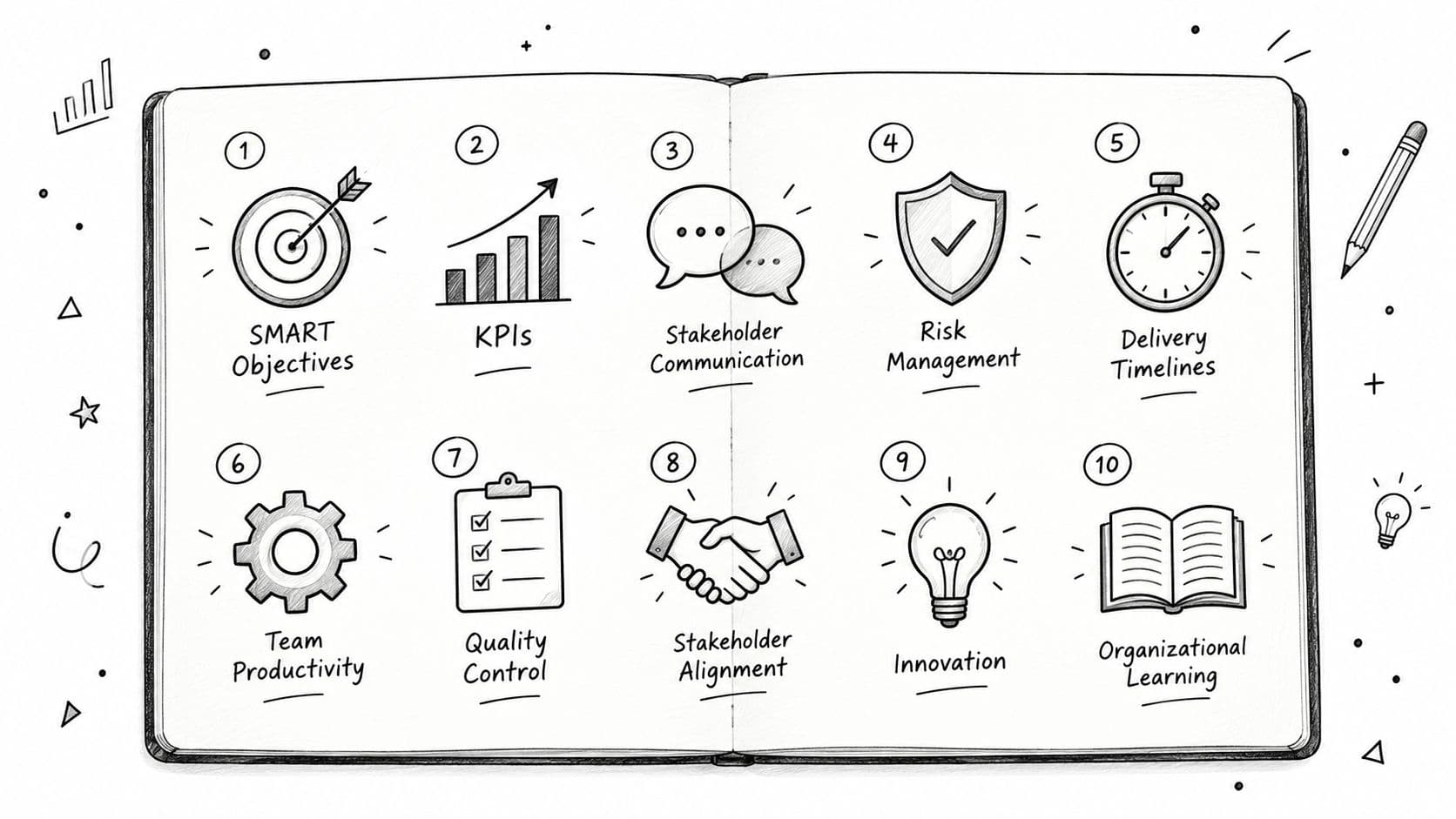
A project can be busy, well attended, and still drift. The calendar is full, meetings happen, tasks move across a board, and stakeholders receive regular updates. Yet the deadline slips, costs rise, or the final deliverable solves a different problem from the one the sponsor approved.
The problem usually isn't effort. It's that the project goals aren't measurable enough to guide daily decisions. “Improve communication” or “deliver successfully” sounds reasonable, but neither tells a team what to do when priorities compete.
The most useful goals for project managers work like operating systems. Each one connects an intended outcome to a SMART objective, a KPI, a realistic scenario, an owner, and a review habit. This list moves from delivery fundamentals through collaboration, focus, scope, capability, risk, resources, quality, stakeholder alignment, and organizational learning.
Use the same planning pattern for every goal: outcome, metric, target, owner, review cadence, and corrective action. That structure turns an ambition into something a team can see, discuss, and adjust before a small deviation becomes a project failure.
1. Deliver Projects on Time and Within Budget
A reliable project manager protects two promises at once: when the work will be delivered and what it will cost. Schedule and budget aren't administrative details. They shape trust, profitability, staffing decisions, and the sponsor's willingness to support the next initiative.
The practical objective might be: “Deliver the approved campaign by the launch date while keeping committed spend within the authorized budget, with milestone status reviewed every week.” The KPIs are milestone variance, planned versus actual spend, and forecast cost at completion. Assign one owner for schedule control and one budget approver, even when the project manager monitors both.
A software team can release a defined feature set through weekly sprint milestones. A construction manager can track each phase against its planned completion date before releasing the next contractor payment. A marketing lead can automate routine tasks while reserving budget for creative production and paid distribution.

Break the plan into milestones, identify critical-path work, and create a modest buffer for genuine uncertainty. Don't pad every task, because inflated estimates hide weak planning and make trade-offs harder to see. Fluidwave's auto-prioritization can help surface urgent work, while delegated administrative tasks can preserve specialist capacity.
Practical rule: Review the burn-down or milestone trend weekly, then record the corrective action beside the slipping task, not in a separate meeting note.
A clear deadline management workflow also needs approval rules before work starts. PMI's 2024 research found that only 48% of projects were rated successful, while 40% had mixed results and 12% were outright failures. PMI combined those figures into a Global Net Project Success Score of 36, a useful reminder that delivery success must be judged by value, not activity alone. PMI's project-success analysis provides the context.
2. Improve Team Collaboration and Communication
A shared task board doesn't automatically create collaboration. People collaborate when they know which information belongs where, who owns the next decision, and when a response is needed.
Set a SMART objective such as: “Keep all active deliverables assigned, documented, and visible in one workflow, with unresolved decisions reviewed during the weekly project check-in.” Useful KPIs include overdue dependency count, decision turnaround time, unassigned task count, and rework caused by unclear requirements.
A design and engineering team preparing a product launch might use a shared board for specifications, dependencies, reviews, and approvals. A remote-first company may use an async-first workflow so people in different time zones can contribute without turning every decision into a meeting. An agency can centralize client requests instead of allowing important changes to disappear in email threads.
Write communication norms into the project itself:
- Choose the right channel: Put decisions in the project record, urgent blockers in the agreed escalation channel, and routine updates in the task.
- Define response expectations: State when owners should acknowledge a request and when a delay must be escalated.
- Make dependencies explicit: Link the design approval to the engineering task so the next owner can see what is blocking progress.
- Use repeatable templates: Standardize kickoff notes, status updates, meeting decisions, and handoffs.
Fluidwave's real-time collaboration features, task templates, calendar view, and automated progress notifications can support this operating rhythm. A virtual assistant can also prepare agendas, chase missing updates, and keep administrative coordination from consuming the team's working time.
A project manager should still protect space for difficult conversations. Tools expose the work, but they don't resolve conflicting priorities or unclear authority. Use a concise project communication plan to define who receives what, through which channel, and at what cadence.
3. Enhance Team Productivity and Focus
Productivity isn't the number of tasks a team touches. It's the amount of valuable work completed without exhausting attention through constant switching.
A useful objective is: “Protect scheduled focus blocks for priority deliverables and reduce avoidable interruptions by reviewing task load at the start and end of each workday.” Track completed priority work, blocked-task age, interruption categories, and time recovered through automation. The project manager owns the workflow design, while each team member owns honest task status.
An engineering team might reserve a four-hour coding block and check messages at defined points. A content team can separate writing, editing, and publishing rather than mixing them across the day. A consultant can protect client delivery time while batching internal administration. These practices can also help neurodivergent colleagues and people with ADHD who find frequent context switching particularly costly.
Use a short daily routine:
- Prioritize the day: Confirm the few tasks that matter most before opening lower-value requests.
- Protect concentration: Block focus time on the calendar and use a “Do Not Disturb” status where appropriate.
- Batch similar work: Group reviews, approvals, and administrative actions into deliberate windows.
- Delegate maintenance: Send email triage, data cleanup, and routine coordination to a virtual assistant when the work doesn't require project judgment.
Fluidwave's auto-prioritization, list view, calendar planning, and delegation workflow can make the priority visible without forcing every person into the same work style. Switch to Kanban when the team needs a collaborative flow review, then return to a focused list for individual execution.
The trade-off is important. More automation doesn't always mean more productivity. If notifications multiply or every task becomes a status exercise, the system creates the distraction it was meant to remove. Use work-in-progress limits to stop the team from starting more work than it can finish.
4. Manage Scope Creep and Change Control
Scope creep rarely arrives as one dramatic request. It appears as a small enhancement, an extra audience, a revised approval path, or a “quick” reporting change. Each addition seems harmless until the original deadline and budget have to absorb it.
Set the objective as: “Evaluate every requested change for impact on scope, time, cost, quality, and capacity before approval.” Track the number of submitted changes, approved changes, rejected changes, cumulative effort added, and the resulting milestone variance. The project manager owns the change log, but the sponsor owns decisions that alter the approved business case.
Consider a software team protecting an MVP with sprint boundaries. A client services firm can require a written change order before adding work. A product team can separate “MVP” and “Future” sections so stakeholders see that a deferred feature hasn't been forgotten. An agency can document out-of-scope items during kickoff, when expectations are easiest to align.
A reusable change-request task should contain:
- Requested outcome: What problem does the change solve?
- Impact assessment: What work, people, cost, and time will it add?
- Trade-off: What will move, shrink, or stop if the change is approved?
- Decision owner: Who has authority to approve it?
- Decision date: When must the team know?
Fluidwave can keep the approved scope, future work, and change requests in separate views. A virtual assistant can triage incoming requests for completeness, but shouldn't approve business-impacting changes without delegated authority.
The goal isn't to reject every addition. It is to make the exchange visible. A sponsor may choose more scope over an earlier date, but that choice should appear in the project record rather than being treated as free work.
5. Develop Team Skills and Capabilities
A project can meet its immediate deadline and still leave the organization weaker if only one person knows how the work was done. Capability building turns delivery into an investment rather than a series of isolated rescues.
Use an objective such as: “Give each critical workstream a documented owner, a backup contributor, and a defined learning outcome before the next major milestone.” Track completed mentoring tasks, documented procedures, backup coverage, and the number of deliverables completed with reduced supervision.
A startup might pair a junior engineer with a senior engineer on a production feature. A consulting firm can rotate people across service lines to build versatility. A remote company can support structured learning through courses or certifications. A project post-mortem can capture not only what went wrong, but also which judgment calls should become reusable practice.
Create recurring tasks for:
- Onboarding: Record systems, access, terminology, and first deliverables.
- Mentorship: Pair a developing contributor with an experienced reviewer on real work.
- Knowledge sharing: Ask a team member to explain a tool, process, or decision.
- Lessons learned: Add the reasoning behind a successful approach to the task record.
Fluidwave can assign stretch tasks with explicit learning outcomes and keep lessons learned attached to the work where future contributors will find them. Delegating routine administration to virtual assistants can also give senior staff more time for coaching, review, and problem-solving.
Don't confuse skill development with sending people to training and hoping capability appears later. The learning must connect to a real deliverable, an accountable mentor, and evidence of changed behavior. Track capability alongside delivery, not as a separate human-resources exercise.
6. Identify and Mitigate Project Risks
Risk management works best before the risk becomes an incident. The project manager's job isn't to predict every problem. It's to make foreseeable uncertainty visible, assign responsibility, and define what the team will do if conditions change.
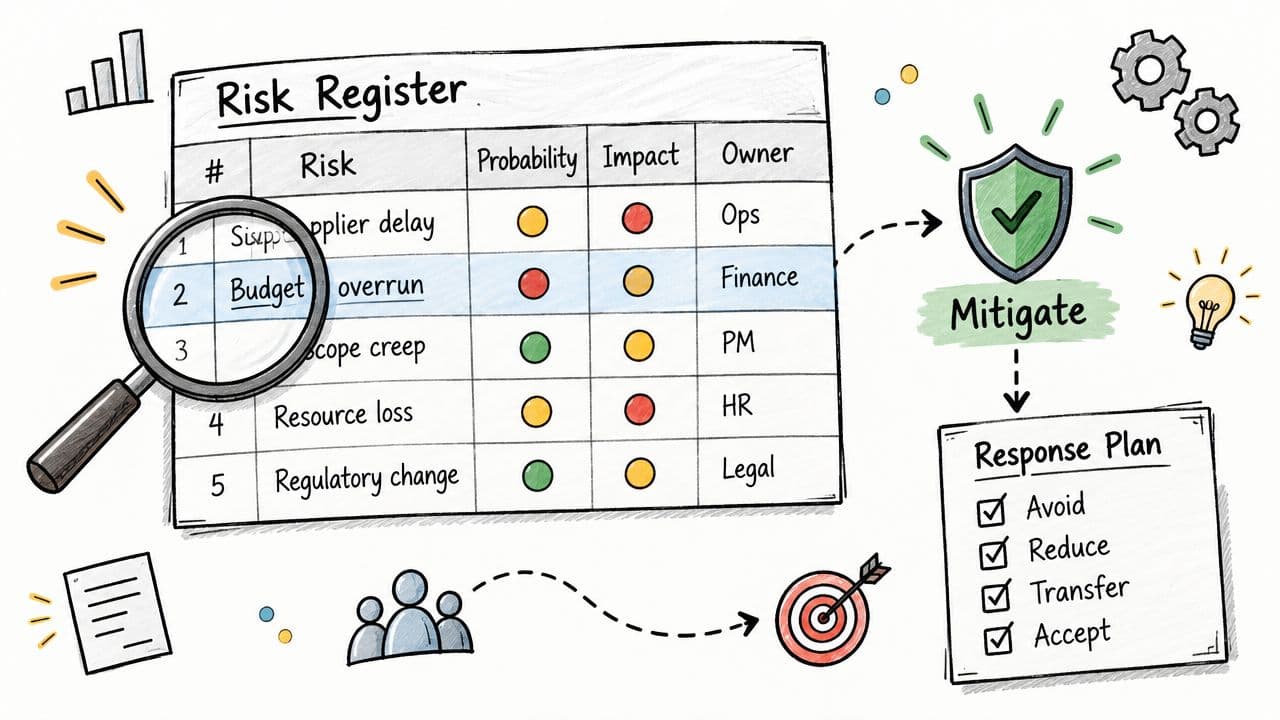
A SMART objective might read: “Review the active risk register at every project health meeting and confirm a response owner for every high-priority risk.” Track open risks by status, overdue mitigation actions, trigger conditions, and residual exposure after a response is in place.
A technology team may identify a key-person dependency for a critical system and create backup coverage. A product launch may prepare for vendor disruption by identifying alternative suppliers or sequencing work differently. A consulting project may flag client readiness as a risk and define the evidence that would trigger additional stakeholder support.
Use a dedicated risk-register structure with:
- Risk ID and description: State the uncertain event and its possible consequence.
- Probability and impact: Use a consistent qualitative scale so risks can be compared.
- Response plan: Avoid, reduce, transfer, or accept the risk deliberately.
- Trigger condition: Describe what would show that the response must begin.
- Owner and review date: Name the person responsible for monitoring it.
Fluidwave's table view can hold these fields in a visible workflow, while recurring review tasks keep the register from becoming a document that nobody opens. A virtual assistant can request updates and maintain the log, but the risk owner must assess changing conditions.
The trade-off is attention. A register with dozens of low-value entries can bury the risks that deserve action. Keep the review focused on uncertainty that could change the project's outcome, and link every important risk to a concrete next step.
7. Optimize Resource Allocation and Utilization
A project can have open calendar slots and still lack usable capacity. The missing ingredient may be a required skill, recent context, energy, or uninterrupted time. Resource allocation should therefore match priority work with people who can complete it under real operating conditions.
Set the objective as: “Match every priority deliverable to an owner with the required capability, visible capacity, and a realistic completion date, then review bottlenecks monthly.” Track planned versus available capacity, overloaded owners, unassigned priority work, rework caused by poor matching, and utilization trends.
A professional services firm may protect billable delivery by reserving specialist time without assigning every available hour. A startup founder can delegate research, scheduling, and routine operations to a virtual assistant, preserving personal capacity for strategy. A product team may balance feature work with technical debt rather than directing all capacity toward new functionality.
Do not plan for full utilization. Leave part of the schedule open for interruptions, support, estimation error, and recovery. Treat that buffer as a planning range, not a universal law. The right level depends on work type, predictability, and the cost of delay.
Fluidwave's calendar view can expose upcoming bottlenecks, while task estimates and skill requirements support better assignments. A multi-project tracking system helps leaders compare competing demands across projects, provided the underlying data stays current.
Capacity test: If one person is assigned to every urgent task, the project has a prioritization problem, not a superhero resource.
Use pay-per-task delegation for suitable low-skill work when flexible support fits the demand better than adding fixed capacity. Review the pattern monthly. Repeated overload points to a planning or staffing decision that no dashboard can make for you.
8. Maintain Quality Standards and Customer Satisfaction
Fast delivery is not successful delivery if the customer receives work that fails acceptance criteria. Quality belongs inside the workflow, where the team can prevent defects and clarify expectations, rather than at the very end when rework is expensive.
Write the objective as: “Complete each major deliverable against documented acceptance criteria, with review evidence recorded before customer approval.” Track escaped defects, rework tasks, approval cycle time, and customer satisfaction feedback. The project manager owns the quality process, while the person producing the deliverable remains accountable for its first-pass quality.
A software team can combine automated testing with code review. A service provider can schedule a post-delivery satisfaction survey. A product team can define quality measures before development begins. An agency can use client approvals at meaningful milestones so misalignment appears before final delivery.
Build quality into task design:
- Define done: State the required format, behavior, audience, and approval condition.
- Use workflow stages: Separate Draft, Review, and Approved so unfinished work isn't presented as complete.
- Create repeatable checks: Use a checklist for common technical, editorial, or compliance issues.
- Log defects visibly: Assign an owner and link the defect to the affected deliverable.
- Close the feedback loop: Schedule customer feedback as a recurring task instead of relying on memory.
Fluidwave's task phases and checklists can make quality gates visible. A virtual assistant can maintain defect logs and summarize recurring issues, but the project team must decide whether a pattern requires a process change.
PMI's measurement research found that 65% of organizations measured customer satisfaction, while 74% used adherence to scope. Those figures show why quality can't be reduced to internal completion alone. PMI's report on measuring project performance connects delivery measures with broader views of project success.
9. Maintain Stakeholder Engagement and Alignment
Stakeholder alignment can weaken without anyone announcing a disagreement. An executive changes priorities, a sponsor assumes a feature is included, or a client stops attending reviews because the project no longer feels relevant. The project manager sees the consequences later, usually as rework or a delayed decision.
Set the objective as: “Give each key stakeholder the information and decision opportunity needed for their role, with unresolved decisions escalated before they affect a milestone.” Track decision age, attendance from required decision-makers, unresolved assumptions, status changes, and feedback turnaround.
An executive team may need a compact dashboard with Red, Amber, or Green status. A sponsor may need a monthly summary that highlights decisions required rather than a long activity report. A steering committee may review scope and budget changes at a defined cadence. A client partnership may use regular demos to replace abstract progress claims with visible evidence.
Create a stakeholder communication task that records:
- Audience: Who needs the update?
- Purpose: Is the message informing, requesting a decision, or seeking feedback?
- Format: Dashboard, summary, demo, meeting, or written decision.
- Cadence: When will the stakeholder receive it?
- Escalation route: What happens when the response is late?
Fluidwave's table view can make project status visible, while recurring review tasks, shared calendar information, templates, and automated notifications reduce the need for stakeholders to ask for updates. A virtual assistant can prepare a draft status report, but the project manager must validate the message and surface bad news clearly.
PMI describes governance through portfolio direction, project sponsorship, management effectiveness and efficiency, and disclosure or reporting. Its governance guidance also distinguishes doing the project right from choosing the right project and sustaining success over time. That distinction keeps stakeholder conversations focused on value, not just activity.
10. Foster Organizational Learning and Continuous Improvement
A retrospective that produces no changed behavior is a conversation, not improvement. Teams learn when they capture a specific lesson, assign an action, and check whether the new practice appears in later work.
Use the objective: “Complete a post-project review, assign improvement owners, and verify adoption of agreed changes during the next project health review.” Track completed improvement actions, recurring issue frequency, adoption evidence, and time or quality changes connected to the improvement.
A software team might run a sprint retrospective every two weeks. A product organization can use product feedback to shape the next iteration. A consulting firm can maintain playbooks that evolve with delivery experience. Startup founders can document decision frameworks and revisit them when assumptions change.
Keep the review practical:
- What worked: Identify the behavior or decision worth repeating.
- What failed: Describe the process condition, not a person to blame.
- What changes next: Convert the lesson into a task with an owner and due date.
- How success appears: Define the observable evidence that the change was adopted.
Fluidwave can store a reusable review template, create a Best Practices view, assign follow-up actions, and schedule quarterly implementation reviews. Team members should document the details because they saw the work directly. Delegation can help format and organize the record, but it shouldn't remove the team's responsibility to think.
PMI's project metrics guidance says effective measures should be informative, predictive, objective, and automated, and that organizations use metrics for control baselines and future cost prediction. The PMI metrics guidance supports a useful discipline here: don't collect lessons or KPIs merely because they're easy to report. Keep the measures that help the next decision.
10-Point Comparison: Project Manager Goals
| Item | 🔄 Implementation Complexity | ⚡ Resource Requirements | 📊 Expected Outcomes | 💡 Ideal Use Cases | ⭐ Key Advantages |
|---|---|---|---|---|---|
| Deliver Projects On Time and Within Budget | Medium–High: needs scheduling, monitoring, change control | PMs, budgeting tools, regular reporting, contingency time | Reduced delays and cost overruns; predictable delivery 📊 | Client work, construction, sprint-based product delivery | Builds trust and predictable cash flow; reduces scope disputes ⭐ |
| Improve Team Collaboration and Communication | Medium: cultural change + tool adoption 🔄 | Real-time collaboration tools, shared boards, training | Faster decisions, less rework, higher engagement 📊 | Remote teams, cross-functional launches, agencies | Better alignment and accountability; reduces duplicate effort ⭐ |
| Enhance Team Productivity and Focus | Medium: requires discipline and workflow redesign 🔄 | Time-blocking tools, automation, focus-friendly interfaces | Higher output per person; fewer interruptions; measured time savings 📊 | Knowledge work, engineering, content creation | Increases throughput without hiring; supports neurodiverse work styles ⭐ |
| Manage Scope Creep and Change Control | High: formal processes, approvals, documentation 🔄 | Change request templates, approval workflows, stakeholder time | Controlled scope, fewer overruns, clearer expectations 📊 | Client services, fixed‑scope projects, MVP deliveries | Protects timeline and budget; clarifies commitments ⭐ |
| Develop Team Skills and Capabilities | Medium: ongoing programs and mentorship 🔄 | Training budget, mentors, time for learning, documentation | Improved internal capability; higher retention over time 📊 | Startups scaling junior hires, firms reducing contractor reliance | Builds long-term resilience and succession depth ⭐ |
| Identify and Mitigate Project Risks | Medium–High: structured identification and monitoring 🔄 | Risk register, owners, contingency reserves, periodic reviews | Fewer surprise crises; improved stakeholder confidence 📊 | Complex tech projects, launches with supply dependencies | Reduces firefighting; enables proactive responses ⭐ |
| Optimize Resource Allocation and Utilization | High: requires accurate data and balancing 🔄 | Capacity planning tools, skill inventories, ongoing review | Better profitability, reduced burnout, transparent capacity 📊 | Professional services, multi-project portfolios, startups | Maximizes value from existing staff; scalable via pay‑per‑task VAs ⭐ |
| Maintain Quality Standards and Customer Satisfaction | Medium: embed QA into workflow, collect feedback 🔄 | QA processes, testing tools, feedback loops, checklists | Higher customer satisfaction; fewer defects and rework 📊 | Software releases, service delivery, product launches | Strengthens brand and enables premium pricing through quality ⭐ |
| Maintain Stakeholder Engagement and Alignment | Medium: regular reporting + tailored communication 🔄 | Dashboards, executive summaries, scheduled reviews | Fewer late surprises; political support and faster approvals 📊 | Executive‑sponsored projects, client engagements, steering committees | Keeps decisions aligned with strategy; prevents misalignment ⭐ |
| Foster Organizational Learning and Continuous Improvement | Medium: cultural + process changes, recurring rituals 🔄 | Time for retrospectives, knowledge base, measurable improvements | Faster organizational learning; fewer repeat mistakes over time 📊 | Teams seeking long-term process gains, consultancies | Compounds small gains into lasting advantages; improves predictability ⭐ |
Make the Goals Visible, Owned, and Reviewable
Ten goals are too many for most project teams to pursue with equal intensity. Choose the goals that match the project's risk profile, then turn each selected goal into a small scorecard. A complex implementation may need delivery control, risk management, stakeholder visibility, and quality gates. A creative campaign may place more weight on scope, customer approval, resource capacity, and deadline reliability.
Write one SMART objective for each priority. The sentence should name the outcome, the metric, the target, the owner, and the review point. For example: “By the agreed launch date, complete all approved campaign deliverables within the authorized budget, with the project manager reviewing milestone and spend variance every Friday.” That sentence gives the team something more useful than “launch successfully.”
Pair each goal with a leading KPI and a lagging KPI. A leading KPI might be overdue risk actions, unassigned dependencies, decision age, or completed quality reviews. A lagging KPI might be final delivery variance, customer satisfaction, escaped defects, or benefits realized. Leading measures help the team intervene. Lagging measures tell you whether the intervention worked.
Assign a direct owner for every goal. The owner doesn't need to complete every task, but they must know the current status, the next review date, and the corrective action if the measure moves in the wrong direction. A task without an owner is a hope. A KPI without a decision rule is decoration.
Schedule the review before the project becomes busy. Weekly reviews suit delivery, scope, blockers, and spend. A recurring risk review keeps mitigation alive. Monthly capacity reviews expose overload trends. Post-project reviews should happen while the decisions and trade-offs are still clear, then improvement actions need a later adoption check.
Start with delivery, risk, and stakeholder visibility. Those three goals expose whether the work is moving, what could derail it, and whether the people who can help still agree with the direction. Add productivity, capability, and continuous improvement goals once the core operating rhythm is stable. Otherwise, the team may spend its limited attention optimizing a workflow around a project that lacks a clear outcome.
Fluidwave can provide a practical place to organize priorities, assign owners, set due dates, create recurring reviews, and switch between table, list, calendar, Kanban, and card views. Its delegation workflow can move suitable administrative work to virtual assistants on a pay-per-task basis, while real-time collaboration keeps project status visible. It doesn't replace judgment, sponsor decisions, or honest conversations. It gives those decisions a clearer record and a more consistent follow-through.
Project governance also matters when several initiatives compete for attention. PMI's governance framework connects sustainable portfolios, efficient delivery, and alignment with organizational objectives. That is why a project manager should ask not only whether the team is completing tasks, but whether the project remains the right use of people, money, and leadership attention.
The best goals for project managers are visible enough to guide the next action, owned enough to create accountability, and reviewable enough to support correction. Put those three conditions in place, and the project has a working management system rather than a list of intentions. For additional preparation around the role, this project manager interview help can also help candidates explain how they connect goals to execution.
Fluidwave combines task creation, auto-prioritization, multiple project views, recurring reviews, real-time collaboration, and delegation to virtual assistants, giving project managers a practical way to turn measurable goals into daily workflows. Visit Fluidwave to organize your next project's outcomes, owners, deadlines, and review habits in one place.
Focus on What Matters.
Experience lightning-fast task management with AI-powered workflows. Our automation helps busy professionals save 4+ hours weekly.