Build a project communication plan to prevent project failure. This guide covers stakeholder mapping, metrics, & Fluidwave automation for success.
June 18, 2026 (3mo ago)
Build a Project Communication Plan That Works
Build a project communication plan to prevent project failure. This guide covers stakeholder mapping, metrics, & Fluidwave automation for success.
← Back to blog
A lot of teams think they have a communication problem when what they have is a control problem.
The kickoff went well. Everyone nodded at the timeline. Someone said they'd “keep stakeholders posted.” Two weeks later, the client is asking why a feature changed, an executive wants a status update the team never prepared, and approvals are stuck because nobody knows who owns the decision. Work keeps moving, but alignment doesn't. That's when projects start burning time without anyone admitting they're off track.
A project communication plan fixes that, but only if it lives beyond a document. The useful version isn't a template you fill out once and forget. It's a working system for who needs what, when they need it, how decisions get made, and what happens when reality changes.
The Silent Project Killer Most Teams Ignore
Most communication failures don't look dramatic at first.
They look like a designer waiting on feedback that never arrives. A vendor hearing about a scope change after work has already started. A project lead rewriting the same update three different ways because each stakeholder expects something different. Nobody calls that project risk in the moment. They call it “just being busy.”
Then the fire drills start.
A launch date slips because approval sat in someone's inbox. A stakeholder gets surprised in a steering meeting and loses confidence in the team. A developer builds to an outdated assumption because the latest decision lived in chat, not in a place anyone could find later. The project doesn't fail because people stopped working. It fails because people worked from different versions of reality.
That's why communication deserves the same discipline as scope, schedule, and risk. It isn't a soft layer around the project. It's part of project control.
According to TeamGantt's project management statistics roundup, 57% of projects fail due to communication breakdown, compared with 39% that fail due to lack of planning. That gap matters. It means strong planning still falls apart when updates are late, ownership is vague, and decisions don't reach the right people.
Practical rule: If a project relies on people “remembering to keep everyone updated,” there is no communication plan.
Teams usually feel this problem before they name it. They notice repeated questions, conflicting expectations, and status meetings that create more confusion than clarity. A good project communication plan prevents that by replacing improvisation with agreed rules.
Laying the Groundwork Define Your Why and Who
Before choosing channels or meeting cadence, get clear on two things. Why does this project need communication, and who needs it?
Most weak plans start with distribution. They jump straight to status emails, recurring meetings, and chat channels. That's backwards. Communication only works when it serves a specific project purpose.
Start with communication objectives
Your objective shouldn't be “send regular updates.” That's activity, not an outcome.
A better objective sounds like this:
- Protect scope alignment: Make sure stakeholders understand what changed, what didn't, and who approved it.
- Reduce decision delay: Route approvals to the right owner fast enough that the team doesn't stall.
- Keep delivery teams synchronized: Give contributors the exact level of detail they need to execute without creating noise.
- Maintain external confidence: Ensure clients, partners, or community stakeholders aren't surprised by changes that affect them.
These objectives force better choices later. If your real problem is decision latency, then a polished weekly newsletter won't help. If your real problem is stakeholder surprise, then internal standups won't fix it.
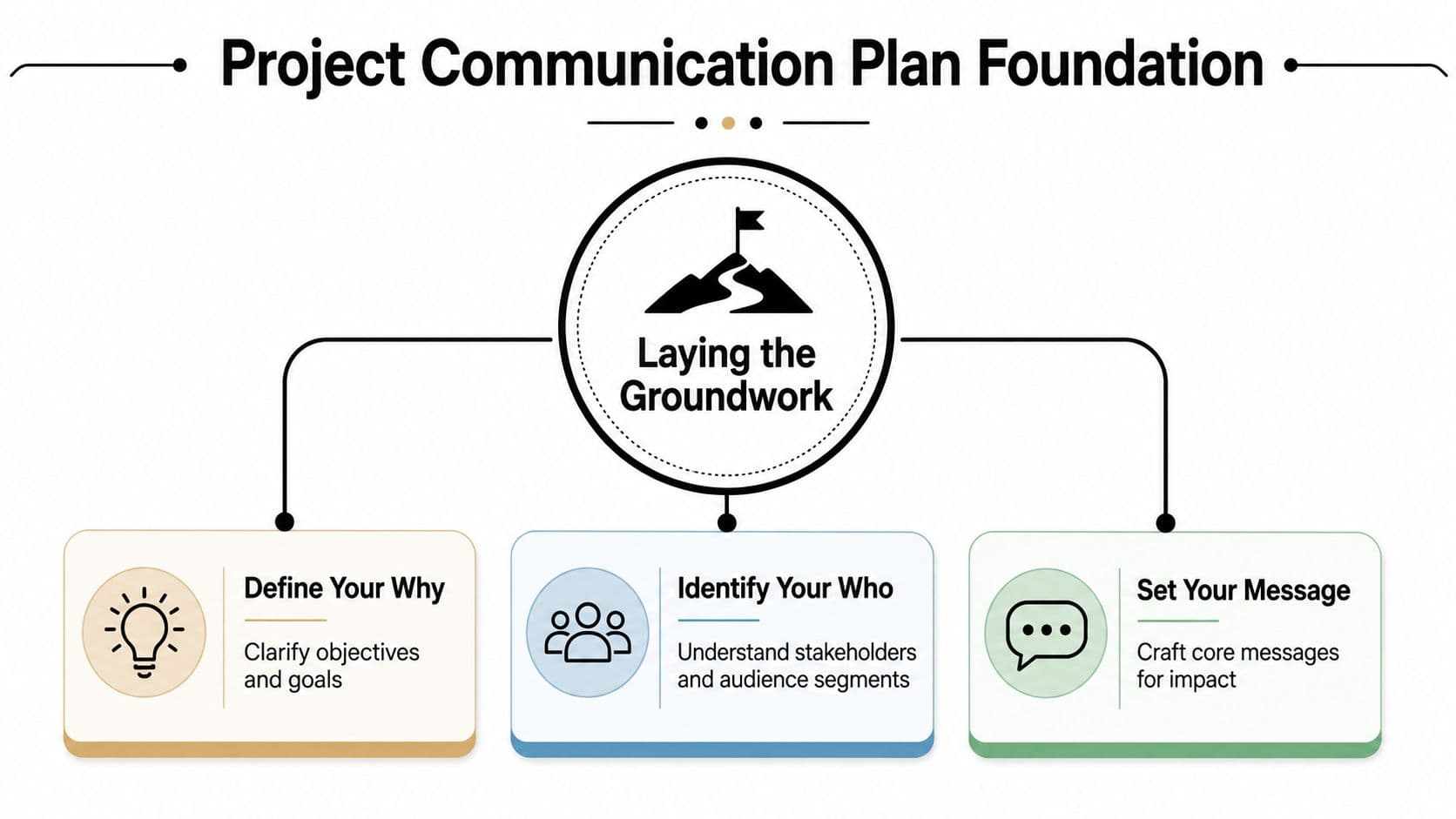
Map stakeholders by need, not just by name
A stakeholder list is not stakeholder analysis.
You need to know who influences decisions, who consumes updates, who creates work for others, and who needs early warning when something shifts. In practice, I've found it useful to think in segments rather than individual names first.
For example:
- Core delivery team: Needs operational detail, blockers, dependencies, and decision history.
- Project sponsor or executives: Need risk, progress, major decisions, and exceptions.
- External partners or clients: Need milestone visibility, change impact, and approved next steps.
- End users or community groups: Need plain-language messaging, timing, and relevance to their experience.
That last category gets ignored more often than it should. More nuanced guidance on project management communication planning points out that a plan should adapt message depth, language, and channels for internal and external stakeholders, different cultures, and different levels of technical expertise. One-size-fits-all communication is a common failure point.
If one audience needs technical detail and another needs business impact, sending the same update to both usually serves neither.
Decide what each group must know
Once your segments are clear, define the minimum information each group needs to act, decide, or stay aligned.
A simple way to do that is to ask four questions for each audience:
- What decisions do they make or influence
- What information do they need before those decisions
- What level of detail is useful versus distracting
- What channel will they pay attention to
Experienced project managers save themselves rework by not over-communicating everything to everyone. They tailor for relevance.
A project communication plan becomes much stronger when it reflects stakeholder reality instead of organizational charts.
Designing Your Core Communication Matrix
This is the part many organizations recognize. It's also the part they often under-design.
A communication matrix is the working backbone of the plan. It tells the team what gets communicated, to whom, how often, through which channel, and who owns it. If any one of those fields is vague, execution gets sloppy fast.
What the matrix must include
The Project Management Institute emphasizes in its guidance on overcoming communication complexity in projects that a formal communication plan matters because communication complexity drives project uncertainty. The practical implication is simple. Define the information, owner, distribution method, and escalation path before execution begins. Otherwise teams fall into ad hoc habits that create frustration and productivity loss.
At minimum, your matrix should answer:
- Communication type: Status update, risk alert, change request, decision log, meeting recap
- Audience: Specific role or stakeholder group
- Frequency: Weekly, milestone-based, as-needed with trigger conditions
- Channel: Email, project workspace, meeting, chat, shared dashboard
- Owner: The person accountable for preparing and sending it
You also need rules that sit around the matrix.
Those rules include what counts as “received” for critical decisions, how long approvals can sit before escalation, and where the official record lives if verbal discussions and chat threads conflict.
A sample project communication matrix
Here's a basic version you can adapt.
| Communication Type | Audience | Frequency | Channel | Owner |
|---|---|---|---|---|
| Weekly status update | Project sponsor, functional leads | Weekly | Email with linked project workspace | Project manager |
| Daily blocker summary | Core delivery team | Daily during active build | Team chat and standup | Delivery lead |
| Scope change notice | Sponsor, affected leads, client contact | As changes are approved | Email and logged decision record | Project manager |
| Risk escalation | Sponsor, risk owner, impacted workstream leads | As trigger occurs | Direct message plus formal log entry | Risk owner |
| Meeting recap with actions | All meeting participants and task owners | After key meetings | Shared workspace and email summary | Meeting owner |
This table is simple on purpose. Teams generally don't need a complicated matrix. They need one that's specific enough to run.
Ownership and escalation are where plans either work or collapse
Teams tend to focus on cadence. They should focus more on ownership.
If the matrix says “weekly update” but no owner is named, everyone assumes someone else will do it. If a scope variance appears and there's no escalation path, the team either delays action or escalates through the wrong channel. Both create avoidable churn.
A workable escalation rule might look like this:
- Approval delay: If a decision passes the agreed threshold, the owner escalates to the project manager
- Scope variance: If a requested change affects timeline or dependencies, route it through formal change review before implementation
- Risk trigger: If a known risk starts affecting delivery, notify named stakeholders through the pre-agreed channel and log the decision trail
The point of a matrix isn't documentation. It's reducing interpretation at the exact moment the project is under pressure.
Build for change, not for a perfect baseline
One more mistake is treating the communication matrix as fixed.
PMI's guidance also stresses that small projects experience scope creep and that communication has to keep right-sizing expectations as conditions change. In practice, that means reviewing the matrix when the project shifts. New stakeholder group. New vendor. New regulatory constraint. New approval bottleneck. Those all justify changing the plan.
The best communication plans are structured early, then adjusted deliberately.
Bringing Your Plan to Life with Fluidwave
Monday starts with a sponsor asking for the latest status, a workstream lead saying they never saw the risk note, and someone in operations forwarding an outdated meeting recap. The communication plan exists, but the team is still running on memory.
That is the failure point.
A communication plan only helps if it shows up inside the work itself. Once the matrix is approved, each line item needs a place in the operating system the team already uses. Otherwise, updates slip behind delivery tasks, follow-ups depend on whoever happens to remember, and the project manager becomes the human router for every message.

Turn the matrix into recurring operational tasks
The practical move is simple. Convert every recurring communication into a task with an owner, a due date, and a completion standard.
A weekly sponsor update should not live as a vague expectation. It should exist as a recurring task that prompts the team to collect progress, confirm risks, review decisions, and send the final summary. A steering committee recap should trigger its own follow-up sequence, including note cleanup, action capture, distribution, and logging the decisions in one place. Escalations should also have triggers. If an approval sits too long or a risk crosses an agreed threshold, the task should appear automatically, not after someone notices the delay.
Communication work competes directly with delivery work. Consequently, teams are usually busy enough to skip anything that is not visible on the plan.
A setup that holds up under pressure usually includes:
- Recurring status tasks: collect updates, review dependencies, prepare the summary, send it on schedule
- Event-based tasks: issue change notices, distribute launch messaging, record stakeholder decisions
- Follow-up tasks: chase missing approvals, confirm receipt of sensitive updates, answer open questions
- Archive tasks: store approved messaging, save lessons learned, and document exceptions that will matter in the next phase
That shift turns communication from a side activity into scheduled work.
Separate preparation from decision ownership
One reason plans break down is that the project manager ends up doing all the prep work personally. That is expensive time to spend on formatting notes, hunting for status inputs, or sending the third reminder for a late response.
A better model splits preparation from judgment. Fluidwave gives teams a place to organize recurring communication work across list, table, calendar, and Kanban views, then assign specific tasks to virtual assistants on a pay-per-task basis. That lets the project lead delegate the administrative layer, such as gathering updates, formatting recaps, or sending reminder tasks, while keeping control of message quality, stakeholder context, and final decisions.
The trade-off is real. Delegation saves time and improves consistency. Poor delegation creates message drift, especially when an assistant is asked to interpret project risk instead of only preparing the materials.
Use a simple rule. Delegate assembly. Keep approval and accountability with the project owner.
Create one visible source of truth
Teams need one shared view of what is due, what has been sent, and where decisions are stuck. Without that, people rebuild context in chat threads and ad hoc calls, which is exactly how inconsistent messaging spreads.
That shared view should make four things obvious at a glance. What communication is due this week. Who owns each item. What decisions have already been made. Where response delays are building.
In practice, that means tracking:
- Upcoming communications: deadlines, owners, and current status
- Decision records: what was approved, by whom, and the latest version of the message
- Pending approvals: requests that are now threatening timeline or execution
- Audience-specific tasks: items that still need tailoring for sponsors, clients, vendors, or internal teams
- Feedback and confusion points: recurring questions that signal the message did not land cleanly
A short product walkthrough helps make this setup more concrete:
Use assistants carefully
Virtual assistants can improve throughput. They should not become unofficial decision-makers.
They can collect updates from workstream leads, clean approved notes into a clear recap, schedule reminders, and maintain the communication log. They should not rewrite scope implications, soften bad news, or close out open issues without review. I have seen teams save hours each week with delegated support, then lose that gain because one poorly framed update created confusion with a sponsor.
The safest operating model is clear:
- The project manager owns stakeholder standards, sensitive messages, and escalations
- The assistant or coordinator owns reminders, formatting, tracking, and administrative follow-through
- The workstream leads own the accuracy of their updates
- The decision owner or sponsor approves changes that affect direction, timeline, or risk
That is how a communication plan becomes active. It runs on tasks, visible ownership, controlled delegation, and a tool that supports the rhythm instead of leaving it in a document no one opens after kickoff.
Measuring Success and Adapting Your Plan
Most communication plans tell you what to send. They don't tell you how to know whether the plan is working.
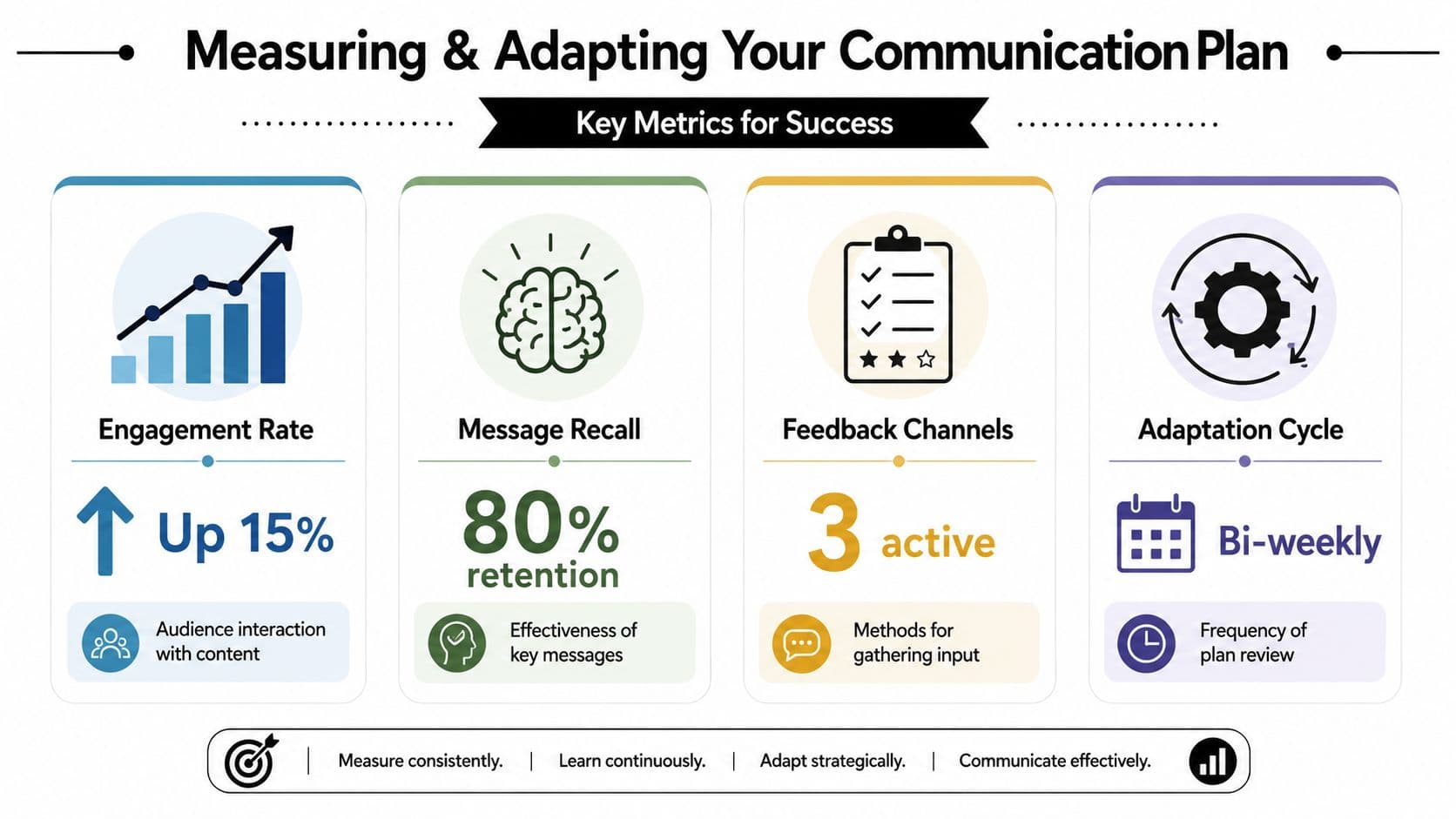
That's a serious gap. Public-sector communication guidance from the U.S. Department of Health and Human Services highlights that many templates define who gets information but fall short on evaluation. Effective plans should measure outcomes such as faster decision turnaround or fewer rework cycles, not just channels and frequency.
What to measure in real projects
You don't need an elaborate analytics setup. You need indicators that tell you whether communication is reducing friction.
Useful measures include:
- Decision turnaround: How long approvals sit before action
- Unanswered stakeholder questions: Whether confusion is shrinking or spreading
- Escalation loops: How often issues bounce across multiple people before resolution
- Rework tied to misunderstanding: Whether teams are acting on stale or incomplete information
These metrics are practical because they connect directly to delivery pain. If decision time improves, the team moves faster. If rework drops, your messages are clearer. If escalation loops increase, responsibilities or channels are probably wrong.
Add a lightweight review cycle
A strong project communication plan should be reviewed on a schedule, but not over-managed.
A short review rhythm is usually enough. Look at recurring questions, delayed approvals, stakeholder complaints, and communication items that repeatedly miss their deadline. Then ask whether the problem is message quality, channel choice, cadence, or ownership.
Good communication plans don't stay static. They absorb what the project teaches.
You should also keep a lessons-learned log during execution, not just after closeout. Capture what worked, what triggered confusion, and which stakeholder groups needed more customized messaging than expected. That record becomes valuable on the next phase or the next project.
Adapt based on signal, not preference
Teams often change communication plans based on the loudest voice in the room.
That's usually a mistake. One executive asking for more updates doesn't necessarily mean the whole cadence needs to change. A single missed email doesn't prove the channel is broken. Adjust based on repeated evidence.
For example, if external stakeholders consistently miss technical updates, rewrite the message depth or switch formats. If approval bottlenecks keep appearing in one workstream, change the owner or escalation threshold. If standups are producing duplicate reporting, simplify them and move detail to the shared workspace.
A measurable plan gives you permission to improve without guessing.
Your Quick Start Checklist and Final Thoughts
A project communication plan works when it reduces ambiguity before the project gets noisy. That means less reliance on memory, fewer accidental surprises, and clearer ownership when something changes.
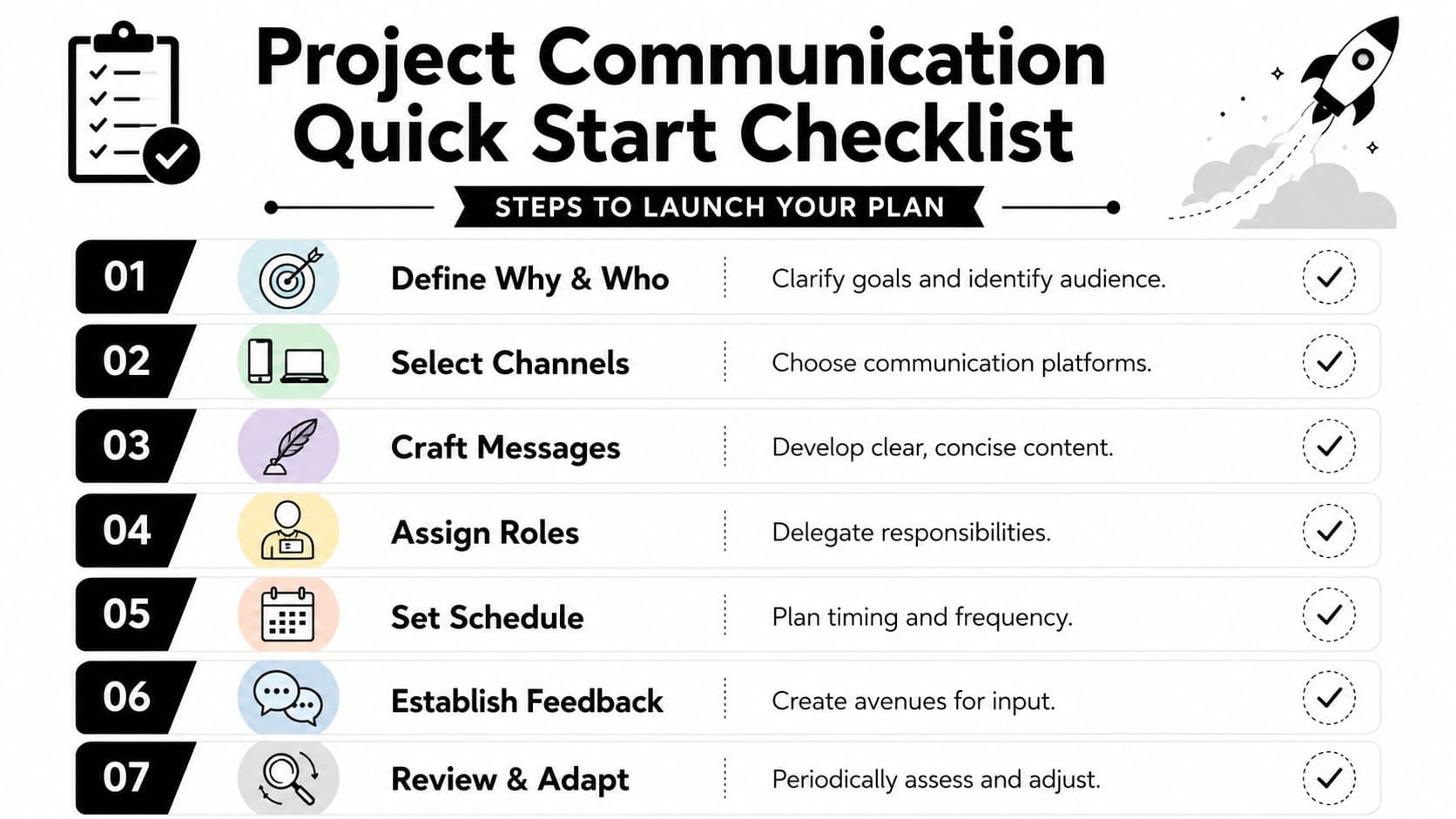
Use this as your quick-start checklist:
- Define the purpose: Tie communication to outcomes like scope alignment, decision speed, or stakeholder confidence.
- Segment stakeholders: Group people by information need, influence, and context, not just by title.
- Set message rules: Decide what each audience must know, how detailed it should be, and where the official version lives.
- Build the matrix: Document communication type, audience, frequency, channel, and owner.
- Add escalation paths: Pre-agree what happens when approvals stall, scope shifts, or risks trigger.
- Operationalize the plan: Turn every recurring communication into a scheduled task with visible ownership.
- Measure and refine: Track confusion, delays, rework, and missed handoffs. Then adjust the plan based on actual friction.
The teams that handle communication well aren't usually the ones writing the longest plans. They're the ones making communication visible, owned, and measurable.
That's the shift. Stop treating project communication as a courtesy layer around delivery. Treat it like infrastructure. When you do, status updates get sharper, decisions move faster, and stakeholders stop learning critical news by accident.
If your current project communication plan lives in a spreadsheet nobody updates, it's worth testing a more operational setup. Fluidwave gives teams a way to turn recurring communications into visible tasks, organize them across multiple project views, and delegate the prep work that usually gets dropped when schedules tighten.
Focus on What Matters.
Experience lightning-fast task management with AI-powered workflows. Our automation helps busy professionals save 4+ hours weekly.