Master deadline management with our step-by-step guide. Learn to plan, prioritize, delegate, and automate to finally hit your targets without the burnout.
July 6, 2026 (3mo ago)
Deadline Management: A Realistic Guide to Stop Missing Dates
Master deadline management with our step-by-step guide. Learn to plan, prioritize, delegate, and automate to finally hit your targets without the burnout.
← Back to blog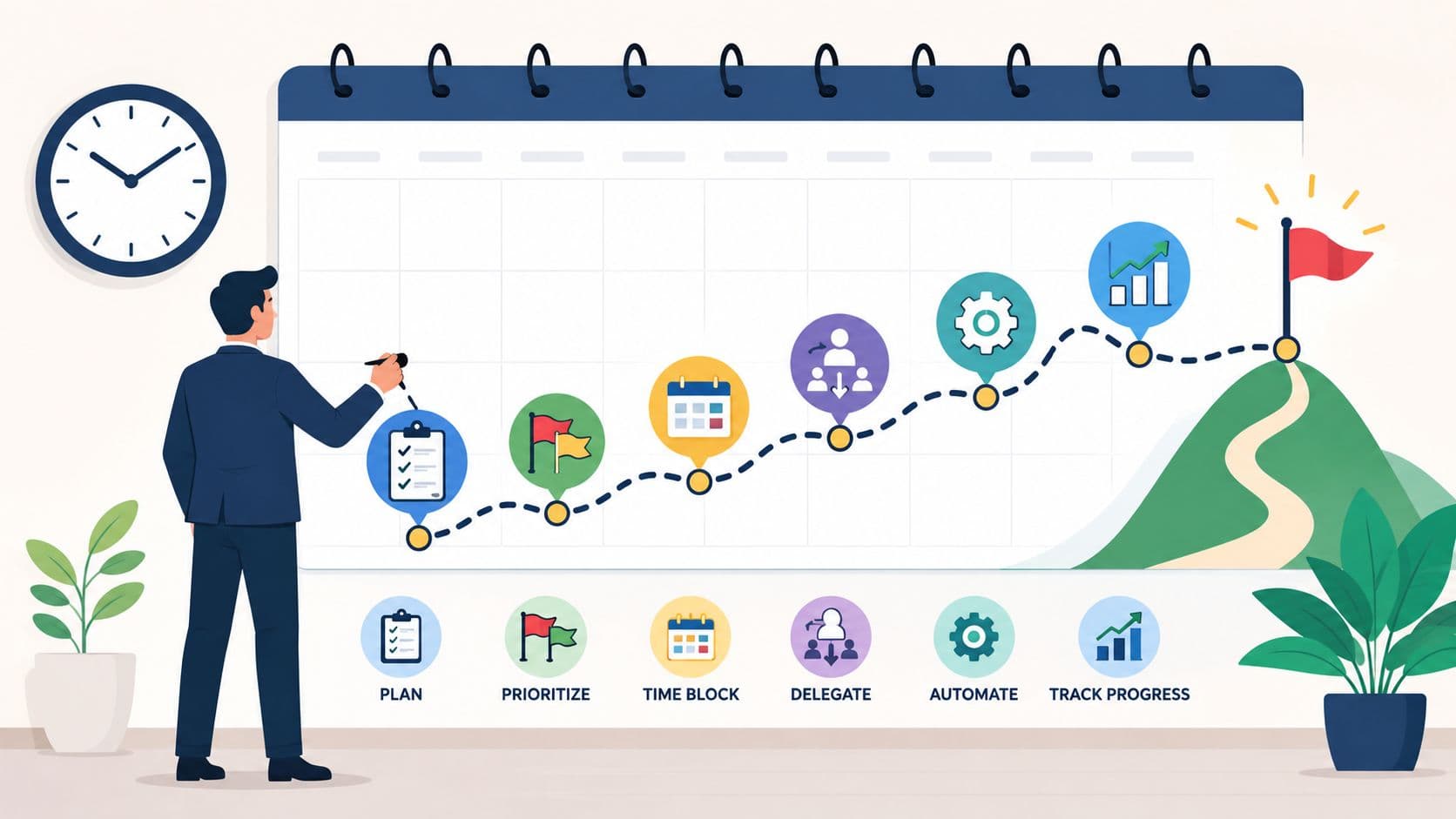
You open your laptop with every intention of getting ahead. By noon, your inbox has turned into triage, Slack has pulled you into three “quick” decisions, and the work that matters is still untouched. Then the familiar math starts. How much can you finish tonight? What can slip? Who needs an update first?
That cycle doesn't usually come from laziness or lack of ambition. It comes from running work through a weak system. U.S. workers miss over one-third of their weekly deadlines, and constant interruptions make the problem worse, according to research summarized from Asana and Microsoft. If you feel like you're always rushing and still falling short, you're not broken. Your process probably is.
Good deadline management isn't a motivational trick. It's a full operating method. You need a way to plan from the end date backward, decide what deserves attention now, protect time to do the work, and adjust early when reality changes. That's what separates people who keep promises from people who keep apologizing.
Beyond the To-Do List The Real Reason You Miss Deadlines
Most missed deadlines look personal from the outside. You waited too long. You got distracted. You overcommitted. Sometimes that's true, but in practice I see a different pattern more often. Smart, responsible people rely on lists that capture tasks but don't control execution.
A to-do list can hold twenty items that all feel urgent. It can't tell you what to start, what to ignore, what to hand off, or what has to happen today for next Thursday not to collapse. That's why people work hard all day and still end the day with the wrong things done.
Deadline dread usually starts earlier than you think
The breaking point rarely arrives on the due date. It starts when work enters your system without a clear shape. A project lands in your lap as “finish the deck” or “launch the campaign,” but nobody breaks it into review rounds, approvals, dependencies, or the quiet work needed before anyone sees a draft.
Then interruptions take over. You lose the morning to fragmented attention, pick at easy tasks for a sense of progress, and tell yourself you'll “really focus later.” If you deal with attention regulation challenges, this can feel even harsher. There's a useful explanation of that dynamic in this guide to executive function.
Practical rule: If a deadline feels emotionally heavy, the problem is usually structural before it's psychological.
That's also why focus protection matters more than most advice admits. The people I see improve fastest aren't always the most disciplined. They're the ones who reduce friction between intention and action. If typing, switching windows, or constant notifications keep pulling you off course, tools that help you improve focus with Voice Control Pro can make concentrated work easier to sustain.
Effort without a system creates false confidence
Here's what doesn't work:
- Working longer hours: More time spent in reactive mode just creates a bigger pile of half-finished work.
- Keeping everything in your head: Memory is unreliable under pressure.
- Treating every task like a fire: If everything is urgent, nothing is prioritized.
- Starting with the easiest item: Quick wins feel productive, but they often postpone critical work.
What does work is building a system that answers four questions every day:
- What does done mean
- What has to happen before that
- What deserves focused time first
- What needs to change when the plan slips
That's the difference between hoping you'll meet a date and being able to trust your own workflow.
Plan Backwards with the Backcasting Method
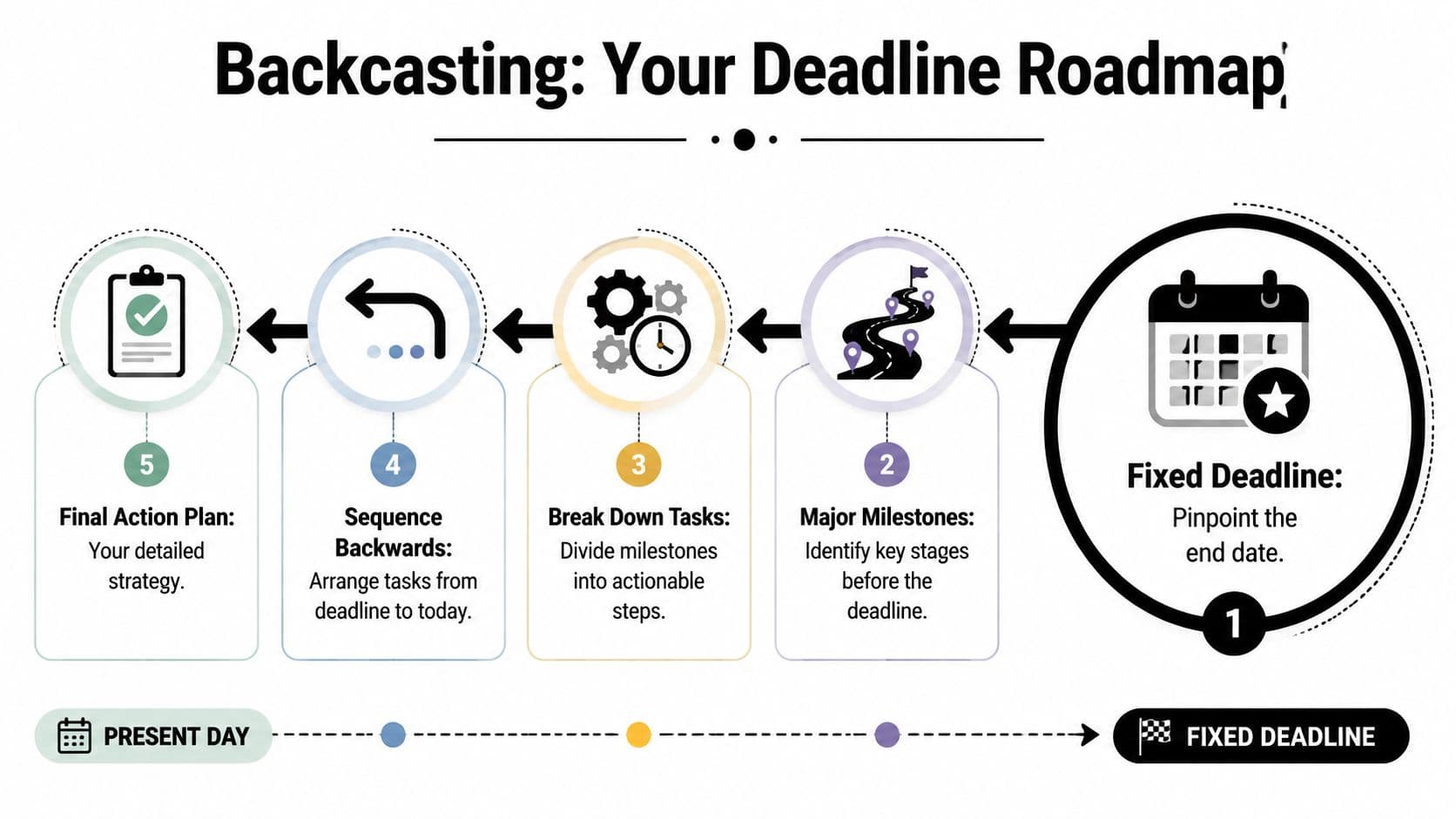
Deadlines are often planned by looking at today and guessing forward. That approach fails because optimism fills the gaps. Backcasting works better. You start with the fixed due date, define what must be true by then, and build the plan backward until you reach today.
That shift sounds small. It changes everything.
Start from the real finish line
“Submit proposal Friday” is not a finish line. “Client-ready proposal approved internally, formatted, reviewed, and sent by Friday at 3 p.m.” is.
That level of clarity matters because deadlines fail at the edges. The document may be drafted, but legal hasn't checked it. The presentation may be done, but the numbers haven't been verified. A proper finish line includes the hidden work.
A simple way to build that plan:
- Define the final deliverable: Write down what must exist at the moment the deadline is met.
- List the major milestones: Draft complete, stakeholder review, revisions, final approval, delivery.
- Break each milestone into tasks: Research, outline, write, data check, design, QA, send.
- Sequence backward from the due date: Put each milestone where it must happen, then place the supporting tasks before it.
- Identify the first next action: The plan is only useful if today's entry point is obvious.
If you need a practical format for that workflow, this action plan template guide is a good companion.
Add slack on purpose
A schedule without breathing room is not a plan. It's a wish.
A key deadline management practice is to add a 20–30% time buffer to each task estimate, which also aligns with the 8/80 rule that tasks should be between 8 and 80 hours for workable tracking, as outlined in Aurora Training Advantage's deadline management guidance. The buffer protects the plan from normal reality. Review takes longer. Someone responds late. You hit a snag that wasn't visible on day one.
Leave space where work actually breaks, not just at the very end.
The 8/80 rule helps in a different way. If a task is smaller than that range, the overhead of tracking it can outweigh the benefit. If it's larger, it's probably too vague to manage. “Marketing launch” is not a task. “Draft launch email copy” is.
A quick example
Say a board memo is due on Friday.
Instead of writing “board memo” on your list Monday morning, backcast it:
| Backward point | What must happen |
|---|---|
| Friday | Memo sent |
| Thursday | Final edits and approval complete |
| Wednesday | First full draft reviewed |
| Tuesday | Data gathered and outline approved |
| Monday | Define argument, collect sources, block writing time |
That plan is already more useful than most task lists because it exposes where the deadline can fail. Not on Friday. On Tuesday, if the outline is still fuzzy.
Backcasting doesn't make work easier. It makes risk visible early enough to do something about it.
Prioritize Your Tasks with Ruthless Clarity
Once you've broken a deadline into real tasks, the next challenge appears fast. Your list gets crowded. Everything seems important because everything belongs to a real project. At this point, people slide back into reaction mode.
The answer isn't to work faster. It's to sort work with sharper criteria.
Research from Acuity Training shows that over 80% of people operate without any structured time management approach, while less than 1 in 5 (18%) have a proper system in place, as noted in their time management research. Overwhelm often looks like a workload problem, but a lot of it is a sorting problem.
Use the matrix as a filter, not a poster
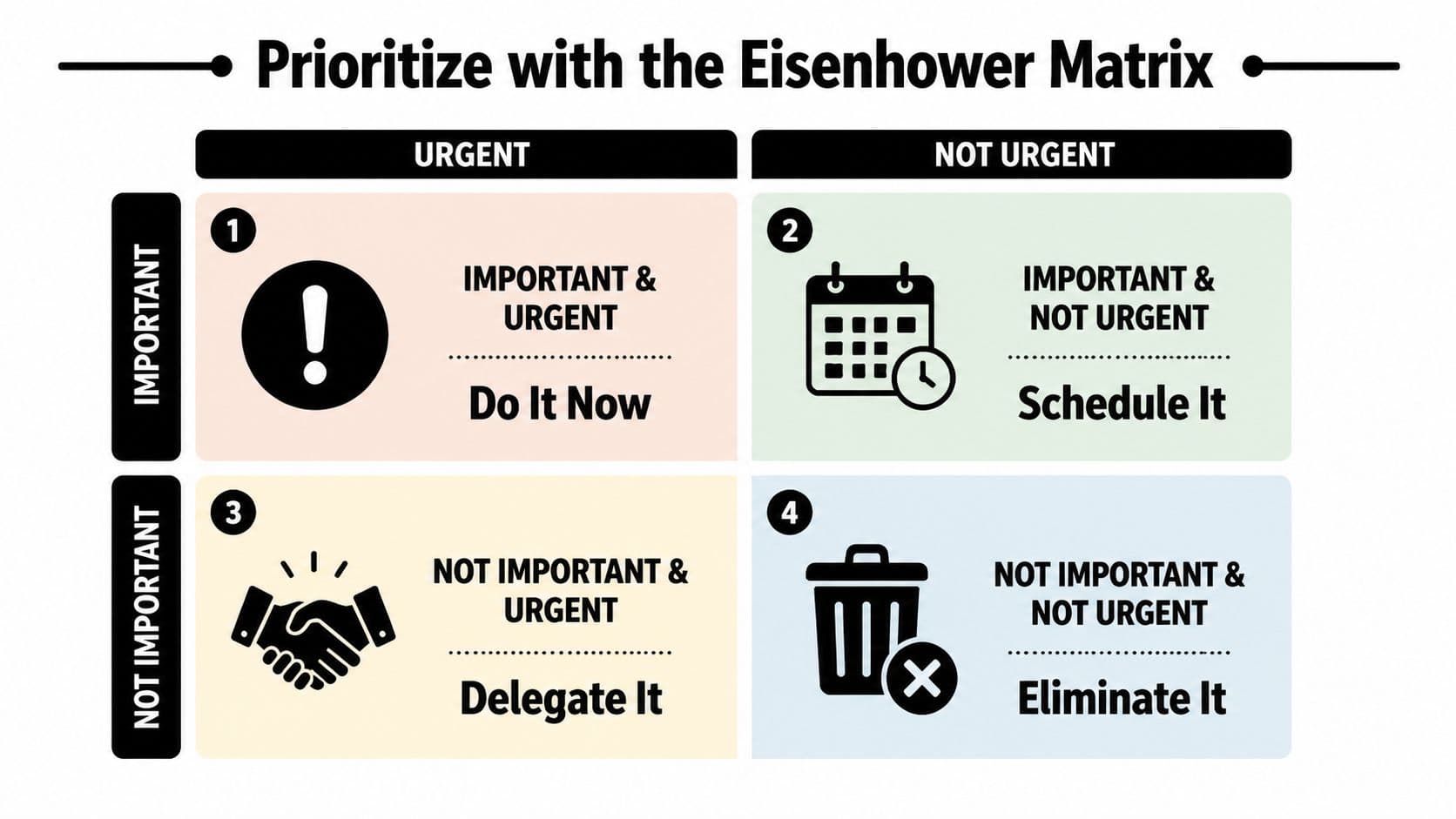
The Eisenhower Matrix still works because it forces one uncomfortable question. Is this task important, or is it just loud?
Think in four buckets:
- Do it now for important, urgent work
- Schedule it for important, non-urgent work
- Delegate it for urgent, low-value work
- Eliminate it for low-value noise
That sounds basic until you apply it honestly. Many professionals spend too much time in the urgent categories because other people's timelines feel more immediate than their own strategic work.
A simple daily check helps:
| Category | Typical example | What to do |
|---|---|---|
| Important and urgent | Final review due today | Handle personally first |
| Important not urgent | Writing, planning, relationship work | Put on calendar before it becomes urgent |
| Urgent not important | Routine follow-ups, scheduling, admin | Hand off if possible |
| Not urgent not important | Habitual checking, low-value requests | Remove |
What ruthless clarity looks like in practice
If you're staring at ten open tasks, ask these questions in order:
- Which item has real downstream consequences if it slips
- Which item only I can do
- Which item creates progress for the rest of the week
- Which item is attracting attention but not creating value
That last one matters. False urgency steals more deadlines than procrastination does.
This short explainer is worth watching if you want a visual reset on prioritization:
Common prioritization mistakes
The task that feels newest is not automatically the task that matters most.
I see the same errors repeatedly:
- Confusing responsiveness with reliability: Fast replies can coexist with late deliverables.
- Promoting easy tasks to the top: Small admin items give closure, but they don't move major deadlines.
- Letting other people's urgency rewrite your day: Not every request deserves immediate access to your best hours.
- Failing to distinguish visible work from valuable work: Some tasks are performative. Some complete the project.
Good deadline management depends on making these trade-offs deliberately. Priority isn't what you say matters. It's what gets your best attention first.
Turn Your Plan into Action with Time-Blocking
A prioritized task list still leaves too much room for avoidance. The work exists, but it hasn't claimed time on your calendar. That gap is where good intentions die.
Time-blocking closes it. You assign specific work to specific hours and treat that block like a real appointment. “Work on proposal” is vague. “Draft proposal section from 9:00 to 10:30” gives your brain a start point, an end point, and a boundary.
Your calendar should show your real commitments
People often use calendars for meetings and task lists for work. That split creates a fantasy schedule. The calendar fills with obligations to others, while the work that creates deadlines gets squeezed into whatever time remains.
A better approach is to place your priority tasks directly into your day.
Try this sequence:
- Block the hard work first: Writing, analysis, planning, and review deserve your best cognitive windows.
- Use task-specific labels: Name the output, not the category. “Revise slides 10 to 15” beats “presentation work.”
- Match block size to the task: Short enough to start, long enough to finish something meaningful.
- Reserve admin windows: Batch email, approvals, and light coordination instead of scattering them.
- Protect transition time: Give yourself space before and after deep work, especially if meetings tend to run long.
Defend the block or it isn't real
Time-blocking fails when people treat focus time as optional. If anyone can book over it, interrupt it, or chip away at it with “just one question,” then it's only decorative planning.
Here are the rules that keep it useful:
- Close the obvious exits: Silence notifications, shut extra tabs, and keep one working document open.
- Start with a visible next action: Don't begin the block by deciding what to do. Decide before the block starts.
- Keep a capture note nearby: When unrelated tasks pop into your head, park them instead of switching.
- Use a recovery plan: If a block gets interrupted, reschedule it immediately. Don't rely on memory.
A blocked hour is not a suggestion to yourself. It's a commitment to the outcome tied to that hour.
Useful adaptations for ADHD and overloaded teams
For neurodivergent professionals, especially those with ADHD, the standard advice to “just focus for two hours” can backfire. Shorter blocks, clearer starts, and stronger visual cues often work better. Try pairing a task with a concrete trigger. Open the file, turn on one playlist, and begin with one subtask that feels mechanically simple.
Teams need a different adjustment. Shared calendars help, but so does visible agreement on when people are available for questions and when they're not. If your team expects instant replies all day, nobody gets a real deep-work block.
Time-blocking isn't rigid. It's protective. It gives important work a place to happen before urgency crowds it out.
Amplify Your Efforts with Delegation and Automation
A lot of deadline pressure comes from doing work you shouldn't be doing personally. Not because it's beneath you. Because it doesn't require your specific judgment.
That's where delegation and automation become force multipliers. Used well, they free your time for the work that needs your expertise. Used badly, they create new layers of coordination and a fresh pile of follow-up.

Decide whether a human or a rule should handle it
The simplest decision framework I use is this:
| If the task requires | Better fit |
|---|---|
| Judgment, nuance, exceptions, communication | Delegate to a person |
| Repetition, triggers, predictable steps | Automate with a rule |
A recurring meeting summary might be automated. A vendor follow-up that needs tone and context should go to a human assistant. File organization, status reminders, and recurring checklists often belong in automation. Research prep, inbox triage, appointment coordination, and admin follow-through can often be delegated cleanly.
If delegation still feels vague, this explanation of what it means to delegate well is a useful reset.
Delegate outcomes, not just tasks
Poor delegation creates more work because the handoff is incomplete. “Can you help with this?” is not a handoff. It's an invitation to start a clarification thread.
A better handoff includes:
- The outcome: What done looks like
- The deadline: When you need it back
- The constraints: Budget, tone, format, approval rules
- The first source of truth: Where they should begin
- The check-in point: When you want an update, if at all
People miss deadlines after delegation for one predictable reason. They assign activity, not ownership.
Automation has a hidden downside
AI tools can speed up execution, but they also create a strange kind of overload. Recent Harvard Business Review data, referenced in Atlassian's deadline management coverage, shows AI tools can increase cognitive switching by 25%, which can lead to more missed deadlines through deadline fatigue rather than lack of ability. Their summary argues for clustering micro-tasks instead of letting them splinter the day into endless check-ins, and you can read that discussion in Atlassian's deadline management article.
That pattern is easy to miss. An AI assistant drafts, summarizes, reminds, and breaks work into smaller chunks. Useful. But if every small chunk becomes a separate deadline, your brain starts serving the system instead of the project.
Group AI-generated micro-tasks into a single review block. Don't let your tools turn one meaningful deliverable into fifteen tiny deadlines.
For founders, freelancers, and neurodivergent professionals, this matters even more. A tool that increases output but constantly interrupts attention may hurt delivery. The fix isn't to avoid automation. It's to contain it.
Adapt and Overcome Monitoring Progress and Difficult Conversations
A static deadline system fails the moment real work begins. Plans change. Dependencies move. Review cycles expand. Someone goes quiet. If you only check progress at the end, you've waited too long.
Strong deadline management includes monitoring and renegotiation. Not as a last resort. As a normal operating habit.
Watch the plan while there is still room to act
You don't need a complicated dashboard to notice slippage. You do need a regular review rhythm.
Look for signs like these:
- A milestone that moved without a replacement date
- Tasks that keep getting rescheduled
- A key dependency still unresolved
- Work in progress expanding while completed work stalls
For team projects, PMI's fixed-deadline guidance is useful here. It recommends breaking work down to the work package level, building the schedule in layers, and using indicators such as SPI and SV to update and control progress through a formal schedule process in PMI's guide to fixed-deadline project management. You don't need enterprise ceremony to apply the principle. You need visible checkpoints and a shared rule for when yellow becomes red.
Negotiate with proof, not emotion
One of the hardest professional skills is telling a stakeholder that the deadline won't hold as stated. Many people wait too long because they don't want to sound difficult, uncommitted, or incapable.
That hesitation is expensive. A PMI study found 68% of project failures stem from scope/time misalignment, yet many guides still don't teach deadline negotiation. The stronger move is to use a definitive estimate and show why the current combination of scope, sequence, and available capacity doesn't fit, as discussed in this PMI-related discussion on proof-based negotiation.
Try language like this:
We can hit the date, but only if we reduce scope. If the scope stays the same, the schedule needs to move. Here's the sequence driving that constraint.
That approach works especially well for professionals who struggle with the social friction of saying no. Data gives the conversation structure. It shifts the discussion from personal resistance to operational reality.
Build a system that can flex
For neurodivergent professionals, resilience often means lowering the penalty of a disrupted day. Use fewer parallel priorities. Keep task starts obvious. Re-enter work from a written checkpoint, not memory.
For teams, resilience means making status visible before a meeting is needed. If a deadline is at risk, people should see it early enough to reassign work, reduce scope, or adjust the date while options still exist.
The best deadline systems aren't rigid. They recover well.
If your deadlines keep slipping because planning, prioritization, delegation, and follow-through live in different places, Fluidwave is worth a look. It combines task organization, automation, calendar-friendly workflow views, and access to human virtual assistants so you can stop juggling work manually and start running a system that holds up under pressure.
Focus on What Matters.
Experience lightning-fast task management with AI-powered workflows. Our automation helps busy professionals save 4+ hours weekly.