Explore 8 real-world examples of group norms for meetings, remote work, and projects. Get actionable tips to build a high-performing team culture.
June 23, 2026 (4mo ago)
8 Powerful Examples of Group Norms for Teams in 2026
Explore 8 real-world examples of group norms for meetings, remote work, and projects. Get actionable tips to build a high-performing team culture.
← Back to blog
Ever left a meeting wondering what it was even for? Or felt the creeping anxiety of a project where no one seems to know who's doing what? These aren't just minor annoyances. They're symptoms of a team operating without clear group norms. Norms are the shared, unwritten rules that govern how people interact, communicate, and work together.
When teams don't make those rules explicit, people fill in the blanks on their own. One person thinks a Slack message means "answer now." Another thinks "today" means end of day. A manager assumes silence means agreement. A contributor assumes silence means "I should wait." That's where friction starts.
Strong teams remove that guesswork. They agree on what good collaboration looks like, then they build it into the way work moves. If you're managing hybrid work, this matters even more. Good norms shape meetings, status updates, handoffs, feedback, and focus time. If you're reworking your setup, these insights for hybrid workplace planning pair well with the examples below.
Here are practical examples of group norms you can use, adapt, and enforce without turning your team into a compliance exercise.
1. Respect for Deep Work and Focus Time
Many teams say they value focus. Fewer teams protect it.
If your calendar is packed, chat is noisy, and every task looks urgent, people never get enough uninterrupted time to do demanding work. The result isn't just slower output. It's shallow work, more rework, and a team that feels busy all day without finishing the hard stuff.

Google's well-known 20% time, Basecamp's "library rules" mindset during focus hours, Microsoft Teams focus features, and Slack's scheduled Do Not Disturb all point to the same operational truth. Deep work doesn't survive by good intentions alone. It survives because teams decide that interruption has a cost.
Sample phrasing that works
A good norm sounds like behavior, not a value statement.
- Protect quiet hours: "No internal meetings from 9 to 11 a.m. unless customer risk or production issues require it."
- Respect status signals: "If someone's calendar shows focus time or their chat is set to Do Not Disturb, wait unless the issue blocks work today."
- Batch low-stakes questions: "Put non-urgent requests into one message or into the task thread instead of sending five pings."
Those examples of group norms work because people can see when they're being followed and when they're not.
Practical rule: If everything can interrupt focus, then focus isn't a norm. It's a wish.
Where teams get this wrong
Some managers block "focus time" on calendars, then override it whenever something feels important. That teaches the team the actual norm. Availability beats concentration.
Use Fluidwave to separate work that requires uninterrupted time from work that can be delegated or queued. Its auto-prioritization is useful here because it forces a harder conversation about what matters now, what can wait, and what should be handed off. If a founder or team lead keeps grabbing low-value admin work during focus blocks, delegation is usually the fix.
A simple enforcement move is to review one week of interruptions in your next team meeting. Don't moralize it. Look at what broke focus, whether it was necessary, and what channel should've been used instead.
2. Transparent Task Status and Progress Updates
It is 4:30 p.m. on Thursday. A stakeholder asks whether a launch is still on track, and three people give three different answers. That is not a planning problem. It is a status norm problem.
Teams work better when status is visible without a scavenger hunt. People should be able to open the task system and see what changed, what is blocked, and what needs a decision. That matters in every environment, but the failure mode differs by team type. Meeting-heavy teams hide updates in calls. Remote teams hide them in chat. Agile teams sometimes confuse standup talk with documented status.
A PMC-indexed study on group norms and expectations of social resources found that norms shape what people expect to receive from a group, including support and responsiveness. In day-to-day delivery work, that shows up as a simpler question. Can I trust the team to keep shared information current?
What this norm looks like in practice
Transparent status updates are specific, lightweight, and tied to the work itself.
- Update when the work changes: "If the status changes, update the task before you start the next thing."
- Use plain blocker language: "If you're blocked, say what is blocking you, who owns the dependency, and when you will escalate."
- Standardize status labels: "In progress, blocked, ready for review, and done have fixed meanings."
- Record scope changes in the task: "If the ask changes, note the change and impact in the same thread."
That last point matters more than teams expect. A lot of schedule risk starts as a small scope shift that never gets written down.
Strategic toolkit by team type
For meeting-heavy teams, cut recap theater. Do not rely on verbal updates that disappear once the call ends. Put the decision, next step, and owner into the task before the meeting closes.
For remote teams, reduce chat churn. Use chat for alerts, then point people back to the record of work. A good rule is simple. If someone will need the update tomorrow, it belongs in the task today.
For agile teams, make the board tell the truth. Standups help with coordination, but they do not replace documented progress. If a card stayed "in progress" for four days while the actual issue sat in Slack, the team has activity without visibility.
If you want a reporting rhythm that does not create extra admin, use a workflow that pulls updates from the task layer itself. This guide to project status reporting in Fluidwave shows a practical way to tie status updates to execution instead of burying them in recap emails.
The trade-off teams need to accept
This norm adds a little discipline. It also removes a lot of noise.
Some people will say constant updating feels bureaucratic. They are partly right. Badly designed status rules create busywork. The fix is not to drop the norm. The fix is to define the minimum useful update and attach it to handoffs, blockers, review requests, and scope changes. One sentence in the right place beats a 20-minute chase later.
Enforcement that actually works
Do not enforce this with vague reminders to "communicate better." Enforce it through task flow.
Set a rule that work cannot move to the next stage without a current status, a named owner, and blocker context when relevant. Review stale tasks once a week. If something sat untouched in "in progress" for too long, ask what signal was missing and adjust the workflow. Praise early risk flags in public. If people get punished for surfacing bad news, they will wait, and your status norm will fail.
Here's a quick visual explainer that fits this norm in practice.
3. Ownership and Accountability for Assigned Tasks
A team without ownership norms turns every project into a relay race with dropped batons.
The clearest version of this norm is simple. If a task has your name on it, you own the outcome until it's done, reassigned explicitly, or escalated with context. You don't disappear when the work gets messy. You don't wait passively when something slips. You don't assume someone else will notice.
That matters in any team, but especially in environments with cross-functional handoffs and delegated work. A task platform makes ownership visible. It doesn't create ownership by itself.
The version that works in real life
In a 2021 field experiment covering 14 teams and 210 employees, teams that adopted explicit accountability norms such as updating shared systems within 24 hours of changes, commenting on tasks stuck in progress, and requiring peer review before completion saw a 32% reduction in overdue tasks, a 27% decrease in rework incidents, and a 19% improvement in internal client-satisfaction scores. That's the practical upside of codified accountability. Less drift, fewer surprises, and cleaner handoffs.
Sample phrasing:
- Own the next move: "If you own the task, you own the next update."
- Escalate early: "Raise risks before the deadline is at risk, not after."
- Close the loop: "A task isn't complete until the output, decision, or handoff is recorded."
Ownership isn't "I tried." Ownership is "I kept the team informed, made decisions within my scope, and surfaced risk before it became someone else's emergency."
Enforcement without micromanagement
Many teams often overcorrect. They say they want accountability, then they create surveillance.
A better model is to clarify authority at the point of delegation. In Fluidwave, that means defining the task, expected output, budget, timeline, and what decisions the assignee can make without asking. If someone owns delivery but has to ask permission for every small step, you've assigned responsibility without control. That setup fails fast.
Review stale tasks weekly. Not every day. Weekly reviews are enough to spot drift without training people to perform updates for the manager instead of moving the work forward.
4. Asynchronous Communication and Documentation First
Meetings feel efficient because they happen in real time. They're often expensive because they disappear in real time too.
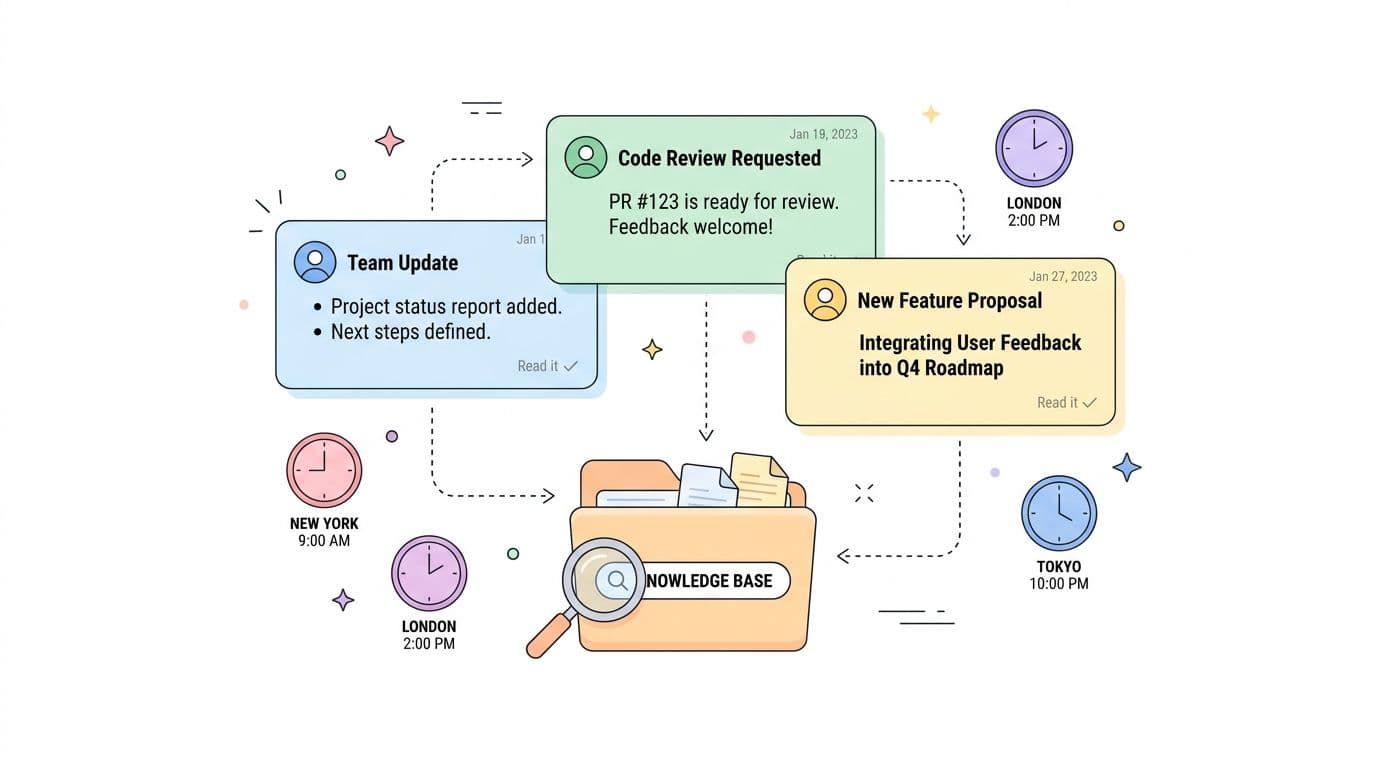
An async-first norm says this: write it down, keep decisions with the work, and use meetings when discussion requires live interaction. For distributed teams, this is less a preference and more an operating requirement. Time zones, different schedules, and focused work blocks all break if every decision depends on immediate availability.
What to write down, and where
Good async teams don't dump everything into long documents. They put the right context in the right place.
- Decisions belong with tasks: Record the choice, the rationale, and any open dependency in the task itself.
- Questions belong in threads: Keep comments attached to the work instead of scattering them across chat and email.
- Meetings need a paper trail: If you had to meet, summarize the outcome in writing before people leave.
That last part matters more than teams think. A 2019 case study of 12 mid-sized software and consulting teams, involving about 180 knowledge workers, found that teams using explicit meeting norms such as a 60-second goal statement and a shared decision log saw a 23% reduction in meeting duration and a 15% increase in completed sprints per quarter. The common thread was structure tied directly to task tracking.
The trade-off most teams need to accept
Async communication feels slower at first because writing exposes fuzzy thinking. That's a feature.
If a team can't explain the decision clearly in a task comment or short written brief, they probably weren't ready to decide in the meeting either. Set a response window so async doesn't become neglect. For example, your norm might be "respond to non-urgent task comments within one business day." Then hold people to it.
Fluidwave helps when teams use task comments as the default record instead of treating the platform as a checklist with the actual context living elsewhere.
5. Psychological Safety and Speaking Up About Problems
Teams don't fail because nobody noticed the issue. They fail because somebody noticed it and decided it wasn't safe, useful, or welcome to say so.
This norm matters most when work is behind, assumptions are wrong, or a deadline was unrealistic from the start. If people can't challenge the plan, the plan gets fake agreement and real failure.

Ground rules that create safer teams
The most useful norms here are concrete. "Be respectful" is too vague to guide behavior when stakes are high.
A stronger set looks like this:
- Challenge ideas, not people: "Disagree directly, without making it personal."
- Surface risk early: "If a task, timeline, or recommendation looks wrong, say so in the task thread or meeting."
- Normalize uncertainty: "It's acceptable to say 'I don't know,' 'I'm stuck,' or 'I need help.'"
Research on inclusion-focused team norms found that teams using ground rules such as listening first, trusting one another, keeping discussions confidential, and making it safe to be wrong reported a 44% higher rate of members speaking up with novel ideas and a 32% reduction in perceived interpersonal conflict. That's a practical reason to make safety operational instead of sentimental.
Say this out loud when assigning work: "If this deadline won't hold, tell me early. That's good judgment, not bad performance."
What leaders often miss
You can't ask for honesty and punish it socially.
If someone raises a blocker in Fluidwave comments, the manager's first move should be thanks, then clarification, then action. Not irritation. Not a lecture about ownership. Teams watch that response closely and learn the de facto norm from it.
Retrospectives help here, but only if they're not disguised blame sessions. Keep the focus on what the team learned, what signal was missed, and what norm needs tightening.
6. Respect for Work-Life Boundaries and Sustainable Pace
At 9:40 p.m., a manager drops three "quick" requests into chat. By 10:15, two people have replied, one person has reopened their laptop, and the team has learned the actual rule. Availability wins over planning.
That pattern does not create commitment. It creates hidden overtime, weaker judgment, and work that gets done by whoever has the loosest boundaries. Teams need a norm that protects output over time, not just effort in the moment.
Turn good intentions into operating rules
"Take care of yourself" is too vague to guide behavior. Teams need wording people can follow during a busy week, a release crunch, or a client escalation.
Use norms like these:
- Availability has clear limits: "Messages sent after hours do not need a response until the next working block unless they are marked urgent in the agreed channel."
- Capacity is planned, not guessed: "If the workload exceeds available time, we re-sequence, reassign, or reduce scope."
- Time off stays protected: "People on leave are not backup coverage unless that handoff was planned in advance."
This matters even more for remote teams and agile teams. Remote teams need explicit response windows because digital tools make every message feel immediate. Agile teams need a pace they can repeat, not one good sprint followed by three recovery weeks.
For teams managing work in Fluidwave, team capacity planning in Fluidwave helps turn this norm into a workflow instead of a slogan. If assigned work is already over capacity, the next step is not "push harder." The next step is to change the plan.
Sample phrasing and enforcement notes
Leads often make this norm weaker by treating it as a wellness preference instead of a delivery standard. A sustainable pace is part of execution quality.
Use direct language:
- For delegation: "I need this by Thursday. If that forces evening work, tell me now so we can change scope or owner."
- For meetings: "We do not book over protected focus blocks unless the issue affects delivery this week."
- For remote communication: "Use comments and task updates for non-urgent items. Reserve alerts for work that is blocked or time-sensitive."
Then enforce it in the same system where work gets assigned. If a task slips because capacity was unrealistic, update the board, change priority, and document the reason. If someone repeatedly creates urgency through poor planning, address that behavior directly. Practical feedback methods inside task workflows help managers correct the pattern without turning every missed estimate into a personal critique.
A useful companion for managers who need sharper language is WeUnite's guide on constructive feedback.
What leaders often get wrong
Late messages are not the only problem. Silent overload is worse.
I see this often with high performers. They absorb extra work, protect everyone else from the problem, and look reliable right up until quality drops or they burn out. The team then misreads the situation and assumes the workload was reasonable. It was not. It was subsidized.
Protecting work-life boundaries means reviewing load before people compensate for a bad plan. Check task counts, review carryover, and look at who always gets the "small extra thing." Sustainable pace is not soft management. It is how teams keep quality, judgment, and trust intact over months of real work.
7. Constructive Feedback and Continuous Improvement Mindset
Teams that avoid feedback don't stay nice. They get vague, political, and brittle.
A useful feedback norm isn't about saying hard things more often. It's about making improvement normal enough that feedback doesn't feel like an ambush. In practice, that means people know when they'll get feedback, how direct it will be, and what the team does with it.
Feedback that improves work instead of draining trust
The strongest phrasing is behavioral and specific:
- Tie feedback to observable work: "Comment on what was done, what happened, and what should change next time."
- Don't save it for reviews: "Address process and quality issues while the work is still fresh."
- Ask upward too: "Leads and managers ask for feedback on decisions, communication, and priorities."
For teams using Fluidwave, task completion is the natural moment to do this. A task isn't just done or not done. It also reveals whether the brief was clear, whether the handoff worked, and whether review happened at the right point. This guide on how to give feedback in Fluidwave can help teams anchor feedback in the work itself instead of in personality judgments.
If you want outside perspective on phrasing, WeUnite's guide on constructive feedback is a useful companion.
"That didn't work" is weak feedback. "The brief missed the approval criteria, so review stalled for a day. Add the criteria to the next draft" is useful feedback.
A common failure pattern
Some teams say they value continuous improvement, then only discuss problems after major misses. That's too late.
Build short review loops into recurring work. After a sprint, launch, or client delivery, ask three questions. What helped? What slowed us down? What should become a norm? Keep it short. Then update the workflow or template so the lesson survives longer than the meeting.
8. Clarity in Priorities and Goals at All Levels
A team can have good people, good tools, and decent communication and still underperform if priorities keep shifting without explanation.
This norm is about alignment. People should know what matters most now, why it matters, and what work gets deprioritized when something new comes in. Without that, every request arrives as a top priority and the loudest stakeholder wins.
The operational version of strategic clarity
A useful priority norm sounds like this:
- Tie tasks to goals: "Every significant task must show which team or company priority it supports."
- Make trade-offs visible: "When we add urgent work, we name what moves out."
- Explain the why: "Task descriptions include not just the deliverable, but the business reason it matters."
This is especially important when AI is helping sort, suggest, or route work. Existing content on norms often stays abstract and misses AI-mediated workflows. As Asana's discussion of group norms examples points out qualitatively, teams increasingly need norms for digital handoffs, documentation, and how to challenge automated suggestions without creating confusion or social risk.
Why this norm pays off
When priorities are clear, delegation gets better. Reviews get faster. People make smarter local decisions because they understand intent, not just instructions.
In Fluidwave, tags, views, and auto-prioritization can work together. Mark which strategic goal each task supports. Use Kanban, list, or calendar views depending on the work. Then establish one strict rule: if a task doesn't connect to a current priority, it doesn't jump the queue unless someone explicitly changes priorities.
This is one of the most underrated examples of group norms because teams often mistake it for planning. It isn't. Planning sets priorities once. Norms govern how people keep those priorities clear when reality changes.
Comparison of 8 Team Norms
| Norm | Complexity 🔄 | Resources & Effort ⚡ | Expected Outcomes 📊 | Ideal Use Cases 💡 | Key Advantages ⭐ |
|---|---|---|---|---|---|
| Respect for Deep Work and Focus Time | 🔄 Moderate, scheduling + cultural buy-in | ⚡ Low–Moderate, calendar tools, DND policies | 📊 Higher-quality complex work; fewer interruptions | 💡 Knowledge work, engineering, remote teams | ⭐ Improved focus, less burnout, better deliverables |
| Transparent Task Status and Progress Updates | 🔄 Moderate, standards + habit formation | ⚡ Low, tooling + update time | 📊 Early blocker detection; fewer status meetings | 💡 Fast-moving projects, distributed teams, sprints | ⭐ Alignment, reduced PM overhead, trust |
| Ownership and Accountability for Assigned Tasks | 🔄 Moderate–High, role clarity & norms | ⚡ Moderate, delegation tooling, check-ins | 📊 Higher completion rates; more reliable delivery | 💡 Product teams, freelancers, mission-critical work | ⭐ Reliability, fewer handoffs, stronger culture |
| Asynchronous Communication and Documentation First | 🔄 Moderate, templates & response SLAs | ⚡ Low–Moderate, writing effort, searchable docs | 📊 Better institutional memory; flexible collaboration | 💡 Multi-timezone teams, remote-first organizations | ⭐ Searchable records, fewer meetings, thoughtful responses |
| Psychological Safety and Speaking Up About Problems | 🔄 High, sustained leadership modeling | ⚡ Moderate, training, feedback rituals | 📊 Early problem detection; improved decision quality | 💡 Creative teams, high-stakes projects, learning orgs | ⭐ Higher performance, retention, open communication |
| Respect for Work-Life Boundaries and Sustainable Pace | 🔄 Moderate, policy + enforcement | ⚡ Low–Moderate, capacity planning, scheduling | 📊 Lower burnout; more sustainable long-term output | 💡 Teams prone to crunch, knowledge workers | ⭐ Better retention, mental health, sustained productivity |
| Constructive Feedback and Continuous Improvement Mindset | 🔄 Moderate, requires norms & practice | ⚡ Moderate, time for cycles and training | 📊 Faster skill growth; iterative process improvement | 💡 Agile teams, growth-focused organizations | ⭐ Accelerated learning, improved processes, performance |
| Clarity in Priorities and Goals at All Levels | 🔄 High, strategy cascade and alignment | ⚡ Moderate–High, OKR systems, communication | 📊 Reduced decision fatigue; aligned execution | 💡 Scaling orgs, strategic initiatives, distributed teams | ⭐ Clear alignment, confident delegation, focused effort |
From Theory to Practice: Implementing Your Team's Norms
Typically, teams don't need more values posters. They need fewer assumptions.
The best group norms are short, observable, and tied to the way work happens. "Respect focus time" means blocked calendars stay blocked. "Keep status visible" means task updates happen without prompting. "Own your task" means the owner posts the next step before anyone has to ask. If you can't observe a norm in behavior, it probably won't stick.
Don't roll out all eight at once. Pick one or two norms that address your biggest source of friction right now. If meetings are wasting time, start with async documentation and meeting structure. If deadlines keep slipping, start with ownership and transparent status. If the team looks busy but feels fried, start with focus time and sustainable pace.
Then write the norm in plain language. Good sample phrasing beats abstract principles every time. A team can follow "Update a blocked task with the blocker and next dependency by end of day" much more easily than "Communicate proactively." Keep the wording tight enough that people can repeat it without looking it up.
Enforcement matters too. Most failed norm-setting happens because leaders treat norms as discussion topics instead of operating rules. Put them where the work already lives. Add them to kickoff docs, recurring agendas, task templates, review checklists, and onboarding notes. If a norm matters, it should show up in the workflow.
Fluidwave is useful for making norms visible by blocking focus time on shared calendars, documenting decisions in task comments, assigning clear owners, using status fields consistently, and delegating lower-value work before overload turns into chaos. Teams also benefit when AI suggestions and human handoffs happen inside the same system instead of across scattered tools.
Review norms regularly. Not constantly, but enough to catch drift. Ask a simple question every few weeks: which norms are helping, which ones are being ignored, and which ones need sharper wording? You don't need a formal culture program for this. You need honesty and follow-through.
Good norms make work feel lighter because they reduce uncertainty. People stop guessing how to behave, when to update, whether to interrupt, and what matters most. That's when collaboration starts to feel less like coordination overhead and more like actual progress.
If you're also investing in team connection outside day-to-day operations, these corporate team building events for 2026 can complement the practical norms above. Just don't use events as a substitute for clear operating habits. Team trust grows faster when expectations are explicit.
Fluidwave gives teams a practical place to turn group norms into daily behavior. You can prioritize the right work, document decisions where the work lives, delegate tasks to human assistants, and keep progress visible without adding more meetings. If your team needs clearer ownership, better handoffs, and less friction, Fluidwave is worth a close look.
Focus on What Matters.
Experience lightning-fast task management with AI-powered workflows. Our automation helps busy professionals save 4+ hours weekly.