Learn how to give feedback that drives results. Our guide covers frameworks like SBI, neurodivergent-friendly tips, and scripts for managers, peers, and VAs.
May 19, 2026 (4mo ago)
How to Give Feedback That Actually Works
Learn how to give feedback that drives results. Our guide covers frameworks like SBI, neurodivergent-friendly tips, and scripts for managers, peers, and VAs.
← Back to blog
You probably need to give feedback today.
Maybe a teammate shipped something messy right before a client call. Maybe your assistant followed the brief, but missed the actual priority. Maybe your manager keeps changing direction in meetings and the team is burning time pretending not to notice. Individuals often don't struggle because they lack good intentions. They struggle because they don't know how to say the hard thing clearly, without turning the conversation into friction.
That's the essence of learning how to give feedback. Not sounding polished. Not sounding “nice.” Saying something useful, at the right moment, in a way the other person can act on.
Why Most Feedback Fails and How to Fix It
A lot of feedback fails before the first sentence lands.
Someone says, “Just a quick note,” then delivers a vague criticism, softens it with fake praise, and ends the conversation without a clear next step. The other person walks away confused, defensive, or both. Nothing changes.

Most bad feedback has three problems. It arrives too late, it stays too vague, or it feels like judgment instead of guidance. People often think the solution is to be gentler. Usually the solution is to be clearer.
Nice is not the same as useful
Teams often confuse kindness with hesitation. They circle the point, over-explain, or hide criticism between compliments. That usually makes the message harder to trust.
Practical rule: Feedback works when the other person can answer two questions immediately: “What exactly happened?” and “What should I do next?”
If you say, “You need to be more professional,” you haven't given feedback. You've given a label. If you say, “In yesterday's client call, you answered before the client finished explaining the issue. That made it harder for the team to hear the full problem. Next time, wait until they finish, then summarize what you heard before offering a solution,” the person can work with that.
That's also why listening matters as much as delivery. Before you correct, you need enough context to know what occurred. Strong feedback usually starts from observation, not assumption. If your team struggles there, this short piece on listening to understand is a useful companion skill.
The fix is clarity, timing, and shared intent
Good feedback doesn't need to feel heavy. It does need to feel grounded.
A reliable pattern looks like this:
- Name the moment clearly so the person knows what event you mean.
- Describe behavior, not personality so they don't feel reduced to a trait.
- Explain the impact so the feedback connects to work, team trust, or outcomes.
- Offer a next step so the conversation ends with direction, not awkwardness.
Here's the trade-off managers learn fast. If you overprotect feelings, people miss the point. If you overcorrect with bluntness, people hear the threat and miss the lesson. The sweet spot is direct and respectful.
Feedback should lower uncertainty. If it increases uncertainty, it needs a rewrite.
The other trap is treating feedback like a special event. It isn't. On healthy teams, it's part of how work moves. A quick message after a meeting, a revision note on a task, a short voice note after a presentation, those are often more effective than a formal sit-down loaded with tension.
The Core Frameworks for Clear and Actionable Feedback
You don't need a script for every situation, but you do need structure. When people freeze in feedback conversations, it's usually because they're trying to improvise a sensitive message in real time.
A framework keeps you from rambling, moralizing, or slipping into blur words like “rude,” “sloppy,” or “not strategic.” Structured models like SBI were designed to reduce vagueness by focusing on specific, observable behavior, which helps lower defensiveness and improve behavior change, as explained in LifeLabs Learning's guidance on constructive feedback.
SBI for fast, direct feedback
SBI stands for Situation, Behavior, Impact.
It's the model I reach for most often because it's short and hard to misuse.
Before You were kind of dismissive in that meeting.
After using SBI In this morning's planning meeting, when Dana was outlining the rollout risk, you interrupted twice before she finished. That shut down the discussion and the team moved on without resolving the issue.
That version is cleaner because it names a specific event, describes what happened, and explains why it mattered.
STAR for developmental feedback
STAR stands for Situation, Task, Action, Result.
It works well when you're coaching someone through a larger performance pattern or helping them reflect on what worked in a project.
Before You did a good job leading that launch.
After using STAR During the launch week, your task was to coordinate updates across design, support, and sales. You set up a single update thread, posted decisions quickly, and flagged blockers early. The result was that everyone had the same status view and the handoffs stayed clean.
STAR is useful because it reinforces repeatable behavior. It helps people understand not just that something went well, but what they did that made it work.
DESC for harder conversations
DESC stands for Describe, Express, Specify, Consequences.
Use it when the issue is recurring, sensitive, or affecting trust.
Before I need you to communicate better.
After using DESC When deadlines shift and I hear about it at the last minute, I end up resetting client expectations under pressure. I need you to flag timeline risk as soon as you see it. That gives us a chance to adjust early and protects the project.
DESC adds a little more emotional honesty without turning the feedback into a personal vent.
Choosing the right feedback framework
| Framework | Best For | Example Focus |
|---|---|---|
| SBI | Quick course correction | A specific meeting, message, or behavior |
| STAR | Coaching and recognition | What someone did well and how to repeat it |
| DESC | Sensitive or recurring issues | A pattern that needs change and clear boundaries |
One extra tool helps across all three. I statements. They're often taught to parents and teachers, but they're just as useful at work because they reduce blame and keep your message grounded in observation and impact. This parent's guide to I statements explains the pattern clearly, and the core idea translates well to peer, managerial, and client-facing conversations.
If your feedback starts sounding like a verdict, switch back to observable facts.
A simple self-edit helps. Replace “You are” with “When you.”
“You are careless” becomes “When the file goes out without the final check, the client sees internal errors.”
That one shift changes the entire conversation.
Mastering Feedback Timing Frequency and Tone
A manager waits for the quarterly review to mention a problem that showed up in Slack three weeks ago. The employee barely remembers the context. The manager has built up frustration. Now a fixable issue turns into a tense conversation about attitude.
That is a timing problem, not a feedback problem.
Research from Gallup's workplace study on fast feedback found that employees are far more likely to feel motivated to do outstanding work when managers give daily feedback instead of annual feedback. Gallup also found that many employees still are not getting feedback weekly. The practical takeaway is simple. If feedback only shows up in formal reviews, it arrives too late to help the work.
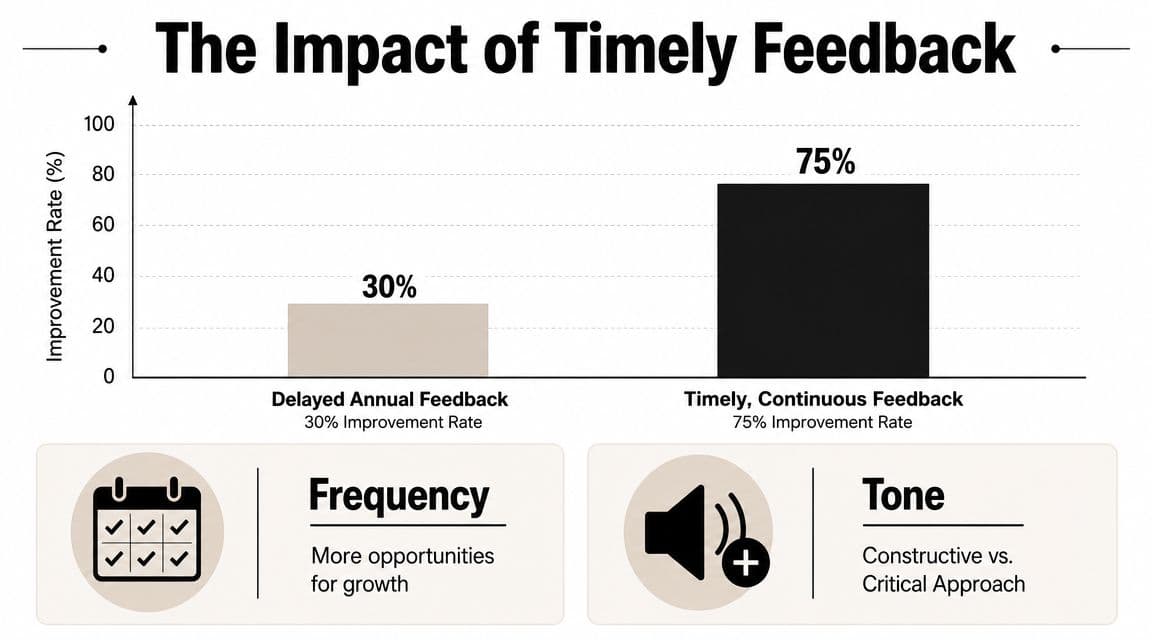
Frequency beats intensity
Short feedback loops outperform big speeches.
In fast teams, work changes before memory fades. Scope shifts on Tuesday. A stakeholder changes direction on Wednesday. A handoff breaks on Thursday. If you save every correction for a monthly review, people cannot connect your comments to the actual moment, and they lose the chance to adjust while the project is still recoverable.
Build feedback into the places where work already happens. Use recurring one-on-ones, retrospective notes, and task-level comments. A clear one-on-one meeting agenda for regular feedback conversations gives people a predictable place to raise issues early instead of waiting until frustration leaks out.
Remote teams need even more structure because silence is easy to misread. In person, someone may catch a raised eyebrow or a quick hallway comment. In remote work, the only signal may be a delayed reply or a vague task edit. Good managers replace that ambiguity with small, regular feedback moments.
Tone should lower threat and raise clarity
Tone matters because people hear feedback with their nervous system first and their logic second.
A steady tone works better than a dramatic one. Clear beats polished. Specific beats “nice.” This matters even more with neurodivergent teammates, peers, or assistants who may prefer direct language, processing time, and fewer implied meanings. “Please add a summary at the top of this update” is easier to use than “Could we maybe make this a little more executive-friendly?”
The trade-off is real. A blunt message can feel efficient to the sender and harsh to the receiver. Too much softening creates confusion and follow-up work. The middle ground is straightforward language with respect.
Use phrasing like this:
“I want to be direct so this is easy to act on. The last two status updates left out blockers, which made planning harder. Next time, include risks even if the details are still forming.”
That style works upward, too. If you need to give feedback to your boss, calm precision protects the relationship better than either silence or emotional buildup.
Match the channel to the issue
The channel shapes the tone before you write a word.
Use async comments for small corrections tied to a task. Use a live conversation for repeated patterns, visible tension, or anything likely to trigger defensiveness. For sensitive issues, send a short setup message first so the person is not ambushed.
A practical rule:
- Write it in the task for small, concrete corrections such as file naming, missing details, or acceptance criteria
- Raise it the same day for meeting behavior, handoff misses, or communication gaps
- Talk live and in private for repeated issues, trust problems, or anything with emotional weight
- Pause before sending if you are angry, overloaded, or guessing at intent
That last point saves a lot of damage. Timely feedback helps. Reactive feedback usually creates a second problem.
One more adjustment improves results across remote teams, peers, and virtual assistants. State whether you want action now, acknowledgment now, or discussion later. For example: “No need to reply immediately. Please update the task before tomorrow,” or “I want to talk this through live because tone may get lost in chat.” People do better when they know what kind of response the moment requires.
Real-World Scripts for Any Professional Relationship
Most advice on how to give feedback assumes you're a manager talking to a direct report. That's too narrow for modern work. Teams are matrixed, work is cross-functional, and people need language for peers, bosses, assistants, and contractors. Guidance from Greater Good notes this gap clearly and argues that feedback works better when it's a dialogue rather than a one-way judgment in its article on giving better feedback at work.
Script for a direct report
Context: A team member keeps bringing issues late, after they've already become expensive.
You don't need a speech. You need a short, specific message.
“On the last two project updates, the risk came up only after the deadline was already slipping. That put the team in catch-up mode. I want you to flag risk earlier, even if you don't have the full solution yet. A quick heads-up is better than a polished late report.”
Then pause.
Ask, “What made it hard to raise this earlier?” That question matters because feedback lands better when the person has room to explain constraints, uncertainty, or missing context.
Script for a peer
Peer feedback gets tricky because authority is shared. The best language sounds collaborative, not managerial.
“In yesterday's meeting, I noticed I had a hard time getting through the dependency update because the topic shifted quickly. I think we missed a decision because of that. Could we try letting each person finish their update before jumping into solutions?”
That works because it stays close to observation and team impact. It doesn't accuse your peer of being controlling, dismissive, or chaotic.
If you need more examples, this collection of peer feedback sample phrases is useful for translating intent into language that doesn't sound preachy.
Script for upward feedback
Feedback to a manager needs two things. Respect and usefulness.
Frame it around team effectiveness, not personal frustration.
“I want to share an observation that might help the team move faster. In the last few planning meetings, priorities changed during the discussion, but we didn't always leave with one final decision. That's made it harder to execute confidently. Would it help if we closed each meeting by confirming the single priority and owner?”
This script works because it avoids the trap of “You keep changing your mind.” Even if that's how it feels, that phrasing almost guarantees defensiveness.
Script for a virtual assistant or freelancer
Delegated work improves fastest when expectations are concrete. General disappointment is useless here.
“On this task, the research was organized well and the links were easy to review. What needs to change is the filtering criteria. I asked for sources focused on operators with self-serve onboarding, but several examples were enterprise-only. Please revise the list using that filter and add one sentence on why each company qualifies.”
Notice the split. First, confirm what was done well. Then identify the specific gap. Then define the revision clearly.
Neurodivergent-friendly wording that helps almost everyone
A lot of people process feedback better when it is literal, low-ambiguity, and easy to review later. That's especially helpful for ADHD, autism, anxiety, or anyone overloaded by fast verbal processing.
Use language like this:
- State the task plainly instead of implying what you meant
- Name one priority first so the person knows what matters most
- Separate observations from requests so they don't have to decode your tone
- Write follow-up notes if the conversation was verbal
Plain language is not robotic. It's considerate.
How to Give Effective Feedback Inside Fluidwave
A task gets marked “needs revision” at 6:12 p.m. The only comment says, “Please clean this up.” By the next morning, the assignee has guessed wrong, the work has bounced back, and now two people are frustrated instead of one.
Fluidwave helps when feedback stays attached to the work, the decision criteria, and the next action. That matters even more for remote teams, peers reviewing each other's work, and assistants or freelancers who cannot rely on hallway context. As noted earlier, feedback works better when it is timely. Inside a task tool, the practical goal is simpler. Make the next step obvious without starting a side conversation in Slack or email.
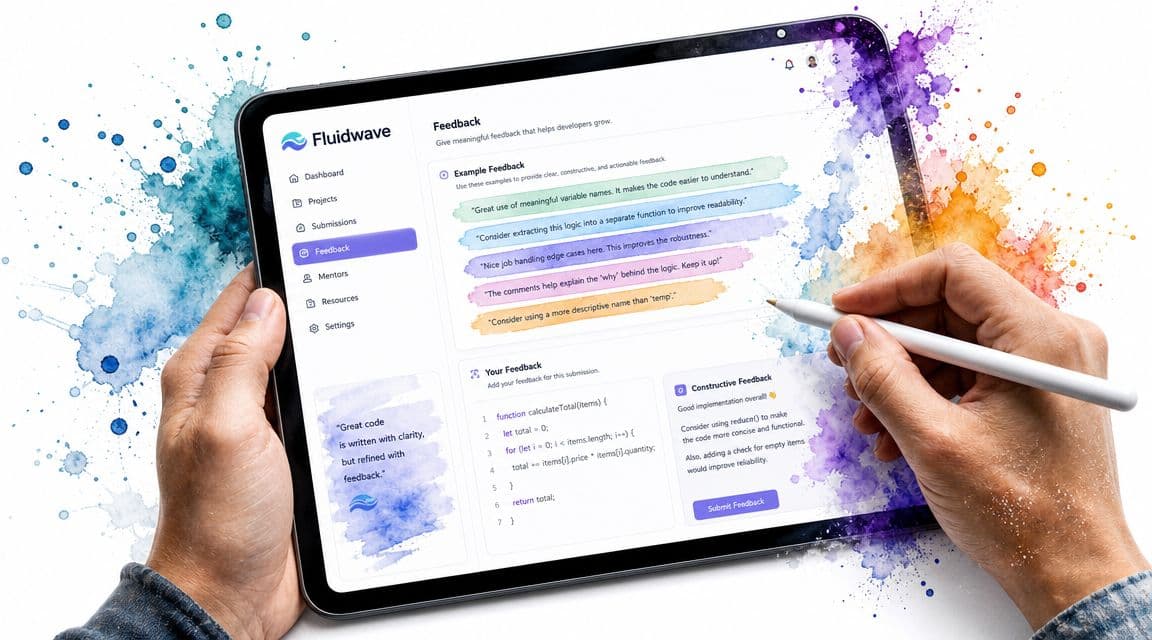
Write feedback where the work already lives
In Fluidwave, the cleanest place for feedback is usually the task comment, checklist item, or approval note tied to the deliverable itself.
Weak comment:
Please clean this up.
Useful comment:
Please revise this in three ways:
- Replace broad claims with examples from the source notes
- Remove duplicate entries in rows 8 to 12
- Rename the final column to “Client Priority”
Keep the current structure. I only need these edits.
That phrasing reduces guesswork. It also works well for neurodivergent teammates because it names the exact change, preserves the parts that are already correct, and limits the amount of interpretation required.
Build the brief so you need fewer correction cycles
A lot of “feedback problems” are assignment problems. If the original task is vague, the comment thread turns into cleanup.
When assigning work in Fluidwave, include four fields in the task description:
-
Outcome
“Deliver a shortlist of five finance software options.” -
Filter
“Small-business friendly, browser-based, simple reporting.” -
Format
“Use one table with name, cost model, strengths, and concerns.” -
Decision rule
“Prioritize tools that are easy to trial, not tools that require enterprise procurement.”
That last line saves time. A capable assistant can complete the visible task and still miss your judgment criteria. Once the decision rule is written into the task, your feedback can stay focused on quality instead of re-explaining strategy.
Use comments differently for peers, direct reports, and contractors
The same interface can hold different kinds of feedback.
For a peer, keep the tone collaborative:
I think this is close. Before we finalize it, can you tighten the first paragraph around the client's actual objection? Right now it reads more general than the sales call notes.
For a direct report, be clear about the standard and the next move:
The draft is organized well. The issue is accuracy in the recommendation section. Two claims are stronger than the source material supports. Please revise those today and tag me when the update is ready.
For a contractor or virtual assistant, spell out the acceptance criteria:
Good first pass. Please revise the list using only companies with self-serve onboarding. Exclude enterprise-only vendors, and add one sentence under each option explaining why it qualifies.
A task tool becomes useful in a very practical way. It gives everyone a written record of what changed, why it changed, and what “done” means.
Make praise reusable, not generic
Fluidwave should capture positive feedback too, especially when you want a behavior repeated across the team.
Try a note like this:
Strong handoff here. The summary at the top made the task easy to scan, and the checklist kept the dependencies clear. Use this structure again for cross-functional work.
Specific praise creates a pattern other people can copy. Generic praise creates a pleasant moment and then disappears.
If you are rolling out new workflows in parallel, training matters just as much as feedback. Teams that want to drive feature adoption usually get better results when the expected behavior is shown inside the workflow, not explained once in a meeting. The same rule applies in Fluidwave. Put the standard in the task, comment on the work against that standard, and leave a record the person can use next time.
Common Pitfalls and Your Quick-Check Template
The fastest way to improve feedback is to stop doing three things.
First, stop using the feedback sandwich. People see it coming, and it makes praise feel fake. Second, stop using blur words like “unprofessional,” “difficult,” or “careless” when you haven't described the behavior. Third, stop making feedback about identity when the issue is action.
A high-reliability feedback workflow includes planning in advance, asking the recipient for their perspective first, using concrete examples, focusing on behavior rather than character, and ending with actionable next steps, as outlined in this clinical guidance on effective feedback.
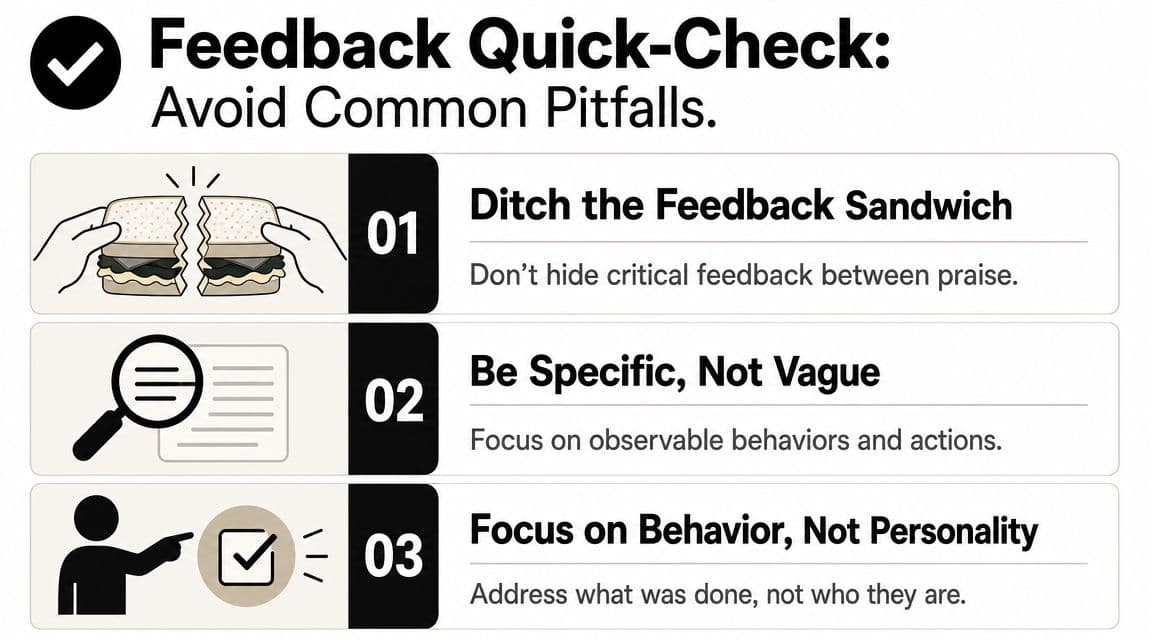
Feedback quick-check
Before you send the message or start the conversation, ask yourself:
-
Is it specific
Can the person identify the exact moment, task, or behavior? -
Is it observable
Am I describing what happened, not what I assume they intended? -
Is it actionable
Will they know what to do differently next time? -
Is my tone helping
Am I being clear without sounding punishing or sarcastic? -
Have I left room for response
Did I ask for their perspective, or only deliver my judgment?
Good feedback is not the hardest truth you can say. It's the clearest useful truth the other person can apply.
If you remember one thing, remember this. The point of feedback is behavior change, not emotional release. When the conversation ends, the other person should know what happened, why it mattered, and what better looks like next time.
If your team needs a cleaner place to delegate work, leave revision notes, and keep feedback attached to the task instead of scattered across tools, Fluidwave is worth a look. It combines task management, collaboration, and delegated execution in one workflow, which makes clear, timely feedback much easier to give and much easier to act on.
Focus on What Matters.
Experience lightning-fast task management with AI-powered workflows. Our automation helps busy professionals save 4+ hours weekly.