Stop just hearing. Start to listen to understand deeply. Our practical guide offers techniques, scripts, and tools to improve communication and drive results.
April 13, 2026 (6mo ago)
Listen to Understand: Master Communication Skills
Stop just hearing. Start to listen to understand deeply. Our practical guide offers techniques, scripts, and tools to improve communication and drive results.
← Back to blog
You join a call thinking the meeting is about timelines. Your client thinks it’s about scope. Your designer hears “simple” and imagines clean visuals. Your engineer hears “simple” and strips out the feature the client cares about. Everyone leaves with notes. Nobody leaves with the same understanding.
That’s the problem with most workplace communication. People hear the words, then fill in the gaps with their own assumptions.
I’ve seen this on project teams, in founder handoffs, with executive assistants, and in remote collaborations that looked fine on the surface. The meeting feels productive. The Slack thread looks active. Then the rework starts. Deadlines slip. Someone gets labeled “difficult” when the underlying issue was that nobody stopped to listen to understand.
Listening gets treated like a soft interpersonal virtue. In practice, it’s an execution skill. It affects whether decisions are clear, whether tasks are delegated correctly, and whether a team can move without constant correction.
Why We Talk Past Each Other in a World of Constant Connection
A remote project meeting can go wrong in a very modern way. Cameras on. Notes shared. Chat active. Everyone speaking in polished, efficient updates. Then two days later, half the team is building toward one interpretation and the other half is defending another.

The issue usually isn’t that nobody spoke. It’s that nobody checked meaning.
Hearing words is not the same as understanding intent
Passive hearing is mechanical. Sound comes in. Your brain recognizes language. You move on.
Listening to understand is different. It asks you to do three things at once:
- Track content: What is the person saying?
- Track meaning: What do they mean by the words they chose?
- Track stakes: Why does this matter to them right now?
That sounds simple until you try to do it during a full day of meetings, pings, side messages, and deadline pressure.
In hybrid and remote work, the risk goes up because people have fewer cues to work with. Tone gets flattened. Silence gets misread. Short answers get treated as resistance. People often compensate by talking more, when what they need is better confirmation.
A useful business lens is this: communication failures are a primary factor in 57% of project failures, according to PMI benchmarks. That figure matters because it puts listening where it belongs. Not in the “nice to have” bucket, but in the same category as planning, scoping, and risk control.
Why smart people still miss each other
Most professionals don’t fail at listening because they’re careless. They fail because they’re overloaded.
They’re doing one or more of these at the same time:
| Common habit | What it sounds like internally | What it causes |
|---|---|---|
| Reply planning | “I know where this is going” | Premature answers |
| Pattern matching | “This is just like the last client” | Wrong assumptions |
| Defensive filtering | “They’re blaming my team” | Distorted interpretation |
| Urgency bias | “We need to move” | Shallow understanding |
When people say, “We had a communication issue,” what they often mean is, “We never established shared meaning.”
Practical rule: If the conversation affects scope, ownership, deadlines, or trust, don’t leave understanding implied. State it back and confirm it.
Listening is a leadership tool, not a personality trait
Strong listeners don’t just make people feel heard. They reduce rework. They surface hidden concerns earlier. They catch ambiguity before it spreads through the team.
That’s why listen to understand matters so much for managers, founders, operators, and anyone who delegates work. The skill isn’t passive. It’s operational.
If you’ve ever thought, “I said it clearly, so why didn’t it happen?” the better question is often, “Did we verify the same meaning before we moved?”
The Three Mindsets of an Exceptional Listener
Techniques help, but technique without mindset turns into performance. People nod, paraphrase, and maintain eye contact while still listening for ammunition, status, or speed.
The best listeners I’ve worked with tend to carry three internal postures. Not all at once in a dramatic way. More like habits they return to under pressure.
The scientist
The scientist enters a conversation with a working theory, not a verdict.
That means replacing “I know what this person means” with “Let me test whether my read is correct.” In real conversations, this changes your timing. You ask one more question. You hold your interpretation a little more loosely. You become less attached to being right early.
A scientist-listener notices loaded words and checks them.
If someone says, “This workflow is inefficient,” a weak listener jumps to fixing speed. A stronger listener asks, “I want to be precise. Is inefficient here about time, errors, approvals, or something else?”
That question does two useful things. It reduces assumption, and it tells the speaker you care about exact meaning.
The apprentice
The apprentice mindset sounds humble because it is. But it isn’t passive.
It says, “This person knows something I don’t yet know, even if I outrank them, disagree with them, or think they’re explaining it poorly.”
That posture matters most when the speaker is junior, frustrated, indirect, or not naturally polished. A lot of leaders only listen well to people who communicate in a format they personally like. That isn’t listening. That’s preference.
The apprentice listens for signal under imperfect delivery.
A project lead might say, “I’m not sure this timeline feels realistic.” A defensive manager hears hesitation. An apprentice hears data trying to surface before failure becomes public.
This is also where rapport matters. If your team doesn’t believe you’re teachable, they’ll edit themselves around you. That creates false agreement. The practical side of this is well covered in Fluidwave’s guide on building rapport, especially if you manage distributed teams.
The speaker doesn’t need to be eloquent for you to listen well. You need to be patient enough to help the meaning emerge.
The diplomat
The diplomat listens for connection, not conquest.
This is the mindset people need most in tense conversations, especially when a deadline is slipping or feedback is uncomfortable. The diplomat isn’t trying to “win the room.” They’re trying to preserve enough trust that the truth can still be said out loud.
That changes your internal goal. Instead of “How do I defend my position?” you ask, “What does this person need me to understand before we can move forward?”
Here’s a simple comparison:
- Debater mode: listens for weak points
- Fixer mode: listens for the first solvable detail
- Diplomat mode: listens for the core concern under the surface conflict
A teammate says, “This process keeps changing.” The literal complaint is process instability. The underlying issue may be lack of trust, role confusion, or fatigue from repeated rework.
The diplomat hears both.
What these mindsets change in practice
When these three mindsets are present, the conversation slows down in the right places and speeds up later where execution matters.
You tend to notice:
- Less false agreement
- Fewer vague approvals
- Clearer ownership
- More honest pushback before the work starts
People often think exceptional listening means being naturally warm or endlessly patient. It doesn’t. Some outstanding listeners are direct, brief, and unsentimental. What sets them apart is that they don’t confuse fast interpretation with clear understanding.
That difference shows up in every important conversation.
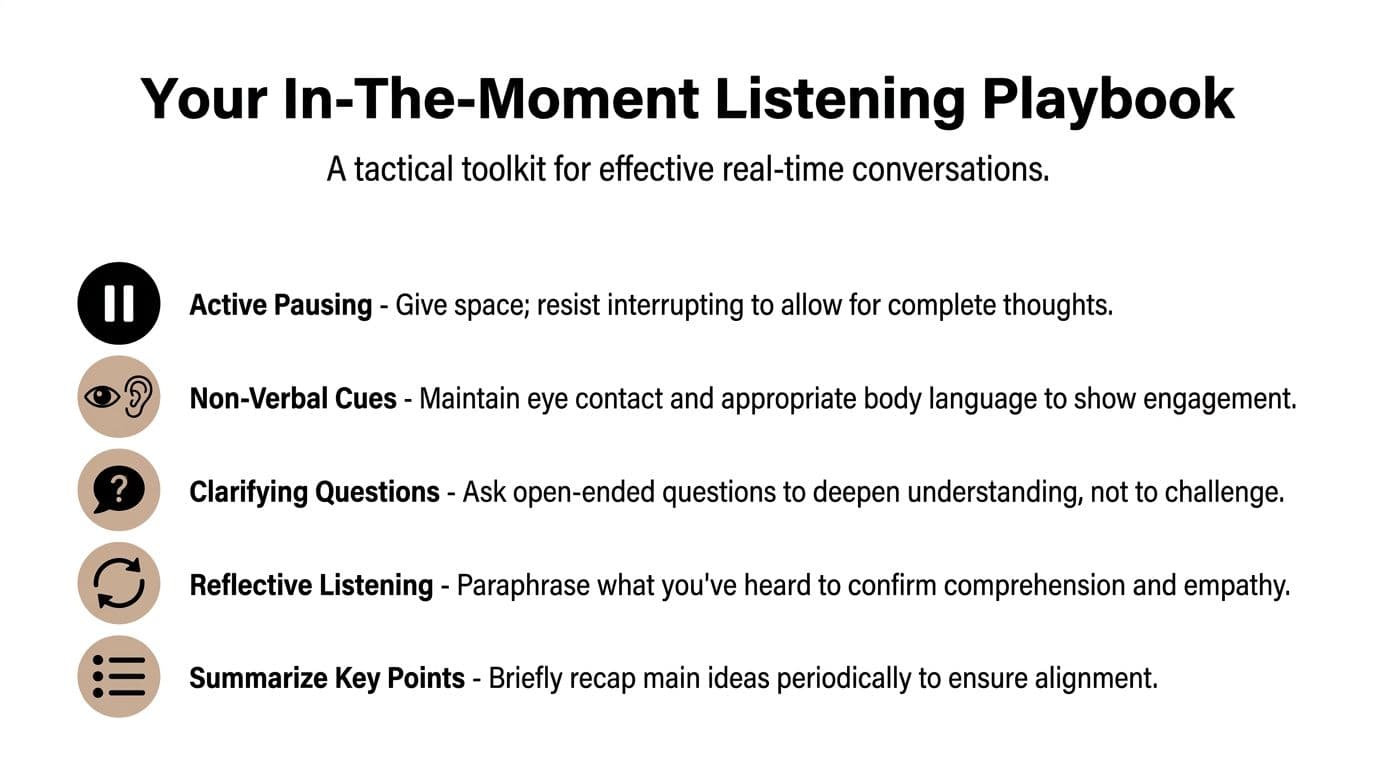
Your In-The-Moment Listening Playbook
Good listening is visible. You can hear it in the questions someone asks, the pauses they allow, and the way they check understanding before moving to action.
Many people know this in theory. The problem is that pressure collapses theory. In a live conversation, you need a playbook.
Start with paraphrase, not opinion
If a point matters, reflect it back before adding your view.
That can sound like:
- “So what I’m hearing is that the deadline isn’t the issue. The issue is that the requirements are still moving. Is that right?”
- “By that, do you mean you want fewer updates, or more concise updates?”
- “Let me check that I’ve got the core point before I respond.”
This works because it forces shared meaning into the open. It also gives the speaker a chance to correct you while the stakes are still low.
One of the clearest practical findings on this topic is that immediately paraphrasing and probing for underlying feelings can reduce misinterpretations by as much as 75% in diverse workforces. That’s a strong argument for making paraphrase a default move, not a special technique reserved for conflict.
Ask questions that widen, then narrow
Bad clarifying questions feel like cross-examination. Good ones help the speaker think more clearly.
Use this sequence:
- Widen the frame: “What’s the main concern from your perspective?”
- Locate the friction: “Where does this break down in practice?”
- Narrow the point: “What would need to be true for this to feel workable?”
That pattern keeps you from latching onto the first detail and missing the actual issue.
A lot of managers skip straight to narrow questions because they’re trying to be efficient. Ironically, that often creates longer conversations later because they solve the wrong problem first.
Name the dynamic when tension enters the room
Some conversations get stuck because everyone keeps discussing content while avoiding the emotional dynamic shaping the content.
When that happens, say the quiet part carefully.
Try lines like:
- “I’m sensing some hesitation. What feels unresolved?”
- “We seem aligned on the goal but not on the approach.”
- “I think there may be two different definitions of success in this conversation.”
This is one of the fastest ways to move from performative agreement to actual clarity.
Field note: If the energy in the room changes and nobody names it, the conversation usually gets less honest from that point forward.
Two scripts for high-stakes moments
Project kickoff
At kickoff, people often pretend clarity exists because nobody wants to look unprepared.
Use a script that pulls assumptions into daylight:
- “Before we assign anything, I want to confirm what problem we’re solving.”
- “What would make this project feel successful to you?”
- “What does ‘done’ mean here in practical terms?”
- “Let me summarize the essential points I heard, and you tell me what I missed.”
This sequence is especially helpful when clients use broad words like “clean,” “urgent,” “strategic,” or “simple.” Those words create confidence and confusion at the same time.
Difficult feedback
Feedback fails when the listener feels judged or when the giver rushes toward advice.
Try this structure:
| Step | Example line | Purpose |
|---|---|---|
| Observation | “I noticed the updates were arriving after key decisions had already been made.” | Keeps it concrete |
| Impact | “That left the team working with incomplete context.” | Shows why it matters |
| Inquiry | “What was happening from your side?” | Opens understanding |
| Check | “Am I seeing that accurately?” | Prevents distortion |
| Forward move | “What would help us avoid that next time?” | Shifts to action |
This keeps the conversation from turning into a lecture.
A daily practice that fits real work
You don’t need a retreat or a coaching certification to get better at this. You need repetition inside normal conversations.
Use one small drill each day:
- In one meeting, paraphrase before giving your opinion
- In one Slack exchange, ask a clarifying question before assigning blame
- In one handoff, summarize the task, the reason, and the expected result
- In one tense moment, name the dynamic without accusation
Those are small reps, but they compound. Listen to understand becomes more natural when you practice it under ordinary pressure, not just in ideal conversations.
Building a Neuroinclusive Listening Environment
A lot of communication advice assumes one narrow definition of “good listening.” Sit still. Make steady eye contact. Don’t interrupt. Respond calmly. Track everything in real time.
For many people, that standard isn’t neutral. It’s exhausting.

If you want people to listen to understand, you have to make understanding more accessible. That matters for everyone, but especially for neurodivergent colleagues, including adults with ADHD.
A useful reminder is that adults with ADHD may interrupt 30 to 50 percent more in conversations due to impulsivity. That doesn’t mean they care less or listen worse. It means communication works better when the environment has structure.
What support looks like in real teams
Neuroinclusive listening is less about etiquette and more about design.
A few practical shifts make a big difference:
- Send agendas early: People process better when they know what kind of conversation they’re entering.
- Make the goal explicit: Say whether the meeting is for brainstorming, decision-making, feedback, or status.
- Use visible summaries: Shared notes, captions, and written action items reduce memory load.
- Normalize clarification: Let people ask for repeats, examples, or a recap without stigma.
- Allow different attention styles: Someone may listen better while doodling, looking away, standing, or using a fidget tool.
Many teams accidentally equate one body language style with engagement. That’s a mistake. A person can maintain eye contact and absorb very little. Another can glance away constantly and follow every detail.
Stop grading listening by appearance
Managers often misread behavior.
Someone who interrupts may be impulsive, not dismissive. Someone who asks for written follow-up may be trying to prevent errors, not avoid responsibility. Someone who goes quiet in a fast discussion may need an extra beat to process before contributing something useful.
That’s why communication norms should be explicit rather than implied.
A healthy team can say things like:
- “I process better if I can see the steps written out.”
- “Please give me a second to finish the thought before jumping in.”
- “I heard the task, but I want to repeat it back to make sure I’ve got it.”
- “I may not make eye contact the whole time, but I’m following you.”
For a broader set of practical habits, this guide on 10 Actionable Tips for Better Communication Skills is a useful companion resource because it emphasizes everyday behaviors teams can adopt without turning communication into a performance test.
A related operational issue is workload design. If your team struggles with focus, switching, and follow-through, the conversation around communication should connect to task systems too. Fluidwave’s article on task management for ADHD is relevant here because listening quality often drops when work itself is fragmented.
Give people more than one way to stay aligned
Written follow-up is not a crutch. It’s often the difference between shared understanding and polite drift.
This short video is a useful prompt for thinking about how people experience communication differently in live settings:
A neuroinclusive team usually builds in multiple channels:
| Need | Better support |
|---|---|
| Processing time | Send notes before and after meetings |
| Working memory support | Keep visible decisions and next steps |
| Reduced interruption friction | Use hand signals, chat, or rounds |
| Clarity under stress | Break tasks into concrete parts |
Good listening environments don’t demand that everyone process the same way. They make it easier for different people to reach the same understanding.
That’s the standard worth aiming for.
Turning Understanding into Action with Fluidwave
Listening is incomplete if it dies in the meeting.
I’ve watched teams have thoughtful conversations, ask smart questions, even reach genuine alignment, then lose the value of all of it because nobody translated understanding into execution. The task gets created without context. The assistant gets the “what” but not the “why.” A good conversation turns into avoidable cleanup.
That’s where post-conversation discipline matters.

Capture the meaning, not just the task
A weak handoff says, “Draft proposal by Friday.”
A strong handoff says what the proposal is for, what concern it must address, who will review it, and what trade-off matters most.
That distinction matters because people don’t execute tasks in a vacuum. They interpret them. If your listening was strong during the conversation but your task capture is thin afterward, the misunderstanding moves downstream.
A simple post-meeting standard helps:
- Write the decision in one sentence
- List the next actions
- Add the reasoning behind those actions
- Flag open questions
- Assign ownership clearly
This is why strong project operators rely on synthesis, not raw note dumps.
Pre-work and post-work drive better delivery
The teams that listen well usually do two things others skip. They prepare before the discussion, and they synthesize after it.
That pattern shows up in project environments too. Teams using smart listening methods that include pre-meeting preparation and post-session synthesis report fewer delays and higher on-time project delivery, as noted through industry coverage. The practical takeaway isn’t just “listen better.” It’s “bookend the conversation so understanding survives contact with execution.”
If you need a structured way to formalize this across a team, a documented communications rhythm helps. Fluidwave’s project communications plan template is useful because it turns vague expectations into repeatable operating rules.
A better workflow for delegation
For busy professionals, especially founders and managers who delegate frequently, I recommend a three-part transfer after any important conversation.
The summary
Create a short recap with plain language.
Include:
- What was decided
- Why it matters
- What success looks like
- What should not be changed without checking back
This avoids a common failure pattern where the delegate completes the visible task but misses the strategic constraint.
The task structure
Break the work into units that can be owned.
Don’t say, “Handle onboarding.” Say what “handle” includes. Does it mean drafting copy, coordinating documents, following up with stakeholders, or building a checklist? Listening to understand should lead to task definition that survives interpretation.
The confirmation loop
Ask the person receiving the work to restate the assignment in their own words.
Not because you distrust them. Hidden assumptions reveal themselves fast at this stage.
A handoff is only complete when the other person can explain the task back to you with the same priorities you intended.
Why this matters in a task platform
A task platform shouldn’t just store assignments. It should preserve context.
That’s the practical value of using a system where you can keep notes, attach rationale, define owners, and track progress without forcing people to hunt through email, chat, and meeting recordings. The more fragmented your work environment is, the more listening value gets lost after the conversation ends.
A good operating pattern inside a task system looks like this:
| After the conversation | What to record |
|---|---|
| Decision made | One-sentence summary |
| Task assigned | Clear owner and due expectation |
| Reason behind it | Context note or brief rationale |
| Risk or ambiguity | Open question or dependency |
| Check for alignment | Restated understanding from assignee |
In this way, listening to understand becomes more than a communication ideal. It becomes workflow design.
If your team still spends too much time re-explaining assignments, chasing status, or correcting “completed” work that missed the point, the issue may not be effort. It may be that understanding was never converted into a usable action system.
How to Sidestep Common Listening Traps
Even skilled communicators fall into predictable listening traps. Usually when they’re rushed, tired, irritated, or overconfident.
That matters because deep listening takes mental effort. It can sharpen insight, but it also increases cognitive load by up to 20% for knowledge workers. If you’re fatigued, your brain looks for shortcuts. Those shortcuts often sound like certainty.
Five traps that show up all the time
Rebuttal brain
You stop listening the moment you hear something you disagree with.
Your internal script becomes, “That’s not right, and here’s why.” From that point on, you’re not receiving information. You’re collecting openings.
If this happens, then do this: pause and ask one question before stating your position.
Problem-solving bulldozer
Someone explains a messy situation and you rush to fix it before you’ve understood it.
This often looks efficient. It usually isn’t. You solve the visible symptom, then learn later that the actual issue was political, emotional, or structural.
Correction: don’t offer a solution until you can state the problem back in one sentence and the speaker agrees with it.
Autobiographical listening
You turn their story into your story.
They describe a difficult client and you jump in with your own similar experience. Sometimes that’s meant as empathy. Often it redirects attention away from the person who’s speaking.
Better move: hold your example unless it will clearly help them think, not just help you relate.
Pseudo-listening
Your face says “I’m with you.” Your mind is in another tab.
This happens in long meetings, familiar topics, and discussions where people use too many vague words. Nodding hides the drift for a while, but your later questions expose it.
Recovery move: interrupt and reset. “I want to make sure I’m tracking. Let me summarize what I heard so far.”
Emotional hijacking
You hear criticism, urgency, or disappointment and your own emotional reaction floods the channel.
At that point, you’re not listening to understand. You’re listening through threat.
Reset: slow the pace, name your need for precision, and ask for one concrete example.
A quick diagnostic table
| Trap | Early warning sign | Fastest fix |
|---|---|---|
| Rebuttal brain | You’re mentally drafting a defense | Ask one clarifying question |
| Bulldozer | You want to solve it in the first minute | Restate the problem first |
| Autobiographical | “This happened to me too” is on your tongue | Stay with their experience |
| Pseudo-listening | You missed the last key point | Summarize and verify |
| Emotional hijacking | Your body feels activated | Slow down and get concrete |
Listening well outside work matters too
These traps don’t stay at the office. They show up at home, especially in close relationships where people assume they already know what the other person means.
That’s one reason relationship-focused resources can still sharpen professional awareness. This piece on improve communication in marriage is useful because it shows how fast assumptions, defensiveness, and rushed replies can erode trust in any ongoing relationship.
The most dangerous listening mistake is confidence without verification.
If you want to listen to understand more consistently, don’t aim for perfection. Aim for earlier recovery. Catch the trap faster. Correct it sooner. That’s how strong communicators improve in real life.
If your conversations are clear but your follow-through is messy, the gap usually isn’t effort. It’s execution. Fluidwave helps turn understanding into organized action with AI-assisted task management, delegation to human virtual assistants, and focused workflows that keep context attached to the work. If you want fewer dropped details and cleaner handoffs, it’s worth a look.
Focus on What Matters.
Experience lightning-fast task management with AI-powered workflows. Our automation helps busy professionals save 4+ hours weekly.