Discover how collaborative task management boosts team productivity, streamlines workflows, and keeps everyone aligned on shared goals.
October 15, 2026 (4d ago)
Collaborative Task Management: A Practical Guide
Discover how collaborative task management boosts team productivity, streamlines workflows, and keeps everyone aligned on shared goals.
← Back to blog
You're in a launch meeting, and nobody can answer a simple question: who owns the next step? The campaign brief is in one chat, the latest creative is in a shared drive, an approval is buried in email, and someone remembers agreeing to a different deadline. By lunchtime, the team isn't moving the launch forward. They're reconstructing it.
That is the problem collaborative task management addresses. It is not a prettier to-do list or another place to copy conversations. It is the deliberate design of how work moves between people, projects, handoffs, and time zones, while keeping ownership and context visible.
The need is especially clear in hybrid teams. Microsoft's Work Trend Index telemetry found that Microsoft 365 users were interrupted every two minutes during core working hours by a meeting, email, or chat, or roughly 275 interruptions per day (Microsoft Work Trend Index). A shared task record can't eliminate every interruption, but it can stop routine status questions from becoming the workday.
When Team Coordination Breaks Down
A marketing team preparing a product launch begins with clear intentions. The campaign manager writes the brief, the designer shares an early concept, the copywriter drafts landing-page text, and the product lead promises an approval. Once work starts, however, each person records progress in a different place.
The designer posts a revised file in project chat. The copywriter opens an older version in the document folder. The product lead announces a changed launch date by email, but the campaign manager misses it until the next morning. A freelancer asks whether “approved” means approved by marketing or by legal. No single record resolves the question.
In this scenario, every question below could have been answered by the task record itself:
- Who owns the next action?
- What does “done” mean for this task?
- Which item is blocking the handoff?
- Where is the latest decision?
- Who needs to review the work, and by when?
A personal task list manages one person's attention. A collaborative system coordinates a shared result. If the designer's file must be reviewed before the copywriter can publish the page, the record should show the owner, dependency, current status, and review requirement. Otherwise, teammates have to reconstruct progress through messages and memory.
That reconstruction creates two kinds of work. People spend time locating context, and they make decisions with incomplete context. A task can appear active while its dependency is waiting, or appear complete while legal review remains outstanding.
Practical rule: If a teammate must interrupt someone to discover the next action, the coordination system is incomplete.
Coordination also includes deciding which questions deserve live attention. A shared record can hold the latest file, decision, owner, and deadline, allowing meetings and messages to focus on judgment rather than status recovery. Microsoft's analysis of the infinite workday describes how meetings, email, and chat compete for attention across the workday (Microsoft's analysis of the infinite workday). The operational goal is not to remove collaboration. It is to make routine collaboration visible without requiring another interruption.
Good coordination is a craft. It means defining ownership, exposing dependencies, writing tasks another person can act on, reviewing AI-suggested priorities, and supporting different ways of processing information. A tool earns its place when it reduces ambiguity while keeping accountability with the people doing the work.
What Collaborative Task Management Actually Means
Start with the difference between a personal list and a shared operating record.
A personal task list is like a prep sheet for one cook. It might say “chop vegetables,” “make sauce,” and “plate dinner.” The cook knows the context, can change the order, and doesn't need to explain every decision to another station.
Collaborative task management is the pass during dinner service. Multiple stations need to see the ticket, understand what's ready, know who owns the next action, and recognize what's holding up the table. The system makes the handoff visible instead of relying on shouted updates or separate notes.
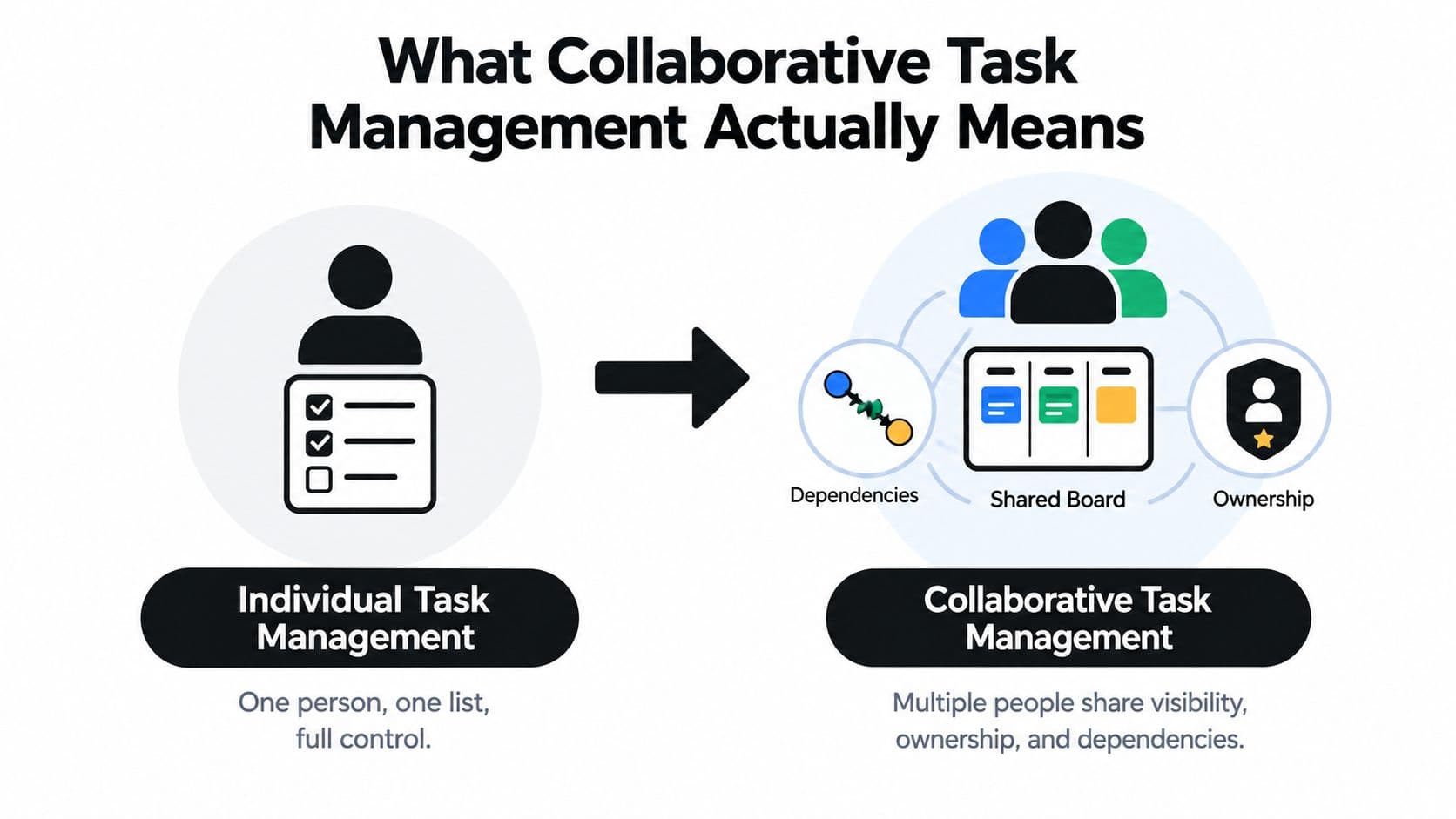
A useful shared task should answer six questions:
- What needs to happen? The task describes an outcome, not just a topic.
- Who owns it? One person is accountable for moving it forward.
- When is it needed? The deadline reflects the project, not only the owner's personal schedule.
- What must happen first? Dependencies show upstream work and blocked states.
- Where does it stand? Status distinguishes planned, active, awaiting review, blocked, and complete.
- What context supports action? The brief, files, acceptance criteria, and decision history sit with the task.
That last point is where many teams get confused. A comment thread in a task isn't just chat attached to a card. It preserves the reasoning that explains why the work changed, what the reviewer requested, and which version should be used. When the next person joins the project, they can understand the work without searching through old conversations.
Research involving 191 people in distributed agile teams across three Norwegian companies found that initiated interdependence was associated with greater clarity about other people's roles, while received interdependence was associated with greater clarity about one's own role. Both forms of role clarity were subsequently linked to stronger team performance (the distributed agile teams study). In practical terms, the way tasks connect should help people understand both whom they depend on and who depends on them.
For a straightforward introduction to the individual side of the discipline, see what task management involves. The collaborative layer begins when a task's success depends on someone beyond its current owner.
Why Coordination Is a Measurable Problem
A product launch can stall because one person is waiting for final assets, another is unsure which deadline applies, and a third is repeating a decision already made in a meeting. The work may look active in several places, yet nobody can see the full sequence or the point where progress stopped. Coordination becomes measurable when a team records those handoffs, decisions, delays, and ownership changes.
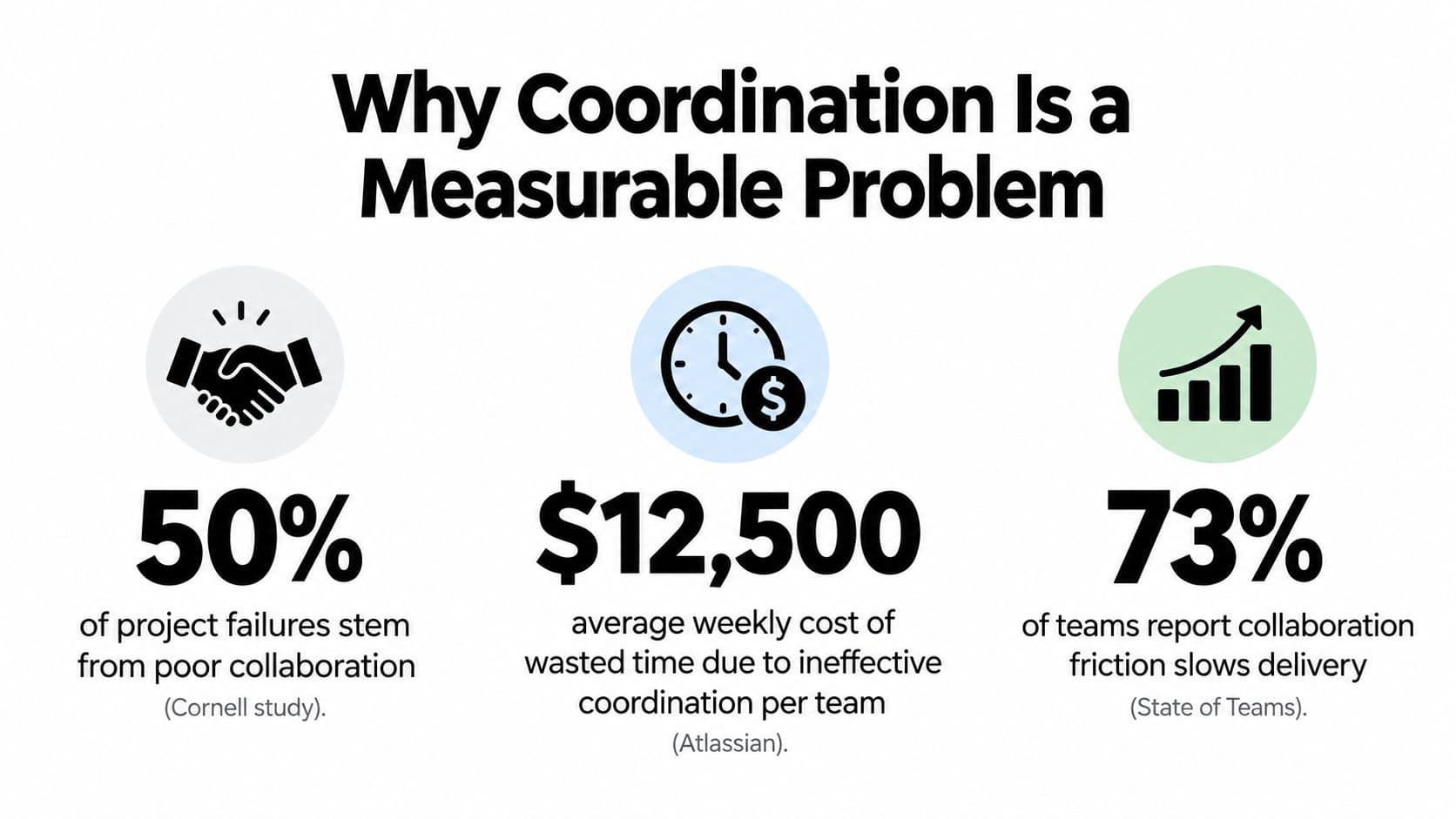
A Cornell University study examined 65 four-person project teams and compared structured training in task- and team-generic teamwork skills with a control condition. Trained members scored 4.06 compared with 3.43 on planning and task coordination, and 5.28 compared with 4.68 on collaborative problem solving. Both differences were statistically significant at p < .01 (the Cornell teamwork study).
The result points to a practical distinction. Software does not create good teamwork by itself. Teams develop coordination through repeatable behaviors, such as setting a clear owner, defining what “ready” means, recording a decision, and identifying who resolves a blocker. A shared task system gives those behaviors a visible place to happen and makes them easier to review.
The enterprise cost of invisible work
The business cost appears in small interruptions. A designer searches for the latest brief, a manager asks who owns approval, and an engineer pauses until missing inputs arrive. Each delay may seem minor, but the team keeps paying for the same reconstruction.
Research summarized in Atlassian's 2024 State of Teams report estimated that ineffective collaboration costs Fortune 500 companies approximately 25 billion work hours annually. The same report found that 93% of executives believed their teams could achieve similar outcomes in half the time if they collaborated more effectively (Atlassian's 2024 State of Teams report).
Those figures describe large enterprises, while the pattern also appears in startups, agencies, professional services firms, and executive offices. People look for the current version, repeat decisions, wait for answers, or attend meetings mainly to collect status updates.
A useful operating test is simple:
If a team cannot describe how it plans, assigns, hands off, and reviews work, meetings and chat will fill the gap.
A task system should record coordination practices, not only completed items. Teams can review whether dependencies were ready on time, how long work stayed blocked, whether reviews happened before deadlines, and whether the final deliverable met its acceptance criteria.
That evidence helps leaders locate delays and helps contributors act without reconstructing the workflow from scattered conversations. It also creates a basis for reviewing AI-suggested priorities: a recommendation should remain accountable to the owner, dependency, and acceptance criteria recorded in the work.
Core Collaboration Features Teams Actually Use
A product team preparing a release rarely struggles because nobody has a task list. The trouble starts when the designer finishes the interface, engineering needs the final assets, and marketing is waiting for a confirmed release date. Shared tasks and dependencies should capture the asset, receiving owner, required format, and condition that makes it ready for engineering.
A marketing team working with freelance writers faces a different coordination problem. The writer needs the brief, audience, tone, source material, and review deadline together. Permissions should let a contractor edit a draft and respond to feedback without changing the project structure or viewing unrelated internal work.
An executive team coordinating a cross-functional initiative needs both altitude and detail. Leaders can review milestones, while individual owners work from the steps assigned to them. Shared views allow the same record to appear as a list, calendar, board, or timeline, so teams can change the way they inspect work without creating duplicate records.
A busy professional delegating research to a virtual assistant needs a handoff that can survive a busy day. Handoff quality depends on the expected result, relevant budget or constraints, due date, and review step. “Research competitors” names a topic. “Compile the current pricing pages for the named competitors, link each source, and flag differences in a comparison table” defines work another person can complete and check.
Evaluate features against the handoff
Real-time editing helps when several people shape a brief or review a deliverable together. It creates noise when every small change sends an alert. Shared tasks improve visibility only when the team agrees what each status means. Permissions protect sensitive work, while overly broad access can make ownership difficult to trace. A handoff is ready when the recipient knows what is arriving and what acceptance looks like.
| Feature | Best used when | Common misuse |
|---|---|---|
| Real-time editing | A brief, plan, or decision needs collaborative input | Turning every document change into a notification |
| Shared tasks | Several people contribute to one outcome | Assigning one vague task to an entire group |
| Permissions | Contractors, clients, assistants, and internal teams need different access | Giving everyone administrative control |
| Handoffs | Work moves from one role to another | Moving a card without adding context or acceptance criteria |
Notice the pattern in the table. Three of the four common misuses are context failures, not tool failures. The card moved, but the acceptance criteria did not move with it. The group received an assignment, but nobody knew who owned the result. The notification appeared, but it did not explain what changed or what action was expected.
The practical rule is to pair each feature with an operating habit. A board cannot define “ready for review” on its own. The team must record the handoff owner, relevant context, and evidence that shows the work meets the agreed standard.
Teams with specialized administrative workflows may also need purpose-built tools alongside a shared task system. A lawn-care business comparing operational software may find a useful starting point in find lawn care invoicing tools, while keeping client work and internal handoffs in its broader collaboration workflow.
For teams working inside documents, messages, and live project records, real-time collaboration workflows provide a useful comparison point. The buying question is whether the team can complete a real handoff without opening five other tools.
AI Assistance Without Losing Accountability
An AI assistant that suggests priorities is not an oracle. Treat it like a junior teammate who can process information quickly but still needs a reviewer, a reason for its recommendation, and a named owner for the result.
Suppose an automated system moves a customer escalation above a product improvement. The team should be able to see what signals influenced that change, who approved it, and how to reverse it if new information appears. If an AI summary leaves out a critical constraint, the person responsible for the task needs a visible way to correct the record.
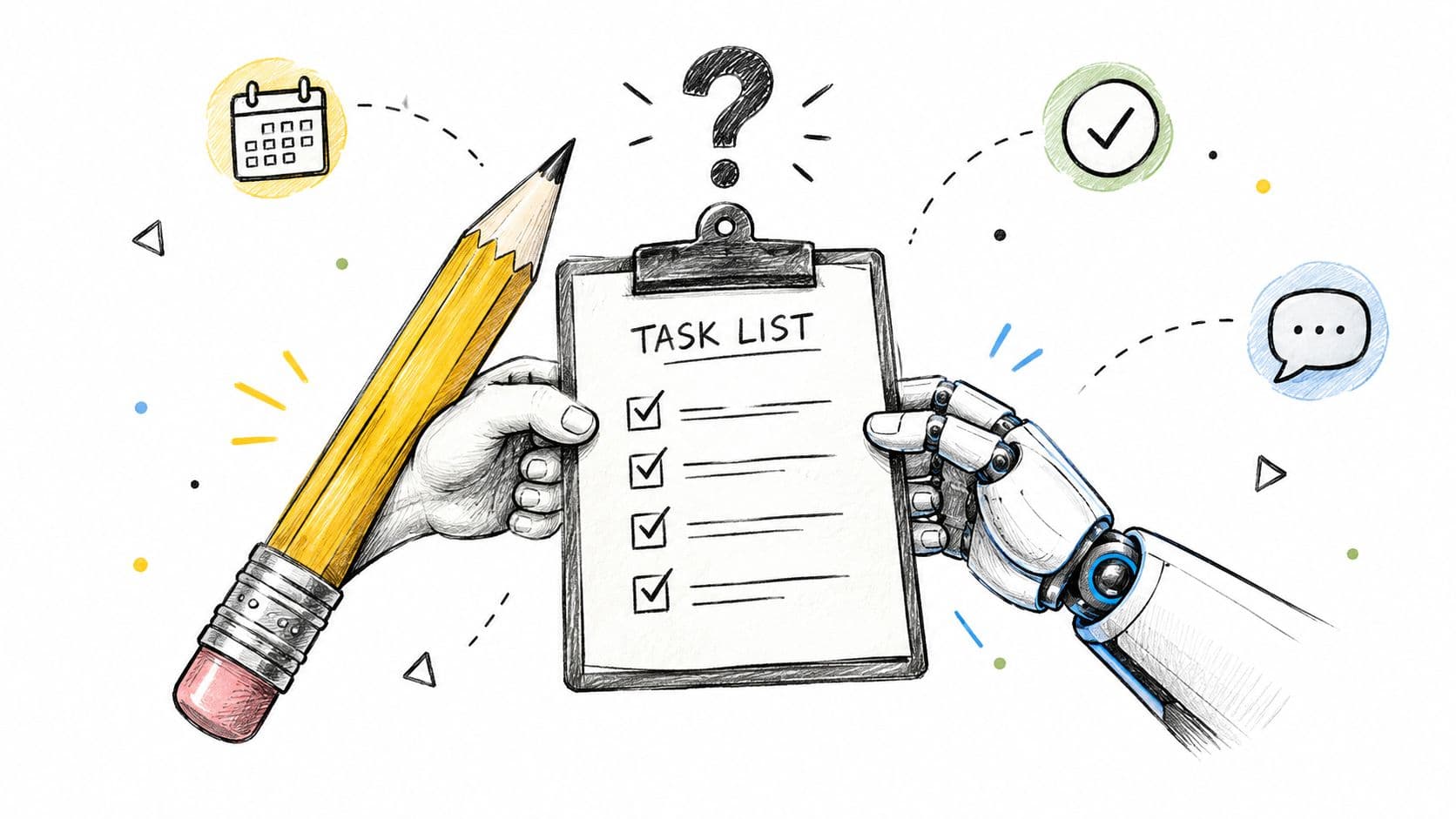
The accountability gap is real. An Avanade study of 700 employees using Microsoft 365 Copilot found that fewer than 64% believed someone was accountable for AI errors, and only 65% said Copilot consistently delivered helpful responses. A broader Workday study of 2,500 workers across 22 countries found that 90% believed AI could improve organizational transparency and accountability (Avanade's Copilot Trust Report). Expectations are high, but confidence in current accountability is incomplete.
Four controls for responsible automation
- Show the signal: Record why a task moved, such as a deadline change, a dependency update, or a new priority marker.
- Keep the history: Preserve earlier priorities, summaries, assignments, and decisions so changes can be reviewed.
- Name a human owner: AI can recommend a sequence, but a person remains responsible for approving and acting on it.
- Escalate high-impact work: Require human review before automation changes a customer commitment, legal deliverable, financial decision, or major dependency.
These controls don't need to create meeting-heavy bureaucracy. A short approval field, a visible change history, and a reversible priority action can provide useful oversight inside the task itself. Teams should also distinguish between low-risk assistance, such as summarizing comments, and decisions that alter commitments or redistribute work.
Organizations coordinating community programs or distributed volunteers can apply the same logic to volunteer management software. The important question is not whether automation exists. It's whether people can inspect, challenge, and correct what the automation did.
For a practical view of AI inside task workflows, compare the model described in an AI project management assistant. The standard should be clear: automation should reduce coordination effort without hiding accountability.
Designing for Different Brains at Work
A shared board can improve visibility and still create friction. Dense notifications, vague task language, unspoken response expectations, and rigid work hours can make a system harder to use for people with ADHD, autism, or other forms of neurodivergence. The issue isn't whether someone can technically access the board. It's whether the workflow lets them contribute without constant interruption or guesswork.
A 2024 systematic review synthesized 79 studies covering workplace experiences of 68,275 people with ADHD across 22 countries. It identified supports including quiet workspaces, flexible hours, breaks during long meetings, delegating tedious tasks, and assistive tools such as to-do lists, checklists, electronic planners, calendars, smartphones, and productivity software (the systematic review of workplace experiences with ADHD).
Those findings translate into ordinary operating choices. A task can state the next physical action instead of using an abstract label. A deadline can remain visible without generating repeated reminders. A teammate can work asynchronously and provide a written update rather than proving commitment through immediate chat responses.
Make the workflow easier to interpret
Use task conventions that reduce the amount of information people must hold in memory:
- Write the next action: Replace “onboarding improvements” with “rewrite the first welcome email and attach the proposed copy.”
- Define completion: State what the owner must produce, who reviews it, and what evidence closes the task.
- Control notifications: Separate urgent blockers from routine progress updates and let people choose quiet periods.
- Allow flexible timing: Focus on the outcome and handoff rather than equating standard hours with availability.
- Delegate repetitive work: Move tedious execution to a willing teammate, assistant, or automation instead of assuming every role should absorb it.
- Use predictable statuses: Keep status names stable so people don't have to decode changing terminology.
Accessibility isn't a special sidebar. Clear task language helps a new hire, a contractor, an executive, and a neurotypical teammate who is switching between projects. Quiet asynchronous collaboration also protects deep work for everyone.
Avoid turning the system into a surveillance device. Detailed review trails can support accountability, but constant monitoring can create its own cognitive load. Show the information needed to coordinate, then give the owner room to execute.
Putting It Together with Fluidwave
Fluidwave brings shared projects, multiple task views, automated prioritization, delegation, comments, and progress tracking into one workflow. A team lead can create a project, review work in a table, list, calendar, Kanban, or card view, and assign tasks to specific people. A virtual assistant can receive execution-heavy work on a pay-per-task basis, while the requester retains the task record and review step.
The useful design choice is keeping the coordination record close to the work. A priority suggestion should be reviewable rather than accepted without review. A delegated task should carry its brief, deadline, budget, and expected result. A comment should clarify the handoff instead of forcing the next owner to search through a separate chat.
Teams should measure shared outcomes rather than ranking people by raw task counts. A 2026 experimental study found that team-level relative-performance information improved performance under task interdependence by strengthening cohesion and coordination, while individual rankings in those conditions created competing mindsets that weakened coordination (the study of performance information and task interdependence). Shared progress, blocked-task duration, review latency, and integrated delivery are more useful signals than a leaderboard of closed tasks.
Fluidwave's model also includes delegation without requiring a subscription for delegation, transparent pricing plans, and a free forever tier. Those product details matter only if they support a clear operating model: one record for the request, the owner, the dependency, the decision, and the final result.
A Two-Week Adoption Plan for Busy Teams
Start small. On day one, choose one live project, define task titles and status names, and agree that every task gets one owner and one expected outcome. From days two through five, migrate only that project and keep decisions in its task records.
From days six through ten, add dependencies, review permissions for contractors or assistants, and test one delegated handoff. From days eleven through fourteen, review blocked work, overdue reviews, notification volume, and whether people can find the next action without asking for it.
Use this framework for turning effort into results to connect activity with outcomes, then keep the checklist practical:
- Visibility: The latest context and status are easy to find.
- Ownership: Every next action has one accountable person.
- AI accountability: Automated suggestions show their reasoning and remain reversible.
- Accessibility: Tasks support clear instructions, quiet focus, and flexible execution.
- Asynchronous handoffs: Decisions and updates stay attached to the work.
Fluidwave combines shared task views, automated prioritization, threaded collaboration, and pay-per-task delegation for teams that need less scattered coordination. Visit Fluidwave to create a shared workflow where ownership, handoffs, and accountability stay visible from request to completion.
Focus on What Matters.
Experience lightning-fast task management with AI-powered workflows. Our automation helps busy professionals save 4+ hours weekly.