See the benefits of delegation in hard numbers, from growth and initiative to burnout, and when handing work off backfires.
November 12, 2026 (1d ago)
Benefits of Delegation for Teams and Leaders
See the benefits of delegation in hard numbers, from growth and initiative to burnout, and when handing work off backfires.
← Back to blog
1,751%. That's the average three-year growth rate Gallup recorded for Inc. 500 chief executives who rated high in its "Delegator" talent category, 112 percentage points above the rate for CEOs with limited or low Delegator talent, in Gallup's analysis of 143 Inc. 500 chief executives.
A number that size makes delegation sound like a switch you flip once and then collect the profits. The CEOs in that sample weren't flipping a switch. They were moving work along with the decisions, the resources, and the review that work needs in order to finish.
That distinction carries the whole topic, because a badly built handoff isn't neutral. It lands a task on someone without the authority to complete it, or on a queue that's already overflowing, and what comes back is rework, ambiguity, and two overloaded people instead of one. The benefits of delegation are real and they are measurable, and every one of them has a condition attached: authority, capacity, and accountability travel with the task, or the benefit turns into someone else's stress.
Measured Benefits of Delegation
Delegation can affect growth, revenue, team performance, and how leaders spend their time. The figures below show possible outcomes, not guaranteed returns. Each depends on what work is handed off and whether the person taking it on can complete it.
| Benefit | What changes | Evidence |
|---|---|---|
| Business growth | Faster expansion and hiring among strong delegators | 21 jobs created over three years vs 17 |
| Revenue | Higher sales in the same CEO sample | 33% more 2013 revenue; about $8 million vs $6 million |
| Innovation | More creative output on the team | 3.9 times more likely |
| Initiative | People act past the formal job | 4.2 times more likely |
| Performance | More people rated high performers | 2.2 times more likely; high standards 1.9 times more likely |
| Recoverable time | Admin and coordination move off the leader | 60% of 2024 public-sector time on non-sector-specific work |
The money rows, and what they don't prove
In Gallup's analysis of Inc. 500 chief executives, strong delegators created 21 jobs over three years, compared with 17, and generated 33% more revenue in 2013, averaging $8 million versus $6 million. These results describe an association between a talent score and business outcomes, not proof that delegation alone caused the differences. The figures also come from one CEO sample, so use them as context rather than a forecast for your organization.
The team rows, where the mechanism is visible
Development Dimensions International's delegation research reports that employees on teams with effective delegation are 3.9 times more likely to produce creative outcomes and 4.2 times more likely to take initiative beyond their formal job description. They are also 2.2 times more likely to be regarded as high performers. Those teams are 1.9 times more likely to maintain high performance standards, while high-potential employees are 3.7 times more likely to leave when managers do not regularly provide growth and development opportunities.
The practical mechanism is ownership with room to act. Give someone a defined result, a deadline, the resources to do the work, and a clear boundary for decisions. That creates a chance to build judgment; assigning responsibility without authority instead creates delays and rework.
The time row you can verify in your own calendar
Time is the benefit you can measure directly. In 2024, 60% of public-sector workers' time went to non-sector-specific activities, including meetings, events, data analysis, research, and project management, according to the UK Office for National Statistics. If six of your ten working hours go to coordination, the opportunity is visible, but it only becomes recovered time if someone else has the capacity and authority to take on that work.
Pick one row. Choose the outcome that reflects your current bottleneck, then measure it again after a handoff. The other figures provide context, not targets.
Set a baseline before delegating. Count hours recovered, not just tasks reassigned, using this guide to how to measure employee productivity. Without a starting measure, you cannot tell whether the handoff reduced workload or only moved it.
Responsibility Authority and Accountability
Delegation works when three things move together: a clear result, enough authority to produce it, and a defined way to review the outcome. Leave one out, and the handoff can transfer stress instead of reducing it.
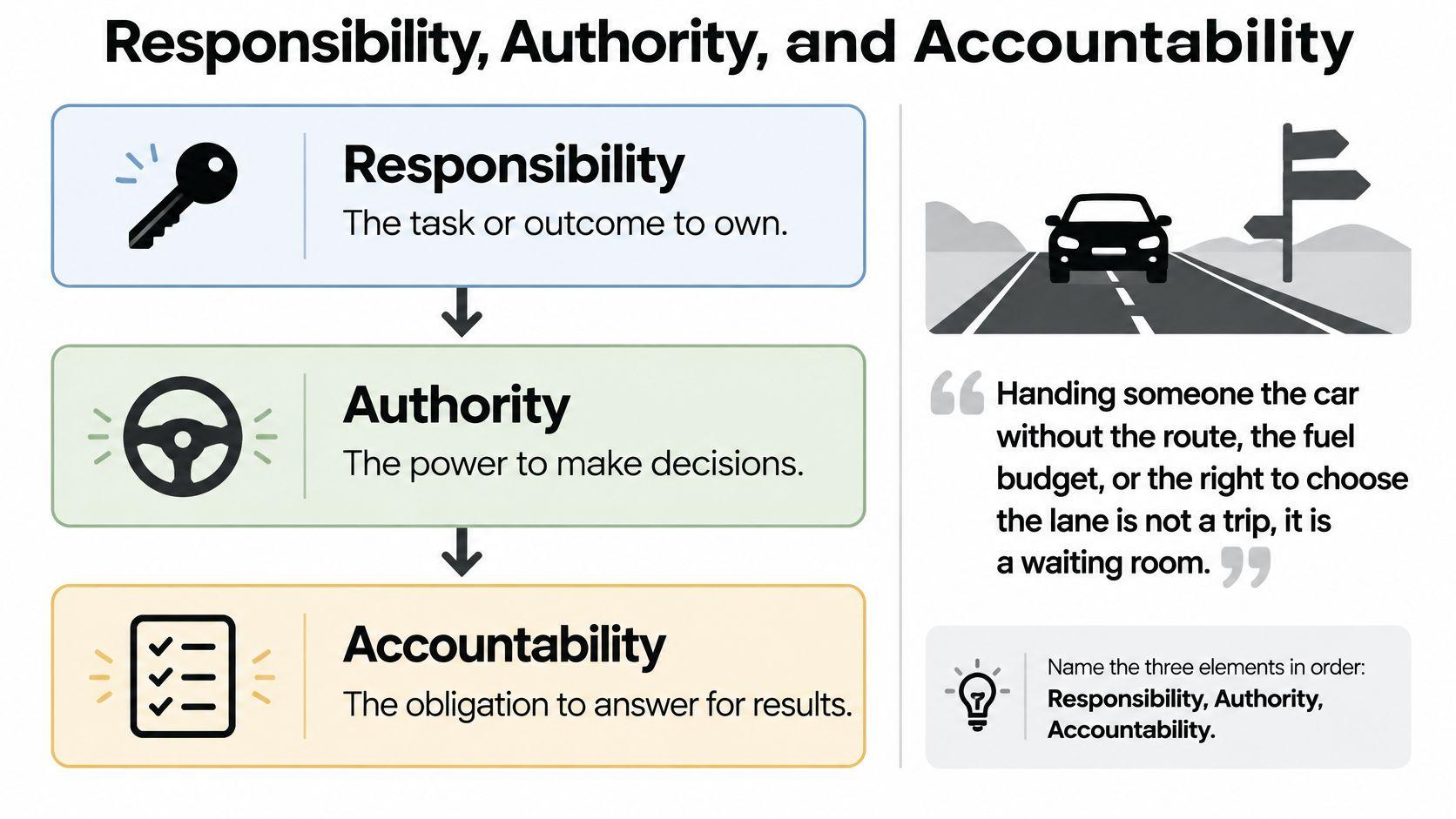
Name the three elements in order
- Responsibility is the result the person must produce. State an outcome, such as “pricing page live and holding baseline conversion by the 14th,” rather than an activity like “work on pricing.”
- Authority defines which decisions, budget, tools, and access the person can use without checking back. For a vendor negotiation, you might set a discount ceiling and let the delegate negotiate within it.
- Accountability sets out who reviews the result, what standard they use, and when they check progress.
A professional review of delegation practice in the American Journal of Health-System Pharmacy describes four practices: agree on responsibilities, define goals and checkpoints, provide appropriate authority, and avoid bypassing the delegate. These practices work as a set. If you retain every decision or give no one responsibility for checking the result, the task is likely to return to your queue.
What the accountability finding actually says
A study published in the An-Najah University Journal for Research examined delegation and job performance in government departments in Irbid. It found that accountability had a positive, statistically significant effect on job performance, while authority and responsibility did not show significant effects in that analysis.
That finding does not make authority or responsibility optional. Accountability helps close the loop: a named reviewer checks an agreed result against a clear standard, then follows up at the agreed point. Without that loop, the delegate may complete the work but still be unsure whether it meets expectations.
If roles blur on your team, this guide to roles in a team can help distinguish who decides, who produces, and who reviews.
A handoff with no reviewer and no standard is an announcement, not a complete delegation.
Rewrite one task you are handing off: state the result, name the decisions the delegate can make, and set a review date.
Match the Task to the Stronger Producer
Delegation is a comparative-advantage decision, not a generosity decision. You're asking who produces this piece of work more cheaply once you account for the cost of moving it.
Research on organizational boundaries reported in the Journal of the European Economic Association models delegation as economically rational when another producer's productivity clears the threshold for keeping work centralized. In the empirical evidence, delegation increased with mean productivity in the input industry, while input riskiness had no significant effect on the delegation decision. That second half is the surprising part: risk alone didn't stop firms delegating. Productivity did drive it.
The productivity-minus-friction test
Expected value equals the other person's output minus the cost of handoff, specification, monitoring, and rework. If that number is positive and the acceptance criteria fit on a short brief, the task is a candidate. If either condition fails, it isn't.
Skill match is the human version of the same test. A founder who is slow at research synthesis and fast at customer judgment should move the synthesis and keep the pricing call. A manager who rewrites every slide should hand the first draft to the person who already knows the data.
| Work type | Delegate when | Keep when |
|---|---|---|
| Repeatable admin | Acceptance criteria are clear and execution cost is lower | Handoff and rework exceed the time saved |
| Specialist production | The other person has better skill or speed | Quality assurance needs the leader's context |
| Development work | The person has spare capacity and real decision rights | Their queue is already full |
| High-impact decisions | A review checkpoint stays with the leader | Uncertainty or stakeholder risk is high |
| Coordination across teams | One owner and a visible waiting state exist | The task is mostly meetings about meetings |
Two contrasts make the test concrete. Inbox triage and scheduling usually clear it: the output is visible, the criteria are easy to state, and the cost of a mistake is small. Hiring decisions, sensitive feedback, and anything without a written definition of done usually fail it, because the specification cost is higher than the work.
Why paying per finished unit changes the arithmetic
A salary or day rate pays for availability. A pay-per-task arrangement pays for a finished unit at an agreed price with milestones, which suits irregular work: expense cleanup, transcript summaries, a one-off competitive scan. The arithmetic only holds when "done" is defined before the work starts, because a vague brief converts a cheap task into paid rework.
Price one recurring task both ways this week: the hours you'd spend multiplied by your effective hourly cost, against a completed-task fee.
When Delegation Cuts Stress Instead of Moving It
More handoffs are not automatically calming. Delegation is a capacity-allocation intervention, and when capacity doesn't travel with the task, the stress doesn't disappear. It relocates.
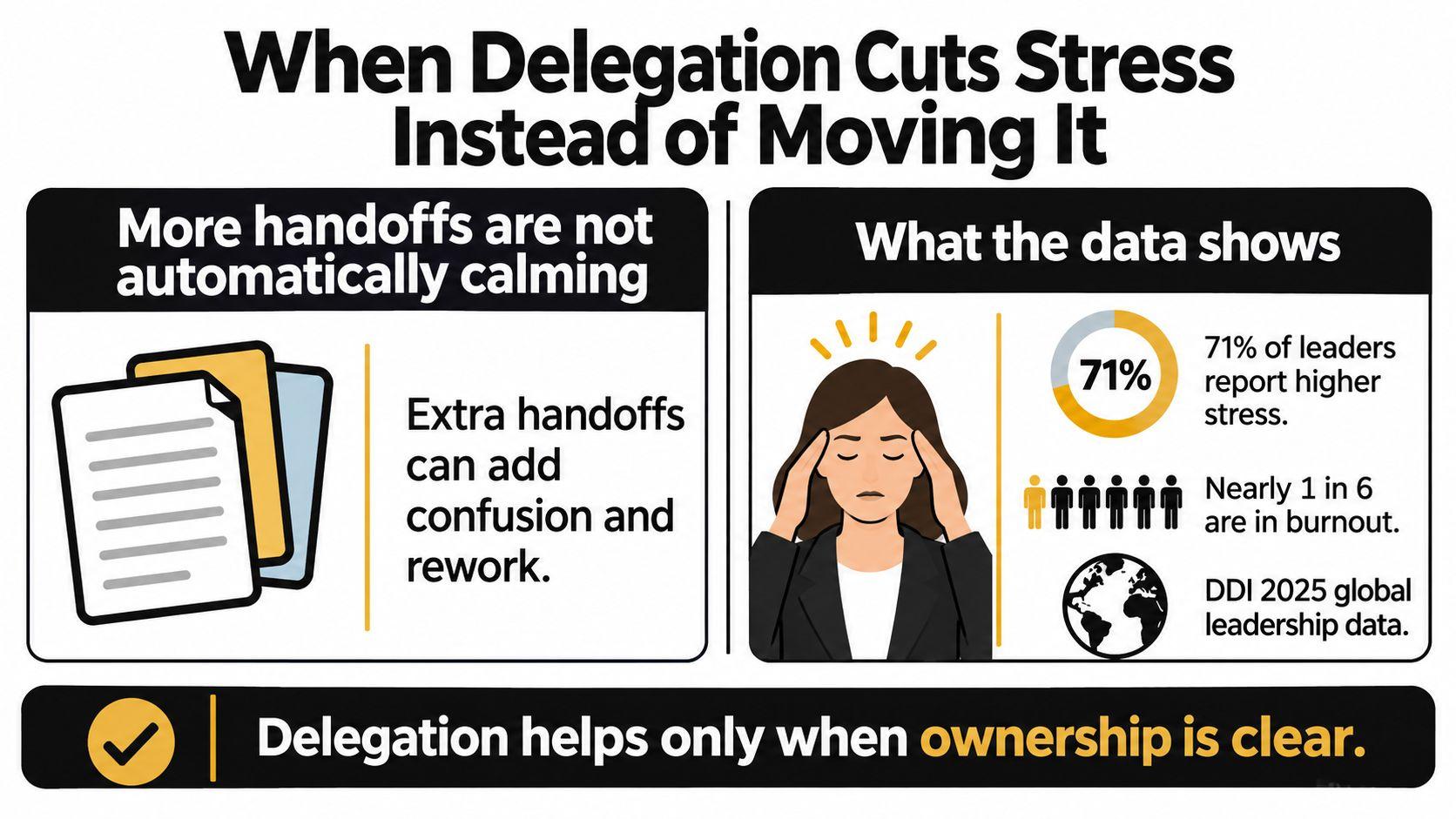
Nearly one in six leaders are in burnout, according to DDI's 2025 global leadership data, which named delegation the most effective skill for preventing it. Yet only 19% of more than 70,000 assessed manager candidates demonstrated strong delegation ability. That gap is the honest version of the story: the skill with the best burnout evidence is the one most managers haven't built.
Separately, 71% of leaders worldwide reported significantly higher stress since entering their current role, as covered in WorldatWork's report on training leaders to delegate.
Check the queue before you check the box
Responsibility without capacity or decision rights produces the three failure modes that eat the benefit: ambiguity about what done means, rework when the guess was wrong, and hidden emotional labor absorbed by the recipient. A full queue turns development work into another burden.
Ask one question before assigning: what comes off this person's list to make room? If the answer is nothing, you're not delegating. You're stacking.
The friction is expensive even before it lands wrong. In 2024, one hour a day spent resolving collaboration problems was estimated to cost organizations up to $16,491 per manager annually in lost productivity, from Zoom's global survey with Morning Consult of 7,969 knowledge workers and team leaders. The upside is equally large when the brief is clean: in 2024, 93% of executives said their teams could deliver similar outcomes in half the time if they collaborated more effectively, per Atlassian's survey of 5,000 knowledge workers and 100 Fortune 500 executives.
Measure the handoff, not the handoff count
Counting tasks moved tells you how busy you were, not whether anything improved. Six measures do.
| Measure | What it tells you | Warning sign |
|---|---|---|
| Managerial focus recovered | Whether you got hours back for work only you can do | Calendar unchanged while task count rises |
| Cycle time | Whether the work moves faster after the handoff | The first deadline slips |
| Rework | Whether the brief was specific enough | The same corrections twice |
| Recipient workload | Whether capacity existed | Their own deadlines start slipping |
| Quality | Whether the standard held | The acceptance check quietly relaxes |
| Burnout risk | Whether the arrangement is sustainable | Someone stops asking questions |
If you're already watching for overload in other forms, these ways to prevent employee burnout pair well with a delegation review, because the same signals show up as declining clarity and rising rework.
Run a one-week check. If the recipient's load spiked and quality fell, pull scope back rather than pushing more. That's not a retreat from delegation. It's the correction that keeps it viable.
How People and Teams Use Delegation
Delegation looks different in each setting, and the benefit shows up in a different place each time. Three scenes make the mechanics concrete.

A founder who approves every customer email. She keeps pricing exceptions and hiring, and moves routine replies and research briefs to one owner with a same-day deadline. The recovered hours go to two customer calls she'd been cancelling for a month. Nothing about her judgment left the business. The approval bottleneck did.
A project team buried in status meetings. Gallup estimates managers account for at least 70% of the variance in employee-engagement scores across business units, according to Gallup's workplace research, which means the fix isn't another meeting. Each person owns one deliverable, decisions that don't need the manager stay with that person, and work waiting on someone else is visibly parked so it doesn't clog the active queue.
A knowledge worker who struggles to start tasks and hold priorities. Many people with ADHD fit this scene. Occupational research identifies difficulties with organization and motivation, both executive-function domains, as risk factors across several workplace outcomes for individuals with ADHD, per research published in the Journal of Occupational Rehabilitation. That supports delegation as job design, not as evidence of a personal flaw. The arrangement sets an explicit outcome, one owner, a visible deadline, a priority label, and a short check-in, while the person still chooses the method.
That distinction between scaffolding and paternalism matters, and it's worth watching in practice.
What the three scenes have in common
Each one moved a task to the producer best positioned to do it and kept judgment in the smaller, higher-value set of decisions. A controlled experiment with 196 participants found that mixed human-plus-model teams outperformed both humans working independently and AI working independently on the assigned work items, reported in ACM's proceedings on algorithmic delegation. Routing routine subtasks while humans retain judgment is the complementarity effect, not labor substitution.
Generic delegation advice assumes everyone benefits from the same level of autonomy and ambiguity. Some people want to choose the method. Others can only use autonomy once the task has been externally structured. Ask which one you're dealing with rather than assuming, and review whether completion, clarity, stress, and skill improved.
Which scene is closest to your week, and which single task in it would you move next?
How to Hand Off One Task Cleanly
Assume the task already cleared the test. The handoff itself is a procedure, and it takes about ten minutes.
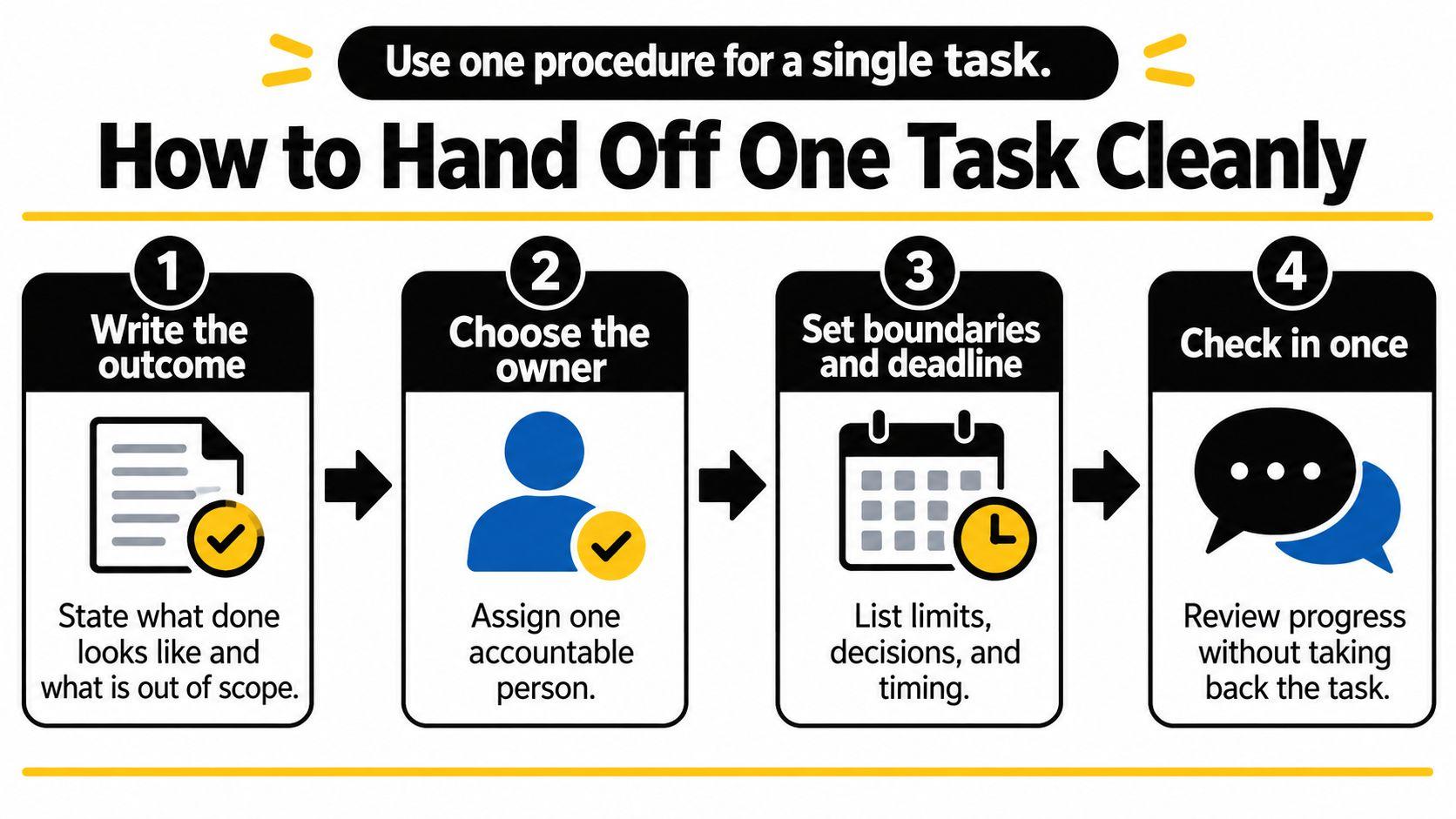
- Write the outcome in one sentence. State what done looks like and what's out of scope. Without it, the recipient invents their own definition and you'll both discover the mismatch at the deadline.
- Name one owner. Two names means no name, and questions with no destination end up back in your inbox. One accountable person prevents the crowd shrug.
- Grant the authority and resources. File access, a budget ceiling, the list of decisions they may make alone. A person who must ask before every small call will ask, and you'll have recreated the bottleneck you were trying to remove.
- Agree the deadline, any milestone, and the acceptance check before work starts. Defining the check afterward invites the argument about whether the result was good enough.
- Set one checkpoint, then leave the method alone. Skip this and you'll drift into micromanagement. Bypass the delegate during the work and you train the whole team to wait for you.
- Review against the acceptance check, note the rework, and adjust the next brief. Without this step, you repeat the same vague brief and blame the recipient for the same gap.
A handoff without a definition of done is a request for mind-reading.
For a large piece of work, split it into sessions with a daily slice rather than one vague block that never gets started. If the task depends on another, write down exactly what it's waiting on, so it doesn't sit in the active list pretending to be startable.
For someone who needs more structure, keep the outcome explicit and the check-in short rather than taking the method away. Structure and autonomy aren't opposites here. One supports the other.
Fill in steps one through four for a task you'll move within two days, and schedule the step six review before you send the brief.
Delegate Your Next Task With Clear Terms
Choose a task that already cleared the test: repeatable, with a written definition of done, and a person who is the stronger producer. Then do it once, completely.
If the task stays inside the team, assign it to one teammate, state the outcome and deadline in a single message, and keep questions in one thread instead of side chats. If it should leave your desk, post the task to Fluidwave's marketplace and agree the price and milestones with the assistant before work starts. Setting a task to Delegate sends it to a human assistant, and payments are held in escrow through Stripe and released when the work is done, so you pay for a completed unit rather than idle time. The acceptance check you wrote becomes the basis for accepting the result.
Keep high-risk calls on your own list: hiring, sensitive feedback, and anything whose failure would be expensive and public.
After the first task comes back, compare three things: hours you got back, rework required, and whether the other person's load stayed reasonable. If those look acceptable, move a second task of the same type. If rework ate the savings, tighten the brief before delegating more.
Delegation on Fluidwave works from the brief you just wrote: you post a defined task to the marketplace, agree a price and milestones with a human assistant, and each payment is held in escrow through Stripe and released only when the work is done. That structure makes the productivity-minus-friction test easy to run for real, because you know the cost before the work starts and you accept the result against your own defined check. Visit Fluidwave to post your first task and see what the recovered hours are worth.
Focus on What Matters.
Experience lightning-fast task management with AI-powered workflows. Our automation helps busy professionals save 4+ hours weekly.