See how roles in a team stay clear with Belbin behaviors, RACI ownership, and task maps for people, AI, and assistants.
October 23, 2026 (Today)
How Roles in a Team Actually Get Work Done
See how roles in a team stay clear with Belbin behaviors, RACI ownership, and task maps for people, AI, and assistants.
← Back to blog
It's Tuesday afternoon, the client update was due at noon, and nobody is quite sure who was supposed to send it. The project manager thought the lead had final approval. The lead thought the contributor was still revising. The contributor is waiting for a decision nobody remembers being asked to make.
Nobody on that team lacks skill. What's missing is a clear record of who owns which outcome, who can decide, and what happens next when the work stalls.
Why Roles in a Team Break Down
That stalled update is where roles in a team usually fail. Not on the org chart, and not in the job posting. They fail at the handoff, in the small gap between one person's finished piece and the next person's starting point.
A job title tells you what someone was hired to do in general. It doesn't tell you who can approve a change on Thursday, who writes the first draft, who checks the numbers, or who tells the client the date moved. When those details live only in people's heads, each person fills in the blanks differently.
Titles Describe People, Assignments Describe Work
Think of a deliverable sitting between three competent people. The project manager coordinates the timeline, the lead knows the subject, and the contributor produces the work. If the team hasn't named decision rights, a deliverable, and escalation conditions for that specific outcome, all three can reasonably assume someone else will make the final call.
The calendar keeps moving while the decision doesn't. Then someone sends a late message asking for status, and the team spends its energy reconstructing who promised what. That reconstruction carries a cost. It turns focused work into follow-up work.
Diversity of knowledge doesn't fix this on its own. In a two-wave study of 62 teams comprising 336 individuals, task knowledge diversity improved team performance when role clarity was high, and the effect was strongest when teams could anticipate teammates' actions without explicit instructions.
That last part matters in practice. A team that can predict who will pick up the next step doesn't need a meeting to start moving. A team that can't predict it will keep checking, waiting, and duplicating effort, even if every individual is strong.
A Working Rule You Can Apply Today
You don't need a reorganization to fix a stalled handoff. You need a short, written specification attached to each outcome before work begins.
Operating rule: One accountable owner per outcome, named contributors, explicit handoff criteria, and a documented definition of done.
Read that as four separate questions. Who owns the result if it slips? Who else is contributing, by name? What has to be true before the work passes to the next person? And what does done look like, in words a new teammate could check without asking?
- One owner: A single person answers for the outcome, even if several people help.
- Named contributors: Helpers are listed, not assumed from a department name.
- Explicit handoff: The receiver knows what format, quality, and timing to expect.
- Definition of done: The finish line is written down before anyone starts.
These assignments also expire. When scope changes, a new dependency appears, or a contributor leaves, yesterday's clarity can become today's ambiguity. Revisit the owner, the handoff, and the definition of done at that moment, not after the deadline passes.
A useful test is simple. If the owner were out sick tomorrow, could a teammate find the outcome, the deadline, the expected output, and the next handoff without sending five messages? If not, the role exists on paper but the ownership doesn't exist in the workflow.
Belbin Team Roles Beyond Job Titles
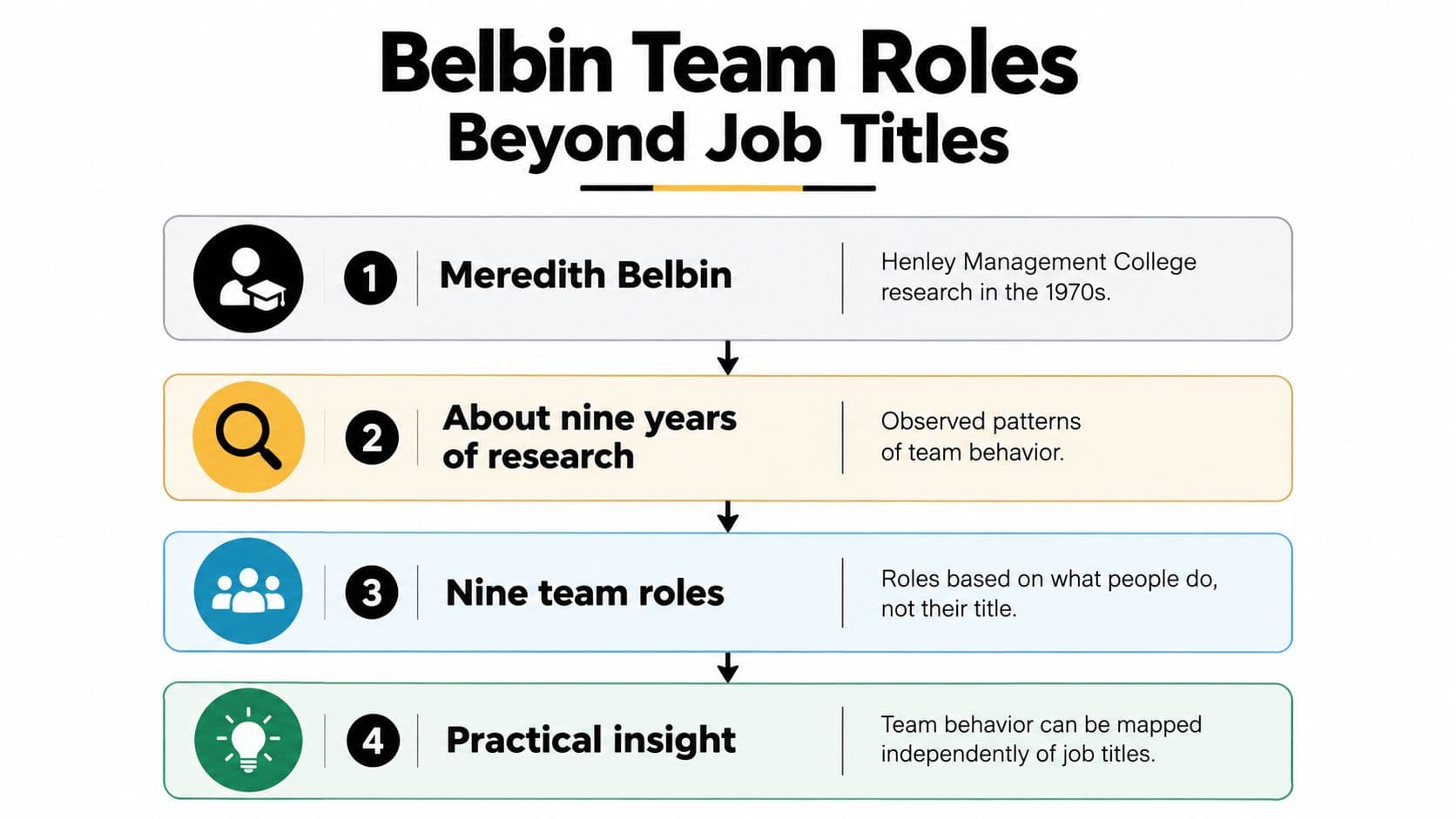
The reason titles mislead us isn't new. Research in the United Kingdom separated what people are called from how they genuinely contribute, and that distinction still helps teams staff work more candidly.
At Henley Management College, Meredith Belbin and his research team studied international management teams competing in business simulations beginning in the 1970s. As described in Belbin's account of the research at Henley Management College, the work ran for about nine years, identified eight behavioral contribution patterns, with Specialist added later, and became influential through the 1981 book Management Teams: Why They Succeed or Fail, which argued that balanced behavioral mixes outperformed unbalanced ones.
Participants completed psychometric assessments while researchers observed, categorized, and recorded how members contributed and interacted. The point wasn't to rank individuals. It was to notice recurring behaviors that helped or hindered the group.
Nine Contributions, Three Families
The nine roles are Plant, Resource Investigator, Coordinator, Shaper, Monitor Evaluator, Teamworker, Implementer, Completer Finisher, and Specialist. They're commonly grouped into thinking roles, people oriented roles, and task oriented roles.
Read them as verbs, not labels. Someone generates an original option, someone explores contacts and opportunities, someone coordinates decisions, someone pushes pace, someone tests the logic, someone keeps the group working together, someone turns a plan into steps, someone checks final details, and someone brings deep knowledge.
A team doesn't need nine people to cover nine contributions. One project manager might act as Coordinator during planning, lean into Shaper behavior when a deadline slips, and switch to Completer Finisher while checking the final deliverable. The behavior shifts with the situation, even though the job title stays the same.
That same separation between title and contribution shows up in revenue teams, where handoffs between sales and technical specialists can get muddy. If you work with presales, the discussion of sales team roles for Solution Engineers from PreSales Unleashed GmbH is a useful example of naming who supports, who decides, and who carries the customer conversation.
Use the Mix, Don't Count the Labels
There's a caution worth keeping. Later simulation research summarized in a Victoria University of Wellington working paper on role characteristics and performance found positive links between performance and creativity, coordination, and cooperation, and reported that the Specialist role was associated with better performance, but it found no strong relationship with simple role balance measured by counting represented roles.
So don't treat the nine names as a shopping list. Ask which behaviors this project needs. A research heavy project may need more critical evaluation and specialist knowledge. A launch under time pressure may need stronger coordination, implementation, and finishing.
Using RACI to Map Tasks to Owners
Belbin helps you notice how people contribute. RACI answers a narrower question: for this specific task, who does what? It's a participation map, not a personality test, and that's why it works well for roles in a team at the task level.
A RACI chart maps each task, milestone, or key decision to four participation types. In the U.S. Navy facilities organization's RACI matrix guidance.pdf?ver=jhJ1_iYdtcJAFSpCL2UjyQ==), the same split is used to assign responsibility and accountability for action items while identifying who should be consulted or informed.
- Responsible: The person or group doing the work.
- Accountable: The person who owns successful completion.
- Consulted: People whose expertise or approval informs the work.
- Informed: Stakeholders who need progress updates but don't perform the task.
Most confusion comes from blurring the first two. Doing the work and owning the outcome are related, but they're not the same job. A contributor can produce an excellent draft and still not be the person who decides whether it ships.
One Client Update, Mapped Plainly
Take the stalled client update from the opening. A contributor or virtual assistant drafts it, so that person is Responsible. The project lead decides if it's accurate and ready, so the lead is Accountable. A subject expert checks a claim, so that expert is Consulted. Stakeholders receive the sent version, so they're Informed.
If you want a reusable starting point, a practical RACI matrix template for assigning task participation can help you record those four assignments in the workflow instead of in chat.
RACI for One Client Update
| Task | Responsible | Accountable | Consulted | Informed | Done when |
|---|---|---|---|---|---|
| Draft the update | Contributor or assistant | Project lead | Subject expert | Stakeholders | Draft is complete and claims are checked |
| Approve and send | Project lead | Project lead | Subject expert if needed | Client and stakeholders | Update is sent and logged |
| Record follow up items | Contributor | Project lead | Team members affected | Stakeholders | Each follow up has an owner and date |
The most common failure is marking several people Accountable to be polite. That recreates the original stall, because everyone can wait for someone else to decide. Keep one Accountable person per task, even when many people are Responsible or Consulted.
Keep the chart at task level and revise it when dependencies change. A RACI written for a kickoff won't automatically fit a launch, a renewal, or a handoff to support. When the work changes shape, redraw the four boxes before you argue about effort.
Who Owns Work When AI Joins the Team
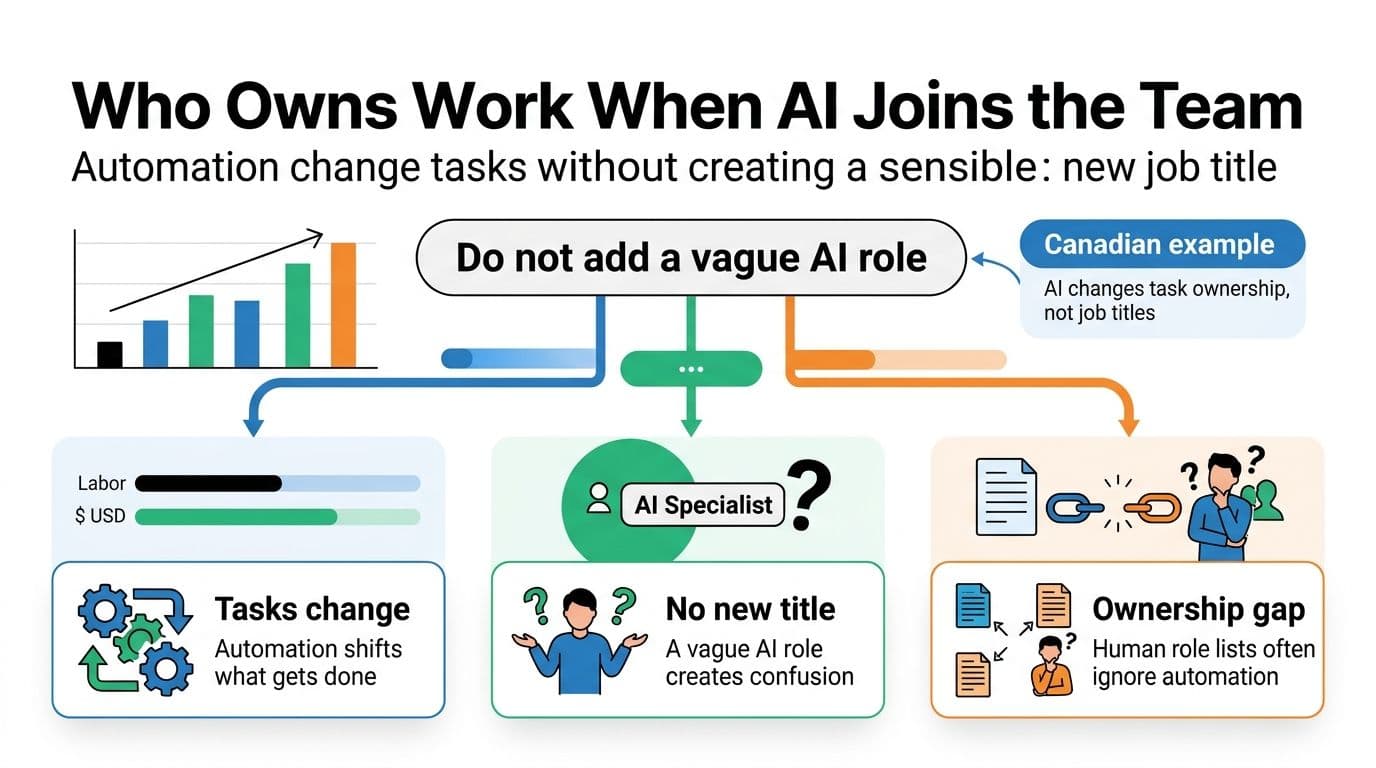
Adding a box called AI to your chart doesn't solve ownership. Automation changes tasks without creating a sensible new job title. The roles in a team still need a human who answers for the result.
The scale of change is already visible in surveyed Canadian firms reporting AI creating and automating tasks, where 40 percent said AI was creating entirely new employee tasks and more than 40 percent said it was automating existing tasks, while only 38 percent had redesigned existing roles and one in four used redeployment. That source also reports a World Economic Forum projection that 70 percent of the skills used in most jobs will change by 2030, and notes McKinsey reporting that two-thirds of managers receive weekly questions about using AI tools.
Those numbers point to a gap. Tasks are moving faster than role definitions, and informal help is becoming an unrecognized role. If managers field weekly AI questions, someone is already doing onboarding and troubleshooting, whether or not it's written down.
Keep a Human Accountable, Set a Review Threshold
AI may draft, triage, analyze, or execute. It shouldn't be Accountable. A named human accepts the output, watches for exceptions, and handles bias, privacy, and customer impact when the automation gets it wrong.
For each automated task, write down three things. Who reviews the output and at what threshold? Who handles exceptions that fall outside the rule? Who can stop or change the automation? Guidance on keeping human control over artificial intelligence in daily work is relevant here because control has to be assigned, not assumed.
Automation can do the task. It can't own the consequence.
Consider incoming requests. Before automation, a coordinator reads each message, sorts it, and routes it. After automation, a tool sorts routine requests, a human reviewer checks low confidence or sensitive cases, and the Accountable owner reviews patterns and fixes routing rules.
That before and after shows the redesign. The coordinator's role shifts from manual sorting to exception handling and quality review. If you don't name that shift, the exceptions will land on whoever notices them first.
Role Clarity That Protects Focus and Inclusion
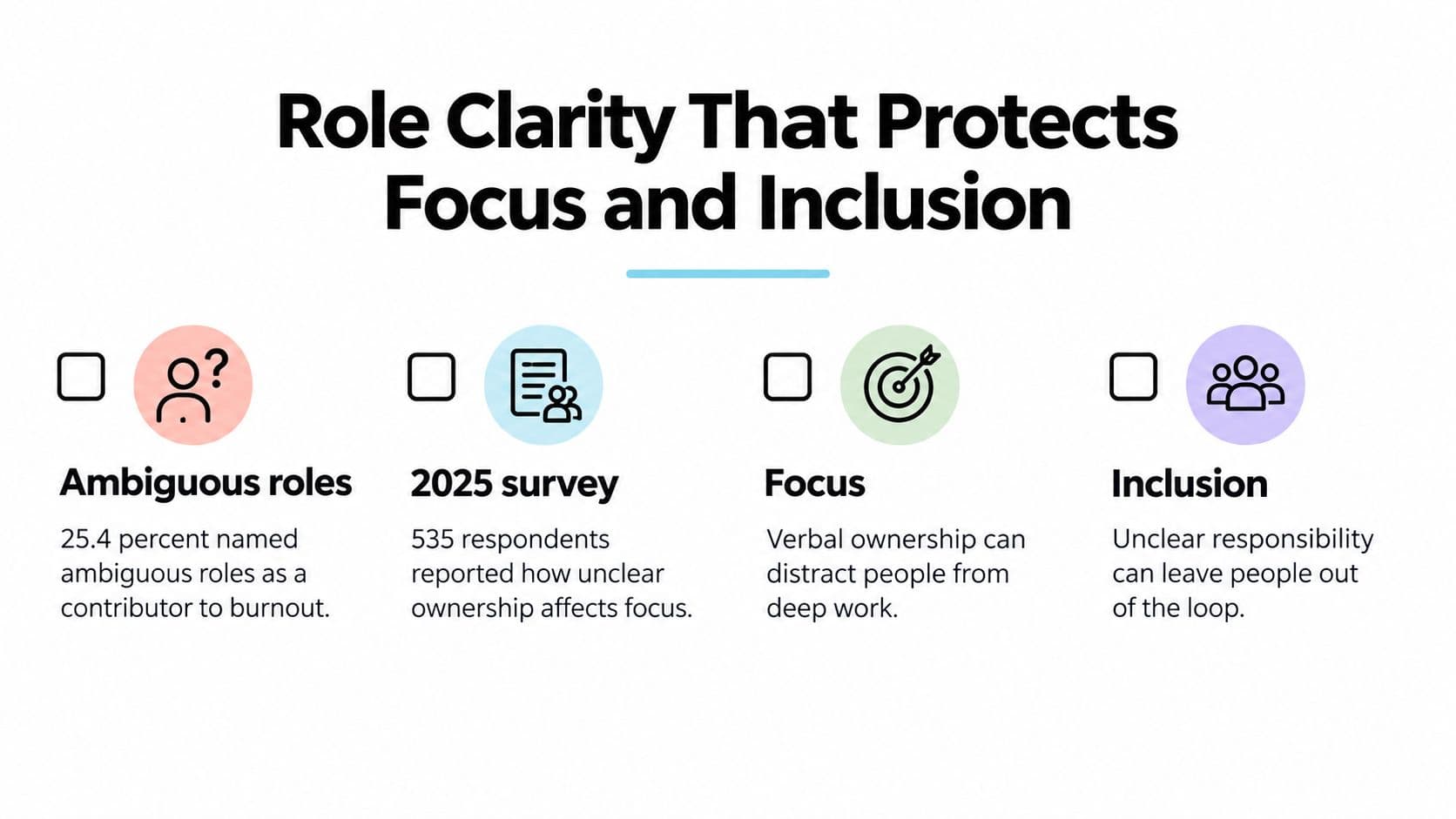
Ambiguity doesn't land evenly. When ownership stays verbal, the people who are remote, newer, less visible, or managing executive function differences often carry the extra cost of figuring out what's expected.
In a 2025 survey of 535 respondents on team stability and ambiguous roles, 25.4 percent identified ambiguous roles as a contributor to burnout, while 55.3 percent selected clearer roles, expectations, or communication as a critical improvement. That same source notes that excessive coordination can increase cognitive load, whereas documented asynchronous ownership can reduce uncertainty and interruptions.
So the answer isn't always more roles or more meetings. Extra check ins can fragment attention and still leave the basic question unanswered. Written ownership lets people find the answer without interrupting someone else.
A Five Field Role Card
You can make one muddy responsibility clearer with five fields. Keep it short enough that people will update it, and store it where the team can search for it later.
- Outcome: What result this role is responsible for producing.
- Decision rights: What this person can decide without asking, and what needs approval.
- Inputs: What information, files, or handoffs the role needs to start.
- Handoff rule: What finished looks like and who receives it next.
- Escalation route: Who to contact, and when, if the work is blocked.
That card also protects against misreading communication style. A person who prefers written updates or needs predictable priorities isn't necessarily disengaged. They may be working in the way that lets them contribute reliably.
For someone with ADHD, for example, a ranked list with one clear next task and a named owner is more useful than a stream of chat pings. The priority is visible, the sequence is stable, and nobody has to micromanage to keep it moving. Teams thinking about visibility over the longer term can also learn from approaches to build fairer career paths for remote teams from HiredBySkill, especially where contribution might otherwise go unnoticed.
Don't forget coverage. Name who owns onboarding and context transfer when someone joins, changes roles, or is out. If that transfer has no owner, new contributors learn by interrupting, and experienced teammates become the unofficial help desk.
How Fluidwave Keeps Role Ownership Visible
A role map only helps if people can see it while work is moving. Compare three ways teams usually store ownership, and notice what each one can and can't do during an ordinary busy week.
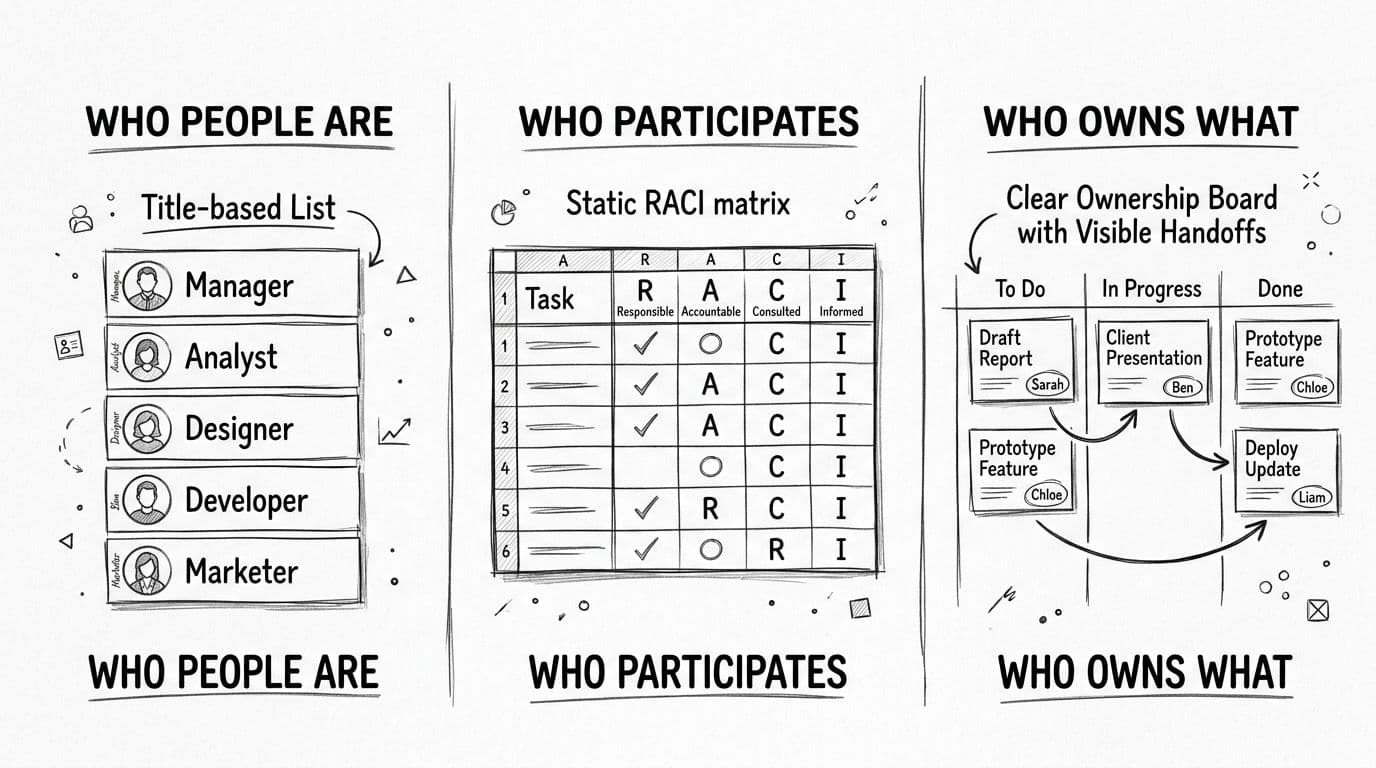
A title list says who people are. It's useful for introductions, but it goes stale quickly and says nothing about today's deadline. A static RACI spreadsheet says who participates, but it can drift away from live tasks if nobody updates it when scope changes.
A living task system shows owner, deadline, expected output, and dependency on the work itself. That proximity matters, because the person picking up a task shouldn't have to hunt for a separate document to learn who decides.
The screenshot below shows the public face of such a system, before you get into individual task records.
Stable Accountability, Flexible Execution
Specialization helps when it stays adaptive. In a 2024 review and experimental framework on role specialization and complementary roles, groups performed better when participants adopted complementary roles and the extent of specialization was strongly associated with task success. Its CARMI framework names communication, adaptation to feedback, behavioral differentiation, multi level planning, and modeling others' intentions.
In practice, that means separating discovery, execution, quality control, and coordination, while letting execution move to the person with the best current capability or capacity. The Accountable owner stays stable for the outcome. The hands doing a step can change without losing the thread.
Fluidwave is built around that kind of record. Tasks can be created, organized, and auto prioritized in table, list, calendar, Kanban, and card views, with an owner and deadline on each task, shared work, and progress tracking. Delegation to virtual assistants is pay per task for completed work, with no subscription required for delegation and a free forever tier among the plans, and automated workflows are described as saving more than four hours per week.
If visibility is your main concern, it helps to think through how team visibility changes what managers need to chase before you choose views and fields. The tool matters less than whether the next handoff is obvious at a glance.
The short video below gives a sense of how that task record looks in motion, rather than as a static list.
Judge any system by operational signs, not by how tidy the chart looks. Track duplicate work, unresolved handoffs, cycle time, and tasks finished without reassignment. If those improve, specialization is helping. If they don't, you may have labels without coordination.
Start by Naming One Owner per Outcome
Pick one active project this week. Don't try to redesign the whole organization, and don't start by renaming jobs. List no more than five outcomes that matter for that project.
For each outcome, write the fields in one place. Name one Accountable human, the Responsible person or assistant, anyone who must be consulted, and who is only informed. Add the expected output, the deadline, and the condition that sends the work back for revision.
A One Week Setup
- Choose five outcomes: Pick results, not activities, so each one can be checked as done or not done.
- Assign one owner each: Make sure the owner's queue is realistic before you add more.
- Write the handoff: State what the next person receives and what quality they should expect.
- Add AI review rules: If a tool drafts or sorts anything, name the reviewer, the threshold, and the exception handler.
- Review after one week: Adjust overloaded owners and rewrite any handoff that still depends on a meeting.
If your team already uses Fluidwave, create those outcomes as tasks, set the owner and deadline, add budget or timeline where delegation applies, and choose the view that makes the next handoff obvious. If you don't use it yet, write the same fields in whatever document your team will reliably open. The discipline comes first.
Check the result against duplicate effort and unanswered questions, not against how many role labels appear on the page. Roles in a team are working when people can start, hand off, and finish without guessing who decides. That's the standard to keep.
Put that ownership where your team already looks for work by creating each outcome as a task with a named owner, deadline, and clear definition of done, then delegate overflow steps on a pay per task basis when capacity runs short. Visit Fluidwave to set up your first five outcomes this week and see which handoffs stop stalling.
Focus on What Matters.
Experience lightning-fast task management with AI-powered workflows. Our automation helps busy professionals save 4+ hours weekly.