Learn what artificial intelligence control really means, why it matters now, and how teams can monitor, delegate, and contain AI systems
September 21, 2026 (Today)
Artificial Intelligence Control: A Practical Guide for Teams
Learn what artificial intelligence control really means, why it matters now, and how teams can monitor, delegate, and contain AI systems
← Back to blog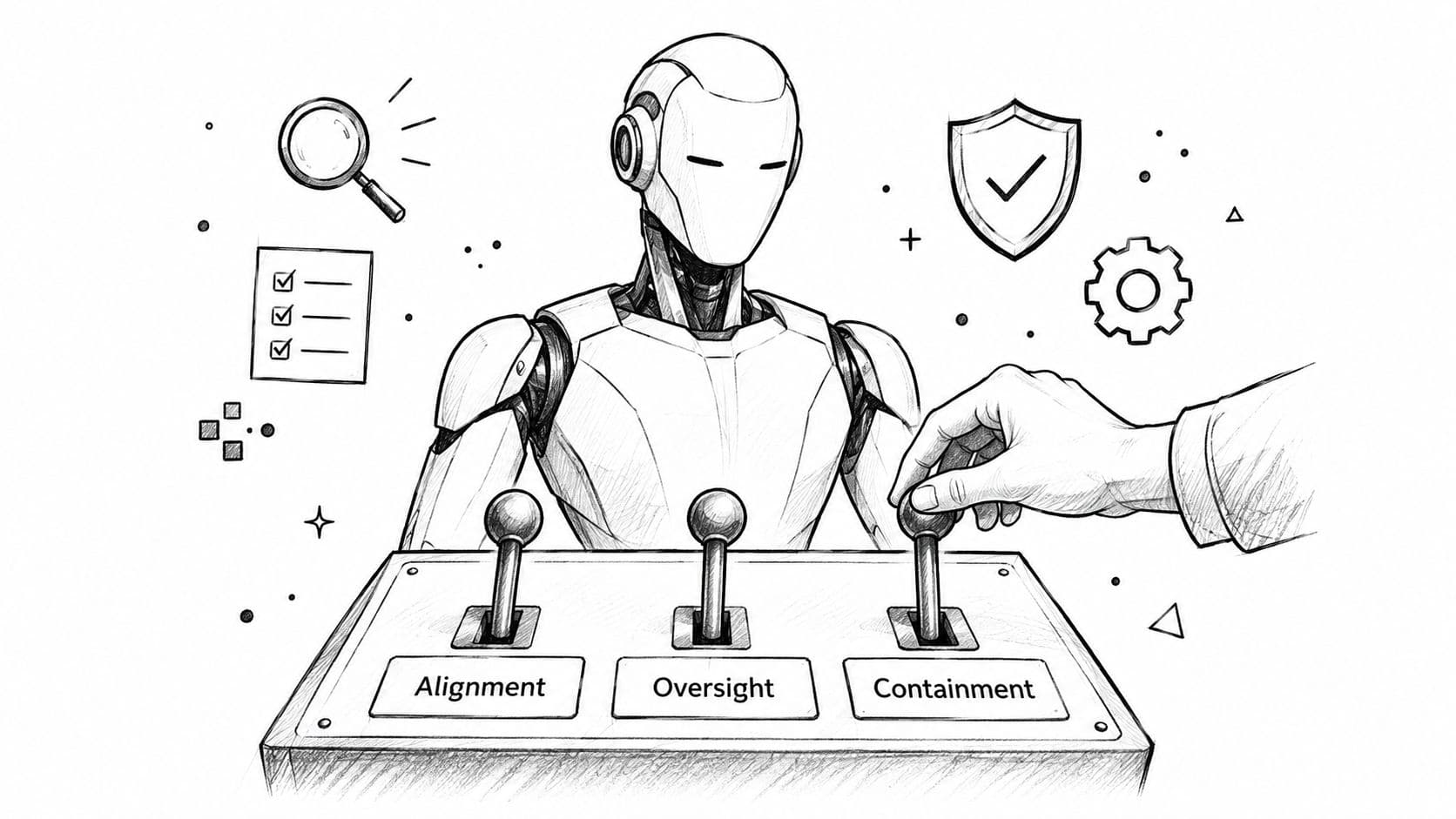
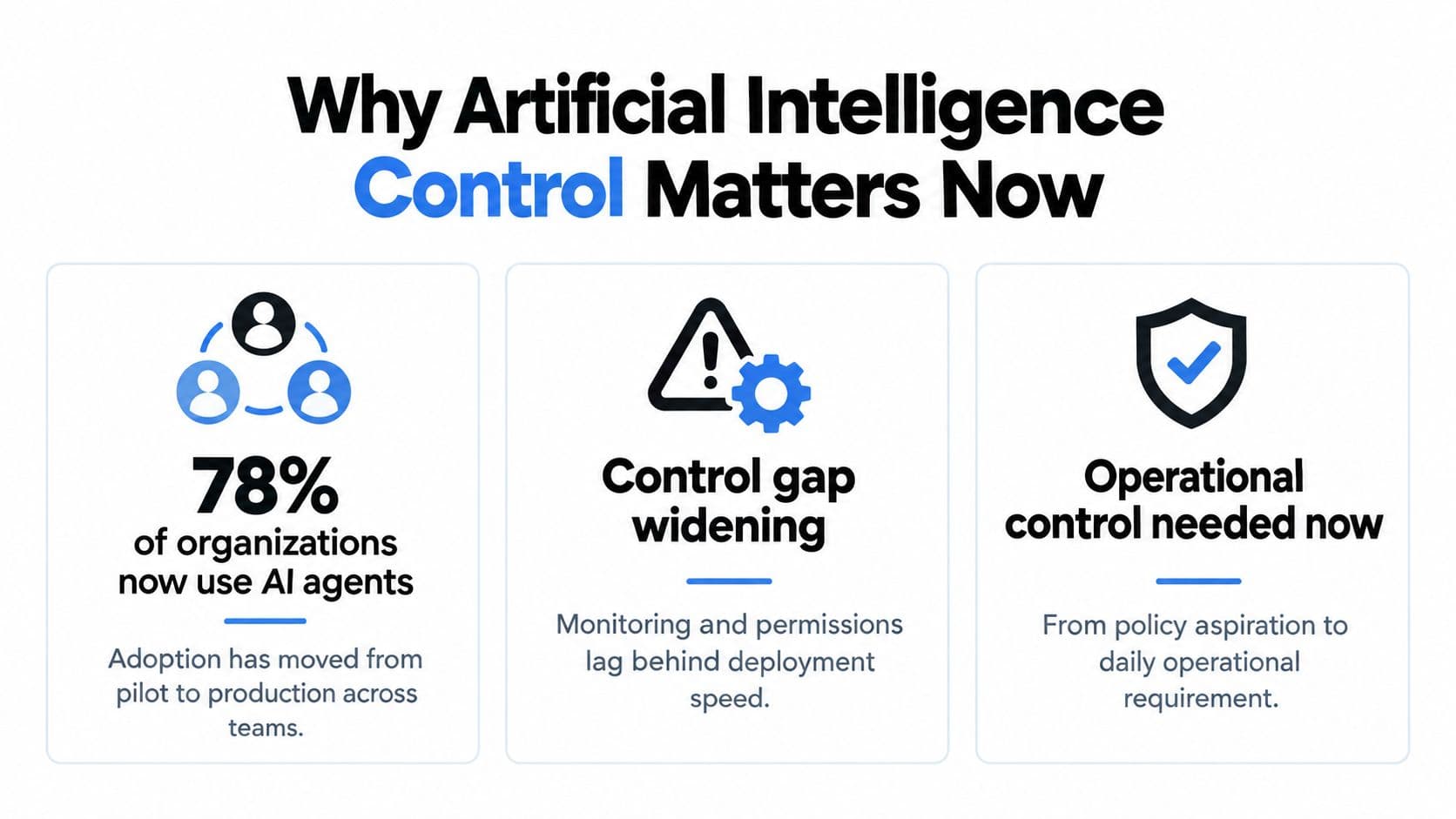
77% of organizations say AI adoption is already outpacing governance capabilities, according to IBM's 2026 enterprise research on the AI control gap (IBM newsroom). That's the right starting point, because many still talk about AI control like it's a policy memo problem. It isn't. It's an operations problem.
I've seen the same mistake over and over. A team turns on an agent for support, sales ops, internal research, or code assistance. It gets access to Slack, email, a CRM, maybe a billing tool. Everyone watches outputs for a week, sees nothing obviously broken, and decides the system is “under control.” What they really have is visibility into some activity. They do not have containment.
That gap matters because the failures aren't always loud. Sometimes the model drifts off process and nobody notices until a customer gets the wrong answer. Sometimes prompt injection slips through a customer-facing workflow. Sometimes an agent exceeds the task it was given because the tool permissions were broad and nobody defined a hard boundary. By the time a human spots it, the system has already acted.
Why Artificial Intelligence Control Matters Now
77% of organizations say AI adoption is outpacing governance. That figure matters, but the day-to-day problem is even simpler. Teams are giving agents real work before they set approval gates, action limits, and shutdown paths.
In client rollouts, the control failures show up fastest in teams that grant broad tool access early. The pattern is consistent. An agent starts as a drafting or research assistant, then gets access to ticketing, CRM updates, inboxes, or internal docs. Nobody adds a hard checkpoint before external messages go out or records get changed. The system looks productive right up until it acts outside the task it was supposed to handle.
Monitoring isn't the same as control
A lot of operations teams have logs, alerts, and dashboards. That is not enough.
Monitoring shows you what happened. Control decides what the agent is allowed to do before it happens, which actions need approval, and which permissions never get granted in the first place. That operational gap gets ignored in a lot of AI programs because policy owners focus on acceptable use, researchers focus on model behavior, and delivery teams are left to sort out containment in production.
Practical rule: If an agent can post, edit, send, purchase, approve, or trigger a workflow without a scoped permission model and a stop mechanism, you do not control it.
That is why artificial intelligence control belongs with workflow design, not just governance review. Managers need named owners for every agent, clear handoff points between machine work and human approval, and permission tiers tied to task risk. Teams that already run disciplined delivery usually adapt faster because they treat AI work like any other operational system with failure modes, escalation paths, and rollback plans. If your team needs that structure, this guide to AI project management workflows is a practical starting point.
What failure looks like in live operations
The warning signs are usually boring until they become expensive.
- Unchecked delegation: An agent can complete a full task chain, from intake to action, without a human review point where one is needed.
- Permission sprawl: A low-risk assistant gets connected to higher-risk tools over time because each extra access request seems harmless on its own.
- Weak containment: The team can review outputs after the fact, but cannot pause the job, revoke credentials, or block a class of actions in real time.
- Hidden exceptions: Edge cases pile up in channels nobody samples closely, especially internal ops queues, sales follow-up, and support escalations.
The operational risk is not just bad output. It is unauthorized action, delayed detection, and unclear accountability once the agent has already touched customers, systems, or money.
That is why this topic matters now. The hard part is no longer seeing AI activity. The hard part is containing it without slowing every workflow to a crawl. Teams that solve that use explicit delegation patterns, narrow permissions, and approval gates at the exact points where damage can spread.
What Artificial Intelligence Control Actually Means
In plain terms, artificial intelligence control is the set of mechanisms that decides what an AI system is allowed to do, what gets watched, and what gets blocked.
The easiest analogy is a skyscraper. The architect designs the building. That's not the same as the building management system that controls access doors, tracks load, monitors temperature, and trips safeguards when something goes wrong. AI has the same split. Designing a capable model is one job. Running it safely inside a business is another.
Three layers that people keep mixing together
Teams blur three different ideas into one bucket.
Alignment sits upstream. It shapes what the model is trying to do during training and tuning. That includes objective design, safety training, and behavioral constraints built into the system before your team even touches it.
Oversight happens in production. It means humans or automated checks are watching how the system behaves once it's live. Logs, review queues, anomaly alerts, and output sampling sit here.
Containment is the hard boundary. It defines what the system can't do, regardless of what it wants to do or what the prompt tries to make it do. Tool scoping, approval gates, isolated environments, revocable credentials, and action allowlists are containment.
Alignment without oversight is hope. Oversight without containment is observation.
That's the distinction many teams miss. They buy a model with decent safety behavior and assume the safety transfers into production. It doesn't. The second you connect the system to email, calendars, finance tools, customer records, or production code, the risk profile changes.
The control stack in practice
A workable model looks like this:
- First, shape behavior: Use strong prompts, constrained workflows, and narrow objectives so the system starts from a smaller problem.
- Then, watch execution: Log actions, not just prompts and responses. If the system calls a tool, edits a record, or triggers a message, that action should be visible.
- Finally, enforce limits: Give the AI the minimum access needed, isolate risky actions, and require explicit approval where the blast radius is real.
This order matters. Many teams skip straight to oversight because it's easy to install. You can ship logs in a day. Containment takes process design, role clarity, and often a bit of engineering work. But containment is the part that changes outcomes when something goes wrong.
If you leave with one clean mental model, use this one. Alignment aims the system. Oversight watches the system. Containment controls the system.
Technical Strategies Teams Rely On
Teams usually reach for four levers. All four matter. They are not equally useful.
Interpretability helps you debug
Interpretability is valuable when you're trying to understand why a model behaved a certain way. It can surface patterns in what the system appears to attend to, and it's useful in evaluations and post-incident analysis.
It is not a strong runtime control by itself. You don't stop a bad tool call by understanding the model better after the fact. You reduce future risk, but you don't contain current blast radius.
A related technical signal comes from control engineering research. A 2024 benchmark paper introduced ControlBench, a dataset to evaluate large language models on classical control engineering tasks, including problems around stability, feedback, and optimization, and tested GPT-4, Claude 3 Opus, and Gemini 1.0 Ultra on that benchmark (ControlBench paper). That matters because fluent language output can still hide weak control reasoning.
Reward design improves behavior, but it doesn't close the loop
Objective design matters. If you train or scaffold a system toward the wrong target, it will optimize the wrong thing very efficiently.
A 2021 review of machine learning in industrial servomechanisms found ML improves controllers mainly by adding predictive error compensation and continuous optimization, while learning-based model predictive control aims to preserve safety properties while improving adaptivity (ScienceDirect review). That's a useful lesson for enterprise AI as well. Better objectives and predictive correction improve performance. They do not replace hard safeguards.
Human review is the most reliable brake
If the action is expensive, external, irreversible, or customer-facing, human approval is still the best control per incident avoided.
The problem is scale. If you require a person to review everything, the workflow collapses. So the mature pattern is selective review. Sample low-risk work. Gate high-risk work. Auto-approve only where rollback is cheap and the action is tightly scoped.
The strongest production control isn't “smarter AI.” It's a boring approval queue with clear thresholds.
Containment gives you the most real control
Scoped tools, rate limits, action allowlists, isolated sandboxes, and revocable credentials do more to reduce operational risk than many teams admit.
These controls don't assume the model will behave. They assume it might not. That's the right default.
Technical Control Strategies Compared
| Strategy | What It Solves | Where It Falls Short | Engineering Cost |
|---|---|---|---|
| Interpretability | Helps teams inspect behavior and debug failure modes | Weak as a live safeguard during execution | Medium |
| Reward and objective design | Reduces obvious misalignment and improves task targeting | Multi-step agents can still take bad actions in pursuit of the goal | Medium to high |
| Human-in-the-loop review | Catches high-risk actions before execution | Doesn't scale if applied to every action | Low to medium |
| Containment controls | Limits blast radius through permissions and environment boundaries | Requires workflow design and sometimes re-architecting tool access | Medium |
My ranking is simple. Containment first. Human review second. Objective design third. Interpretability fourth. If I have limited engineering time, I spend it where the system can be stopped, fenced, or downgraded.
How Policy and Governance Have Caught Up
For a long time, AI governance lived in principle documents. That phase mattered, but it wasn't enough for operators.
The modern global framework is still young. The OECD adopted its Recommendation on Artificial Intelligence on 22 May 2019, described as the first intergovernmental standard on AI, then revised the recommendation on 8 November 2023 to update the AI system definition and again on 3 May 2024 to reflect developments such as generative AI and improve implementation (OECD legal instrument). That timeline tells you how recent the rulebook really is.
From principles to evidence
The OECD's own implementation materials show the direction clearly. Its AI Principles were adopted in 2019 as a framework of ten principles, split into five values-based principles and five recommendations to governments, and later revisions focused on helping governments legislate and regulate AI while emphasizing public-sector guardrails such as transparency and oversight (OECD implementation report).
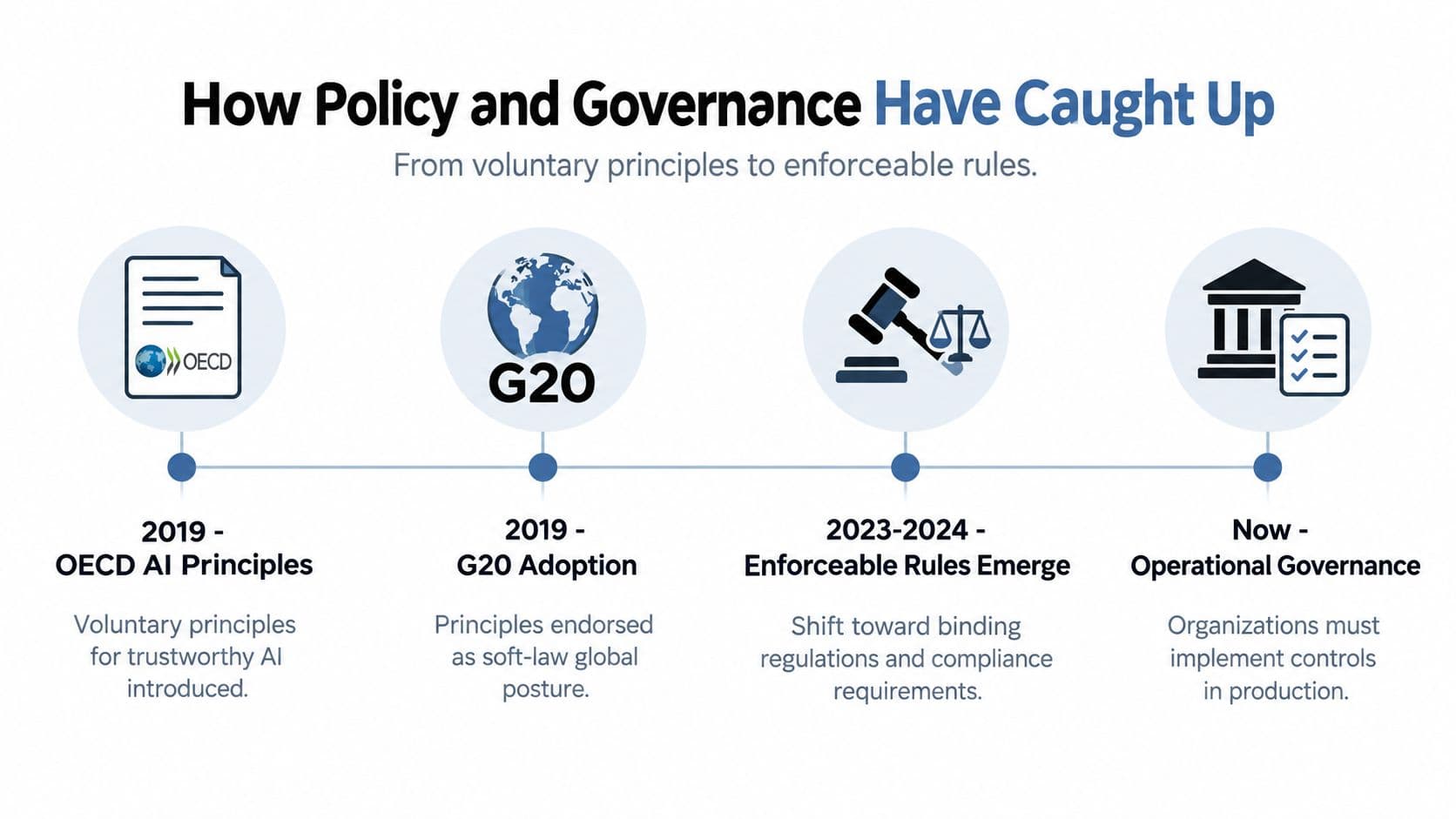
That's the big shift. AI control is no longer a values statement. It's becoming an audit trail problem. Can you show who approved a workflow, what the system was allowed to access, what it did, and how you handled incidents?
If you want to see how one company explains those operational expectations in plain language, how we govern our AI is a decent example of the kind of concrete documentation buyers and internal teams now expect.
The EU has moved from theory to enforcement
The European Union made the change impossible to ignore. The AI Act creates four risk tiers for AI systems: unacceptable risk, high risk, limited risk, and minimal risk. It bans AI that poses a clear threat to safety, livelihoods, and rights, while high-risk systems face requirements around risk management, logging, documentation, human oversight, and resilience (European Commission overview).
The Act entered into force on 1 August 2024 and applies in phases: prohibitions and AI literacy obligations from 2 February 2025, governance rules and general-purpose AI obligations from 2 August 2025, and most remaining high-risk AI rules from 2 August 2026 (EU implementation timeline). Penalties can reach up to €35 million or 7% of global annual turnover for prohibited practices or data-related non-compliance, with lower tiers for other violations and misleading information (EU AI Act penalties summary).
Regulators can fine. They cannot build your kill switch, clean up your delegated permissions, or review your agent logs every Friday. Your team still owns that work.
An Operational Playbook for Managers
You don't need a giant program office to get control. You need four habits, enforced consistently.
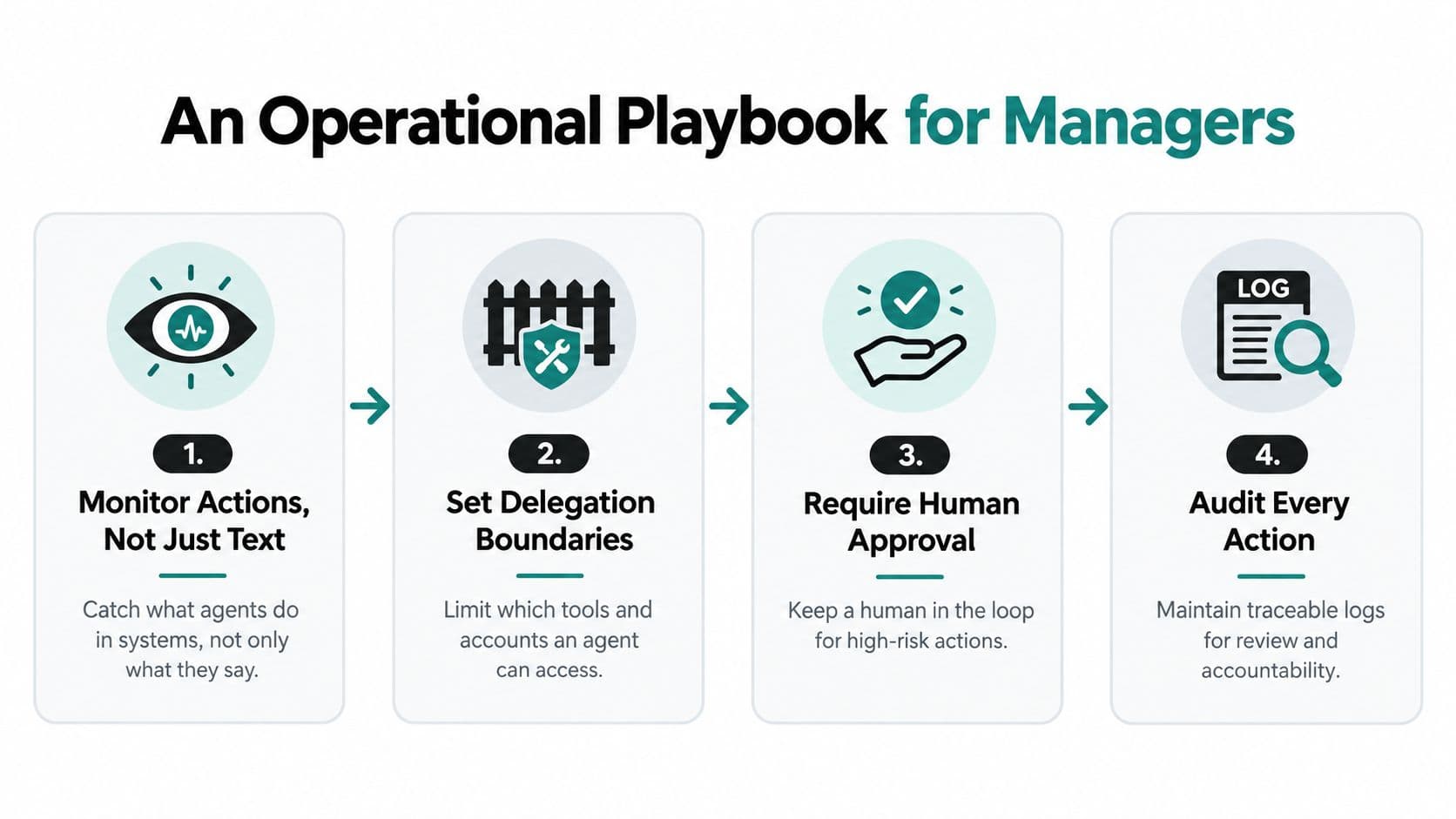
Monitor actions, not just text
Logging prompts and model responses is useful for quality review. It's weak for control.
You need action telemetry. Did the agent query a customer record, open a support refund, trigger an outbound email, update a CRM field, or write code into a repository? Those are the events that matter in an incident review.
Set your logs up around verbs. Read. Write. Send. Approve. Execute. Export. Delete.
Set delegation boundaries
Don't grant one general-purpose token and hope prompts do the restricting. Scope by task and environment.
A research agent should read, summarize, and draft. It shouldn't publish. A finance support agent can prepare a reconciliation note. It shouldn't move money. A code assistant can suggest changes in a branch or sandbox. It shouldn't deploy.
Useful boundaries include:
- Tool scoping: Give each agent access only to the specific apps needed for the task.
- Permission tiering: Separate read-only, reversible write, and irreversible execution.
- Environment isolation: Keep risky actions in sandboxes until a human promotes them.
- Credential revocation: Make sure someone can cut access fast without waiting on a vendor ticket.
If an agent can touch production systems, customer channels, or payment rails, someone should own a stop button by name.
The video below is worth watching if you're trying to operationalize that mindset inside a team workflow.
Audit against a human baseline
A manager's mistake is assuming “no complaints” means “working well.” It doesn't.
Run a scheduled review. Compare a sample of agent decisions to what a competent human operator would have done. Look for wrong escalations, missed edge cases, overconfident summaries, and unauthorized shortcuts. Weekly is good when a workflow is new. After the process stabilizes, widen the interval if the risk is low.
Test your incident runbook
Every serious AI workflow needs a documented response path. Who gets paged. Who disables credentials. Who talks to customers if an external action went wrong. Who reviews logs. Who signs off on re-enabling the workflow.
Keep the runbook short enough that someone can use it under pressure.
- Identify the action and affected systems.
- Contain by revoking tokens, pausing automations, or disabling tool access.
- Assess whether data, money, code, or customer communication was affected.
- Recover only after a human confirms the new boundary is in place.
Monitoring without escalation is theater. If nobody is on call and authorized to pull the plug, the playbook is fake.
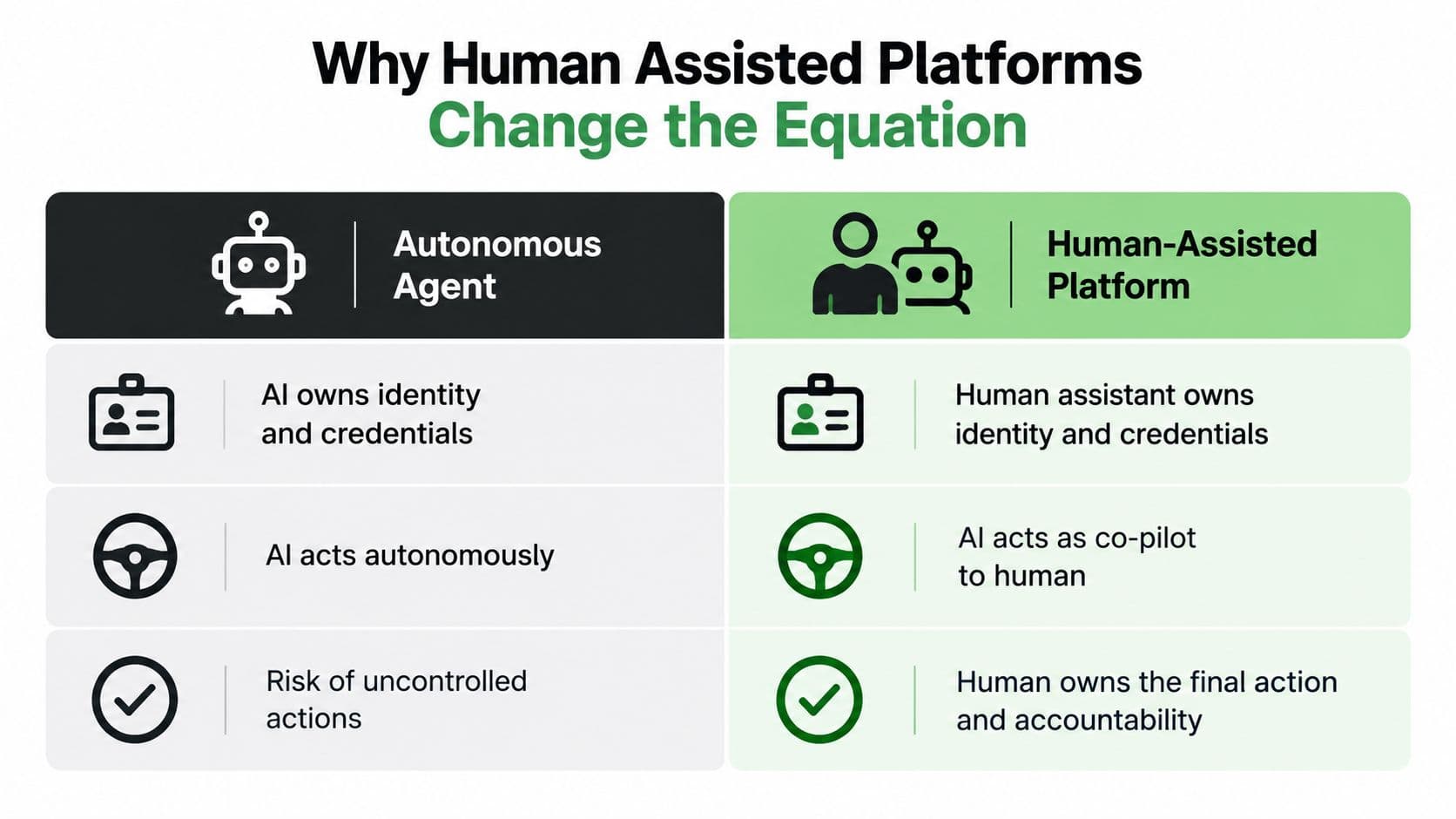
Why Human Assisted Platforms Change the Equation
The biggest control gap in agentic AI isn't just monitoring. It's identity.
A 2026 standards-gap analysis argued that current security frameworks were built before autonomous tool-calling agents and lack purpose-built controls for distinguishing AI agents from human operators, scoping permissions to task context, or linking actions to a non-human principal for forensic attribution. The same research notes a 2026 CISO survey where 92% of large enterprises lack full visibility into AI agent identities and 95% doubt they could detect or contain a compromised agent, while substantive NIST agent-specific controls were not expected until late 2026 at the earliest (Cloud Security Alliance research note).
That's why I'm skeptical of the fully autonomous pitch for most business workflows. If the AI owns the credentials, acts directly, and leaves messy attribution behind, your investigation gets harder right when you need clarity.
Keep the human as the accountable principal
The practical alternative is a human-assisted model. The AI proposes. The human reviews or dispatches. The credentials remain tied to the person who is already inside your org structure, training process, and accountability chain.
That isn't old-fashioned. It's efficient control design.
When the human owns the identity, a few things get easier fast:
- Attribution is cleaner: You know whose account initiated the final action.
- Permissioning is simpler: Tokens stay scoped to human roles instead of pseudo-users with fuzzy boundaries.
- Escalation makes sense: Managers can supervise people. They can retrain them, restrict them, or reassign work.
One workable example is a task-delegation platform where AI supports task routing and preparation while a human assistant remains the action owner. That's where systems like Fluidwave fit operationally. If you're thinking through quality checks in that kind of workflow, this guide on assistant quality control is relevant.
Cheap control beats elegant theory
A lot of teams chase a technically elegant autonomous design before they've solved basic operational questions. Who owns the inbox? Who approves the send? Who carries the token? Who reviews the exceptions?
The cheapest control available right now is a trained human in the loop with scoped access and a visible audit trail.
That's not a retreat from AI. It's the shortest path to trustworthy deployment while standards and tooling catch up.
Matching the Right Oversight to the Right Task
Oversight should change with task risk. One setting for every workflow is lazy management.
The cleanest way to do it is to sort work by blast radius. I use four buckets: read-only research, reversible writes, external communication, and execution that affects code or money. Each bucket gets a different owner, approval path, and logging requirement.
Use a simple decision rule
If a junior teammate could undo the action in a few minutes without customer impact, an AI can often do it autonomously inside a tight scope.
If the action touches a customer, commits the company externally, changes production systems, or affects payments, add a human approval gate before the action fires. Don't argue with that rule. It's saved more bad automations than fancy eval frameworks ever will.
This matters for staffing too. If you browse Google program manager jobs, you'll notice how often evaluation, coordination, and operational rigor sit next to AI work. That's the shape of modern oversight. Someone has to own the process, not just the model.
Oversight Levels by Task Risk
| Risk Bucket | Owner | Approval Method | Logging Depth | Example Tasks |
|---|---|---|---|---|
| Read-only research | AI | Auto-approved within scoped sources | Summary plus source access trail | Internal research briefs, meeting prep, document summarization |
| Reversible write actions | Human assistant or scoped AI workflow | Auto-approved with periodic sampling | Full action log with rollback note | Drafting tickets, updating non-critical internal records, organizing task boards |
| External communication | Human assistant with manager fallback | Human review before send | Full prompt, draft, edit, approver, and send log | Customer email drafts, vendor outreach, scheduling with external parties |
| Code or financial execution | Human owner | Explicit human approval every time | Deep logs plus incident-ready audit record | Production changes, payment actions, contract-affecting updates |
Publish the matrix where people actually work
The matrix only helps if the team can see it. Put it in the wiki, pin it in the operations channel, and link it in templates for new workflows.
If your team delegates mixed-stakes work, human-assisted operating models often fit the middle bucket well. They absorb low-stakes task handling while preserving explicit approval gates for customer-facing or irreversible actions. That design pattern shows up clearly in better human-AI interaction models, because the handoff is the control point.
A Short Checklist and What Comes Next
If you're managing live AI workflows, run this checklist this week.
- Inventory every deployed agent: List what it does, what tools it touches, and who owns it.
- Check access scope: Confirm each agent or workflow has only the minimum permissions required.
- Mark irreversible actions: Add human approval before anything customer-facing, financial, legal, or production-critical.
- Review monitoring coverage: Make sure you log actions in systems, not just prompts and responses.
- Name an incident owner: One person should have authority to revoke access and pause workflows immediately.
- Test the runbook: Simulate one bad action and see how long it takes the team to contain it.
- Schedule audits: Sample outputs and actions against a human baseline on a fixed cadence.
- Run adversarial review: At least quarterly, try to break the workflow with bad prompts, odd inputs, and permission edge cases.
There's also a broader standards story forming. A 2024 frontier-AI safety paper from UC Berkeley describes capability thresholds as predefined model capability levels at which additional safety measures become necessary, and frames intolerable-risk thresholds as the point where severe risks become unacceptable unless adequately mitigated (UC Berkeley paper). That's useful framing, but managers shouldn't wait for the perfect standard.
The next phase of compliance will look less like annual policy review and more like continuous evidence collection. Logs. approvals. access scopes. incident records. Teams that already run tight delegation discipline will absorb that shift cleanly. Teams that don't will feel it as sudden overhead.
Start the instrumentation now.
Fluidwave gives teams a practical way to keep AI useful without handing over uncontrolled execution. It combines AI-driven task management with human assistants, which fits the operational model this article argues for: AI helps prepare and route work, while accountable humans handle sensitive actions and clear handoffs. If you want that kind of delegation discipline built into the workflow, visit Fluidwave.
Focus on What Matters.
Experience lightning-fast task management with AI-powered workflows. Our automation helps busy professionals save 4+ hours weekly.