Build a reliable assistant quality control system with clear KPIs, QA workflows, checklists, and feedback loops that scale without slowing your team down.
August 17, 2026 (1mo ago)
Assistant Quality Control: A Practical Framework for Teams
Build a reliable assistant quality control system with clear KPIs, QA workflows, checklists, and feedback loops that scale without slowing your team down.
← Back to blog
Many teams start assistant quality control by adding another reviewer. That feels responsible, but it often treats the symptom instead of the failure. The expensive mistakes usually begin earlier, when an assistant receives incomplete context, vague acceptance criteria, or no clear rule for escalating an uncertain result.
The right question isn't, “How do we review everything?” It's, “Which outputs can move forward safely, and which ones require human judgment?” A durable system combines bounded delegation, measurable standards, audit trails, and escalation thresholds. It protects quality without turning every task into a bureaucratic approval chain.
Why More Review Does Not Mean Better Quality
More review can improve quality, but only when reviewers know what they're checking and have the context to make a sound decision. Adding a second or third pass to an unclear task creates more opportunities for people to interpret the assignment differently. The result is often slower delivery, duplicated effort, and no reliable explanation of why an output passed.
A 2026 developer survey found that 65% of respondents said assistants miss relevant context during refactoring, while about 60% reported the same problem in testing, writing, or reviewing. Even among users who believe AI improves quality, 53% still wanted better context handling. Those findings point to a governance problem, not just a proofreading problem. The State of AI Code Quality report supports a more targeted approach, inject the right context, set review thresholds, and escalate only when the task crosses a defined risk boundary.
Find the actual failure point
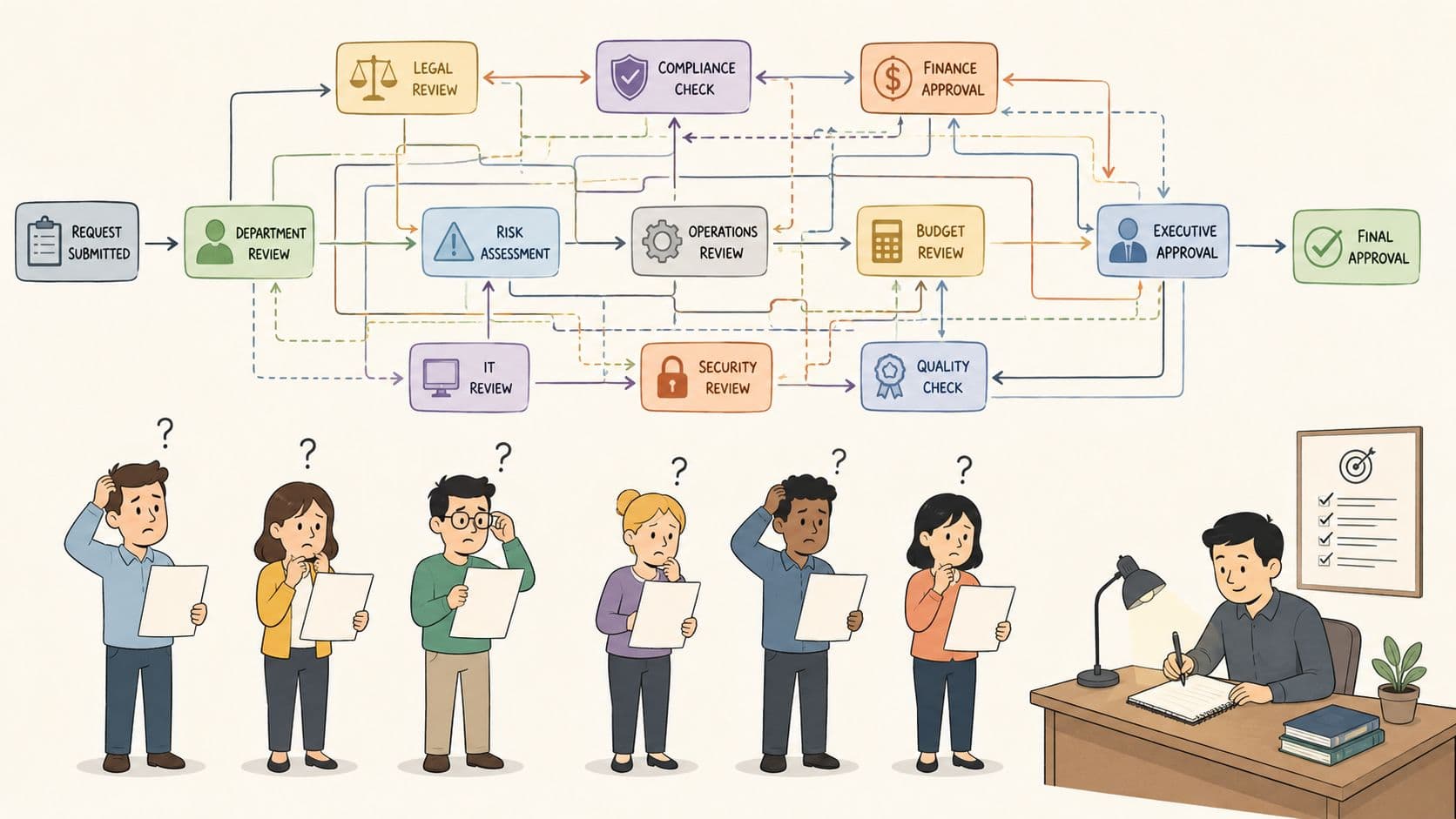
In distributed operations, quality commonly breaks at the handoff. A manager assumes the assistant knows the preferred format. The assistant sees a task title but not the customer history, source files, exclusions, or decision authority. A reviewer later checks the finished work against assumptions that were never written down.
Blanket double-checking doesn't fix that gap. It may also create review fatigue, where reviewers approve routine work quickly while spending too little attention on the exceptions that matter. A better control separates tasks by consequence:
- Routine and reversible: Formatting, categorization, calendar cleanup, and other bounded work can move through automated checks and sampled review.
- Context-sensitive: Customer responses, financial summaries, and research synthesis need stronger source controls and a clear reviewer.
- High-impact or irreversible: Compliance decisions, legal language, access changes, and external commitments should require human approval before release.
Practical rule: Review intensity should follow the cost of an undetected error, not the presence of an assistant.
The control system should also record why an output was escalated. “Needs review” is not useful on its own. “Source conflict,” “missing authorization,” “outside task scope,” and “low confidence in a required field” give the next reviewer an actionable starting point.
Defining Acceptance Criteria and KPIs Before Delegation
Quality starts before delegation. If the requester and assistant don't share the same definition of done, a later review becomes a negotiation rather than a verification step. Structured outsourced workflows have been associated with a 65% improvement in project success rates, with first-time acceptance above 90%, QA automation coverage above 75%, and defect reduction greater than 40%, as summarized by FullScale's quality-control guidance for outsourced development. These figures don't replace local measurement, but they show why standards need to exist before work begins.
Write the task so another person can test it
A useful delegation brief contains five fields:
- Scope: State what the assistant should do and what falls outside the assignment.
- Inputs: Identify the approved documents, systems, examples, and source dates.
- Output: Define the format, destination, naming convention, and required fields.
- Acceptance criteria: Describe the checks that determine pass or fail.
- Escalation: State what the assistant must pause on rather than resolve independently.
For example, “prepare the vendor comparison” is too vague. A testable version might require a table using only the supplied proposals, one row per vendor, citations beside each factual claim, explicit notation for missing information, and escalation when two documents conflict. The assistant can complete the work without guessing what the requester meant.
Choose KPIs that expose rework
A small set of operational measures usually tells you more than a long scorecard:
| KPI | What it reveals |
|---|---|
| First-pass acceptance | Whether the task brief and execution aligned |
| Defect leakage | Which errors survived the intended review |
| Rework rate | How much capacity is consumed correcting avoidable defects |
| Decision consistency | Whether reviewers apply the rubric similarly |
| Escalation quality | Whether uncertain cases reach the right human |
Define the measurement method beside each KPI. For example, decide whether a defect means any correction or only a material correction. Record whether rework came from an unclear brief, missing context, execution error, or reviewer disagreement. Teams can use this guide to measuring anything to turn broad expectations into observable operating measures.
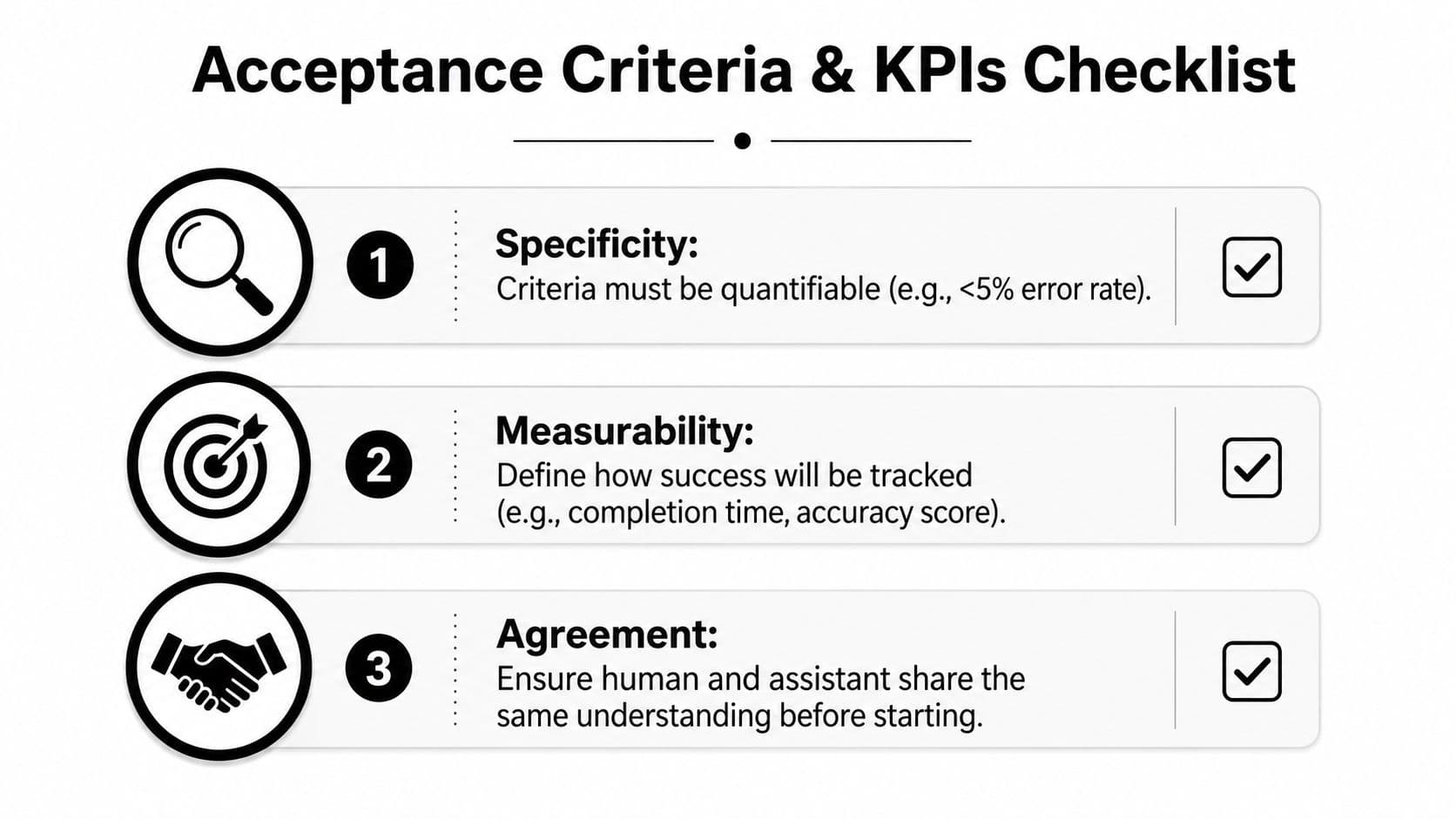
A short pre-delegation agreement prevents many downstream disputes. The requester confirms the standard, the assistant confirms the interpretation, and the reviewer knows what evidence to inspect. That small exchange is often more valuable than adding another approval layer after delivery.
Designing a Repeatable QA Workflow
A workflow that succeeds once but fails under volume isn't a quality system. Repeatability comes from assigning each control to the cheapest reliable mechanism, then reserving human attention for ambiguity, exceptions, and consequences.
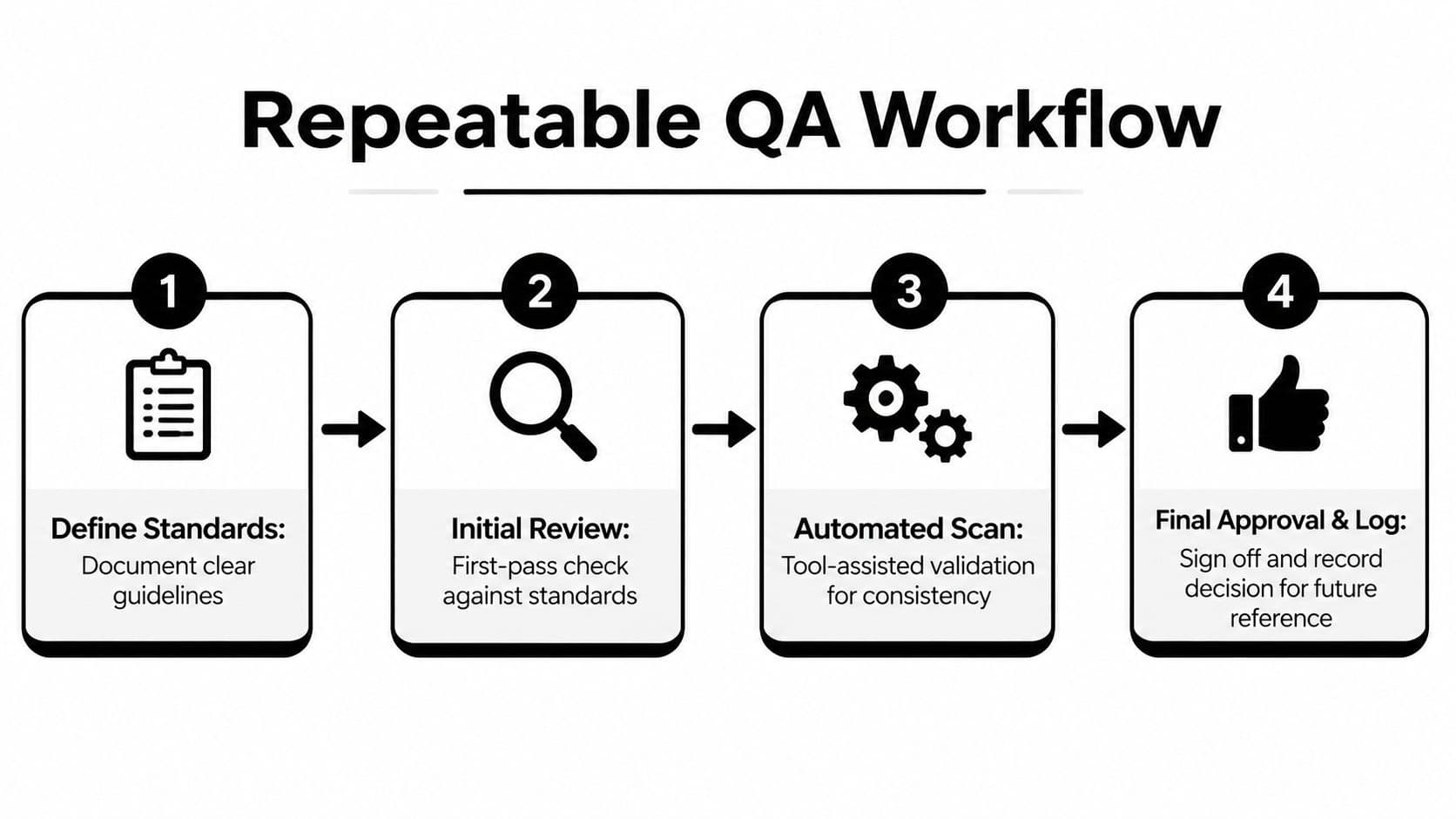
Use four deliberate passes
Start with documentation. Store the task brief, source boundaries, acceptance criteria, and authorization in the same work record as the assignment. Next, perform an initial review against the criteria, not against personal preference. This first pass should catch missing fields, unsupported claims, formatting failures, and scope violations.
Automated scanning belongs after the initial review when the checks are stable and high-volume. Depending on the work, that may include required-field validation, duplicate detection, format checks, source presence, or rule-based policy screening. Automation is useful because it applies the same test repeatedly, but it shouldn't be mistaken for judgment.
Final approval handles the remaining uncertainty. The approver records the decision, the reason for any rejection, and the corrective action. That record turns an isolated review into operational learning.
Separate routine checks from judgment
Routine validation can often run automatically or through a lightweight checklist. Judgment-heavy work needs a defined rubric, examples of acceptable and unacceptable outputs, and a second look at disputed cases. In one industrial outsourcing study, repeatability between the original operator's control judgment and an outsourced control was 89%, meaning roughly 11% of cases were classified differently. The MATEC Conferences paper on quality-control repeatability makes the operational implication clear, standardized tasks can still produce reviewer disagreement.
Track inter-rater agreement or decision consistency as a signal. If reviewers disagree frequently, don't just tell them to be more careful. Revisit the rubric, add edge-case examples, or move the task into a higher trust tier.
For human assistant hiring and delegation, structured tools such as assess candidates with Talantrix scorecards can help teams define evaluation dimensions before work is assigned. The same principle applies to AI assistants, where the scorecard should assess evidence quality, instruction adherence, context use, and escalation behavior.
Build the workflow around exceptions. Routine work should become easier over time. Edge cases should become more visible, not disappear inside a generic pass or fail label.
Building Checklists and Audit Trails for Traceability
A checklist is useful only when it captures evidence. “Reviewed” doesn't tell you what was checked, who checked it, or whether the reviewer had authority to approve the result. A traceable record connects the task, assignee, authorization, output, verification method, and decision.
The University of Calgary's delegation log template provides a practical model. It records the delegated task, assigned individual, delegation date, and authorization history, including a dedicated delegation-of-authority record. The University of Calgary task delegation log template demonstrates how responsibility becomes auditable when teams document who was allowed to do what and when.
Keep the record inside the workflow
A workable audit entry can include:
- Assignment: Task name, owner, scope, and deadline.
- Authority: Person or system authorized to perform and approve the work.
- Evidence: Source documents, links, attachments, or tool outputs used.
- Checks: Criteria applied, automated validations completed, and exceptions found.
- Decision: Approved, returned for correction, escalated, or rejected.
- Reason: A concise explanation tied to the standard.
- Follow-up: Corrective action, owner, and closure status.
The log shouldn't become a separate administrative project. Put these fields in the task template, require only the evidence relevant to the task tier, and auto-populate timestamps where the platform supports it. A low-risk formatting task may need a simple completion record. A compliance-sensitive deliverable needs a fuller chain of authority and verification.
Test the assistant, not just the final answer
AI-assisted work requires controls beyond surface accuracy. Reviewers should validate outputs against the approved source material, test whether instructions can be manipulated by untrusted content, and check that the assistant doesn't claim to have completed actions it only recommended. Self-checks and output validation can help, but they don't eliminate the need for downstream verification.
Use this checklist creation guide to turn recurring controls into reusable task structures. The aim isn't paperwork. It's the ability to reconstruct a decision when a customer, auditor, manager, or future reviewer asks how the output was produced.
Real-Time Monitoring and Feedback Loops
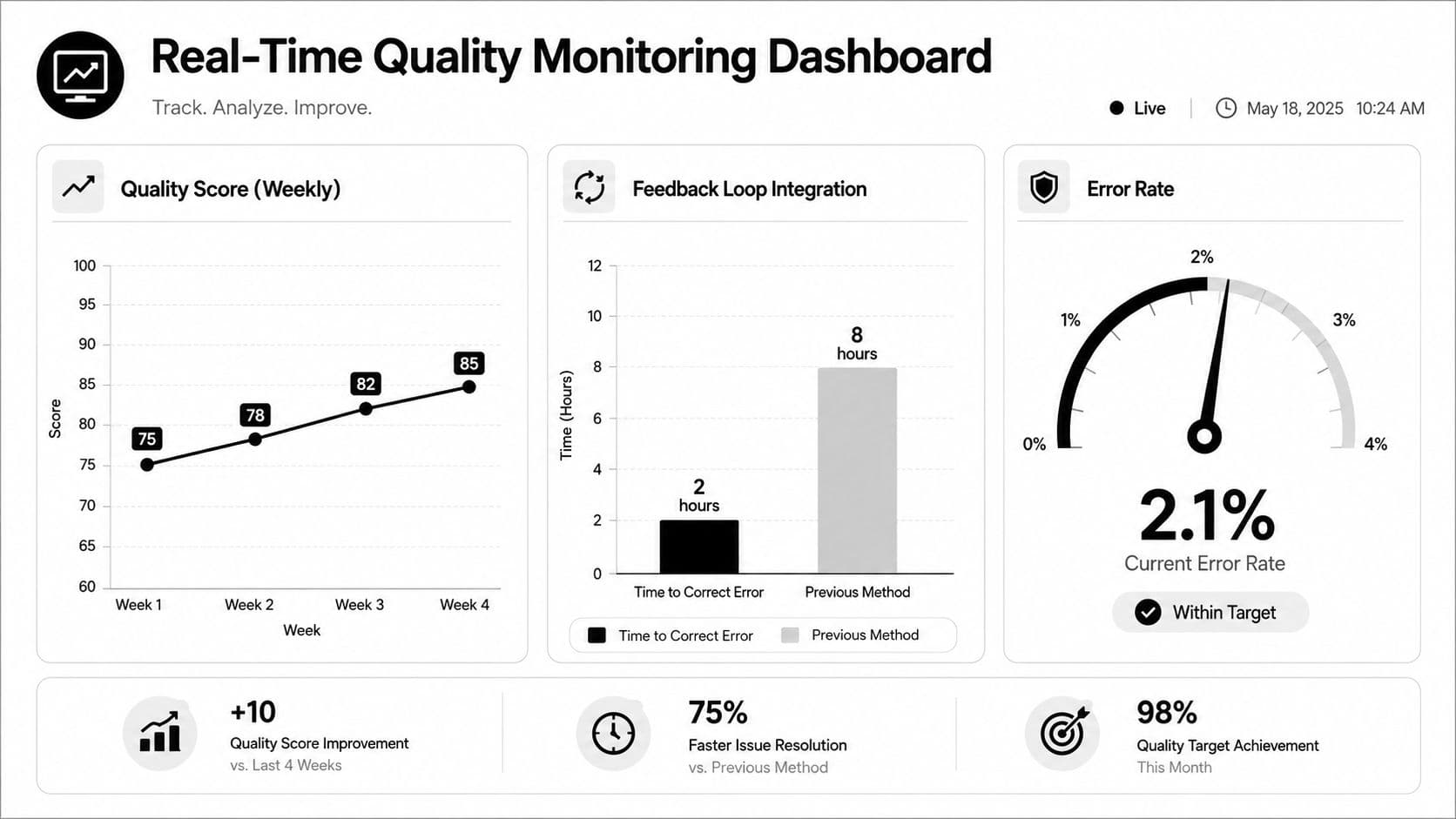
A quality issue caught immediately is usually a correction. The same issue discovered after related tasks have been completed becomes a rework campaign. Real-time monitoring matters because it shortens the distance between an observed defect and a changed instruction.
Track a small operational dashboard rather than every available event. First-pass acceptance shows whether assistants are meeting the brief without intervention. Defect leakage identifies problems that survived the intended control. Rework rate shows the workload cost. Escalation volume and resolution time reveal whether the threshold is too sensitive or too permissive.
Make feedback corrective, not punitive
A useful feedback loop answers four questions:
- What failed?
- Which acceptance criterion exposed the failure?
- What context or instruction was missing?
- What changes before the next assignment?
If the assistant omitted a required source, update the task template or source-ingestion step. If the assistant misunderstood a category, add examples to the rubric. If the reviewer applied a personal preference, clarify the acceptance standard. Feedback should change the system, not merely mark the individual output as wrong.
A platform such as Fluidwave can place delegated tasks, progress updates, assistant communication, and workflow automation in one operating view. That makes it easier to connect the assignment with the correction record instead of scattering evidence across chat, email, and separate spreadsheets. Teams can also use feedback loops in task workflows to formalize how issues move from detection to resolution.
Set thresholds before the pressure arrives
Escalation rules work best when they're written before a difficult case appears. Examples include:
- Pause on missing evidence: The assistant cannot verify a required claim from approved sources.
- Pause on conflicting instructions: Two task inputs establish different priorities or outcomes.
- Pause on authority limits: The requested action changes an account, commitment, policy position, or regulated record.
- Pause on repeated defects: The same failure appears across multiple outputs and suggests systemic drift.
- Route disputed decisions: Two reviewers reach different outcomes under the same rubric.
Automated alerts can surface these conditions, but a human owner must decide what happens next. The feedback loop closes only when someone updates the instruction, resolves the exception, and records the decision for future work.
Establishing Trust Tiers and Escalation Rules
Trust shouldn't be binary. An assistant can be reliable for organizing supplied information and unsuitable for making an unsupported compliance judgment. Teams that treat every task identically either expose high-risk work or burden low-risk work with unnecessary review.
Use consequence to set the tier
A practical model has three levels:
- Delegated with audit trail: Reversible administrative work using bounded inputs and clear output rules. The assistant completes the task, records evidence, and receives sampled review.
- Delegated with human verification: Work that affects customers, finances, public statements, or important internal decisions. The assistant prepares the output, but a named person verifies the evidence before release.
- Human-led with assistant support: Compliance-sensitive, legally consequential, irreversible, or highly ambiguous work. The assistant may retrieve, summarize, or organize information, but a qualified human controls the decision at each critical step.
Trust must also reflect observed failure, not just task labels. A 2025/2026 European Broadcasting Union and Which? audit found 45% of AI responses had at least one significant issue, 81% had some issue, 20% had significant accuracy problems, and 31% had serious sourcing problems. The EBU and Which? AI audit supports a minimum standard based on provenance, timestamps, source verification, and explicit approval checkpoints rather than confidence in fluent wording.
Define the minimum acceptable standard
For any professional workflow, an assistant should meet four baseline conditions:
- Traceability: The team can identify the task owner, source material, and approval history.
- Bounded behavior: The assistant knows what it may do and what it must escalate.
- Verifiable output: A reviewer can test important claims against evidence.
- Recoverability: The team can correct or reverse the result without losing the record.
A 2024 peer-reviewed study of an AI assistant for software quality assurance reported 87% accuracy in detecting user intents and generating relevant responses. The study by Kaushik Jana offers a useful benchmark, but it isn't a universal permission slip. The acceptable threshold depends on the task, the cost of failure, and whether a human verifies the result before action.
Fluidwave combines task management, delegation to human virtual assistants on a pay-per-task basis, live progress updates, and assistant communication, which can support this kind of tiered operating model. Visit Fluidwave to organize delegated work with clear task instructions, monitoring, and review records so your team can move quickly without treating every assistant output as equally trustworthy.
Focus on What Matters.
Experience lightning-fast task management with AI-powered workflows. Our automation helps busy professionals save 4+ hours weekly.