Master asynchronous collaboration with practical frameworks, workflows, and tool tips that help distributed teams stay aligned, focused, and productive.
September 1, 2026 (1mo ago)
Asynchronous Collaboration Guide for Modern Teams
Master asynchronous collaboration with practical frameworks, workflows, and tool tips that help distributed teams stay aligned, focused, and productive.
← Back to blog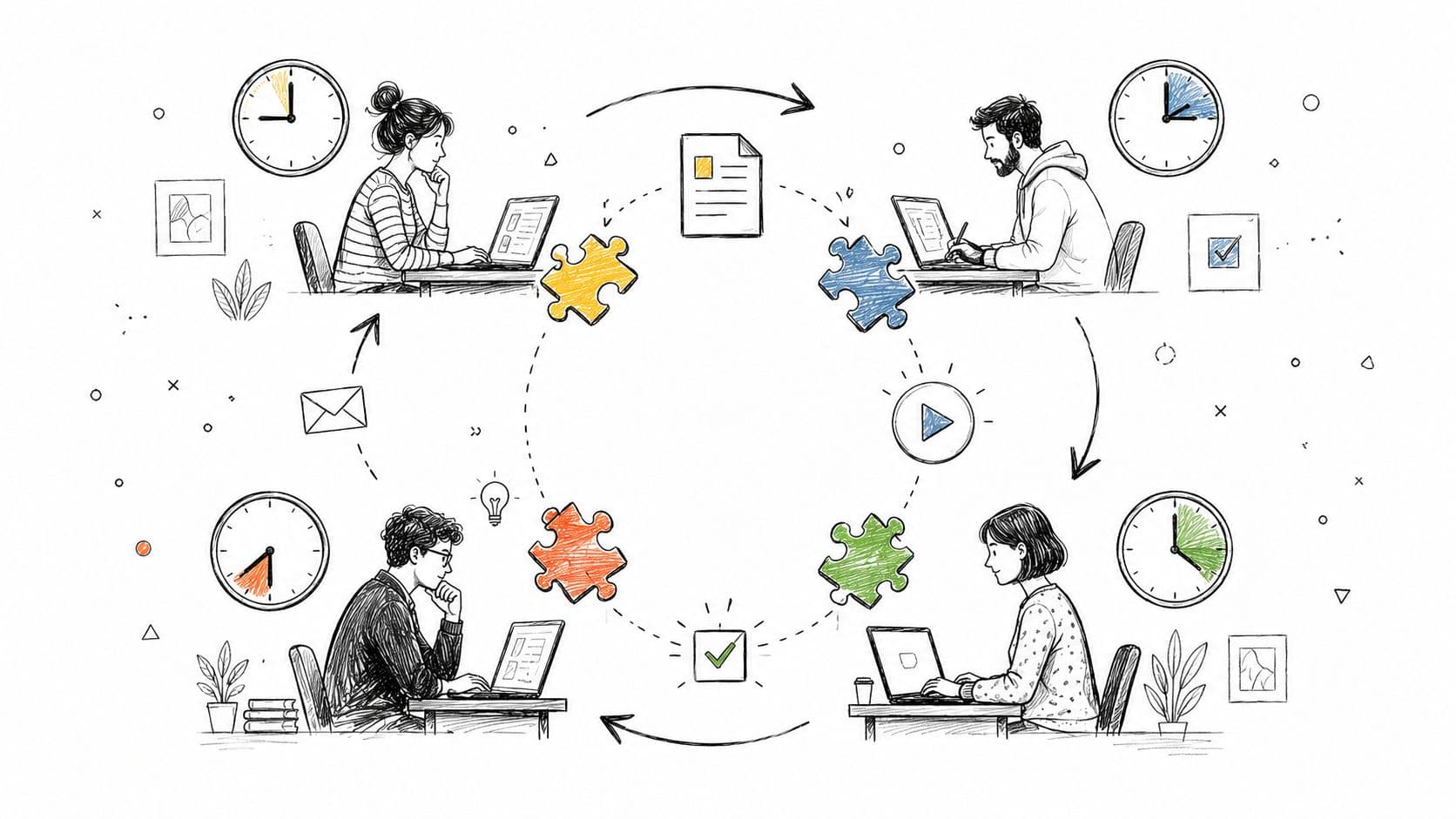
Maya opens Slack at 8:15 a.m. in Berlin and finds that the product launch has already changed twice. While she slept, a developer in San Francisco questioned the release sequence in a late-night thread. A product manager in Singapore approved a different interpretation of the rollout plan. The decision is buried between status reactions and unrelated messages, so Maya spends the first part of her day reconstructing what happened instead of moving the launch forward.
This is the daily reality of distributed work. Time zones, deep-work preferences, flexible schedules, contractors, and regional holidays have fragmented the workday into overlapping windows. Teams often aren't failing because people lack commitment. They're losing momentum because context, decisions, and ownership don't travel reliably from one working window to the next.
Asynchronous collaboration addresses that operating problem. It isn't a rule to delay replies or replace every meeting with a message. It is a way to preserve enough context for work to continue when nobody is online together. Teams that want a practical look at communication habits across distributed work can also use Voice Control Pro for distributed teams as a useful reference point.
The difference appears in small moments: a designer knows why a request changed, an engineer sees which option was approved, and a contractor can begin without scheduling a call. The structures below turn lost messages, duplicated work, and context-switching across tools and clocks into repeatable workflows.
The Dynamics of Distributed Teamwork
Distributed teamwork behaves like a relay across changing work windows. Maya's team does not need everyone on the track together, but each person needs a clear baton, a visible route, and enough context to understand what happened before their turn.
Without those conditions, invisible queues form. A developer waits for clarification from an offline product manager. The product manager assumes the developer saw a decision posted in another channel. Maya opens three tools, finds partial conversations, and repeats questions someone already answered elsewhere.
The workday is no longer one shared room
Research involving Microsoft employees found that, as firm-wide remote work increased, email volume rose, while instant-message volume rose more sharply. At the same time, conference calls and other synchronous communication fell, while asynchronous communication increased, as documented in the 2022 Nature Human Behaviour study.
The finding points to a structural shift rather than a simple preference. Distributed teams need written, time-shifted coordination so work can pass between regions, schedules, and periods of limited availability. A practical reference such as Voice Control Pro for distributed teams can also help teams review their communication habits.
The handoff is the unit of continuity. If one person finishes work in Singapore and another starts in San Francisco, the second person should be able to continue without reconstructing the first person's entire day.
Context is the operating layer
Chat can announce that something happened, but it rarely preserves the full reason, owner, status, or next action in a durable form. A task record, decision log, or handoff note stays attached to the work and carries that context into the next working window.
Practical rule: If the next person must ask what changed, why it changed, or what to do next, the handoff is incomplete.
This rule changes the design question. Teams do not need to force everyone into one conversation. They need to preserve what remains understandable after the conversation ends: the objective, relevant background, decision history, current state, and named next owner.
That is why task systems and decision logs matter more than message volume. Selective delegation can also keep work moving, provided the delegate receives the same context, authority, and expected outcome needed to act without waiting.
What Asynchronous Collaboration Actually Means
Think of a research library. One contributor adds a well-catalogued note with a clear title, references, conclusion, and subject tags. Another contributor can find it later, understand its purpose, and build on it without waiting in line for the original writer.
A phone call works differently. Both people must be present, attentive, and ready to respond at the same moment. That can be useful, but it ties progress to shared availability.
Asynchronous collaboration decouples time, place, and pace.
- Time: A review can happen after the draft is submitted, not during a scheduled meeting.
- Place: A teammate can contribute from another region without joining a shared virtual room.
- Pace: Someone can read a complex proposal carefully, leave considered feedback, and return to the work later.
A recorded Loom review is asynchronous because the recipient can watch it when ready and replay a difficult explanation. A live walkthrough is synchronous because the presenter and reviewers need to coordinate their calendars and respond together.
Async by default is not async for everything
A team can make status updates, routine approvals, research reviews, documentation, and non-urgent handoffs asynchronous by default. Brainstorming, conflict resolution, sensitive feedback, and urgent incident response often benefit from real-time interaction.
The communication modes for knowledge teams offer a helpful way to distinguish channels by the type of work they support. The point isn't to select one mode permanently. The point is to choose the least costly mode that still preserves clarity and momentum.
Context artifacts carry the work
A context artifact is a durable written or recorded output that explains intent, status, decisions, and next steps. Examples include a task brief, a design review attached to the design file, a decision record, a recorded walkthrough, and a structured handoff.
| Dimension | Synchronous | Asynchronous |
|---|---|---|
| Timing | People participate together | People contribute at different times |
| Response | Immediate back-and-forth | Deliberate response within agreed windows |
| Best fit | Urgency, ambiguity, conflict, relationship building | Reviews, handoffs, documentation, routine decisions |
| Main risk | Interruptions and weak documentation | Delayed decisions and missing context |
A useful handbook definition is: Asynchronous collaboration lets people move shared work forward at different times through visible context, clear ownership, and durable decisions.
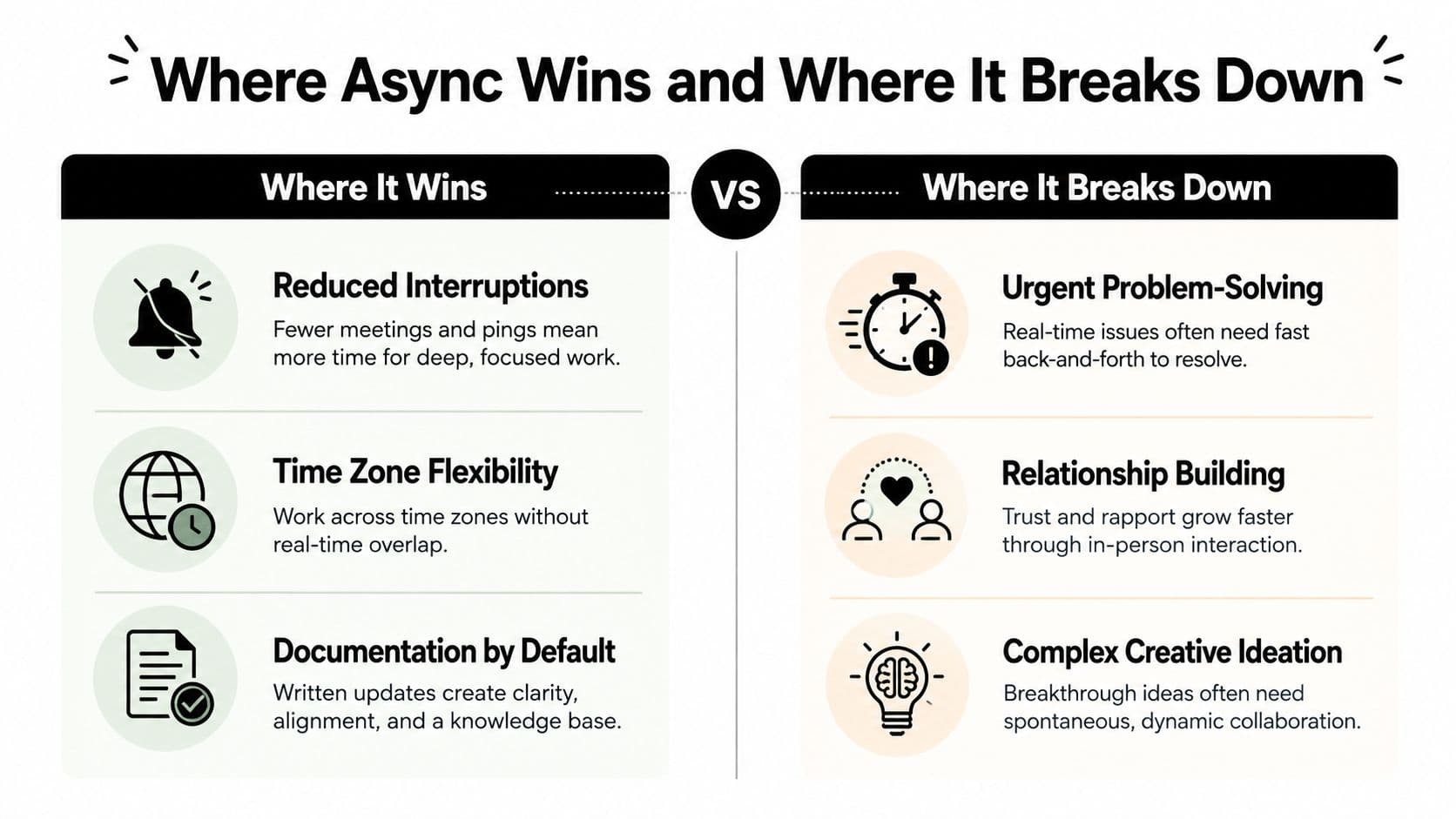
Where Async Wins and Where It Breaks Down
At 9 a.m. in Singapore, an engineer may finish an architecture note just as a teammate in Berlin starts work. If the task contains its context, the second teammate can review the reasoning, add questions, and continue without scheduling a meeting. If the context lives only in chat, the handoff becomes a scavenger hunt.
Asynchronous collaboration works best when work can be divided into clear steps and each step leaves a usable record. A new engineer can watch a recorded walkthrough, read the linked design decisions, and prepare focused questions. A reviewer can comment on the document itself rather than trying to recall every point from a live discussion.
Research on multinational companies supports this mixed approach. A 2017 study of 92 multinational companies found that asynchronous computer-mediated communication had a direct positive effect on organizational performance, although it did not show a significant direct relationship with internal or external collaboration. The study also found positive direct effects from synchronous communication, and that live communication could encourage later use of asynchronous media and collaboration. The findings support choosing the mode that preserves context for the work. The study is available through the PolyU research record.
The practical advantages
Async gives teams room to protect concentration, include colleagues across time zones, and preserve the reasoning behind a decision.
- Reduced interruptions: People batch updates and reviews instead of responding to every notification.
- Flexible participation: Contributors work during their productive hours while leaving a record others can use.
- Better onboarding: Recorded explanations and linked decisions show new hires how the work developed.
- Durable history: Future teammates can inspect what was decided and why without relying on memory.
Timing still matters. In a controlled study of distributed teams, communication delays of 800 milliseconds and 1600 milliseconds did not reduce task accuracy, but they reduced process efficiency. Teams took longer with the shorter delay, while the longer delay led to less information sharing and more frustration than no delay. The findings are documented in the Virginia Tech research archive.
The boundary conditions
Async breaks down when ownership is unclear, a decision cannot wait, or the work depends on subtle shared interpretation. Recent design research found that cross-time-zone asynchronous methods still struggle with design interpretation and unstructured communication when people need rapid back-and-forth sensemaking. The comparative study of synchronous and asynchronous collaborative design examines that boundary.
Use real-time collaboration for incidents and creative sessions when immediate responses carry more value than a written queue. The same applies to high-stakes conflict and sensitive relationship work. If a thread reaches more than six back-and-forth messages without a logged decision, stop extending it asynchronously. Hold a conversation, then record the outcome in the task or decision log.
Multiteaming adds another risk. A 2025 study of 176 student teams found that higher multitasking-team demands were associated with more asynchronous communication, while increased async communication was negatively associated with team creativity through reduced information elaboration. The lesson is selective async. More messages do not automatically produce better coordination.
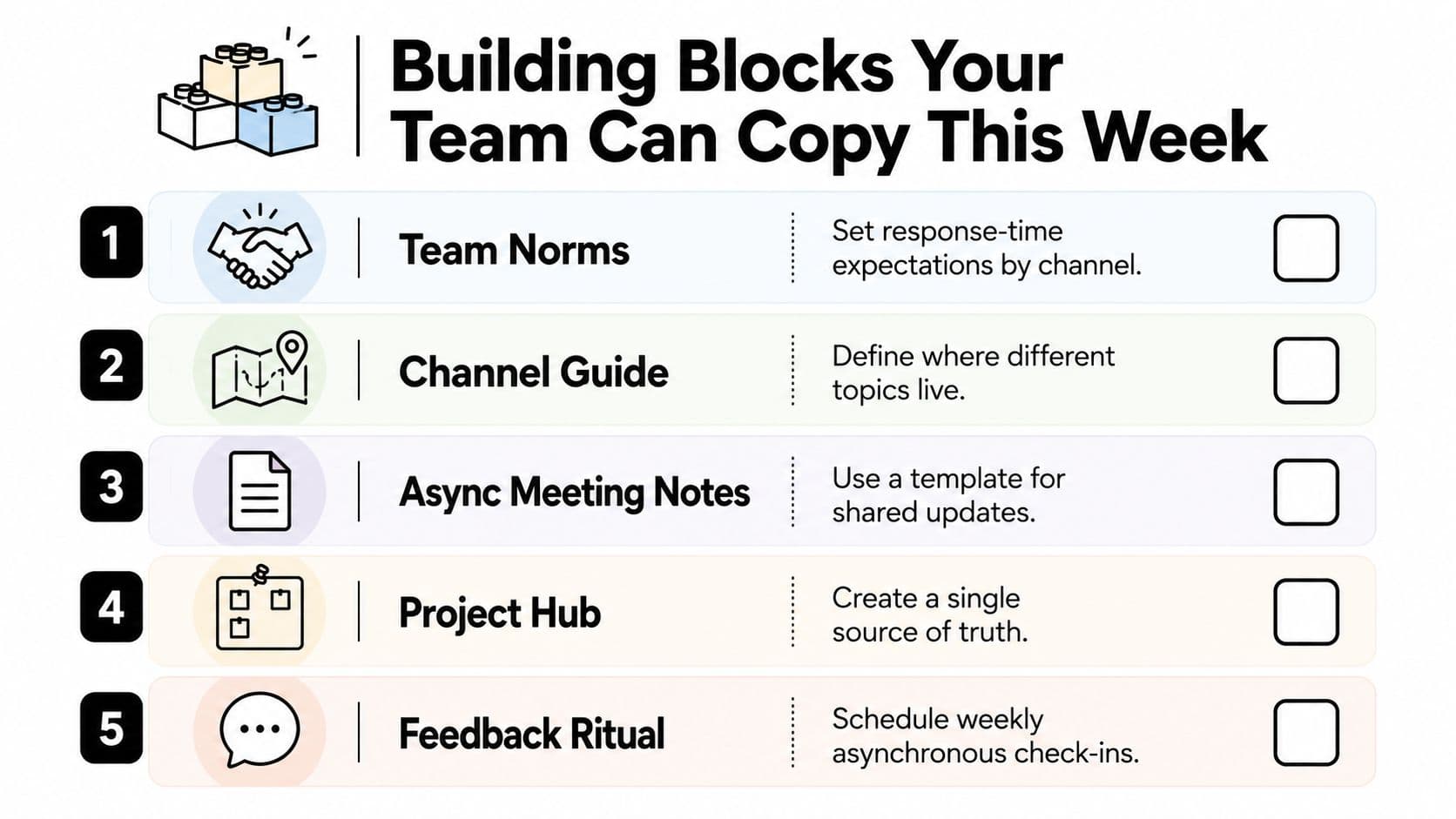
Building Blocks Your Team Can Copy This Week
A reliable async system starts with agreements that remove guesswork. People shouldn't need to infer whether a message requires an answer, where a decision belongs, or how long a review can wait.
Set norms before adding tools
Write a one-page charter that states channel purpose, response expectations, escalation rules, and protected focus periods. A team might expect replies to ordinary threads within four business hours and document reviews within 24 hours, provided those are realistic for its schedules. Keep a defined block of overlapping time for work that benefits from live discussion.
Add a meeting-cost rule: every proposed meeting needs a written purpose, a decision or outcome, and an explanation of why a document or recording won't work. This doesn't ban meetings. It makes the cost visible before calendars fill.
Log decisions where people can find them
A decision log can stay lightweight:
- Context: What problem are we solving?
- Options: Which alternatives did we consider?
- Decision: What did we choose?
- Owner: Who carries the next action?
- Revisit date: When will we review the assumption?
Example:
Vendor decision: We selected Vendor B for the analytics integration because its implementation fits the current data model and the team can support the handoff. Maya owns contract review. The team will revisit the choice after the first release cycle.
Make handoffs executable
A handoff shouldn't say, “Over to you.” It should tell the next person what they can trust.
Designer to developer
- Done: Mobile and desktop layouts are approved.
- Blocked: The empty-state copy still needs product approval.
- Next: Build the primary flow using the attached components.
- Watch for: The error state uses a different validation pattern.
For prioritization, try a 3-3-3 method: three important tasks today, three priorities this week, and three outcomes this month. The exact categories matter less than giving people enough direction to triage without repeated pings.
A written status update can follow the same logic: current state, completed work, blocker, next action, owner, and decision needed. Paste these templates into the team wiki, use them consistently, and revise only after observing where the handoffs fail.
Choosing Tools That Preserve Context
Chat is useful for quick coordination, but it makes a poor knowledge base. A Slack DM is ephemeral, thread-bound, and difficult for a new teammate to interpret without the surrounding history. A task system or document can hold the actual state of work, including ownership, dependencies, decisions, and next actions.
Separate conversation from the record
Use tools by function rather than asking one application to do everything.
- Task management: Linear, Asana, or Jira can hold owners, priorities, due dates, status, dependencies, and work-specific comments.
- Documentation: Notion, Confluence, or Slab can store operating procedures, project briefs, and durable background.
- Async video: Loom, Vidyard, or Switch can explain a screen, workflow, or visual issue without requiring a live walkthrough.
- Decision records: A dedicated wiki area or a tool such as Tettra can keep choices and rationale easy to retrieve.
The right setup lets a new team member catch up by reading. It doesn't require a private tour through someone's memory.
Match the stack to the work
| Team Type | Recommended Stack | Primary Async Workflow |
|---|---|---|
| Engineering squad | Jira or Linear, Confluence, Loom, Slack for alerts | Tasks hold implementation state, docs preserve architecture, recordings explain complex changes |
| Marketing team | Asana, Notion, Loom, Slack channels | Campaign briefs hold context, comments collect review, status updates replace routine meetings |
| Small consultancy | Fluidwave, shared documentation, recorded walkthroughs, focused chat | Client work stays in tasks, delegated execution follows explicit handoffs, decisions remain attached to deliverables |
For teams evaluating how applications connect to existing workflows, Fluidwave's integration capabilities provide a relevant reference. Fluidwave combines task organization across table, list, calendar, Kanban, and card views with delegation to human virtual assistants, so a task can carry its owner, budget, timeline, and progress rather than leaving execution details in chat.
Avoid three common anti-patterns. Don't use DMs as the project archive, don't rely on memory for current state, and don't force every tool into real-time mode. Choose systems where state lives in the record, not in someone's head.
Accessibility and Neurodiversity Benefits
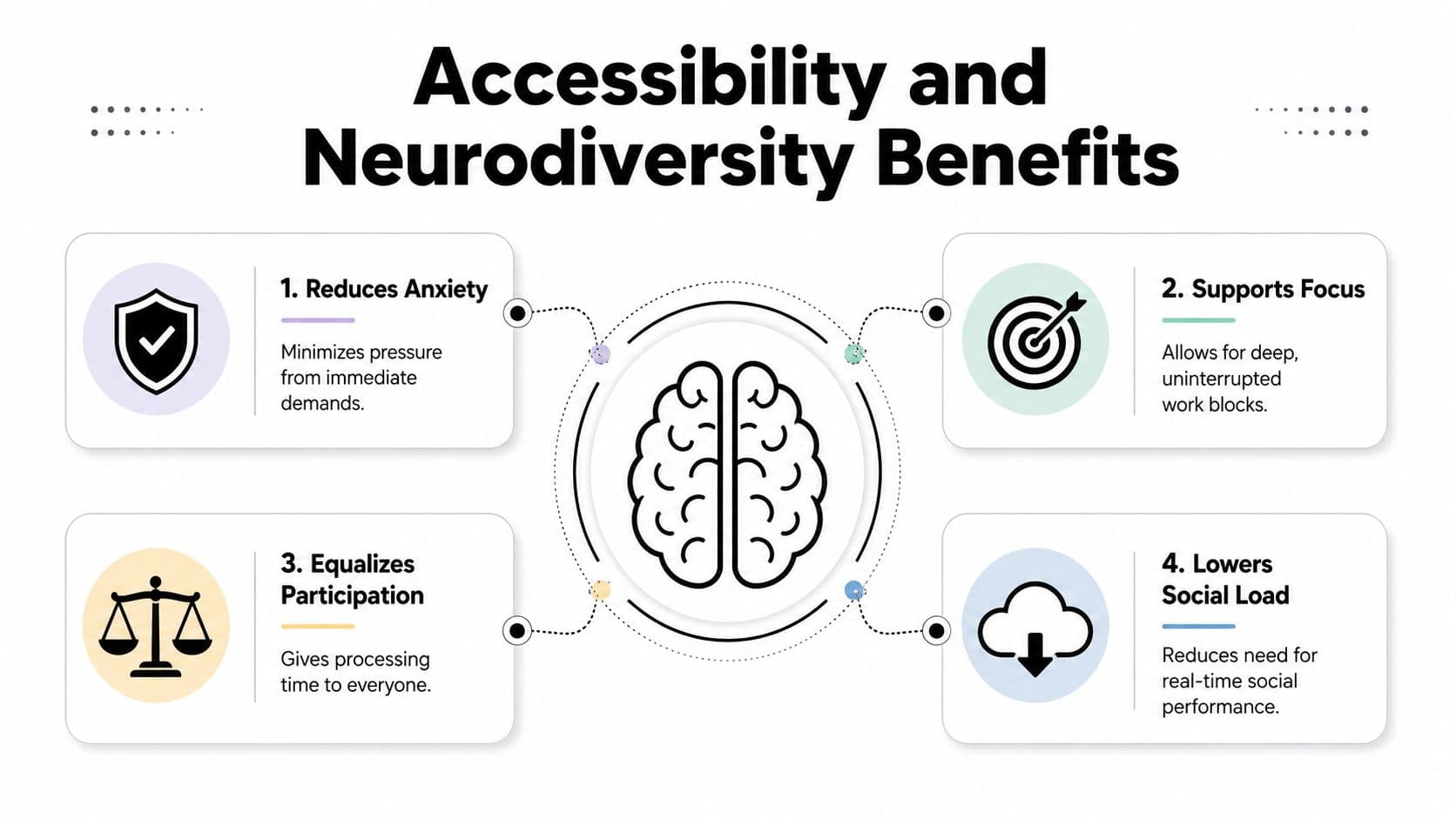
Async collaboration can lower the cost of participation, especially for people who find constant interruption or rapid verbal exchange difficult. A teammate with ADHD may need fewer competing pings to protect attention. An autistic teammate may contribute more effectively after processing a question without social pressure. Someone managing anxiety may communicate a complex concern more clearly in writing than in an improvised meeting.
Written records also support deaf and hard-of-hearing teammates without making live captioning the only route to essential information. Non-native English speakers can reread a proposal, check unfamiliar terms, and respond with greater confidence. Caregivers and people with variable schedules gain room to contribute during their strongest working windows.
Replace real-time performance with clear contribution
A live meeting often rewards speed, interruption, confidence, and comfort with spontaneous discussion. A written-first workflow shifts attention toward the quality of the reasoning and the usefulness of the handoff.
Practical accommodations include:
- Quiet chat hours: Turn off non-urgent notifications and define when interruptions are appropriate.
- Written-first decisions: Share the proposal before discussion so people can process it before a live session.
- Optional attendance: Make recordings, notes, and action items sufficient for people who don't need to attend.
- Think time: State when replies are expected and allow contributors time to form an answer.
- Explicit invitations: Managers should ask for input directly instead of waiting for the most vocal people to speak.
Async isn't automatically accessible. Poorly written tasks, unclear deadlines, and unspoken urgency create a different kind of barrier. The team still needs predictable response windows, plain language, accessible documents, and managers who actively include quieter contributors.
For practical ideas on structuring work around attention differences, neurodivergent productivity offers useful context. The central principle is simple: contribution quality should matter more than response speed.
Measuring Whether Async Is Working
Treat measurement as a checkup, not a report card. The purpose isn't to make people answer messages faster. It's to discover whether the workflow preserves context, reduces avoidable meetings, and moves work forward without adding hidden coordination overhead.
Track a small set of signals from work already happening:
- Time to decision: Measure the time between a documented proposal and a recorded decision.
- Meeting-free handoffs: Count how often a receiving owner starts work without scheduling clarification.
- Focused hours: Compare protected calendar blocks with meeting and interruption patterns.
- Async rework: Review how often deliverables return because the brief or handoff omitted critical context.
- Decision retrieval: Ask whether a teammate can locate the latest decision and its rationale from the project record.
Use task state transitions, document comment timestamps, calendar holds, and revision history instead of building a heavy survey program. A task moving from “ready for review” to “approved” provides a useful cycle signal. A repeated return to “needs clarification” points toward a handoff problem.
| Indicator Category | Metric Example | How to Capture | Why It Matters |
|---|---|---|---|
| Leading | Decision cycle time | Compare proposal and decision timestamps | Shows whether work is waiting for alignment |
| Leading | Draft-to-publish hours | Check document and publication history | Reveals review friction |
| Leading | Standup response latency | Review update timestamps | Shows whether status flows predictably |
| Lagging | Cycle slips | Compare planned and actual milestones | Connects coordination to delivery |
| Lagging | Quality defects | Review rework and returned deliverables | Tests whether context was sufficient |
| Lagging | Retention | Use people data with care and privacy controls | Indicates whether the operating model feels sustainable |
If two of the five indicators move in the wrong direction for two consecutive cycles, pause the rollout and inspect the handoff template first. Broken handoffs are often the most direct source of async friction because they force the receiving person to reconstruct the sender's thinking.
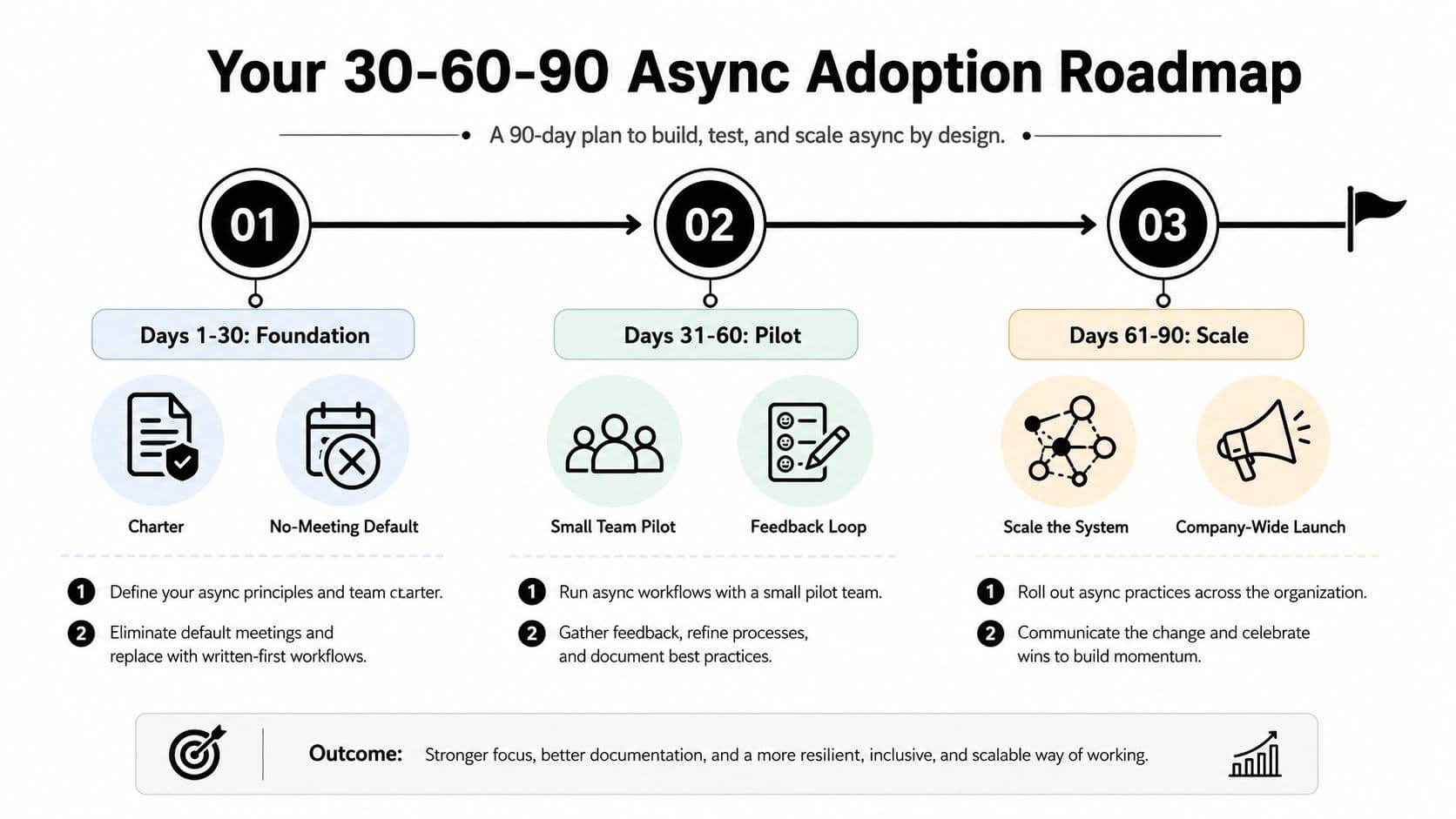
Your 30-60-90 Async Adoption Roadmap
Adopt asynchronous collaboration as a staged experiment, not a blanket mandate. A team needs enough structure to learn what works, but not so much policy that people spend their time maintaining the system.
Days 1 to 30, foundation
Write the one-page async charter. Define channel purposes, response expectations, escalation paths, and protected focus periods. Replace one recurring status meeting with a structured decision log, then pilot the handoff template with one team rather than imposing it everywhere.
At the end of this phase, review examples of good and bad updates. Don't judge the writing style. Check whether a teammate can identify the owner, current state, decision needed, and next action.
Days 31 to 60, pilot
Teach document-first writing through real work. Ask contributors to place context in tasks and project documents before sending a chat notification. Create a triage channel for genuine interruptions so people know where urgent requests belong without treating every message as urgent.
Start capturing the five health indicators. Look for repeated clarification questions, stalled approvals, and work that changes hands without an explicit acceptance point.
Days 61 to 90, scale
Run a retrospective focused on failed handoffs. Remove any rule that adds friction without improving clarity or delivery. Onboard the next team with the same charter as a working contract, while allowing that team to adjust response windows and escalation rules for its work.
A small FAQ helps prevent overcorrection:
When is two hours of overlap healthier than four? When the work needs occasional live alignment but doesn't justify keeping everyone available for half the day. Protect the smallest overlap that resolves real ambiguity.
Why does a perfect handoff still need a reviewer? A handoff can be complete and still contain a wrong assumption. The receiving owner should confirm understanding, risks, and the next action without turning every transfer into a meeting.
When does async become overhead? When people spend more time locating context, waiting for scattered reactions, or rewriting unclear requests than advancing the task. Rising rework, delayed decisions, and increasingly long threads signal that the workflow needs redesign or a synchronous escalation.
Start with one project this week. Write the decision log, attach the handoff to the task, and measure what changes before expanding the practice.
Fluidwave gives teams a shared task system for organizing work across table, list, calendar, Kanban, and card views, while delegation lets users assign defined tasks to human virtual assistants with budgets and timelines. Visit Fluidwave to create a context-rich workflow that keeps ownership, progress, and delegated execution visible without requiring everyone to be online at the same time.
Focus on What Matters.
Experience lightning-fast task management with AI-powered workflows. Our automation helps busy professionals save 4+ hours weekly.