Compare AI project management software by features, pricing, and fit. Learn what AI capabilities matter and how Fluidwave stacks up against alternatives.
September 12, 2026 (Today)
AI Project Management Software: A Buyer's Guide
Compare AI project management software by features, pricing, and fit. Learn what AI capabilities matter and how Fluidwave stacks up against alternatives.
← Back to blog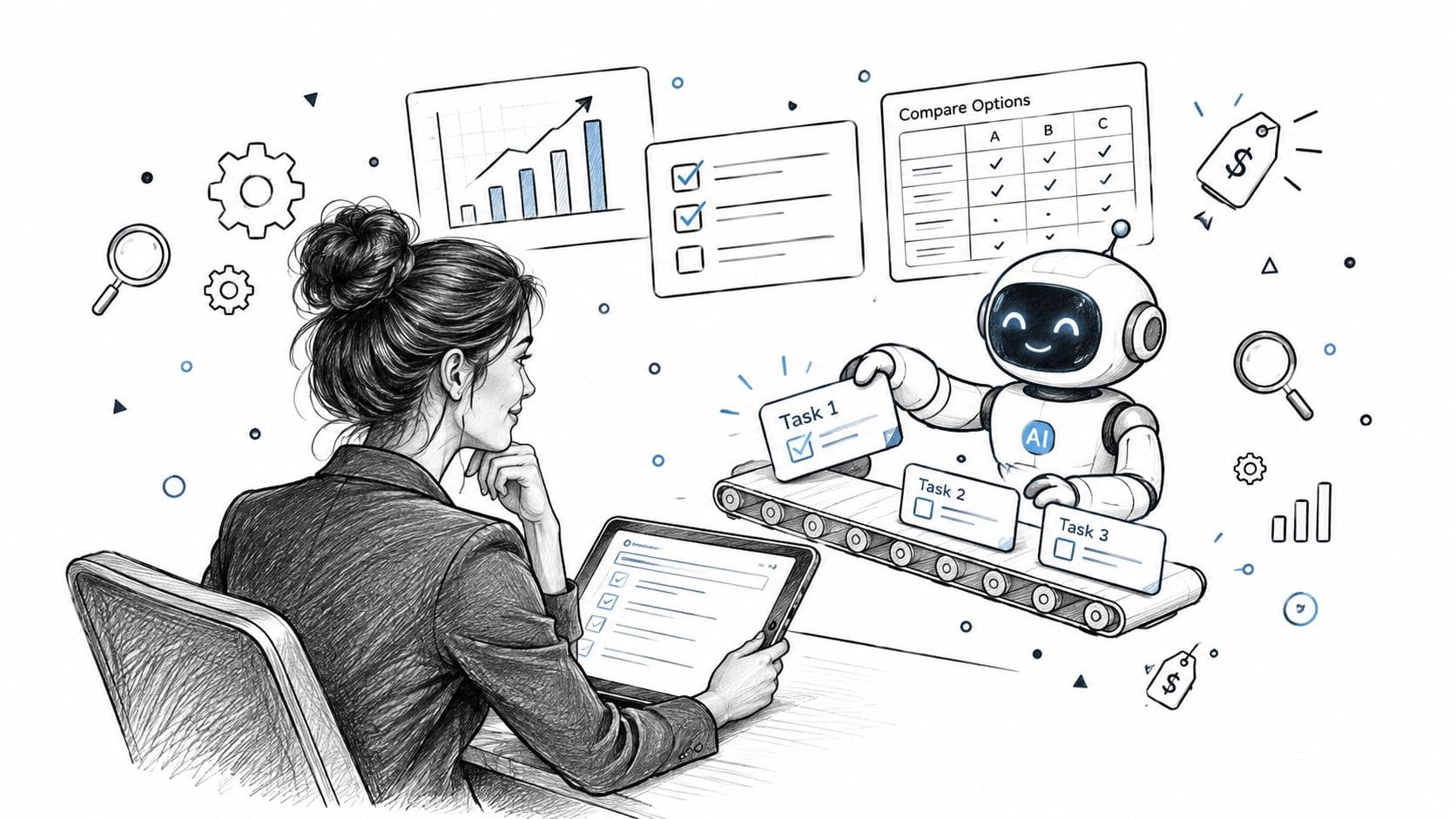
55% of professionals now say AI functionality is their primary reason for buying project management software, according to Capterra's 2025 Project Management Software Trends Survey of 2,545 professionals. That changes the buying question. You're no longer choosing between a task board and a dashboard. You're deciding which work should stay with people, which work can be delegated to AI or assistants, and what each completed delegation costs your business.
The strongest evaluation lens is the human-VAI delegation model. A virtual AI team member should handle clearly defined execution loops while people retain judgment, context, approvals, and accountability. Compare vendors by total cost per delegated task, not just by seat price or the length of their feature list.
Why AI Project Management Software Is Now a Board-Level Decision
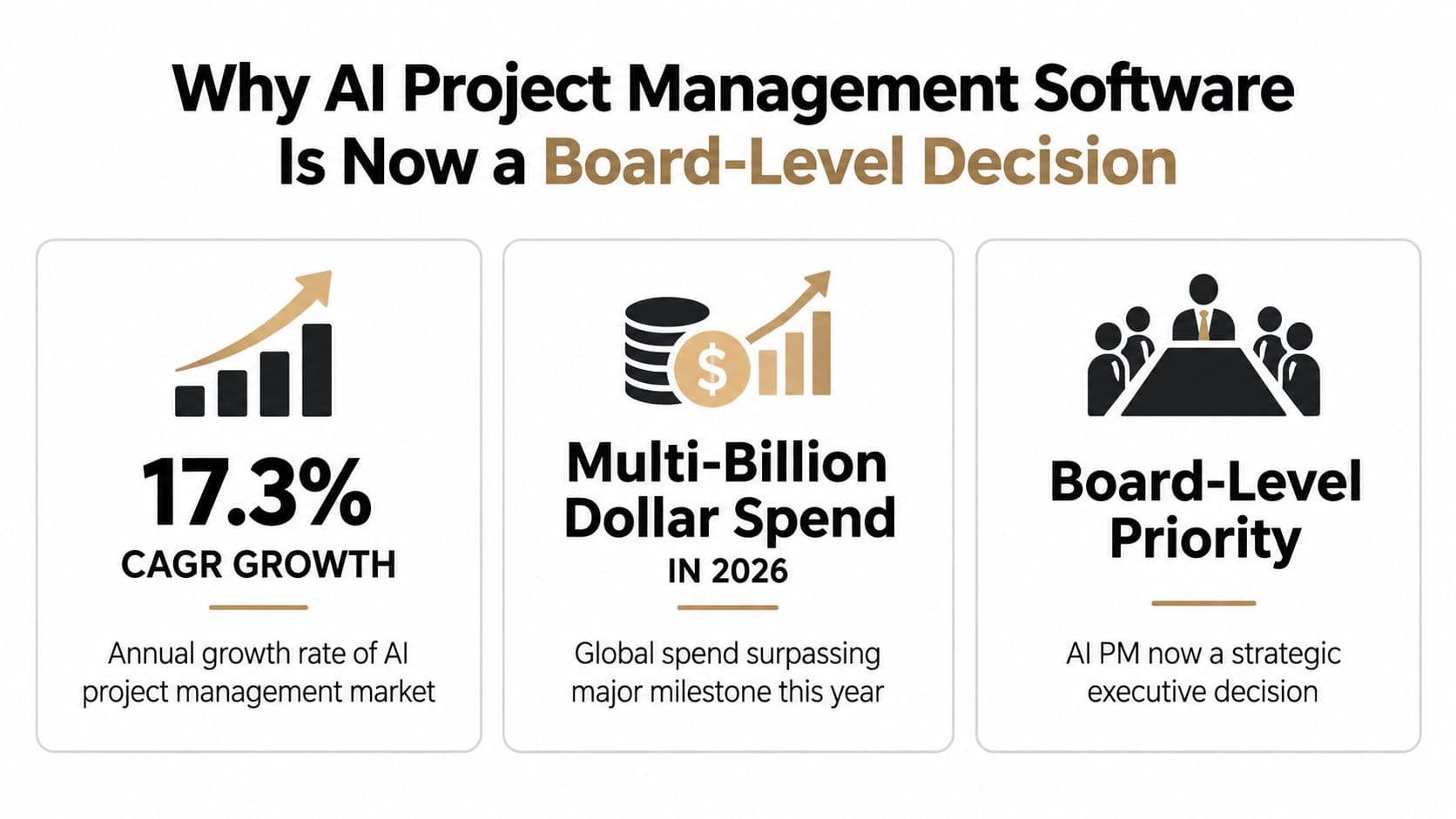
The market is moving quickly. One widely cited forecast values the AI in project management market at USD 2.2265 billion in 2022 and projects it to reach USD 7.7 billion by 2030, implying a 17.3% CAGR, according to MarketsandMarkets' AI in project management market analysis. Another forecast places the market at USD 2.5 billion in 2023, rising to USD 5.7 billion by 2028 at the same 17.3% CAGR.
That trajectory matters because AI project management software has moved beyond experimental tooling. Founders and executives are buying it to address familiar operating problems: project delays, distributed collaboration, overloaded managers, inconsistent follow-through, and pressure to increase output without adding administrative headcount.
The procurement question has changed
A conventional project management suite helps people organize work. AI-enhanced software can also interpret requests, summarize activity, draft updates, identify risks, and recommend what should happen next. A delegation-first platform goes further by allowing a person or AI-enabled assistant to complete defined work on the user's behalf.
Those are different operating models. In the first, a team operates the tool. In the second, the system absorbs part of the execution burden. Buyers should know which model they're purchasing before comparing screens and integrations.
Capterra's 2025 survey found that 55% of 2,545 professionals identified AI functionality as their primary purchase reason, while 41% reported adoption challenges connected to skills gaps and onboarding, as reported in coverage of the survey by Fortune Business Insights. Demand is high, but buying enthusiasm doesn't guarantee usage.
Procurement rule: Don't approve an AI PM purchase until the vendor can show which human task disappears, who reviews the output, and what the completed task costs.
The board-level issue is therefore not “Does this platform have AI?” Nearly every serious product now has some form of AI. The useful questions are narrower: Can it predict slippage? Can it rebalance work? Can it complete a task without constant prompting? Can people audit and override its actions?
That's the filter for the rest of the buying process.
The AI Capabilities That Actually Matter in 2026
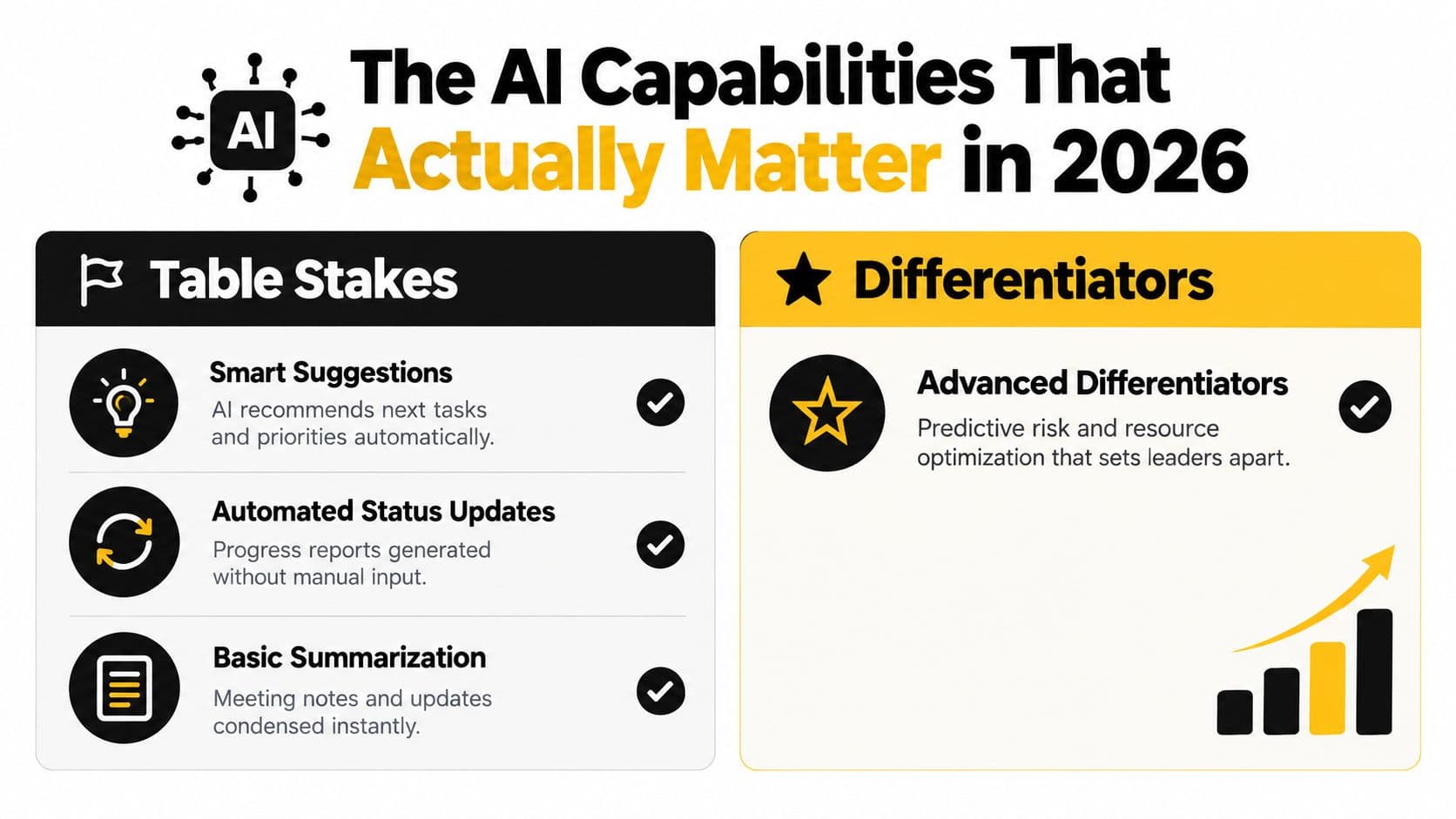
Most platforms now offer automated status reporting, natural-language task creation, meeting-note extraction, smart suggestions, and summaries. These features are useful, but they're becoming table stakes rather than decisive advantages. Independent 2026 comparisons identify risk prediction, predictive scheduling, smart notification filtering, resource-allocation intelligence, and AI-assisted sprint planning as the capabilities that create meaningful differentiation, according to Agile Genesis' 2026 AI project management rankings.
Prediction should change decisions
A weak AI feature tells you that a task is late. A stronger system detects the pattern that makes a milestone likely to slip and explains which dependency, workload imbalance, or unresolved action is driving the risk.
Look for:
- Risk forecasting: The system identifies emerging delivery risk before a deadline is missed.
- Predictive scheduling: It models dependencies and capacity rather than merely moving dates on a calendar.
- Sprint intelligence: It helps teams commit based on available capacity and work complexity.
- Notification filtering: It separates urgent intervention from routine activity.
Ignore vague claims about “AI-powered insights” unless the vendor demonstrates the underlying signal, recommended action, and human approval path.
Rebalancing should reduce coordination work
Resource intelligence is valuable only when it leads to a practical intervention. The software should surface overloaded people, conflicting priorities, idle capacity, or blocked work, then make reassignment or sequencing easier.
A serious system should help answer:
- Who can take this task without creating a new bottleneck?
- Which work should move if the deadline stays fixed?
- What changes if a dependency slips?
- Which recommendations require manager approval?
Many generic AI assistants fall short. They can draft a recommendation, but they don't maintain the operating context needed to rebalance a live portfolio.
Governance keeps delegation safe
Autonomy without controls is a liability. Enterprise buyers should evaluate role-based access, SSO or SCIM, audit logs, approval gates, and override controls alongside the AI feature set, all of which are increasingly part of serious enterprise evaluations according to the Agile Genesis comparison.
The practical standard is simple. AI can suggest or execute within a defined scope, but people must be able to see what happened, stop future actions, and correct the system without creating a support ticket.
For a broader view of how AI agents can support execution beyond conventional project boards, see AI agents for productivity.
How to Score AI Project Management Software Before You Buy
Use a weighted scorecard instead of letting the most polished demo win. A 2026 independent scoring framework assigns 40% to feature depth, 30% to ease of use, and 30% to value, according to World Metrics' AI project management software comparison. That weighting is sensible, but value needs a sharper definition than “price per user.”
For a delegation-first model, measure cost per completed task. For a traditional suite, measure the combined cost of seats, AI credits, setup, administration, integrations, and the human time required to keep workflows moving.
| Dimension | Weight | What to Measure | Fluidwave (typical) | Traditional Suite (typical) |
|---|---|---|---|---|
| Feature depth | 40% | Delegation, prediction, automation, approvals, governance | Stronger where work can be handed off and completed | Stronger breadth across planning, dashboards, and reporting |
| Ease of use | 30% | Onboarding, learning curve, visibility of AI actions | Direct task handoff with less dashboard configuration | Familiar boards, but deeper setup can create friction |
| Value | 30% | Cost per completed task, seat cost, admin burden | Spend can track delegated output | Spend usually tracks human users and plan tiers |
Score a real workflow, not a feature tour
During a trial, use one recurring process that currently consumes attention. Examples include inbox triage, vendor follow-ups, weekly reporting, client check-ins, or meeting action tracking.
Give each vendor the same inputs and score:
- Handoff quality: Can a user describe the outcome without writing a detailed automation rule?
- Execution depth: Does the system complete the work or only create a reminder?
- Oversight clarity: Can a manager review, edit, approve, or stop the action?
- Integration quality: Does the output land where the team already works?
- Value density: How much completed work results from the spend?
Traditional suites such as ClickUp, Asana, and Monday generally win when the priority is shared planning, cross-functional visibility, dashboards, and broad integrations. A delegation-plus-automation model is more compelling when the bottleneck is execution overhead rather than portfolio reporting.
Don't sign an annual contract after a generic demo. Run a representative workflow, record the number of interventions required, and calculate the cost of the finished result.
Real Workflows Where Fluidwave Stands Out
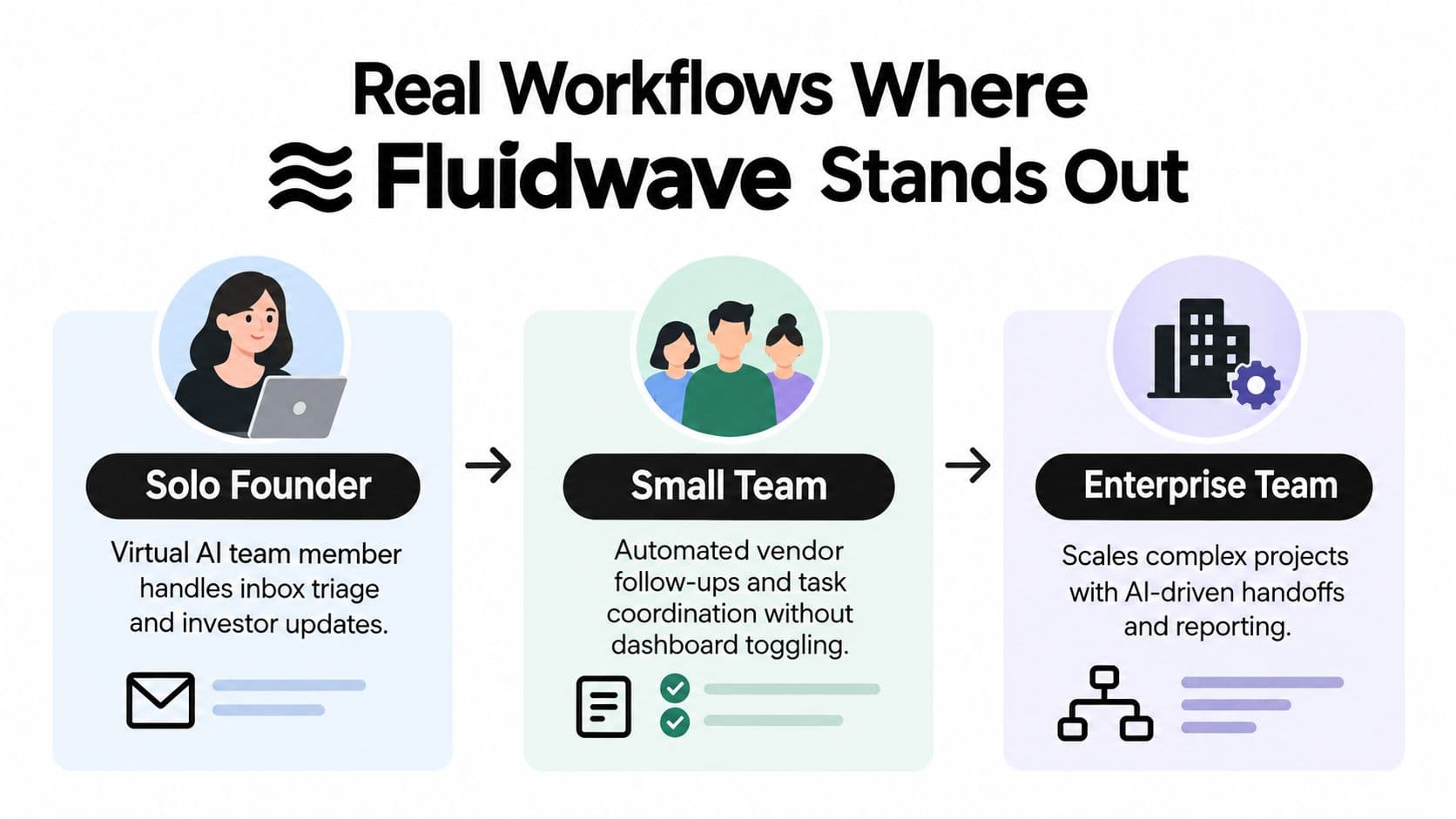
A solo founder rarely needs another place to check. The founder needs someone, or something, to move work forward. Inbox triage, vendor follow-ups, scheduling, and weekly investor updates are all recurring loops that can be delegated when the inputs and desired outputs are clear.
A traditional suite can organize those activities, but the founder still has to create tasks, configure rules, check transitions, and confirm completion. The delegation model changes the unit of work from “I must operate this board” to “I need this outcome completed.”
Three people who feel the difference
The solo founder delegates inbox sorting, follow-up queues, and investor-update preparation. The founder still decides what matters, but doesn't spend the morning turning incoming information into a list of tiny actions.
The neurodivergent knowledge worker uses delegation to reduce execution loops that compete with creative or analytical work. Scheduling, status pings, reminder cascades, and routine coordination can move outside the person's working memory, leaving attention for the work that requires judgment.
The agency project manager delegates client check-ins, scope tracking, and deliverable QA queues. Instead of repeatedly checking whether every contributor replied, the manager reviews exceptions and steps in where context or negotiation is required.
The contrast with a traditional suite is practical. A suite user may still configure boards, write automation rules, maintain fields, and monitor transitions manually. A delegation-first user defines the task, sets the relevant constraints, and reviews the result.
“Hiring a colleague who charges by the task, not a tool you operate.”
That line captures the economic distinction. The question isn't whether a board exists. It's whether the buyer is paying for software access or for completed execution.
Large enterprises with rigid compliance stacks gain the least from this model. They may need granular permissions, formal procurement controls, established data residency requirements, and deep integration with existing portfolio systems. In those environments, delegation can still help, but governance and system compatibility usually outrank convenience.
Pricing Models Compared Across AI PM Tools
Traditional project management products such as ClickUp, Asana, and Monday generally use per-seat subscriptions. The company pays for human users, often with different plan tiers and separate costs for advanced AI, integrations, storage, or administrative controls.
A per-task model changes the economics. Instead of paying for every person who might touch the system, the buyer pays for delegated work that gets completed. Fluidwave's published model is built around delegated tasks completed by virtual assistants, with no subscription required for delegation and transparent pricing options described through its pricing transparency guide.
| Pricing Model | Scales With | Best Fit | Watch Out For |
|---|---|---|---|
| Per-seat subscription | Number of human users | Teams needing shared boards and broad collaboration | Unused seats, plan upgrades, AI add-ons |
| Per-task consumption | Completed delegated work | Buyers with clear recurring execution loops | Unpredictable volume, task definition quality |
| Hybrid setup | Seats plus delegated output | Growing teams combining planning and execution | Overlapping costs and unclear ownership |
A simple way to compare the economics
Suppose a ten-person team is considering a subscription priced at $14 per user per month, which would produce a monthly seat cost of $140. That figure is only an illustration of seat math, not a claim about current ClickUp, Asana, or Monday pricing.
Now compare it with 200 completed AI tasks at roughly $1 to $3 each, producing an estimated task spend between $200 and $600. The per-task option costs more than the illustrated seat plan at the lower volume comparison, but it may also replace work that would otherwise require human attention. The right break-even point depends on task complexity, review time, delegation frequency, and whether the subscription would be purchased anyway.
The hidden cost is usually not the headline price. It's unused seats, premium AI credits, integration add-ons, onboarding effort, administrator time, and contract commitments that become expensive when a team changes shape.
Before choosing, forecast:
- Delegation volume: How many tasks could realistically be handed off each month?
- Task consistency: Are the tasks repeatable, or does each one require bespoke context?
- Review load: How much human checking does each completed task need?
- Growth pattern: Will users or delegated work increase faster?
- Exit risk: Can you change the model without carrying unused commitments?
A buyer who optimizes for cost per completed task should not automatically choose the cheapest seat plan.
The Hidden Adoption Gap Most Buyers Miss
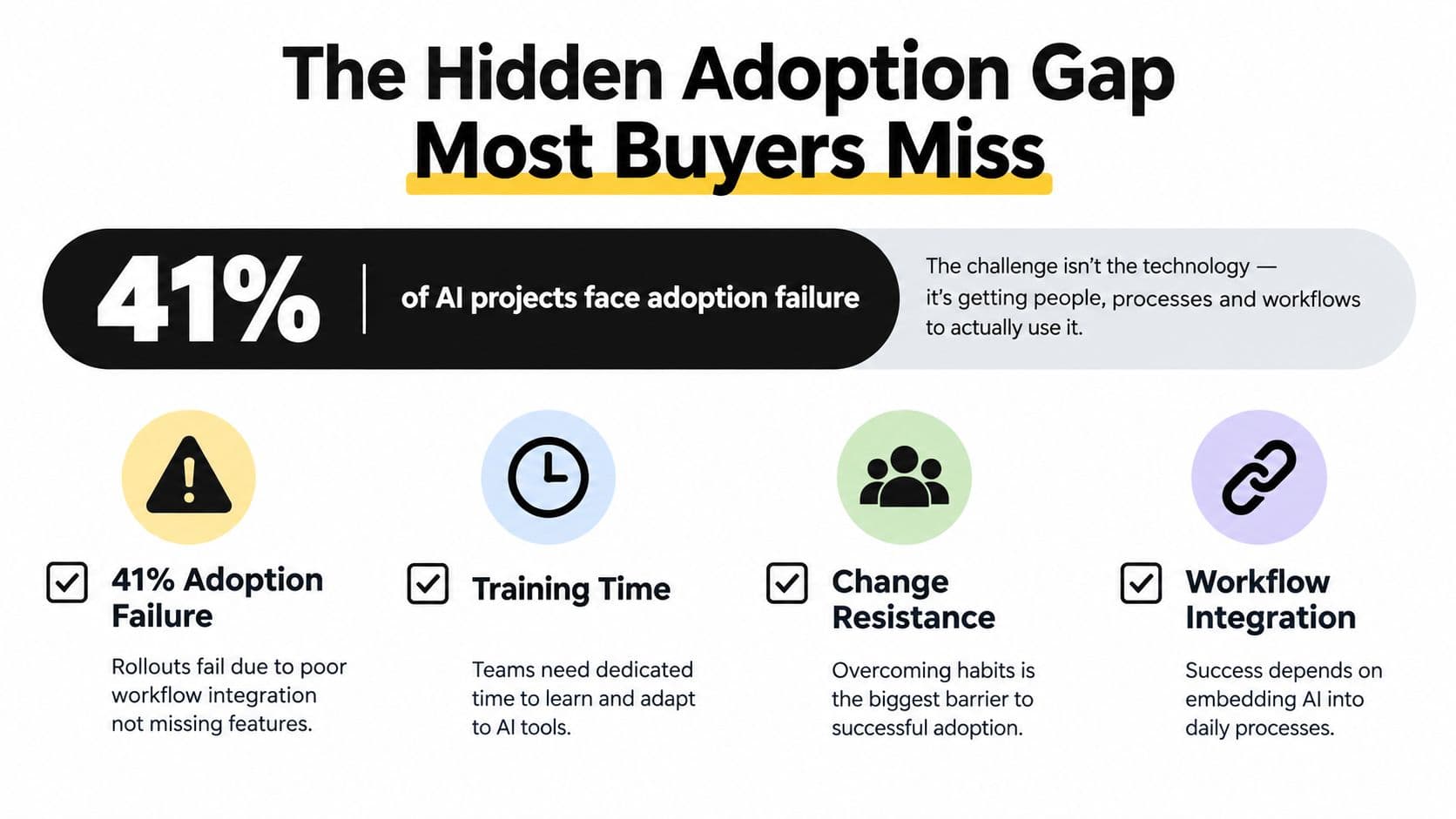
41% of project-management software buyers reported AI adoption challenges tied to skills gaps, onboarding, and workflow misalignment, according to the verified survey findings summarized by PMI Southeast Europe. That's the part of the buying process most feature comparisons underweight.
The problem usually isn't that the platform lacks an AI feature. The problem is that nobody changes the daily workflow around it. A team may activate summaries and automated updates, then continue copying information between systems, holding the same meetings, and manually chasing the same people.
Adoption is an operating-design problem
A 2025 global PMI chapter report identifies the AI training gap, leadership trust, and organizational resistance as major barriers, while a related PMI update says over 40% of respondents lacked AI training, based on the same verified PMI reporting. Capterra's related findings also identify 39% citing a lack of AI skills and 36% struggling to integrate tools into existing processes, as summarized in the Fortune Business Insights reference cited earlier.
Those findings should change the scorecard. Add measures for:
- Time to first useful outcome: How quickly does a new user complete a meaningful delegated task?
- Onboarding friction: How much configuration is required before the workflow works?
- Oversight ergonomics: Can users understand and correct AI actions without technical help?
- Workflow fit: Does the platform sit inside existing routines or create another destination?
- Manager confidence: Can leaders explain what the system did and why?
Traditional suites often accumulate AI features faster than teams can absorb them. The result is shelfware with an impressive roadmap. A virtual AI colleague requires a different ramp. The user must define the task, clarify acceptable outcomes, set boundaries, and establish a review habit.
For a practical example of the human-control layer, see assistant quality control.
Questions to ask during diligence
Ask the vendor to demonstrate onboarding with a real workflow, not a prepared sample. Ask what training is included, how the system handles an ambiguous instruction, where completed work appears, and how a user corrects a poor result.
Also ask who owns adoption after launch. If the answer is “the team will figure it out,” budget for slow usage and inconsistent results. The vendor should explain how it measures activation, supports workflow redesign, and helps managers decide which work should remain human-owned.
Which AI Project Management Software Should You Pick
There isn't one universal winner. The right choice depends on whether your constraint is execution capacity, shared visibility, governance, or integration depth.
| Buyer Profile | Best Fit | Why It Wins | Trade-off |
|---|---|---|---|
| Solo founder or lean operator | Delegation-plus-automation model | Removes recurring execution loops without adding another large operating system | Less suited to formal portfolio governance |
| Neurodivergent knowledge worker | Delegation-first task management | Reduces coordination load and protects focus for creative work | Requires clear task boundaries and review habits |
| Small agency | Delegation model or hybrid | Handles follow-ups, scope tracking, and QA queues while managers review exceptions | Traditional reporting may still need a separate suite |
| Larger cross-functional organization | ClickUp, Asana, Monday, or another established suite | Strong dashboards, permissions, integrations, and shared planning | More configuration and seat-based cost exposure |
| Growing team with mixed needs | Hybrid setup | Keeps the established suite for planning and visibility, adds delegated execution where it pays | Requires clear ownership between systems |
When the delegation model wins
Choose a delegation-first setup when your team's pain is repetitive execution. That includes follow-ups, administrative coordination, recurring research, status collection, task organization, and routine quality checks.
This is especially relevant for founders, small agencies, freelancers, knowledge workers, and people who lose productive time to switching between tasks. A useful external comparison of adjacent categories is this guide to best AI productivity tools, which can help buyers distinguish general productivity assistants from systems designed around actual task completion.
When a traditional suite wins
Choose ClickUp, Asana, Monday, or a comparable suite when the organization needs cross-functional dashboards, granular permissions, portfolio reporting, dependency visibility, and established integrations at scale. Those platforms are built for teams that need a shared operational picture, not only delegated execution.
The hybrid path is often the practical answer for a growing company. Keep the existing suite for sprint planning, stakeholder visibility, and formal reporting. Add delegation where people are losing time to recurring execution and coordination.
My recommendation is direct: if you're optimizing for cost per completed task, start with a delegation-first workflow and test it against real work. If you're optimizing for cost per seat and centralized visibility, choose the traditional suite. If you need both, don't force one product to solve two different operating problems.
Fluidwave combines AI task organization, auto-prioritization, workflow automation, and delegated work completed by virtual assistants on a pay-per-task basis. Create a small set of recurring tasks, define budgets and timelines, and measure the human review time before expanding. Visit Fluidwave to test whether delegated execution can reduce your coordination burden without adding another tool your team has to operate.
Focus on What Matters.
Experience lightning-fast task management with AI-powered workflows. Our automation helps busy professionals save 4+ hours weekly.