Stuck before you start? Practical ADHD task initiation strategies: shrink the first step, use timers, cut friction and let Fluidwave prioritize.
November 10, 2026 (Today)
ADHD Task Initiation: Why You Stall and How to Start
Stuck before you start? Practical ADHD task initiation strategies: shrink the first step, use timers, cut friction and let Fluidwave prioritize.
← Back to blog
You've known about that report for three days. It's not long, it's not even hard, and once you're inside it you'll probably finish the outline in one sitting. Yet every time you sit down, you check messages, tidy a file name, make coffee, or decide you'll do it properly after lunch.
That's ADHD task initiation in plain sight. The block isn't doing the work. It's crossing the gap between intending to start and making the first physical move, and willpower is a lousy tool for closing that gap.
I treat starting as a design problem, not a motivation problem. Shrink the first action until it's obvious, attach it to a cue that already happens, remove the competing choices, and record whether you started. That last part matters more than many people expect.
A Five-Step Routine for Starting Any Task
A start you can execute takes about ninety seconds to set up. The report can stay in Downloads until that setup is finished. Skip the hunt for a cleaner morning or a sudden burst of discipline.
If you want the mechanics behind why starting tasks feels difficult, Integrative Psychiatry of America gives a useful plain-language account. Run the routine first. Read after the first action is already on the page.
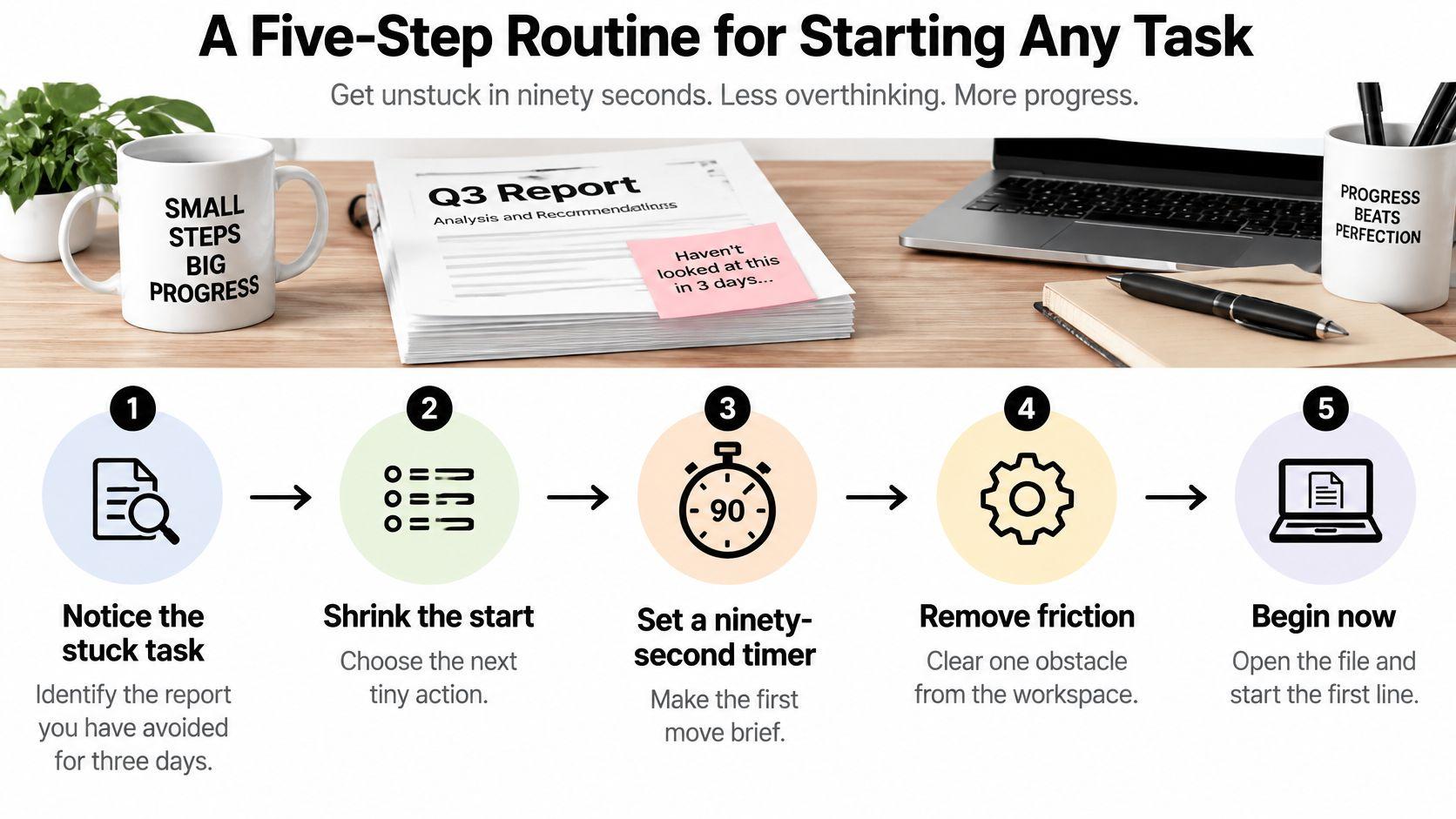
Run These Steps in Order
- Choose one task only. Pick the item due soonest, or the one you would most regret dropping. One task ends the hidden decision about what deserves you first. Three candidates left open turn the next minute into dithering, and dithering gets mislabeled as laziness.
- Name the smallest physical first action. "Open Q3-report.docx and type the heading Findings" is a start. "Work on the report" is still a goal. If you cannot picture your hands doing it, shrink it again.
- Attach that action to a cue you already have. Write one if-then plan: "If I open the project document at 9:00, then I will write the first sentence." That style of concrete trigger matches the kind described in the ADHD Productivity task initiation guide, which also notes experiments using plans like "Whenever my rule is wrong, then I will try another rule." The cue decides when you begin. A second competing if-then rule puts the decision back, so keep one.
- Leave only the app the first action needs. Close the rest. You are removing choices that are easier to start than the report. Keep the document and a timer. Drop anything that can hand you a smaller, faster reward.
- Set a ten-minute timer, do only the first action, then mark the start. The timer is permission to stop, which makes starting cheaper. Use the interval for the heading and one sentence, not for outlining the whole document. When it ends, tick a date or write a one-line note: started, or not. Treat a missed start as a cue-design failure first, rather than a verdict on your effort.
Practical rule: If the first action takes longer to explain than to do, you've probably written a goal, not a start.
What Counts as Success
A successful first interval can look small. The file is open. The heading exists. One ugly sentence is on the page. That counts as a start, even if you stop when the timer ends.
I would not score the routine by whether the report is finished today. Score it by whether the first action happened at the cue, without a new negotiation. If it did not, shrink the action or move the cue onto something that already happens, such as finishing coffee or sitting down at the desk. Fix the rule you have. Do not stack another one on top.
Why Some Tasks Start Easily and Others Never Do
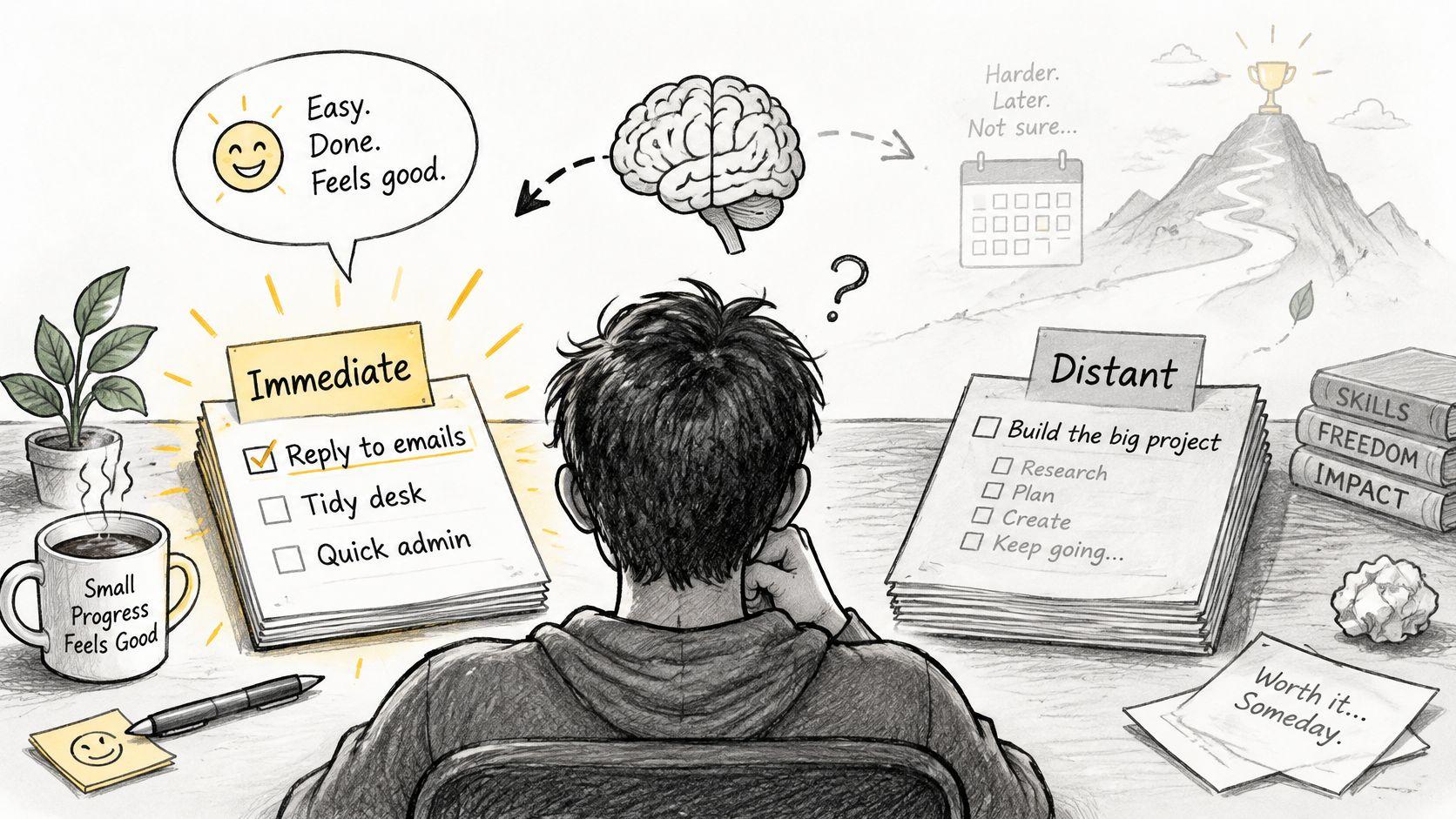
Ask three questions before you blame yourself. Is this task new or interesting? Is there an immediate payoff? Is the first action clear? If the answer to all three is no, change the task setup before you judge your character.
When a payoff is far away, uncertain, or weakly visible, you discount it. Urgent work borrows pressure from the deadline, novel work brings its own stimulation, and routine work offers neither. Refresh Psychiatry & Therapy has a helpful overview on understanding ADHD and delayed action if you want that pattern spelled out clinically.
This isn't rare or idiosyncratic. A 2024 systematic review reported that 89% of children and adults with ADHD showed impairment in at least one executive-function component, a domain closely associated with difficulty initiating tasks, according to the Zalfol summary of that review.
Match the First Move to the Task Type
| Task type | Why it stalls | First move |
|---|---|---|
| Novel, urgent or interesting work | Immediate payoff or pressure makes starting feel worth it | Open the file and write one line |
| Routine or repetitive work | The payoff is distant and weakly visible | Attach a visible check-in after 10 minutes |
| Vague multi-step work such as write the proposal | The starting point is unclear, so the brain stalls | Name the file, person or tool you need |
| Work waiting on someone else | Nothing can move until a reply arrives | Mark it as waiting and note the date to follow up |
The middle row is where a lot of professionals get stuck. "Write the proposal" hides decisions about audience, length, source material, and who approves it. If you're circling those choices instead of moving, the pattern described in this guide to decision-making paralysis will look familiar.
The Intention Action Gap
You can know exactly what should happen and still watch the cue pass. The meeting ends, you meant to send the follow-up, and by the time you remember, you're in another call. That's not a knowledge problem. It's a cue and first-action problem, and it's fixable without a personality overhaul.
Shrinking the First Step With Timers and Micro-Tasks
Take a task you'd happily do if someone else had started it for you. A pricing-page brief, say. "Write the brief" is too large to begin, even on a good day, because it bundles research, judgement, and writing into one label.
Build a chain instead. Each micro-task should be a visible action you could finish in one short sitting, written with a verb and an object you can point to.
A Worked Example You Can Copy
- List the questions. Write the three questions the brief must answer, in the document, badly if needed.
- Pull the current prices. Copy them into a sheet. Don't analyse them yet.
- Write one sentence per question. Placeholder sentences count. You're building a surface to revise.
- Draft the summary last. Only now do you ask the material to cohere.
Notice what's missing. There's no step called "think about positioning" or "get clear on strategy." Those may be real work, but they're not starts. If a micro-task doesn't produce something you can see, rewrite it until it does.
This approach has a tested pedigree. In a randomized trial described in the CBT for adolescents with ADHD trial report, the procrastination module taught breaking assignments into manageable steps, setting realistic completion goals, and challenging perfectionistic beliefs. Adults doing knowledge work need the same three moves, especially the last one.
Timer Rules That Protect the Start
Use a 15-minute interval with a stop rule. When it ends, you stop or consciously choose another interval. If 15 minutes feels impossible, use a two-minute starter whose only job is the first physical action, opening the file or typing the heading.
The stop rule matters even when work is going well. If every short timer secretly becomes an open-ended session, you'll stop trusting the timer, and starting gets expensive again. If you want the classic structure behind this, the Pomodoro Technique for productivity lays out the interval and break pattern.
A timer that never lets you stop isn't a starting aid. It's a trap you learn to avoid.
Mistakes That Quietly Recreate the Problem
- Timer set too long. A long block raises the entry price. Shorten it until starting feels almost trivial.
- Micro-tasks that are still vague. "Research competitors" is a category, not an action. "Open two competitor pricing pages and paste the URLs" is an action.
- Reading a missed interval as laziness. A missed interval tells you the cue, size, or timing was wrong. Adjust one variable and rerun it.
- Perfectionism at step one. The first sentence is scaffolding. If you're polishing it, you've skipped ahead to editing and made the start heavier than it needs to be.
Clearing Friction From Your Workspace and Plan
The file you need sits under a dozen tabs. Your phone is an arm's length away. Thirty tasks are visible, and none of them names the first physical move. That stall comes from too many competing starts.
Visibility is the core issue. A list that shows everything makes choosing the hard part, while a list filtered to what you can act on now lowers the decision cost. This overview of how to reduce friction covers the broader principle if you want to apply it beyond task lists.
Fix the Friction You Can See
| Friction point | Quick change | Effort |
|---|---|---|
| Too many open tabs | Close everything except the one file you need | Low |
| Phone within reach | Move it to another room for the first interval | Low |
| Task list with thirty items shown at once | Show only tasks you can act on now | Medium, once |
| Unclear next step | Write the next physical action on a sticky note | Low |
A task manager can do some of this filtering for you. In Fluidwave, the Active filter hides tasks you cannot act on right now and puts the most important task at the top. Setting a task to Waiting on a message, an email, or a call removes it from the assignee's Active list until the reply arrives, and the Waiting view shows every handoff in progress. Once that top item is clear, write the first physical action before you open anything else. If a chore itself is the blocker, setting the task to Delegate sends it to a human assistant through the marketplace instead of leaving it on your list.
The same logic applies outside your task app. If inbound calls keep breaking your first interval, it's worth looking at ways to find affordable AI receptionist options through DBotMaker rather than letting every ring reset your start.
One Caution About Setup
Tool setup can become avoidance with better branding. Cap it at one session. Build the filtered view, write next actions for your top few tasks, then stop and start one of them.
Review the setup weekly, not daily. Daily redesign feels productive and reliably eats the energy you needed for the first interval. Count whether you started, not whether the workspace looks finished.
Habit Stacking and Accountability That Does Not Nag
A stack only works if the anchor already happens without willpower. Coffee, sitting down, opening your laptop, coming back from lunch. Pick anchors you'd notice if they disappeared.
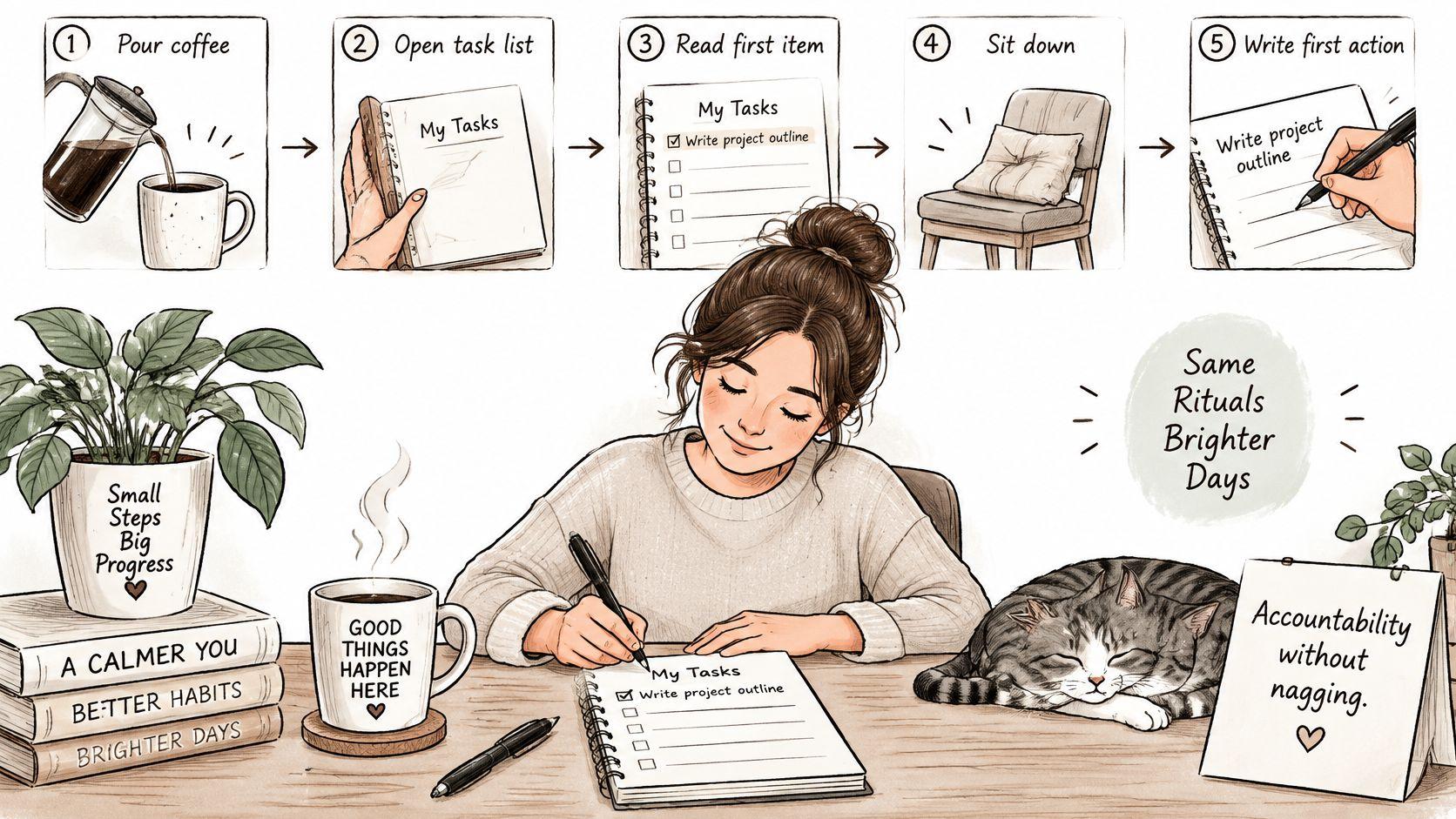
Two Stacks Worth Stealing
- After I pour my coffee, I open the task list and read only the first item out loud.
- After I sit down at my desk, I write the first physical action for that item on paper before opening email.
Build two or three stacks, not ten. Each new link competes for the same shaky cue, and a chain you can't remember won't fire. If a stack fails twice, the anchor is probably not as daily as you thought.
Accountability With Limits
Body doubling works best as a silent call for a fixed block, cameras on, each person working on their own thing. The moment it becomes a running chat, you've traded one distraction for another. You're borrowing presence at the threshold, not hiring a supervisor.
A check-in at a set time is the lighter version. One message, at an agreed hour, asking whether you started. Not whether you finished, and not five pings across the afternoon.
Escalation needs a threshold or it turns into nagging. Tell a colleague only after the same start is missed twice. That keeps the consequence real without making every ordinary stall a public event.
This short video shows how a calm, structured co-working setup can lower the cost of beginning without turning support into surveillance.
What to Avoid
Shame-based dashboards, streak counters that punish a missed day, and gamification that pushes you past rest all backfire in the same way. They raise the emotional price of the next start. You'll avoid the tool before you avoid the task, and then you've lost both.
A rule for breaks: A scheduled break is not avoidance. Schedule it, take it, and judge the stall only after you've actually rested.
Intentional rest also protects your data. If you never distinguish "I chose to stop" from "I couldn't start," every pause looks like failure, and you'll abandon a system that was working.
Measuring Starts Instead of Finished Work
A randomized clinical trial of cognitive-behavioral treatment for adults with ADHD, reported in the CADDI trial paper on PMC, found approximately 22.5% dropout in the CADDI condition and 21.3% in the comparison condition. The same paper reports greater improvement in activation than the comparator, without a significant between-group effect on procrastination.
Read that split result carefully. Better starts don't automatically mean fewer delays, so measure initiation and procrastination separately. And with roughly one in five people dropping out, build a tracking habit simple enough to survive a bad week.
Four Numbers You Can Log This Week
| Metric | How to log it | What a better trend means |
|---|---|---|
| Start latency | Minutes from assigning a task to the first action | Starts are coming sooner |
| Starts before deadline | Percentage of tasks begun before the due date | More tasks begin in time |
| Prompts needed | Number of reminders before the first action | The cue is working without extra nudges |
| Completion rate | Share of started tasks that get finished | Task size fits the time available |
A notebook works. So does a spreadsheet with four columns. Don't build a dashboard before you've logged a single week.
How to Act on the Review
Review weekly and change one thing. If latency is falling but completion is flat, your task size is the issue, so split the work smaller. If prompts stay high, your cue is weak or attached to something that doesn't happen reliably.
After each ten-minute interval, note whether you started, decide whether the next interval needs a smaller first action, and schedule the next check-in. I won't promise you a success rate, because outcomes depend on the person and on how consistently the system is followed.
Do one concrete thing now. Pick the task you've been avoiding most, write its first action as a sentence beginning with a verb, and run the routine within the next hour.
Put the task you've been avoiding at the top of a list that only shows work you can act on now, open it without the tabs and handoffs competing for your attention, and delegate the blocker that doesn't need you. That's how Fluidwave is built to support a start, so visit and set up your first task with a written first action today.
Focus on What Matters.
Experience lightning-fast task management with AI-powered workflows. Our automation helps busy professionals save 4+ hours weekly.