Struggling with focus? Learn the Pomodoro Technique for productivity. This guide covers setup, customization for ADHD, and smart tool integration.
March 28, 2026 (6mo ago)
Master the Pomodoro Technique for Productivity in 2026
Struggling with focus? Learn the Pomodoro Technique for productivity. This guide covers setup, customization for ADHD, and smart tool integration.
← Back to blog
The Pomodoro Technique for productivity is a time management method built around focused 25-minute work sprints, each separated by a short break. It's a surprisingly simple system designed to sharpen your focus, cut down on mental fatigue, and make even the most overwhelming projects feel manageable.
Why This Simple Technique Still Wins
Most productivity hacks feel like noise. They promise a complete overhaul of your work life but tend to lose their appeal after a week. The Pomodoro Technique is different. It’s not a passing trend; it’s a time-tested method for winning back your focus in a world filled with constant notifications.

Its power comes from a simple idea: creating protected, intentional blocks of time for deep work. It directly targets the biggest enemy of modern professionals—digital distractions and the urge to multitask.
By committing to a single task for just 25 minutes, you’re giving yourself permission to ignore everything else. This deliberate focus is the perfect antidote to what we call context switching. Constantly bouncing between emails, Slack messages, and your actual project work absolutely kills your momentum and drains your mental battery faster than you realize.
To get started, you just need to understand the basic rhythm of the technique. It's a simple, repeatable loop.
The Core Pomodoro Cycle at a Glance
| Phase | Duration | Purpose |
|---|---|---|
| Focus Session (Pomodoro) | 25 minutes | Work on a single, pre-defined task with zero interruptions. |
| Short Break | 5 minutes | Step away from your work. Stretch, grab water, or just rest your eyes. |
| Repeat Cycle | 4 times | Complete four Pomodoro cycles in a row. |
| Long Break | 15-30 minutes | After four Pomodoros, take a longer, more substantial break to recharge. |
This cycle is the foundation. From here, you can customize everything to fit your personal workflow and energy levels.
The Science of Focused Sprints
The Pomodoro Technique isn’t just a nice idea; its effectiveness is grounded in how our brains actually work. The structured cycle of work and rest provides clear psychological benefits.
Many high-achievers see breaks as a sign of weakness or lost time. This method reframes them as a strategic tool. These brief rests give your brain a chance to reset, which is critical for maintaining high performance throughout the day.
This isn't just anecdotal. One study found that structured work intervals delivered impressive results. Participants who worked in focused sessions of around 24 minutes followed by a 6-minute break reported a 20% reduction in fatigue. They also showed major improvements in motivation and their ability to tune out distractions compared to people who took breaks whenever they felt like it.
The Core Principle: The Pomodoro Technique isn’t about working more hours. It’s about making the hours you do work count by protecting your focus and respecting your brain’s need for rest.
This method is incredibly effective for anyone feeling pulled in a million directions, from startup founders to entire remote teams. By breaking a huge project into a series of small, achievable sprints, you build momentum and replace that feeling of dread with a sense of accomplishment. It’s a small change that can genuinely reshape your entire workday.
Kicking Off Your First Successful Pomodoro Session
Jumping into the Pomodoro Technique shouldn't feel like adding another chore to your already packed schedule. The whole point is to make focus feel effortless. So, let's walk through exactly how to launch your first sprint without the usual friction. It’s about more than just starting a timer; it’s about intentionally creating a ‘focus fortress’ from the get-go.

Before you can get into a rhythm, you just need to make two quick decisions: what timer you'll use and what task you'll tackle. These choices really set the stage for whether the pomodoro technique for productivity will click for you.
Choose Your Weapon: A Simple Timer
Don't get bogged down in finding the "perfect" timer. Honestly, when you're just starting, simpler is almost always better. You just need an external cue that you can set and then completely forget about until it goes off.
Here are a few options that work well for people:
- A Physical Timer: Something like a basic kitchen timer—yes, even the classic tomato-shaped one—is fantastic. The physical act of twisting it becomes a small ritual that signals to your brain it's time to focus.
- Your Phone's Clock App: The timer on your smartphone is more than enough to get the job done. The crucial part here is putting your phone on 'Do Not Disturb' mode so a random text doesn't completely derail your flow.
- Dedicated Apps: If you're a data person, tools like BeFocused or a simple browser extension can be great. They not only time your sprints but also track your sessions and provide reports. For a good overview, publications like Forbes often review the top productivity apps available.
Don't overthink it. Just pick the one that feels easiest to you right now and move on.
Pick One High-Priority Task
This is where the magic really happens. The Pomodoro Technique is built for single-tasking. Trying to juggle multiple things in one sprint completely defeats the purpose and is the fastest way to kill deep work.
Glance at your to-do list and pull out just one thing. If you’re using a project management tool like we do at Fluidwave, this is as simple as dragging a single card into your "Doing" column and committing to it for one Pomodoro.
Pro Tip: Is your task something huge like "Write full project proposal"? That's too big for a single 25-minute session. Break it down. Your first Pomodoro task might be "Outline the proposal's introduction" or "Find three key statistics for the market analysis section." Get specific.
Build Your Focus Fortress
Before you hit start, take just two minutes to clear the deck. This prep work is what makes the pomodoro technique for productivity truly effective. It's about being proactive, not just hopeful.
- Broadcast Your Status: Let your team know you're going dark for a bit. A quick Slack status update—something like "🎧 In a focus session - back in 25"—is perfect. It sets expectations and prevents interruptions.
- Go Silent: Turn off all notifications. I mean all of them. Your computer, your phone, your watch. Close those email pop-ups and any browser tabs that aren't directly related to your task.
- Prep Your Environment: Grab a glass of water. If you have an office door, close it. The goal is to eliminate any physical reason to get up or get distracted before your timer signals a real break.
By taking these small but critical steps, you're not just wishing for focus—you're engineering the conditions for it.
Now you're ready. Set your timer and go.
How to Adapt the Pomodoro Technique for Your Brain
If you’ve tried the classic 25/5 Pomodoro split and it didn't quite click, you're not alone. Lots of people treat that timing like a non-negotiable rule, get frustrated when it interrupts their flow, and then ditch the whole system. The secret isn't in forcing yourself to fit the clock, but in making the clock fit you.
Think of the Pomodoro Technique as a flexible framework, not a rigid mandate. Your brain's rhythm changes throughout the day, and different tasks demand different levels of focus. Real success comes when you give yourself permission to experiment and find a cadence that feels energizing, not restrictive.
Finding Your Ideal Pomodoro Rhythm
The classic 25-minute sprint is fantastic for chipping away at your inbox, but it can feel jarringly short when you're deep in creative work. On the other hand, for a task you've been dreading, even 25 minutes can feel like an eternity.
This is where experimenting with your timing becomes a game-changer. One analysis of productivity data found that the top performers weren't strictly adhering to the classic model. Instead, they often worked in focused bursts of 52 minutes followed by a restorative 17-minute break. This longer interval allows for deeper immersion, making it perfect for complex projects that require uninterrupted thought. You can read more about how different timings impact focus in this productivity data analysis.
Key Takeaway: The perfect interval lets you get completely absorbed in a task without feeling rushed, followed by a break that actually recharges you.
To help you find your starting point, here are a few common timing structures that have worked well for different people and tasks.
Finding Your Ideal Pomodoro Rhythm
Use this table as a starting point for your own experiments. Try a template for a few days, take note of how you feel, and don’t be afraid to adjust the numbers until you land on a rhythm that syncs with your natural energy levels.
| Template | Work Interval | Break Interval | Best For |
|---|---|---|---|
| The Classic | 25 min | 5 min | Standard tasks, administrative work, and getting started. |
| Deep Work | 52 min | 17 min | Complex projects, coding, writing, or creative problem-solving. |
| Focus Stamina | 90 min | 20-30 min | Following the body's natural Ultradian Rhythms for extended focus. |
| Momentum Builder | 15 min | 3 min | Overcoming procrastination or tackling tasks you've been avoiding. |
Remember, these are just templates. Your ideal timing might be 45/15 or 60/10. The goal is to listen to your brain and body, not just the timer.
Customizing Pomodoro for Neurodivergent Minds
For many neurodivergent professionals, particularly those with ADHD, the Pomodoro Technique can be a lifesaver. An endless to-do list often feels paralyzing, but breaking that mountain of work into a series of small, timed sprints makes it immediately more approachable. The timer provides an external structure that helps manage focus and executive function.
The built-in breaks are an essential feature, not an optional one. For a brain prone to hyperfocus, the timer’s chime acts as a crucial circuit breaker, pulling you out of a task before you burn out. These scheduled pauses are what make sustained productivity possible over a long day.
Here are a few adjustments that can make a huge difference:
- Start Small: If 25 minutes feels daunting, don't force it. Begin with incredibly short intervals, like 15 minutes of work and a 3-minute break. You can gradually increase the time as you build your focus muscle.
- Use a Visual Timer: A physical timer like the Time Timer or a digital app that shows time disappearing can be much more effective than just seeing numbers on a screen. That visual cue makes the passage of time tangible.
- Move Your Body: Make your breaks active. Instead of scrolling on your phone, get up and stretch, walk around the room, or do a few jumping jacks. Physical movement resets the brain far more effectively than passive screen time.
Ultimately, the most effective pomodoro technique for productivity is the one you can stick with consistently. By tailoring the intervals and embracing its flexibility, you can turn a simple timer into a personalized system that works with your brain, not against it.
Weaving the Pomodoro Technique Into Your Real Workday
Let’s be honest: a timer is just a timer. The real magic happens when you weave those focused sprints directly into your task management system and daily rhythm. It's about turning a simple timing trick into a powerful cycle of deep work and seamless hand-offs.
The goal is to stop randomly hitting "start" on a timer and start strategically mapping out your day with Pomodoros. This means knowing exactly which tasks deserve your full, uninterrupted attention and which are better suited for the shorter breaks in between.
How to Plan Your Pomodoro Day
Before the morning chaos kicks in, take a few minutes with your calendar and to-do list. The first step I always take is identifying my one to three absolute must-do tasks. These are the needle-movers—the things that, if I get them done, make the day a win no matter what else happens.
This approach is a close cousin to another powerful productivity method. We actually dive deep into structuring your entire day around these non-negotiable focus blocks in our guide on time blocking your schedule. Think of it as making an appointment with your most important work.
Once you have your priorities, you can start assigning Pomodoros. It’s a quick estimation game that brings a ton of clarity.
- "Draft marketing brief" might feel like a huge task, but breaking it down to two Pomodoros feels manageable.
- "Review Q3 budget" is a classic single-Pomodoro job.
- "Respond to high-priority client emails" can also be batched into one focused sprint.
Suddenly, that intimidating to-do list becomes a concrete, achievable plan. You have a realistic roadmap that shows you not just what you need to do, but how you're going to get it done.
Don't Go It Alone: Team and Tool Integration
While the Pomodoro Technique is a fantastic tool for solo focus, it truly shines when you plug it into a team workflow. This is where a system like Fluidwave can be a game-changer, letting you move from a focus sprint to delegation without missing a beat.
Imagine this: you just finished a 25-minute Pomodoro drafting that marketing brief. Instead of breaking your concentration to fire off emails, you can immediately create and delegate the next steps within your workflow. Assign tasks like "Create design mockups based on brief" or "Get quotes from printers" to a team member or virtual assistant.
This closes the loop. You stay in your deep-work zone, while your team picks up the baton and keeps the project moving. It's the secret to maintaining personal flow without creating bottlenecks for everyone else.
This isn't a one-size-fits-all approach. You have to adapt your Pomodoro style to the task at hand, whether it’s intense deep work or just clearing out your admin backlog.
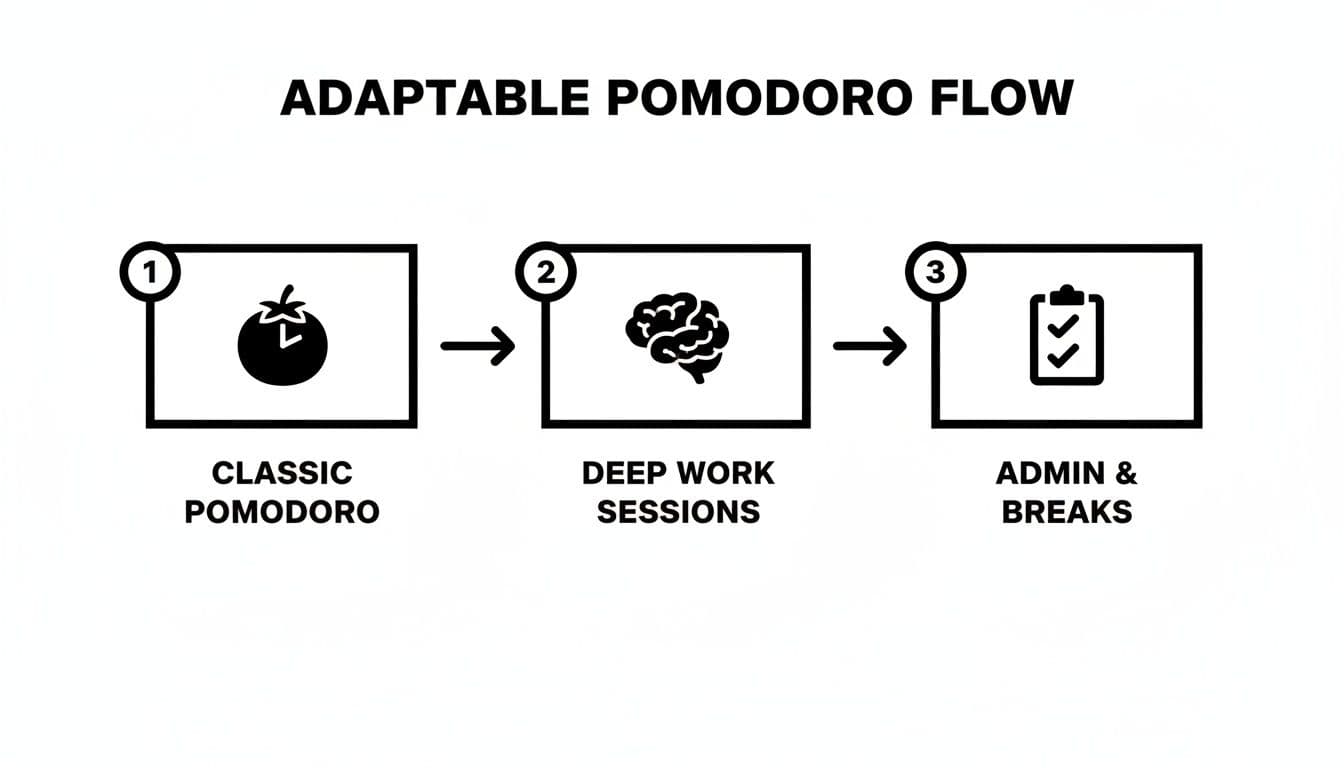
Matching the type of focus to the type of task is what really unlocks next-level efficiency.
Set Up Your Space for Success
Finally, none of this works if your environment is working against you. Your physical workspace is a critical piece of the puzzle. A comfortable, distraction-free setup is essential for protecting your focus sprints from both mental and physical interruptions. Something as simple as your posture can make or break your concentration, so it’s worth learning how to sit correctly for better posture and productivity.
When you combine smart planning, effective delegation, and a supportive environment, the Pomodoro Technique becomes more than a timer—it becomes the engine of a truly productive workflow.
Tracking Your Focus and Overcoming Common Pitfalls
So you've started using the Pomodoro Technique—that's a huge step. But how can you be sure it's actually working for you? Just going by how you feel at the end of the day can be misleading. To get a true picture of its impact, you need to look beyond intuition and start tracking some real data.

The easiest way to get started is with a simple daily log. Grab a notebook, open a spreadsheet, or use an app—whatever works. At the end of each day, just jot down the tasks you completed and how many Pomodoros each one took.
This small habit is incredibly revealing. You'll quickly discover that “writing the weekly report” consistently takes four Pomodoros, while “clearing your inbox” is usually just one. This isn't just trivia; it's powerful data that makes your weekly planning more realistic and helps you stop overcommitting.
Navigating Common Roadblocks
Even with the best plan, things go sideways. I’ve seen it a hundred times. The key isn't avoiding snags entirely but knowing how to handle them so they don't throw your entire day off course.
Here are the most frequent challenges people run into, along with some go-to fixes:
- Handling Unavoidable Interruptions: You're deep in a sprint, and a colleague taps you on the shoulder. Don't let your focus shatter. The move here is to "inform, negotiate, and reschedule." A quick, "Hey, I'm deep in a focus block right now, can I circle back in 15 minutes?" works wonders. Make a quick note to follow up, and dive right back into your task.
- Feeling Guilty About Breaks: It feels productive to skip that five-minute break when you're on a roll, right? It’s a trap. This is a fast track to burnout. Those breaks aren't just a nice-to-have; they’re a non-negotiable part of the system that lets your brain reset. Your mind simply isn't wired for nonstop, high-intensity focus. Exploring some actionable strategies to boost concentration and focus can really help you maximize your work intervals.
- Losing Motivation: The initial buzz can fade after a few days. If you find your enthusiasm flagging, it’s often a sign that your sprints are too long or your tasks are too vague. Try shrinking your work interval to just 15 minutes. A shorter sprint feels much less daunting and makes it easier to just get started.
The goal isn't perfect execution from day one. It's building resilience. Every time you gracefully handle an interruption or force yourself to take that break, you're reinforcing the habit and making it stick for the long haul.
Making Measurement Your Ally
Tracking your Pomodoros isn't about scoring your performance or feeling bad about an "unproductive" day. It’s about gaining clarity. This data helps you understand what you can realistically accomplish and empowers you to make smarter choices with your most valuable resource: your time.
If you’re looking for more ways to protect your focus during those work sprints, we’ve put together a full guide on how to focus at work that you might find helpful. When you pair good tracking with a solid plan for overcoming these hurdles, you build a productivity system that’s not just effective, but truly sustainable.
Frequently Asked Questions About the Pomodoro Technique
Theory is one thing, but putting a productivity method into practice is where the real questions pop up. As you begin integrating the Pomodoro Technique into your daily routine, you'll inevitably hit a few snags. I've coached many professionals through this process, and the same handful of questions almost always come up.
Let's walk through those common roadblocks and how to navigate them.
What Should I Do If I Finish a Task Before the Timer Ends?
This is a great sign—it means your estimates are getting better! The temptation is to stop the clock and grab your phone, but that defeats the purpose of building focus. The goal is to train your brain to stay locked in for the full session.
If you find yourself with extra time, use it for what's called "overlearning." This reinforces the work you just did.
- Review and Refine: Take another pass over your work. Did you miss a typo? Could a sentence be clearer?
- Plan the Next Move: Use the remaining minutes to map out the very next step for this project. What's the target for your next Pomodoro?
- Deepen Your Knowledge: Do a quick search on a concept related to your task. If you just wrote a report on market trends, spend five minutes reading a related article.
Sticking with the timer, even after the task is "done," is how you build the mental endurance that makes this technique so powerful.
Can I Use the Pomodoro Technique for Group Projects?
Absolutely. In fact, it can be a game-changer for keeping teams aligned, especially in a remote or hybrid setup. We call these "team Pomodoros" or focused sprints.
Here’s how it works: The team agrees on a shared objective for the session. Everyone starts their timers simultaneously and works on their individual piece of the puzzle. The magic happens during the shared break—it becomes a dedicated checkpoint to ask questions, share quick updates, or just recharge as a group before diving back in. It’s a simple way to keep everyone marching in the same direction.
Is It Okay to Skip Breaks If I Am in a State of Flow?
This is the most common question I get, and it's a tough one. When you're in the zone, the last thing you want is an alarm yanking you out of it. But as a rule, I strongly advise against skipping breaks. Those pauses are what make your focus sustainable over a full day.
Forcing yourself to step away, even for just five minutes, often lets your brain reset. You might come back and instantly solve a problem you were just wrestling with.
If you consistently feel like the timer is interrupting your deep work, that's a signal. The standard 25-minute interval might be too short for the type of tasks you do. Try experimenting with a longer work block, like the 52/17 method, to find a rhythm that feels more natural for you.
How Many Pomodoros Should I Aim for in a Day?
There is no magic number. A far better goal than a high count is consistency. When you're just starting out with the pomodoro technique for productivity, aiming for 4 to 6 truly focused, high-quality sessions is a fantastic goal.
The real win isn't the number of Pomodoros you complete, but the amount of meaningful work you get done within them. As you build your focus stamina, you'll naturally find you can handle more sessions. The key is to track your daily count to find your personal baseline and then work on improving it gradually, without sacrificing quality.
Ready to stop juggling tasks and start achieving deep focus? Fluidwave combines intelligent task management with seamless delegation, helping you integrate Pomodoro sprints directly into a smarter workflow. Get started for free and see how much more you can accomplish. Learn more at Fluidwave.
Focus on What Matters.
Experience lightning-fast task management with AI-powered workflows. Our automation helps busy professionals save 4+ hours weekly.