Master how to focus at work with proven, practical strategies you can use today to remove distractions, structure deep work, and build habits that boost concentration and output.
June 23, 2025 (1y ago) — last updated April 17, 2026 (5mo ago)
How to Focus at Work: Practical Tips
Science-backed strategies to remove distractions, structure deep work, and build focus habits that boost productivity at work.
← Back to blog
How to Focus at Work: Practical Tips
Master how to focus at work with proven strategies from productivity experts. Practical techniques to remove distractions, structure deep work, and reclaim focus with simple, science-backed habit changes.
Why Your Brain Fights Focus (And It’s Not Your Fault)
Ever feel like you’re in a tug-of-war with your own mind? You’re pulling toward a deadline, but your attention drifts to email, a feed, or the window. That’s normal. Your brain evolved to seek novelty—quick checks of your phone deliver small, unpredictable rewards that are hard to ignore. Modern offices with pings, pop-ups, and chatter play directly to that wiring, so sustaining deep concentration can feel like swimming upstream.
The Real Cost of Switching Tasks
The biggest harm from distractions isn’t the minutes lost but the attention residue that lingers when you switch tasks1. Even a short interruption can make it hard to return to complex work and increases cognitive load. This constant gear-shifting lowers work quality and drains energy. When scaled across teams, the effect is substantial: only 21% of employees report feeling actively engaged at work2.
Willpower alone won’t fix this. The most productive people design systems that work with how their brains operate. The aim isn’t to remove every distraction—it’s to manage them so you can create real pockets of focus. For more systems-level tactics, see our guide on how to stay focused at work.
Design Your Personal Focus Fortress

Your ability to concentrate depends on both physical and digital surroundings. Treat your workspace as a partner: it either helps you focus or works against you. Building a focus fortress means making small, deliberate changes that remove distractions before they grab your attention.
Flexible work often increases deep-focus time and productivity, so claim control over when and where you work when possible3.
Tame Your Physical Space
Your desk sends signals to your brain. A cluttered surface competes for attention and raises mental load. Try these practical moves:
- Mind the phone. Put your smartphone out of sight or in another room during deep work.
- Clear your desk. Spend five minutes at day’s end to tidy. Keep only essentials to create a ready-to-work space.
- Use focus triggers. Pick a sensory cue—noise-canceling headphones, a playlist, or a specific tea—that signals it’s time to concentrate. Repeat it before each work block to build a mental shortcut into flow.
Master Deep Work Sessions That Deliver
Blocking time is only the start. Deep work is deliberate: prepare, define a clear outcome, and set the right conditions for sustained attention. Match session type to task and your energy cycle—creative work often suits mornings; editing or analysis may fit afternoons.
Structure Focus Blocks for Impact
Before each session, spend two minutes to define a specific outcome. Replace “work on the proposal” with “draft the executive summary and outline the budget section.” Concrete goals remove friction and make it easier to start.
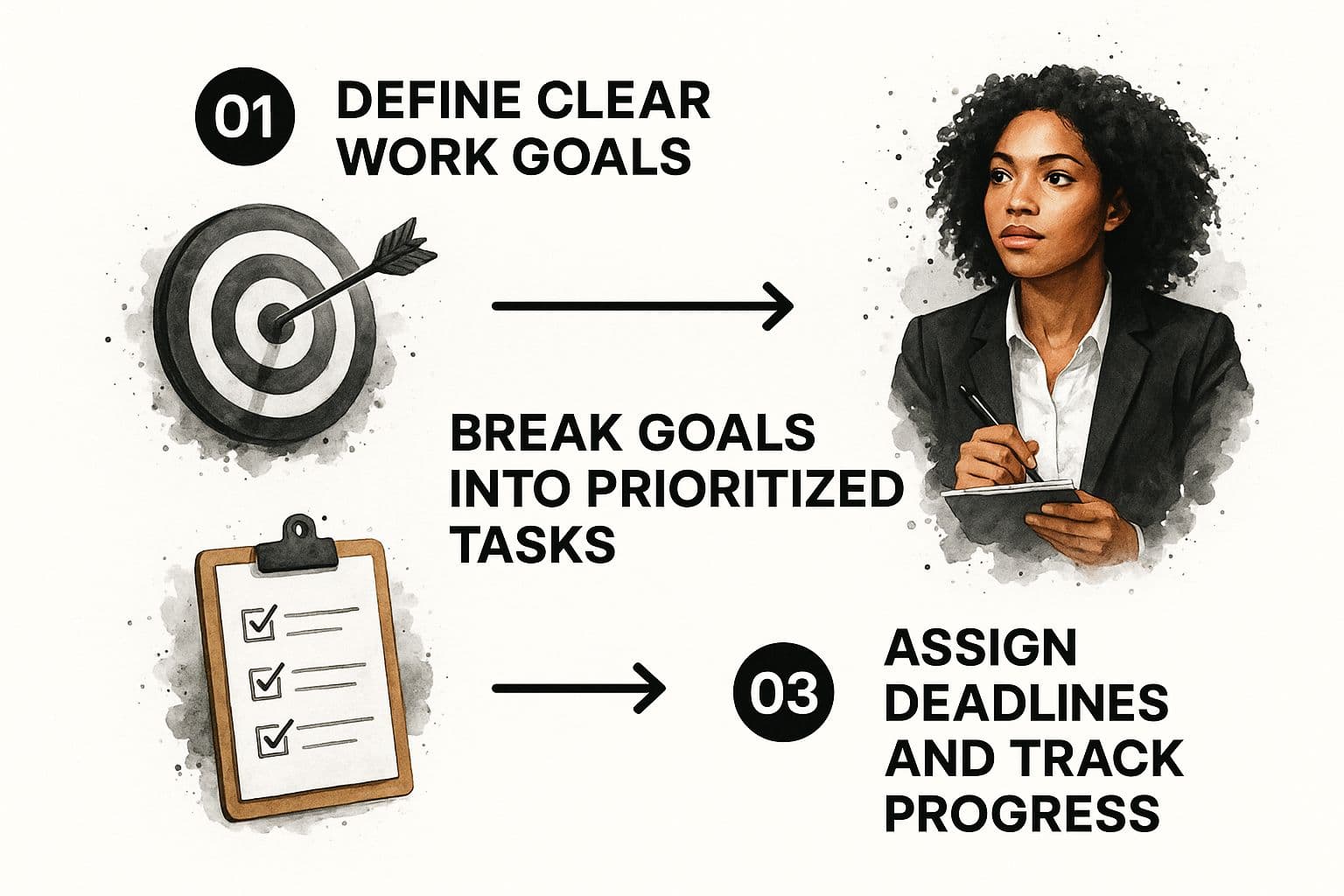
Turn abstract goals into step-by-step tasks, assign mini-deadlines, then execute.
Compare Deep Work Techniques
| Technique | Typical Duration | Best For | Difficulty | Effectiveness |
|---|---|---|---|---|
| Pomodoro | 25/5 | Short focused tasks, habit building | Easy | ★★★☆☆ |
| Time blocking | 60–120 min | Complex projects, creative thinking | Medium | ★★★★☆ |
| 50/10 method | 50/10 | Sustained analysis, writing | Medium | ★★★★★ |
| Monastic approach | Days–weeks | Major projects, isolation | Hard | ★★★★★ |
| Bimodal approach | 1–3 full days/week | Strategic sprints | Hard | ★★★★☆ |
Experiment and pick what fits your tasks and temperament.
Work with Your Brain’s Rhythms
Our alertness cycles roughly every 90 minutes. Focused sprints of 50–90 minutes followed by a 10–15 minute break respect that rhythm and help recovery from interruptions4. Use breaks to fully disengage: walk, stretch, or do something light to restore energy.
For handling routine items that interrupt deep work, use tools that offload low-value tasks so protected time goes to high-value work.
Conquer Digital Overwhelm

Digital chaos—emails, pings, and multiple tools—fragments attention and leaves you busy but not productive. Employees spend significant time on “work about work,” like switching apps and managing communication; better workflows have driven recent productivity gains but only when designed intentionally6.
Tame Your Digital Workflow
Start with a digital audit: track app switches for a day to reveal time drains. Then:
- Consolidate tools. Do you need three chat apps? Cut platforms that force context switching.
- Master notifications. Turn off nonessential alerts. For team apps, get pinged only for direct mentions or keywords.
- Use Do Not Disturb. Set focus modes aggressively during deep work. It’s a clear signal you’re unavailable.
Automate and Delegate
Automate routine decisions with email rules, templates, and scheduled posts. Delegate tasks like meeting notes, basic research, and scheduling so you can focus on high-leverage work.
Build Focus Habits That Stick
Small, consistent actions become automatic. Don’t chase perfection—start with micro-habits and scale gradually.
Prime Your Day for Focus
A short morning routine can protect your most productive hours:
- Hydrate first. Drink water before your phone or coffee.
- Move. A short walk or stretch boosts alertness.
- Pick your One Thing. Write the most important task before opening email.
An evening shutdown—five minutes of tidying or a quick calendar check—creates closure and keeps work from spilling into personal time. Build habits with a 30–60–90 day plan of incremental changes.
| Time Period | Habits to Introduce | Success Metrics | Challenges | Adjustments |
|---|---|---|---|---|
| Days 1–30 | 15-minute deep block; turn off one app notif; define One Thing | Complete block consistently; fewer phantom checks | Feels too small; forgetting | Use a timer; phone reminder; prioritize consistency |
| Days 31–60 | Extend deep work to 30–45 min; try Pomodoro; 5-min shutdown | 2–3 Pomodoro cycles; less morning overwhelm | Distractions; fatigue | Noise-canceling headphones; schedule cleanup before logout |
| Days 61–90 | Two 60-min deep blocks; half-day time blocking; weekly review | Project progress; schedule control | Meetings derail plans | Block flex time; reassess weekly; use tool assistance for estimates |
Be flexible on chaotic days—short sessions are adaptation, not failure.
Handle Interruptions Without Losing Flow

Interruptions are inevitable. The skill is managing them so they don’t derail your day. A quick visit can shatter deep work; studies show it can take over 23 minutes to fully resume a task after an interruption5. Protect your focus without seeming rude: say, “I’m in the middle of something; I can help in about 30 minutes.”
Triage and Recover Quickly
When interrupted, triage: is it urgent or can it wait? Offload non-urgent items immediately so they don’t clutter your mind. After an interruption, use a recovery anchor—re-read your last sentence or check the last data point—to regain momentum. Frequent interruptions may signal process gaps; build shared resources or delegate repetitive questions to reduce future disruptions.
Your Personalized Focus Implementation Plan
Shift from knowing to doing. Pick your biggest challenge—notifications, drop-ins, or procrastination—and start there. Build a system that fits your work style.
First Steps Checklist
- Identify a focus trigger. Choose one action to signal deep work—headphones, closing the door, or opening a focus app—and use it consistently.
- Schedule one daily focus block. Block a non-negotiable 45-minute session and treat it like a meeting.
- Perform a 5-minute shutdown. Clear your physical and digital workspace at day’s end.
When You Hit a Wall
Setbacks happen. Adapt rather than abandon: turn a missed 45-minute block into a 20-minute sprint. Consistency beats perfection. Delegate small but critical interruptions—research, scheduling, follow-ups—to preserve attention for high-impact work.
Q&A: Quick Answers to Common Focus Questions
Q: How long should I aim to focus in one session?
A: For complex work, aim for 50–90 minutes with a 10–15 minute break. Use 25-minute Pomodoro blocks to build habit.
Q: What single change gives the biggest return?
A: Turn off nonessential notifications and run a one-day digital audit—many people reclaim an hour or more by checking fewer apps6.
Q: How do I manage coworkers who interrupt often?
A: Set polite boundaries and offer a callback time. If interruptions are frequent, create shared documentation or delegate routine requests.
Quick Q&A Summaries
Q: What’s the fastest way to start focusing today?
A: Put your phone away, set a 45-minute focus block, and define one clear outcome.
Q: Which technique works best for deep tasks?
A: Try 50/10 or 60–90 minute blocks aligned with your energy; use Pomodoro to build consistency.
Q: How do I recover after interruptions?
A: Use a recovery anchor—re-read the last sentence or data point—and triage the interruption before returning.
1.
S. Leroy, “Why Is It So Hard to Do My Work? The Nature of Attention Residue,” Organizational Behavior and Human Decision Processes. [https://www.sciencedirect.com/science/article/pii/S0749597809000798](https://www.sciencedirect.com/science/article/pii/S0749597809000798)
2.
Gallup, “State of the Global Workplace,” 2023. https://www.gallup.com/workplace/349484/state-of-the-global-workplace.aspx
3.
MyHours, “Productivity Statistics 2025,” reporting on remote work and flexible schedule benefits. https://myhours.com/articles/productivity-statistics-2025
4.
Sleep Foundation, “Ultradian Rhythms and How They Affect Your Sleep and Productivity.” https://www.sleepfoundation.org/how-sleep-works/ultradian-rhythms
5.
G. Mark et al., “The Cost of Interrupted Work: More Speed and Stress,” CHI 2008. https://www.ics.uci.edu/~gmark/chi08-mark.pdf
6.
ProofHub, “Workplace Productivity Statistics,” including estimates of time spent on “work about work” and recent productivity trends. https://www.proofhub.com/articles/workplace-productivity-statistics
Focus on What Matters.
Experience lightning-fast task management with AI-powered workflows. Our automation helps busy professionals save 4+ hours weekly.