Why is organization important? Discover cognitive, financial & productivity benefits. Reduce stress & save 4+ hours weekly. Get started today.
April 21, 2026 (5mo ago)
Why Is Organization Important? Boost Productivity Today
Why is organization important? Discover cognitive, financial & productivity benefits. Reduce stress & save 4+ hours weekly. Get started today.
← Back to blog
You probably don’t need another lecture about color-coded folders or a cleaner desktop.
What you may need is an explanation for why your workday feels heavier than it should. You open your laptop with good intentions. Then the tabs multiply. Slack pings. A note lives in one app, a deadline in another, and the one task that matters gets buried under five smaller ones that feel urgent. By noon, you’ve been busy for hours but haven’t moved the work that matters.
That’s usually the moment people ask, why is organization important, really? Not in a tidy-desk sense. In a “why do I feel mentally fried by work that I technically know how to do?” sense.
The short answer is this. Organization protects your attention. It reduces friction between deciding and doing. It helps individuals and teams stop wasting energy on finding, remembering, re-checking, and recovering. For many busy professionals, that’s the difference between ending the day with momentum or ending it with guilt.
The Real Cost of a Cluttered Workflow
Take a familiar day. A project manager starts the morning with a simple goal: confirm priorities, answer a few messages, and move a client deliverable forward. Instead, she spends the first hour reconstructing context. The latest file is in email. Feedback is in chat. The task list is outdated. Two deadlines are floating in her head, but she can’t remember which one changed.
Nothing dramatic has happened. That’s the point.
Disorganization usually doesn’t announce itself as a crisis. It shows up as friction. Tiny moments of confusion. Repeated double-checking. Reopening the same tabs. Asking the same questions. Feeling behind before the actual work even starts.

What clutter does to your brain
A cluttered workflow creates cognitive overload. That means your brain isn’t only doing the work itself. It’s also trying to remember where things are, what matters first, what’s missing, and what you might forget.
That extra mental labor is expensive.
In task management systems like Fluidwave, organizing work across multiple views such as table, list, calendar, Kanban, and cards reduces cognitive load and decision fatigue by 25-40%, while disorganized workflows create context-switching costs where knowledge workers lose 20-40% of productive time per interruption, according to DemandZEN’s discussion of why relevant data matters to organizations.
If you’ve ever felt exhausted after a day that was mostly “small stuff,” this is often why. The fatigue isn’t imaginary. Your attention keeps getting reset.
Practical rule: The more often you have to ask “where was I?”, the more your workflow is costing you.
The hidden symptoms people miss
Many assume disorganization means a messy desk or an overflowing inbox. Sometimes it does. But in modern work, it often looks more subtle:
- Repeated task switching that makes every job take longer than expected
- Mental bookmarking where you keep reminders in your head because the system doesn’t feel reliable
- Duplicate effort because people can’t see what’s already been done
- Delayed decisions because key information is scattered
- Low-grade anxiety from feeling like something important is about to slip
This is why organization isn’t just administrative. It’s protective. It gives your brain fewer loose ends to carry.
Why busy teams feel this first
The faster your work moves, the more expensive disorder becomes. A solo freelancer can sometimes patch over a messy system with memory. A growing team can’t. Once multiple people are touching the same tasks, deadlines, and files, confusion spreads quickly.
If you’re trying to streamline business processes, organization is the foundation. Process improvement doesn’t begin with fancy automation. It begins with making work visible, trackable, and clear enough that people can act without reinterpreting the same information every day.
A good way to test your current system is simple. Ask yourself:
- Can I tell what matters most right now?
- Can someone else step in without me explaining everything live?
- Can I find what I need in under a minute?
If the answer is often no, the issue usually isn’t motivation. It’s structure.
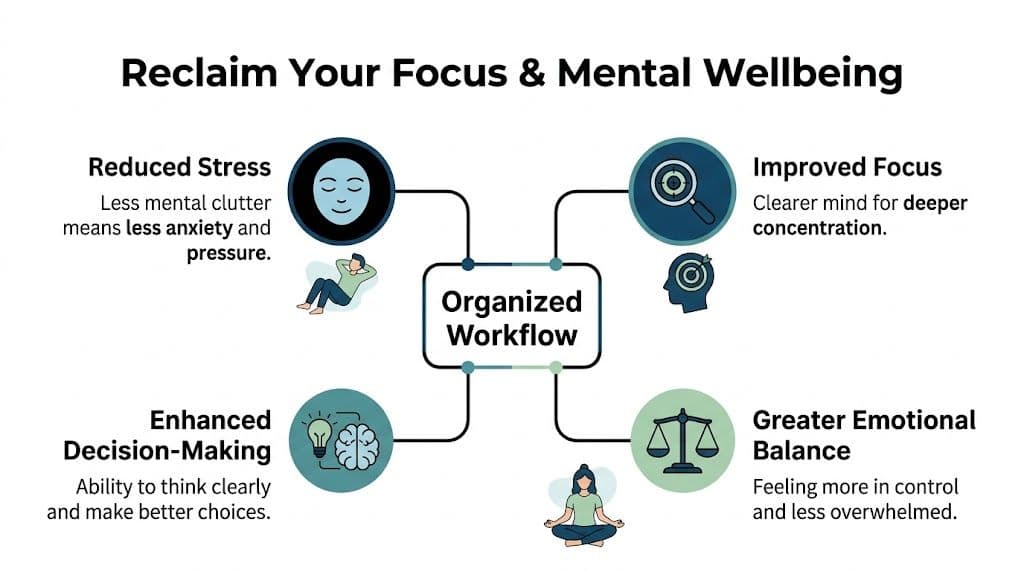
Reclaim Your Focus and Mental Wellbeing
There’s a reason disorganization feels emotional, not just logistical.
When work is unclear, your nervous system treats everything as potentially urgent. That’s why a messy workflow can make you feel restless even when you’re technically sitting still. Your brain keeps scanning for what it might be missing.
An organized system does the opposite. It acts like an external support structure. Instead of storing everything in your head, you let the system hold deadlines, task order, and next actions. That frees up energy for thinking, creating, and finishing.
Why structure feels calming
People often resist organization because they imagine rigid rules. But organization's core purpose is relief.
When your tasks have a home, your deadlines are visible, and your priorities are easier to sort, you spend less energy holding the whole day together by force. That lowers stress because fewer decisions are made under pressure.
Here’s the practical shift:
| Disorganized day | Organized day |
|---|---|
| You react to whatever appears first | You can see what deserves attention |
| You re-decide priorities all day | You follow a clearer sequence |
| You carry reminders in your head | You trust the system to hold them |
| You end the day scattered | You end the day with closure |
That emotional difference matters. Professionals often assume they need more discipline when they really need less chaos.
Organization and ADHD
The conversation often gets too generic at this point.
For many neurodivergent professionals, especially people with ADHD, organization isn’t a nice extra. It’s an accessibility issue. Starting tasks, estimating effort, resisting distraction, and returning after interruption can all be harder when the system is vague.
Data highlighted by Points of Light’s article on under-resourced communities notes that ADHD adults lose 22% of work time to disorganization, equating to over 4 hours weekly, and that AI-driven tools can help recover that time through auto-prioritization and distraction-free interfaces that combine automation with human support.
That matters because many people with ADHD don’t struggle from laziness or lack of ambition. They struggle with executive friction. The work may be clear in theory but difficult to enter in practice.
A good organizational system doesn’t ask your brain to become someone else’s brain. It reduces the number of decisions you have to manufacture from scratch.
Useful supports often include:
- Visible task views so work doesn’t disappear once it’s written down
- Simple next-action framing so starting feels smaller
- Calendar and board options because different brains process time differently
- Distraction-reduced interfaces that lower visual noise
- Human accountability when self-direction alone isn’t enough
A lot of general productivity advice breaks down here because it assumes everyone can hold, sort, and sequence tasks in the same way. They can’t.
For readers trying to protect their energy instead of pushing through constant overload, this piece on protecting your energy at work is a useful companion. The best organizational systems don’t just make you faster. They make your workday less punishing.
Focus improves when the starting line is obvious
People get stuck on focus as if it’s a personality trait. Usually it’s more mechanical than that. Focus improves when the next step is obvious enough to begin without negotiation.
That’s why organized workflows help people enter deep work more reliably. You’re not spending the first twenty minutes choosing, reconstructing, or calming yourself down. You can start.
A short visual explanation helps make that concrete:
When people feel better organized, they often report something simple but powerful: they feel less chased by their own responsibilities. That feeling is not trivial. It changes how sustainable your work becomes.
How Organization Unlocks Peak Productivity
Productivity advice often gets framed like a motivation problem. Work harder. Wake up earlier. Be more disciplined.
But productivity usually improves when work becomes easier to see, easier to sequence, and easier to complete without rework. That’s why organization matters so much. It turns effort into output instead of letting effort leak into confusion.
Time saved is only part of the story
Organized systems help people move faster, but speed isn’t the only payoff. They also reduce preventable mistakes.
According to AIU’s overview of keeping organizations organized, organization directly enhances operational productivity, and Fluidwave users report saving more than four hours per week through automated workflows and intelligent task prioritization. The same source notes that disorganized data structures increase the likelihood of duplications and missing information.
That combination matters more than is often realized. Saving time is useful. Avoiding duplicate work, lost details, and preventable corrections is often even more valuable because it protects deadlines and quality at the same time.
What organized work looks like in practice
Think about three common situations.
A freelancer manages five clients. Without structure, every request feels equally urgent, and the day gets eaten by follow-ups. With a clearer system, client tasks are separated, deadlines are visible, and administrative work stops crowding out billable work.
A founder is doing product, hiring, customer support, and investor prep. The issue isn’t only workload. It’s that tiny operational tasks keep breaking concentration. Once those tasks are grouped, delegated, or automated, strategic work gets protected.
A team lead spends half the week checking status updates. Not because the team is underperforming, but because the work isn’t visible enough. Shared views reduce the need for constant clarification.
Productivity rises when people spend less time recovering information and more time acting on it.
The environment matters too
Digital organization gets most of the attention, but physical setup still influences how well people work. If your space constantly interrupts you, the best task list in the world won’t solve everything. That’s why this guide on Boosting Workplace Productivity with Smart Office Design is useful alongside any workflow conversation.
Physical design and digital design work together. One shapes your environment. The other shapes your attention.
If you want a stronger conceptual framework for building systems that hold up under pressure, principles of organizing is a solid next read. The core idea is simple: productivity doesn’t come from stuffing more into the day. It comes from reducing drag.
The Strategic Business Case for Getting Organized
At the individual level, disorganization feels like delay, stress, and wasted effort. At the business level, it becomes a cost center.
Leaders usually notice the symptoms before they name the cause. Forecasts are less reliable. Teams duplicate work. Handoffs break. Reporting takes too long. Decisions get made with partial information. Everyone feels busy, but important work still slips.
This is why organization should be treated as an operational capability, not a personality preference.
Poor organization becomes a financial problem
The business case gets sharper when data quality enters the picture. A cluttered workflow is rarely just about tasks. It’s also about how information is stored, accessed, and trusted.
A Gartner survey cited by DataPatrol’s article on why business data matters found that low-quality data costs companies an average of $9.7 million per year. The source ties that cost to poor decision-making, operational inefficiencies, compliance failures, and lost opportunities.
That number is large, but the mechanism behind it is familiar. When teams can’t rely on their information, they create workarounds. They verify manually. They hold extra meetings. They hesitate. Or worse, they move ahead with flawed assumptions.
Why executives should care
Organization improves business performance because it supports better decisions under real conditions.
Consider what happens when work is structured well:
- Managers allocate resources more clearly because priorities are visible
- Teams collaborate with fewer misunderstandings because the latest status is shared
- Leaders spot risk earlier because delays and bottlenecks are easier to see
- Operations scale more smoothly because repeatable processes don’t depend on one person’s memory
None of that is glamorous. All of it matters.
A lot of companies chase efficiency through isolated fixes. Another dashboard. Another meeting. Another reporting layer. But if the underlying workflow stays fragmented, those additions often create more overhead, not less.
Organization creates decision readiness
One of the strongest strategic benefits of organization is decision readiness. That means a team can answer basic questions quickly and confidently:
| Business question | Organized operation |
|---|---|
| What’s behind schedule? | The status is visible |
| Where is capacity tight? | Workload is easier to map |
| Which tasks are blocked? | Dependencies are easier to track |
| What changed this week? | Updates are captured in one place |
That’s not just convenience. It affects execution quality.
For leaders thinking in broader operational terms, this explanation of operational efficiency is a useful lens. Efficient companies don’t only move faster. They waste less motion between intention and action.
When organization is missing, businesses compensate with heroics. People stay late, patch holes, and rescue projects manually. That can work for a while. It doesn’t scale well, and it usually burns out your strongest people first.
From Chaos to Control Your Action Plan
Seldom is a perfect system required. What's needed is one clear enough to trust.
That’s the part many organization articles skip. They explain the value of order but not how to build it when your day is already crowded. If your work is messy right now, start smaller than your instincts want to. The goal isn’t to organize everything at once. The goal is to make the next layer of work easier to manage.
Start with a simple reset
Use this sequence:
-
Capture everything in one place
Don’t organize while ideas are still scattered. Pull tasks, reminders, requests, and deadlines into one holding area first. -
Separate work by type Split deep work, quick admin, waiting items, and delegated tasks. Overwhelm often arises when unlike work is mixed together.
-
Choose views that match the job
Deadlines are easier to see in calendars. Pipelines are easier to see on boards. Repetitive tasks often work better in lists or tables. -
Define the next action
“Finish proposal” is vague. “Review section two and send edits” is usable. -
Review daily, not constantly
A system should reduce checking, not create compulsive checking.
If your organization method takes more energy to maintain than it saves, it won’t last.
Three quick examples
A freelancer juggling multiple clients often needs better separation, not more hustle. One client board per account, a deadline view for the week, and a single place for assets can stop the constant “where did that request go?” spiral.
A startup founder usually benefits from pulling small operational tasks out of their main thinking space. That can mean grouping admin work into one block, assigning repeatable requests, and protecting a few hours for decisions only the founder can make.
A project manager often needs shared visibility more than personal reminders. When the team sees task ownership, due dates, and current status in one place, fewer updates have to travel through private messages.
A practical tool map
Below is a simple way to connect common problems to useful solutions.
| Common Challenge | Fluidwave Solution | The Benefit |
|---|---|---|
| Too many small tasks | Pay-per-task delegation to virtual assistants | Clears low-value admin from your plate |
| Losing track of deadlines | Calendar view with auto-prioritized tasks | Makes timing visible and easier to act on |
| Team communication breakdown | Real-time collaborative tasks | Gives everyone a shared source of truth |
| Priorities keep changing | Table, list, Kanban, and card views | Lets you sort work in the format that fits |
| Hard to start important work | Distraction-free interface and smart prioritization | Lowers friction at the moment of entry |
| Work gets stuck with one person | Shared tasks and delegation workflows | Reduces bottlenecks and improves continuity |
The value of a hybrid system becomes apparent. Fluidwave combines AI-based task organization with human virtual assistant support, which means you can sort, prioritize, and delegate work inside the same environment rather than patching together separate tools and services.
Build habits that support the system
Tools matter, but habits keep them useful. Focus on a few:
- End-of-day reset: Spend a few minutes clearing loose notes and confirming tomorrow’s top tasks.
- Weekly review: Check deadlines, blocked items, and tasks that no longer matter.
- One source of truth: Avoid maintaining parallel lists unless each one has a very clear purpose.
- Visible delegation: If someone else owns the task, the system should show that clearly.
A lot of disorganization comes from hidden work. The email you meant to send. The follow-up you’re waiting on. The task you mentally assigned but never formally tracked. Once those become visible, control returns quickly.
What if you fall off the system
You probably will at some point. Everyone does.
A travel week, a busy launch, a family issue, a rough month. The system gets messy again. That doesn’t mean you failed. It means your reset process matters more than your perfection.
Use a short recovery checklist:
- Delete stale tasks that no longer belong
- Move unfinished work to a real date or status
- Rename vague items so they’re actionable
- Reassign delegated work if ownership is unclear
- Choose only a few priorities for the next day
The reason this works is psychological as much as practical. People regain momentum when the system becomes believable again.
Organization is less about making work look neat. It’s about making action easier than avoidance.
Achieving Balance in an Organized World
There’s one more truth worth saying plainly. More structure isn’t always better.
Some people finally get organized, feel the relief, and then keep tightening the system until it becomes another burden. Too many tags. Too many categories. Too many rules for what belongs where. At that point, organization stops supporting work and starts becoming work.
That risk is real. A 2025 Harvard Business Review analysis referenced here reported that teams with hyper-structured workflows experienced 25% lower idea generation rates, which highlights the downside of excessive rigidity.
The goal is support, not control
Creative work needs space. Strategic work needs room to notice patterns, follow unexpected leads, and rethink assumptions. If every minute is pre-labeled and every task is over-specified, people can become efficient at the wrong things.
That’s why the best systems feel more like guardrails than cages.
A balanced approach usually includes:
- Enough structure to reduce confusion
- Enough flexibility to adapt when priorities shift
- Enough visibility to coordinate with others
- Enough breathing room for thinking
Organized people aren’t the ones who control every variable. They’re the ones who can find their footing quickly when the day changes.
What sustainable organization looks like
Sustainable organization is light enough to maintain and strong enough to rely on. It helps you enter flow, not just document activity.
That matters for founders, team leads, freelancers, and especially neurodivergent professionals. A system only works if it respects real human energy. Some days you need a board. Some days you need a simple list. Some days you need to delegate the task instead of tracking it more elegantly.
If you remember one idea from this article, let it be this: organization matters because it turns scattered effort into usable momentum. It supports focus, protects wellbeing, improves execution, and gives teams a better shot at working calmly instead of reactively.
That’s the answer to why is organization important. It helps you do meaningful work without spending all your strength just trying to stay on top of it.
If your current system feels too fragmented or too heavy to maintain, Fluidwave is one option to explore. It offers a free tier and combines AI task organization with human delegation support, which can be useful if you want more structure without building a rigid workflow from scratch.
Focus on What Matters.
Experience lightning-fast task management with AI-powered workflows. Our automation helps busy professionals save 4+ hours weekly.