Explore what is productivity beyond just being busy. Learn proven frameworks and actionable strategies to boost your efficiency and achieve meaningful results.
March 26, 2026 (5mo ago)
What Is Productivity and How Can You Master It?
Explore what is productivity beyond just being busy. Learn proven frameworks and actionable strategies to boost your efficiency and achieve meaningful results.
← Back to blog
Ask ten people what productivity means, and you’ll probably get ten different answers. At its simplest, productivity is a measure of how well you turn stuff like time and effort into valuable results. But that definition really just scratches the surface.
True productivity has zero to do with being busy 24/7 or working longer hours. It’s about achieving meaningful results with focus and intention.
Moving Beyond Busy: What Is Productivity Today?
Let’s face it—the old-school idea of productivity is completely broken. For decades, it was all about activity: more hours clocked, more emails fired off, more tasks crossed off a list. But this "more is more" approach just leads to burnout, not breakthroughs.
It’s the classic difference between running on a treadmill and actually finishing a race. One generates a lot of motion and sweat, but the other gets you to a destination. Modern productivity is about making real progress toward that finish line. It shifts the entire focus from the sheer volume of work to the value of the outcome.
Are you moving critical projects forward? Are you solving tough problems? Are you creating something high-quality and impactful? Answering "yes" to those questions is the real measure of productivity today.
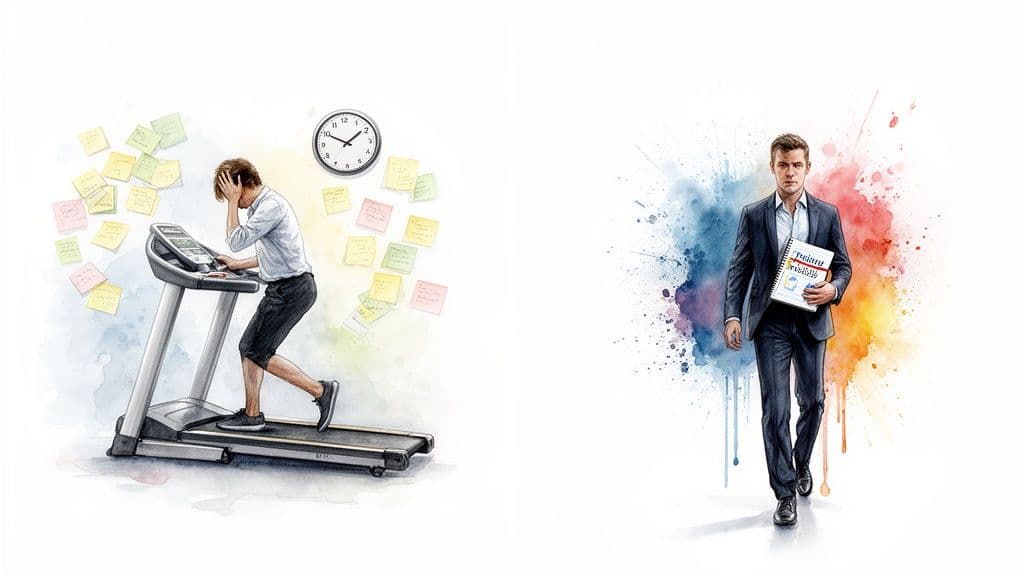
Unlearning Old Habits
To really get behind this new way of thinking, we have to unlearn the myths that keep us stuck on that treadmill. The whole idea that being productive means being available 24/7 or glorifying a packed schedule isn't just outdated; it's actively holding you back.
Real effectiveness comes from strategic work, not constant work.
This isn't just some philosophical shift; the data backs it up. To get a handle on productivity in the modern workplace, you have to look beyond metrics like hours logged. For instance, since remote work became more common, the average workday has actually shortened by 36 minutes, yet overall productivity has increased by 2%. This proves that the quality and efficiency of your output matter way more than the time you spend at a desk. You can dive deeper into these modern workplace trends with research from Eptura.
Productivity Myths vs. Modern Realities
To really cement this new way of thinking, let's put some of those old, outdated ideas side-by-side with more effective, modern approaches. The table below highlights the fundamental shift from an activity-based mindset to one that's laser-focused on outcomes.
| Common Myth | Modern Reality |
|---|---|
| Being busy equals being productive. | Meaningful outcomes are the true measure of productivity. |
| More hours worked means more output. | Focused, high-quality work periods yield better results. |
| Multitasking is an essential skill. | Single-tasking and deep focus are more efficient. |
| Productivity is about getting more done. | Productivity is about getting the right things done. |
This guide is designed to help you move from the "myth" column to the "reality" column. By the end, you'll be equipped to focus on achievement over activity and quality over sheer quantity.
Why Meaningful Productivity Matters
So, we've defined productivity. But that begs a much bigger question: why should you even care?
It's easy to dismiss the whole idea as just another corporate buzzword, a flimsy way to squeeze more out of your workday. But when you look closer, true productivity isn't about the relentless hustle. It's about building a more sustainable and fulfilling way to work and live.
Think of it as the direct path to more autonomy, less stress, and the mental space to be creative. Making meaningful progress is a powerful motivator. Just remember the last time you finally finished a tough but important project—that feeling of genuine accomplishment is what this is all about.
The Connection Between Engagement and Output
That link between personal satisfaction and productive output isn’t just a nice idea; it has a massive impact on the global economy. How connected people feel to their work is a direct predictor of their performance, and right now, that connection is incredibly weak.
The numbers are staggering. According to Gallup's State of the Global Workplace Report, only 21% of employees say they feel engaged at work. A shocking 62% are "quiet quitting"—showing up but doing the absolute bare minimum—while another 17% are actively disengaged, sometimes even working against their own teams. This massive disconnect costs the global economy billions. You can dig into the full Gallup findings on the global workforce to see the scale of the problem.
When people feel their work matters and they are effective in their roles, they don't just produce more; they produce better. Highly engaged teams become the engines of sustainable growth and innovation.
This shows that the drive for real productivity isn't just a personal goal. For any organization, creating an environment where people can do meaningful work is the ultimate competitive advantage. It’s what turns a workplace from a place of obligation into a hub of purpose and shared success.
From Individual Effort to Lasting Impact
At its core, meaningful productivity is the bridge between your daily to-do list and your long-term goals. When you get a handle on your workflow, you start creating real value without burning yourself out in the process.
- For you as an individual: It means ending the day feeling accomplished, not just drained. It gives you the freedom to truly log off, knowing you made real progress on things that count.
- For your team: It builds a culture of trust and momentum. When everyone is focused on high-value work instead of just staying busy, collaboration becomes smoother and projects actually get done.
Ultimately, mastering productivity is about taking back control of your most finite resource: your time. By learning what works, you can get more done in fewer hours, which frees up the mental and emotional energy you need for big-picture thinking, creative problem-solving, and your life outside of work. You can explore more on the advantages of time management in our guide.
This is what separates people who are simply busy from those who truly make an impact.
2. Finding Your Flow With Proven Productivity Frameworks
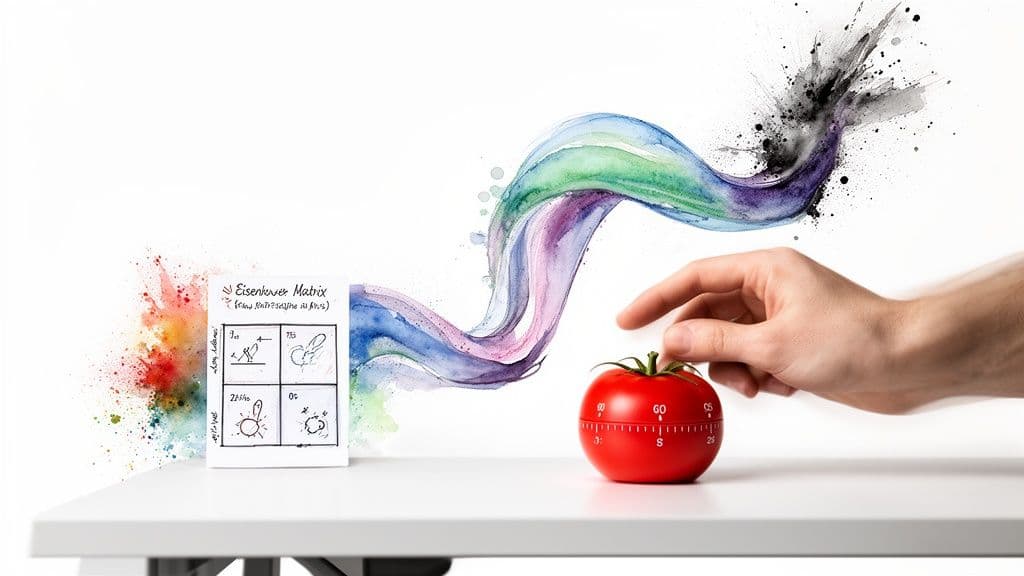
Knowing what productivity means is one thing; actually making it happen is a whole different ballgame. This is where a good framework comes in. Forget abstract theories—we're talking about proven systems that give you a concrete way to manage your time and, more importantly, your attention.
Think of these frameworks less like rigid rulebooks and more like trusted recipes. A chef knows dozens of techniques and picks the right one for the dish. Similarly, you can pick the right productivity method for the task in front of you. Let's break down a few of the most reliable ones I’ve seen work time and again.
The Eisenhower Matrix: Your Personal CEO
What if you had a personal CEO who could instantly tell you what to work on next? That's pretty much what the Eisenhower Matrix does. At its core, this simple but incredibly effective tool helps you finally stop confusing what is merely urgent with what is truly important.
The matrix sorts your tasks into four clear quadrants:
- Important and Urgent (Do First): These are the fires you have to put out. We’re talking about critical project deadlines, sudden client issues, or anything that demands immediate action to prevent bad stuff from happening.
- Important but Not Urgent (Schedule): This is where real, meaningful progress is made. This quadrant is for strategic planning, building professional relationships, and working toward your long-term goals. You have to be intentional and schedule this work, or it will always get shoved aside by the "urgent."
- Urgent but Not Important (Delegate): These are the constant interruptions that feel pressing but don't actually move the needle on your key objectives. Think of certain emails, meeting requests that could be handled by someone else, or minor admin tasks. If you can, pass them off.
- Not Important and Not Urgent (Delete): This is the land of time-wasters and distractions. Mindless social media scrolling, unnecessary app notifications, and other pointless activities live here. The goal is simple: get rid of them.
This matrix is a game-changer for anyone who feels perpetually pulled in a million directions. It forces a moment of reflection before you act, making sure your effort is always pointed where it counts. Many people also pair this with the Getting Things Done (GTD) method, another fantastic system for organizing tasks. If you're interested, you can explore the Getting Things Done methodology in our detailed guide.
The Pomodoro Technique: Interval Training for Your Brain
If the Eisenhower Matrix helps you decide what to do, the Pomodoro Technique is all about how you do it with laser focus. Think of it as high-intensity interval training for your brain, designed to build your concentration while systematically preventing burnout.
The whole concept is refreshingly straightforward. You work in focused 25-minute sprints, known as "Pomodoros," with short breaks in between. Research has shown that these brief recovery periods are incredibly effective at helping you stay sharp over longer work sessions.
The real magic here is that the frequent breaks keep your mind from getting tired. It's a system built to work with your brain's natural rhythm, not against it.
Here’s the simple four-step process:
- Pick one task to focus on.
- Set a timer for 25 minutes and give that single task your undivided attention. No emails, no notifications, no distractions.
- When the timer goes off, take a quick 5-minute break. Get up, stretch, grab a glass of water—just step away from your work.
- After four Pomodoros, reward yourself with a longer break, typically 15-30 minutes.
I’ve found this technique to be incredibly valuable for creatives, developers, writers, and anyone whose work demands sustained periods of deep thought. It brilliantly transforms a massive, intimidating project into a series of calm, manageable sprints.
Finding Your Flow State
Ultimately, both the Eisenhower Matrix and the Pomodoro Technique are tools to help you create the perfect conditions for a flow state. You know that feeling—when you're so completely absorbed in an activity that you lose all track of time, feel energized, and produce your absolute best work.
Flow doesn't just happen by accident. It shows up when you have a clear goal, get immediate feedback on your progress, and are tackling a challenge that perfectly balances your skill level. The frameworks we've discussed help engineer this environment by removing distractions and structuring your work into focused, goal-driven blocks. When you apply them, you're not just checking off tasks—you're consciously designing a workflow that leads to peak performance and a genuine sense of accomplishment.
Productivity Strategies for Every Brain Type
The idea of a one-size-fits-all approach to productivity is a myth. Our brains are all wired differently, so what one person finds motivating, another might find completely stifling. This is especially true for neurodivergent individuals, whose unique cognitive wiring often clashes with conventional productivity advice.
For many, the standard methods simply don't stick. Telling someone whose mind is already juggling a dozen competing thoughts to "just make a list" can feel like a recipe for overwhelm, not a solution.
Moving Beyond the Standard Playbook
The real key is to find strategies that work with your brain's natural tendencies, not against them. Instead of trying to force a system that doesn’t fit, you can lean into your own strengths—whether that’s a talent for intense creative bursts, visual thinking, or the ability to hyperfocus on something that genuinely fascinates you.
It's all about shifting your perspective. Instead of seeing certain traits as flaws, we can reframe them as powerful assets when channeled correctly. For example, understanding the connection between ADHD and productivity shows how traits like high energy and out-of-the-box creativity can become major advantages with the right support.
This isn't about fixing yourself; it's about finding tools that feel genuinely helpful and validate your experience while offering practical, brain-friendly solutions.
Leaning into Visual and Tangible Workflows
For many of us, abstract lists and digital calendars just don't connect with the actual work. "Out of sight, out of mind" isn't just a saying; it’s a daily reality. This is exactly why visual and tangible systems can be so incredibly effective.
Take Kanban boards, for instance. A Kanban board—whether it's a physical one with sticky notes or a digital version like the board view in Fluidwave—lets you "see" your entire workflow at a glance. Tasks move cleanly from a "To-Do" column to "In Progress" and finally to "Done."
This visual progression delivers a few powerful benefits:
- It externalizes your memory: You no longer have to hold every single task in your head, which frees up a tremendous amount of mental energy.
- It clarifies priorities: Seeing everything laid out helps you instantly spot what needs your attention most.
- It provides a dopamine hit: Moving a card to the "Done" column creates a real, tangible sense of accomplishment that fuels your motivation for whatever's next.
By making your work visible and interactive, you can turn an overwhelming mental checklist into a manageable, almost game-like process.
The goal isn’t to find a "perfect" system but to create a flexible one that adapts to your energy and focus levels. When you make progress tangible, you create a positive feedback loop that makes it easier to stay engaged.
The Power of Micro-Tasks and Time-Boxing
Massive, ambiguous projects are often the biggest source of procrastination. A task like "write the quarterly report" feels so monumental that it’s hard to even know where to begin. The trick is to break it down into satisfyingly small micro-tasks.
"Write quarterly report" suddenly becomes:
- Gather sales data for Q3.
- Create a new document and write just the executive summary (one paragraph is fine).
- Draft the section on marketing performance.
- Find one compelling chart to include.
Each step is concrete, achievable, and gives you a quick win. This approach immediately replaces that sense of dread with a feeling of real momentum.
Combining this with time-boxing adds another layer of helpful structure. Instead of working on a task until it's "done," you simply commit to working on it for a set period, like 25 or 45 minutes. This removes the pressure of finishing and reframes the goal as just putting in focused effort for a short, defined time. It's a strategy that aligns perfectly with the brain's natural cycles of energy, allowing for intense focus followed by necessary rest.
How to Build Your Personal Productivity System
Understanding productivity in theory is great, but the real change happens when you put those ideas into practice. It’s time to go from abstract concepts to a concrete, personalized system that you'll actually use day in and day out. This isn't about chasing the "perfect" app or following a rigid set of rules; it's about crafting a reliable workflow that fits your life and work.
A truly dependable system rests on four key pillars. When they work together, they create a loop that takes all the chaotic stuff life throws at you and turns it into focused, meaningful work. Let's walk through how you can build this for yourself.
Pillar 1: Capture Everything
Your brain is for creative thinking, not for storage. The very first step is to get every single task, idea, reminder, and to-do out of your head and into a trusted place. This "brain dump" is incredibly liberating—it instantly quiets the mental chatter of trying to remember it all.
Don't just limit this to work tasks. Capture it all:
- Project deadlines and notes from your last meeting.
- That spark of an idea for a new side project.
- Personal errands, like "schedule dentist appointment."
- Books you want to read or articles you've saved for later.
Whether you prefer a simple notebook, a digital tool like Fluidwave, or just a voice memo app on your phone, the most important thing is consistency. Make capturing effortless, and it will quickly become a habit.
Pillar 2: Organize Logically
Once you’ve captured everything, it’s time to bring some order to the chaos. A messy, unorganized list is nearly as stressful as keeping it all in your head. The goal here is to sort your captured items into logical categories so you always know where everything is and can find it easily.
You could structure your system around:
- Projects: Grouping all tasks related to a specific goal (e.g., "Q3 Marketing Report").
- Contexts: Categorizing tasks by where or when you can do them (@Office, @Calls, @Computer).
- Time Horizons: Separating tasks by urgency (Today, This Week, Someday/Maybe).
Using a flexible tool that lets you see your work in different ways—like a Kanban board for projects or a calendar for deadlines—can be a game-changer. This is the step that turns your raw brain dump into an organized inventory of your commitments. To build out your system, exploring some of the best productivity tools can help you find one that clicks with your style.
The process below shows how strategies that are especially helpful for neurodivergent individuals, like visualizing work and breaking it down, can be powerful organizational aids for anyone.
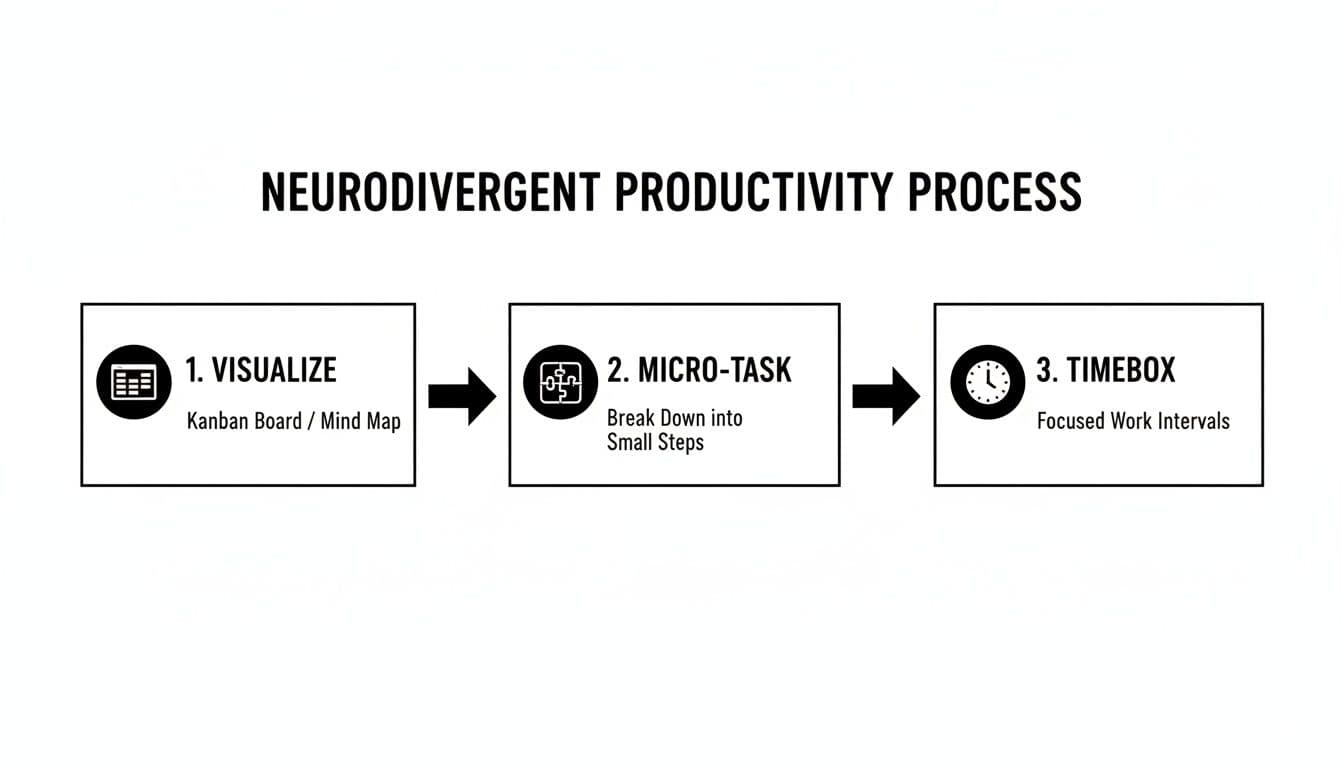
The big takeaway here? Making work tangible and splitting it into smaller, time-bound pieces can transform an overwhelming list into a clear, manageable plan.
Pillar 3: Prioritize Intelligently
With a clear, organized list in front of you, you can finally decide what actually matters. Prioritization is how you separate the high-impact work from the low-value noise. A common trap is treating every task as equally important, which keeps you busy but not truly productive.
Use a simple framework like the Eisenhower Matrix (Urgent vs. Important) to make better strategic choices about where your focus should go. Just ask yourself: "Does this task move me closer to a major goal?" If the answer is no, it's a good candidate to be delegated, automated, or maybe even deleted entirely.
A weekly review is a non-negotiable habit for staying on track. Set aside 30-60 minutes each week to look over your upcoming tasks, check in on your big goals, and decide on your top 3-5 priorities for the week ahead. This ritual ensures your daily actions are always aligned with your larger vision.
Pillar 4: Execute with Focused Intent
This final pillar is where the rubber meets the road. Execution isn't just about grinding it out; it's about working smart. This means designing your environment and your schedule to support deep, uninterrupted focus. Try out techniques like time-boxing or the Pomodoro Technique to work in focused sprints.
Beyond that, smart automation and delegation can be your secret weapons.
- Automate: Set up rules to automatically sort your emails or use templates for reports you create often.
- Delegate: Hand off tasks that don't need your specific skills to a team member or a virtual assistant.
These strategies free you from the busywork, protecting your most valuable resource—your attention—for the strategic efforts that only you can do. By combining all four pillars, you'll create a workflow that is both powerful and resilient. If you want to dive deeper, check out our guide on building effective personal productivity systems.
Ready to put all this into practice? It's easy to feel a surge of motivation after reading about a new approach, but the real challenge is turning that inspiration into action.
Let's make it simple. This isn't about a massive, life-altering overhaul. It's about building momentum with a few small, manageable wins that prove to you this stuff actually works. The journey starts with a single step, so here’s a quick-start guide to get you moving today.
A Simple Game Plan to Get Started
Think of this less as a summary and more as a launchpad. You don't have to do everything at once. Just pick one or two of these that feel doable and commit to trying them out.
-
Map Out Your Top 3 Priorities for Tomorrow: Before you sign off for the day, take five minutes to identify the three most important things on your plate for tomorrow. Write them down somewhere you can’t miss them. This simple ritual eliminates the "what should I do now?" paralysis that so often kills a productive morning.
-
Schedule a Single 25-Minute Focus Block: Find a 25-minute gap in your calendar tomorrow and block it off. When the time comes, set a timer, shut down your notifications, and dive into one of your top priorities. It's just 25 minutes. See for yourself what an uninterrupted burst of concentration can do.
The goal here isn't to be perfect; it's to get a win on the board. A single, 25-minute sprint is small enough that you can't really fail, but powerful enough to show you what’s possible when you eliminate distractions.
-
Find One Thing to Automate or Delegate: Look at your weekly tasks. Is there a repetitive report, a tedious email sorting rule, or a recurring meeting you always have to schedule? Find just one of those low-impact tasks you dread and commit to either automating it with a tool or handing it off to a teammate this week.
-
Do a Quick "Brain Dump": Grab a notebook or open a blank document and spend ten minutes writing down every single to-do, idea, worry, and reminder rattling around in your head. Don't organize it. Don't judge it. Just get it all out. This simple act frees up an incredible amount of mental bandwidth and is the first step to building a system you can trust.
You now have a clear, actionable roadmap to go from understanding productivity to actually being more productive. All you have to do is take the first step.
Common Productivity Questions Answered
Even with the best plans, you’re going to have questions. As you start putting these ideas into practice, you'll inevitably hit a few roadblocks. This section tackles some of the most common questions I hear, offering practical answers to help you navigate your own productivity journey with confidence.
What Is The Difference Between Being Busy and Being Productive?
This is the big one. Getting this distinction right changes everything. Think of it this way: being busy is about motion, while being productive is about meaningful progress.
Busyness feels like a full calendar and a never-ending to-do list. You're constantly moving, but are you actually getting anywhere important? Productivity, on the other hand, is about zeroing in on tasks that directly move you toward your biggest goals. It’s measured by valuable output, not just the hours you put in. The real goal is to focus your finite energy on high-impact work, not just fill your day with activity for activity's sake.
How Can I Stay Productive When I Feel Unmotivated?
Here’s a hard truth: motivation is fickle. It’s an emotion, and you can't rely on it to show up every day. The most productive people I know don't wait for motivation to strike; they build systems that work even when they don't feel like it.
A great place to start is with the “two-minute rule,” a concept from author David Allen. If a task takes less than two minutes, just do it now. Don't even think about it. For bigger projects that feel overwhelming, the trick is to break them down into laughably small first steps.
The goal is to make the first move so easy you can't say no. Instead of a task like "write the quarterly report," your first step becomes "open a new document and write a single headline." That tiny win is often all it takes to build enough momentum to keep you going.
It also helps to keep your "why" front and center. Connecting your daily tasks to a larger purpose or a future goal you're excited about can be just the spark you need when your internal drive is running low.
Can Technology Actually Make Me Less Productive?
Without a doubt, yes. Technology is a double-edged sword. While it can be an incredible asset, it’s also one of the biggest threats to focused work. The constant barrage of pings, notifications, and the siren song of social media apps are productivity killers. These interruptions shatter your attention and make it almost impossible to achieve that deep, satisfying state of flow.
The only way to win this battle is to use your technology with intention. You have to be the one in control, not your devices.
Here are a few ways to take back command:
- Turn off all non-essential notifications on your phone and computer. Every single one.
- Schedule specific "batches" for checking email and messages instead of reacting to them all day.
- Use tools that are intentionally designed to minimize distractions, creating a digital workspace that helps you focus.
Ultimately, your technology should serve your goals, not sabotage them.
Ready to build a system that finally works for you? Fluidwave combines smart task management with simple delegation, helping you focus on what truly drives results. Create, prioritize, and automate your workflow to get more done with less stress. Start streamlining your productivity with Fluidwave today.
Focus on What Matters.
Experience lightning-fast task management with AI-powered workflows. Our automation helps busy professionals save 4+ hours weekly.