Stop missing deadlines. Our guide teaches practical methods for accurate timeline estimation, from task breakdown to managing uncertainty. Create realistic
June 21, 2026 (3mo ago)
Better Timeline Estimation: Guesswork to Reality
Stop missing deadlines. Our guide teaches practical methods for accurate timeline estimation, from task breakdown to managing uncertainty. Create realistic
← Back to blog
A lot of projects don't fail in one dramatic moment. They slip a day here, a meeting there, one “small” revision after another, and then suddenly the original deadline is fiction. Everyone involved worked hard. Nobody intended to miss. The estimate was just built on hope instead of a system.
That's why timeline estimation deserves more respect than it usually gets. Many teams treat it as a kickoff exercise. A few smart people make a prediction, everyone nods, and the actual work starts. In practice, that approach breaks down fast because estimates have to survive messy calendars, changing priorities, and the very human habit of underestimating effort.
Good timeline estimation isn't about sounding confident. It's about making uncertainty visible early enough that you can still do something about it.
Why Your Timeline Estimates Are Always Wrong
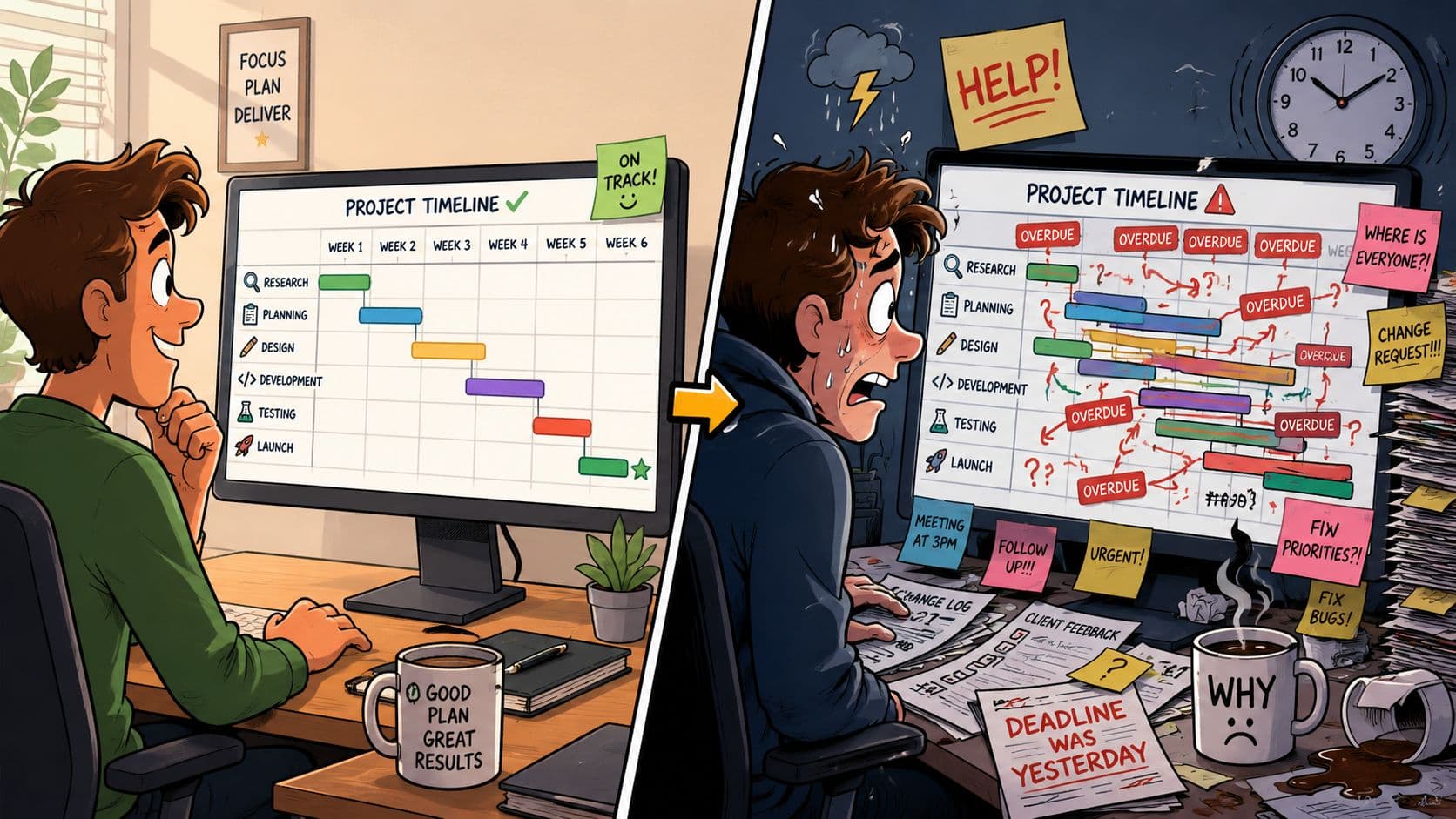
The pattern is familiar. A team scopes a project on Monday, picks a date that feels achievable, and leaves the meeting relieved. Two weeks later, dependencies appear, approvals drag, someone gets pulled into another priority, and work that looked simple turns out to have hidden steps. The date doesn't move at first. The team just absorbs the pressure.
Then weekends get mentioned.
That spiral doesn't happen because people are lazy or careless. It happens because intuitive estimation is a bad tool for complex work. SketchDeck's analysis of project estimates found that projects are underestimated by an average of 67 hours, or 1.6 times the actual duration, and that intuitive estimation fails 67% of the time. For projects with three or more steps, the underestimation gap widens to 81 hours.
The real problem isn't effort
Most bad estimates start with a vague sentence disguised as a plan. “Redesign the landing page.” “Launch the campaign.” “Migrate the data.” Those sound concrete until the team has to do the work. Then the hidden pieces show up. Reviews. Fixes. Waiting. Rework. Coordination.
That's also why “just work harder” is such a damaging response. Extra effort can recover some slippage, but it can't fix a timeline built on missing tasks and unrealistic assumptions. If you want better delivery dates, you need better estimation inputs.
Practical rule: If a timeline sounds clean before the work starts, it probably hasn't accounted for the work well enough.
There's also a behavioral side to this. Teams often conform to the number already in the room, especially when a senior stakeholder says, “Can we do it by the end of the month?” That's less estimation and more social pressure. The ideas behind Synopsix behavioral intelligence are useful here because they help explain why groups often agree to dates they don't believe in.
When that happens repeatedly, people stop trusting plans. They start treating every date as negotiable. If that feels familiar, it's worth looking at the common patterns behind why projects fail, because weak estimation usually shows up alongside weak scope control and poor dependency management.
What actually changes the outcome
Teams get better when they stop treating timeline estimation as a guess and start treating it as modeling. That means breaking work apart, estimating at the task level, accounting for uncertainty, and converting effort into an actual calendar instead of an idealized fantasy week.
Once you do that, the conversation changes. You're no longer arguing over whether a deadline feels right. You're asking which assumptions make it possible and which risks make it fragile.
Start by Decomposing Your Work
If the work is fuzzy, the estimate will be fiction. That's why the first serious step in timeline estimation is a Work Breakdown Structure, or WBS. A sound methodology starts with a WBS to identify all granular tasks. This decomposition is the first of three critical phases, followed by applying techniques like PERT and CPM analysis.
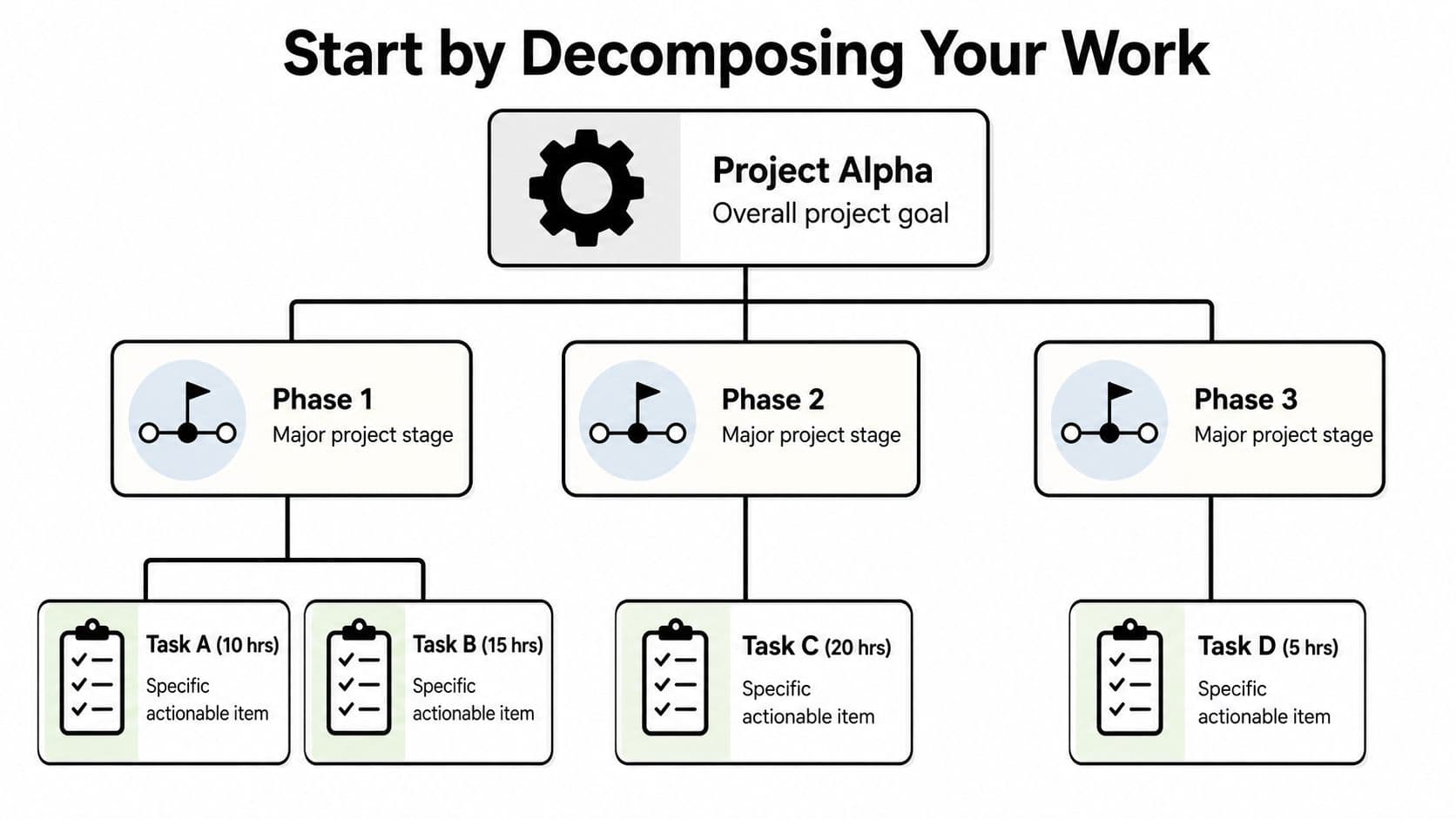
A WBS sounds formal, but the idea is simple. Stop estimating the project title. Start estimating the parts.
Break deliverables into work you can actually assign
Take something broad like “launch a new marketing campaign.” That isn't a task. It's a container. To estimate it properly, break it down into layers such as:
- Campaign strategy
- Creative production
- Landing page updates
- Email build
- Paid distribution setup
- Internal approvals
- Launch and reporting
Then break each of those into smaller pieces.
For example, “creative production” might include writing copy, designing assets, internal review, revisions, and final export. “Landing page updates” might include wireframe edits, development, QA, legal review, and publishing. You're not done until each item is small enough that a person can own it and estimate it without guessing wildly.
Smaller tasks don't just improve accuracy. They expose dependencies, handoffs, and waiting time before those problems hit your calendar.
A useful test for task size
If a task description still contains “and,” it probably needs to be split again.
“Write and design webinar promo email” is at least two tasks. “Build dashboard and validate data” is also at least two tasks. Combined tasks hide effort because one half is usually harder than the other, and the estimate gets anchored to the easier half.
Here's a simple filter I use when reviewing a breakdown:
- Can one owner complete it? If ownership is shared, the task is probably too broad.
- Can the team explain what done looks like? If not, the task is still a deliverable, not a unit of work.
- Would a delay have a clear cause? If the answer would be vague, the task needs more definition.
Later, when you estimate, sequence, and track, this granularity pays for itself.
A short walk-through helps if your team hasn't done this before:
What a good breakdown changes
A strong WBS does three things at once:
- It removes ambiguity: Teams stop estimating the label and start estimating real tasks.
- It reveals missing work: Review cycles, approvals, testing, and handoffs become visible.
- It improves accountability: Each task can be owned, tracked, and adjusted without rewriting the whole plan.
The point isn't bureaucracy. The point is clarity. Once the project is decomposed, estimation becomes less emotional and much more operational.
Choose the Right Estimation Method for the Job
Not every task should be estimated the same way. That's where many teams go wrong. They use one habit for everything. Usually it's a top-down guess made early and defended too long.
Different kinds of work need different methods. A well-defined migration task doesn't need the same treatment as a new feature with lots of unknowns. A rough executive forecast isn't the same thing as a delivery plan your team will be judged against.
Bottom-up when details matter
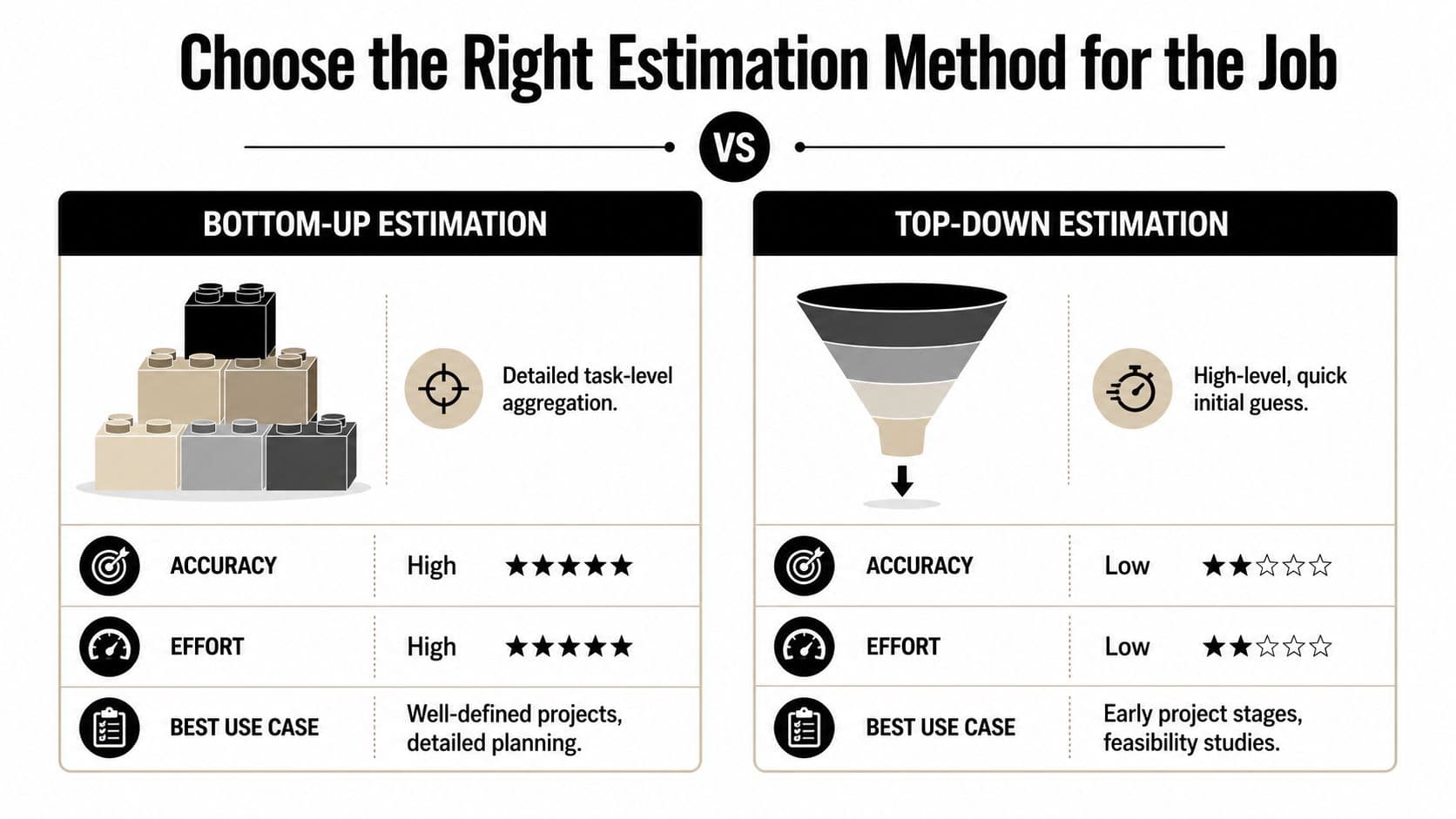
Bottom-up estimation starts with the task list and rolls those estimates upward into a project total. It takes more effort, but it's the method I trust when a date matters.
One verified data point is hard to ignore: statistical analysis of project estimation found that bottom-up estimation combined with expert judgment achieves a 75% on-time delivery rate, whereas top-down or analogous estimation alone reaches 45%.
Use bottom-up when:
- The scope is reasonably clear
- Multiple people or teams are involved
- Dependencies and approvals can affect delivery
- The estimate will be used as a commitment
The downside is time. You have to do the decomposition properly and involve the people who'll perform the work. But that effort buys you a much stronger delivery plan.
PERT when uncertainty is real
Some tasks aren't stable enough for a single number. That's where PERT, or three-point estimation, earns its place. The formula is:
TE = (O + 4R + P) / 6
Where:
- O is the optimistic duration
- R is the realistic duration
- P is the pessimistic duration
This method is useful for work with unclear complexity, external dependencies, or higher risk. Verified data notes that this weighted average can reduce variance by 30-40% compared to single-point estimates.
A practical example:
| Estimate type | Duration |
|---|---|
| Optimistic | 2 days |
| Realistic | 4 days |
| Pessimistic | 8 days |
Using PERT:
TE = (2 + 4(4) + 8) / 6 = 26 / 6
That gives you an expected estimate of a little over four days. The value isn't just the math. It forces the conversation teams usually skip. What has to go right for the optimistic case? What commonly goes wrong? What would create the pessimistic case?
If you need a visual planning companion for this approach, a PERT chart overview helps teams connect estimated durations to task relationships.
The best estimation discussions are rarely about arithmetic. They're about assumptions.
Analogous or top-down when speed matters more than precision
Sometimes you need a directional number fast. Early discovery, feasibility conversations, and portfolio planning often call for a top-down or analogous estimate. That's fine, as long as everyone understands what kind of estimate it is.
Use it when:
- Scope is still emerging
- You need an early planning range
- Historical similarity is strong
Avoid using it as the final delivery commitment. Top-down estimates are useful for deciding whether to proceed, not for pretending uncertainty has disappeared.
A simple decision guide
Here's the short version:
| Situation | Best fit |
|---|---|
| Detailed scope and real deadline | Bottom-up |
| High uncertainty in a task | PERT |
| Early-stage rough planning | Analogous or top-down |
The mistake isn't choosing the wrong method once. The mistake is never upgrading the estimate as the project becomes clearer.
Embrace Uncertainty with Buffers and Ranges
A single date looks decisive. It also hides risk.
When someone says, “This will take five days,” what they usually mean is, “If nothing unexpected happens and my assumptions are right, I think five days is plausible.” That's not the same thing as certainty, and stakeholders know it. They may still ask for one number, but they trust the estimate more when you show the range and explain the conditions.
Stop giving single-point estimates for uncertain work
Ranges communicate reality better than precision theater. They leave room for variation without sounding evasive.
For task-level work, I prefer language like:
- Likely range: best used when the work is partially known
- Working estimate: useful when dependencies are still moving
- Commit date with conditions: appropriate only when scope, ownership, and approvals are clear
That shift matters because uncertainty isn't a weakness in the estimator. It's a property of the work.
Buffers aren't laziness
Teams often treat buffers as something to hide, as if adding contingency means the estimate wasn't good. In real delivery environments, buffers are what make an estimate usable.
Verified industry data from LeadDev on data-driven estimation notes that even with data-driven models, it's standard practice to pad timelines by 15-25% for project risks such as unexpected roadblocks, scope adjustments, and coordination overhead.
That doesn't mean you should slap the same padding onto everything. A better approach is to think about where uncertainty lives.
Consider these categories:
- Coordination risk: Work crossing teams, functions, or vendors usually needs more breathing room.
- Approval risk: Legal, finance, leadership, or client reviews often take longer than expected.
- Discovery risk: New systems, vague requirements, and changing scope deserve a wider range.
- Execution risk: Novel work tends to vary more than repeatable work.
Field note: A visible risk buffer is easier to defend than a missed date followed by excuses.
Where to place the buffer
Some teams put contingency on every task. Others add it only at the project level. In practice, both can work if you're disciplined.
Task-level buffers are helpful when a specific item is volatile. Project-level buffers are better for absorbing coordination drag and cross-team friction. What doesn't work is pretending no buffer exists and hoping people will “make it up” later.
A useful way to communicate this is with a short planning table:
| Estimate component | What it covers |
|---|---|
| Base effort | The work itself |
| Risk allowance | Known uncertainty and expected disruption |
| Delivery range | The realistic calendar window |
This keeps the conversation grounded. You're not adding mystery time. You're separating work time from risk time.
Say what would change the date
A range only helps if you attach conditions to it. Otherwise it sounds soft.
Good examples:
- We can deliver within this window if approvals stay within the planned sequence.
- The range holds if scope remains at the current level.
- If another team owns a dependency, the outer edge of the range becomes more likely.
That kind of language is honest and useful. It turns timeline estimation into a management tool instead of a ceremonial promise.
Integrate Your Timeline into a Real Workflow
This is the part many estimation guides skip. They help you estimate effort, then leave you alone with a calendar. That's a major gap because effort hours are not delivery dates.
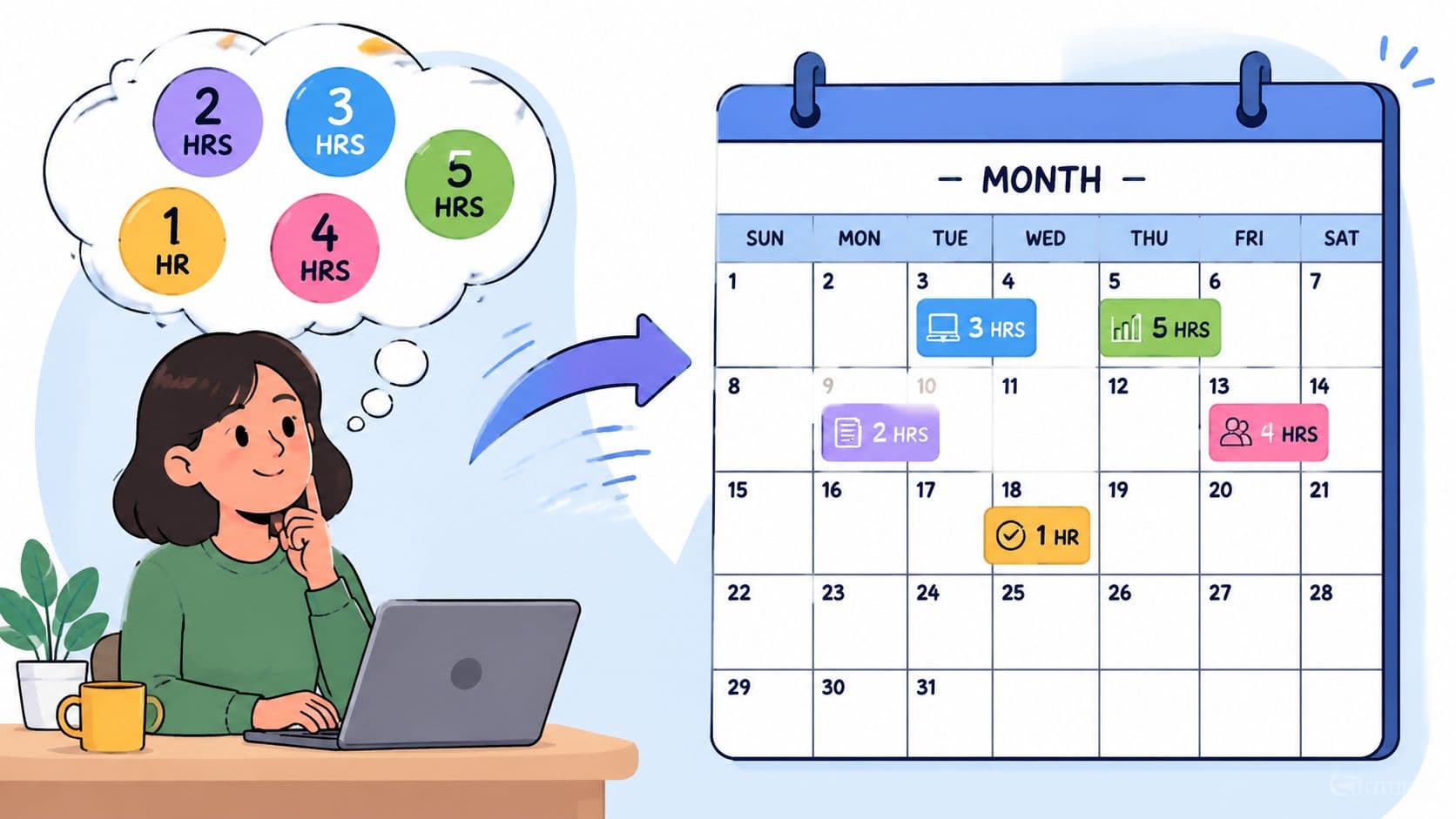
A software estimation framework discussed in this wall-clock estimation approach argues that estimates should be mapped to actual calendar time rather than idealized “programmer days,” and should include uncertainty and feedback from real outcomes. That's exactly right. Nobody works in uninterrupted blocks for days at a time.
Convert effort into wall-clock time
A task estimated at ten hours does not automatically fit into a day and a quarter. Real schedules contain meetings, admin, interruptions, partial availability, and task switching. Shared resources make this even messier.
When converting estimated effort into dates, check:
- Actual availability: Is the owner fully available, or split across multiple initiatives?
- Calendar constraints: Are there reviews, PTO, launch windows, or stakeholder meetings that affect timing?
- Dependency timing: Can the next task start immediately, or does it wait for someone else?
- Batching behavior: Will work happen in one focused block or in fragments across the week?
That translation step is where many “accurate” estimates become late deliveries.
Use a schedule people can see and update
A timeline hidden in a spreadsheet usually goes stale. Teams need the estimate represented in a working tool, where tasks, dates, owners, and dependencies are visible together.
That might be a Kanban board, a calendar view, or a Gantt-style schedule. If you need a straightforward way to visualize sequencing, how to create a Gantt chart is a practical reference for turning task estimates into a real delivery map.
I also like tools that let teams move between list, calendar, and board views without rebuilding the plan each time. Fluidwave is one example because it supports task organization across multiple views and shared progress tracking, which is useful when the estimate needs to live inside day-to-day execution rather than in a static planning document.
Build the schedule around how work actually gets done
A clean planning sequence looks like this:
- Estimate the task effort: Start with the method that fits the work.
- Place dependencies first: Sequence blockers and prerequisite items before filling the calendar.
- Map around fixed events: Reviews, recurring meetings, and launch windows should shape the schedule early.
- Protect focus time: Deep work tasks need uninterrupted blocks or they'll stretch.
- Reserve room for coordination: Handoffs and approvals rarely happen the instant you're ready for them.
A schedule becomes believable when it reflects interruptions before they happen, not after.
This matters for commercial work too. If your project is tied to staged deliverables, timeline realism affects cash flow as much as delivery confidence. Teams handling client projects and operators working on milestone-based engagements often run into this. The operational advice in Capstacker's piece on getting paid on milestone deals is useful because payment timing usually depends on the same assumptions that make project timelines fragile.
A timeline isn't finished when the estimate is done. It's finished when the estimate survives contact with the calendar.
Track Adjust and Improve Your Next Estimate
Even a well-built timeline needs maintenance. Work changes. Priorities shift. Assumptions fail. The teams that improve at timeline estimation aren't the ones that predict perfectly. They're the ones that notice variance early and re-estimate without pretending nothing changed.
Track actuals while the project is still active
Waiting until the project ends is too late. You want to compare actual progress against the estimate while there's still time to respond.
A simple review rhythm helps:
- Check completed work against estimated work
- Look for repeated slippage on the same type of task
- Flag dependencies that are consuming more time than expected
- Decide whether the remaining plan still matches reality
This doesn't need to become heavy process. The point is to catch drift before it hardens into deadline failure.
Re-estimate with discipline
Re-estimation is where many teams get sloppy. They anchor to the old date, subtract work that's done, and assume the remaining work will now behave better than before. It usually won't.
There's also a subtle judgment problem here. Research summarized in this PubMed record on delay and estimation distortion found that even a 2-minute time delay can produce significantly larger estimates, which suggests that elapsed time and context can distort judgment. In project terms, that means re-estimation isn't neutral. Delays, frustration, and fresh setbacks can skew the number upward just as optimism skews early estimates downward.
When you re-estimate, don't ask only “How much is left?” Ask, “What has changed since the original assumptions were made?”
A practical reset method works well:
| Re-estimation question | Why it matters |
|---|---|
| What assumptions broke? | Prevents repeating the same bad logic |
| What new tasks appeared? | Captures hidden work, not just slower work |
| Which dependencies moved? | Updates the real driver of dates |
| What evidence do we have from actuals? | Grounds the revision in observed work |
Use every project as training data
The payoff comes later. When teams keep a record of estimates, actual effort, delays, and causes, the next plan gets sharper. You start seeing patterns. Certain approvals always run long. Certain handoffs always create churn. Certain task types are routinely underestimated.
That's how estimation matures. Not through confidence, but through feedback.
If you want a place to turn estimates into working schedules your team can use, Fluidwave is worth a look. It gives you multiple task views, shared progress tracking, and a practical way to keep timelines connected to the day-to-day work instead of leaving them buried in a planning document.
Focus on What Matters.
Experience lightning-fast task management with AI-powered workflows. Our automation helps busy professionals save 4+ hours weekly.