Discover effective task management for teams with clear workflows, prioritization, and delegation strategies that boost productivity and accountability.
August 28, 2026 (1mo ago)
Task Management for Teams: A Practical Guide That Works
Discover effective task management for teams with clear workflows, prioritization, and delegation strategies that boost productivity and accountability.
← Back to blog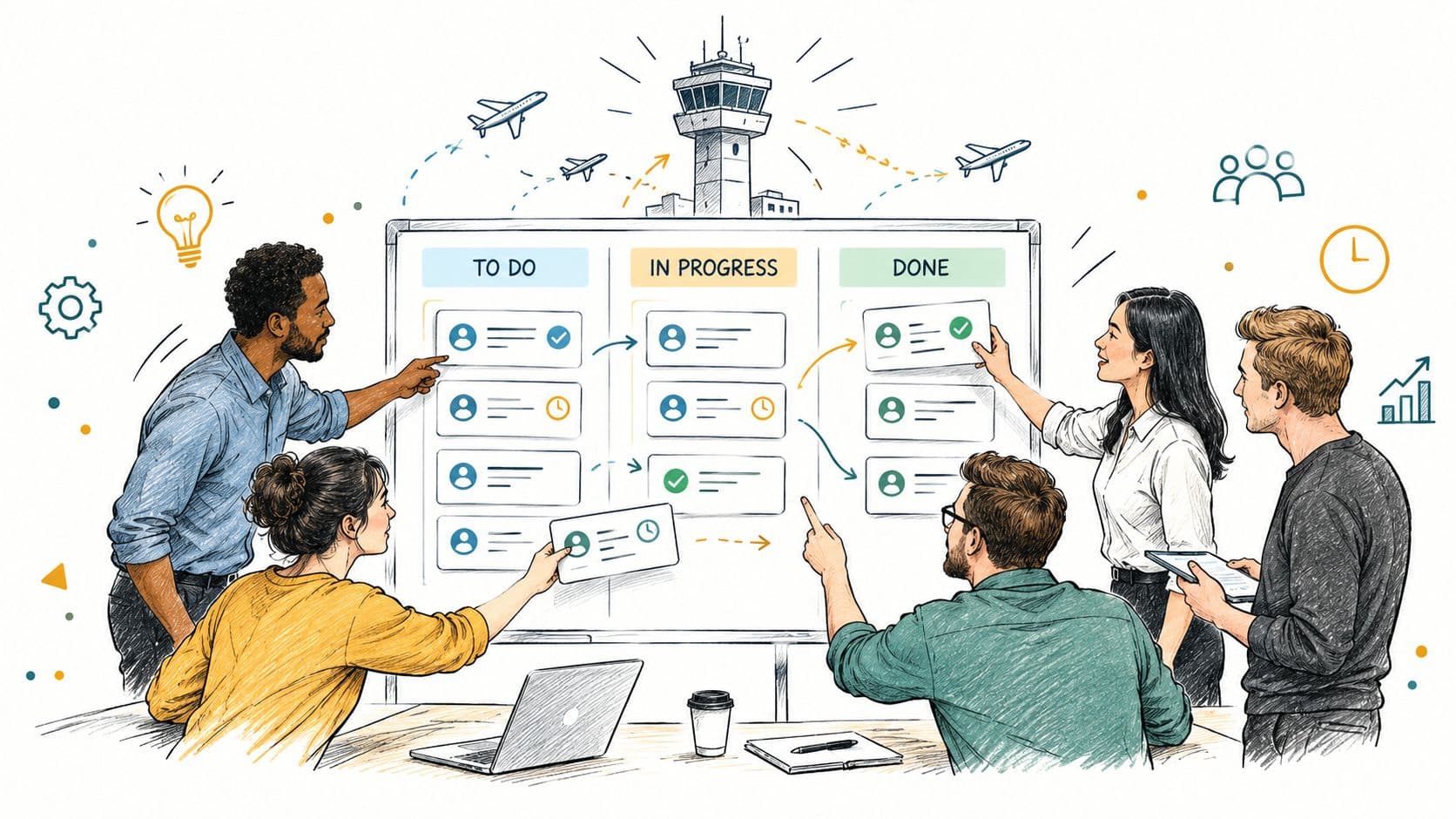
A launch is three days away, and your five-person team is busy. A designer has started the landing page, a developer is waiting on final copy, marketing assumes the tracking links are handled, and the product manager is searching through chat for the message that assigned the release checklist. Everyone is working, but nobody can answer a simple question: what needs to happen next, who owns it, and what could stop it?
That's the problem task management for teams must solve. It isn't a collection of checkboxes or a prettier replacement for a spreadsheet. It's a shared coordination system that makes work visible, sequences dependent tasks, distributes responsibility fairly, and gives people enough structure to follow through.
When Tasks Disappear Into Chat Threads
The launch task appeared in a Slack thread on Tuesday afternoon. Someone asked whether the analytics events had been added to the new onboarding flow. A developer replied that the events were ready for testing, the product manager reacted with a thumbs-up, and the conversation moved on to pricing feedback, a customer escalation, and an unrelated hiring question.
By Thursday, nobody knew whether the events had been tested. The developer thought the product manager owned verification. The product manager thought the developer would confirm completion. Marketing discovered the gap during campaign setup, when the missing data meant the team couldn't validate the funnel.
Nothing dramatic happened. No one ignored the work. The request appeared once, scrolled out of sight, and became dependent on memory.
Chat is useful for discussion, but it's a poor place to hold the official state of work. A message can contain context, but it rarely gives the whole team a reliable view of ownership, priority, deadline, dependency, and status. Even a careful person can miss a request when several conversations compete for attention.
Practical rule: Use chat to discuss a task, but use a shared task record to decide whether the task exists, who owns it, and whether it's finished.
The fix doesn't require a complicated rollout. Convert the request into one shared task. Assign one owner. Add the due date. Record the acceptance criteria. Link the relevant conversation, then mark the blocker if testing depends on a completed build. A team member opening the task should immediately understand the next action without reconstructing the story from old messages.
That approach also supports asynchronous communication, because people can check the current state when they're ready instead of asking someone to repeat the update in another meeting.
The cost of untracked work is coordination loss. The rest of this guide focuses on the principles that prevent it: shared visibility, deliberate prioritization, role-based delegation, fair dashboards, a sustainable weekly cadence, and an accessible rollout that people can maintain.
What Task Management for Teams Is
A team can have skilled people and still lose time between handoffs. One person finishes a draft, another is waiting for approval, and a third is working from an older request. The problem is not effort. It is the missing coordination layer that shows how individual work connects.
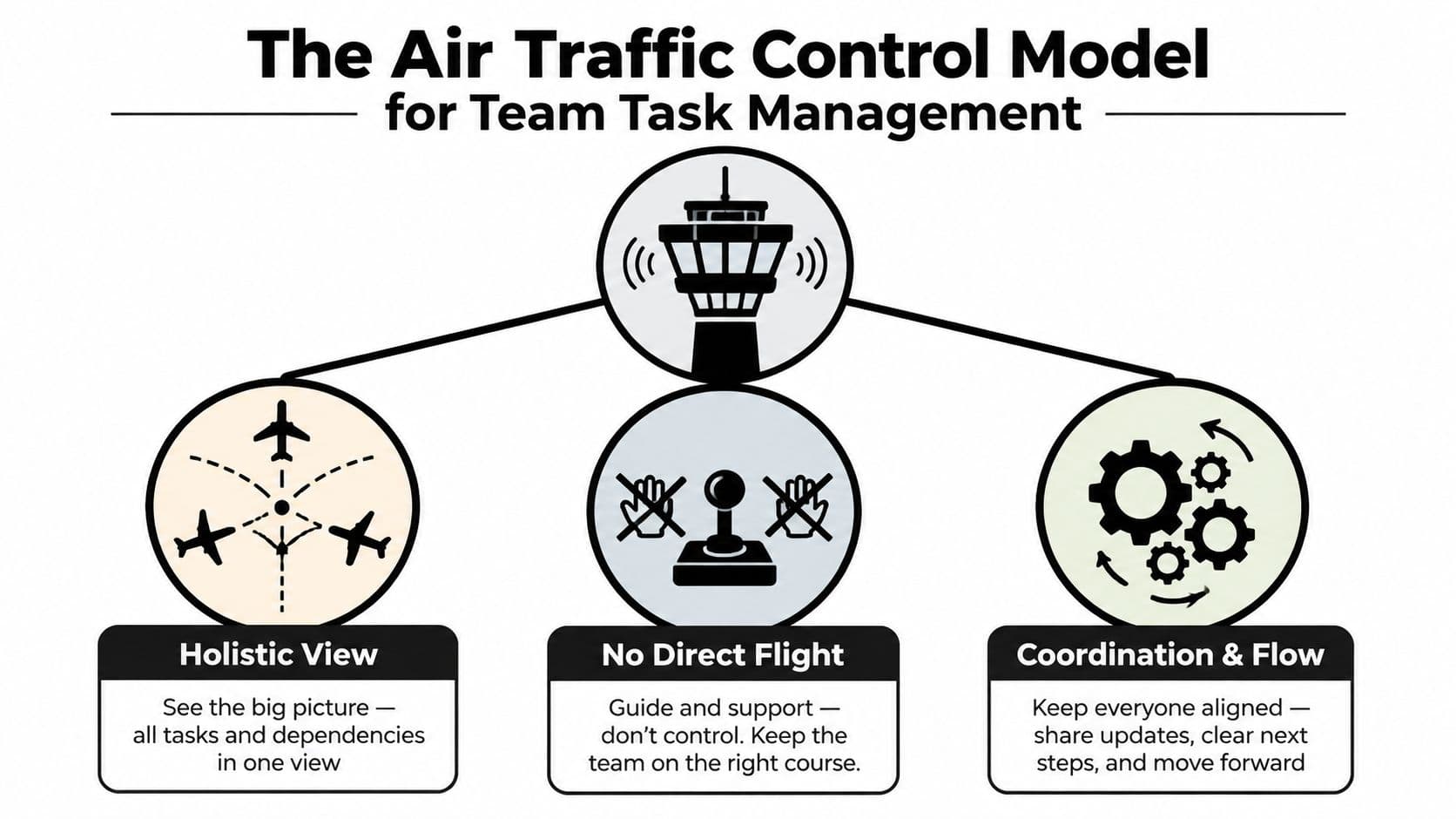
A team task system provides that layer. It gives everyone a dependable view of commitments, decisions, dependencies, and next actions, while leaving judgment, craft, and leadership with the people doing the work. The goal is a shared operating picture, not another place to record activity.
The three controls every system needs
A single source of truth answers, “Where does this task live?” Email, chat, documents, and calendars can still support the work, but the task record should hold the current status and next action. If two places disagree, trust in the system falls quickly.
One owner per task answers, “Who is responsible for moving this forward?” Contributors and approvers may participate, yet one person must carry accountability. That owner can request help, escalate a blocker, or change the plan when conditions shift. Clear ownership also makes delegation to an assistant safer, because the task still has one accountable person.
A trusted status answers, “What state is the work in?” Use terms simple enough for everyone to apply consistently. A task might move from Backlog to Ready, In Progress, Blocked, Review, and Done. Status should describe the current condition, not the outcome people hope to report.
Prioritization supplies the sequence. A visible backlog without an agreed order still makes each person guess what deserves attention. The system should show urgent work, waiting work, and dependencies that prevent another item from starting.
Team coordination is different from a personal list
A personal to-do list helps one person remember commitments. Team task management coordinates relationships between commitments. It makes dependencies, handoffs, shared milestones, and cross-team decisions visible.
That distinction supports fairer workload distribution. A highly organized employee can still miss a deadline if an input arrives late, the reviewer is unclear, or several departments assume they come first. Shared structure exposes those conditions early, gives managers a clearer basis for rebalancing work, and reduces the memory burden for neurodivergent team members who benefit from visible, consistent expectations. Coordination, rather than individual discipline, is the outcome the system must produce.
Choosing a Prioritization Method That Fits the Work
Prioritization methods aren't interchangeable labels for the same activity. Each one helps with a different decision, and each can create confusion when a team applies it outside its intended context.
The Eisenhower matrix works well for a solo triage session or a small operations team facing a crowded week. Sort work into urgent and important categories, then decide whether to do it, schedule it, delegate it, or remove it. It helps when the central question is, “What deserves attention now?” It's less useful for comparing a large product backlog where several valuable ideas compete for limited capacity.
RICE is better suited to product teams evaluating feature requests. Score each option by Reach, Impact, Confidence, and Effort, then use the result to make trade-offs explicit. For example, a feature with broad customer reach and meaningful impact may still lose priority if the team has low confidence in the evidence or expects substantial effort. RICE creates a reasoned conversation, but it can give false precision when estimates are weak.
MoSCoW divides work into Must have, Should have, Could have, and Won't have for the current scope. It fits release planning when stakeholders need a clear boundary around what will and won't ship. Weighted shortest job first favors work that delivers strong value quickly, which can help a team manage a queue, but it may push aside important work whose benefit takes longer to appear.
| Method | Best For | Weakness |
|---|---|---|
| Eisenhower matrix | Urgent versus important triage | Doesn't compare complex backlog options well |
| RICE | Product feature and investment decisions | Depends on credible estimates |
| MoSCoW | Release scope and stakeholder alignment | Categories can become political |
| Weighted shortest job first | Sequencing valuable work with limited capacity | Can undervalue longer-term outcomes |
Use task prioritization techniques as a reference point, but don't select a framework because another team uses it. Start with the decision you need to make. Are you sorting today's interruptions, choosing product investments, defining release scope, or sequencing a queue?
Review the method quarterly. Your work may shift from launch execution to maintenance, discovery, customer support, or a mixed portfolio, and the framework that helped last quarter may no longer reflect the decisions in front of you.
Delegating Tasks Without Dropping the Ball
Delegation fails when the sender transfers an obligation but keeps the information in their own head. The recipient receives a sentence such as “Can you handle the vendor follow-up?” and must then discover the purpose, deadline, contact, constraints, and expected result through a chain of messages.
A stronger system separates three roles.
Give each role a clear job
The owner is responsible for completion and outcome. Assign this role to the person who can coordinate the work, even if another person performs part of it.
The reviewer checks quality before approval. Use a reviewer when the task affects customers, finances, compliance, brand standards, or another team's work. Don't assign a reviewer just to create another notification.
The informed party needs visibility but isn't expected to act. This role prevents unnecessary meetings while keeping stakeholders aware of progress and results.
Write the task brief so an assistant or teammate can execute it without guessing:
- Context: Explain why the task matters and include the relevant background.
- Outcome: Describe the result, not just the activity. “Prepare a reconciled supplier list” is clearer than “Review suppliers.”
- Deadline: State the delivery date and any earlier checkpoint required for review.
- Constraints: Include budget, format, approved sources, privacy requirements, or decisions the owner must not make alone.
- Definition of done: Name the evidence that closes the task, such as an uploaded file, sent confirmation, approved draft, or updated record.
Recurring administrative work often suits a virtual assistant when the process is stable. Batch similar requests, define a service-level expectation, provide templates, and review the output weekly rather than interrupting the assistant for every item. A lightweight costs vs benefits review can help you decide whether delegation removes meaningful coordination work or merely creates another layer to supervise.
For practical guidance on maintaining responsibility after handoff, these field team accountability tips are useful beyond field operations.
Use this first-day check after delegation:
- Confirm receipt: Ask the owner to acknowledge the brief and flag missing context.
- Verify the next action: Make sure the task has moved from assigned to an active state.
- Set the checkpoint: Agree on when the owner will report progress or raise a blocker.
- Protect the handoff: Keep questions and decisions on the task record instead of scattering them across chat.
Designing Dashboards for Coordination, Not Competition
An individual leaderboard answers the wrong question. It encourages managers to ask who closed the most tasks, while a useful team dashboard asks where work is slowing down and who needs help.
That distinction becomes critical when tasks are interdependent. A designer may finish a brief quickly, but the developer cannot start until the requirements are approved. The developer's visible output may look lower even though the dependency, not effort, controls progress. Ranking people in that situation can punish collaboration and encourage employees to optimize their own numbers instead of the shared result.
A 2025 study on relative performance information found that individual relative performance information improved performance when tasks weren't interdependent, but reduced performance when tasks were interdependent. Team-level relative performance information improved performance in the interdependent condition by strengthening cohesion and coordination (study details).
Show flow, not busyness
A useful dashboard can include:
- Work in progress: How many tasks are active, and where is the queue building?
- Blocked items: Which tasks need a decision, input, approval, or resource?
- Queue age: How long have tasks waited before someone starts them?
- Shared milestones: Which outcomes matter to the whole team, and what remains before completion?
- Workload distribution: Who has too much active work, and who is waiting for input?
A Kanban board makes status visible. A calendar view makes timing visible. A workload heat map makes capacity concerns visible. These views should describe the same underlying tasks rather than create separate reporting systems.
| Signal Type | Team Dashboard | Individual Leaderboard |
|---|---|---|
| Primary question | Where is flow blocked? | Who closed the most? |
| Useful behavior | Helping, sequencing, escalating | Optimizing personal counts |
| Treatment of dependencies | Makes them visible | Can make them look like underperformance |
| Best use | Interdependent team delivery | Narrow, independent production work |
Teams comparing platforms can use a practical guide to find team collaboration tools for startups, then test whether each option supports shared milestones and dependency visibility. The tool matters less than the behavior the dashboard rewards.
Building a Weekly Cadence That Sticks
A task system needs a rhythm, but the rhythm should reduce meetings rather than create meetings about meetings. The most reliable cadence is short, predictable, and connected to decisions people must make.
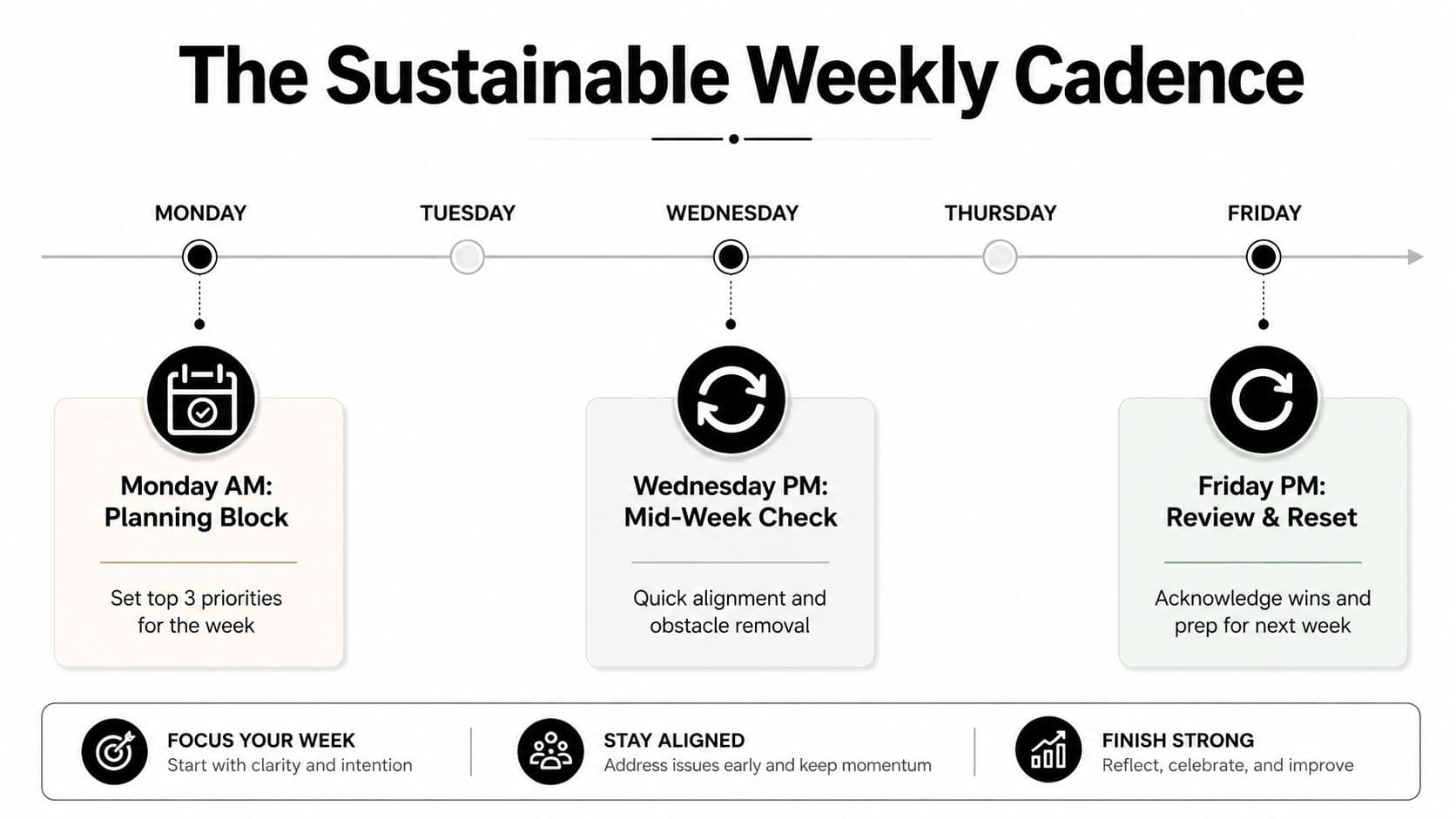
Monday sets the direction
Use a planning block to choose the week's highest-value outcomes. Don't fill every available space. Confirm the top priorities, identify dependencies, assign owners, and move work that can't realistically start into a later queue.
Ask three questions:
- What must move this week?
- What input or approval could delay it?
- What will we deliberately not start?
Wednesday is for correction, not status theater. Each owner should update the task record before the check-in. The team then discusses only blockers, changed assumptions, overloaded people, and decisions that can't wait.
Friday closes the loop. Record what shipped, what slipped, what changed, and what should be retired. A slipped task isn't automatically a failure. The useful question is whether the team learned about the constraint early enough to make a responsible adjustment.
Measure movement through the system
Track metrics that describe flow:
- Cycle time: How long work takes from active start to completion.
- On-time completion rate: How reliably tasks finish by their agreed deadlines.
- Completed versus added: Whether the team is reducing its queue or continually adding more work than it finishes.
Don't treat total tasks closed as the main success measure. A person can close many trivial tasks while a critical dependency remains blocked. The dashboard should help leaders improve sequencing and capacity, not reward activity for its own sake.
A simple first-week template looks like this:
| Day | Practice | Output |
|---|---|---|
| Monday morning | Choose priorities and owners | A ranked weekly queue |
| Wednesday afternoon | Review blockers and dependencies | Clear decisions and adjusted plans |
| Friday afternoon | Review delivery and retire stale work | A clean queue for the next cycle |
Keep the cadence long enough for people to form a habit, but short enough that the team can change a rule when it creates friction.
Rolling Out a System Your Team Will Adopt
Start on a Monday with a small pilot rather than a company-wide migration. Select a workflow with visible pain, such as a launch checklist, client onboarding process, or recurring operations queue. Include people who create tasks, complete them, review them, and depend on the results. A system works like a shared map: it helps each person see where work sits and what the next handoff requires.
A practical four-week pilot
Week one, clarify the operating rules. State the system's purpose, define task statuses, explain what priority means, and name the person responsible for maintaining the queue. Assign owners to pilot tasks and write several complete briefs, including the requested outcome, deadline, and relevant context.
Week two, migrate one workflow. Move only the selected workflow into the shared system. Keep statuses limited, connect dependencies, and remove duplicate tracking where possible. The goal is one reliable source of coordination, not another place to copy updates.
Week three, run the cadence. Use the Monday planning block, Wednesday blocker check, and Friday review. Ask participants where the system reduces guessing and where it adds work. Record those observations while the workflow is still small enough to adjust.
Week four, survey and adjust. Review feedback, inspect blocked tasks and stale items, and change the rules before expanding. A coordinator, operations lead, or virtual assistant can schedule check-ins, clean task records, write follow-up items, and keep the pilot moving. That division prevents a founder or manager from becoming the only person responsible for upkeep.
Teams seeking a practical place to manage action items in a workspace can use that approach when deciding where decisions, owners, and follow-ups should live.
Make the system usable for more minds
Clear structure can support neurodivergent teammates by reducing the information they must hold in working memory. A 2021 workplace study on ADHD associated inattention with work-related problems and identified practical supports including structured notes and agendas, regular supervision with feedback, smaller targets and work units, quieter workspaces, flexible time, and incentive systems (workplace ADHD research). A separate review connects ADHD symptoms with organization and time-management difficulties and discusses workplace accommodations and coaching as support for organizational skills (workplace accommodations review).
Use written briefs instead of relying on verbal huddles. Offer an asynchronous alternative to meetings, protect quiet hours, and let people customize dashboards so they see the fields and views they need. Concrete planning and follow-through support matter because controlled research found significant workplace deficits among adults with ADHD compared with a matched non-ADHD group (controlled workplace study).
Finish the pilot with a fairness check:
- Balanced workload: Look for hidden administrative work and repeated urgent assignments.
- Transparent priorities: Apply the same priority rules across remote and in-office staff.
- Visible contribution: Recognize review, coordination, and unblocker work, not only completed tickets.
- Shared ownership: Let the team improve the system instead of making one manager police it.
A task system earns adoption when it helps people make better decisions with less guessing. Begin with one workflow, assign real owners, and revise the rules based on what the team encounters.
Fluidwave combines shared task management, multiple views, automation, and delegation to human virtual assistants. Teams can keep ownership and progress visible while moving repeatable work to appropriate support. Create a focused workflow, define the handoff, and visit Fluidwave to explore a way to coordinate the work your team needs to finish.
Focus on What Matters.
Experience lightning-fast task management with AI-powered workflows. Our automation helps busy professionals save 4+ hours weekly.