Master short term and long term goals with a practical method. Learn to set SMART objectives, break them into actions, and track progress without burnout.
September 25, 2026 (1d ago)
Short Term and Long Term Goals: How to Align Them
Master short term and long term goals with a practical method. Learn to set SMART objectives, break them into actions, and track progress without burnout.
← Back to blog
You've probably experienced the disconnect firsthand. The annual plan says your team will improve customer retention, launch a new service, or prepare for a larger market. Monday arrives, and everyone is answering messages, fixing defects, revising presentations, and attending meetings that weren't on the plan. By Friday, the long-term goal still sounds important, but nobody can point to the work that moved it forward.
Short-term goals govern the work you can complete and review soon. Long-term goals describe the direction you want your career, team, or business to take. Neither works well alone. Long-term goals without near-term commitments become slogans, while short-term goals without a destination create activity without progress.
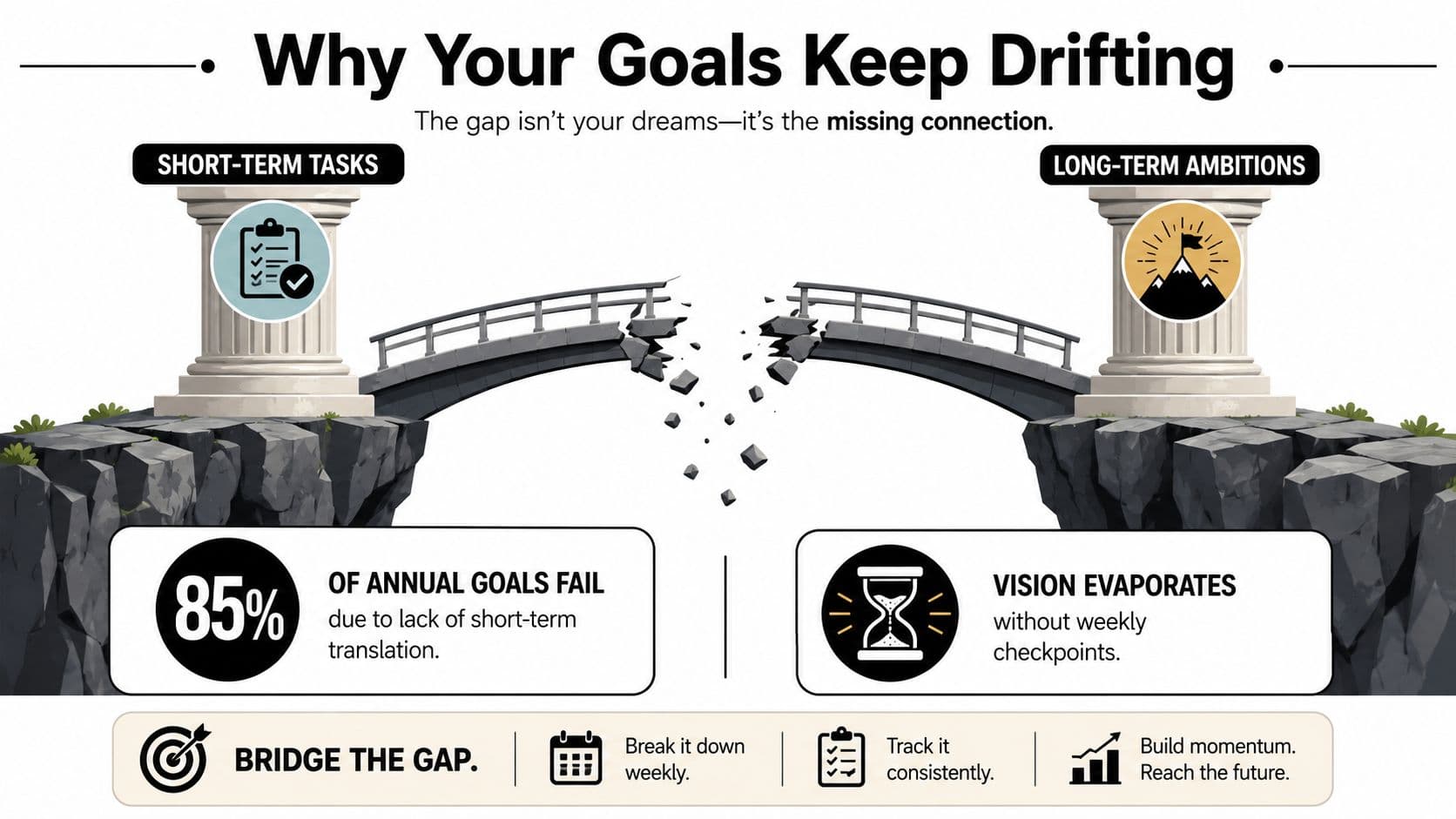
Why Your Goals Keep Drifting
Goal drift usually starts with a planning mistake: treating strategy and execution as separate conversations. A leadership team may agree that it wants to become the most trusted provider in a category. A department may translate that into “improve the customer experience.” Individual contributors then receive tasks such as updating documentation, responding to tickets, and joining research calls. Each task may be reasonable, yet the connection to the ambition remains invisible.
The problem isn't that people lack discipline. The problem is that the plan doesn't tell them what to do when competing priorities arrive. A product manager works on a roadmap, sales asks for a custom feature, and support escalates a recurring issue. Without a short-term decision rule, the loudest request wins. The annual objective remains on the slide deck while the team spends its capacity elsewhere.
The missing connection
A useful plan answers three questions at every level:
- Direction: What outcome are we trying to create over the long term?
- Translation: What must change during the current planning period?
- Evidence: What will we inspect to determine whether the work is helping?
Suppose a marketing team's long-term goal is to build a dependable pipeline from organic search. “Publish more content” is not a sufficient short-term goal. A workable commitment might define the content group to be improved, the review process, the owner, and the signal that will be checked during the next review. The team can then decide whether this week's brief, editorial review, or technical fix supports the commitment.
Structured goal-setting has a practical relationship with performance. In a field study summarized by Tilburg University's reporting on goal setting, workers produced 16% more, hourly productivity rose 8%, and average labor output increased 13% after goal setting. Piece-rate workers saw a 32% output increase and a 24% productivity gain, while reported goal tracking was associated with 72% achievement, compared with 17% among people who didn't track progress, according to the same source.
Catch drift before it becomes normal
The strongest teams don't wait for the annual review to discover that priorities have changed. They create a recurring checkpoint where someone asks:
- Which long-term outcome does this work support?
- What evidence has changed since the last review?
- What should we stop, continue, or adjust?
- What is the next visible action, and who owns it?
That rhythm also helps individuals. If you're building a new leadership capability, a weekly review should identify a conversation to lead, a decision to document, or feedback to request. A small record of commitments is more useful than another motivational statement. People who want a simple way to structure personal goals and streak-based habits can also consult this handleiding doelen streaks RecensioAI B.V., particularly when consistency is the problem.
Practical rule: If a long-term goal can't produce a clear action for this week, it isn't yet connected to execution.
The Architecture of Effective Goal Setting
A long-term goal gives you a destination. A short-term goal gives you a controlled experiment in the direction of that destination. The architecture between them matters because the connection point is where most plans fail.
Consider the difference between these two objectives:
| Weak objective | Executable objective |
|---|---|
| Improve sales performance | Increase qualified opportunities by improving the discovery process, with the sales operations lead responsible for the review |
| Build a stronger team | Establish a documented coaching routine owned by the team manager and inspect progress during regular one-to-ones |
| Modernize reporting | Replace the current manual workflow with an agreed reporting process, with a named analyst responsible for delivery |
The stronger versions identify what will happen, how it will happen, and who is responsible. They also give the team something concrete to examine. A goal doesn't need to predict every detail, but it must be specific enough to guide choices when time and resources are limited.
Turn intentions into milestones
A long-range objective should be divided into time-lined benchmarks, not left as a statement of eventual success. Guidance from the University of California Office of the President on writing SMART goals emphasizes that time-bound goals need a clear deadline or timeline. It also recommends breaking long-range goals into benchmarks that create urgency and a schedule for checking progress.
For a transformation project, the sequence might look like this:
- Long-term outcome: Establish a reliable self-service reporting capability.
- Near-term benchmark: Agree on the first reporting use case and acceptance criteria.
- Weekly commitment: Interview users, document the workflow, and resolve one disputed definition.
- Review evidence: Confirm whether the agreed output is usable by the people who requested it.
This doesn't turn a complex project into a rigid script. It gives the team a way to learn without losing direction. If the benchmark proves unrealistic, you adjust the benchmark or capacity. You don't casually rewrite the destination every time delivery becomes difficult.
The distinction between a goal and an objective can sharpen this structure further. A goal often describes the broader result, while an objective defines a more observable commitment. The difference between goals and objectives is useful when a planning document contains impressive ambitions but few statements that a team can verify.
Tracking is part of the design
Tracking shouldn't be added after the goal has been approved. Decide in advance what information will show movement, who will maintain it, and when the team will review it. If the evidence is unavailable, either create a practical measurement method or rewrite the goal so it can be evaluated objectively.
This principle applies beyond corporate projects. Students, freelancers, and early-career professionals often need the same structure for competing commitments. A practical student guide to time management can help translate a broad intention into scheduled work, protected focus, and visible follow-through.
A useful test is simple: can another person read the goal and understand the expected result without asking the author to interpret it? If not, the plan still contains an aspiration rather than an operating commitment.
Applying the SMART Framework
The SMART framework is useful because it forces a vague ambition through five filters: specific, measurable, achievable, relevant, and time-bound. The framework doesn't guarantee success. It makes weak planning easier to detect before the work begins.

Start with the sentence you currently use. “Improve sales,” “become a better manager,” and “make the process more efficient” all describe worthwhile intentions, but none tells a colleague what to do next. Rewrite each one by adding the missing operating details.
Specific means assignable
A specific goal should state what will be done, how it will be done, and who is responsible. The SMART goal guidance from Southern New Hampshire University also describes measurability as identifying the data or metric that will demonstrate progress.
A vague sales ambition might become:
“Improve sales.”
A more useful version could be:
“The account team will standardize discovery questions, review completed discovery notes each week, and use the agreed opportunity-quality measure to identify weak qualification.”
The rewrite doesn't pretend that the result is guaranteed. It defines the work, the method, the owner, and the evidence.
Measurable means inspectable
A measurement can be a count, a completion state, a quality assessment, or another verifiable signal. The important point is that the team agrees what counts as progress before opinions become polarized.
For example:
- Vague: “Improve onboarding.”
- Specific: “The onboarding manager will document the first-use journey, remove the agreed friction points, and review completion feedback at the end of the planning period.”
- Measurable: “The team will compare the agreed onboarding indicators against the starting position during the review.”
Don't choose a metric merely because it is easy to collect. A busy team can produce plenty of activity data while missing the outcome that matters. Ask whether the measure helps you decide what to continue or change.
Achievable and relevant protect the purpose
Achievable doesn't mean easy. It means the commitment fits the available authority, skills, time, and dependencies. If an individual contributor is accountable for improving a workflow but cannot change the underlying system, the goal needs a partner, a narrower scope, or a different owner.
Relevance prevents impressive side projects from displacing the main objective. A professional may want to learn a new tool, publish more often, and redesign a process. Those activities become relevant only when they strengthen the current direction. If they don't, record them as ideas rather than commitments.
Time-bound creates the review point
“Eventually” is not a deadline. A time-bound goal includes a completion date or defined period, then uses interim checks to reveal whether the work is moving at a sustainable pace. Quarterly and weekly planning work well together because the quarter creates a meaningful boundary while the weekly review catches drift early.
A practical template is:
“By [date or review point], [owner] will [specific outcome] by [method]. Progress will be assessed using [evidence], with a review on [checkpoint].”
Use that template for the long-term objective's next milestone, not for every minor task. The aim is clarity without turning the entire working day into administrative reporting. For more approaches to structuring goals, milestones, and accountability, compare the goal-setting frameworks that fit your team's operating style.
Bridging the Gap Between Vision and Action
The most reliable translation sequence is long-term objectives, quarterly themes, weekly reviews, and daily actions. Each layer has a different job. The long-term objective protects direction, the quarterly theme limits the immediate focus, the weekly review tests reality, and the daily action makes progress possible.
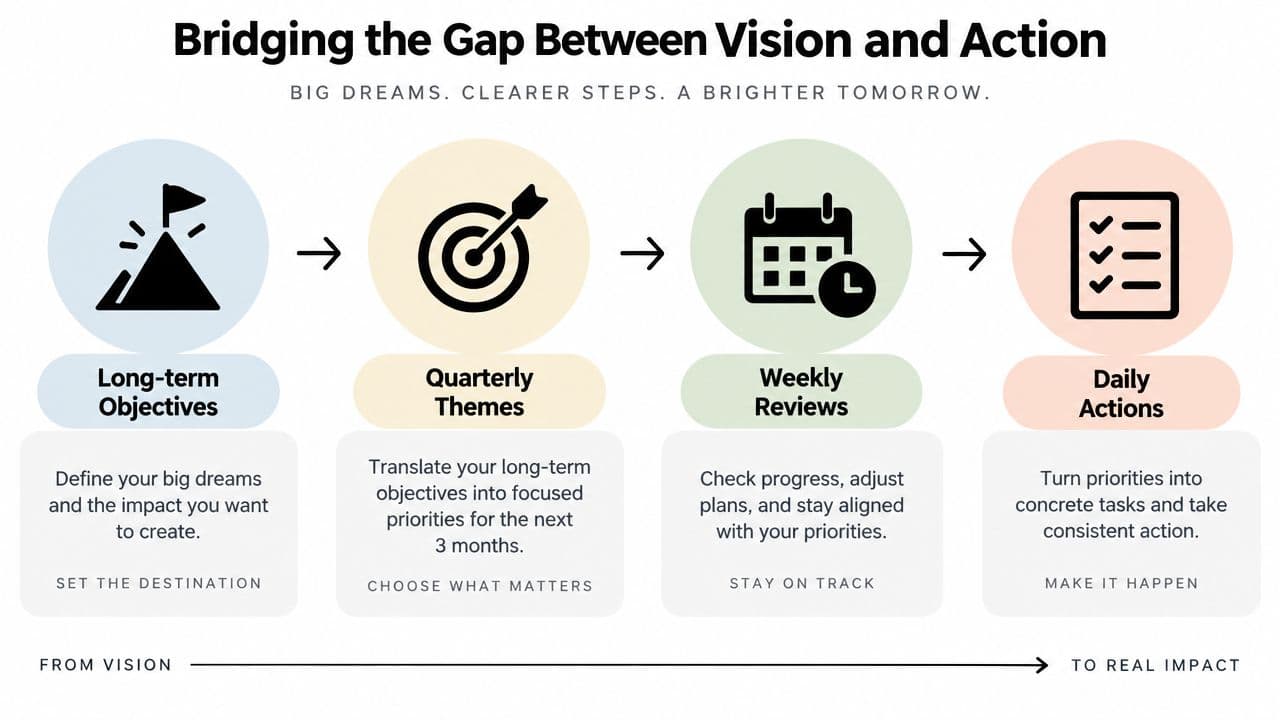
A company might set 3–7 company-level goals across a 3–5 year horizon, identify annual themes for each goal, translate those themes into quarterly goals, and recalibrate during weekly and quarterly reviews, as described in Tability's comparison of short-term and long-term business goals. This structure reduces the temptation to replace a long-term objective before the organization has given the work enough time to produce evidence.
Compare two planning styles
| Ambitious planning | Disciplined translation |
|---|---|
| Lists every important initiative | Selects the theme that matters most now |
| Treats the annual plan as a fixed promise | Treats it as direction with scheduled learning |
| Assigns tasks without a visible outcome | Connects tasks to a quarterly result |
| Reviews progress when the year is nearly over | Checks movement every week and recalibrates at planned intervals |
The disciplined version isn't less ambitious. It makes ambition survivable. A customer-experience objective may require research, service changes, training, and measurement. The quarterly theme might focus only on clarifying the highest-friction journey. That narrower scope gives the team a chance to learn what actually needs to change.
For personal goals, the same logic applies. “Move into a strategic leadership role” can become a quarterly theme around leading a cross-functional initiative. The weekly review then identifies the next stakeholder conversation, decision, or piece of evidence needed. Daily actions should be small enough to complete, but meaningful enough to keep the theme alive.
Use reviews to make decisions
A review is not a status recital. It should produce a decision. Ask what changed, what blocked progress, what no longer matters, and which commitment deserves the next available capacity.
The review can also protect the long-term goal from short-term noise. A senior stakeholder may introduce an urgent request, but the team can assess it against the current theme rather than accepting it automatically. If the new work matters more, make the trade-off explicit by removing or delaying something else.
The guide to creating an action plan can help turn this sequence into assigned work, dependencies, and checkpoints. The important practice isn't the document itself. It's the repeated movement from intention to decision to action to evidence.
Let the plan learn without wandering
Recalibration isn't failure. It means the team is using new information. The boundary is important, though. Change a quarterly action when evidence demands it. Don't change the long-term direction merely because the first implementation was inconvenient or because a new idea is more exciting.
A stable direction with flexible actions gives a team room to learn without giving it permission to drift.
Prioritizing Without Burning Out
Overcommitment often looks like ambition at the beginning. A manager approves several strategic initiatives, each with a credible business case. The team then carries the old workload, absorbs new requests, and tries to make progress on every goal at once. Meetings multiply, focus fragments, and people work late to preserve the appearance that every commitment remains active.
Effective goal-setting requires a capacity decision before it requires a motivational one. A government toolkit recommends goals that are SMARTS, meaning specific, measurable, achievable, realistic, time-framed, and strengths-based. It also emphasizes identifying strengths, clarifying responsibility, and narrowing the focus to one or two short-term goals when needed, as explained in the New York City goal-setting and individualized service-planning toolkit.
Make the constraint visible
Before accepting a new objective, check four conditions:
- Capacity: What existing work will make room for it?
- Ownership: Who can make the required decisions without waiting indefinitely?
- Strengths: Which people already have the capability to move it forward?
- Evidence: What will tell us that the commitment deserves continued investment?
If the answer to the first question is “nothing,” the new goal isn't funded by capacity. It's an additional wish placed on top of existing work. A responsible plan names the displaced work, reduces the scope, or postpones the new commitment.
Use a narrow operating routine
A sustainable routine can be simple:
- At the start of the planning period, select the short-term goals that directly support the long-term direction.
- During the weekly review, inspect evidence, identify blockers, and choose the next actions.
- During daily planning, reserve time for the highest-value action before reactive work fills the day.
- At the end of the period, record what was completed, what changed, and what should be carried forward.
- At the quarterly review, decide whether the theme should continue, change, or close.
This cadence gives busy professionals several chances to correct course without requiring constant planning. It also creates a record of decisions, which helps managers explain why a target moved and helps individuals show how their work contributed.
Protect focus with deliberate trade-offs
A goal should earn its place by supporting a meaningful outcome, not by sounding impressive. If two commitments compete for the same specialist, choose the one with the stronger connection to the current theme. If a task can be delegated without weakening quality, assign it clearly instead of allowing it to consume the owner's attention. If a goal repeatedly misses checkpoints because the scope is too broad, narrow the goal rather than blaming the team for insufficient effort.
Fluidwave can support this operating pattern by organizing tasks across list, table, calendar, Kanban, and card views, linking work to goals, and adding milestones, subtasks, delegation, and recurring reviews. Visit Fluidwave to connect daily work with broader objectives, assign ownership, and make the next checkpoint part of the workflow rather than an afterthought.
Focus on What Matters.
Experience lightning-fast task management with AI-powered workflows. Our automation helps busy professionals save 4+ hours weekly.