Master the differences between goals and objectives. Learn how to align long-term vision with measurable steps to boost team productivity and personal focus.
September 13, 2026 (1d ago)
Differences Between Goals and Objectives Explained
Master the differences between goals and objectives. Learn how to align long-term vision with measurable steps to boost team productivity and personal focus.
← Back to blog
A team can spend an entire week answering messages, attending meetings, updating task boards, and closing small requests without making meaningful progress on its most important priority. The problem usually isn't effort. It's that people are completing work without a shared understanding of how each task connects to the result the team wants.
That's where the differences between goals and objectives become operationally important. A goal describes the broad destination. An objective defines the measurable checkpoint that shows whether the team is moving toward it. Once you separate those levels, a crowded to-do list becomes easier to prioritize, delegate, and review.
Why Your Team is Busy but Not Moving Forward
A startup team decides it needs to “improve customer retention.” The founder asks marketing to publish educational content, product to add requested features, customer success to schedule more check-ins, and operations to automate support follow-ups. Everyone is active. The shared workspace fills with completed tasks.
A month later, nobody can clearly explain what changed. The team has produced more content, released features, and contacted customers, but those activities were never connected to a defined checkpoint. Each department interpreted the broad intention differently.
The goal was improve customer retention. It gave the team a meaningful direction, but it didn't explain what success would look like in the next work cycle. An objective might define a specific retention result, the customer group involved, the measurement method, and the date for review. That objective gives people something they can observe and verify.
Goals describe the destination
A goal is generally a broad, high-level statement of intent. It can be aspirational and qualitative, such as:
- Strengthen customer relationships
- Build a healthier personal routine
- Expand the company's presence in a target market
- Create a more reliable support operation
Goals help leaders make choices because they establish the outcome that matters. They also give work emotional and strategic meaning. A person is more likely to understand why a task matters when it connects to a larger result.
Objectives make progress visible
An objective turns that direction into an observable result. It answers practical questions:
- What exactly will be accomplished?
- How will progress be measured?
- Who owns the result?
- When will the team review completion?
- What threshold counts as success?
The Stony Brook guidance on articulating goals and objectives describes goals as broad outcomes and objectives as specific, measurable outcomes with a defined timeframe. That distinction matters because an objective can be assigned, tracked, and audited, while a goal often needs interpretation before anyone can act on it.
Practical rule: If two reasonable team members could complete different work and both claim they followed the plan, the statement probably needs an objective beneath it.
This also applies to process improvement. Before automating a workflow, clarify the business result and the checkpoint that proves the change helped. A practical guide to how automation cuts SME costs can help leaders think through the connection between repetitive work, operating capacity, and measurable outcomes.
The distinction doesn't reduce ambition. It protects ambition from being diluted by disconnected activity. The goal keeps people pointed in the same direction, while objectives tell them what must become true next.
The Three Core Differences in Scope and Measurement
The clearest way to understand goals and objectives is to compare them across scope, time horizon, and measurability. These dimensions overlap, but they answer different planning questions.
| Feature | Goals | Objectives |
|---|---|---|
| Scope | Broad and strategic | Narrower and execution-focused |
| Time horizon | Often longer-term | Usually tied to a defined work cycle or deadline |
| Measurement | May remain qualitative | Must be observable and measurable |
| Function | Defines the desired destination | Shows how progress will be demonstrated |
| Ownership | Guides shared direction | Assigns responsibility for a specific result |
| Language | Aspirational and outcome-oriented | Precise, action-oriented, and auditable |
Scope separates purpose from delivery
A goal covers a wide area of intent. “Create a more reliable customer experience” could influence product design, support procedures, training, and communication. It gives those activities a common reason to exist.
An objective has a tighter boundary. It might address one customer journey, one process, or one measurable result. Objectives shouldn't attempt to contain the entire strategy. Their job is to convert strategy into manageable commitments.
A useful hierarchy is:
- Goal: the broad result the organization wants.
- Objective: the measurable outcome that advances that goal.
- Initiative or task: the work required to achieve the objective.
The Penn State planning guidance explains that one goal can have multiple objectives, while each objective is tied to a single goal. That one-to-many relationship helps prevent scope creep. If an objective supports several unrelated goals, it may be too broad or poorly defined.
Time horizon creates pacing
Goals often provide continuity over an extended period, while objectives create a nearer checkpoint. The exact cadence depends on the work, but the objective needs a clear review point. Without one, a team can't tell whether it should continue, adjust, or stop.
This is why planning frameworks emphasize measurable and time-related objectives. George T. Doran's 1981 paper formalized the SMART framework as a way to make planning more precise, moving management practice from vague aspirations toward operational targets (historical background on SMART goals and OKRs). The framework described objectives as specific, measurable, assignable, realistic, and time-related.
For a broader explanation of planning structures, teams can also review goal-setting frameworks and choose a model that matches their operating rhythm.
Measurement makes accountability possible
A goal can remain qualitative. An objective must provide evidence. That evidence might involve a quantity, deadline, milestone, performance threshold, or completion condition.
The Saylor management resource describes goals as general direction-setting statements and objectives as measurable, time-based elements that make goals operational. In practice, this means a manager can ask whether an objective is complete without relying on personal interpretation.
For career documents, the same distinction helps applicants avoid vague statements. Someone writing a resume objective can find useful context in using StoryCV for resume objectives, especially when translating a broad professional direction into a concise statement of intended contribution.
The main lesson is simple: goals define the destination, and objectives define the measurable route. A plan needs both. Goals without objectives encourage activity without proof of progress. Objectives without a goal can produce efficient work that leads nowhere important.
Adapting Objectives in High-Velocity Work Environments
Traditional planning often assumes that goals and objectives move at the same pace. That assumption breaks down when customer needs, product priorities, or available resources change faster than the planning cycle.
A team might begin with an objective to improve a particular acquisition channel. New information then shows that customers are arriving through a different route, or a critical dependency becomes unavailable. Keeping the original objective unchanged can turn discipline into waste. Abandoning the broader goal can create unnecessary strategic drift.

Keep the goal stable enough to guide decisions
A goal should provide continuity while tactics change. If the goal is to improve the quality of a customer onboarding experience, the team can revise the supporting objective when research, capacity, or technology changes. The purpose remains recognizable even when the route changes.
This separation is especially useful for founders, operators, and neurodivergent professionals who work with fluctuating attention, interruptions, or shifting priorities. A stable goal reduces the need to reconsider the entire strategy every time a task changes. A flexible objective provides a manageable next checkpoint.
The Atlassian explanation of project objectives frames objectives as measurable steps or deliverables that connect desired outcomes with execution. That connection works best when teams review the objective at a cadence suited to the work rather than treating it as permanent.
Rewrite the checkpoint, not the purpose
When conditions change, ask three questions:
- Purpose: Is the original goal still relevant?
- Evidence: What new information changes the route?
- Checkpoint: What measurable result should replace the current objective?
If the goal still makes sense, update the objective, owner, method, or deadline. Don't preserve an outdated tactic merely because it appeared in the original plan.
A flexible objective isn't a weaker commitment. It's a commitment to the right evidence and result under current conditions.
Daily tasks should sit below the objective, not replace it. A task such as “review onboarding emails” is an activity. It becomes strategically useful only when the team knows which objective it supports and what decision the review will inform.
Teams can use velocity tracking to make work pace more visible, but the tool should serve judgment rather than dictate it. A rising task count doesn't automatically mean the team is closer to its goal. Leaders still need to examine whether completed work produced the intended result.
The practical cadence is a loop: set a goal, choose an objective, execute the supporting work, inspect the evidence, and revise the objective when circumstances require it. That rhythm gives high-velocity teams room to pivot without turning every priority change into a complete strategic reset.
Real-World Examples Across Personal and Team Contexts
The fastest way to classify a statement is to ask whether it describes the destination, the measurable checkpoint, or the work needed to reach the checkpoint.
Product launch example
A product team's goal might be:
Goal: Launch a dependable product that solves a clear customer problem.
That statement gives the team direction, but it doesn't tell the product manager what must be true before launch. Supporting objectives could include:
- Validation objective: Complete customer testing against defined usability criteria.
- Readiness objective: Resolve all launch-blocking defects identified during review.
- Enablement objective: Prepare support documentation and internal training before release.
Each objective supports the same goal, but each has a distinct result and owner. The supporting tasks might include scheduling interviews, documenting defects, reviewing fixes, and preparing training materials. Those tasks aren't objectives because completing them doesn't automatically prove that the product is ready.
Personal health example
Consider the broad goal build a healthier daily routine. It can remain motivating without becoming a detailed project plan.
A useful objective could be: Complete a planned movement session on the scheduled days during the current review period, and record completion after each session. The exact measure should reflect the person's circumstances and should be realistic enough to guide behavior rather than create avoidable failure.
Tasks beneath that objective might include putting exercise clothes near the bed, selecting a route, or blocking time on a calendar. If the task list becomes difficult to maintain, revise the tasks first. Don't immediately discard the broader goal.
Freelance business example
A freelancer may set the goal build a more sustainable client business. That goal could produce separate objectives for qualified inquiries, delivery capacity, and financial administration.
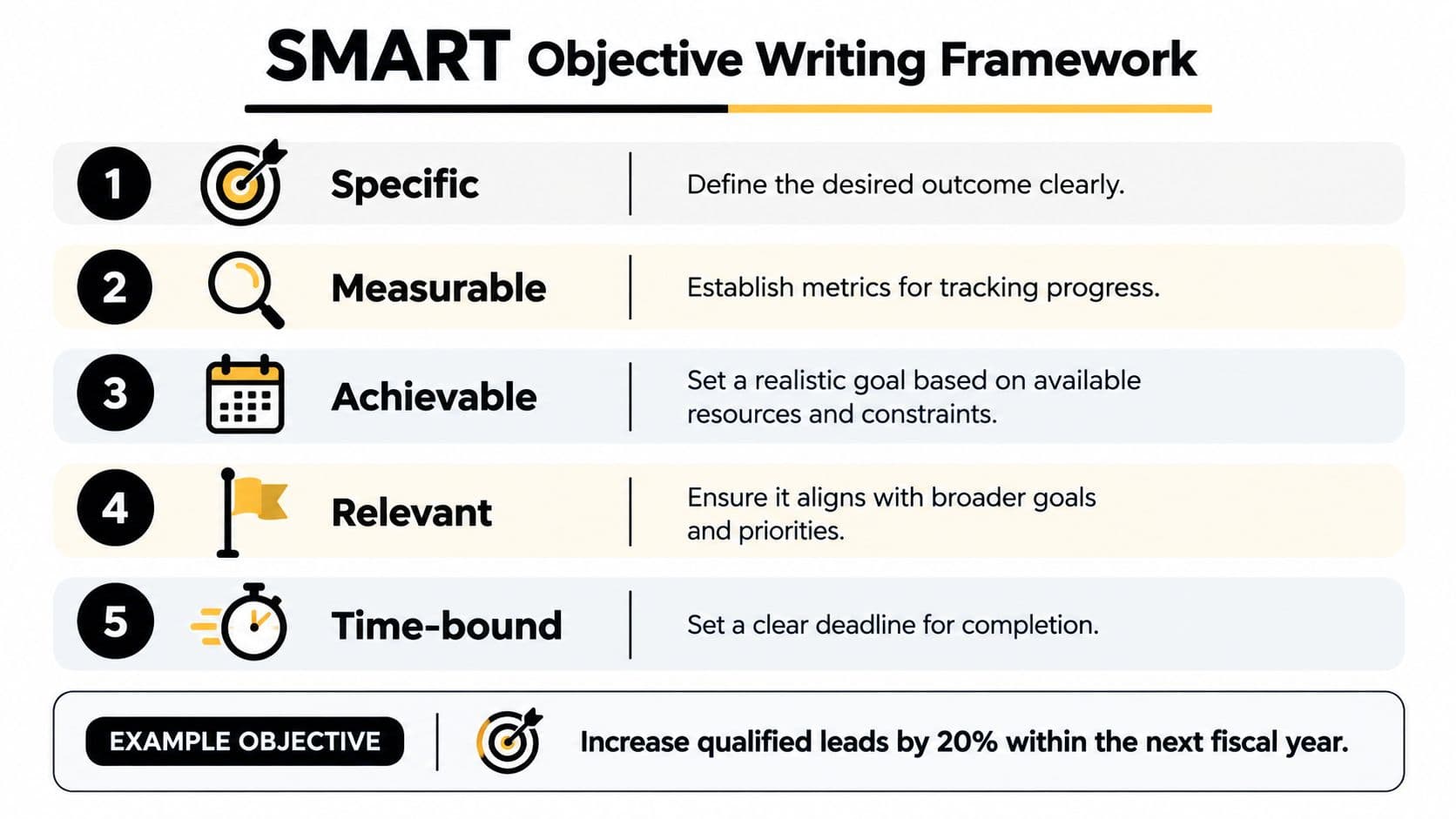
The Minnesota Department of Health guide to SMART objectives describes SMART objectives as specific, measurable, achievable, relevant, and time-bound details that show how a group will achieve a goal. Applying that logic, an objective should state what will happen, how it will be assessed, and when the assessment will occur.
Use this classification test:
- If the statement describes the desired future state, it's probably a goal.
- If it names a result with evidence and a deadline, it's probably an objective.
- If it describes an action someone performs, it's probably a task or initiative.
One statement can sound measurable and still be a goal if it sits at the highest level of the hierarchy. Measurability helps, but hierarchy, time horizon, and role in the plan provide the better classification rule.
Writing Effective Objectives and Delegating the Work
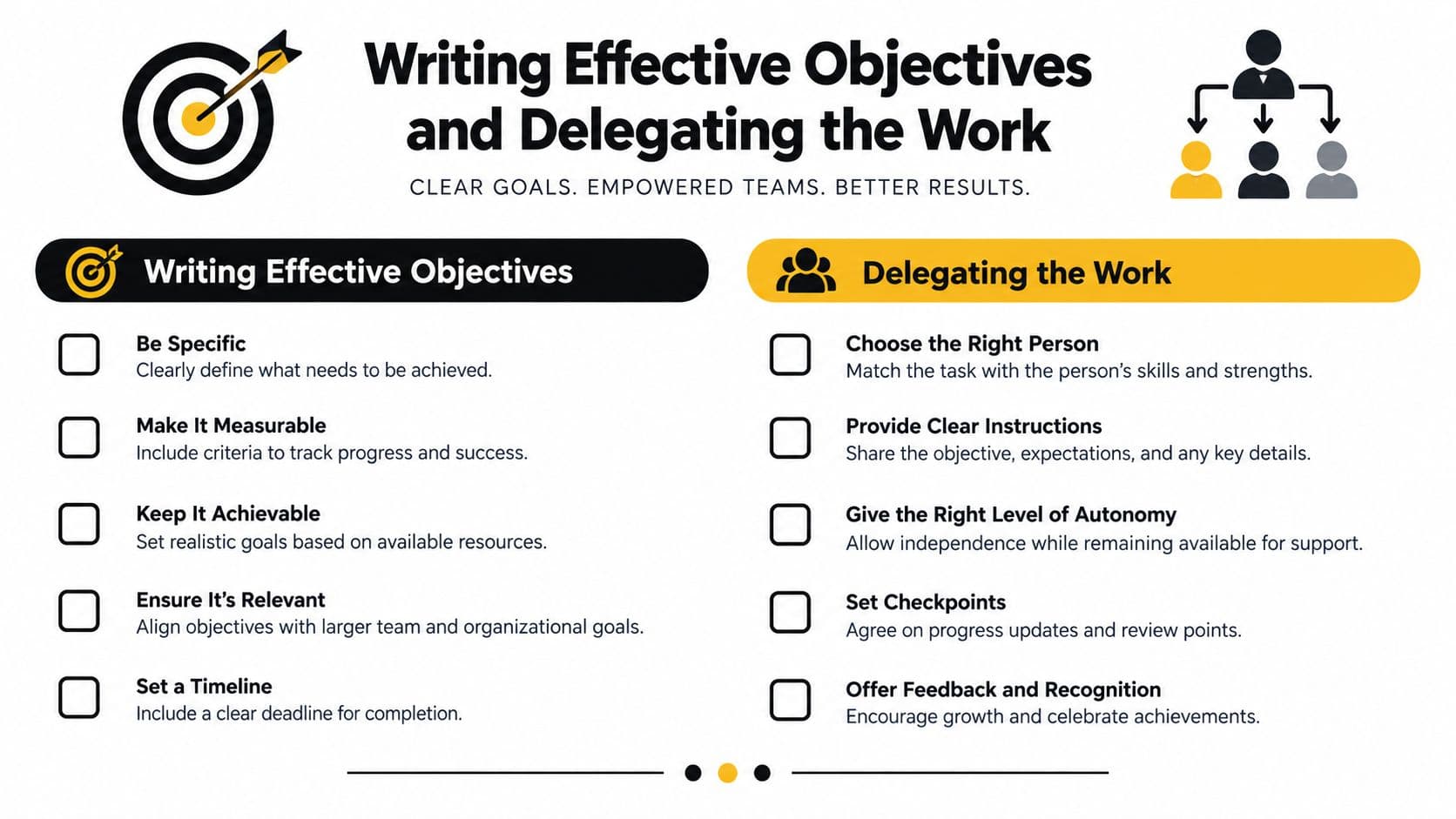
A strong objective gives a busy team a reliable handoff point. It tells people what result matters, how completion will be judged, and when someone will review the evidence.
Start with the goal, then write the objective as a result rather than a vague activity. “Improve the sales process” describes an intention. “Document the agreed sales qualification process and make it available to the sales team by the review date” is closer to an objective because it defines an observable deliverable and a timeframe.
Apply the SMART test
Use the five criteria as an editing pass:
- Specific: Name the outcome, audience, process, or deliverable.
- Measurable: Identify the evidence that will demonstrate progress.
- Achievable: Match the commitment to available capacity and authority.
- Relevant: Explain how the result supports the broader goal.
- Time-bound: Set a deadline or review point.
The University of Kansas Community Tool Box guidance emphasizes that an objective should specify how much of what will be accomplished by when. That phrasing is useful because it forces the writer to identify both the result and the deadline instead of hiding behind activity language.
Once the objective is clear, break it into initiatives and tasks. A project coordinator might turn a documentation objective into research, drafting, review, approval, and publication tasks. Each task should have one owner, a visible status, and enough context for another person to understand the expected handoff.
Delegate the result, not just the motion
Poor delegation sounds like “work on the onboarding project.” Effective delegation identifies the task, desired output, context, constraints, and review point. The person receiving the work should know what decision they can make independently and when they need to escalate an issue.
A practical resource on how to delegate effectively can help managers improve the handoff itself. Delegation works best when the manager transfers ownership of a defined piece of work rather than distributing disconnected chores without explaining the objective behind them.
Use a task system that lets you view the same work at different levels. A table can show owners and deadlines, a Kanban board can show workflow status, and a calendar can reveal timing conflicts. Fluidwave combines task organization, multiple work views, automation, and delegation to human virtual assistants, so a manager can connect a defined objective with trackable execution. Teams considering this approach can also review what it means to delegate before assigning work across internal and external contributors.
Before handing off a task, check four points:
- Outcome: What must be delivered?
- Context: Which goal and objective does it support?
- Authority: What decisions can the owner make?
- Review: When and how will the work be checked?
That structure reduces follow-up questions without forcing the manager to micromanage every step.
Aligning Daily Tasks with Your Broader Vision
The goal-objective relationship only helps when the team maintains it. Planning isn't a document you create once and then ignore. It's a working loop that connects intention, execution, evidence, and adjustment.
At the start of a work cycle, review the active goals and choose the objectives that deserve attention now. During execution, ask whether each task supports an objective or merely occupies available time. At the review point, compare the expected evidence with what happened, then keep, revise, or replace the objective.
For people managing heavy cognitive loads, this structure acts like an external decision system. Instead of repeatedly asking, “What should I do next?”, they can ask, “Which task advances the current objective?” That narrower question reduces decision friction and helps protect focus, particularly when interruptions or competing requests appear.
The best task list doesn't just show what remains. It shows why the work matters.
Keep these distinctions visible:
- Goals provide stability: They preserve the broader purpose when tactics change.
- Objectives create pacing: They turn that purpose into a measurable checkpoint.
- Tasks enable delivery: They define the next action someone can complete or delegate.
- Reviews protect alignment: They reveal whether activity is producing useful progress.
A goal can inspire a team, but an objective gives the team something to prove. When every active task connects to an objective and every objective connects to a goal, completed work becomes easier to prioritize and more meaningful to review.
Fluidwave helps busy professionals organize goals into trackable tasks, view work in formats such as lists, tables, calendars, and Kanban boards, and delegate defined tasks to virtual assistants. Visit Fluidwave to connect broader objectives with clearer daily execution.
Focus on What Matters.
Experience lightning-fast task management with AI-powered workflows. Our automation helps busy professionals save 4+ hours weekly.