Learn how to outsource project management safely: which tasks to delegate, how to choose a provider, price the work, and keep quality on track.
November 1, 2026 (Today)
How to Outsource Project Management Without Losing Control
Learn how to outsource project management safely: which tasks to delegate, how to choose a provider, price the work, and keep quality on track.
← Back to blog
Outsourced project work can miss time, budget, and quality expectations when deliverables and decision ownership are unclear, as PMI-associated guidance on outsourcing models helps frame. The risk is not hiring someone who cannot build a schedule. It is assigning work without measurable deliverables, acceptance criteria, escalation paths, or a named internal owner who can make decisions.
Outsourcing moves execution, coordination, and reporting across an organizational boundary. That adds handoff risk while increasing capacity, so accountability stays with the business. Treat the arrangement as controlled delegation: define small, checkable tasks, retain decision rights, and prepare a route to bring the work back in-house if the arrangement fails.
Which Project Tasks Are Safe to Hand Off
Outsourced support is already mainstream. Deloitte's 2024 Global Outsourcing Survey, based on responses from more than 500 executives worldwide, found that 87% of organizations count contractors, outsourced teams, and other third-party workers as part of their overall workforce. The same survey reported that 80% of executives planned to maintain or increase investment in third-party outsourcing.
That doesn't make every project task safe to hand off. You need a risk-based split before you talk to any provider. Strategic priorities, stakeholder alignment, compliance judgment, and final acceptance shape the business, so they need an internal owner with real decision rights. Task breakdown, status tracking, research, documentation, and routine admin are safer to delegate because you can check them against a written definition of done.
Where Each Responsibility Should Sit
| Responsibility | Where it should sit | Why |
|---|---|---|
| Strategic priorities and trade-offs | Internal owner | Only the business can rank competing goals |
| Stakeholder alignment and sign-off | Internal owner | Decision rights stay with the client |
| Regulatory and compliance judgment | Internal owner | Legal responsibility does not transfer cleanly |
| Acceptance criteria | Internal owner, drafted with the provider | Defines what done means for both sides |
| Task breakdown and scheduling | Delegate | Repeatable and easy to verify against a plan |
| Status reporting and tracking | Delegate, reviewed weekly | Mechanical work that still needs a fixed cadence |
| Research, documentation and admin | Delegate | Clearly specified and low risk |
| Risk register upkeep | Shared | Provider flags risks, client makes the call |
Keep that split visible when you scope the work. If you're also looking at the supply side of this market, landing better project engagements with Capstacker is a useful resource for understanding how independent project managers position defined engagements rather than open-ended availability.
If a task requires a decision that would change priorities, budget, or risk exposure, keep it internal. If you can verify it against a written definition of done, it's a delegation candidate.
A project that's already in trouble won't be fixed by outsourcing it. Weak planning, unclear scope, and slow internal approvals travel with the work, and the extra coordination layer can make them harder to diagnose. Outsource now if you have defined deliverables, a named internal owner, and at least one checkable task. Wait if the strategy itself is still unclear, because an outside manager can't rank goals you haven't ranked.
Freelancers, Agencies or Virtual Assistants Compared
Good help is getting harder to secure. PMI's 2025 project talent announcement estimates that nearly 40 million project professionals were in the workforce in 2025, yet demand could require up to 65 million by 2035, a projected rise of as much as 64%. Price alone tells you very little in that market, especially when industry experience, time zone coverage, and stakeholder complexity vary sharply between providers.
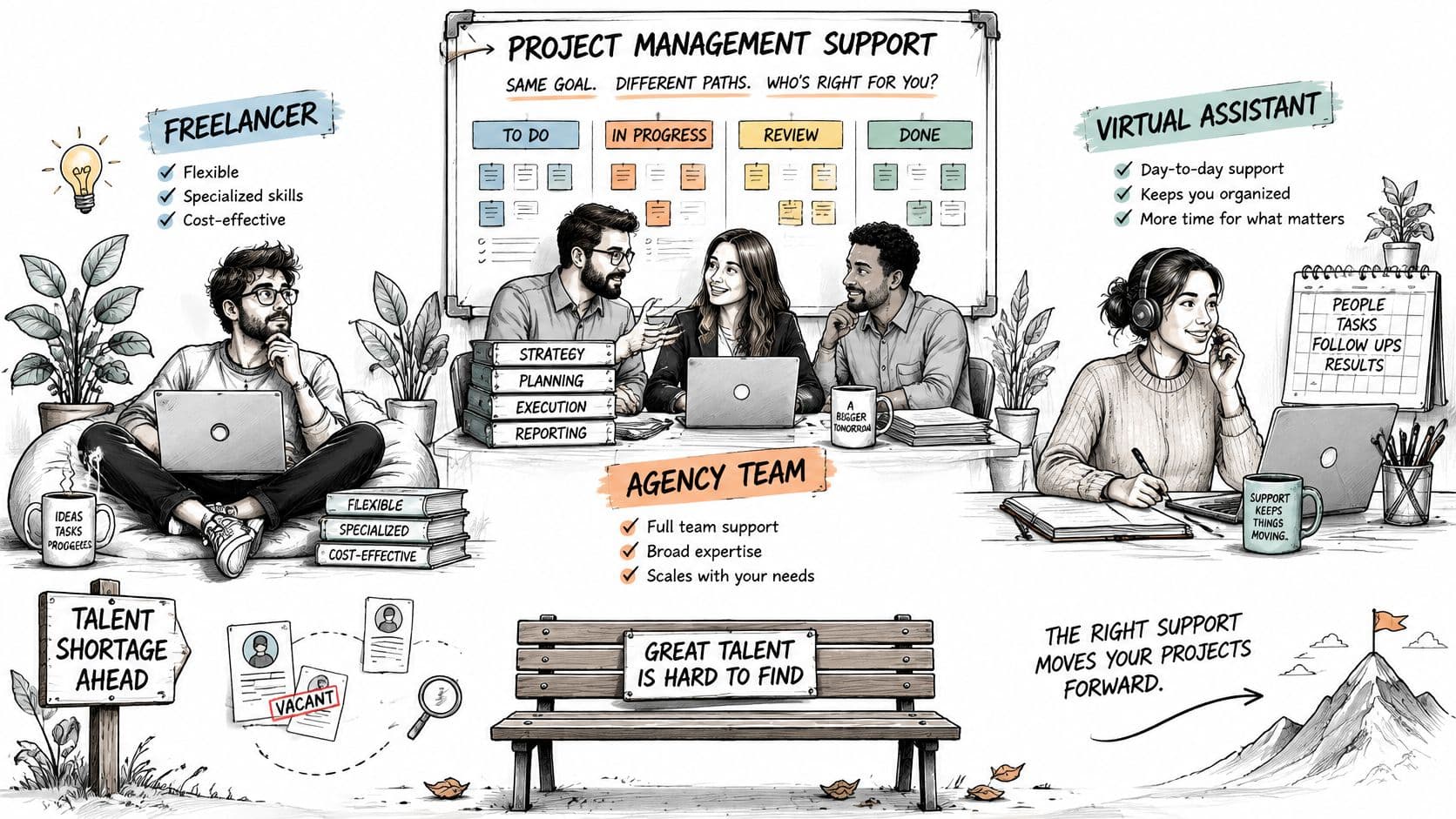
The visual comparison below sets out the three structures most small teams consider first.
Four Realistic Options
| Provider type | Best for | Management effort | Main risk |
|---|---|---|---|
| Freelance project manager | Defined projects lasting under three months | High, you set every routine | Single-person dependency and limited availability |
| Project management agency | Complex, multi-team programs | Low to medium | Overhead and account turnover |
| Virtual assistant | Task-level coordination and admin | Medium, needs clear briefs | Narrow scope and limited decision authority |
| Fractional project manager | Startups needing senior oversight part-time | Medium | Thin coverage during crunch periods |
A freelance project manager can be the fastest route for one bounded project, but you're buying one person's calendar and habits. An agency brings bench strength and established routines for multi-team work, although the person who sold the engagement may not run your weekly review. A virtual assistant works best below the decision layer, chasing updates, maintaining trackers, booking reviews, and preparing status packs from written briefs. A fractional project manager gives a startup senior oversight for a few hours a week, which is often enough if internal leads still own delivery between sessions.
If task-level help is the fit, work through a practical guide to hiring a virtual assistant before you write the brief, because assistants perform well only when tasks, evidence, and deadlines are explicit.
The short video below is a useful prompt for testing how candidates communicate, not just how they describe their credentials.
Test beyond price. Ask each candidate for a sample written status update based on messy sample data, check references in a similar industry and time zone, and confirm exactly who will do the work each week. Don't hire one outside individual without documented workflows, shared task visibility, and backup coverage. If that person disappears, your project history shouldn't disappear with them.
Pricing Models and What Each Really Costs
The pricing model decides who carries the pain when scope changes. A cheap hourly rate can cost more than a higher fixed fee if nobody controls new requests. Conversely, a fixed fee looks tidy until every small change becomes a negotiation.
Say a website migration is scoped at 120 hours at $60 per hour. That's a $7,200 estimate. If scope grows by 40 percent with no change control, you're no longer arguing about the original estimate. You're paying for the larger project, plus the coordination time needed to sort out what was approved and what drifted in.
Budget pressure is normal. SupportNinja and CMSWire's 2024 outsourcing statistics report that 63% of the 488 leaders surveyed said their outsourcing budget had increased over the previous year. Plan for growth instead of pretending the first number is permanent, and weigh structure as carefully as rate when you compare costs against benefits.
Pricing Models and When Each Fits
| Pricing model | Best when | Cost predictability | Main risk |
|---|---|---|---|
| Hourly rate | Scope is unclear and still changing | Low | Hours grow without visible progress |
| Fixed fee per milestone | Deliverables are well defined | High | Change requests become expensive |
| Monthly retainer | Steady, ongoing coordination | High | Paying for capacity you do not fully use |
| Pay per completed task | Repeatable, small and checkable tasks | High, you pay only for finished work | Splitting work into tasks takes upfront effort |
To convert a milestone fee into a per-task price, split the milestone into tasks of known size, then price the task only when its output can be accepted or rejected. A status pack, cleaned tracker, or researched vendor shortlist works. "Coordinate stakeholders" doesn't, because there's no clear finish line.
Change control rule: Any change above 10% of the milestone value needs written approval before work starts, with the cost and date impact in the same message.
Paying per completed task shifts unfinished-work risk toward the provider, but only if the task is defined tightly enough. Hourly billing needs a weekly burn check against accepted milestones, not hours logged. Retainers need a monthly use review. Whatever you choose, tie payment to accepted evidence, not activity.
Service Levels, Data Security and Contract Terms
Start with data, because project files often contain customer names, employee details, and commercial plans. Under GDPR Article 28, when an outsourced project team processes personal data for a business operating under the GDPR, the relationship must be governed by a controller-processor contract or equivalent legal act. That contract must specify the processing subject matter and duration, the nature and purpose of the work, the types of personal data involved, the categories of data subjects, and the parties' rights and obligations.
The processor may use personal data only on your documented instructions and cannot appoint a subprocessor without your prior specific or general written authorization. Put subcontracting approval in the agreement in plain language. If a freelancer brings in another assistant, a researcher, or a data-entry subcontractor, you should know before that person sees your files.
Clauses You Need Before Access Is Granted
- Security evidence: Ask for relevant security policies or certifications, password and authentication rules, and how devices are protected.
- Access boundaries: Name who can access which folders, trackers, inboxes, and project tools, and remove access that isn't needed.
- Incident handling: Set how incidents and suspected breaches are reported, who receives the notice, and how quickly you expect it.
- Exit handling: State how files, credentials, and accounts are returned or deleted when the engagement ends, with a named owner for the check.
Service levels then turn good intentions into measurable work. Don't guess targets in a proposal meeting. Run the work for two weeks, look at real delivery, response, and rework data, and set targets that are demanding but tied to the actual task mix. Every metric needs an owner, a calculation method, and a review date.
Service Level Metrics With Example Targets
| Metric | Example target | How to measure |
|---|---|---|
| On-time delivery | 90% of milestones met | Milestones met versus plan each month |
| First-time acceptance | 85% of deliverables accepted without rework | Accepted deliverables over submitted deliverables |
| Rework rate | Under 10% of tasks reopened | Reopened tasks over closed tasks |
| Response time to questions | Within one business day | Time from question sent to answer received |
| Escalation resolution | Blockers resolved within three working days | Days from escalation to written decision |
| Cost variance | Within 5% of budget per milestone | Actual spend minus budgeted spend, divided by budget |
A missed target should trigger a written corrective plan before anyone reaches for penalties. State what slipped, why it slipped, what changes next, and the date you'll remeasure. Penalties without diagnosis just teach a provider to hide bad news earlier.
How to Brief and Onboard an Outside Project Manager
Onboarding is where most arrangements are won or lost. PMI program-management research on outsourcing reports insufficient planning as a failure factor in 94% of analyzed cases, poor vendor selection in 92%, and inadequate communication in 91%. Treat the first two weeks as a governance build, not a friendly handover call.
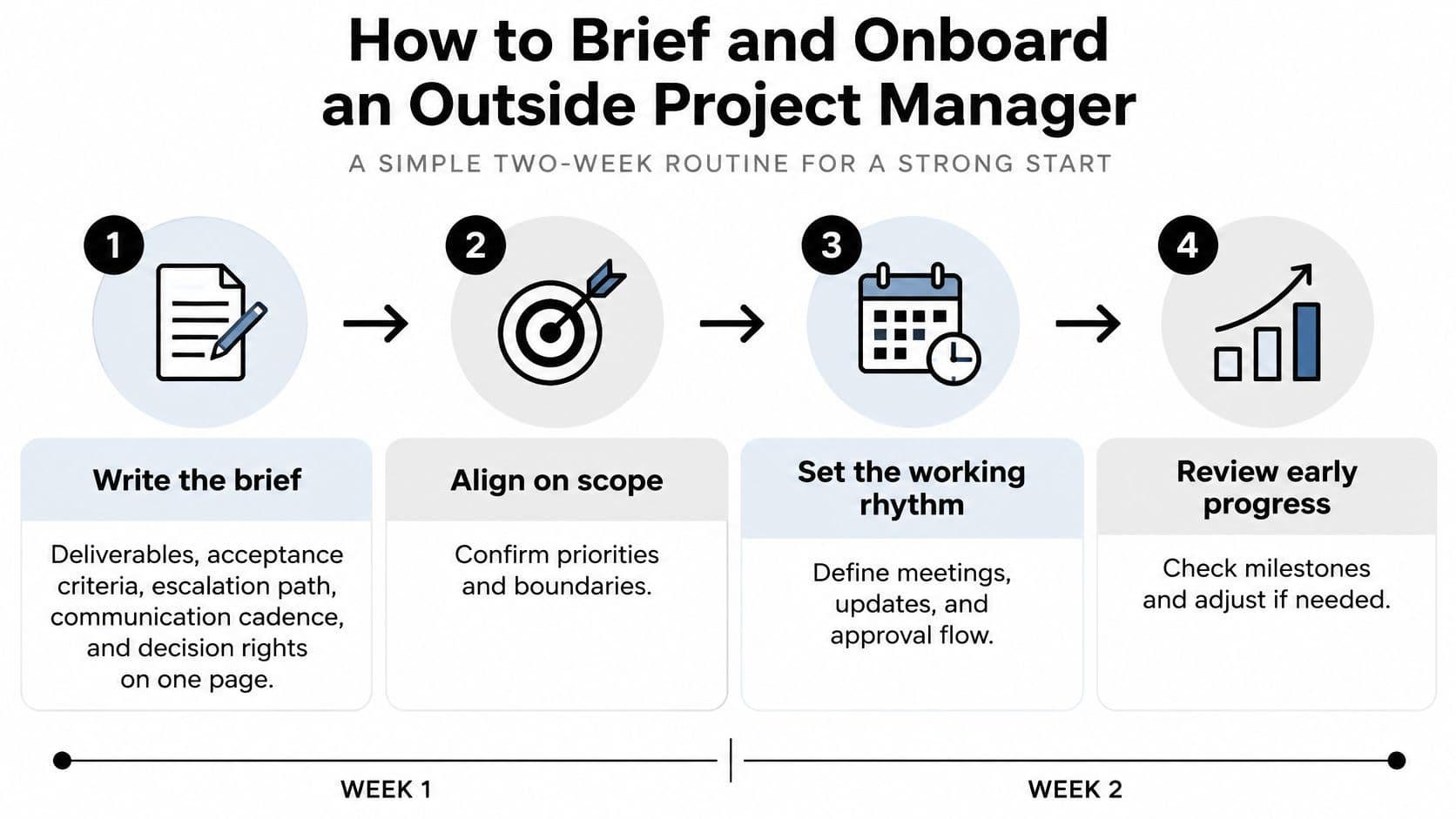
The infographic below condenses the sequence into four visible steps you can adapt to your first fortnight.
A Two Week Onboarding Routine
-
Write the one-page brief. Put deliverables, acceptance criteria, escalation path, communication cadence, and decision rights on one page. Vague scope creates later disputes because each side fills the gaps with its own assumptions.
-
Run structured due diligence. Check capability, planning method, quality checks, security, and how the provider manages its own people. Repeat the checks during the engagement, since team members, workload, and controls change after signature.
-
Model transition and dependency risk. List what knowledge must transfer, which internal approvals could block work, and which tools or accounts the provider needs. The common slip is discovering in week three that legal, finance, or a product owner was never in the plan.
-
Name the two accountable leads. Assign one client product owner and one vendor delivery lead, then build a RACI matrix for decisions, approvals, production, and acceptance. If two people can approve the same change, nobody effectively owns it.
-
Set up the shared operating system. Create one task board, one risk, issue, assumption, and dependency register, and one joint dashboard showing overdue tasks, reopened work, and acceptance rate. Don't let status live in private inboxes or personal spreadsheets.
-
Run a paid pilot. Use two to four weeks on a low-risk, bounded task to test communication, judgment, and evidence quality. Skipping the pilot saves a little time and moves the mismatch discovery to a more expensive month.
Make every work item traceable from requirement to acceptance evidence. A task should show who requested it, what done means, where the output sits, who accepted it, and what changed during review. That trace is more valuable than a polished status narrative because you can audit it when dates move.
Blocker rule: Every blocker gets one accountable owner and a written resolution date. "Waiting on feedback" is not a status, it's an unnamed decision aging in public.
You'll know onboarding worked when the first deliverables are accepted with minor changes, questions arrive early rather than at deadline, and status updates land on schedule without chasing. If you need to remind the provider how to report in week two, tighten the routine immediately. Small cadence failures at the start usually become reporting failures when the project gets busy.
Don't overload the first brief with background history. Give the outside manager the current plan, live risks, decision log, stakeholder map, and examples of accepted work. Context helps, but too much unstructured history slows the first useful output. I'd rather see a correct small deliverable in week one than a long discovery document that repeats what your team already knows.
Governance Routines That Keep Work on Track
Outsourcing risk often arrives late. A Project Management Institute analysis of project risk lessons found that outsourcing represented more than one-quarter of identified resource risks in the projects it examined. Supplier delay was the most significant outsourcing-related problem, causing projects to slip by more than two months on average, and delays were frequently discovered late.
Your governance rhythm has to surface trouble while there's still time to act. Use a simple cadence and keep it even when things look calm.
- Weekly operational review: Work through blockers, overdue tasks, clarification latency, and decisions needed in the next seven days.
- Monthly steering meeting: Review cost against accepted milestones, scope changes, top risks, and whether internal dependencies are causing provider delays.
- Quarterly fit review: Decide whether the provider, pricing model, and task split still match the work, using a clear record such as a RACI matrix template to recheck ownership.
Track leading indicators before you rely on final cost or schedule. Overdue tasks, slow clarification answers, reopened work, defect escape rate, and decision aging show strain weeks before a milestone turns red. If clarifications take three days, the schedule is already absorbing delay even if the milestone date hasn't moved yet.
A green status with aging decisions is not green. It's a late surprise that hasn't been dated yet.
Build the re-entry plan while the relationship is healthy. Document workflows, templates, credentials, decision logs, stakeholder contacts, and where source files live, all in accounts your organization controls. Test that an internal person can pick up the tracker and explain the next two weeks without asking the provider to interpret it. If they can't, you're not buying flexible capacity. You're building dependency.
Start With a Paid Pilot Before Committing
Use a direct decision rule. Outsource now if the project has defined deliverables, a named internal owner, and at least one checkable task you can delegate without giving away judgment. Wait if the strategy is unclear, nobody can approve work quickly, or acceptance would be based on taste rather than evidence.
Pick one bounded workstream for a two to four week paid pilot, such as weekly status reporting, tracker cleanup, or research for a single milestone. Don't test with your most political stakeholder meeting or your messiest dependency. You want a fair sample of normal work, tight enough that both sides can tell whether it succeeded.
Set three criteria before the pilot starts, using the same measures you'll enforce later.
- On-time delivery: Did agreed outputs arrive on the dates promised?
- First-time acceptance: Could you accept the work without sending it back for material rework?
- Response time: Did questions and blockers get answered within the agreed window?
If the pilot meets them, expand to the next workstream and keep the same dashboard. If it misses, don't expand and hope volume fixes fit. Use the re-entry plan, bring the work back, and keep the documented brief for the next provider.
Do one thing this week. Write the one-page scope, pick the pilot task, and name the internal owner. That's enough to test whether you can outsource project management without surrendering control.
If you're ready to delegate defined project tasks without losing the review step, Fluidwave lets you assign work to skilled virtual assistants on a pay-per-task basis, track progress across shared views, and pay only for completed work. Start with one small, checkable pilot task, measure delivery, acceptance, and response time, then expand only if the evidence supports it.
Focus on What Matters.
Experience lightning-fast task management with AI-powered workflows. Our automation helps busy professionals save 4+ hours weekly.