Ditch the vague resolutions. Our 2026 list of goals in life offers actionable steps for professionals to achieve career, financial, and personal growth.
August 11, 2026 (1d ago)
A Practical List of Goals in Life for 2026
Ditch the vague resolutions. Our 2026 list of goals in life offers actionable steps for professionals to achieve career, financial, and personal growth.
← Back to blog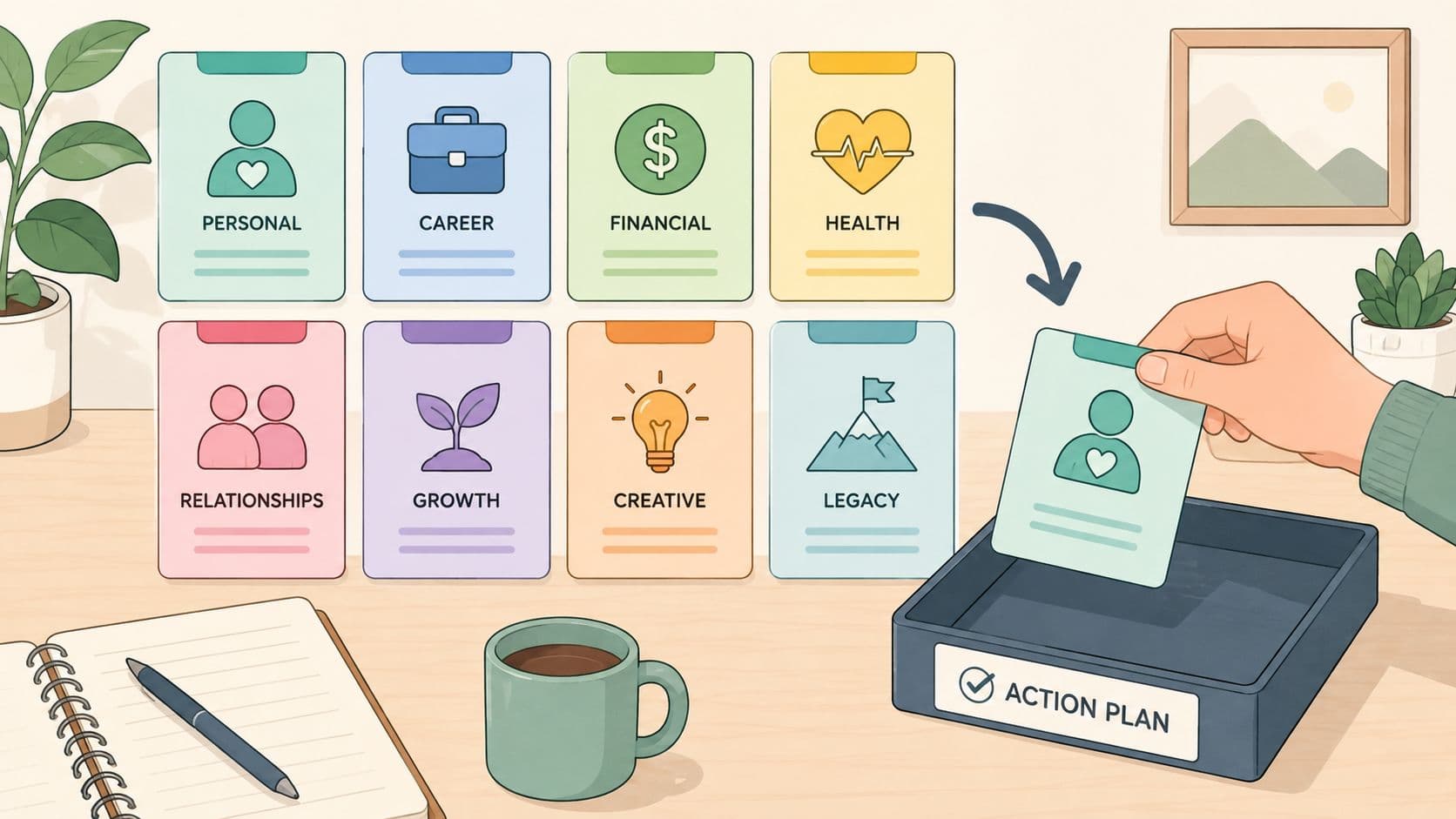
Tired of vague resolutions that sound impressive in December and disappear by February? A useful list of goals in life has to do more than inspire you for a week. It needs to survive real calendars, real fatigue, real work pressure, and the way attention gets pulled in ten directions at once.
That's why the strongest goal lists aren't just wish lists. They're systems for choosing, writing, and reviewing what matters, because people who write goals down are reported to outperform those who don't in long-running goal-setting summaries, and specific, challenging goals repeatedly beat vague ones in later research summaries goal-setting history and success patterns. The practical lesson is simple. If your brain is already overloaded, memory alone won't carry your ambitions very far.
Start with the kind of support that makes execution easier, not harder. If routines keep slipping, you may want to automate your daily routines before you try to add more ambition to your week.
1. Build a Sustainable Career with Work-Life Balance
A career should pay the bills, but it also has to leave room for the rest of your life. That matters even more if you're a manager, founder, or remote worker, because the work can expand until it fills every open hour. A better goal is to build a career that creates income without destroying your health, family time, or attention.
Protect the hours that actually matter
Busy professionals usually don't need more motivation. They need fewer low-value commitments and clearer boundaries. A practical version of this goal looks like using task management to spot work you can delete, delegate, or delay, then protecting personal time the same way you protect a client meeting.
Practical rule: if a task doesn't move revenue, relationships, or long-term skill, ask whether someone else should handle it.
That's where delegation becomes a career strategy, not a luxury. An entrepreneur can hand off admin work to a virtual assistant, a remote worker can build a shutdown routine for the end of the day, and a tech executive can defend no-meetings Fridays so deep work happens. If burnout has already started creeping in, it helps to read a focused guide on how to avoid burnout and then use that advice to rewrite your schedule.
The trade-off is obvious. Strong boundaries can make some people uncomfortable at first. But vague availability usually costs more in the long run, because it turns your best hours into scraps. Schedule personal time like it's a client deadline, track when your energy is highest, and state your limits clearly before resentment builds.
2. Develop Deep Expertise in Your Field
Surface-level competence is useful. Deep expertise is what makes people trust you with hard problems. In practice, that means going beyond general knowledge and building the kind of judgment that comes from deliberate practice, repetition, and a long memory for what works.
Make learning a recurring appointment
The best experts don't treat skill-building as a side quest. They block time for it every week, and they keep that time protected. A software engineer might go deep on system architecture, a marketer might specialize in conversion rate optimization, and a project manager might pursue a PMP credential because the field rewards structured thinking.
This goal gets stronger when learning turns into output. Write an article, create a short internal guide, or teach a teammate what you just learned. That forces you to organize your thinking instead of just collecting notes. If you want a cleaner framework for focused skill-building, the deep work summary is a useful companion because expertise usually grows in uninterrupted stretches, not in scraps between notifications.
Strong expertise rarely comes from variety alone. It comes from repeated contact with the same hard problems until patterns become visible.
Read the canonical texts in your field, ask a mentor for direct feedback, and keep a record of what you've learned. The trade-off is that depth can make you slower to branch out. That's fine if the goal is mastery. Breadth has value, but depth is what turns you into the person others call when the situation is messy and the stakes are high.
3. Launch and Scale a Successful Business or Side Venture
A business goal sounds glamorous until you realize how much of it is unsexy. Customer interviews, pricing tests, operational cleanup, and follow-up emails usually matter more than logos or launch posts. A realistic list of goals in life should include at least one path to building value outside a paycheck, whether that becomes a full-time company or a profitable side venture.
Validate before you build too much
Founders often waste months building what no one asked for. A better approach is to start small, test the problem with real people, and only add complexity after the market shows interest. Consultants can productize a service, creators can test monetization through digital products, and e-commerce sellers can focus on one niche before expanding.
Practical rule: sell the problem before you perfect the solution.
That discipline keeps you from sinking time into features nobody will use. It also makes it easier to outsource or automate repetitive tasks early, so you don't become the bottleneck in your own business. The goal is not to do everything yourself. The goal is to build something that can keep moving when your attention is elsewhere.
Tracking matters too. Revenue, expenses, customer churn, and delivery time should all be visible from day one, even if the numbers are small at first. A side venture can stay sustainable only if it doesn't devour the rest of your life. Entrepreneurs who ignore that trade-off often end up with a second job instead of a business.
4. Achieve Financial Independence or Early Retirement
Financial independence is really a freedom goal. It's about reaching the point where work becomes a choice, not a requirement. For some people that means an early retirement path. For others it means enough savings and passive income to take bigger risks without panic.
Make the number real, not vague
The smartest version of this goal starts with a specific target for the lifestyle you want. Once that number is clear, the rest gets more practical. You can automate investing, grow income through career advancement or business work, and resist lifestyle inflation when pay increases.
People often say they want freedom, but their spending tells a different story. A high income with no savings discipline still leaves you dependent on the next paycheck. That's why this goal works best when it combines earning, saving, and patience.
Diversifying income also reduces pressure. A tech worker might add equity compensation to salary, a real estate investor might build rental cash flow, and an online business owner might sell digital products that keep earning after the initial work is done. Each path has trade-offs. Investing is slower, business income is less predictable, and real estate brings its own management burden. Still, the point stays the same, build enough margin that your calendar isn't controlled by fear.
5. Build Strong Relationships and Community
A fulfilling list of goals in life should never treat relationships as an afterthought. People often discover that career wins feel thinner when there's nobody to share them with. Friendships, family ties, and community involvement need actual scheduling, because they rarely survive on intention alone.
Put connection on the calendar
This goal becomes real when you reserve time before your week gets crowded. A professional can set recurring friend dinners, a business leader can maintain a mastermind group, and a family can protect a weekly dinner tradition. The point is not to pack your schedule with social activity. The point is to keep the people who matter from disappearing into “someday.”
Choose quality over quantity. Two hours of real attention with a friend beats a month of half-listening over text. Be present, leave the phone out of sight, and initiate contact instead of waiting for everyone else to do the emotional labor. If you're overwhelmed, start with one dependable rhythm and let it grow from there.
The trade-off is that relationships take coordination. They don't always fit neatly into a productivity system. But they're worth the effort because they give your life texture, support, and perspective. When work gets hard, community is often what keeps the whole plan from feeling hollow.
6. Optimize Physical Health and Fitness
Health goals work best when they're built for real life, not ideal weeks. Exercise, food, sleep, and preventive care are the foundation that makes every other goal easier to pursue. Without that base, even simple plans can feel heavier than they should.
Choose consistency over intensity
A lot of people fail here because they start too hard. They buy the expensive plan, do too much in the first two weeks, then disappear after soreness or schedule chaos takes over. A more durable goal is to find exercise you can repeat, build slowly, and protect with the same seriousness you'd give a work deadline.
Automation helps here too. Grocery delivery, meal prep services, a standing desk, and a trainer can all remove friction. If you have a health condition, a demanding job, or attention challenges, it helps to reduce decision fatigue wherever possible. One strong routine beats five ambitious plans you can't maintain.
A few examples fit this goal well. Executives often use trainers and nutrition support, professionals may commit to daily workouts, and individuals trying to avoid fad diets can choose evidence-based eating patterns instead of chasing the newest trend. Track the metrics that matter to you, which might be energy, sleep quality, strength, or endurance rather than scale weight alone.
The trade-off is that health habits can feel boring compared with more dramatic goals. They're still worth it. Good health doesn't just add years, it makes the rest of your goals easier to carry.
7. Master Productivity and Time Management
Productivity is not about doing more for the sake of it. It's about using less mental energy to get more of the right work done. For busy professionals and entrepreneurs, this is a meta-goal, because it makes every other goal more likely to survive a real week.
Build a system that reduces friction
The most useful time systems are simple enough to repeat. Time blocking helps CEOs protect strategic work, deep work sessions help knowledge workers think without interruption, and transparent task management keeps teams aligned without endless check-ins. The mistake is adding tools that create more setup time than actual clarity.
A better routine starts with the few tasks that matter most. Protect those first. Batch similar work together so you're not switching contexts all day, and review your week regularly so you can spot what's draining time without adding value. If you need a practical structure, the time management guide is worth using alongside a stripped-down weekly planning habit.
Say no more often than feels comfortable at first. If a request doesn't support your current priorities, it still costs you time.
That boundary matters even more for neurodivergent readers who can get pulled into overcommitting when the system isn't clear. The right productivity setup should reduce decision load, not add another layer of guilt. If your current process depends on remembering everything, it's probably too fragile.
8. Develop Leadership and Influence
Leadership isn't limited to formal management roles. People lead by clarifying direction, calming conflict, making decisions, and helping others do their best work. That can happen in a company, a startup, a community group, or a content audience.
Lead through behavior, not title
The strongest leaders usually work on emotional intelligence first. They learn how to hear criticism without getting defensive, how to ask better questions, and how to handle difficult conversations without making the room smaller. Managers can get coaching, founders can ask their teams for honest feedback, and community organizers can practice bringing different personalities into the same effort.
Reading helps, but practice changes behavior. Study leadership philosophy, then test it in real conversations. Ask people you lead what's unclear, where they feel blocked, and what they wish you'd do differently. That kind of feedback can sting, which is exactly why it's useful.
This goal also rewards vulnerability. Admitting uncertainty when you don't know something often builds more trust than pretending to have every answer. The trade-off is that leadership exposes you. People see your blind spots faster. Still, if you want influence that lasts, you have to be willing to grow in public.
9. Create Meaningful Work or Contribution
Purpose doesn't have to look dramatic. It can show up in a job, a business, a creative project, or volunteer work that lines up with your values. The question is whether your effort feels connected to something larger than your own convenience.
Start with value, then look for fit
This goal gets clearer when you reflect on what matters most to you. Journaling can help identify the problems you care about, the people you want to serve, and the kinds of work that leave you energized instead of drained. A software engineer might move toward climate tech or healthcare, while a consultant might donate expertise to a social enterprise.
A low-risk way to test alignment is to start with pro bono work or volunteering. That gives you a closer view of whether a cause fits your strengths and temperament. It also helps you see whether the mission is real or just attractive from a distance.
Meaningful contribution usually feels more durable than excitement. The work may not always be easy, but it should make sense to you when you look at it honestly.
Build networks with people already doing work you admire. That gives you context, models, and a better sense of what the day-to-day looks like. The trade-off here is that purpose can't be forced. If you rush it, you may just end up chasing someone else's idea of meaning.
10. Continuous Learning and Intellectual Growth
Curiosity keeps your mind flexible. It also keeps you useful. In fast-changing fields, learning isn't optional, and outside of work it still gives your life range, perspective, and enjoyment.
Protect time for learning like you protect meetings
People who learn consistently usually don't wait for extra free time. They build reading into the day, choose high-quality sources carefully, and make space for learning communities that challenge them. Some professionals read broadly, others focus on one domain and go deep, and both approaches can work if they're deliberate.
The key is application. Read, then use what you learned in a project, a discussion, or a decision. That's what turns information into skill. If you only consume content, you'll feel busy without necessarily becoming better.
This goal also pairs well with teaching. Explaining an idea to someone else exposes gaps in your understanding fast. If you want growth that lasts, keep a habit of returning to what you've learned and using it again in a new context.
10 Life Goals Comparison
| Item | Implementation Complexity 🔄 | Resource Requirements ⚡ | Expected Outcomes ⭐ | Ideal Use Cases 📊 | Key Advantages & Tips 💡 |
|---|---|---|---|---|---|
| Build a Sustainable Career with Work-Life Balance | Medium, habit change and boundary-setting | Moderate, time, possible income adjustments, delegation support | High, reduced burnout, sustained performance | Professionals at risk of burnout; remote/hybrid workers | Delegate routine work, schedule non‑negotiable personal time |
| Develop Deep Expertise in Your Field | High, years of deliberate practice and feedback | High, time, mentorship, specialized training | Very High, mastery, rare problem‑solving ability | Specialists, technical experts, academic/practitioner tracks | Block focused time, teach to deepen learning |
| Launch and Scale a Successful Business or Side Venture | High, product/market fit, ops, scaling systems | High, capital, time, diverse skills/team | Variable, high upside but significant risk | Entrepreneurs, side‑hustlers aiming to grow revenue | Validate early, automate operational tasks, track financial metrics |
| Achieve Financial Independence or Early Retirement | Medium–High, long‑term planning and discipline | High, sustained savings, investments, income growth | Very High, financial freedom and choice | High earners, savers, investors pursuing FIRE | Automate investments, calculate your target number |
| Build Strong Relationships and Community | Medium, consistent intentional effort | Low–Moderate, time, emotional energy, presence | High, increased wellbeing and social support | Anyone seeking stronger social ties; community builders | Schedule relationship time, prioritize quality interactions |
| Optimize Physical Health and Fitness | Medium, habit formation and personalization | Moderate, time, possible coaching or services | High, energy, longevity, reduced health risk | All professionals; those needing improved energy/health | Start small, automate healthy choices, track meaningful metrics |
| Master Productivity and Time Management | Medium, system setup and regular reviews | Low–Moderate, tools, discipline, occasional delegation | High, more output with less wasted time | Knowledge workers, leaders, busy teams | Protect high‑impact time, batch tasks, review weekly |
| Develop Leadership and Influence | High, emotional work, feedback, practice | Moderate, coaching, mentoring, experience opportunities | High, career advancement and broader impact | Managers, founders, community organizers | Invest in emotional intelligence, seek regular feedback |
| Create Meaningful Work or Contribution | Medium, values clarification and alignment | Variable, may require income tradeoffs or new networks | High, greater satisfaction and perceived impact | Mission‑driven professionals, social entrepreneurs | Clarify values, prototype via volunteering or pilot projects |
| Continuous Learning and Intellectual Growth | Medium, ongoing curation and application | Low–Moderate, time, courses, communities | High, adaptability, better problem solving | Professionals in changing fields, lifelong learners | Schedule learning, curate sources, apply and teach what you learn |
From List to Life Your Next Actionable Step
A list of goals in life is only useful when it changes what happens on your calendar. The most common mistake is trying to act on everything at once. That usually turns ambition into clutter. Pick one goal that matters most right now, write a version that is concrete and time-bound, and break it into the smallest first action you can complete this week.
The research on goal writing becomes practical. People who document goals tend to do better than people who keep them in their heads, and structured goals work best when they're reviewed instead of forgotten goal-setting evidence and practical patterns. The point isn't to make the list longer. The point is to make it easier to act.
Use a multi-domain lens if you need help choosing. Career, health, finances, relationships, personal growth, experiences, and legacy are all valid places to look, but you probably don't need equal attention in every area at once life-goal domain guidance. If your time is limited, ask a harder question. Which area would matter if it went untouched for a year? That answer is often more useful than a perfect list.
Then reduce friction. Delete low-value work, delegate what someone else can handle, and protect the hours that matter most. Fluidwave fits that kind of execution because it combines task organization with delegation, which makes it easier to keep ambitious goals from drowning in admin. If you're building toward better systems in 2026, pair your goal list with a weekly review, one delegated task, and one protected block of focused work.
If you want your plans to survive real life, start with structure, not inspiration. Visit Fluidwave and see how task management and delegation can help you turn a crowded list of goals into a system you can follow through on.
Focus on What Matters.
Experience lightning-fast task management with AI-powered workflows. Our automation helps busy professionals save 4+ hours weekly.